
NSF Training Standard Apprentice Skills Crime Scene Preservation
- Slides: 54
NSF Training Standard Apprentice Skills Crime Scene/ Preservation of Evidence Lesson Topic 5. 1 5 -1 -1
Classroom Policy 5 -1 -2
Enabling Objectives • IDENTIFY investigative responsibilities for processing a crime scene related to proceeding, arrival, secondary actions, safety, and awareness • COMPARE and contrast the tools used and the requirements necessary to document a crime to include notes, photographs, and sketches • DISTINGUISH between the types of evidence and the hearsay rule; and recall basic rules for gathering and collecting evidence at crime scenes • IDENTIFY sections and the contents that should be entered in each block of OPNAV 5580/2 5 -1 -3
Overview • Investigative responsibility • Note-taking • Crime scene process • Investigative awareness • Evidence • Search the crime scene • Documentation of evidence 5 -1 -4
Process Crime Scenes • Investigate Responsibility – NCIS • Responsible for investigating major criminal offenses and counter intelligence matters – Command investigators • Work at the command level and investigate cases not handled by NCIS 5 -1 -5
Process Crime Scenes • Note Taking – Taken to remember details of situation. – Start when you receive call from dispatch. – Use short meaningful phrases – Include the who, what, when, where and how as it pertains to the incident 5 -1 -6
Process Crime Scenes • Note taking cont’d – Note date / time / weather conditions, etc. – Get complete identity information. – Include anything considered pertinent to the investigation – Your notes are the property of the Navy. 5 -1 -7
Process Crime Scene • Crime Scene Process – Proceeding to the crime scene • The dispatcher will attempt to give you all information collected. • Mentally prepare your self before arriving and pay attention to surroundings • Additionally, while enroute, be aware of suspects leaving the scene and of possible escape routes that may need to be blocked off 5 -1 -8
Process Crime Scene • Crime scene process – Arriving at the scene • Immediately notify dispatch. • Assist injured persons and safeguard crime scene • Check for signs of life and initiate CPR • Not date, time and weather conditions 5 -1 -9
Process Crime Scene • Crime Scene Process – Arriving at the scene (cont) • Always stay alert, suspect could come back or still be on scene • Note all alterations to the crime scene to safeguard evidence • Get a description of the suspect(s) and/or the vehicle(s) used, and the direction they left in 5 -1 -10
Process Crime Scene • Crime Scene Process – Arriving at the scene (cont) • Weapons used • Relay all this information to the dispatcher who will put it over the radio for other units to be on the lookout. • If upon arrival you decide the crime needs an NCIS response, notify the dispatcher 5 -1 -11
Process Crime Scene • Crime Scene Process – Secondary actions • Control the flow of traffic • Notify proper agencies • Prevent unauthorized persons from entering the scene • Prevent victim(s) and or witnesses from leaving the 5 -1 -12 scene
Process Crime Scene – Secondary actions (cont) • Protect evidence from damage or contamination • Identify and separate potential witness(s) and suspect(s) to prevent rehearsal of, or changing of, stories by witnesses • Conduct preliminary questioning to determine what happened. Be prepared to read rights advisement to any person who becomes a suspect 5 -1 -13
Process Crime Scene – Secondary actions (cont) • Prevent unnecessary movement within the crime scene and the immediate vicinity. Take precautions in areas where impressions, footprints, or tire tracks might be • Avoid unnecessarily touching doors, doorknobs, light switches, floors and windows 5 -1 -14
Process Crime Scene • Crime Scene Process – Officer Safety • Upon arrival, make sure the area is secure from additional or continued threats to your or others’ safety • Do not attend to injured person(s) until the scene is secured and under control 5 -1 -15
Process Crime Scene – Officer Safety cont’d • When arriving at the scene of violence on the street, vacant area, or in a parking lot, make sure the suspect is not in the area and you have enough back‑up to control the situation before taking any further action. • When arriving at the scene of violence in a domicile or commercial structure, clear the building before rendering aid or commencing your preliminary investigation 5 -1 -16
Process Crime Scene – Officer Safety cont’d • Brief questions concerning who or where the suspect is may be appropriate, but distraction during this time puts your life and the lives of others in danger. Do not totally trust the victim's responses • Communicate the situation to the dispatcher when you are reasonably sure you can do this safely. Stay focused and secure the scene first 5 -1 -17
Process Crime Scene • Investigate Awareness – Be aware of and note comments made by persons on the scene – Look for and at the body language and glances made by people at the scene – Other details to be noted include: • Doors • Windows • Lights • Odors • Blinds • Sketches • Photography 5 -1 -18
Process Crime Scene • Investigate Awareness – Photography • Normally a photographer from the Base Photo Lab will respond, or NCIS investigators may take their own pictures • Photographs supplement notes and sketches, clarify written reports, provide personnel identification, and provide a permanent record of fragile evidence 5 -1 -19
Process Crime Scene – Photography cont’d • Photograph all evidence or possible evidence before anything is moved or touched. – Place a ruler next to the item to show size. – Use tags or pointer tags – Completely identify each photograph 5 -1 -20
Process Crime Scene • Investigate Awareness – Photography Log • Record technical data for each photograph in your notes. • A photo log is a detailed record of each photo taken at a crime scene. – Tells what time and type of photo. – Tells what camera was used, along with technical data. 5 -1 -21
Process Crime Scene • Investigate Awareness – Sketches • A rough sketch is completed at the scene and should not be changed after departing the scene. • Sketch should include: – Location of approaches, roadways, entrances, etc. – The size of the area or building 5 -1 -22
Process Crime Scene – Sketch cont’d • Specific location ad relative position of all evidence found at the scene • A legend to explain objects in the sketch • A title block identifying date, time, location, offense, victim, investigator, and incident number. 5 -1 -23
Process Crime Scene • Crime Scene Process – Evidence • Real – Physical objects and marks or wounds on a person’s body. • Testimonial – Oral or written statements 5 -1 -24
Process Crime Scene – Evidence cont’d • Direct – Evidence which tends to directly prove or disprove a fact in an issue. • Circumstantial – Evidence which tends to indirectly involve a person in an offense. 5 -1 -25
Process Crime Scene • Evidence cont’d – Documentary • Anything in writing – Hearsay Rule • Testimony given by a witness who relates, not what he knows personally, but what others have told him, or what he has heard said by others. 5 -1 -26
Process Crime Scene • Evidence cont’d – Dying Declaration • A statement made when the victim was aware of his/her impending death and without the hope of recovery 5 -1 -27
Process Crime Scene • Evidence cont’d – Excited Utterance • A statement concerning the circumstances of a startling event made by a person while he was in such a condition of excitement, shock, or surprise, caused by his participation in or observation of the event, as to warrant a reasonable inference that he made the utterance as an impulsive and instinctive outcome of the event, and not as a result of deliberation or design. 5 -1 -28
Process Crime Scene • Searching the Crime Scene – Once the scene is secured and victims have been treated or removed, you are ready to search for evidence – Basic rules: • Ensure the crime scene has been dusted for fingerprints prior to opening and closing drawers, closets, etc 5 -1 -29
Process Crime Scene • Basic rules: cont’d – Develop definite plans for the search to include what to look for, who will search where, what to do when evidence is found, and what search method is suitable for the scene – Complete the search once started, regardless of when or where a piece of evidence is found 5 -1 -30
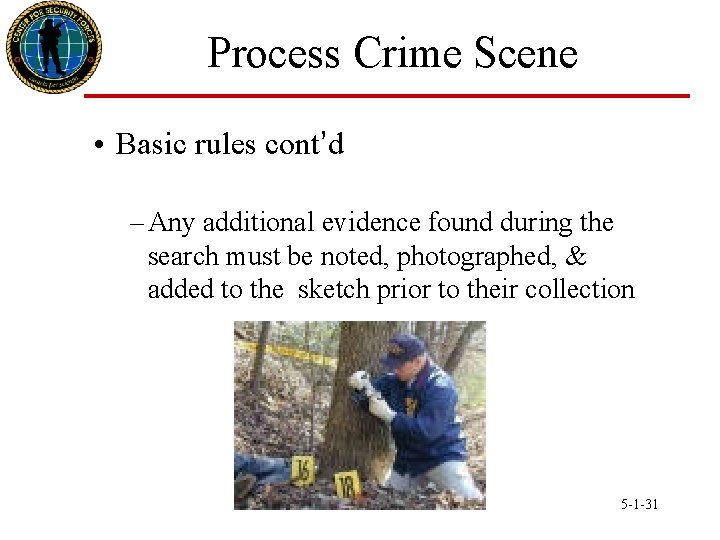
Process Crime Scene • Basic rules cont’d – Any additional evidence found during the search must be noted, photographed, & added to the sketch prior to their collection 5 -1 -31
Process Crime Scene • Collecting Evidence – Give first priority to fragile evidence that can be altered by time or elements. – Collecting evidence is usually done after the search is completed, but under certain conditions, fragile items may be collected as they are found. – Next, collect items that could impede the search. It is essential that evidence be carefully and properly collected 5 -1 -32
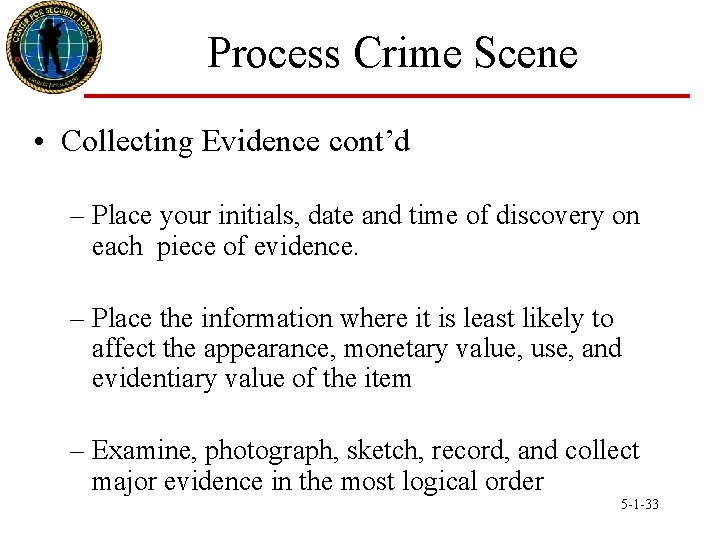
Process Crime Scene • Collecting Evidence cont’d – Place your initials, date and time of discovery on each piece of evidence. – Place the information where it is least likely to affect the appearance, monetary value, use, and evidentiary value of the item – Examine, photograph, sketch, record, and collect major evidence in the most logical order 5 -1 -33
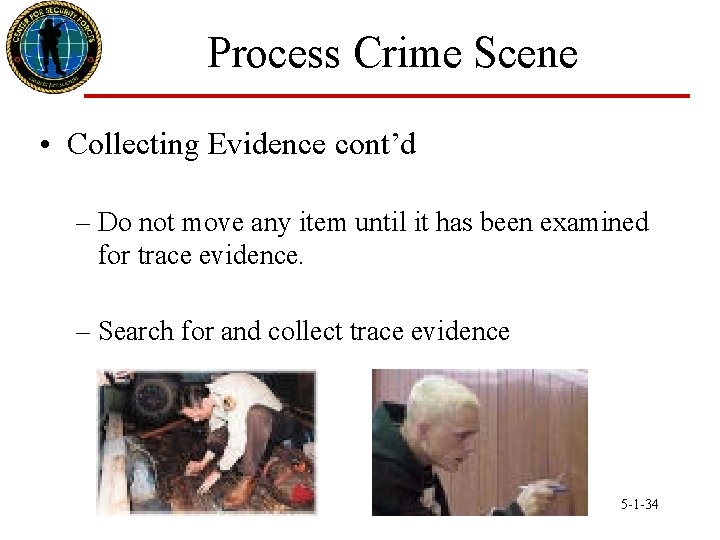
Process Crime Scene • Collecting Evidence cont’d – Do not move any item until it has been examined for trace evidence. – Search for and collect trace evidence 5 -1 -34
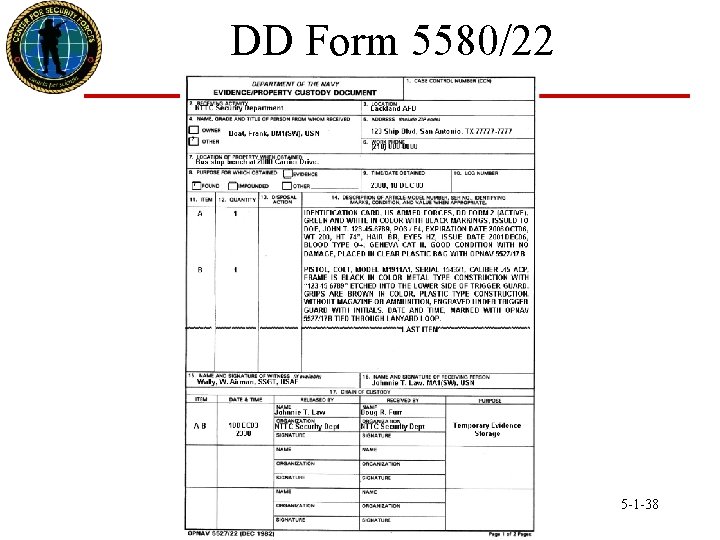
Process Crime Scene • Documenting Evidence – There are several different documents that you will use when dealing with evidence. – The most important form is the OPNAV 5580/22 (Evidence/Property Custody Receipt). – This form is used for evidence, found property, or other items taken by the security patrolman because it is of evidentiary value 5 -1 -35
Process Crime Scene • Documenting Evidence cont’d – The chain of custody identifies evidence and shows who handled the evidence as it was processed – Evidence should be turned over to the evidence custodian or locked in an evidence locker until the evidence custodian is ready to receive it 5 -1 -36
Process Crime Scene • Documenting Evidence cont’d – The chain of custody begins with the first person that collected the evidence. – As the evidence goes from person to person, everyone must sign the receipt. – This pattern will continue until final disposition of the property is made after the case is adjudicated. 5 -1 -37
DD Form 5580/22 5 -1 -38
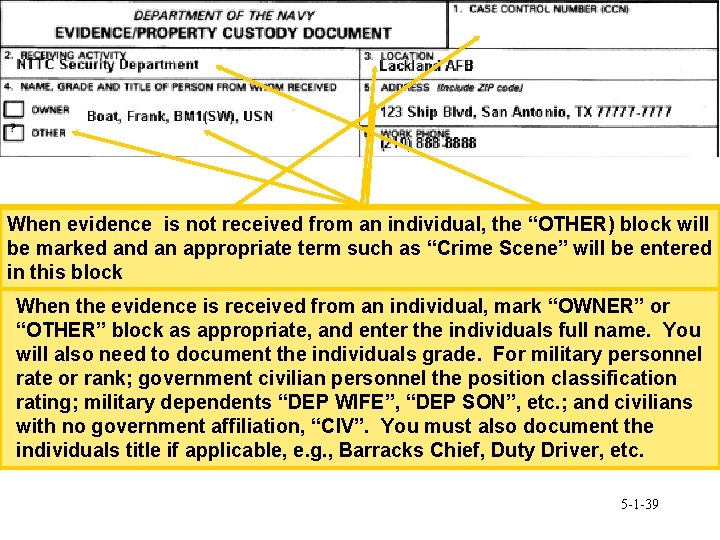
Block 4, 1, 2, Name, Case Receiving 3, Phone. Location. Control Grade Activity. and Number Enter Title the of (CCN). Person location the Enter name from of the of Whom the receiving CCN activity Received. from activity. the which original This haswill 6, Work Enter the. Enter work telephone number of the individual, When evidence is not received from an individual, the “OTHER) block Block 5, Address. Enter the address of the person from whom the Incident received is primarily Report the an evidence/ (IR) used toproperty. document the individual turning the ifblock military, from whom evidence For all others enter the be marked and appropriate term as “Crime Scene” will be entered evidence/property wasthe received. If such itwas wasreceived. not received from an individual, evidence/property over to the Security Department. home telephone number. in this“N/A. ” block enter When the evidence is received from an individual, mark “OWNER” or “OTHER” block as appropriate, and enter the individuals full name. You will also need to document the individuals grade. For military personnel rate or rank; government civilian personnel the position classification rating; military dependents “DEP WIFE”, “DEP SON”, etc. ; and civilians with no government affiliation, “CIV”. You must also document the individuals title if applicable, e. g. , Barracks Chief, Duty Driver, etc. 5 -1 -39
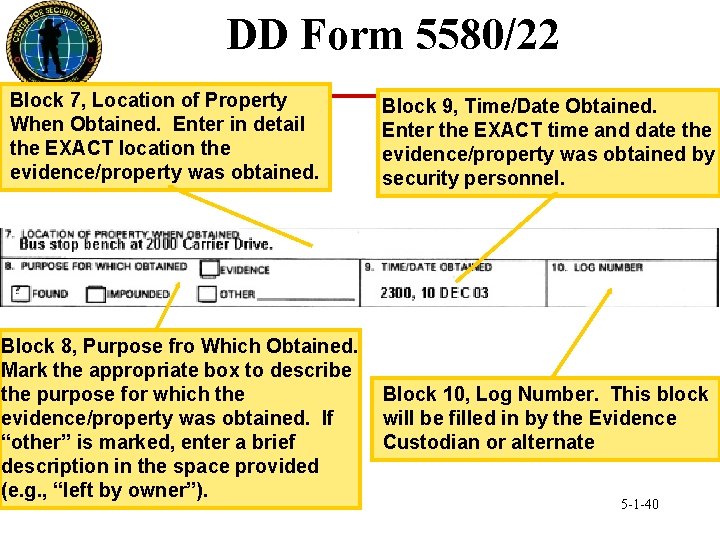
DD Form 5580/22 Block 7, Location of Property When Obtained. Enter in detail the EXACT location the evidence/property was obtained. Block 8, Purpose fro Which Obtained. Mark the appropriate box to describe the purpose for which the evidence/property was obtained. If “other” is marked, enter a brief description in the space provided (e. g. , “left by owner”). Block 9, Time/Date Obtained. Enter the EXACT time and date the evidence/property was obtained by security personnel. Block 10, Log Number. This block will be filled in by the Evidence Custodian or alternate 5 -1 -40
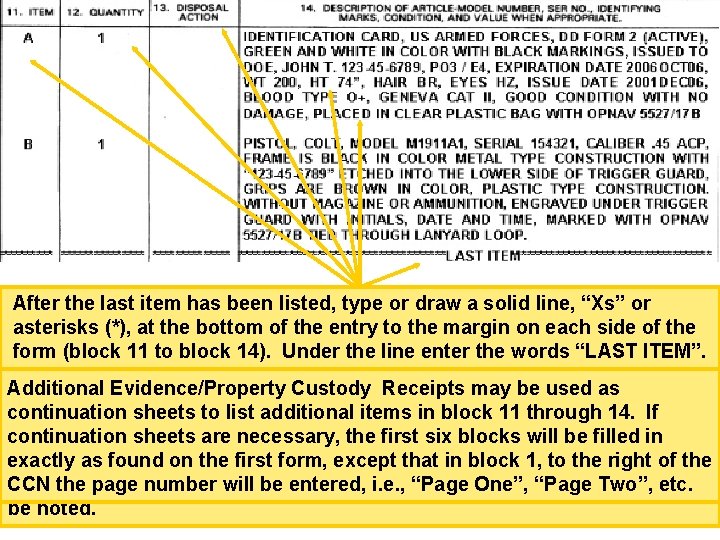
After last item has listed, type or draw aof solid line, “Xs” or Blockthe 12, current Quantity. Enter the number of each item of evidence listed Estimate Block 13, 14, 11, Disposal Description Item. Alphabetically value Action. ofbeen based Article. This on identify block Enter your experience is aeach description used item by the and evidence of Evidence any teach records item with Custodian of the or on first asterisks (*), at bottom the to the margin on each side ofare the Evidence Tag. For example, ifentry there are four briefcases listed as Item information or evidence, item alternate beingdetailed “A”, to provided enter theaccurately second aby number theof “B”, victim. and etc. based letter To In determine the code. upon event what These that if is estimating codes all actually letters are observed current (A-Z described form to block 14). the line enter the words A, block the(block Quantity isthe “ 4”. value in about used, is continue the appropriate, 20 item of 11 this at using form. check time double it your is. Under letters, acquired. local i. e. , SOP AA, or BB with etc. your local“LAST JAG. ITEM”. Additional List the brand, Evidence/Property model number Custody and serial. Receipts number may be used as continuation sheets to list additional items in block 11 through 14. If List identifying marks continuation sheets are necessary, the first six blocks will be filled in exactly Describe asthe found physical on the characteristics first form, except and that conditions in blockof 1, the to the item(s), right of the CCN especially the page if they number appear will tobe beentered, valuable. i. e. , Any “Page obvious One”, damage “Page Two”, shouldetc. also 5 -1 -41 be noted.
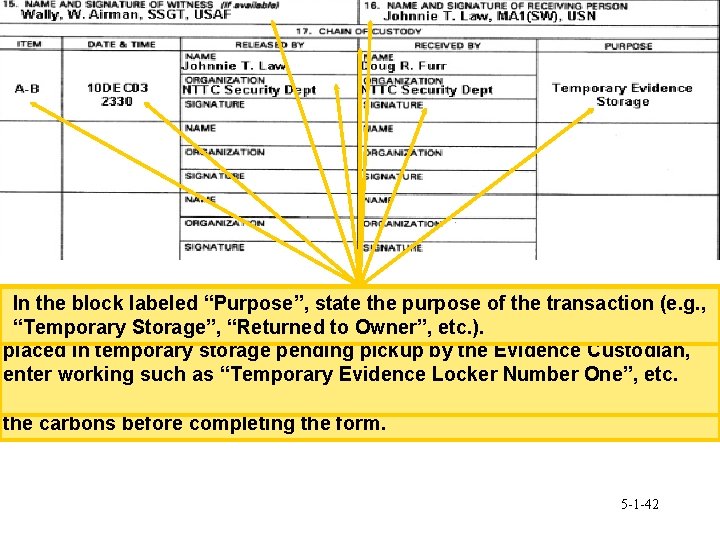
In the block labeled “Released By”, enter the name and organization, with In the By” block, enter the name and theenter In the block labeled “ITEM”, enter the alphabetic identification form Block 15, Name and Signature of Witness. Ifform aaorganization, witness is available, Block In The the“Received 17, 16, Evidence/Property block In Chain Name the labeled next and of Custody: block, Signature “Purpose”, enter Custody This of the state Receiving area Receipt date the ofand the purpose has Person. time hard of establishes of the Enter the copy transaction the of with the printed (e. g. , or the signature of theitem person releasing the evidence. signature the individual receiving the If the itemsas are column 11 ofof each toinevidence/property. the custody of individual. the printed or typed name and the witness it. another accountability. typed “Temporary identification name with Storage”, part Each attached signature of “Returned thetransferred sub-blocks as ofhave the toback Owner”, security page block etc. ). person of 17 sign this must who multi-copy befirst completed received from. It the placed in temporary storage pending pickup by the evidence/property, Evidence Custodian, For example, several, all, items are transferred enter as appropriate, each evidence/property only person includes inif the blocks at chain the 1 or location. through releases 16. and This receives hard copy is provided to theuntil enter working as “Temporary Evidence Number One”, “Aperson through L”, such “C and D”, evidence/property etc. the final disposition identified in ofblock the 4 as a receipt for Locker is themade. property Thisand block must isetc. be continued presented ontothe obtain backrelease of the page, (if appropriate) with reminder of the to items remove listed. and reverse the carbons before completing the form. 5 -1 -42
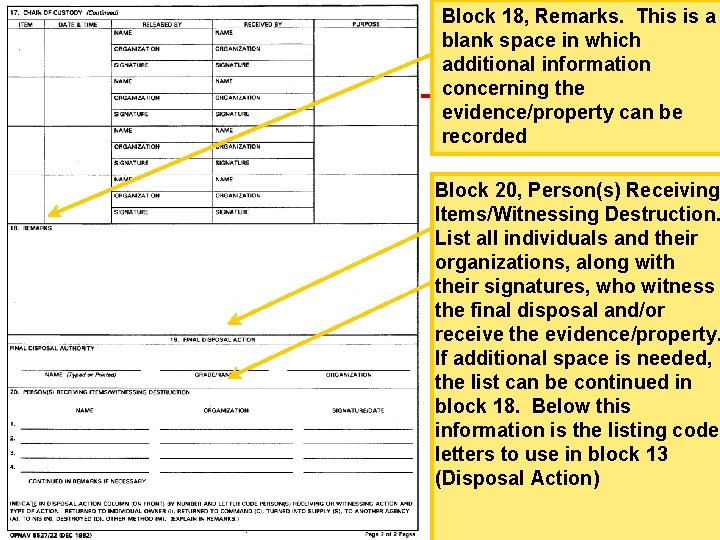
Block 18, Remarks. This is a blank space in which additional information concerning the evidence/property can be recorded Block 20, 19, Person(s) Final Disposal Block Receiving Action. Enter the. Destruction. typed or Items/Witnessing printed name, grade/rank and List all individuals and their organization ofalong the individual organizations, with signatures, final disposal authority. their who witness the final disposal and/or receive the evidence/property. If additional space is needed, the list can be continued in block 18. Below this information is the listing code letters to use in block 13 (Disposal Action) 5 -1 -43
Search for Evidence • General Observations – Consider the size and shape of the building/area to be searched. – Decide what method to use – Brief searchers on a description of the item being searched for (if known) and what action to take when the item sought is found. 5 -1 -44
Search for Evidence • General Inspections cont’d – You must formulate a plan when searching for evidence. An effective plan uses a systematic and methodical approach. 5 -1 -45
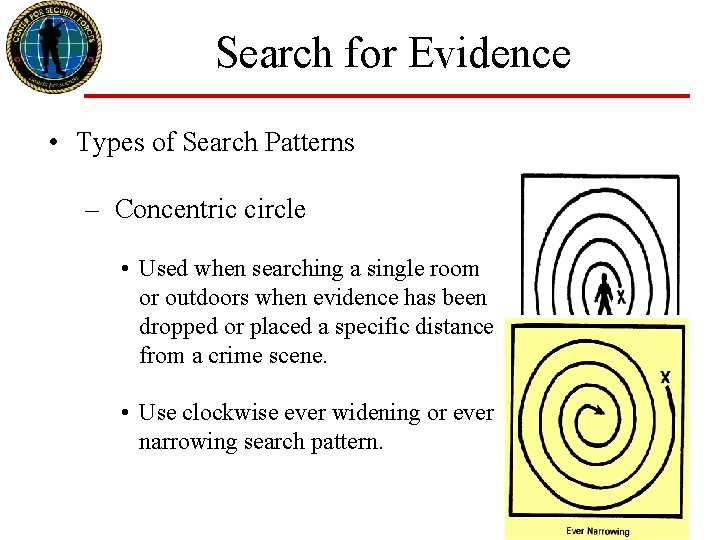
Search for Evidence • Types of Search Patterns – Concentric circle • Used when searching a single room or outdoors when evidence has been dropped or placed a specific distance from a crime scene. • Use clockwise ever widening or ever narrowing search pattern. 5 -1 -46
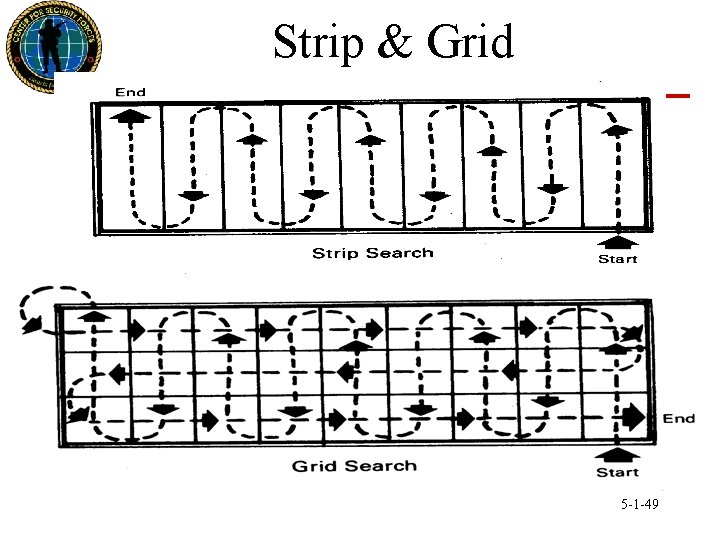
Search for Evidence • Types of Search Patterns cont’d – Strip & Grid • Normally used in large outdoor areas. • When using the strip search, divide the area into strips approximately 4 feet wide. The search starts at one end and moves back and forth across the area from one side to the other. 5 -1 -47
Search for Evidence – Strip & Grid (cont) • Perform the grid search following the strip search. It covers the same area except from end to end instead of side to side. • Multiple searchers can be used with this search method with each searcher being responsible for a particular area. 5 -1 -48
Strip & Grid 5 -1 -49
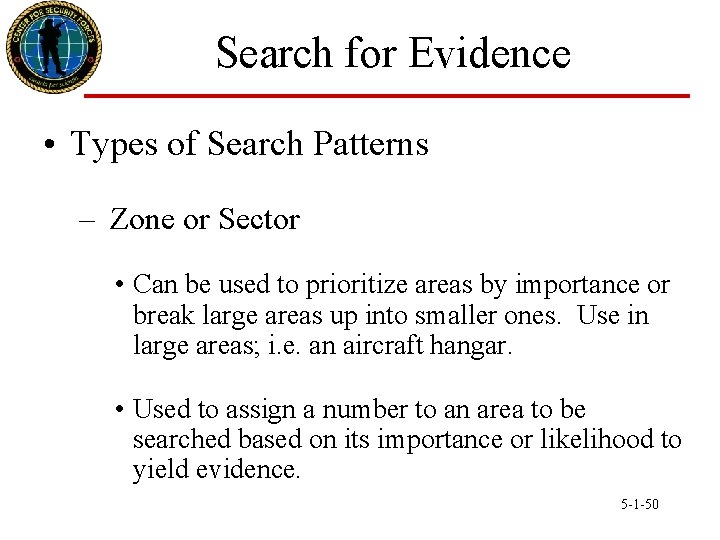
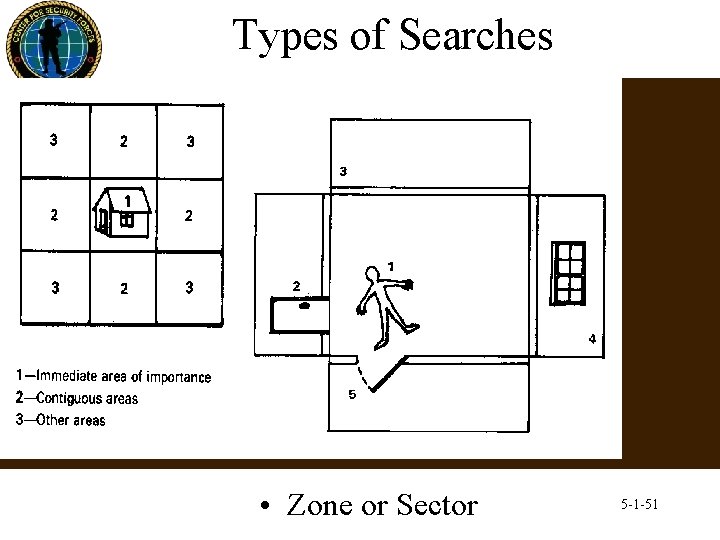
Search for Evidence • Types of Search Patterns – Zone or Sector • Can be used to prioritize areas by importance or break large areas up into smaller ones. Use in large areas; i. e. an aircraft hangar. • Used to assign a number to an area to be searched based on its importance or likelihood to yield evidence. 5 -1 -50
Types of Searches • Zone or Sector 5 -1 -51
Review and Summary • • Investigative responsibility Note taking The crime scene process Investigative awareness Evidence Search the crime scene Collecting evidence Documenting evidence 5 -1 -52
Review and Summary • Forms: OPNAV 5580/16 and 5580/22 • General inspections • Types of search patterns 5 -1 -53
Questions 5 -1 -54