
NSF NSF Biological Sciences Muriel Poston Ph D
NSF
NSF - Biological Sciences Muriel Poston, Ph. D. mposton@nsf. gov National Science Foundation 2005
NSF IN A NUTSHELL n n Independent Agency Supports basic research & education Uses grant mechanism Low overhead; highly automated n n Discipline-based structure Cross-disciplinary mechanisms Use of Rotators/IPAs National Science Board
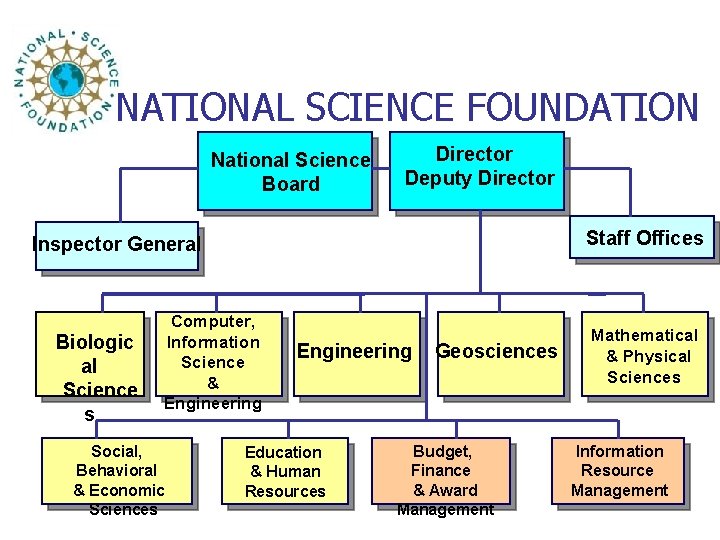
NATIONAL SCIENCE FOUNDATION National Science Board Director Deputy Director Staff Offices Inspector General Biologic al Science s Computer, Information Science & Engineering Social, Behavioral & Economic Sciences Engineering Education & Human Resources Geosciences Budget, Finance & Award Management Mathematical & Physical Sciences Information Resource Management
OTHER NSF OFFICES n n n EPSCo. R n Equal Opportunity n General Council Integrative Affairs International S&E Legislative & Public Affairs Multidisciplinary Activities n Overseas (Paris/Tokyo) n Polar Programs n SBIR/STTR
NSF’s ORIGIN, MISSION & GOAL n n n Established in 1950 by NSF Act Only Agency Authorized to Provide Funding for Research Across All S&E Disciplines “To Promote Progress of Science” and “Advance National Health, Prosperity & Welfare by Supporting Research & Education in S&E”
NSF STRATEGIC INVESTMENT GOALS n n People - Developing “a diverse, internationally competitive and globally engaged workforce of scientists, engineers, and well-prepared citizens. ” Ideas - Enabling “discoveries across the frontier of science and engineering, connected to learning, innovation, and service to society. ” Tools - Providing “broadly accessible, state-of-theart shared research and education tools. ” Organizational Excellence – Operating an agile, innovative organization with leadership and sound business practices
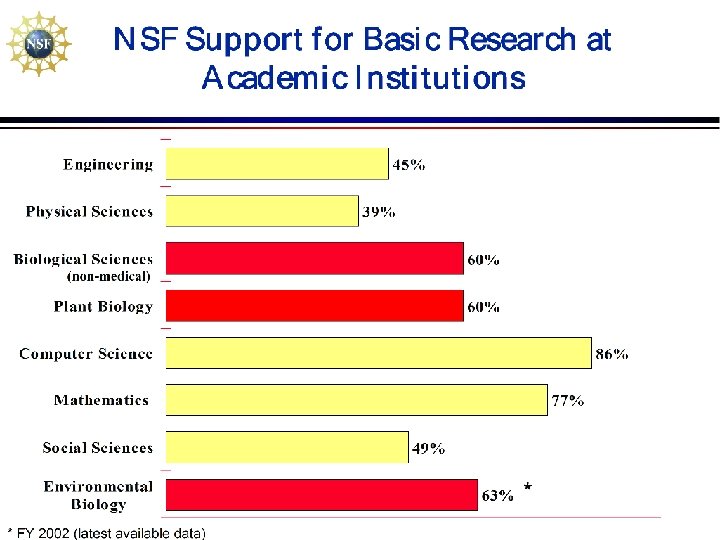
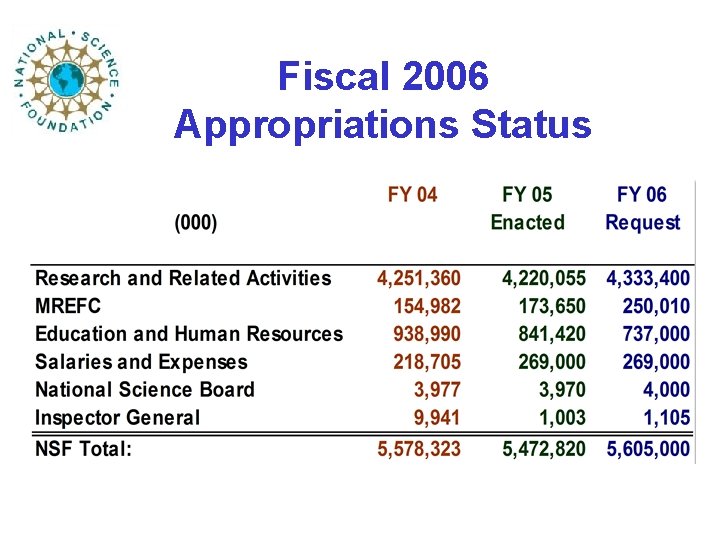
Fiscal 2006 Appropriations Status
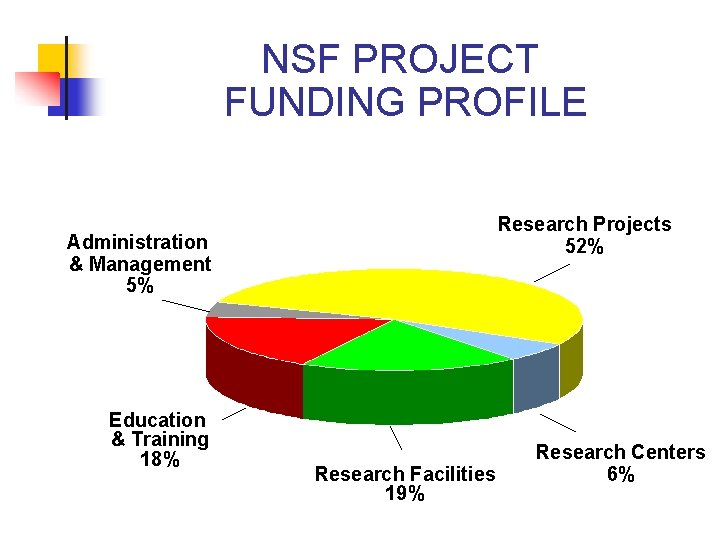
NSF PROJECT FUNDING PROFILE Research Projects 52% Administration & Management 5% Education & Training 18% Research Facilities 19% Research Centers 6%
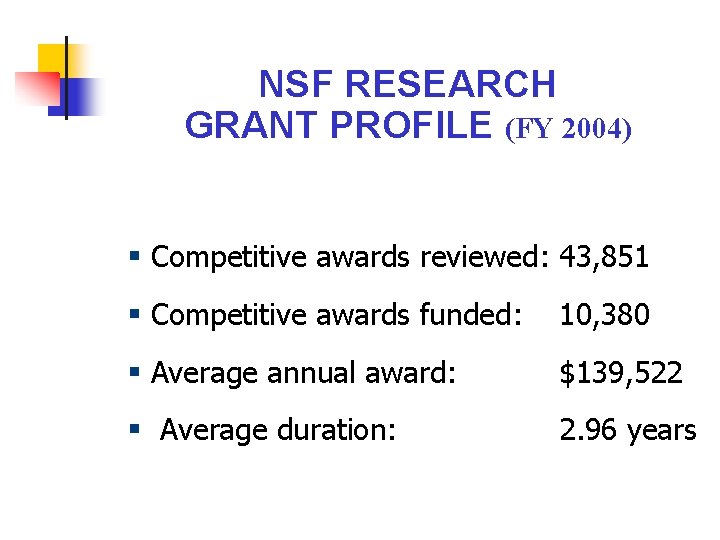
NSF RESEARCH GRANT PROFILE (FY 2004) § Competitive awards reviewed: 43, 851 § Competitive awards funded: 10, 380 § Average annual award: $139, 522 § Average duration: 2. 96 years NSF-10
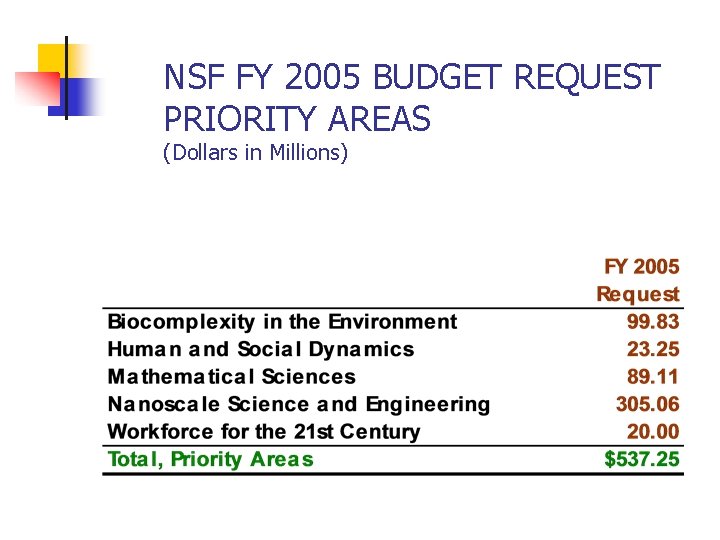
NSF FY 2005 BUDGET REQUEST PRIORITY AREAS (Dollars in Millions)
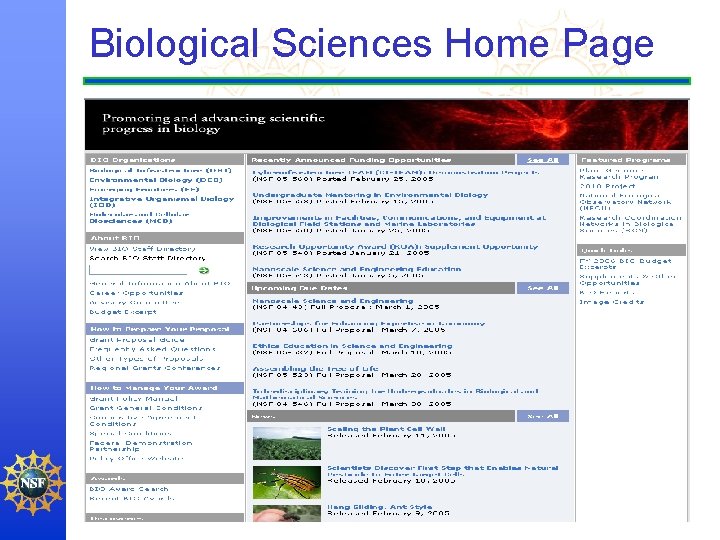
Biological Sciences Home Page
BIO Mission n To support the vitality of the biological sciences at US colleges and universities, especially in those areas where NSF has major responsibilities.
Major BIO Responsibilities § Long-Term Ecological Research § Systematic Biology (Biodiversity) § Evolutionary Biology § Environmental Biology § Plant Biology § Bioinformatics § Non-medical Microbial Biology
Current Issues and Challenges § Implement 21 st Century Biology § § § Multidimensional Multidisciplinary Data driven Educationally oriented Internationally engaged
Current Issues and Challenges § Development of the next generation of scientists § Broadening Participation § Infrastructure § Enhance Federal Investment § Internationalization of science
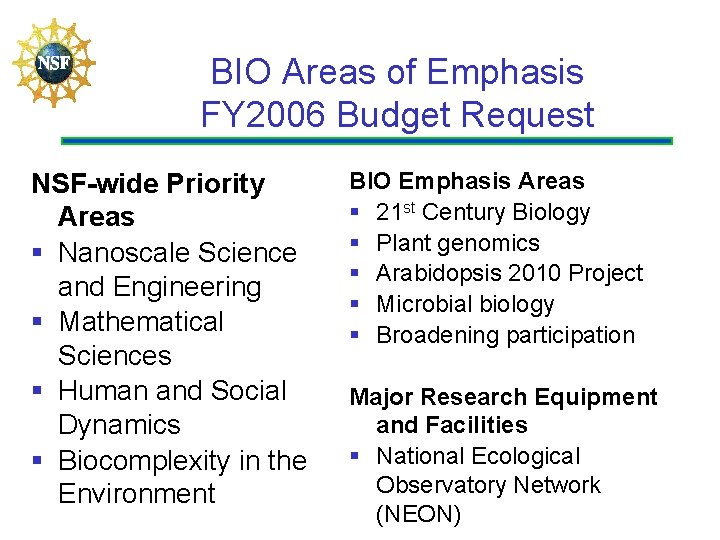
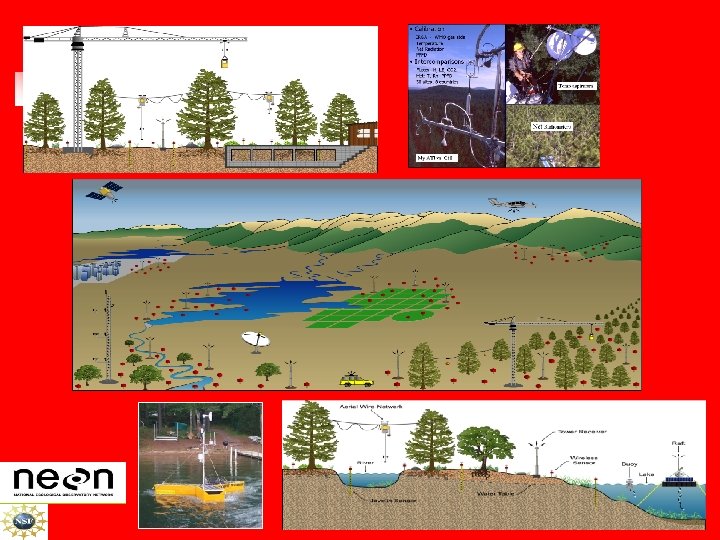
BIO Areas of Emphasis FY 2006 Budget Request NSF-wide Priority Areas § Nanoscale Science and Engineering § Mathematical Sciences § Human and Social Dynamics § Biocomplexity in the Environment BIO Emphasis Areas § 21 st Century Biology § Plant genomics § Arabidopsis 2010 Project § Microbial biology § Broadening participation Major Research Equipment and Facilities § National Ecological Observatory Network (NEON)
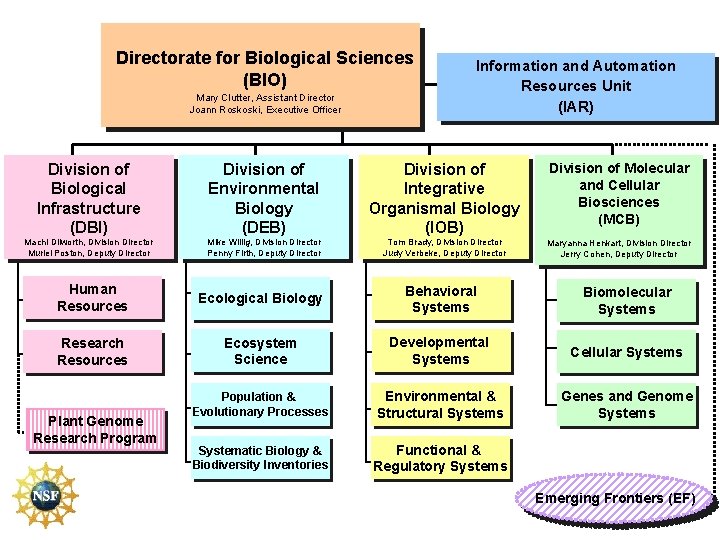
Directorate for Biological Sciences (BIO) Mary Clutter, Assistant Director Joann Roskoski, Executive Officer Information and Automation Resources Unit (IAR) Division of Biological Infrastructure (DBI) Division of Environmental Biology (DEB) Division of Integrative Organismal Biology (IOB) Division of Molecular and Cellular Biosciences (MCB) Machi Dilworth, Division Director Muriel Poston, Deputy Director Mike Willig, Division Director Penny Firth, Deputy Director Tom Brady, Division Director Judy Verbeke, Deputy Director Maryanna Henkart, Division Director Jerry Cohen, Deputy Director Human Resources Ecological Biology Behavioral Systems Biomolecular Systems Research Resources Ecosystem Science Developmental Systems Cellular Systems Population & Evolutionary Processes Environmental & Structural Systems Genes and Genome Systems Systematic Biology & Biodiversity Inventories Functional & Regulatory Systems Plant Genome Research Program Emerging Frontiers (EF)
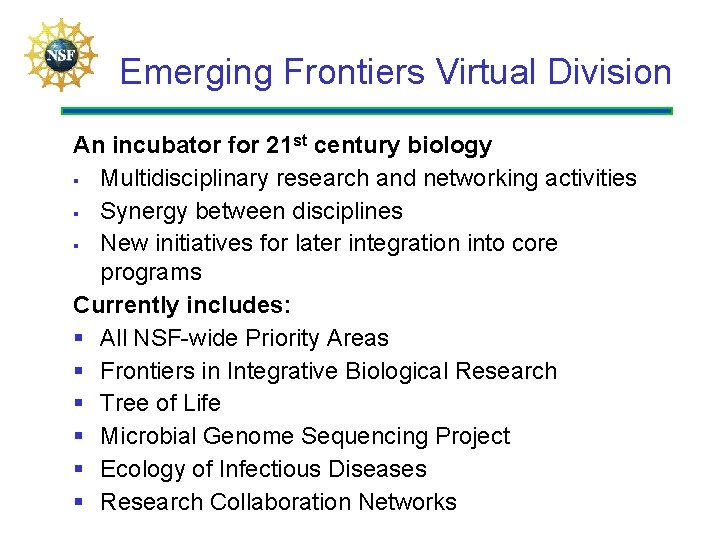
Emerging Frontiers Virtual Division An incubator for 21 st century biology § Multidisciplinary research and networking activities § Synergy between disciplines § New initiatives for later integration into core programs Currently includes: § All NSF-wide Priority Areas § Frontiers in Integrative Biological Research § Tree of Life § Microbial Genome Sequencing Project § Ecology of Infectious Diseases § Research Collaboration Networks
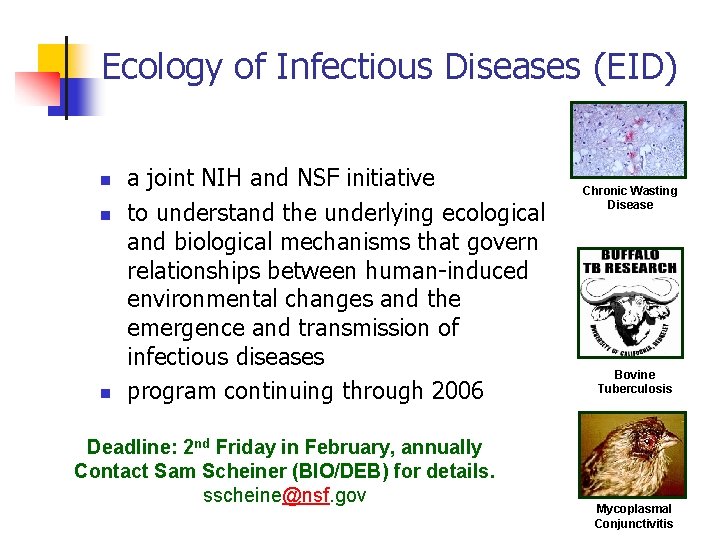
Ecology of Infectious Diseases (EID) n n n a joint NIH and NSF initiative to understand the underlying ecological and biological mechanisms that govern relationships between human-induced environmental changes and the emergence and transmission of infectious diseases program continuing through 2006 Deadline: 2 nd Friday in February, annually Contact Sam Scheiner (BIO/DEB) for details. sscheine@nsf. gov Chronic Wasting Disease Bovine Tuberculosis Mycoplasmal Conjunctivitis
Research Coordination Networks in Biological Sciences n n Foster communication and promote collaboration among scientists with common interests from broad backgrounds and across geographically, disciplinary, and organizational boundaries Create new research directions Program Announcement: NSF-05 -569 Deadline: June 26, 2006
Funding Opportunities for Plant Research o Core programs in the BIO Directorate o DBI n DEB n IBN n MCB Cross-cutting programs n The 2010 Project n Assembling the Tree of Life (ATo. L) n Research Coordination Networks (RCN) n Frontiers in Integrative Biological Research (FIBR) o Plant Genome Research Program (PGRP) n
Plant Genome Research Program Overall Program Goals n n n Support research on the structure, organization and function of plant genomes, elucidate fundamental biological processes Accelerate the acquisition and utilization of new knowledge and innovative technologies Focus is on plants of economic importance and plant processes of potential economic value. FY’ 05 -’ 06 Program (NSF 05 -603) n n Virtual Center Awards in Plant Genome Research Individual and Small Group Awards in Plant Genome Research
Plant Genome Research Program Three kinds of activities will be supported in FY 2006: n n n Research to tackle unanswered questions in plant biology on a genome-wide scale Translational research to move findings from model systems into plants of economic importance Tools and resource building
Funded Plants o Arabidopsis o Medicago o Oat Barley o Brassica o Pepper o Sorghum Cotton o Pine o Tobacco Grape o Poplar o Tomato o Lettuce o Potato o Wheat o Maize o o Rice o Soybean
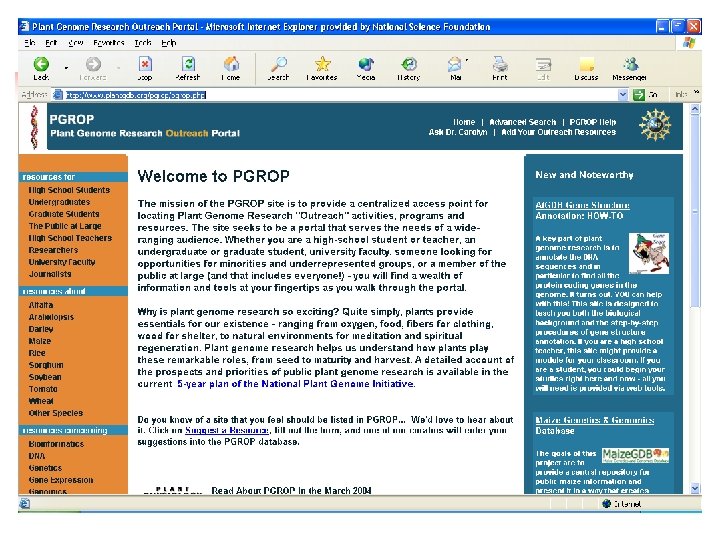
Plant Genome Educational Resources 1. 2. 3. All NSF PGRP projects have training and outreach components Many other projects have developed educational resources A collection of these resources can be accessed at the Plant Genome Research Outreach Portal (PGROP): http: //www. plantgdb. org/pgrop. php
Division of Biological Infrastructure Examples of Research Areas Supported Under DBI § § § § § Postdoctoral Fellowships Program Research Experiences for Undergraduates Sites Undergraduate Mentorship in Environmental Biology Collaborative Research at Undergraduate Institutions Biological Field Stations and Marine Laboratories Instrument Development for Biological Research Multi-user Biological Equipment and Instrumentation Biological Databases and Informatics Living Stock Collections Biological Research Collections
Major Research Instrumentation Program § NSF wide program, BIO managed review § Designed to improve the condition of scientific and engineering equipment and facilities for research and research training § Awards for instrumentation will range from $100, 000 to $2 million. Deadline: 3 rd Thursday in January, annually Program Announcement: NSF-05 -515
Multi-User Biological Equipment and Instrumentation Resources (MUE) § provides support for the purchase of major items § § S Ufrom requests can be $40, 000 to $400, 000. SP E Nequipment single items of biological or several D ED purpose pieces of equipment with a related § must be shared by 3 to 7 investigators with actively -funded NSF research projects. Program Announcement: NSF 05 -534 Deadline: 1 st Wednesday in July, annually
Field Stations & Marine Labs Program Successful projects have: § Demonstrated infrastructure need § High potential biological impact § Broad user base § Educational outreach Read the Program Announcement for more information. Program Announcement: NSF 05 -550 Target date: April 26, 2005
Biological Research Collections n Collection Enhancement n Computerization of specimen-related data n Curation and Collection Management research Program solicitation NSF: 05 -0575 Target date: July, 15, 2005
Biological Databases and Informatics n To encourage support of new approaches to the management of biological knowledge that render the collection, maintenance, dissemination and query of the data and information therein of greater utility to the scientific community. Program Solicitation: NSF 05 -577 Target date: July 18, 2005
C-RUI: Cross-disciplinary Research at Undergraduate Institutions n n Supports research efforts involving faculty from different fields Targeted at cross-disciplinary research projects that require contribution of from more than one disciplinary area Focused on undergraduate students from predominantly undergraduate institutions Anticipated funding for program - $2 million; up to 8 awards Read the Program Announcement for more information. Program Announcement: NSF 04 -536
Research Experiences for Undergraduates effective for attracting and retaining undergraduates in careers in mathematics, science and engineering incorporates active research experience REU supplements to PIs with existing awards REU sites: NSF 05 -592 Sites Deadline: Sept. 7, 2005 Supplement Deadline: Contact your Program Officer for details.
Undergraduate Mentoring in Environmental Biology § institutional awards to give students research experience in environmental biology - broadly defined § proposals should emphasize factors that enable underrepresented groups to enter and remain in environmental biology § major emphasis on direct student participation in research during the academic year and summer, with students remaining in program for > 1 year Program Announcement: NSF 05 -558 Preliminary proposal target date: May 18 th 2005 Full proposal target date: October 17 th 2005
Postdoctoral Fellowship Programs Awards for research and training Applicants choose sponsoring scientist and provide research/training plan Two year awards n Minority Postdoctoral Fellowships n n n Program announcement NSF 00 -139; Deadline: First Monday in December Postdoctoral Research Fellowships in Interdisciplinary Informatics n n Program Announcement NSF 04 -539 Deadline: April 11 th, 2005
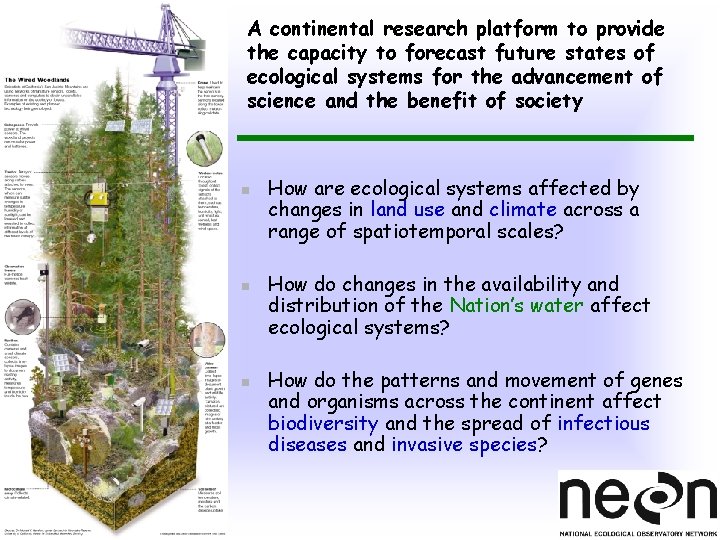
A continental research platform to provide the capacity to forecast future states of ecological systems for the advancement of science and the benefit of society n n n How are ecological systems affected by changes in land use and climate across a range of spatiotemporal scales? How do changes in the availability and distribution of the Nation’s water affect ecological systems? How do the patterns and movement of genes and organisms across the continent affect biodiversity and the spread of infectious diseases and invasive species?
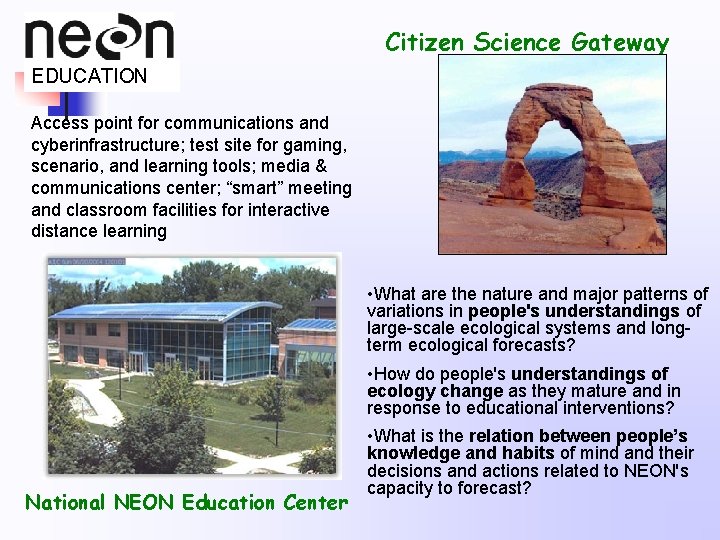
Citizen Science Gateway EDUCATION Access point for communications and cyberinfrastructure; test site for gaming, scenario, and learning tools; media & communications center; “smart” meeting and classroom facilities for interactive distance learning • What are the nature and major patterns of variations in people's understandings of large-scale ecological systems and longterm ecological forecasts? • How do people's understandings of ecology change as they mature and in response to educational interventions? National NEON Education Center • What is the relation between people’s knowledge and habits of mind and their decisions and actions related to NEON's capacity to forecast?
Research at Undergraduate Institutions (RUI) n Eligibility: must be predominantly undergraduate institution n 2 -yr and 4 -yr colleges Master’s level and small doctoral colleges that have undergraduate enrollment larger than graduate and award no more than 10/yr Ph. D. degrees in all science fields (avg. 2 -5 yrs) RUI supports faculty from PUI n n Research project funding to individual or collaborative group Purchase of shared instrumentation
Research at Undergraduate Institutions (RUI) n Impact Statement (maximum length 5 pages) n Impact of the proposed research activity: n n n The research environment of the institution The career(s) of the faculty participants The ability of the involved department(s) to prepare students for entry into advanced-degree programs and/or careers in science and engineering
Research Initiation Grants and Career Advancement Awards to Broaden Participation in the Biological Sciences Increase the number and competitiveness of underrepresented groups in biology as well as scientists at minority-serving institutions. § For faculty at any college or university. § Proposed activities must facilitate broadening participation by underrepresented groups in biology. § RIG - beginning investigators - for activities, (e. g. preliminary data or developing collaborations) in order to formulate competitive grant applications. § CAA – established scientists – to enhance career development and competitiveness (e. g. , acquiring new tools, skills). Announcement: NSF 05 -581 Target date: Jan. 12, 2006
RESEARCH EXPERIENCE FOR TEACHERS § 1 -year supplement to current NSF Awards § help build long term collaborative relationships between K-12 teachers of science and mathematics and the NSF research community § encourages researchers to form partnerships with teachers at inner city schools and less well- endowed school districts Consult with the Program Director of your particular NSF award. Dear Colleague Letter: NSF 05 -524
Research Opportunity Award Supplementary funding through ongoing NSF research grants to allow faculty at predominantly undergraduate institutions or secondary schools to participate in research activities under the aegis of NSF-supported investigators § details located within the RUI program announcement Consult with the Program Director of your particular NSF award. Dear Colleague Letter: NSF 05 -548
Research Assistantships for Minority High School Students (RAMHSS) § involves high school minority students in research § provides funding supplements to PIs supported by NSF § occurs throughout the academic year and summer Contact the Program Officer in the appropriate program for details.
Mathematical Biology Research n n Joint DMS/BIO/NIGMS Initiative to Support Research in the Area of Mathematical Biology NSF 04 -572 - Deadline June 15, 2005 Interdisciplinary Training for Undergraduates in Biological and Mathematical Sciences NSF 04 -546 - Deadline March 30, 2005 New Mathematical And Statistical Tools For Understanding Complex Systems In The Environment NSF 04 -538 Deadline: November 15, 2004 Quantitative Environmental and Integrative Biology (QEIB) NSF 00 -149 – Deadlines: Contact Program Contact: Sam Scheiner, sscheine@nsf. gov NSF 04 -572, 04 -546, 00 -149
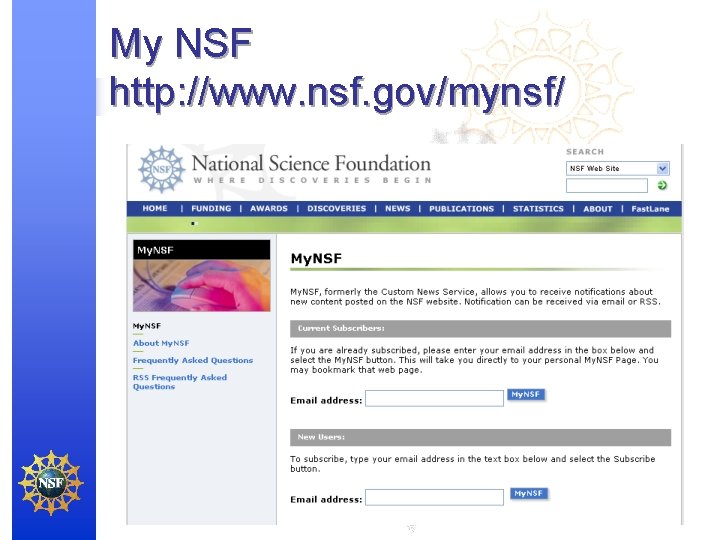
My NSF http: //www. nsf. gov/mynsf/
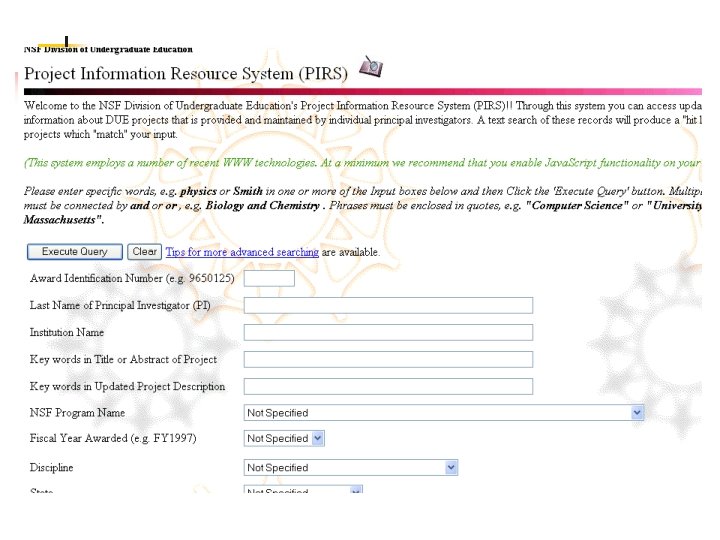
Sources of Information on NSF Funding Opportunities § Web: www. nsf. gov § Grant Proposal Guide: http: //www. nsf. gov/pubs/gpg/nsf 04_23/ § NSF – Awards: http: //www. nsf. gov/awardsearch/ § Program Officer § Colleagues
GEO Education Division of Atmospheric Sciences n n Contact: Robert Kerr rkerr@nsf. gov Division of Earth Sciences Contact: Mike Mayhew mmayhew@nsf. gov Division of Ocean Sciences including Centers for Ocean Science Education Excellence (COSEE) Contact: Lisa Rom erom@nsf. gov GEO has a Directorate-wide program to fund formal (K-16) and informal geoscience education activities. Contact: Jackie Huntoon jhuntoon@nsf. gov
Graduate Teaching Fellows in K-12 Education (GK 12) n Graduate programs in STEM disciplines partner with K-12 schools to provide fellowships and associated training n n n Improved communication and teaching skills for graduate students Professional development for K-12 teachers Enriched learning for K-12 students Program solicitation: NSF 05 -553 Deadline: June 2, 2005
IGERT Integrative Graduate Education and Research Traineeship Program n n n Innovative research based graduate education Organized around an interdisciplinary research theme Provide a framework for integrating research and education and promoting collaborations across departments and institutions Involve a diverse group of faculty members Students gain a breadth of skills and understanding to work in interdisciplinary environments while being grounded with knowledge of disciplinary field Program Announcement: NSF 04 -546 Full Proposal: Mar. 29, 2006
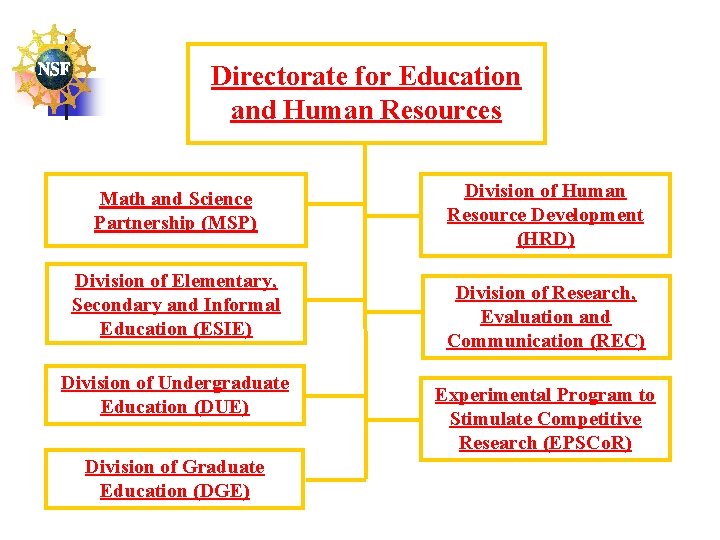
Directorate for Education and Human Resources Math and Science Partnership (MSP) Division of Elementary, Secondary and Informal Education (ESIE) Division of Undergraduate Education (DUE) Division of Graduate Education (DGE) Division of Human Resource Development (HRD) Division of Research, Evaluation and Communication (REC) Experimental Program to Stimulate Competitive Research (EPSCo. R)
New CCLI Emphases Revised CCLI program emphasizes: n n n Building on prior work and contributing to the STEM education knowledge base Building a community of STEM education scholars Identifying and using a set of measurable outcomes Program Solicitation: NSF-05 -559 Deadline: Jan. 24, 2006
Build on Prior Work and Contribute to the Knowledge Base Build on prior work. Nothing is created in a vacuum. Put the work in the context of educational and scientific advances within the field and STEM in general n Research and acknowledge work by others and yourself that relate to the project and n Cite the relevant literature and people you consulted Contribute to the knowledge base. Leave a legacy for others. n Indicate how and with whom you will disseminate the results of the project. n If appropriate indicate the potential of the proposed work to serve as the basis for future research in science education.
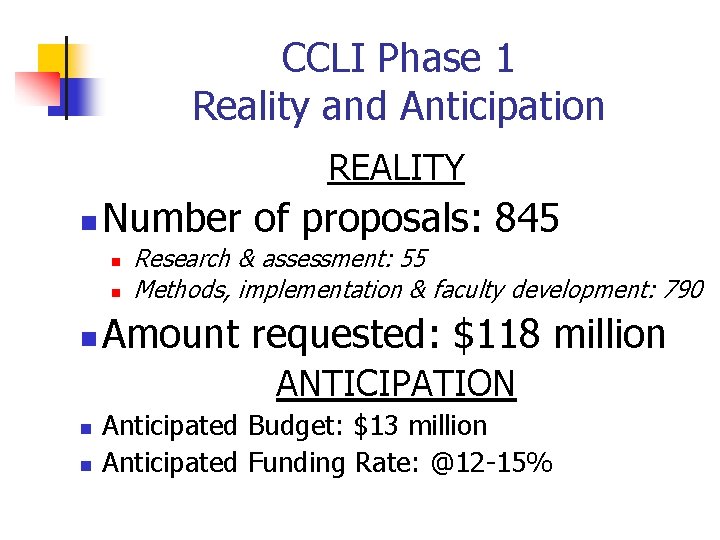
CCLI Phase 1 Reality and Anticipation REALITY n Number of proposals: 845 n n n Research & assessment: 55 Methods, implementation & faculty development: 790 Amount requested: $118 million ANTICIPATION n n Anticipated Budget: $13 million Anticipated Funding Rate: @12 -15%
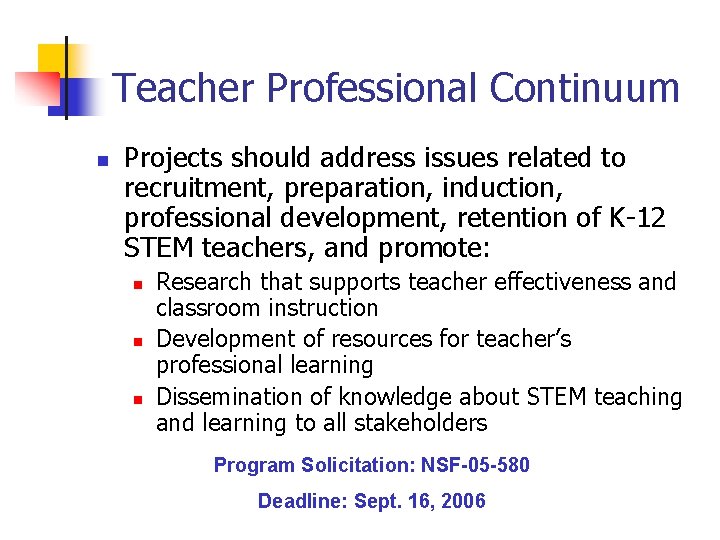
Teacher Professional Continuum n Projects should address issues related to recruitment, preparation, induction, professional development, retention of K-12 STEM teachers, and promote: n n n Research that supports teacher effectiveness and classroom instruction Development of resources for teacher’s professional learning Dissemination of knowledge about STEM teaching and learning to all stakeholders Program Solicitation: NSF-05 -580 Deadline: Sept. 16, 2006
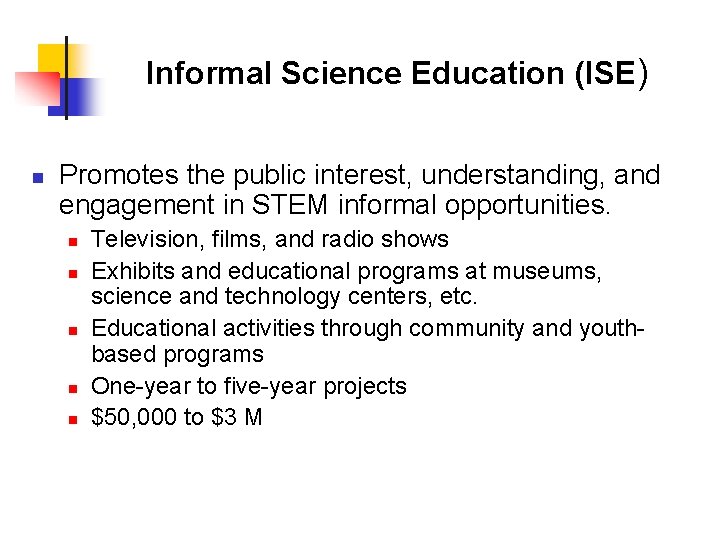
Informal Science Education (ISE) n Promotes the public interest, understanding, and engagement in STEM informal opportunities. n n n Television, films, and radio shows Exhibits and educational programs at museums, science and technology centers, etc. Educational activities through community and youthbased programs One-year to five-year projects $50, 000 to $3 M
- Slides: 64