
NSF Funding Opportunities for Cyberenabled Research Advanced Cyberinfrastructure

NSF Funding Opportunities for Cyberenabled Research Advanced Cyberinfrastructure Computing & Communication Foundations Computer & Network Systems Information & Intelligent Systems Vasant G Honavar Professor of Information Sciences and Technology Professor of Computer Science Professor of Bioinformatics and Genomics Professor of Neuroscience Director, Center for Big Data Analytics and Discovery Informatics Associate Director, Institute for Cyberscience Council Member, Computing Community Consortium Executive Committee Member, Northeast Big Data Hub Acknowledgements: Some of the material is adapted from public presentations given by CISE AD
Research Interests • • Machine learning: Statistical, information theoretic, linguistic and structural approaches to machine learning; learning predictive relationships from sequential, graph-structured, multi-relational, multimodal, partially specified, partially labeled, distributed data, linked data Knowledge Representation and Inference: Logical, probabilistic, and decisiontheoretic knowledge representation and inference; federated knowledge bases; selective information sharing; federated services; representing and reasoning about qualitative preferences; representing and reasoning about causal effects Applied Informatics – Bioinformatics: Macromolecular structure and function, analysis, inference, modeling, and prediction of macromolecular (protein-protein , protein-RNA, and protein-DNA) interaction networks and interfaces, immune networks, etc. – Health Informatics: Predictive and causal modeling of health outcomes from patient (health records, genomics, socio-economic, environmental) data – Brain Informatics: Modeling and analysis of structure and dynamics of brain networks from f. MRI data Algorithmic Discovery: Representations and processes that underlie scientific research, including construction of communicable models and shareable representations, causal inference from disparate studies
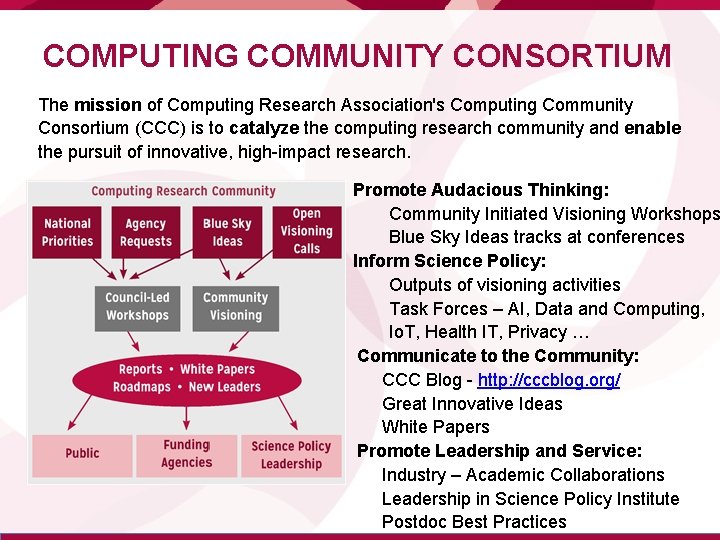
COMPUTING COMMUNITY CONSORTIUM The mission of Computing Research Association's Computing Community Consortium (CCC) is to catalyze the computing research community and enable the pursuit of innovative, high-impact research. Promote Audacious Thinking: Community Initiated Visioning Workshops Blue Sky Ideas tracks at conferences Inform Science Policy: Outputs of visioning activities Task Forces – AI, Data and Computing, Io. T, Health IT, Privacy … Communicate to the Community: CCC Blog - http: //cccblog. org/ Great Innovative Ideas White Papers Promote Leadership and Service: Industry – Academic Collaborations Leadership in Science Policy Institute Postdoc Best Practices
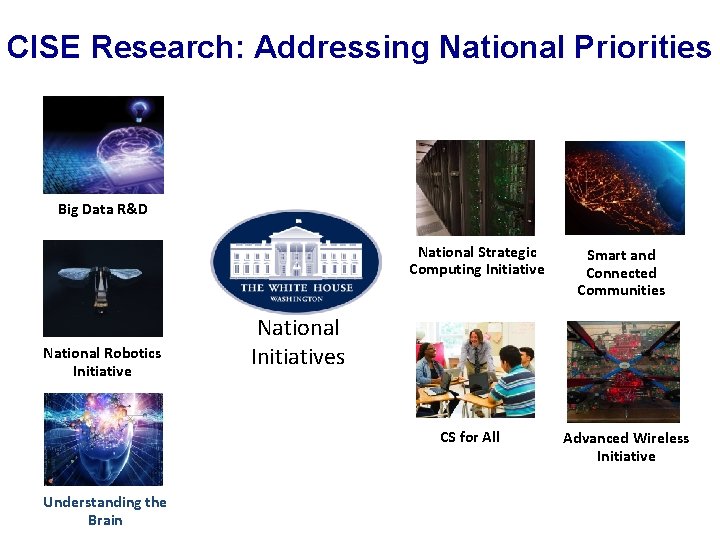
CISE Research: Addressing National Priorities Big Data R&D National Strategic Computing Initiative National Robotics Initiative National Initiatives CS for All Understanding the Brain Smart and Connected Communities Advanced Wireless Initiative
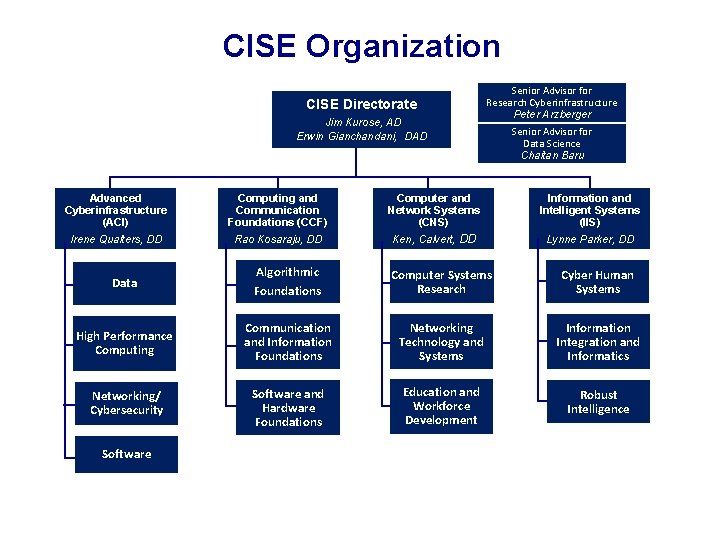
CISE Organization CISE Directorate Jim Kurose, AD Erwin Gianchandani, DAD Advanced Cyberinfrastructure (ACI) Irene Qualters, DD Computing and Communication Foundations (CCF) Rao Kosaraju, DD Senior Advisor for Research Cyberinfrastructure Peter Arzberger Senior Advisor for Data Science Chaitan Baru Computer and Network Systems (CNS) Ken, Calvert, DD Information and Intelligent Systems (IIS) Lynne Parker, DD Data Algorithmic Foundations Computer Systems Research Cyber Human Systems High Performance Computing Communication and Information Foundations Networking Technology and Systems Information Integration and Informatics Networking/ Cybersecurity Software and Hardware Foundations Education and Workforce Development Robust Intelligence Software
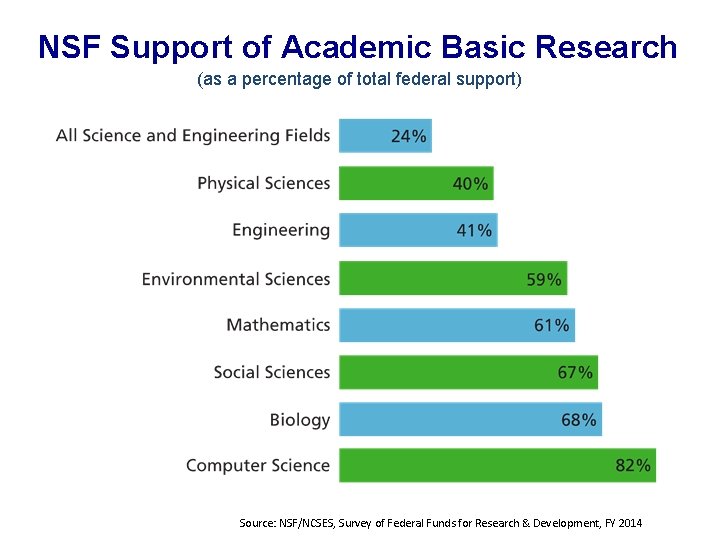
NSF Support of Academic Basic Research (as a percentage of total federal support) Source: NSF/NCSES, Survey of Federal Funds for Research & Development, FY 2014
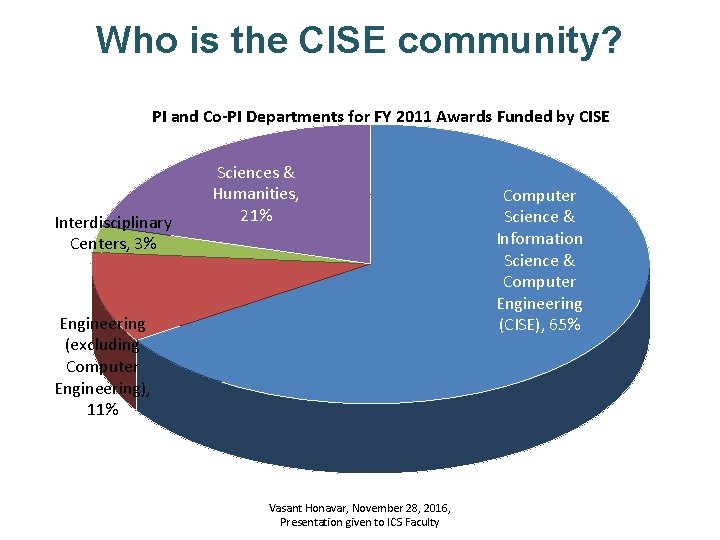
Who is the CISE community? PI and Co-PI Departments for FY 2011 Awards Funded by CISE Interdisciplinary Centers, 3% Sciences & Humanities, 21% Engineering (excluding Computer Engineering), 11% Vasant Honavar, November 28, 2016, Presentation given to ICS Faculty Computer Science & Information Science & Computer Engineering (CISE), 65%
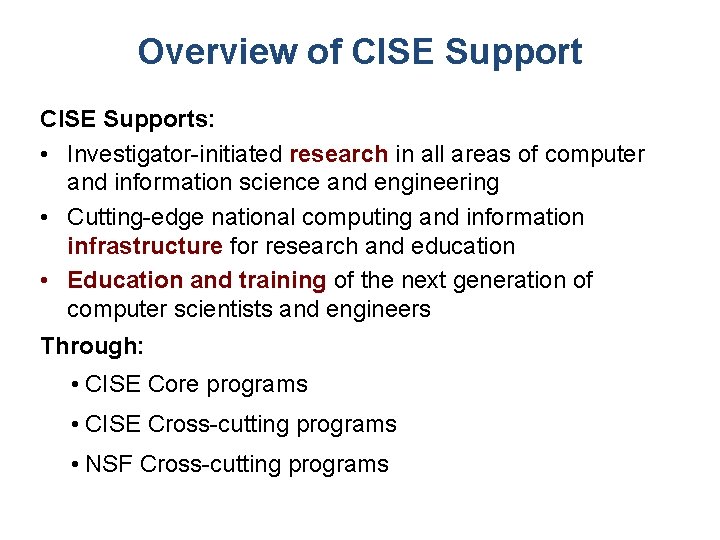
Overview of CISE Supports: • Investigator-initiated research in all areas of computer and information science and engineering • Cutting-edge national computing and information infrastructure for research and education • Education and training of the next generation of computer scientists and engineers Through: • CISE Core programs • CISE Cross-cutting programs • NSF Cross-cutting programs
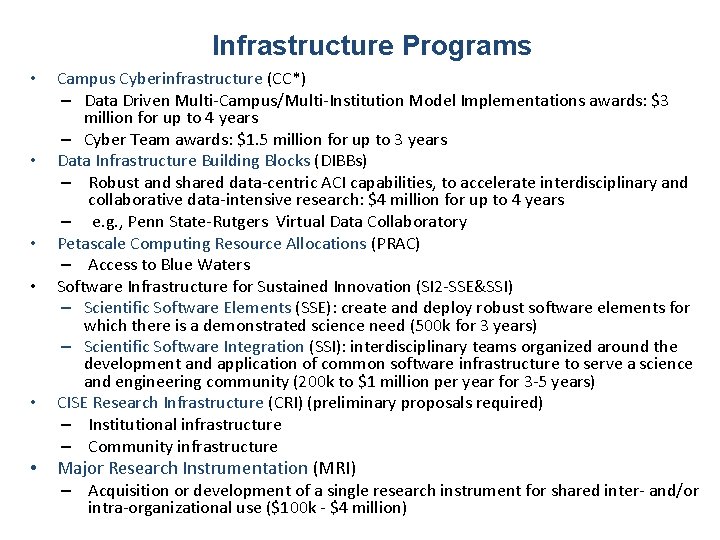
Infrastructure Programs • • • Campus Cyberinfrastructure (CC*) – Data Driven Multi-Campus/Multi-Institution Model Implementations awards: $3 million for up to 4 years – Cyber Team awards: $1. 5 million for up to 3 years Data Infrastructure Building Blocks (DIBBs) – Robust and shared data-centric ACI capabilities, to accelerate interdisciplinary and collaborative data-intensive research: $4 million for up to 4 years – e. g. , Penn State-Rutgers Virtual Data Collaboratory Petascale Computing Resource Allocations (PRAC) – Access to Blue Waters Software Infrastructure for Sustained Innovation (SI 2 -SSE&SSI) – Scientific Software Elements (SSE): create and deploy robust software elements for which there is a demonstrated science need (500 k for 3 years) – Scientific Software Integration (SSI): interdisciplinary teams organized around the development and application of common software infrastructure to serve a science and engineering community (200 k to $1 million per year for 3 -5 years) CISE Research Infrastructure (CRI) (preliminary proposals required) – Institutional infrastructure – Community infrastructure Major Research Instrumentation (MRI) – Acquisition or development of a single research instrument for shared inter- and/or intra-organizational use ($100 k - $4 million)
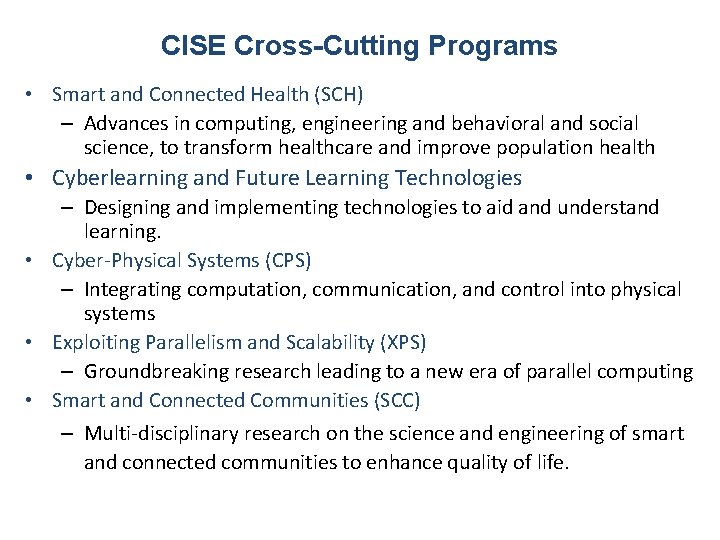
CISE Cross-Cutting Programs • Smart and Connected Health (SCH) – Advances in computing, engineering and behavioral and social science, to transform healthcare and improve population health • Cyberlearning and Future Learning Technologies – Designing and implementing technologies to aid and understand learning. • Cyber-Physical Systems (CPS) – Integrating computation, communication, and control into physical systems • Exploiting Parallelism and Scalability (XPS) – Groundbreaking research leading to a new era of parallel computing • Smart and Connected Communities (SCC) – Multi-disciplinary research on the science and engineering of smart and connected communities to enhance quality of life.
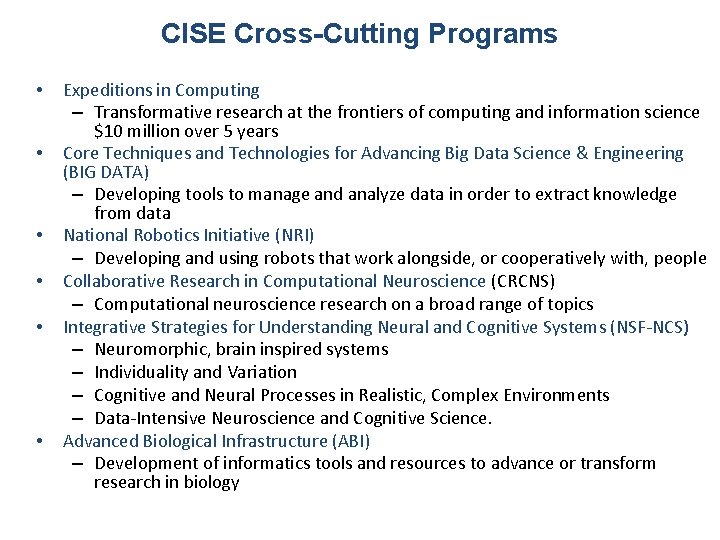
CISE Cross-Cutting Programs • • • Expeditions in Computing – Transformative research at the frontiers of computing and information science $10 million over 5 years Core Techniques and Technologies for Advancing Big Data Science & Engineering (BIG DATA) – Developing tools to manage and analyze data in order to extract knowledge from data National Robotics Initiative (NRI) – Developing and using robots that work alongside, or cooperatively with, people Collaborative Research in Computational Neuroscience (CRCNS) – Computational neuroscience research on a broad range of topics Integrative Strategies for Understanding Neural and Cognitive Systems (NSF-NCS) – Neuromorphic, brain inspired systems – Individuality and Variation – Cognitive and Neural Processes in Realistic, Complex Environments – Data-Intensive Neuroscience and Cognitive Science. Advanced Biological Infrastructure (ABI) – Development of informatics tools and resources to advance or transform research in biology
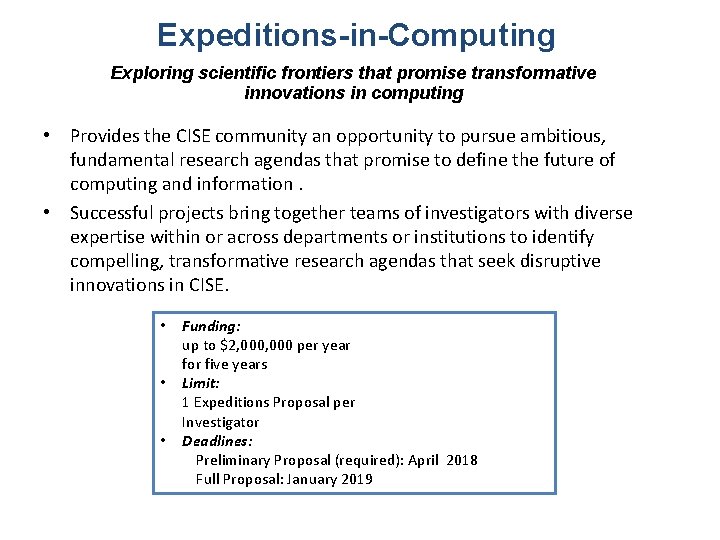
Expeditions-in-Computing Exploring scientific frontiers that promise transformative innovations in computing • Provides the CISE community an opportunity to pursue ambitious, fundamental research agendas that promise to define the future of computing and information. • Successful projects bring together teams of investigators with diverse expertise within or across departments or institutions to identify compelling, transformative research agendas that seek disruptive innovations in CISE. • Funding: up to $2, 000 per year for five years • Limit: 1 Expeditions Proposal per Investigator • Deadlines: Preliminary Proposal (required): April 2018 Full Proposal: January 2019
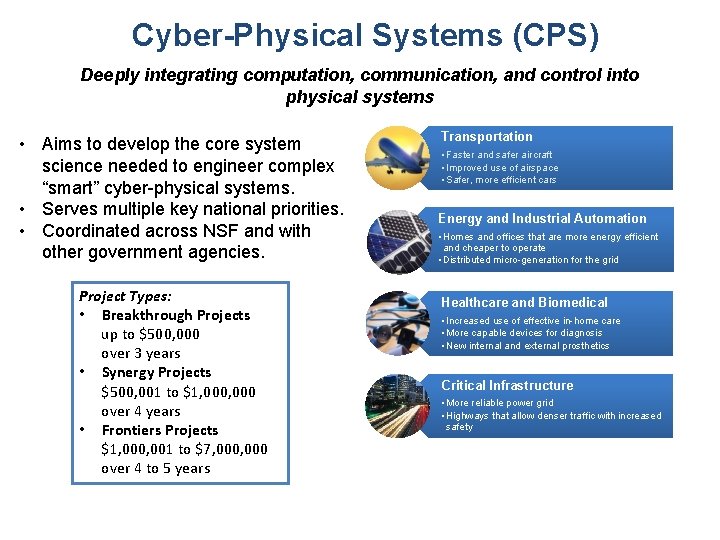
Cyber-Physical Systems (CPS) Deeply integrating computation, communication, and control into physical systems • Aims to develop the core system science needed to engineer complex “smart” cyber-physical systems. • Serves multiple key national priorities. • Coordinated across NSF and with other government agencies. Project Types: • Breakthrough Projects up to $500, 000 over 3 years • Synergy Projects $500, 001 to $1, 000 over 4 years • Frontiers Projects $1, 000, 001 to $7, 000 over 4 to 5 years Transportation • Faster and safer aircraft • Improved use of airspace • Safer, more efficient cars Energy and Industrial Automation • Homes and offices that are more energy efficient and cheaper to operate • Distributed micro-generation for the grid Healthcare and Biomedical • Increased use of effective in-home care • More capable devices for diagnosis • New internal and external prosthetics Critical Infrastructure • More reliable power grid • Highways that allow denser traffic with increased safety
CISE’s 2017 budget priorities § Continued strong commitment to § Core research programs § Cross-cutting programs § New CISE programs in 2017: § Smart and Connected Communities § Smart and Autonomous Systems § National Strategic Computing Initiative § Data for Scientific Discovery and Action (D 4 SDA)
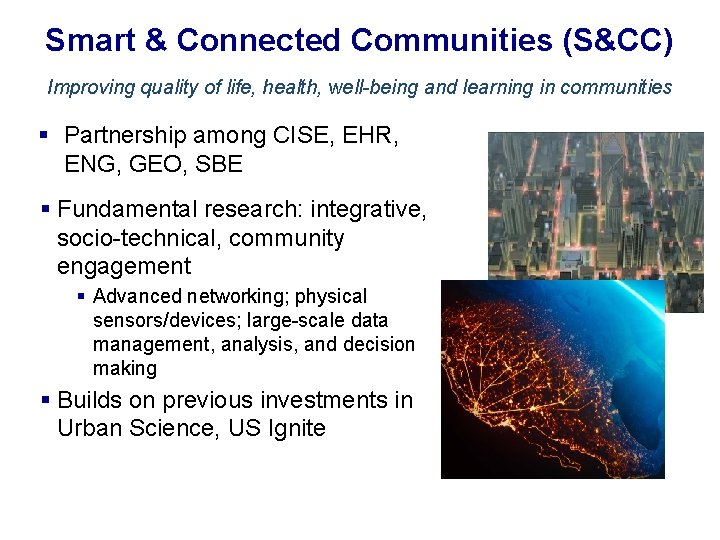
Smart & Connected Communities (S&CC) Improving quality of life, health, well-being and learning in communities § Partnership among CISE, EHR, ENG, GEO, SBE § Fundamental research: integrative, socio-technical, community engagement § Advanced networking; physical sensors/devices; large-scale data management, analysis, and decision making § Builds on previous investments in Urban Science, US Ignite
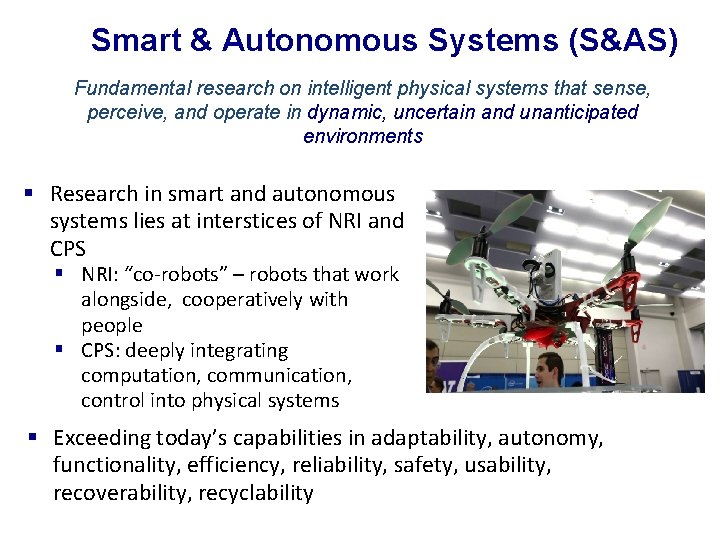
Smart & Autonomous Systems (S&AS) Fundamental research on intelligent physical systems that sense, perceive, and operate in dynamic, uncertain and unanticipated environments § Research in smart and autonomous systems lies at interstices of NRI and CPS § NRI: “co-robots” – robots that work alongside, cooperatively with people § CPS: deeply integrating computation, communication, control into physical systems § Exceeding today’s capabilities in adaptability, autonomy, functionality, efficiency, reliability, safety, usability, recoverability, recyclability
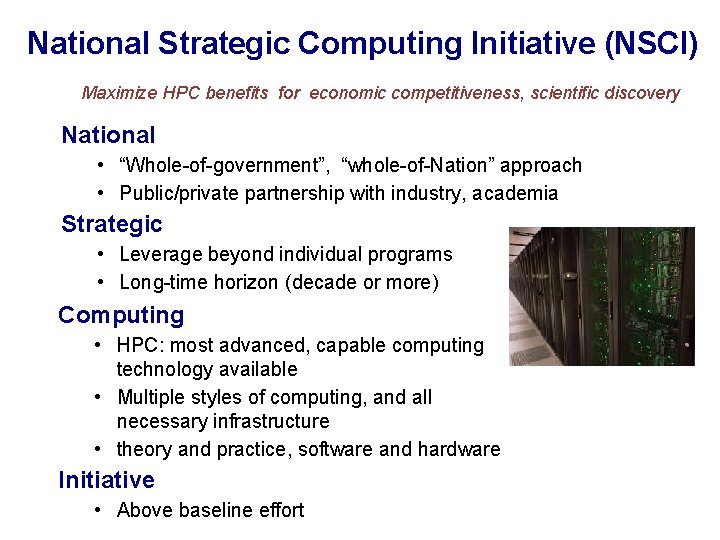
National Strategic Computing Initiative (NSCI) Maximize HPC benefits for economic competitiveness, scientific discovery National • “Whole-of-government”, “whole-of-Nation” approach • Public/private partnership with industry, academia Strategic • Leverage beyond individual programs • Long-time horizon (decade or more) Computing • HPC: most advanced, capable computing technology available • Multiple styles of computing, and all necessary infrastructure • theory and practice, software and hardware Initiative • Above baseline effort
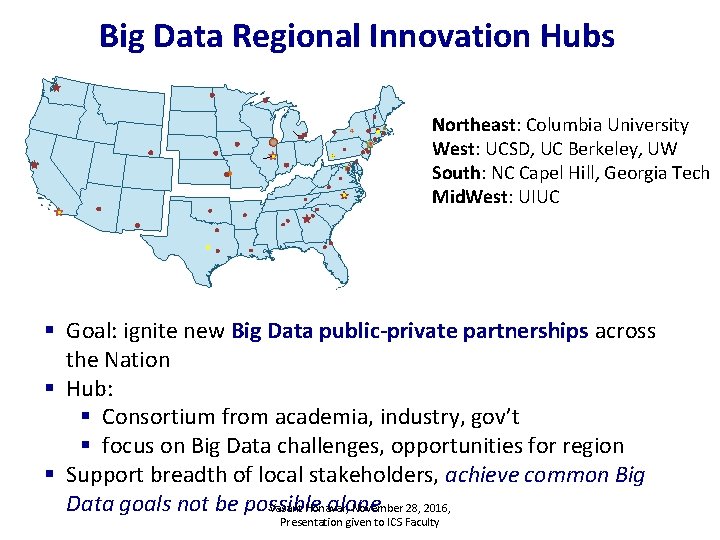
Big Data Regional Innovation Hubs Northeast: Columbia University West: UCSD, UC Berkeley, UW South: NC Capel Hill, Georgia Tech Mid. West: UIUC § Goal: ignite new Big Data public-private partnerships across the Nation § Hub: § Consortium from academia, industry, gov’t § focus on Big Data challenges, opportunities for region § Support breadth of local stakeholders, achieve common Big Data goals not be possible alone Vasant Honavar, November 28, 2016, Presentation given to ICS Faculty
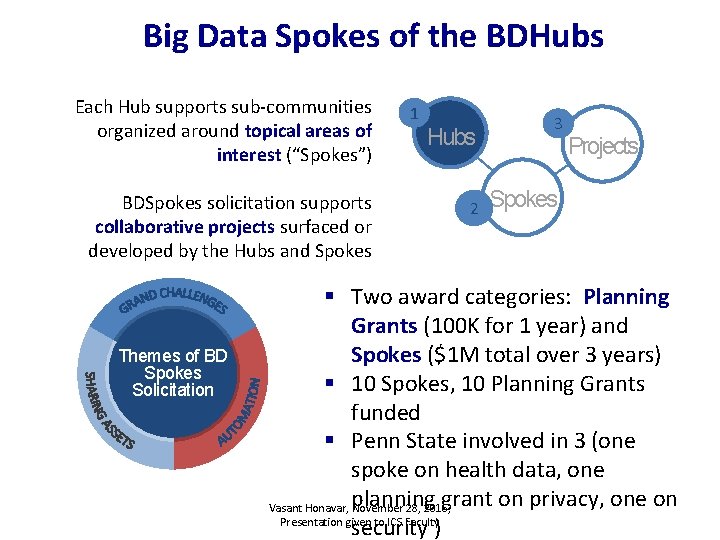
Big Data Spokes of the BDHubs Each Hub supports sub-communities organized around topical areas of interest (“Spokes”) BDSpokes solicitation supports collaborative projects surfaced or developed by the Hubs and Spokes Themes of BD Spokes Solicitation 1 Hubs 2 3 Projects Spokes § Two award categories: Planning Grants (100 K for 1 year) and Spokes ($1 M total over 3 years) § 10 Spokes, 10 Planning Grants funded § Penn State involved in 3 (one spoke on health data, one planning grant on privacy, one on Vasant Honavar, November 28, 2016, Presentation given to ICS Faculty security )
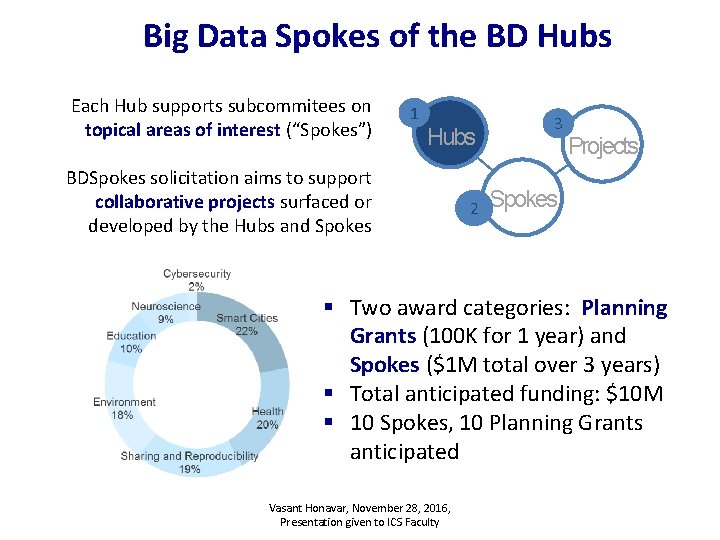
Big Data Spokes of the BD Hubs Each Hub supports subcommitees on topical areas of interest (“Spokes”) 1 Hubs BDSpokes solicitation aims to support collaborative projects surfaced or developed by the Hubs and Spokes 2 3 Projects Spokes § Two award categories: Planning Grants (100 K for 1 year) and Spokes ($1 M total over 3 years) § Total anticipated funding: $10 M § 10 Spokes, 10 Planning Grants anticipated Vasant Honavar, November 28, 2016, Presentation given to ICS Faculty
NSF “Big Ideas”
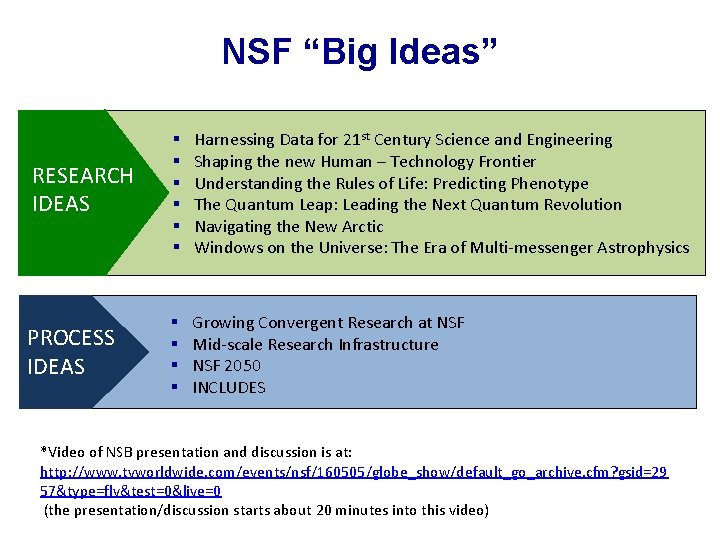
NSF “Big Ideas” RESEARCH IDEAS § § § Harnessing Data for 21 st Century Science and Engineering Shaping the new Human – Technology Frontier Understanding the Rules of Life: Predicting Phenotype The Quantum Leap: Leading the Next Quantum Revolution Navigating the New Arctic Windows on the Universe: The Era of Multi-messenger Astrophysics PROCESS IDEAS § § Growing Convergent Research at NSF Mid-scale Research Infrastructure NSF 2050 INCLUDES *Video of NSB presentation and discussion is at: http: //www. tvworldwide. com/events/nsf/160505/globe_show/default_go_archive. cfm? gsid=29 57&type=flv&test=0&live=0 (the presentation/discussion starts about 20 minutes into this video)
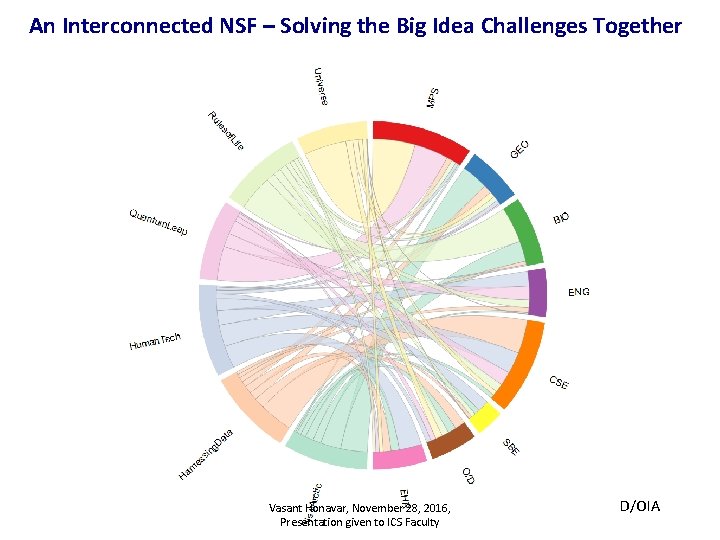
An Interconnected NSF – Solving the Big Idea Challenges Together Vasant Honavar, November 28, 2016, Presentation given to ICS Faculty Paul Morris OD/OIA
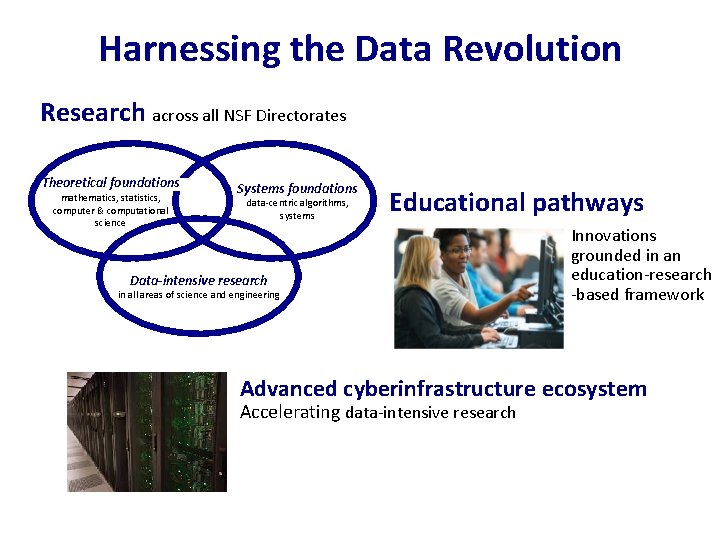
Harnessing the Data Revolution Research across all NSF Directorates Theoretical foundations mathematics, statistics, computer & computational science Systems foundations data-centric algorithms, systems Educational pathways Data-intensive research in all areas of science and engineering Innovations grounded in an education-research -based framework Advanced cyberinfrastructure ecosystem Accelerating data-intensive research
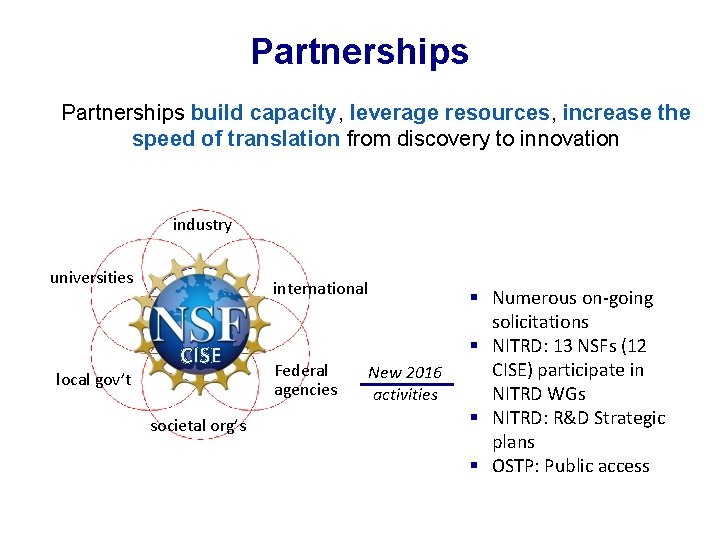
Partnerships build capacity, leverage resources, increase the speed of translation from discovery to innovation industry universities local gov’t international CISE societal org’s Federal agencies New 2016 activities § Numerous on-going solicitations § NITRD: 13 NSFs (12 CISE) participate in NITRD WGs § NITRD: R&D Strategic plans § OSTP: Public access
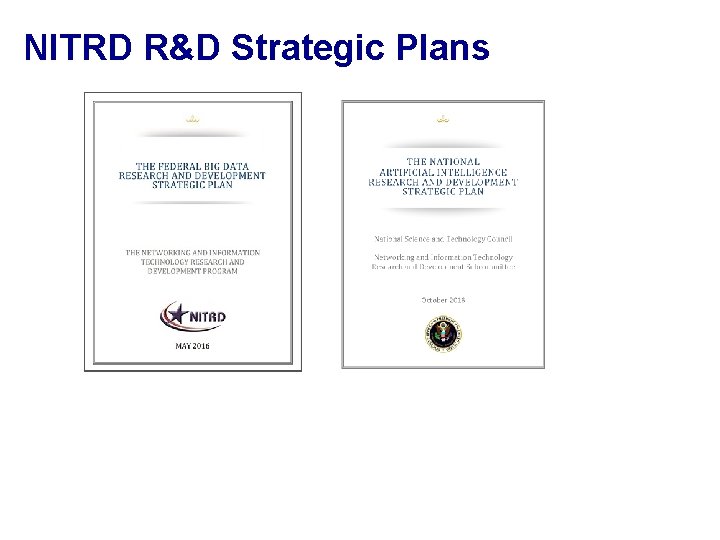
NITRD R&D Strategic Plans
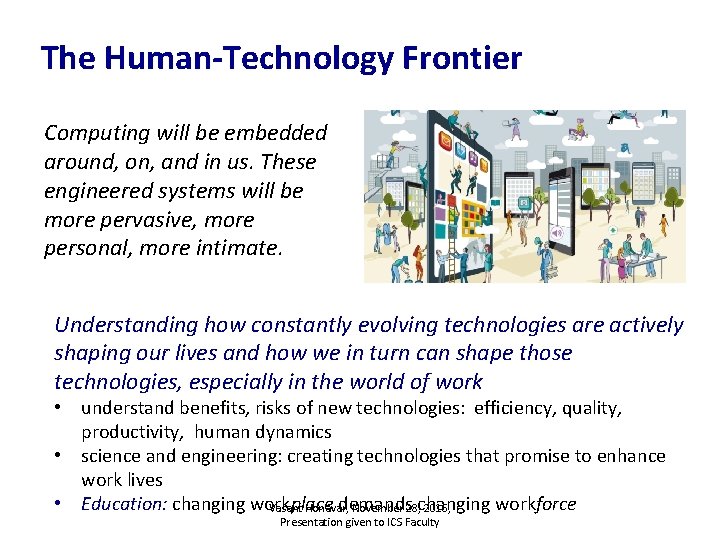
The Human-Technology Frontier Computing will be embedded around, on, and in us. These engineered systems will be more pervasive, more personal, more intimate. Understanding how constantly evolving technologies are actively shaping our lives and how we in turn can shape those technologies, especially in the world of work • understand benefits, risks of new technologies: efficiency, quality, productivity, human dynamics • science and engineering: creating technologies that promise to enhance work lives • Education: changing workplace demands changing workforce Vasant Honavar, November 28, 2016, Presentation given to ICS Faculty
NSF-wide Opportunities • Faculty Early Career Development (CAREER) • Integrated NSF Support for Interdisciplinary Research and Education (INSPIRE) • Grants for Rapid Response Research (RAPID) • EArly-concept Grants for Exploratory Research (EAGER) • Research Experiences for Undergraduates (REU) • Conferences, Summer Schools, and Workshops • International Collaborations
Engaging with NSF Ø Submit well-crafted, innovative research proposals Ø Subscribe to NSF mailing list to keep yourself informed of new opportunities Ø Let your PD know when your research yields especially noteworthy results or impact Ø Serve on proposal review panels Ø Consider participating in the Computing Community Consortium: http: //www. cra. org/ccc Ø Consider serving as an NSF program director or a division director
- Slides: 29