
NSF CAREER Award Strategies for Successful Proposal Development
- Slides: 21
NSF CAREER Award Strategies for Successful Proposal Development March 28, 2016 Some information used with permission from UW Delta Program
Agenda • Overview of NSF CAREER award criteria and framework • Panel: Strategies and advice • Breakout sessions with panelists • Networking and reception
Faculty Early Career Development (CAREER) Program • Most prestigious awards to help a junior faculty member develop activities that can effectively integrate research and education within the context of his/her organization. • In 2014, CAREER Proposals submitted by New PIs - 66% • Awards to New PIs - 54%
CAREER Program Goals • Provide stable support for 5 years (≥ 400 K in most Directorates; BIO, GEO/PLR, ENG are ≥ 500 K) to allow the career development of outstanding new teacher-scholars in the context of the mission of their organization. • Increase participation of those traditionally underrepresented in science and engineering. • Build a foundation for a lifetime of integrated contributions to research and education. • Provide incentives to universities to value the integration of research and education.
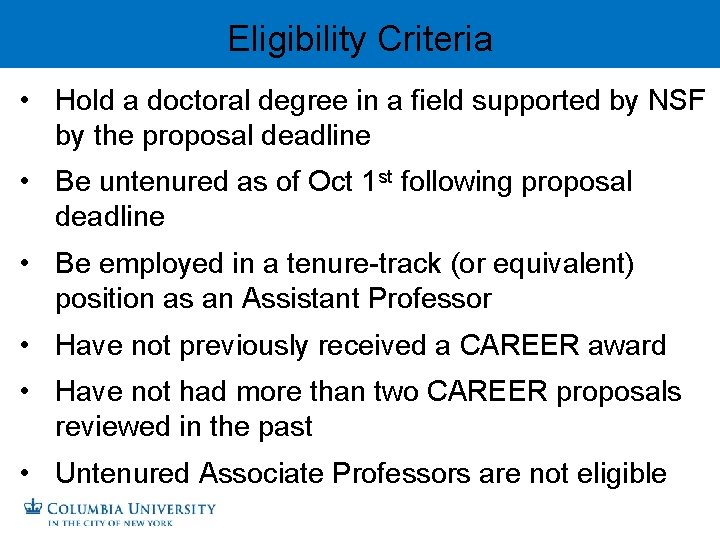
Eligibility Criteria • Hold a doctoral degree in a field supported by NSF by the proposal deadline • Be untenured as of Oct 1 st following proposal deadline • Be employed in a tenure-track (or equivalent) position as an Assistant Professor • Have not previously received a CAREER award • Have not had more than two CAREER proposals reviewed in the past • Untenured Associate Professors are not eligible
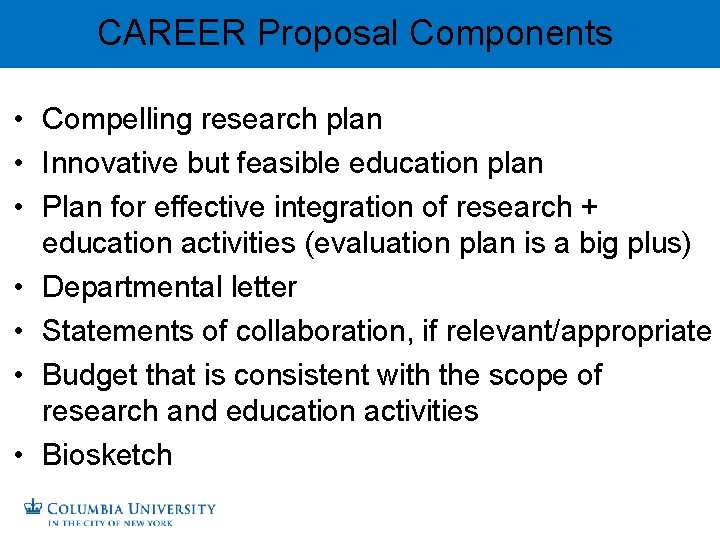
CAREER Proposal Components • Compelling research plan • Innovative but feasible education plan • Plan for effective integration of research + education activities (evaluation plan is a big plus) • Departmental letter • Statements of collaboration, if relevant/appropriate • Budget that is consistent with the scope of research and education activities • Biosketch
Integration of Research and Education
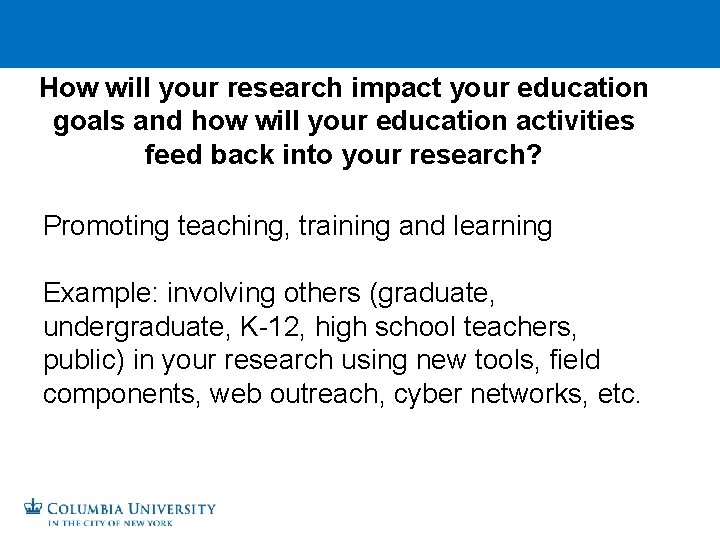
How will your research impact your education goals and how will your education activities feed back into your research? Promoting teaching, training and learning Example: involving others (graduate, undergraduate, K-12, high school teachers, public) in your research using new tools, field components, web outreach, cyber networks, etc.
How will your research impact your education goals and how will your education activities feed back into your research? Broadening participation of underrepresented groups Example: Hosting students and/or teachers from under-served demographic groups; integrating a service teaching project in your course
How will your research impact your education goals and how will your education activities feed back into your research? Enhancing the infrastructure for education Examples: • Searching for new methods to deliver your research results to a broader audience than those in the immediate research community • Using the broader community to gather data for your research (crowdsourcing; “citizen science”)
Approaching your Education Plan • Your approach to your education plan should be thoughtful / informed and create new opportunities – Avoid reinventing wheels • Do some background research in advance – Seek connections and collaborations on campus • Leveraging the expertise and infrastructure of existing centers/programs • Seeking collaborators with expertise in the area • Have a well-considered assessment/evaluation plan
Your Education Plan • Develop a creative plan that ties to your research- the education plan can be a way to strengthen your brilliant research proposal • Do NOT propose something you have no interest in doing • Education part (no matter how wonderful) cannot make up for a deficient research plan.
Education component – critical to success! • Your education component - innovative and creative • Demonstration of prior results with successful education activities is a plus • Leverage activities at Columbia that have relevance to your research • Make sure that the education activities are well integrated with the research – otherwise, the workload will not be manageable • Who will benefit from the proposed activities? • How will you know if these activities are having an impact? (evaluation & assessment? )
Do… • seek out the assistance of your peers and colleagues. • something you are genuinely excited about. • partner with groups/centers on campus to take advantage of existing infrastructure. • leverage existing NSF funds. • give a detailed timeline.
I should have… • talked with my Program Officer before submitting the grant… • started earlier • included funding for education activities in my budget • not overcommitted- proposing too much is as bad as proposing too little • proofread and polished far ahead of the deadline • not cut and pasted from my research papers - it makes a poor read
Be Persuasive • Demonstrate that your ideas are creative and will make an impact in your field. (Sell the idea. ) • Demonstrate that you are capable of carrying out what you propose. (Sell yourself. ) • Demonstrate that you are motivated to conduct the proposed work. (Sell your enthusiasm. )
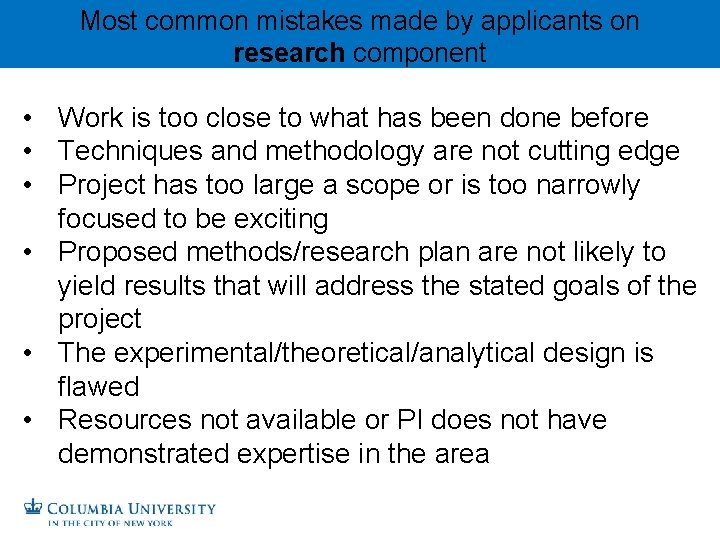
Most common mistakes made by applicants on research component • Work is too close to what has been done before • Techniques and methodology are not cutting edge • Project has too large a scope or is too narrowly focused to be exciting • Proposed methods/research plan are not likely to yield results that will address the stated goals of the project • The experimental/theoretical/analytical design is flawed • Resources not available or PI does not have demonstrated expertise in the area
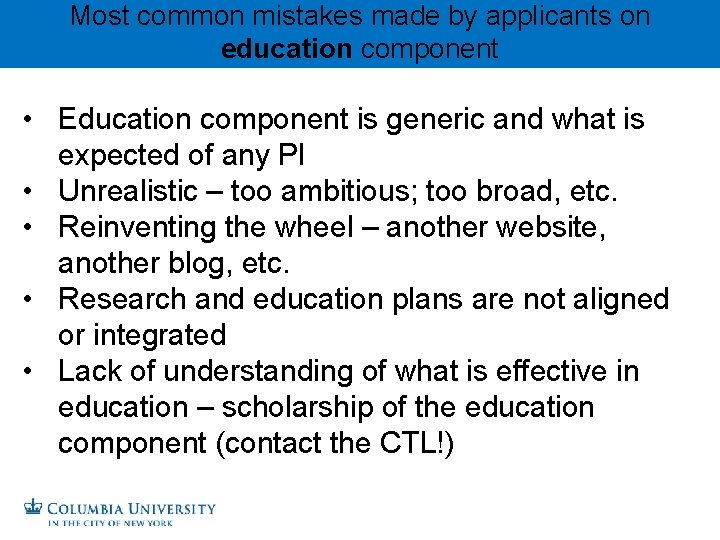
Most common mistakes made by applicants on education component • Education component is generic and what is expected of any PI • Unrealistic – too ambitious; too broad, etc. • Reinventing the wheel – another website, another blog, etc. • Research and education plans are not aligned or integrated • Lack of understanding of what is effective in education – scholarship of the education component (contact the CTL!)
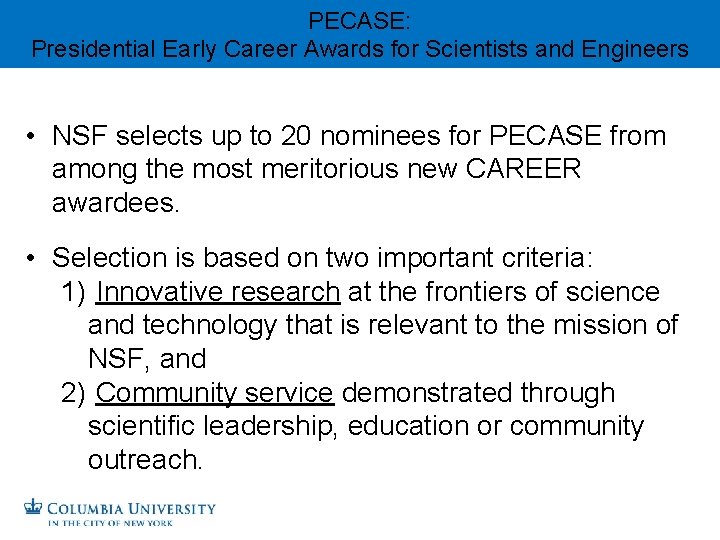
PECASE: Presidential Early Career Awards for Scientists and Engineers • NSF selects up to 20 nominees for PECASE from among the most meritorious new CAREER awardees. • Selection is based on two important criteria: 1) Innovative research at the frontiers of science and technology that is relevant to the mission of NSF, and 2) Community service demonstrated through scientific leadership, education or community outreach.
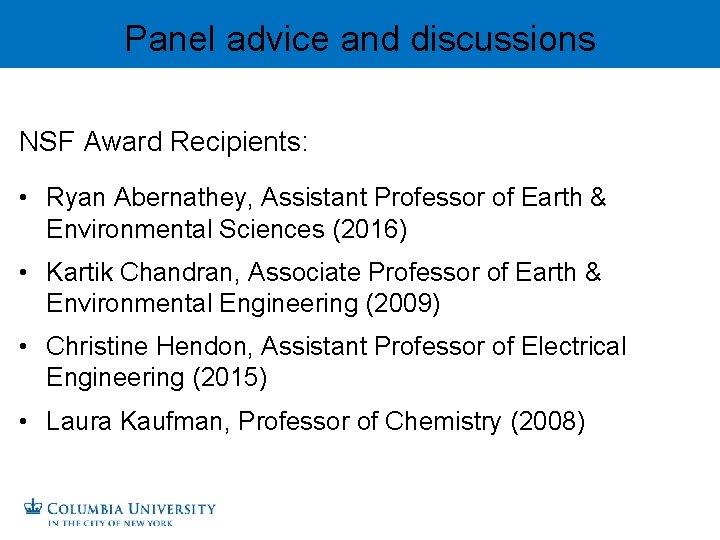
Panel advice and discussions NSF Award Recipients: • Ryan Abernathey, Assistant Professor of Earth & Environmental Sciences (2016) • Kartik Chandran, Associate Professor of Earth & Environmental Engineering (2009) • Christine Hendon, Assistant Professor of Electrical Engineering (2015) • Laura Kaufman, Professor of Chemistry (2008)
Panel advice and discussions NSF CAREER Reviewers: • John Cunningham, Assistant Professor of Statistics • Julia Hirschberg, Professor & Chair of Computer Science