
NSF 17 598 Cyberlearning for Work at the
NSF 17 -598 Cyberlearning for Work at the Human-Technology Frontier WEBINAR: October 17, 2019 PROPOSAL DEADLINE: JANUARY 14, 2019
FY 19 Highlights Continuation of solicitation from last year NSF 17 -598 with deadline January 14, 2019 *Note that the program continues to fund learning technology research in any content area with any participants and in any context (not just within or in preparation for work) We will accept CAREER proposals beginning in 2019 *IF* the project does not fit other NSF program areas There are opportunities for cyberlearning research with other NSF programs, particularly FW-HTF (Future of Work at the Human-Technology Frontier)
NSF and Cyberlearning Background: NSF Cross-directorate programs in advanced learning technologies The continuing new focus (FY 17 forward) NSF 17 -598: Cyberlearning for Work at the Human. Technology Frontier Cyberlearning program (2011 -present); Advanced Learning Technologies (2005 -), and other initiatives such as “Learning and Intelligent Systems” “Collaborative Research in Learning Technologies (CRLT)” 1996 “We encourage transformative proposals that integrate advances in what is known about how people learn with the opportunities offered by new and emerging technologies such as artificial intelligence (AI) and virtual or augmented environments to prepare future learners and workers across the lifespan, in formal and informal settings” This program continues to fund projects in advanced learning technologies for STEM and other foundational areas that enable STEM learning (that are not work-focused)
A cross-directorate effort CISE – Computer and Information Science and Engineering EHR – Education and Human Resources ENG – Engineering SBE – Social, Behavioral and Economic Sciences
Overall Scope of Program NSF 17 -598 Projects should be exploratory, experimental; risky and potentially transformative encouraged Content area: STEM and other foundational areas supported by NSF that enable STEM learning (e. g. , self-regulation, literacy, communication, collaboration and social skills). Population and context: learners, teachers and workers in formal or informal settings (e. g. , workplace, online, classroom, museums); and individual, collective, and collaborative learning across the lifespan. Projects should be highly interdisciplinary Budget up to $750 k
Require innovations in both learning and computer science/technology All projects must address a learning need or opportunity within the educational or work context and must have integrated learning and technology goals: Learning and educational goals: to investigate learning processes and principles (e. g. , cognitive, neurobiological, behavioral, affective, cultural, social, volitional, epistemological, developmental and other perspectives) relevant for the proposed learning technology innovation. The learning goals should advance education and learning sciences. Technology goals: to introduce new or emerging technologies within the learning or work context (e. g. , intelligent tutoring and other AI technologies, virtual or augmented environments, humantechnology partnerships, socio-technical integration within learning environments, multimodal modeling and sensing of cognitive or emotional states, natural language and multimodal interfaces, embodiment, and learning analytics). The technology goals should advance the fields of computer science, information science, and/or engineering.
Focus on Work at the Human-Technology Frontier (FW-HTF) We challenge you to contextualize cyberlearning research projects for this new focus on W-HTF For example: (1) design and develop future learning environments to educate or re-educate workers for new work environments and experiences in collaboration with advanced technology; (2) develop relevant formal and informal learning experiences as well as justin-time training on the job; (3) support the needs of diverse workers from a broad set of backgrounds and experiences; and (4) support the future work of teachers in classrooms and other related settings.
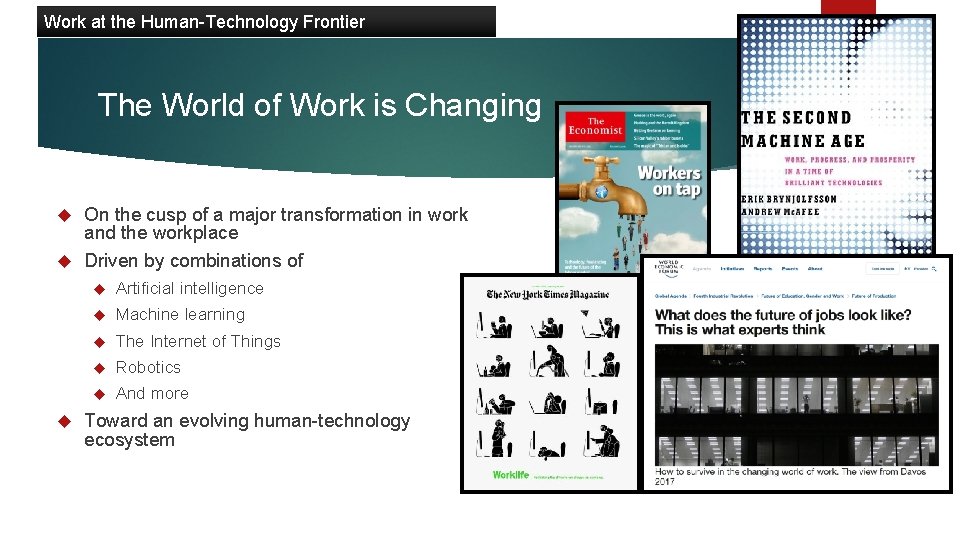
Work at the Human-Technology Frontier 8 The World of Work is Changing On the cusp of a major transformation in work and the workplace Driven by combinations of Artificial intelligence Machine learning The Internet of Things Robotics And more Toward an evolving human-technology ecosystem
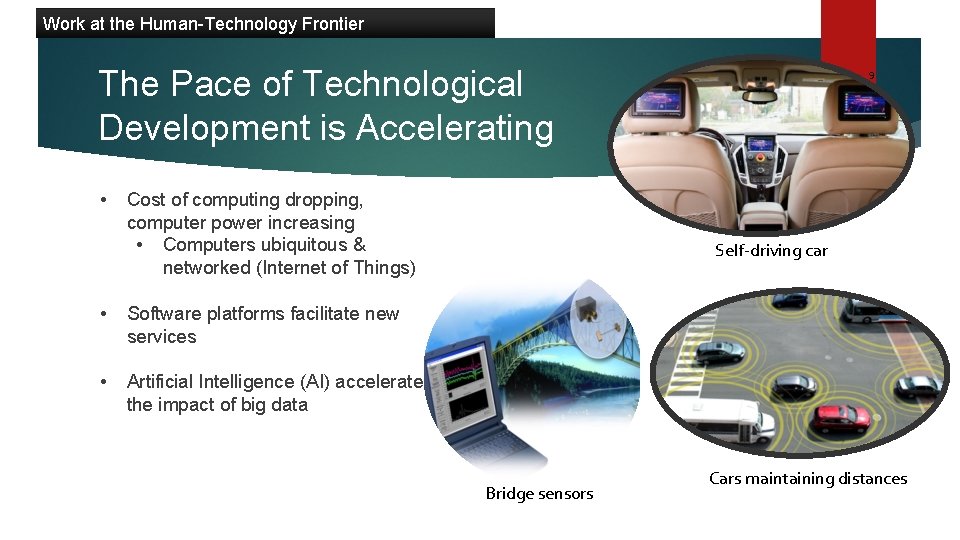
Work at the Human-Technology Frontier The Pace of Technological Development is Accelerating • Cost of computing dropping, computer power increasing • Computers ubiquitous & networked (Internet of Things) • Software platforms facilitate new services • Artificial Intelligence (AI) accelerates the impact of big data 9 Self-driving car Bridge sensors Cars maintaining distances
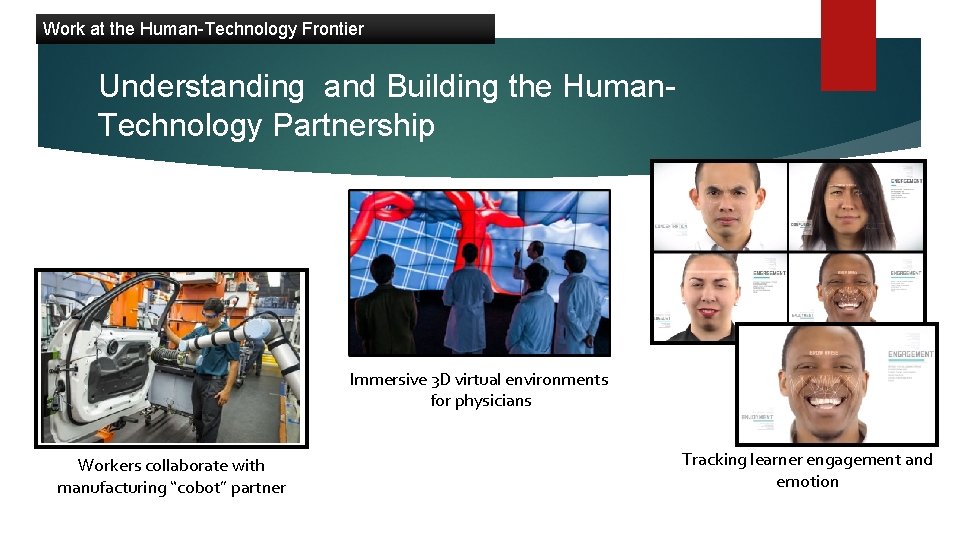
Work at the Human-Technology Frontier Understanding and Building the Human. Technology Partnership Immersive 3 D virtual environments for physicians Workers collaborate with manufacturing “cobot” partner Tracking learner engagement and emotion
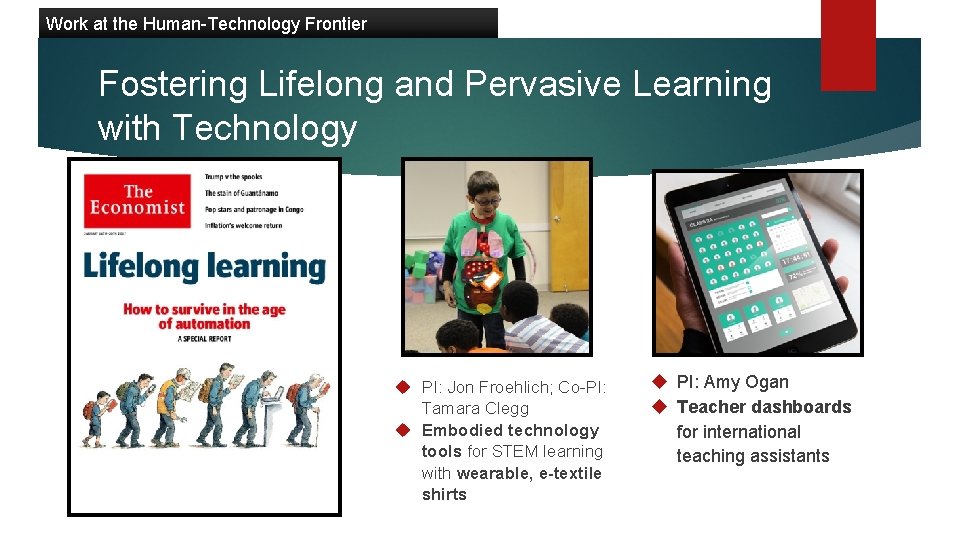
Work at the Human-Technology Frontier Fostering Lifelong and Pervasive Learning with Technology PI: Jon Froehlich; Co-PI: Tamara Clegg Embodied technology tools for STEM learning with wearable, e-textile shirts PI: Amy Ogan Teacher dashboards for international teaching assistants
Comments on scope of 17 -598 Envision the future of re-education/re-skilling/up-skilling in the future work context – e. g. , 10+ 25+ years What advanced learning technologies could play a role in these new work experiences? Consider the work of teachers/professors Imagine the role of STEM and STEM-enabling content areas for learners of all ages as important foundations for work at the human-technology frontier
What’s not a fit for 17 -598 In general, learning technology projects that are not a fit for this program include those: • That simply focus on making teaching easier; • That aim simply to implement and evaluate a software application or technology in support of a specific course; • That are primarily technology-enabled teaching or technology-enabled research on learning; • Where students learn to use technology; and • That are primarily about educational impact in the here and now (implementation projects). In the context of work, the program does not fund projects: • that are primarily retraining with available technology - there must be significant innovations in the advanced learning technologies for future work settings
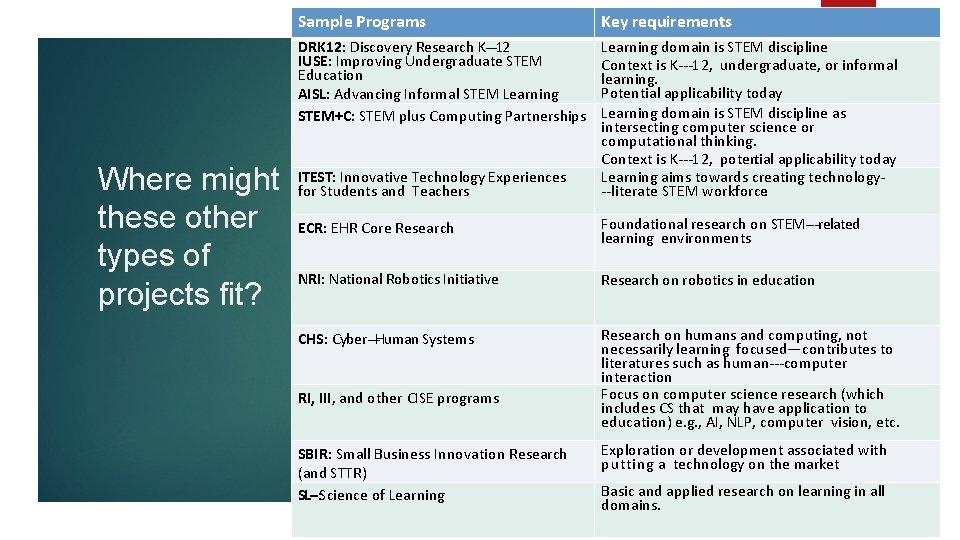
Sample Programs Key requirements DRK 12: Discovery Research K‐‐‐ 12 IUSE: Improving Undergraduate STEM Education AISL: Advancing Informal STEM Learning STEM+C: STEM plus Computing Partnerships Learning domain is STEM discipline Context is K‐‐‐ 12, undergraduate, or informal learning. Potential applicability today Learning domain is STEM discipline as intersecting computer science or computational thinking. Context is K‐‐‐ 12, potential applicability today Learning aims towards creating technology‐ ‐‐literate STEM workforce. Innovative Technology Experiences Where might ITEST: for Students and Teachers these other ECR: EHR Core Research types of NRI: National Robotics Initiative projects fit? CHS: Cyber‐‐‐Human Systems RI, III, and other CISE programs SBIR: Small Business Innovation Research (and STTR) SL : Science of Learning Foundational research on STEM‐‐‐related learning environments Research on robotics in education Research on humans and computing, not necessarily learning focused—contributes to literatures such as human‐‐‐computer interaction Focus on computer science research (which includes CS that may have application to education) e. g. , AI, NLP, computer vision, etc. Exploration or development associated with putting a technology on the market Basic and applied research on learning in all domains.
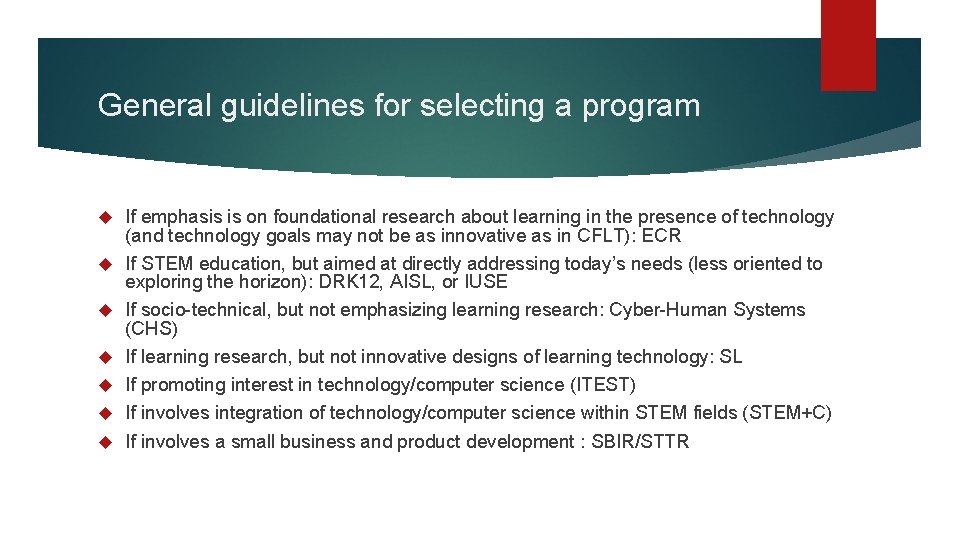
General guidelines for selecting a program If emphasis is on foundational research about learning in the presence of technology (and technology goals may not be as innovative as in CFLT): ECR If STEM education, but aimed at directly addressing today’s needs (less oriented to exploring the horizon): DRK 12, AISL, or IUSE If socio-technical, but not emphasizing learning research: Cyber-Human Systems (CHS) If learning research, but not innovative designs of learning technology: SL If promoting interest in technology/computer science (ITEST) If involves integration of technology/computer science within STEM fields (STEM+C) If involves a small business and product development : SBIR/STTR
CAREER proposals We will accept CAREER proposals beginning in 2019 for projects that do not fit other NSF programs Same requirements for CAREERs as for regular Cyberlearning proposals Must be highly interdisciplinary with innovations in both technology and learning Important to send a 1 -2 page summary of the project to one of the Cyberlearning co-leads to determine whether the project is a fit for CAREER Cyberlearning
Cyberlearning and the Big Idea: “Future of Work at the Human-Technology Frontier (FW-HTF)” *Look for upcoming solicitations for the FW-HTF Big Idea that may support larger-scale (not just exploratory) cyberlearning projects 2 Successes of Cyberlearning PIs in funded projects through last year’s FW-HTF solicitation (NSF 18 -548)! “The future of classroom work: Automated Teaching Assistants” ($1. 5 M) (Kurt Van. Lehn, lead PI) “Augmented Cognition for Teaching: Transforming Teacher Work with Intelligent Cognitive Assistants” ($3 M) (James Lester, lead PI)
The Center for Innovative Research in Cyber. Learning (CIRCL) The CIRCL website collects resources that can be helpful, as general background, for proposal writing. Further, once projects are selected for funding, CIRCL can help awardees in five ways: Amplifying project news Strengthening your broader impact plan Building relationships to related researchers Working with other projects on shared resources Sharing your expertise with others to build your reputation More information at: http: //circlcenter. org/resources/five-ways-circl-can-help/

Questions (see notes below)
- Slides: 19