
NSDI National Spatial Data Infrastructure National Geospatial Enterprise
- Slides: 35
NSDI National Spatial Data Infrastructure National Geospatial Enterprise Architecture Principles for Geospatial Interoperability Presented by Eliot Christian, USGS/FGDC 28 Jan 2004 1
NSDI Presentation Outline National Spatial Data Infrastructure Ø Ø Ø Spatial Data Infrastructures (SDIs) Requirements of Law and Policy Process for Achieving Interoperability General Principles for Geospatial Interoperability Five Interface Agreements Additional requirements under law and policies 15 March 2005 National Geospatial Enterprise Architecture 2
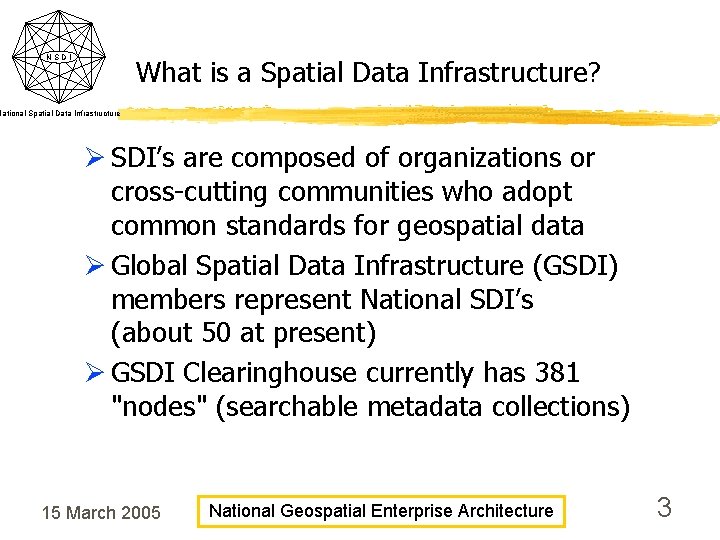
NSDI What is a Spatial Data Infrastructure? National Spatial Data Infrastructure Ø SDI’s are composed of organizations or cross-cutting communities who adopt common standards for geospatial data Ø Global Spatial Data Infrastructure (GSDI) members represent National SDI’s (about 50 at present) Ø GSDI Clearinghouse currently has 381 "nodes" (searchable metadata collections) 15 March 2005 National Geospatial Enterprise Architecture 3
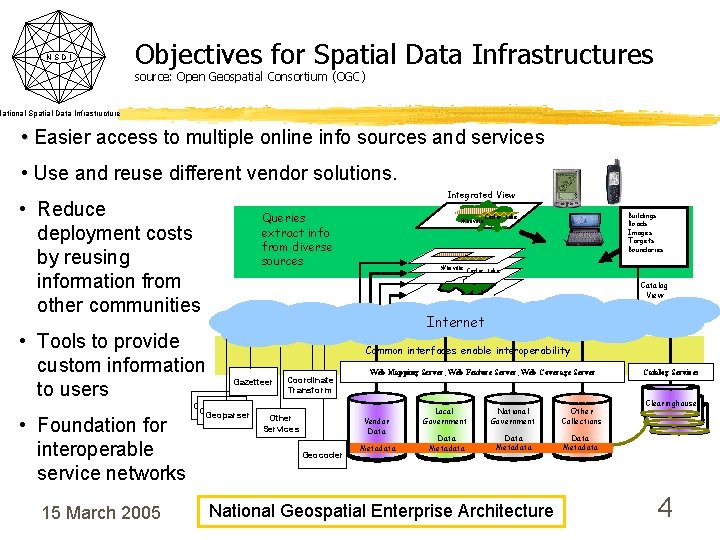
NSDI Objectives for Spatial Data Infrastructures source: Open Geospatial Consortium (OGC) National Spatial Data Infrastructure • Easier access to multiple online info sources and services • Use and reuse different vendor solutions. Integrated View • Reduce deployment costs by reusing information from other communities • Tools to provide custom information to users • Foundation for interoperable service networks 15 March 2005 Queries extract info from diverse sources Whoville Buildings Roads Images Targets Boundaries. . . Cedar Lake Whoville Cedar Lake Catalog View Internet Common interfaces enable interoperability Gazetteer Geoparser Coordinate Transform Other Services Web Mapping Server, Web Feature Server, Web Coverage Server Vendor Data Geocoder Metadata Local Government National Government Other Collections Data Metadata National Geospatial Enterprise Architecture Catalog Services Clearinghouse 4
NSDI Presentation Outline National Spatial Data Infrastructure Ø Ø Ø Spatial Data Infrastructures (SDIs) Requirements of Law and Policy Process for Achieving Interoperability General Principles for Geospatial Interoperability Five Interface Agreements Additional requirements under law and policies 15 March 2005 National Geospatial Enterprise Architecture 5
Requirements of Law and Policy NSDI E-Government Act (FGDC) National Spatial Data Infrastructure Section 216 of the E-Government Act, "Common Protocols for Geographic Information Systems", establishes in law the authorities and responsibilities of the Federal Geographic Data Committee (FGDC) The law defines "geographic information" as: "information systems that involve locational data, such as maps or other geospatial information resources" 15 March 2005 National Geospatial Enterprise Architecture 6
NSDI Requirements of Law and Policy E-Government Act (FGDC) National Spatial Data Infrastructure E-Government Act of 2002 requires: Ø the development of common protocols for the development, acquisition, maintenance, distribution, and application of geographic information [. . . ] Ø The common protocols shall be designed to (1) maximize the degree to which unclassified geographic information from various sources can be made electronically compatible and accessible; and (2) promote the development of interoperable geographic information systems technologies 15 March 2005 National Geospatial Enterprise Architecture 7
NSDI Requirements of Law and Policy Federal Policy (Circular A-16) National Spatial Data Infrastructure OMB Circular A-16: "establishes a coordinated approach to electronically develop the National Spatial Data Infrastructure" Purpose of the NSDI: To encourage the collection, processing, archiving, integration, and sharing of geospatial data and information using common standards and interoperable systems and techniques 15 March 2005 National Geospatial Enterprise Architecture 8
NSDI Requirements of Law and Policy Federal Policy (Circular A-16) National Spatial Data Infrastructure "provides direction for federal agencies that produce, maintain or use spatial data either directly or indirectly" directs such agencies, "both internally and through their activities involving partners, grants, and contracts" to: (1) Prepare, maintain, publish, and implement a strategy for advancing geographic information and related spatial data activities appropriate to their mission, in support of the NSDI Strategy. [. . . ] (2) Collect, maintain, disseminate, and preserve spatial information such that the resulting data, information, or products can be readily shared with other federal agencies and non-federal users, and promote data integration between all sources. [. . . ] 15 March 2005 National Geospatial Enterprise Architecture 9
NSDI Requirements of Law and Policy Federal Policy (Circular A-16) National Spatial Data Infrastructure (4) Use FGDC data standards, FGDC Content Standards for Digital Geospatial Metadata, and other appropriate standards, documenting spatial data with the relevant metadata, and making metadata available online through a registered NSDI-compatible Clearinghouse node. [. . . ] Before the obligation of funds, ensure that all expenditures for spatial data and related systems activities financed directly or indirectly, in whole or in part, by federal funds are compliant with the standards and provisions of the FGDC. All Information Technology systems which process spatial data should identify planned investments for spatial data and compliance with FGDC standards within the Exhibit 300 capital asset and business plan submission (see OMB Circular A-11, sec. 300). 15 March 2005 National Geospatial Enterprise Architecture 10
U. S. National Spatial Data Infrastructure (NSDI) NSDI National Spatial Data Infrastructure Ø Extensive partnerships established Ø Law and policy for federal spatial data Ø President’s management agenda initiative Ø E-Government portal developed Ø Clearinghouse network thriving Ø Standards – international, community 15 March 2005 National Geospatial Enterprise Architecture 11
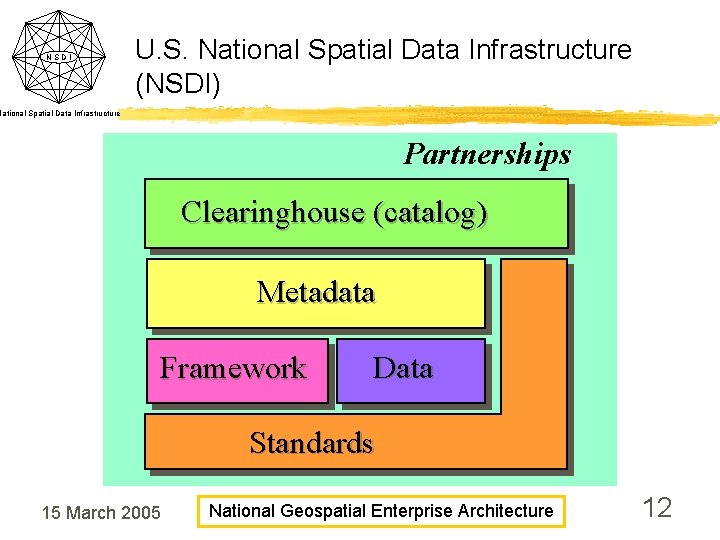
NSDI U. S. National Spatial Data Infrastructure (NSDI) National Spatial Data Infrastructure Partnerships Clearinghouse (catalog) Metadata Framework Data Standards 15 March 2005 National Geospatial Enterprise Architecture 12
Toward a National Geospatial Enterprise Architecture NSDI National Spatial Data Infrastructure Given SDI requirements under U. S. law and policy, How can the U. S. NSDI leverage aspects of Enterprise Architecture? 15 March 2005 National Geospatial Enterprise Architecture 13
NSDI Presentation Outline National Spatial Data Infrastructure Ø Ø Ø Spatial Data Infrastructures (SDIs) Requirements of Law and Policy Process for Achieving Interoperability General Principles for Geospatial Interoperability Five Interface Agreements Additional requirements under law and policies 15 March 2005 National Geospatial Enterprise Architecture 14
NSDI Process for Achieving Interoperability Services Oriented Architecture National Spatial Data Infrastructure Ø Software components of systems are now built to interoperate primarily through the passing of structured messages at interfaces designed for networking Ø Each set of operations exposed at such a network interface is defined as a “service” Ø NSDI requires this interoperability approach, known as a Services Oriented Architecture 15 March 2005 National Geospatial Enterprise Architecture 15
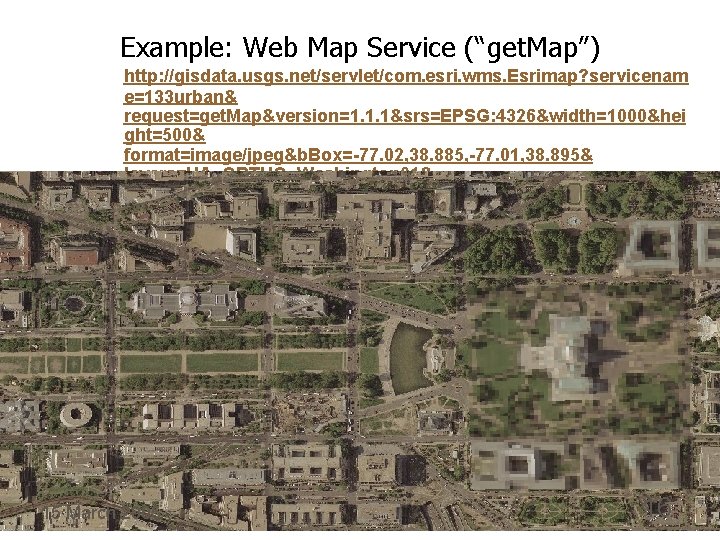
Example: Web Map Service (“get. Map”) http: //gisdata. usgs. net/servlet/com. esri. wms. Esrimap? servicenam e=133 urban& request=get. Map&version=1. 1. 1&srs=EPSG: 4326&width=1000&hei ght=500& format=image/jpeg&b. Box=-77. 02, 38. 885, -77. 01, 38. 895& layers=UA_ORTHO_Washington 01& 15 March 2005 16
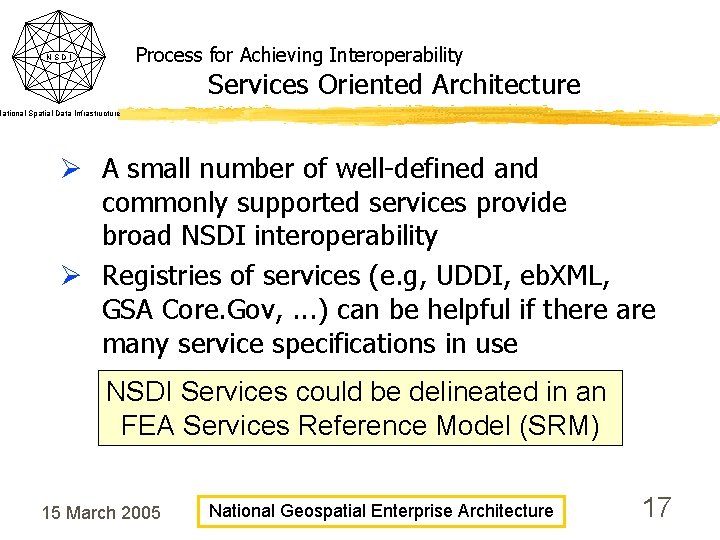
Process for Achieving Interoperability NSDI Services Oriented Architecture National Spatial Data Infrastructure Ø A small number of well-defined and commonly supported services provide broad NSDI interoperability Ø Registries of services (e. g, UDDI, eb. XML, GSA Core. Gov, . . . ) can be helpful if there are many service specifications in use NSDI Services could be delineated in an FEA Services Reference Model (SRM) 15 March 2005 National Geospatial Enterprise Architecture 17
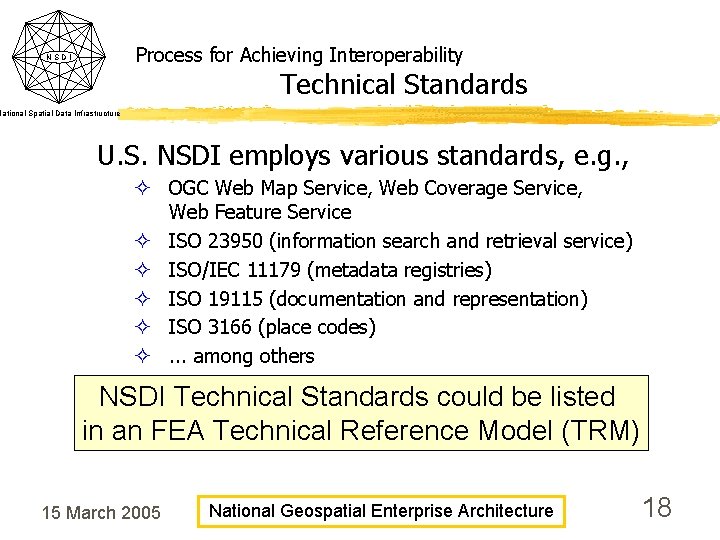
Process for Achieving Interoperability NSDI Technical Standards National Spatial Data Infrastructure U. S. NSDI employs various standards, e. g. , ² OGC Web Map Service, Web Coverage Service, Web Feature Service ² ISO 23950 (information search and retrieval service) ² ISO/IEC 11179 (metadata registries) ² ISO 19115 (documentation and representation) ² ISO 3166 (place codes) ². . . among others NSDI Technical Standards could be listed in an FEA Technical Reference Model (TRM) 15 March 2005 National Geospatial Enterprise Architecture 18
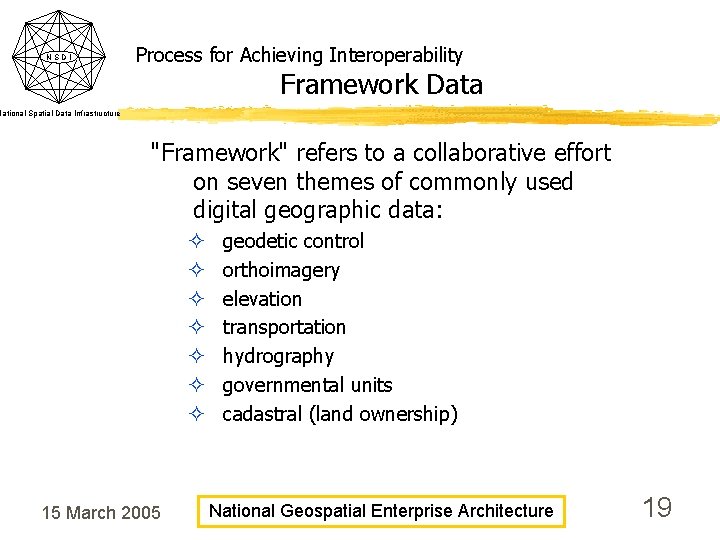
NSDI Process for Achieving Interoperability Framework Data National Spatial Data Infrastructure "Framework" refers to a collaborative effort on seven themes of commonly used digital geographic data: ² ² ² ² 15 March 2005 geodetic control orthoimagery elevation transportation hydrography governmental units cadastral (land ownership) National Geospatial Enterprise Architecture 19
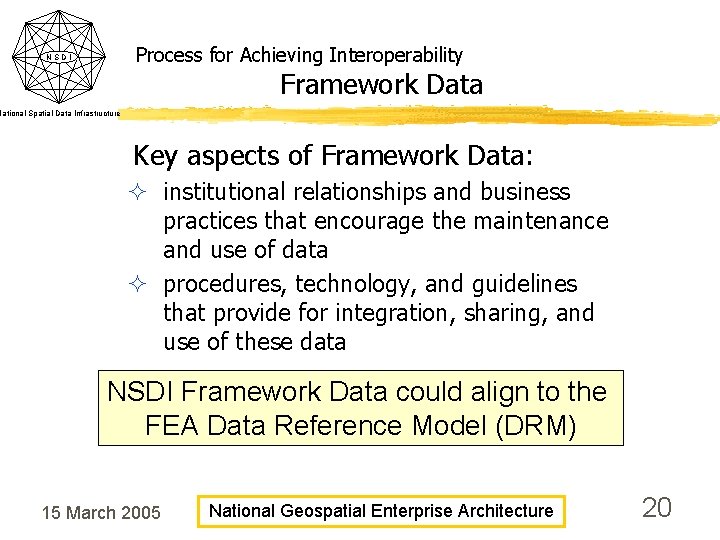
Process for Achieving Interoperability NSDI Framework Data National Spatial Data Infrastructure Key aspects of Framework Data: ² institutional relationships and business practices that encourage the maintenance and use of data ² procedures, technology, and guidelines that provide for integration, sharing, and use of these data NSDI Framework Data could align to the FEA Data Reference Model (DRM) 15 March 2005 National Geospatial Enterprise Architecture 20
NSDI Presentation Outline National Spatial Data Infrastructure Ø Ø Ø Spatial Data Infrastructures (SDIs) Requirements of Law and Policy Process for Achieving Interoperability General Principles for Geospatial Interoperability Five Interface Agreements Additional requirements under law and policies 15 March 2005 National Geospatial Enterprise Architecture 21
General Principles for Geospatial Interoperability NSDI National Spatial Data Infrastructure Geospatial interoperability should be inclusive, spanning levels of Government (Local, State, Tribal and Federal), as well as academic, commercial, and other non-Government organizations Hence the term "National Geospatial Enterprise Architecture" 15 March 2005 National Geospatial Enterprise Architecture 22
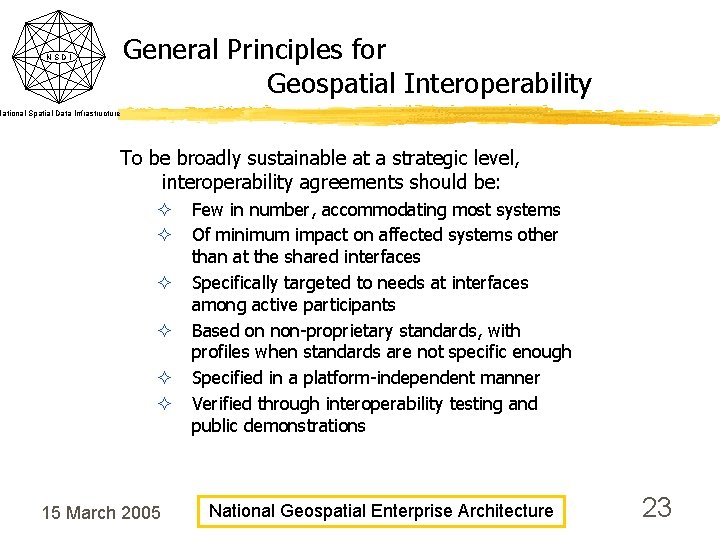
General Principles for Geospatial Interoperability NSDI National Spatial Data Infrastructure To be broadly sustainable at a strategic level, interoperability agreements should be: ² ² ² 15 March 2005 Few in number, accommodating most systems Of minimum impact on affected systems other than at the shared interfaces Specifically targeted to needs at interfaces among active participants Based on non-proprietary standards, with profiles when standards are not specific enough Specified in a platform-independent manner Verified through interoperability testing and public demonstrations National Geospatial Enterprise Architecture 23
NSDI Presentation Outline National Spatial Data Infrastructure Ø Ø Ø Spatial Data Infrastructures (SDIs) Requirements of Law and Policy Process for Achieving Interoperability General Principles for Geospatial Interoperability Five Interface Agreements Additional requirements under law and policies 15 March 2005 National Geospatial Enterprise Architecture 24
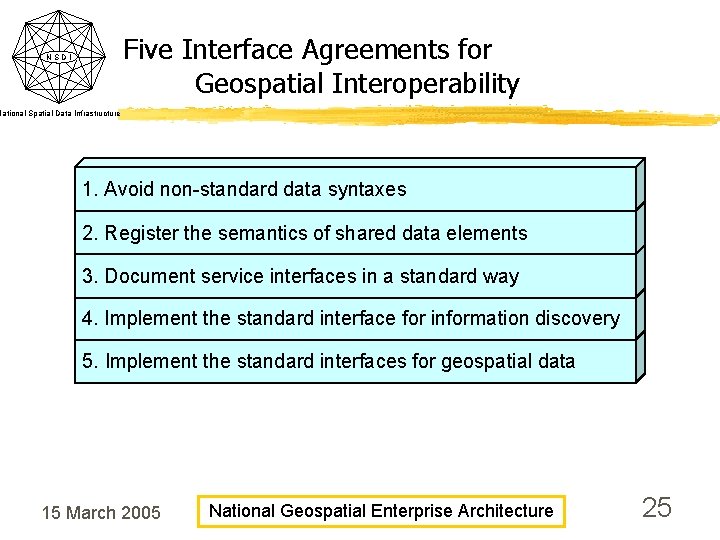
Five Interface Agreements for Geospatial Interoperability NSDI National Spatial Data Infrastructure 1. Avoid non-standard data syntaxes 2. Register the semantics of shared data elements 3. Document service interfaces in a standard way 4. Implement the standard interface for information discovery 5. Implement the standard interfaces for geospatial data 15 March 2005 National Geospatial Enterprise Architecture 25
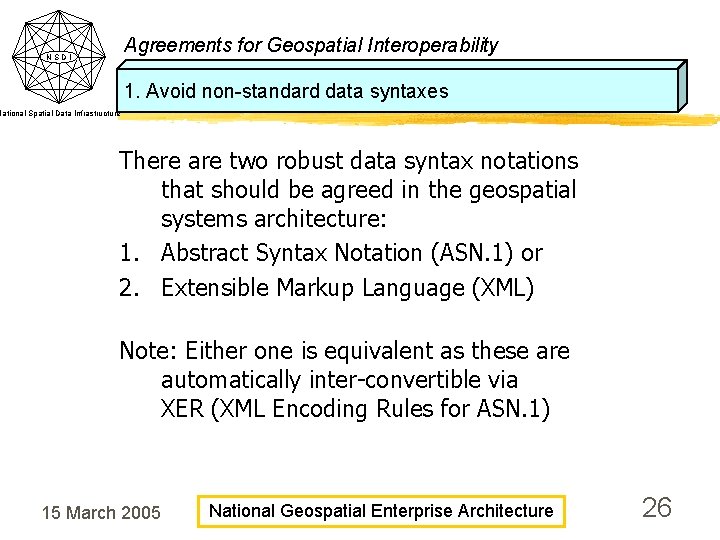
Agreements for Geospatial Interoperability NSDI 1. Avoid non-standard data syntaxes National Spatial Data Infrastructure There are two robust data syntax notations that should be agreed in the geospatial systems architecture: 1. Abstract Syntax Notation (ASN. 1) or 2. Extensible Markup Language (XML) Note: Either one is equivalent as these are automatically inter-convertible via XER (XML Encoding Rules for ASN. 1) 15 March 2005 National Geospatial Enterprise Architecture 26
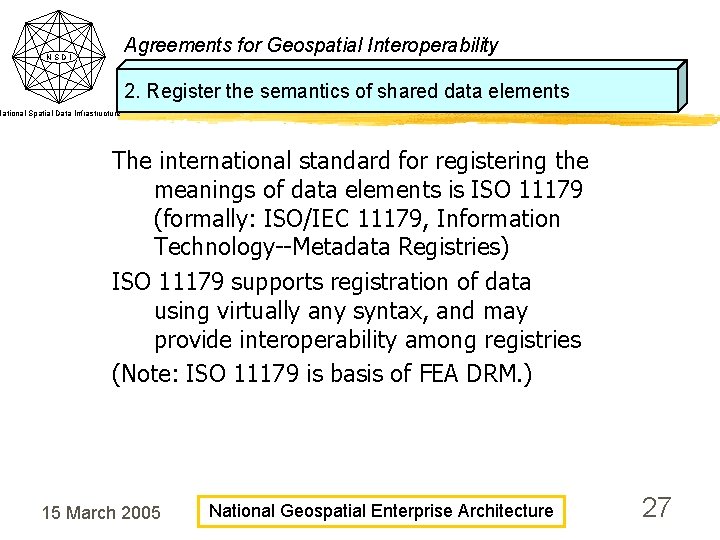
Agreements for Geospatial Interoperability NSDI 2. Register the semantics of shared data elements National Spatial Data Infrastructure The international standard for registering the meanings of data elements is ISO 11179 (formally: ISO/IEC 11179, Information Technology--Metadata Registries) ISO 11179 supports registration of data using virtually any syntax, and may provide interoperability among registries (Note: ISO 11179 is basis of FEA DRM. ) 15 March 2005 National Geospatial Enterprise Architecture 27
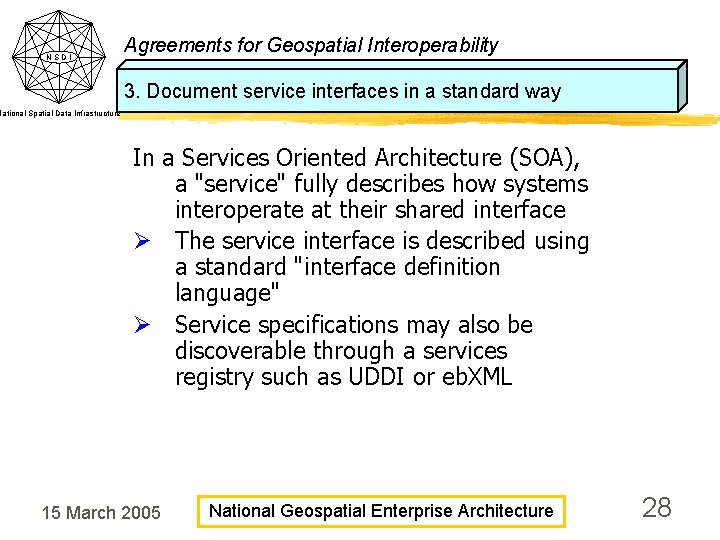
NSDI Agreements for Geospatial Interoperability 3. Document service interfaces in a standard way National Spatial Data Infrastructure In a Services Oriented Architecture (SOA), a "service" fully describes how systems interoperate at their shared interface Ø The service interface is described using a standard "interface definition language" Ø Service specifications may also be discoverable through a services registry such as UDDI or eb. XML 15 March 2005 National Geospatial Enterprise Architecture 28
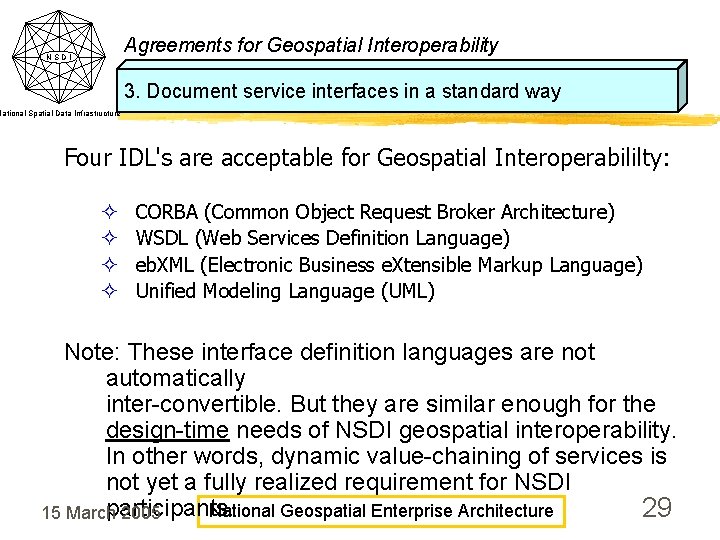
Agreements for Geospatial Interoperability NSDI 3. Document service interfaces in a standard way National Spatial Data Infrastructure Four IDL's are acceptable for Geospatial Interoperabililty: ² ² CORBA (Common Object Request Broker Architecture) WSDL (Web Services Definition Language) eb. XML (Electronic Business e. Xtensible Markup Language) Unified Modeling Language (UML) Note: These interface definition languages are not automatically inter-convertible. But they are similar enough for the design-time needs of NSDI geospatial interoperability. In other words, dynamic value-chaining of services is not yet a fully realized requirement for NSDI participants. 29 National Geospatial Enterprise Architecture 15 March 2005
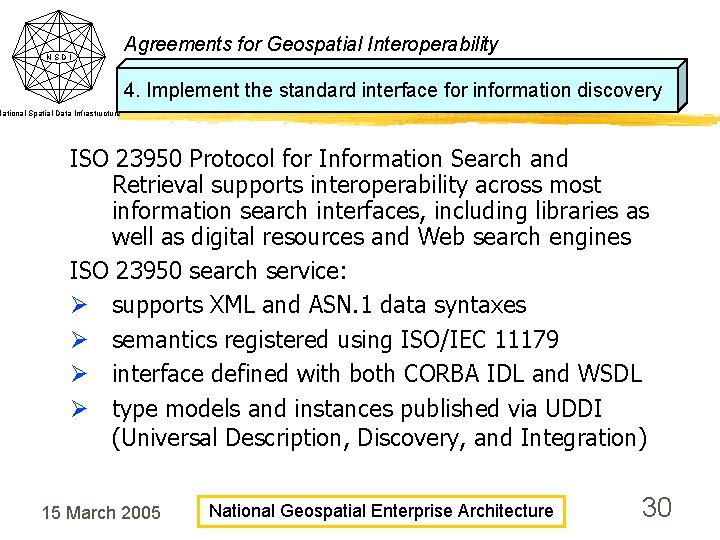
NSDI Agreements for Geospatial Interoperability 4. Implement the standard interface for information discovery National Spatial Data Infrastructure ISO 23950 Protocol for Information Search and Retrieval supports interoperability across most information search interfaces, including libraries as well as digital resources and Web search engines ISO 23950 search service: Ø supports XML and ASN. 1 data syntaxes Ø semantics registered using ISO/IEC 11179 Ø interface defined with both CORBA IDL and WSDL Ø type models and instances published via UDDI (Universal Description, Discovery, and Integration) 15 March 2005 National Geospatial Enterprise Architecture 30
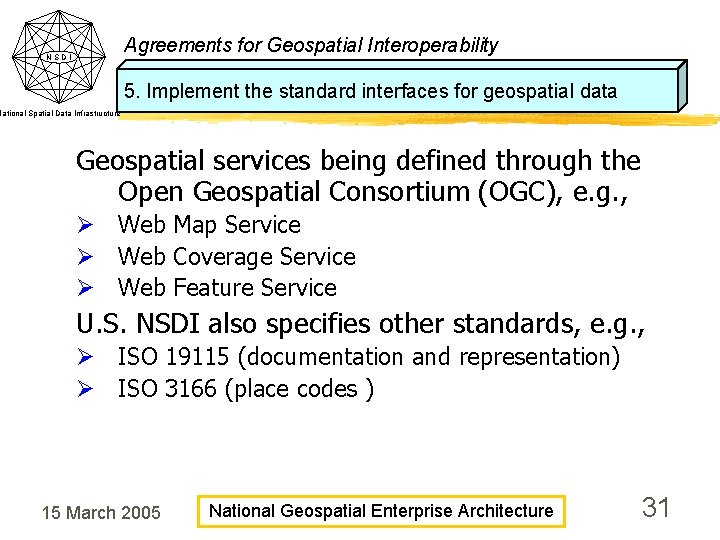
Agreements for Geospatial Interoperability NSDI 5. Implement the standard interfaces for geospatial data National Spatial Data Infrastructure Geospatial services being defined through the Open Geospatial Consortium (OGC), e. g. , Ø Web Map Service Ø Web Coverage Service Ø Web Feature Service U. S. NSDI also specifies other standards, e. g. , Ø ISO 19115 (documentation and representation) Ø ISO 3166 (place codes ) 15 March 2005 National Geospatial Enterprise Architecture 31
NSDI Presentation Outline National Spatial Data Infrastructure Ø Ø Ø Spatial Data Infrastructures (SDIs) Requirements of Law and Policy Process for Achieving Interoperability General Principles for Geospatial Interoperability Five Interface Agreements Additional requirements under law and policies 15 March 2005 National Geospatial Enterprise Architecture 32
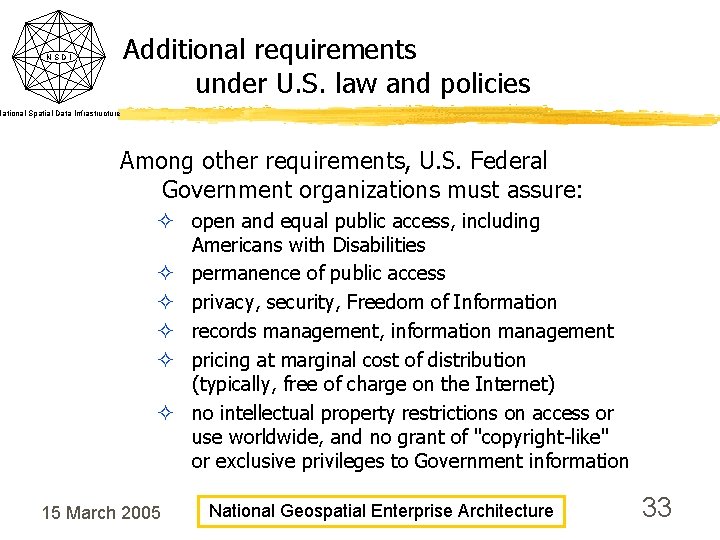
Additional requirements under U. S. law and policies NSDI National Spatial Data Infrastructure Among other requirements, U. S. Federal Government organizations must assure: ² open and equal public access, including Americans with Disabilities ² permanence of public access ² privacy, security, Freedom of Information ² records management, information management ² pricing at marginal cost of distribution (typically, free of charge on the Internet) ² no intellectual property restrictions on access or use worldwide, and no grant of "copyright-like" or exclusive privileges to Government information 15 March 2005 National Geospatial Enterprise Architecture 33
Additional requirements under U. S. law and policies NSDI National Spatial Data Infrastructure All participants in the National Geospatial Enterprise Architecture are expected to: Ø acknowledge Government sources of information and services Ø clearly communicate what Government information is in the public domain 15 March 2005 National Geospatial Enterprise Architecture 34
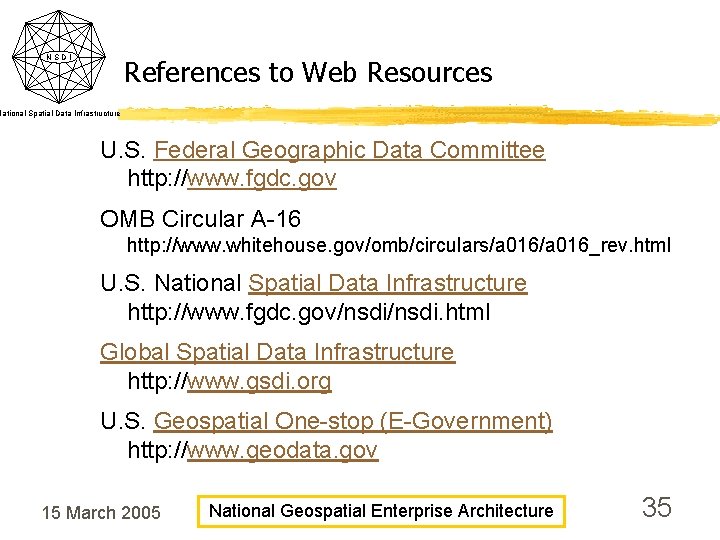
NSDI References to Web Resources National Spatial Data Infrastructure U. S. Federal Geographic Data Committee http: //www. fgdc. gov OMB Circular A-16 http: //www. whitehouse. gov/omb/circulars/a 016_rev. html U. S. National Spatial Data Infrastructure http: //www. fgdc. gov/nsdi. html Global Spatial Data Infrastructure http: //www. gsdi. org U. S. Geospatial One-stop (E-Government) http: //www. geodata. gov 15 March 2005 National Geospatial Enterprise Architecture 35