
ns3 and wifi An overview of physical layer
- Slides: 14
ns-3 and wifi An overview of physical layer models Jens Mittag, Timo Bingmann Workshop on ns-3 – in conjunction with SIMUTools 2009 March 2 nd, 2009 Decentralized Systems and Network Services Research Group and Junior Research Group for Traffic Telematics Institute of Telematics – University of Karlsruhe Jens Mittag DSN Research Group – Institute of Telematics – University of Karlsruhe
I. Background » Research background: Vehicular Ad-hoc NETworks: – Protocol development, evaluation and optimization » » Characteristics of VANETs: – Very high mobility of network nodes – Diverse environment – urban scenarios – rural scenarios – highway scenarios – Radio signal propagation conditions are – changing rapidly over time – different w. r. t. environmental effects – Fully distributed communication system Our ns-2 / ns-3 experience – ns-2 PHY/MAC improvements, e. g. cumulative interference, capture capabilities or Nakagami-m distribution (2006) – Port of improvements to ns-3 finished – merge into main branch pending 2 Jens Mittag, Timo Bingmann DSN Research Group – Institute of Telematics – University of Karlsruhe
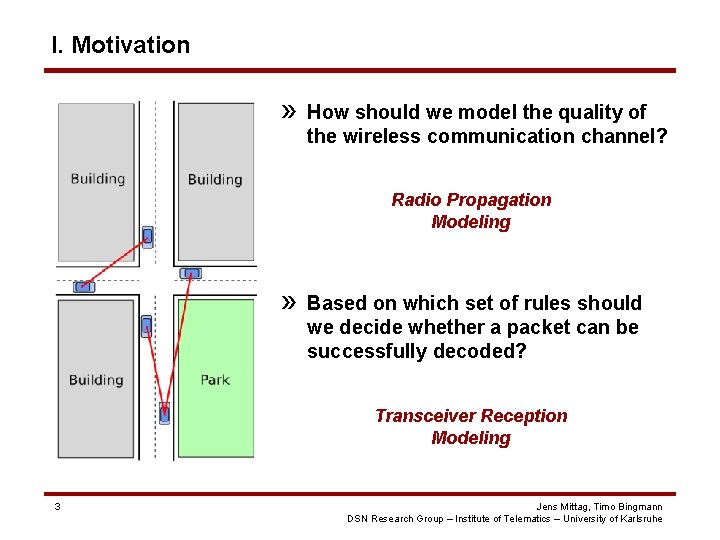
I. Motivation » How should we model the quality of the wireless communication channel? Radio Propagation Modeling » Based on which set of rules should we decide whether a packet can be successfully decoded? Transceiver Reception Modeling 3 Jens Mittag, Timo Bingmann DSN Research Group – Institute of Telematics – University of Karlsruhe
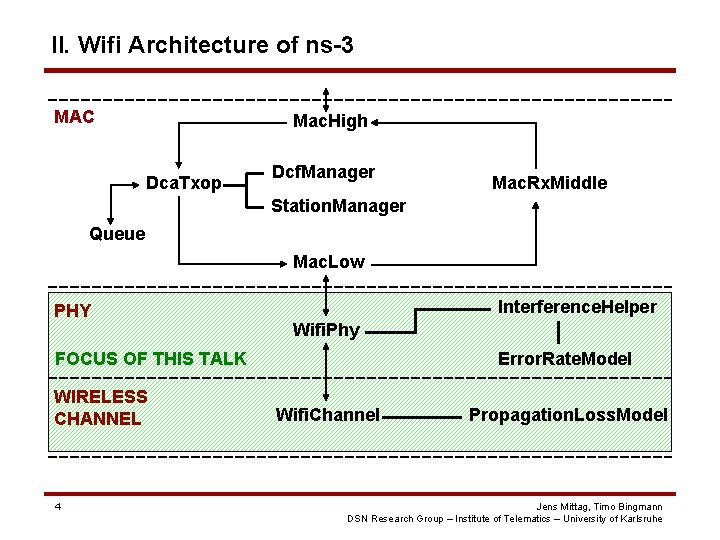
II. Wifi Architecture of ns-3 MAC Mac. High Dca. Txop Dcf. Manager Mac. Rx. Middle Station. Manager Queue Mac. Low PHY Interference. Helper Wifi. Phy FOCUS OF THIS TALK WIRELESS CHANNEL 4 Error. Rate. Model Wifi. Channel Propagation. Loss. Model Jens Mittag, Timo Bingmann DSN Research Group – Institute of Telematics – University of Karlsruhe
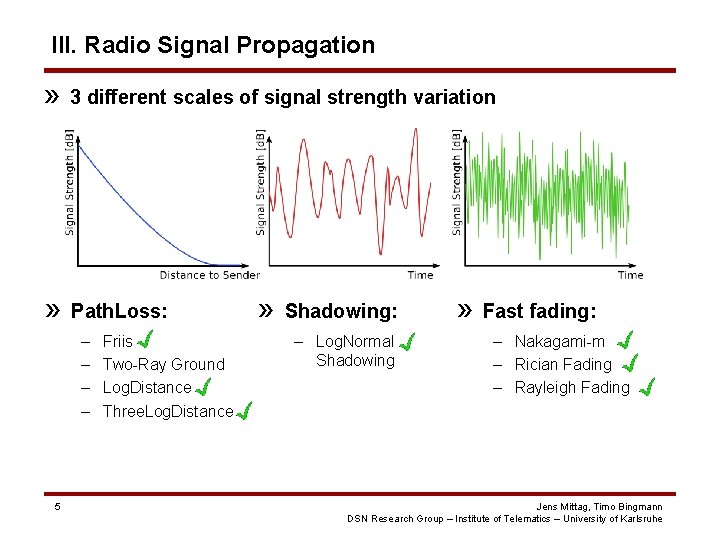
III. Radio Signal Propagation » 3 different scales of signal strength variation » Path. Loss: – – 5 Friis Two-Ray Ground Log. Distance Three. Log. Distance » Shadowing: – Log. Normal Shadowing » Fast fading: – Nakagami-m – Rician Fading – Rayleigh Fading Jens Mittag, Timo Bingmann DSN Research Group – Institute of Telematics – University of Karlsruhe
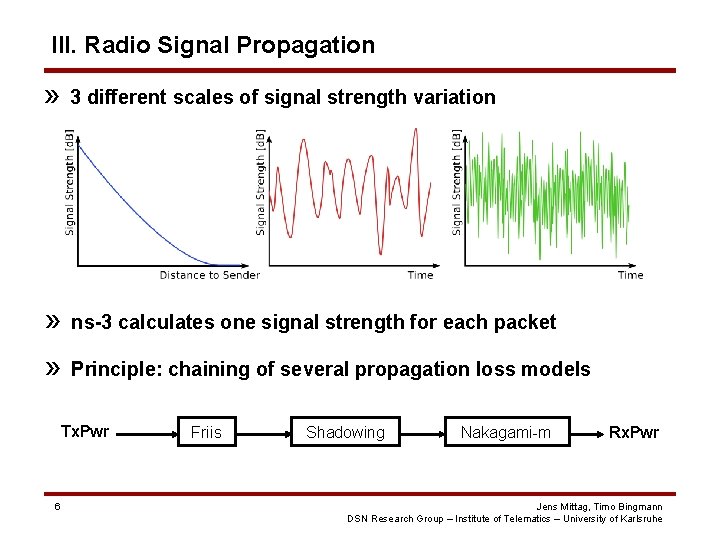
III. Radio Signal Propagation » 3 different scales of signal strength variation » ns-3 calculates one signal strength for each packet » Principle: chaining of several propagation loss models Tx. Pwr 6 Friis Shadowing Nakagami-m Rx. Pwr Jens Mittag, Timo Bingmann DSN Research Group – Institute of Telematics – University of Karlsruhe
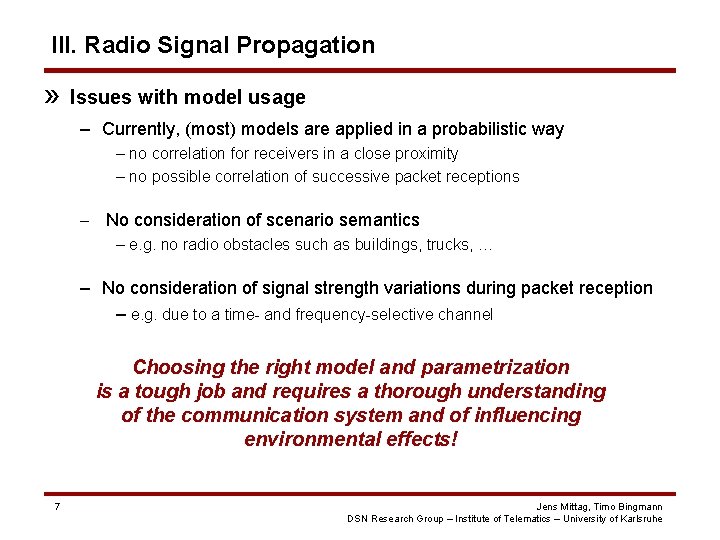
III. Radio Signal Propagation » Issues with model usage – Currently, (most) models are applied in a probabilistic way – no correlation for receivers in a close proximity – no possible correlation of successive packet receptions – No consideration of scenario semantics – e. g. no radio obstacles such as buildings, trucks, … – No consideration of signal strength variations during packet reception – e. g. due to a time- and frequency-selective channel Choosing the right model and parametrization is a tough job and requires a thorough understanding of the communication system and of influencing environmental effects! 7 Jens Mittag, Timo Bingmann DSN Research Group – Institute of Telematics – University of Karlsruhe
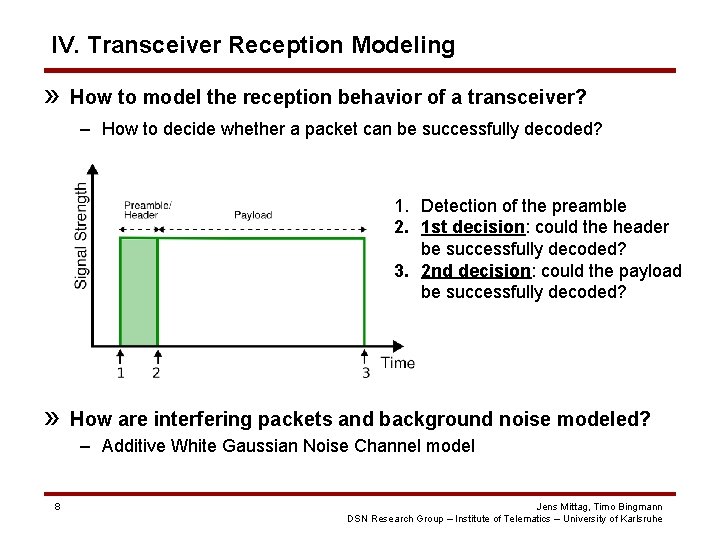
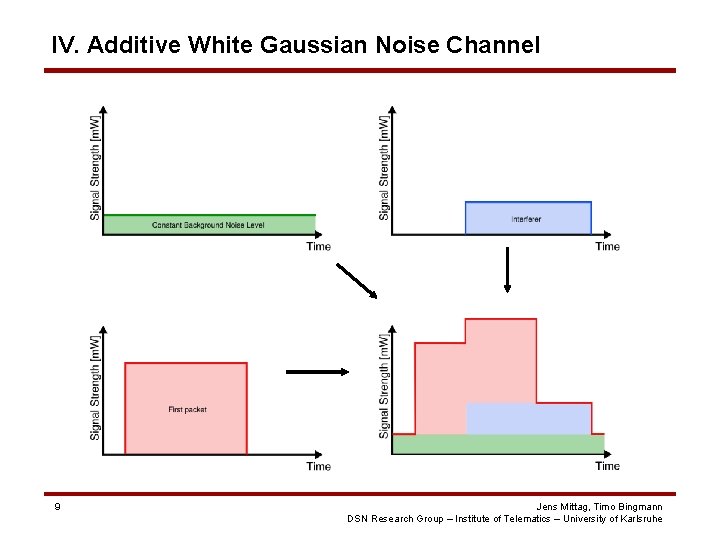
IV. Transceiver Reception Modeling » How to model the reception behavior of a transceiver? – How to decide whether a packet can be successfully decoded? 1. Detection of the preamble 2. 1 st decision: could the header be successfully decoded? 3. 2 nd decision: could the payload be successfully decoded? » How are interfering packets and background noise modeled? – Additive White Gaussian Noise Channel model 8 Jens Mittag, Timo Bingmann DSN Research Group – Institute of Telematics – University of Karlsruhe
IV. Additive White Gaussian Noise Channel 9 Jens Mittag, Timo Bingmann DSN Research Group – Institute of Telematics – University of Karlsruhe
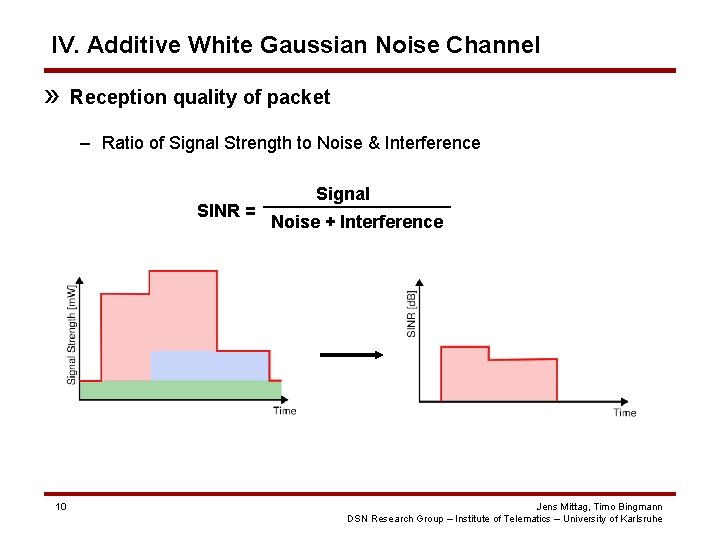
IV. Additive White Gaussian Noise Channel » Reception quality of packet – Ratio of Signal Strength to Noise & Interference SINR = 10 Signal Noise + Interference Jens Mittag, Timo Bingmann DSN Research Group – Institute of Telematics – University of Karlsruhe
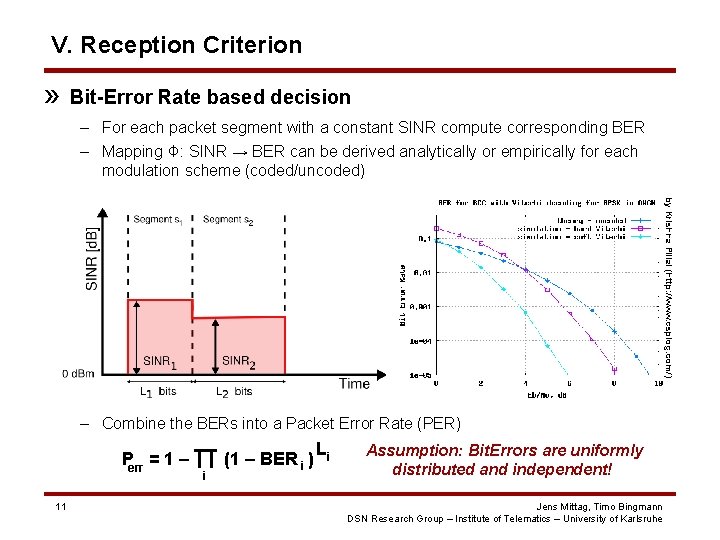
V. Reception Criterion » Bit-Error Rate based decision – For each packet segment with a constant SINR compute corresponding BER – Mapping Φ: SINR → BER can be derived analytically or empirically for each modulation scheme (coded/uncoded) by Krishna Pillai (http: //www. dsplog. com/) – Combine the BERs into a Packet Error Rate (PER) Perr = 1 – 11 i (1 – BER i ) Li Assumption: Bit. Errors are uniformly distributed and independent! Jens Mittag, Timo Bingmann DSN Research Group – Institute of Telematics – University of Karlsruhe
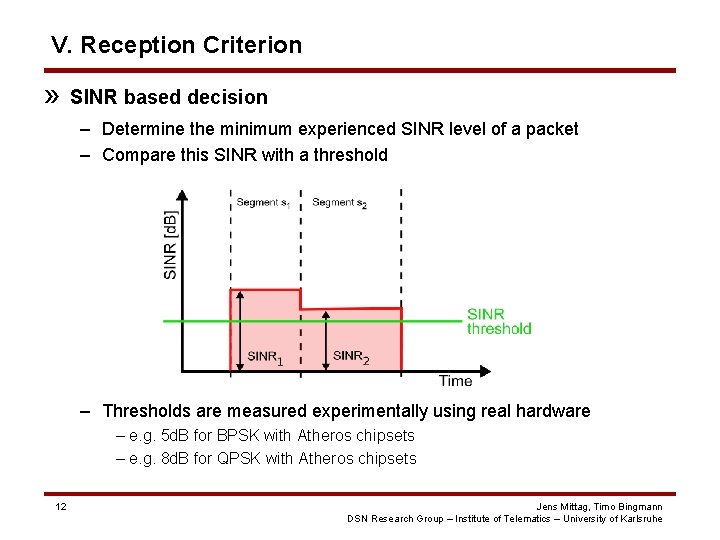
V. Reception Criterion » SINR based decision – Determine the minimum experienced SINR level of a packet – Compare this SINR with a threshold – Thresholds are measured experimentally using real hardware – e. g. 5 d. B for BPSK with Atheros chipsets – e. g. 8 d. B for QPSK with Atheros chipsets 12 Jens Mittag, Timo Bingmann DSN Research Group – Institute of Telematics – University of Karlsruhe
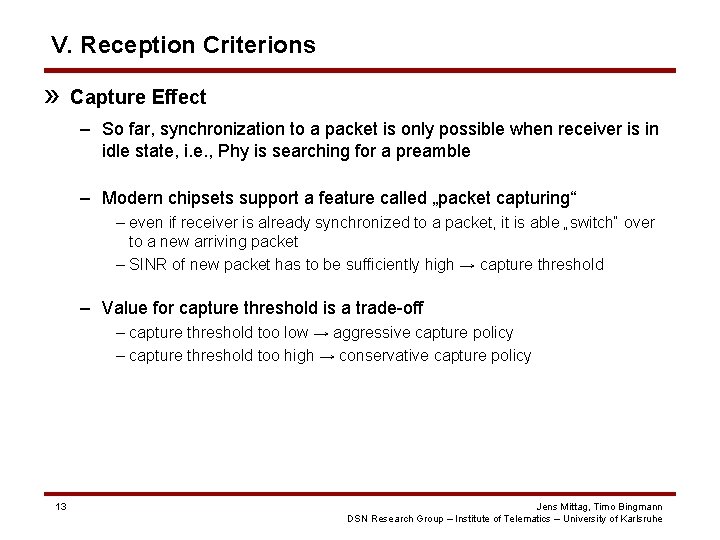
V. Reception Criterions » Capture Effect – So far, synchronization to a packet is only possible when receiver is in idle state, i. e. , Phy is searching for a preamble – Modern chipsets support a feature called „packet capturing“ – even if receiver is already synchronized to a packet, it is able „switch“ over to a new arriving packet – SINR of new packet has to be sufficiently high → capture threshold – Value for capture threshold is a trade-off – capture threshold too low → aggressive capture policy – capture threshold too high → conservative capture policy 13 Jens Mittag, Timo Bingmann DSN Research Group – Institute of Telematics – University of Karlsruhe
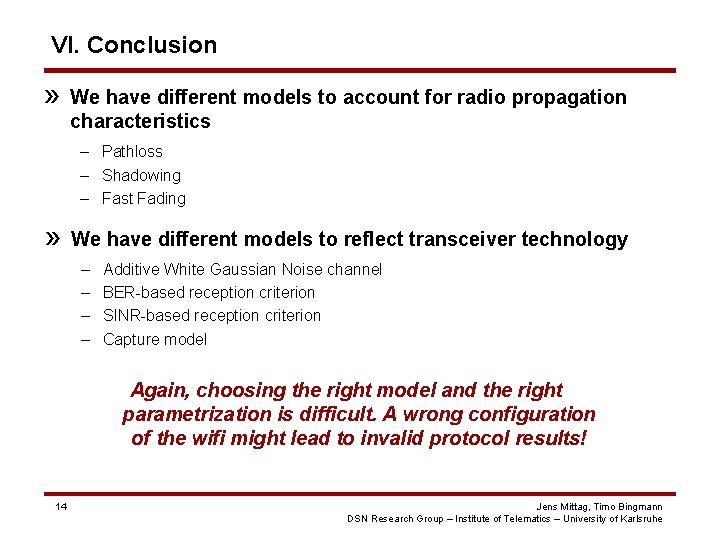
VI. Conclusion » We have different models to account for radio propagation characteristics – Pathloss – Shadowing – Fast Fading » We have different models to reflect transceiver technology – – Additive White Gaussian Noise channel BER-based reception criterion SINR-based reception criterion Capture model Again, choosing the right model and the right parametrization is difficult. A wrong configuration of the wifi might lead to invalid protocol results! 14 Jens Mittag, Timo Bingmann DSN Research Group – Institute of Telematics – University of Karlsruhe