
NS 3310 Physical Science Studies History of Life

- Slides: 31
NS 3310 - Physical Science Studies History of Life On Earth
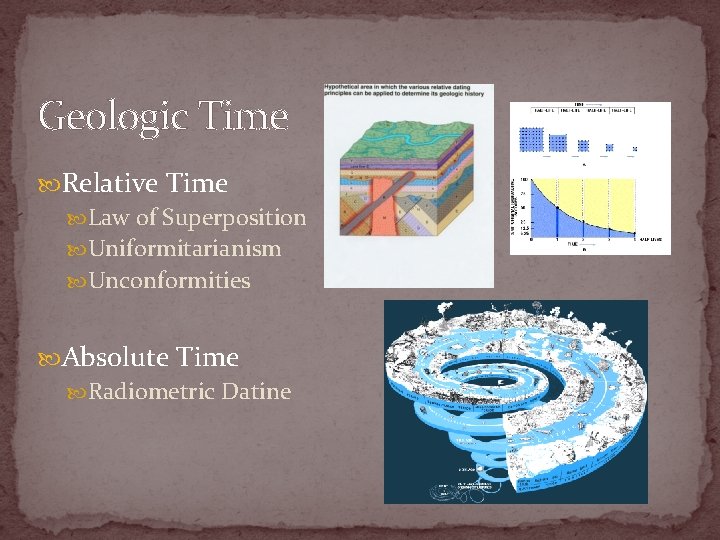
Geologic Time Relative Time Law of Superposition Uniformitarianism Unconformities Absolute Time Radiometric Datine
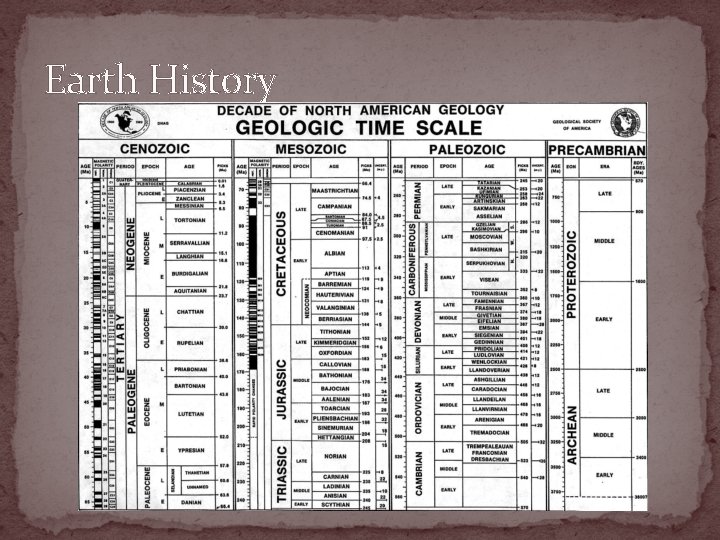
Earth History
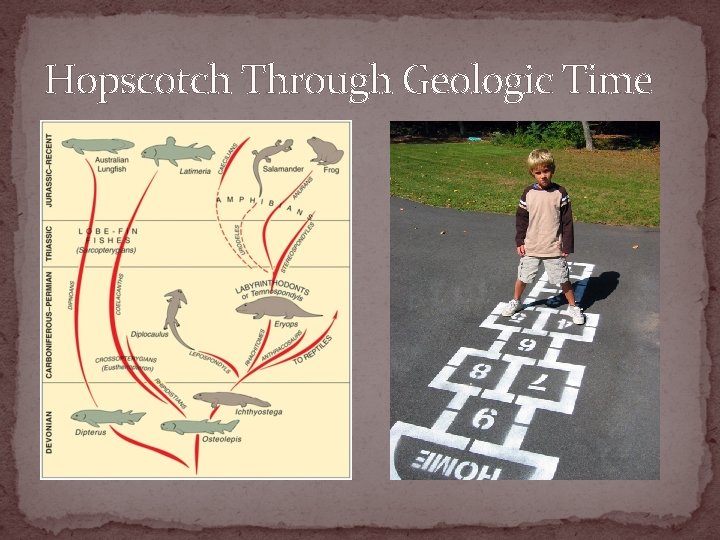
Hopscotch Through Geologic Time
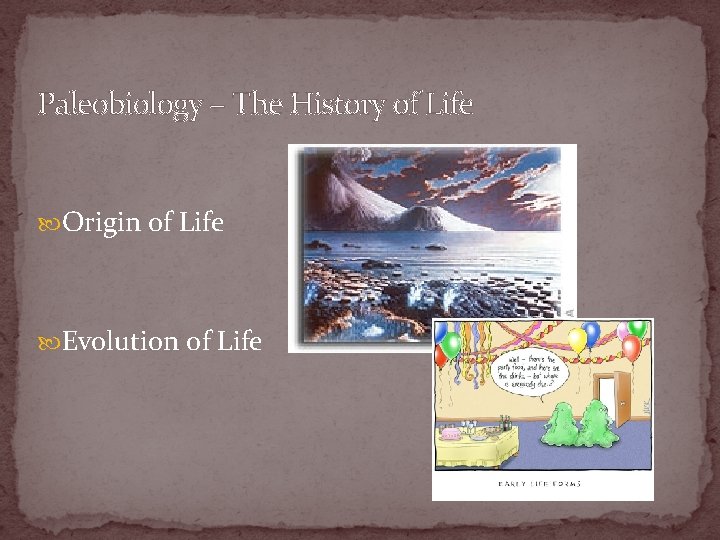
Paleobiology – The History of Life Origin of Life Evolution of Life
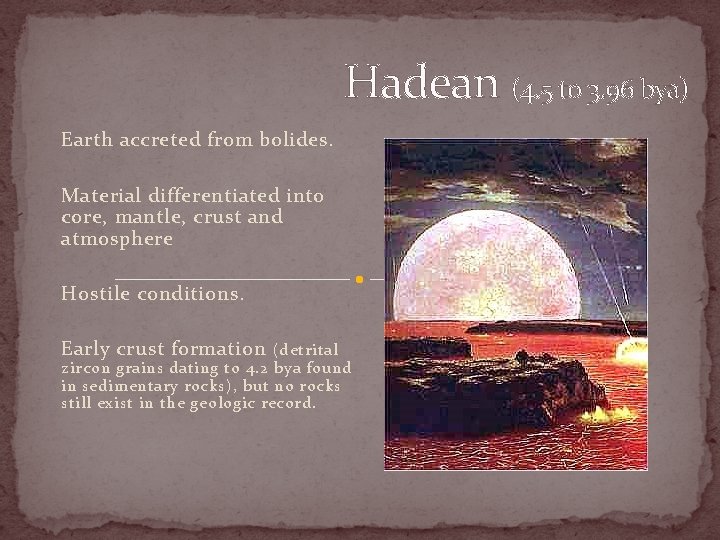
Hadean (4. 5 to 3. 96 bya) Earth accreted from bolides. Material differentiated into core, mantle, crust and atmosphere Hostile conditions. Early crust formation (detrital zircon grains dating to 4. 2 bya found in sedimentary rocks), but no rocks still exist in the geologic record.
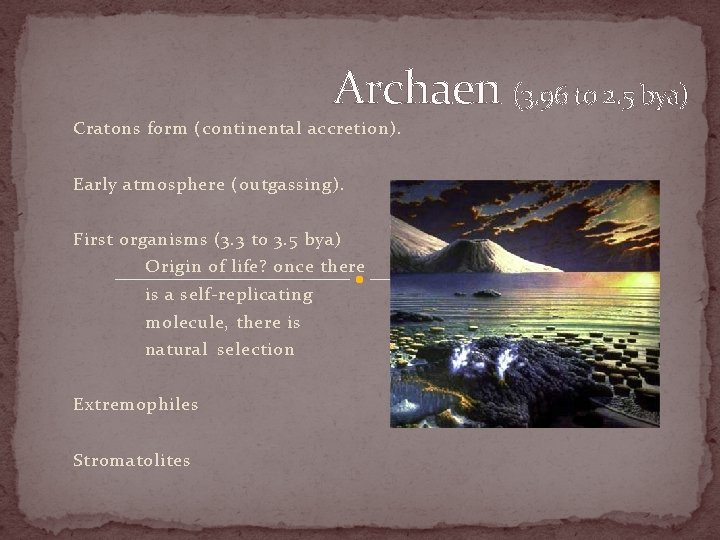
Archaen (3. 96 to 2. 5 bya) Cratons form (continental accretion). Early atmosphere (outgassing). First organisms (3. 3 to 3. 5 bya) Origin of life? once there is a self-replicating molecule, there is natural selection Extremophiles Stromatolites
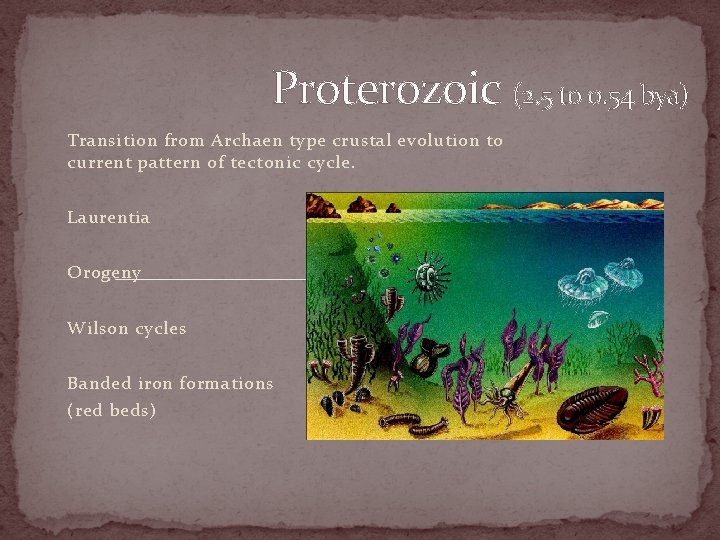
Proterozoic (2. 5 to 0. 54 bya) Transition from Archaen type crustal evolution to current pattern of tectonic cycle. Laurentia Orogeny Wilson cycles Banded iron formations (red beds)
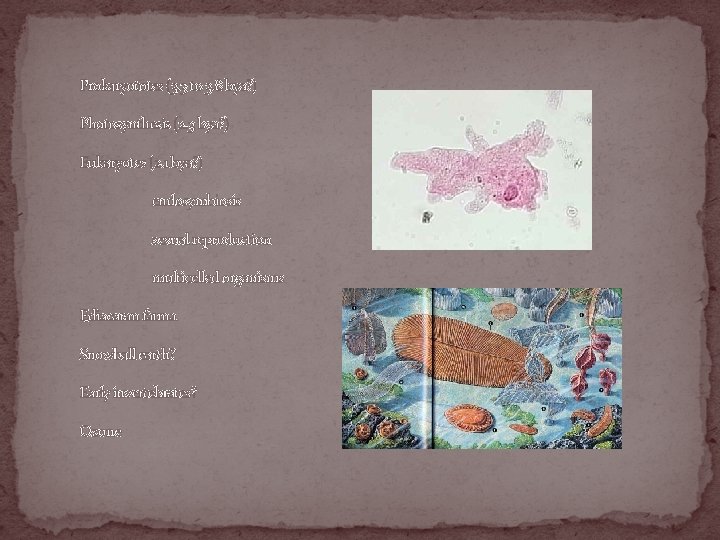
Prokaryototes (3. 3 to 3. 8 bya? ) Photosynthesis (2. 3 bya? ) Eukaryotes (2. 1 bya? ) endosymbiosis sexual reproduction multicelled organisms Ediacaran fauna Snowball earth? Early invertebrates? Ozone
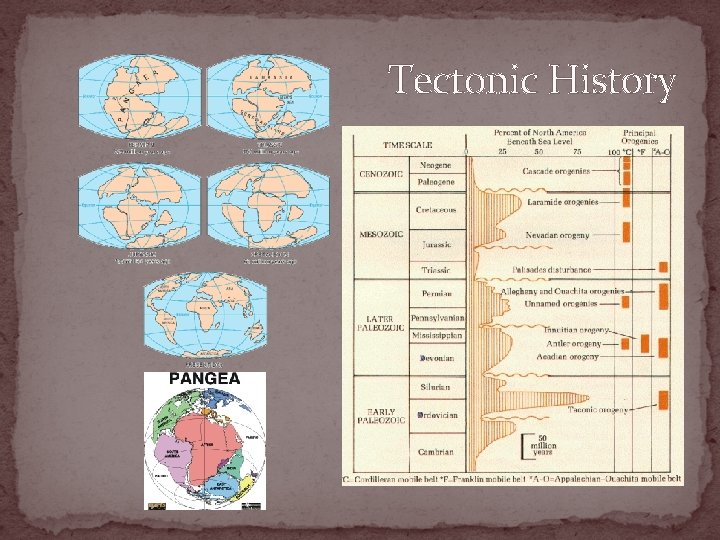
Tectonic History
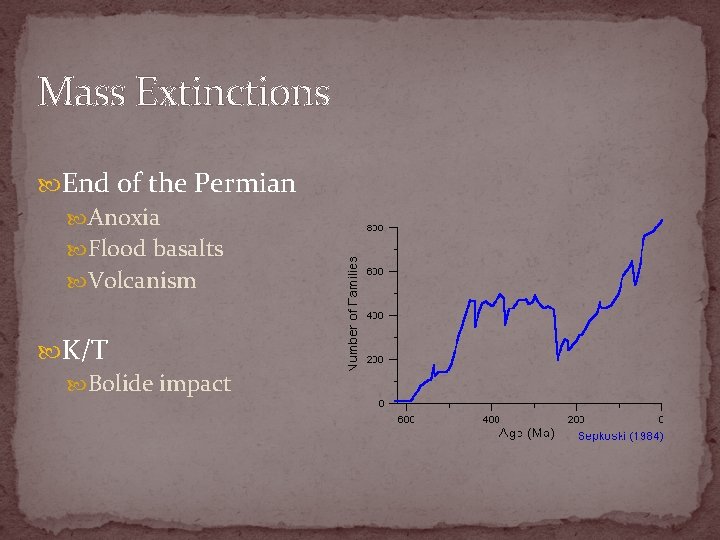
Mass Extinctions End of the Permian Anoxia Flood basalts Volcanism K/T Bolide impact
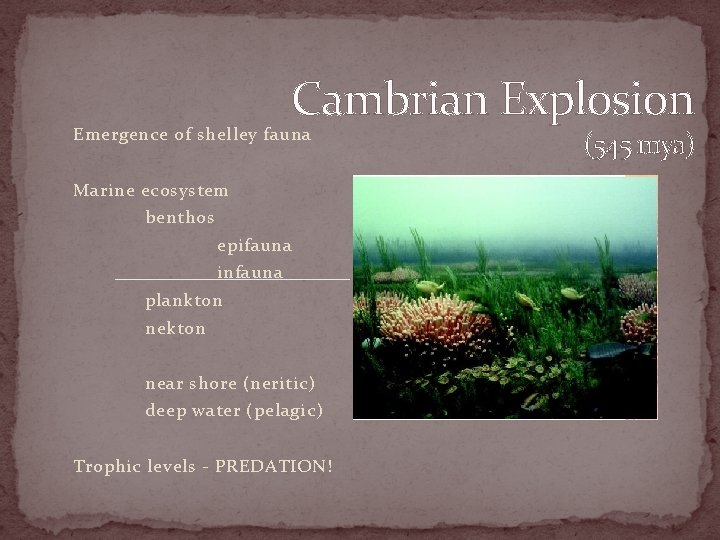
Cambrian Explosion Emergence of shelley fauna Marine ecosystem benthos epifauna infauna plankton near shore (neritic) deep water (pelagic) Trophic levels - PREDATION! (545 mya)
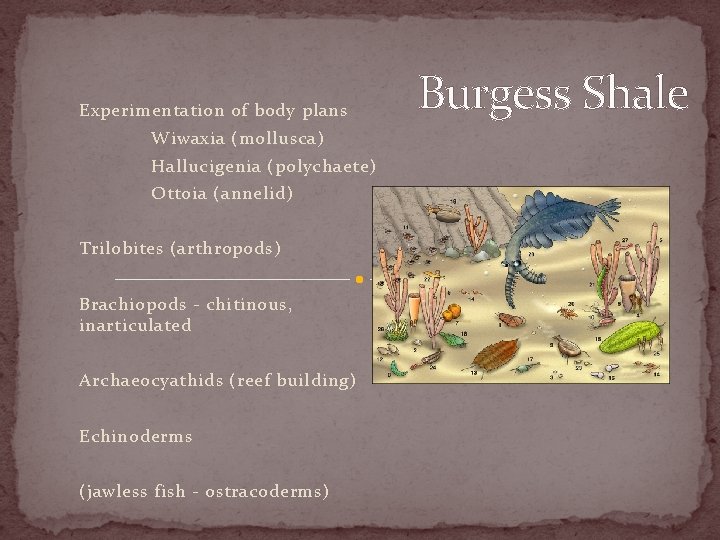
Experimentation of body plans Wiwaxia (mollusca) Hallucigenia (polychaete) Ottoia (annelid) Trilobites (arthropods) Brachiopods - chitinous, inarticulated Archaeocyathids (reef building) Echinoderms (jawless fish - ostracoderms) Burgess Shale
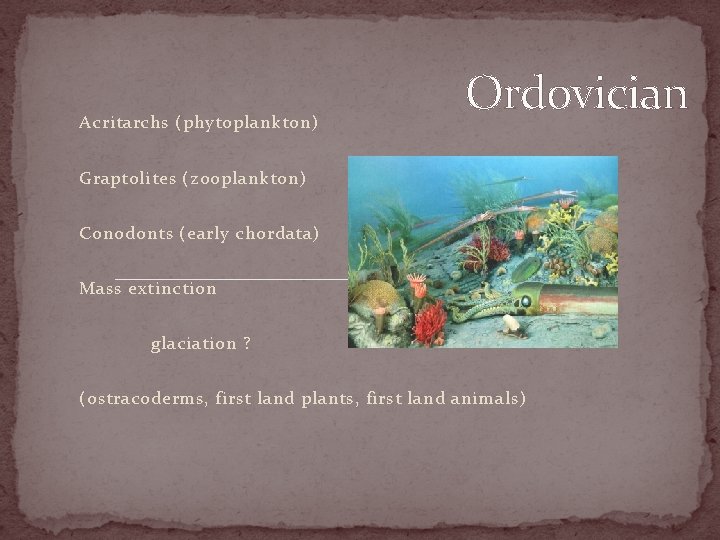
Acritarchs (phytoplankton) Ordovician Graptolites (zooplankton) Conodonts (early chordata) Mass extinction glaciation ? (ostracoderms, first land plants, first land animals)
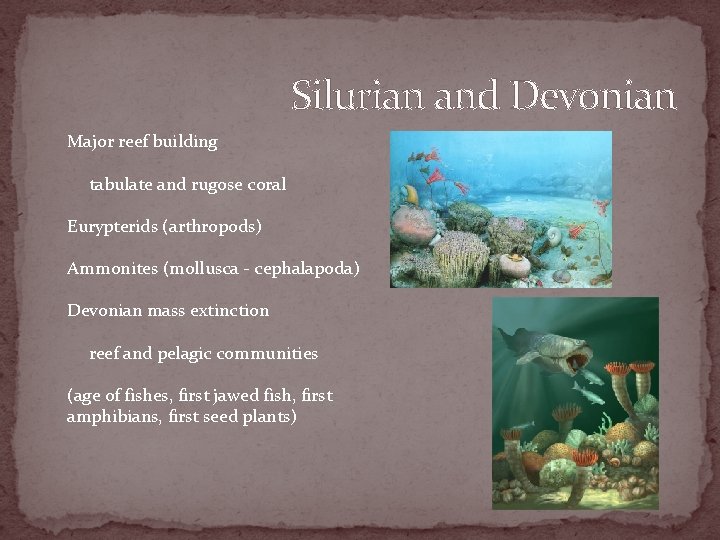
Silurian and Devonian Major reef building tabulate and rugose coral Eurypterids (arthropods) Ammonites (mollusca - cephalapoda) Devonian mass extinction reef and pelagic communities (age of fishes, first jawed fish, first amphibians, first seed plants)
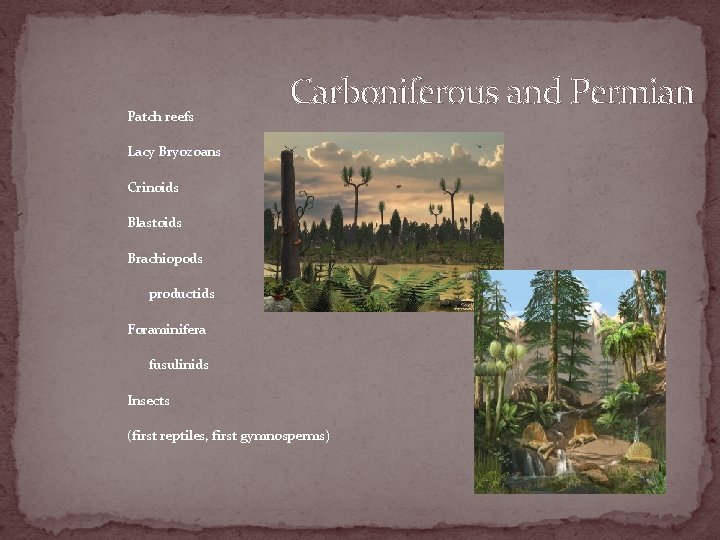
Patch reefs Carboniferous and Permian Lacy Bryozoans Crinoids Blastoids Brachiopods productids Foraminifera fusulinids Insects (first reptiles, first gymnosperms)
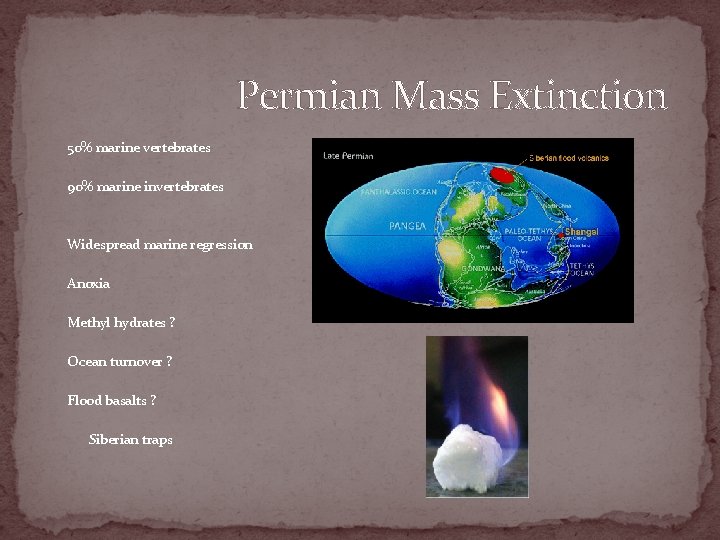
Permian Mass Extinction 50% marine vertebrates 90% marine invertebrates Widespread marine regression Anoxia Methyl hydrates ? Ocean turnover ? Flood basalts ? Siberian traps
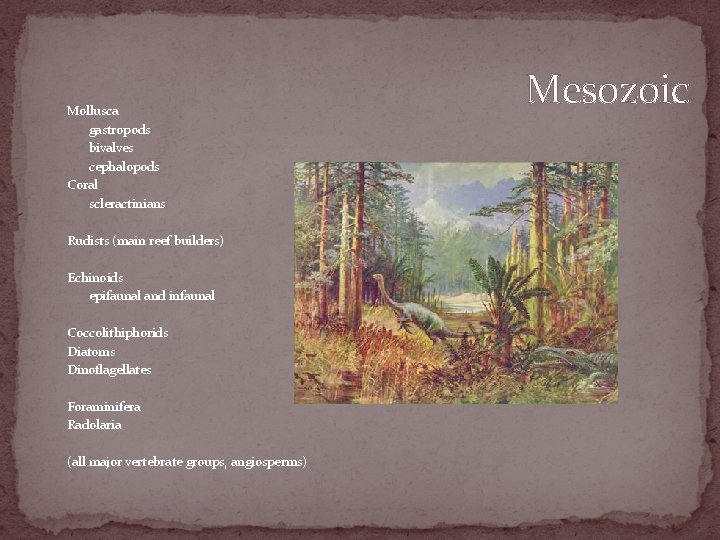
Mollusca gastropods bivalves cephalopods Coral scleractinians Rudists (main reef builders) Echinoids epifaunal and infaunal Coccolithiphorids Diatoms Dinoflagellates Foraminifera Radolaria (all major vertebrate groups, angiosperms) Mesozoic
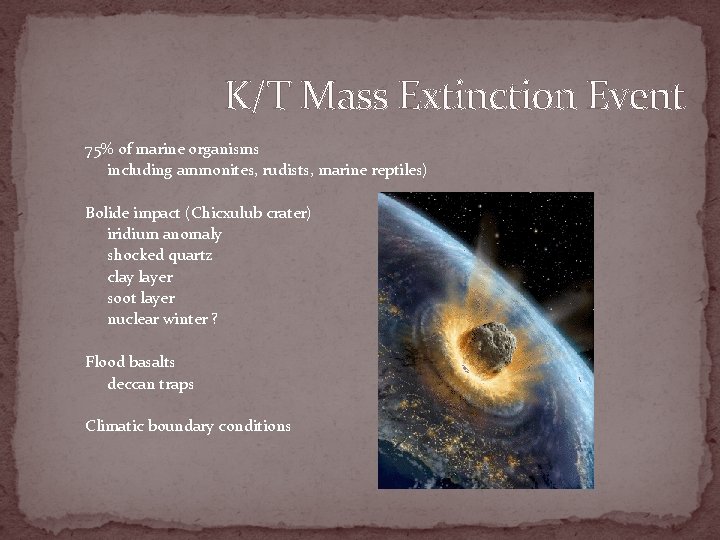
K/T Mass Extinction Event 75% of marine organisms including ammonites, rudists, marine reptiles) Bolide impact (Chicxulub crater) iridium anomaly shocked quartz clay layer soot layer nuclear winter ? Flood basalts deccan traps Climatic boundary conditions
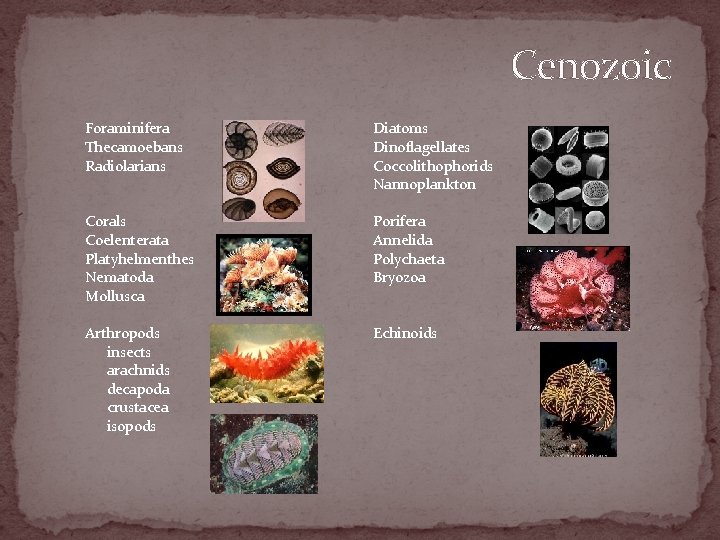
Cenozoic Foraminifera Thecamoebans Radiolarians Diatoms Dinoflagellates Coccolithophorids Nannoplankton Corals Coelenterata Platyhelmenthes Nematoda Mollusca Porifera Annelida Polychaeta Bryozoa Arthropods insects arachnids decapoda crustacea isopods Echinoids
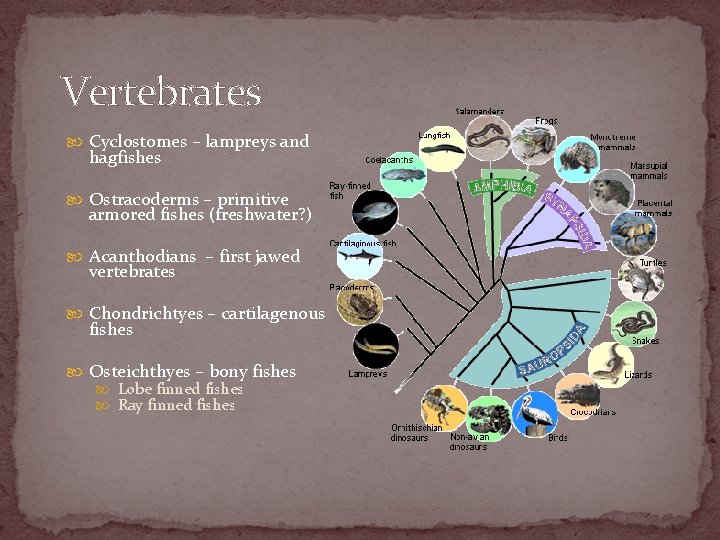
Vertebrates Cyclostomes – lampreys and hagfishes Ostracoderms – primitive armored fishes (freshwater? ) Acanthodians – first jawed vertebrates Chondrichtyes – cartilagenous fishes Osteichthyes – bony fishes Lobe finned fishes Ray finned fishes
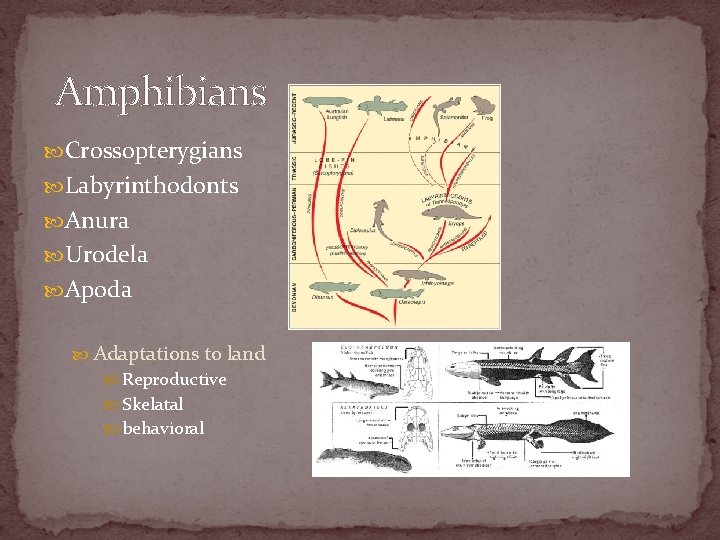
Amphibians Crossopterygians Labyrinthodonts Anura Urodela Apoda Adaptations to land Reproductive Skelatal behavioral
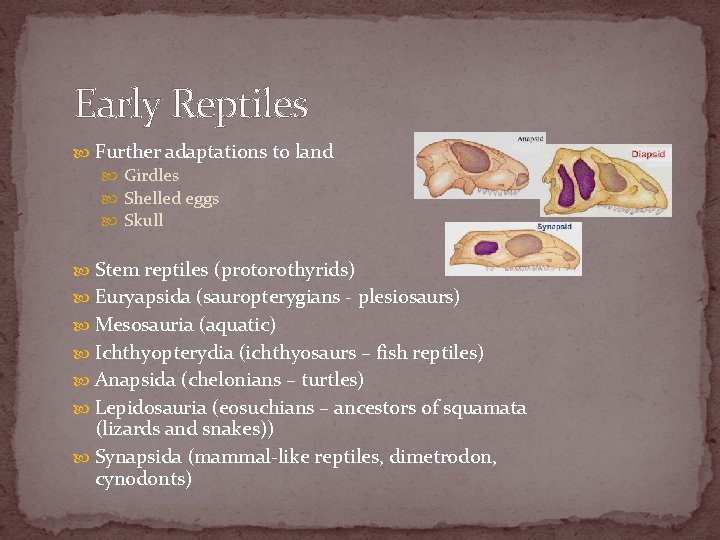
Early Reptiles Further adaptations to land Girdles Shelled eggs Skull Stem reptiles (protorothyrids) Euryapsida (sauropterygians - plesiosaurs) Mesosauria (aquatic) Ichthyopterydia (ichthyosaurs – fish reptiles) Anapsida (chelonians – turtles) Lepidosauria (eosuchians – ancestors of squamata (lizards and snakes)) Synapsida (mammal-like reptiles, dimetrodon, cynodonts)
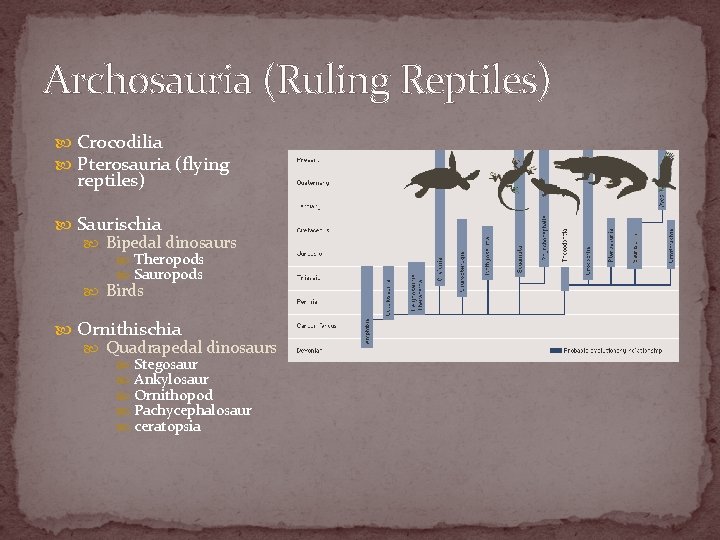
Archosauria (Ruling Reptiles) Crocodilia Pterosauria (flying reptiles) Saurischia Bipedal dinosaurs Theropods Sauropods Birds Ornithischia Quadrapedal dinosaurs Stegosaur Ankylosaur Ornithopod Pachycephalosaur ceratopsia
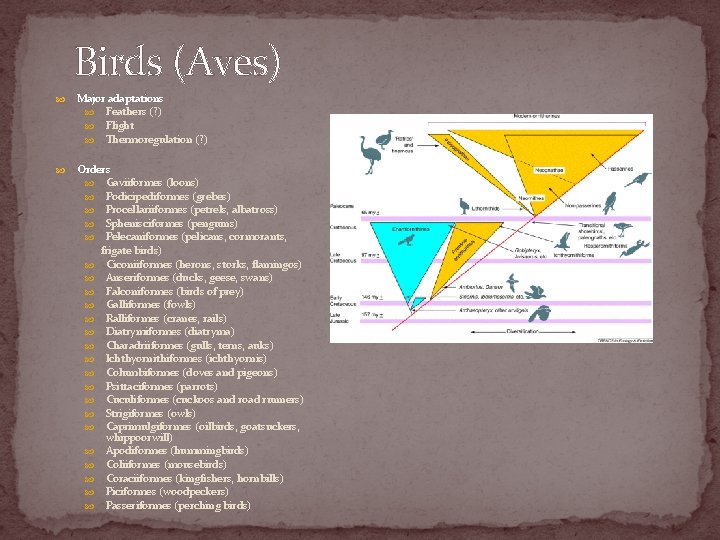
Birds (Aves) Major adaptations Feathers (? ) Flight Thermoregulation (? ) Orders Gaviiformes (loons) Podicipediformes (grebes) Procellariiformes (petrels, albatross) Sphenisciformes (penguins) Pelecaniformes (pelicans, cormorants, frigate birds) Ciconiiformes (herons, storks, flamingos) Anseriformes (ducks, geese, swans) Falconiformes (birds of prey) Galliformes (fowls) Ralliformes (cranes, rails) Diatrymiformes (diatryma) Charadriiformes (gulls, terns, auks) Ichthyornithiformes (ichthyornis) Columbiformes (doves and pigeons) Psittaciformes (parrots) Cuculiformes (cuckoos and road runners) Strigiformes (owls) Caprimulgiformes (oilbirds, goatsuckers, whippoorwill) Apodiformes (hummingbirds) Coliiformes (mousebirds) Coraciiformes (kingfishers, hornbills) Piciformes (woodpeckers) Passeriformes (perching birds)
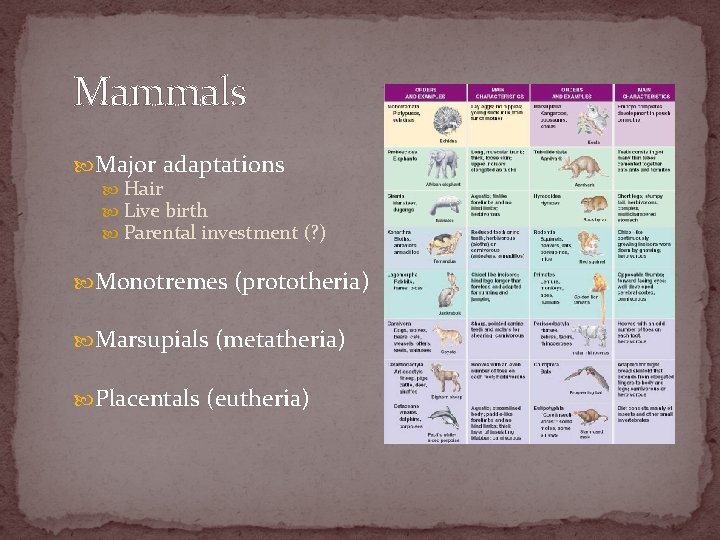
Mammals Major adaptations Hair Live birth Parental investment (? ) Monotremes (prototheria) Marsupials (metatheria) Placentals (eutheria)
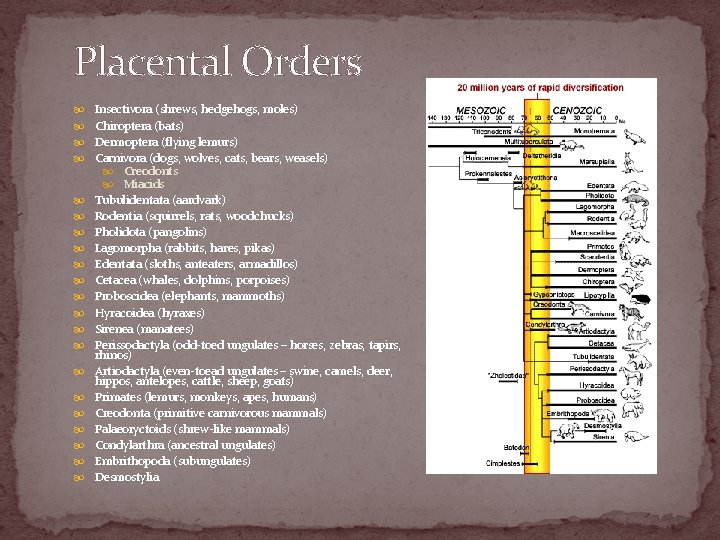
Placental Orders Insectivora (shrews, hedgehogs, moles) Chiroptera (bats) Dermoptera (flying lemurs) Carnivora (dogs, wolves, cats, bears, weasels) Creodonts Miacids Tubulidentata (aardvark) Rodentia (squirrels, rats, woodchucks) Pholidota (pangolins) Lagomorpha (rabbits, hares, pikas) Edentata (sloths, anteaters, armadillos) Cetacea (whales, dolphins, porpoises) Proboscidea (elephants, mammoths) Hyracoidea (hyraxes) Sirenea (manatees) Perissodactyla (odd-toed ungulates – horses, zebras, tapirs, rhinos) Artiodactyla (even-toead ungulates – swine, camels, deer, hippos, antelopes, cattle, sheep, goats) Primates (lemurs, monkeys, apes, humans) Creodonta (primitive carnivorous mammals) Palaeoryctoids (shrew-like mammals) Condylarthra (ancestral ungulates) Embrithopoda (subungulates) Desmostylia
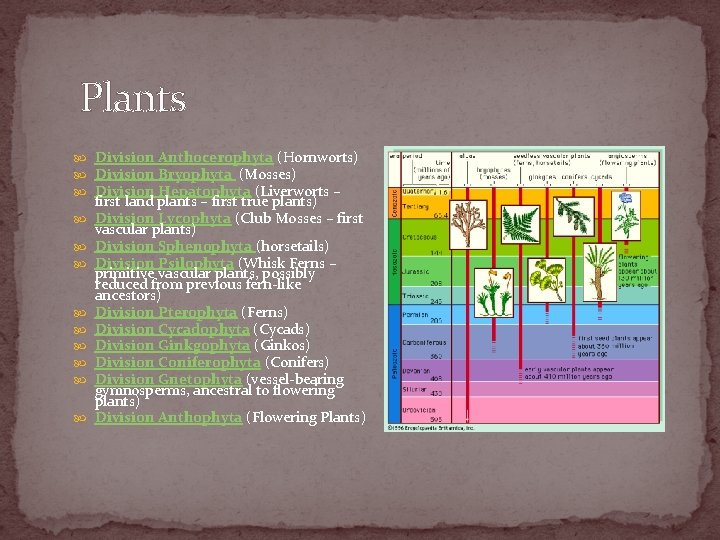
Plants Division Anthocerophyta (Hornworts) Division Bryophyta (Mosses) Division Hepatophyta (Liverworts – first land plants – first true plants) Division Lycophyta (Club Mosses – first vascular plants) Division Sphenophyta (horsetails) Division Psilophyta (Whisk Ferns – primitive vascular plants, possibly reduced from previous fern-like ancestors) Division Pterophyta (Ferns) Division Cycadophyta (Cycads) Division Ginkgophyta (Ginkos) Division Coniferophyta (Conifers) Division Gnetophyta (vessel-bearing gymnosperms, ancestral to flowering plants) Division Anthophyta (Flowering Plants)
Plant Adaptations Reproduction/Life cycles From slime molds to mosses Spores Seeds Gymnosperms Angiosperms Food and water transport Non-vascular plants Vascular plants Monocots dicots
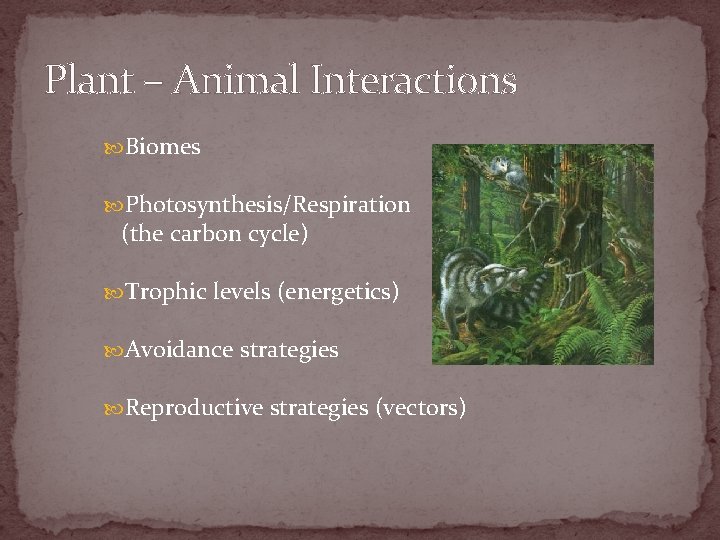
Plant – Animal Interactions Biomes Photosynthesis/Respiration (the carbon cycle) Trophic levels (energetics) Avoidance strategies Reproductive strategies (vectors)
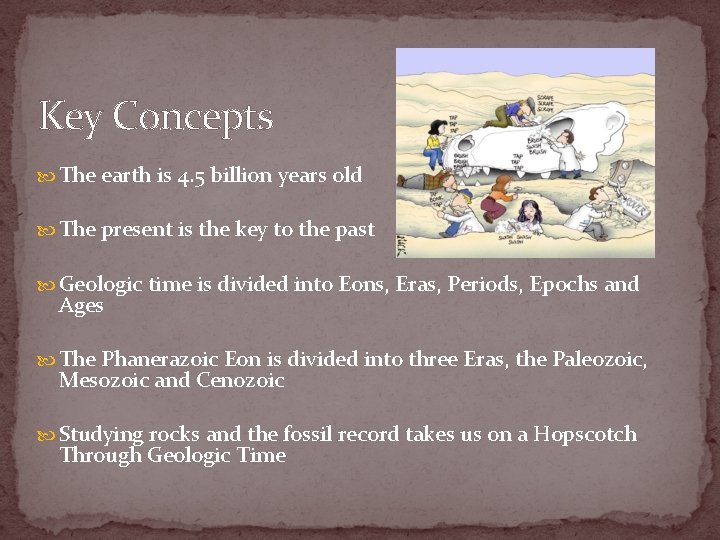
Key Concepts The earth is 4. 5 billion years old The present is the key to the past Geologic time is divided into Eons, Eras, Periods, Epochs and Ages The Phanerazoic Eon is divided into three Eras, the Paleozoic, Mesozoic and Cenozoic Studying rocks and the fossil record takes us on a Hopscotch Through Geologic Time