
NRF Evaluation Rating Prof Robert Morrell UCT Research

NRF Evaluation & Rating Prof. Robert Morrell, UCT Research Office 09 September 2014
What is an NRF rating? �Assessment of your recent research track record. �Based on the quality of your research outputs. �International peer-review system.
Why be rated? �Access to NRF funding for 6 years. �Benchmarking. Assist UCT to improve its research profile. �Maintain publishing record.
NRF rating categories Y, P Researchers who show promise to become established. C, B, A Established researchers.
NRF rating categories: Definitions A B Researchers who are unequivocally recognised by their peers as leading international scholars in their field for the high quality and impact of their recent research outputs. Researchers who enjoy considerable international recognition … for the high quality and impact of their recent research outputs.
NRF rating categories: Definitions C Established researchers with a sustained recent record of productivity in the field.
NRF rating categories: Definitions P Young researchers (normally younger than 35 years of age; doctorate or equivalent less than five years) who…are considered likely to become future leaders in their field.
NRF rating categories: Definitions Y Young researchers (40 years or younger; doctorate or equivalent less than five years) who are recognised as having the potential to establish themselves as researchers within a five-year period after evaluation.

How is your application processed? Submission of scholarly achievements Specialist Committee Not accepted Selection of 6 peers/reviewers Reviewers’ reports Assessor Specialist Committee Joint meeting
![How is your application processed? [2] Joint meeting Consensus B, C, Y Inform Applicant](http://slidetodoc.com/presentation_image/23f02973e95bbce3073bc9a2531d8a38/image-10.jpg "How is your application processed? [2] Joint meeting Consensus B, C, Y Inform Applicant")
How is your application processed? [2] Joint meeting Consensus B, C, Y Inform Applicant No Consensus A, P recommendation Executive Evaluation Committee Appeals Committee
Tasks of specialist committees �Selecting reviewers. �Rating the quality of reports by reviewers. �Deciding the rating value of each reviewer report �Recommending a rating for each applicant based solely on reports by reviewers. �Identifying feedback. �Advising NRF.
Peers/reviewers � Applicants are given the opportunity to nominate their own reviewers. � They are also given the opportunity to indicate who should not be approached. � A mix of national and international reviewers is appropriate in most cases. � Ideological differences within disciplines in the social sciences and humanities could confound the selection of suitable peers. However, reports by peers in such instances should be identifiable and treated appropriately by wise panel members.
What do reviewers comment on? �Quality of research outputs over the last eight years (2007 -2014). �Impact of research outputs on the field. �Standing as a researcher, nationally and internationally. �Coherence of researcher’s work.
Information required by NRF • Personal details • Biographical sketch (1 page) • Career profile • Description of completed research (2 pages) • Self-assessment (1 page) • Qualifications obtained • Research expertise • Research outputs of last eight years (2007 -2014) • Five best recent research outputs (2007 -2014) • Ten best research outputs before 2007 • Ongoing and planned future research (1 page) • Six nominated reviewers • Assessment panel(s) 26 September/14 October/ 13 November: Writer’s Workshop to
Research outputs of the last 8 years 1 Jan. 2007 to 31 Dec. 2014 • Publications in peer-reviewed journals • Technical reports • Books/chapters in books • Patents, artefacts and products • Peer-reviewed published conference proceedings • Keynote/Plenary addresses • Other significant conference outputs • Other recognised research outputs • Best outputs from students supervised in last 8 years Emphasis on peer-review and accessibility of outputs to reviewers
Definition of research � � � For purposes of the NRF, research is original investigation undertaken to gain knowledge and/or enhance understanding. Research specifically includes: the creation and development of the intellectual infrastructure of subjects and disciplines (e. g. through dictionaries, scholarly editions, catalogues and contributions to major research databases); the invention or generation of ideas, images, performances and artefacts where these manifestly embody new or substantially developed insights; building on existing knowledge to produce new or substantially improved materials, devices, products, policies or processes. It specifically excludes: routine testing and analysis of materials, components, instruments and processes, as distinct from the development of new analytical techniques. � the development of teaching materials and teaching practices that do not embody substantial original enquiry. � �
Five best recent research outputs (2007 -2014) �Prepare e-copies of five best outputs �NRF will request these in April/May
Applying online: https: //nrfsubmission. nrf. ac. za/Nrf. Mk. II �New online system (as from 2012) �Will open on 09 September �Will make help documents available on RO web site �Paul Dantu (Paul. Dantu@uct. ac. za; tel 650 1954), based in the Research Office, will be available for assistance.
Working online �The online form (for those who have previously created online profiles/inputted data) has been altered so that the box asking for ‘First (primary/main) Author’ has been DELETED. The net effect of this change is that in the box ‘All Authors in Order Appearing on Output’ applicants should ensure that all authors, as they appear in the relevant publication, appear in the order in which they are cited.
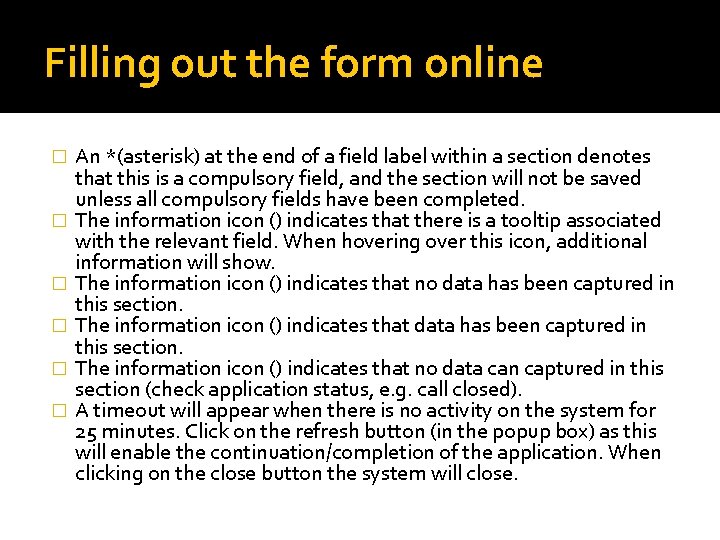
Filling out the form online � � � An *(asterisk) at the end of a field label within a section denotes that this is a compulsory field, and the section will not be saved unless all compulsory fields have been completed. The information icon () indicates that there is a tooltip associated with the relevant field. When hovering over this icon, additional information will show. The information icon () indicates that no data has been captured in this section. The information icon () indicates that no data can captured in this section (check application status, e. g. call closed). A timeout will appear when there is no activity on the system for 25 minutes. Click on the refresh button (in the popup box) as this will enable the continuation/completion of the application. When clicking on the close button the system will close.
Registration and login If you are a new user or have never used a previous NRF online system, log on to the NRF Online Submission system (https: //nrfsubmission. nrf. ac. za/Nrf. Mk. II/Default. aspx) and complete all the required fields (indicated with *) in order to submit your registration. You can use the password you created on previous NRF systems or you can create a password that is at least 6 characters long, contains small letters, capital letters and numerals. Please type a password which meets these requirements and which you will remember. If you do not have an alternative email address, please leave the field blank and do not enter anything, such as N/A. The fields indicated with are searchable fields. To avoid having to search through the full list, simply type one keyword into the field provided. The results will appear in the drop-down list. Kindly note that this registration process should be completed only once. After you have successfully registered, login to the system (https: //nrfsubmission. nrf. ac. za/Nrf. Mk. II/Default. aspx) by using the ID/passport number and password you provided. � If you have already registered on the previous systems (NRF Online and Interim), please use your existing login details to access this system. � If you have already registered but have forgotten your password, please click on the Forgotten Password link on the left-hand menu. Enter your ID/Passport/Unique Number in the block provided. Instructions on how to reset your password will be sent to your primary email address captured on the system. Before the email is sent, the relevant email address will be displayed to you for verification. Please click on Support should this email address be incorrect. �
UCT Internal review �Closing date: Week 3 -7 November 2014. �Applications reviewed by panel of specialists. �Feedback provided during Dec/early Jan, with option to meet with panel member. �Final submission date: 15 February. �All applications must be reviewed internally, prior to submission to the NRF. �Research Office submits applications to the NRF.
Contacts �Robert. Morrell@uct. ac. za or x 2433 �Paul Dantu@uct. ac. za or x 1954 �Research Office: 2 Rhodes Ave, Mowbray � 2014 Documents will be made available for download from http: //www. researchoffice. uct. ac. za/nrf_ratin gs/overview/
- Slides: 23