
NRCS Environmental Compliance and the NRCSCPA52 Jeff Combs
NRCS Environmental Compliance and the NRCS-CPA-52 Jeff Combs Biologist, Environmental Compliance Bozeman, MT 1
PRESENTATION OBJECTIVES • Overview: NEPA and the NRCS • Completing the NRCS-CPA-52 • Questions and Answers 2
Acknowledgements • Meg Bishop, WNTSC, Ret • Mathew Judy, CNTC • Montana Area Biologists 3
NEPA and NRCS – An Overview • All NRCS planning activities will be conducted in compliance with NEPA • NEPA will be incorporated into all steps and activities of the planning process and should not be considered as a separate process or requirement • (7 CFR Part 650) • (GM 190, parts 410. 7 and 410. 8) • NECH 4
National Environmental Policy Act ¯Effective January 1, 1970 ¯Procedural Act (vs. Regulatory e. g. , ESA) 5
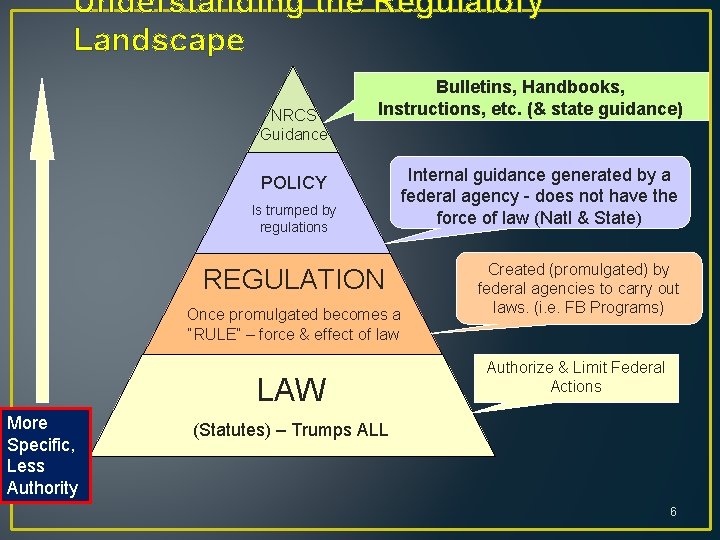
Understanding the Regulatory Landscape NRCS Guidance Bulletins, Handbooks, Instructions, etc. (& state guidance) POLICY Is trumped by regulations Internal guidance generated by a federal agency - does not have the force of law (Natl & State) REGULATION Once promulgated becomes a “RULE” – force & effect of law LAW More Specific, Less Authority Created (promulgated) by federal agencies to carry out laws. (i. e. FB Programs) Authorize & Limit Federal Actions (Statutes) – Trumps ALL 6
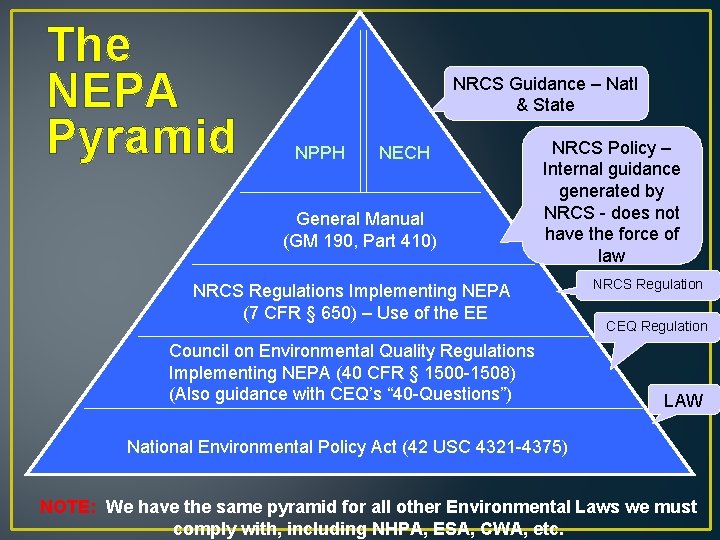
The NEPA Pyramid NRCS Guidance – Natl & State NPPH NECH General Manual (GM 190, Part 410) NRCS Policy – Internal guidance generated by NRCS - does not have the force of law NRCS Regulations Implementing NEPA (7 CFR § 650) – Use of the EE Council on Environmental Quality Regulations Implementing NEPA (40 CFR § 1500 -1508) (Also guidance with CEQ’s “ 40 -Questions”) NRCS Regulation CEQ Regulation LAW National Environmental Policy Act (42 USC 4321 -4375) NOTE: We have the same pyramid for all other Environmental Laws we must comply with, including NHPA, ESA, CWA, etc.
The NEPA Mandate ¯To Protect and Enhance the QUALITY of the HUMAN environment (includes all SWAPA+H+E). ¯It requires all federal agencies to take into account the environmental impact of the actions they propose. 8
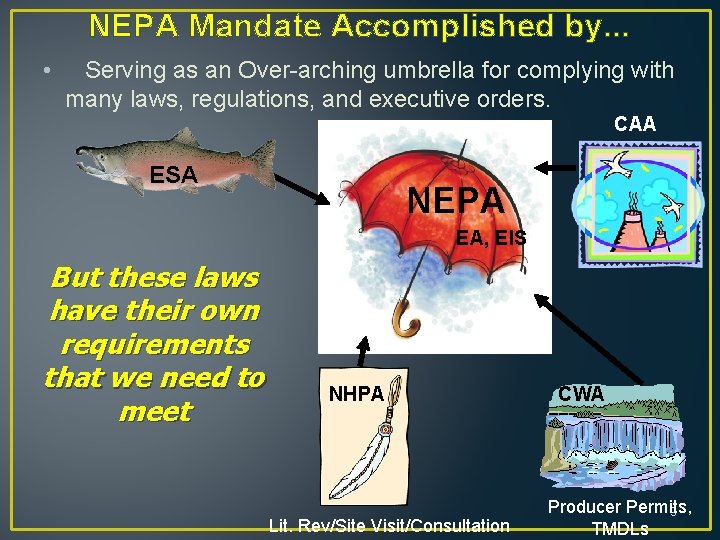
NEPA Mandate Accomplished by. . . • Serving as an Over-arching umbrella for complying with many laws, regulations, and executive orders. CAA ESA NEPA EA, EIS But these laws have their own requirements that we need to meet NHPA Lit. Rev/Site Visit/Consultation CWA Producer Permits, 9 TMDLs
Important Elements of NEPA ¯Public Disclosure of Federal Actions ¯Presentation of Appropriate Range of Alternatives (at least 2 – “No Action” and “Proposed Action”) ¯Interagency Coordination (as appropriate) ¯Public Participation (as appropriate, e. g. scoping under EIS) 10
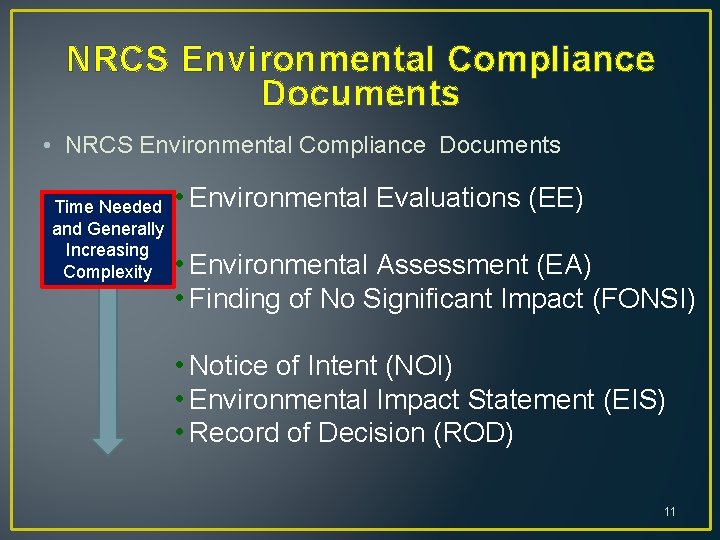
NRCS Environmental Compliance Documents • NRCS Environmental Compliance Documents Time Needed and Generally Increasing Complexity • Environmental Evaluations (EE) • Environmental Assessment (EA) • Finding of No Significant Impact (FONSI) • Notice of Intent (NOI) • Environmental Impact Statement (EIS) • Record of Decision (ROD) 11
Enforcement ¯NRCS can be sued in federal court to stop action by arguing that NRCS did not follow procedures required by NEPA ¯NEPA does require that the proper procedures are followed when considering the effects of our actions on the environment. ¯NEPA does not require NRCS to take the most environmentally proper action. ¯However, NRCS policies require us to take actions which avoid, minimize, or mitigate adverse effects. 12
When Does NEPA Apply? NEPA applies whenever a federal agency proposes to take a “major federal action” that may significantly affect the quality of the human environment. OK, so what is “Major”? ? • Major Action = “Significant”, therefore, an action must be analyzed in several contexts with respect to the intensity or severity of its impact. 13
“Federal Actions” that Trigger NEPA • And What is a “Federal Action”? ? • Federal Actions = Federal Control and/or Responsibility • Financed/Funded • Approved/Authorized • Assisted • Conducted • Regulated 14
“Federal Actions” do NOT include: ¯Situations where NRCS is ONLY providing technical assistance (CTA) because we have no control over what the client will do with it. HOWEVER. . ¯NRCS Policy – complete a CPA-52 as a part of EVERY planning activity, regardless of whether it is a federal action under NEPA. 15
For Example, a CPA-52 is Required for: • • • Individual Conservation Plans for All Programs Area-wide & Watershed Planning Grant Funding (e. g. , CIGs) Conservation Activity Plans (CAPs) New SNOTEL sites, Plant Material Facilities, etc. Propagation & Release of Plant Materials EWP Damage Survey Reports (DSRs) NRCS-assisted programs w/ FSA (e. g. , CRP, etc. ) CUAs on WRP Easements Others. . . 16
The CPA-52, Its Not Just a NEPA Thing. . . • Integrates environmental concerns throughout the planning, installation, and operation of NRCS-assisted projects • Used for all planning actions • Decision tool for Landowner 17
The 52. . Worthy of Due Diligence • Unique to NRCS and FSA (project specific EAs and EISs for other agencies) • Assists landowner with conservation decisions • Always open to public scrutiny and lawsuits • You, and the landowner, can be held personally liable for violation of any of the laws covered under the NEPA umbrella 18

OK, ITS TIME TO WRITE YOUR FIRST CPA-52. . RELAX, IT’S ALREADY WRITTEN! (well. . . mostly) 19
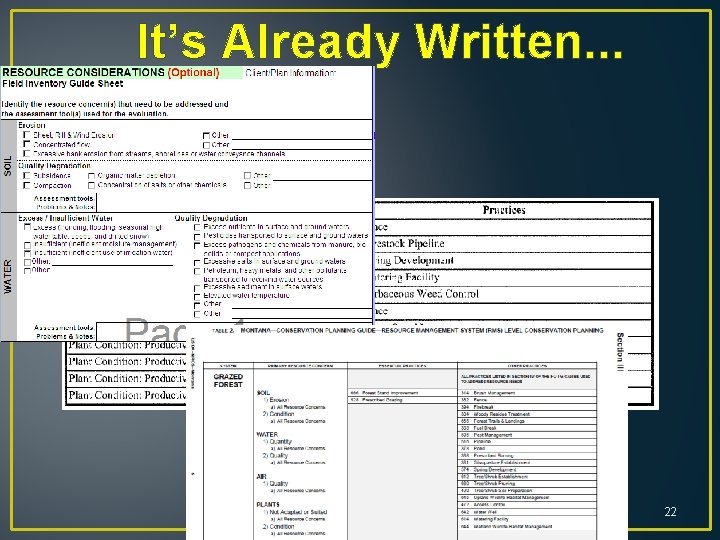
It’s Already Written. . . ¯Coincides with Planning Steps 1 -7 and information already contained in the project file. ¯Project Narrative ¯Assessment Documents ¯Analysis Documents ¯Also, Many Tools and Tables to Help 20
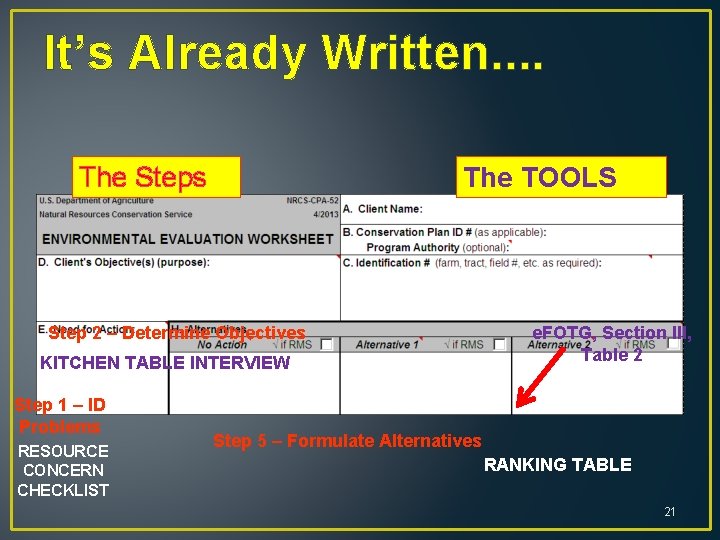
It’s Already Written. . The Steps The TOOLS Step 2 – Determine Objectives KITCHEN TABLE INTERVIEW Step 1 – ID Problems RESOURCE CONCERN CHECKLIST e. FOTG, Section III, Table 2 Step 5 – Formulate Alternatives RANKING TABLE 21
It’s Already Written. . . 22
No Action Alternative ¯The “no action” alternative must always be included in the review and is required by NEPA. ¯The no action alternative is the predicted future condition if “no action” by NRCS is implemented (but what will the landowner due in absence of our assistance? ? ) ¯Think in terms of starting at the baseline and extending into the foreseeable future 23
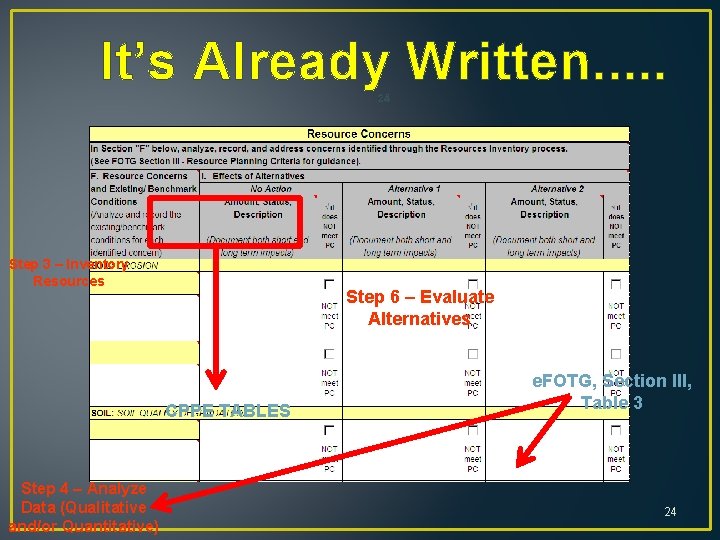
It’s Already Written. . . 24 Step 3 – Inventory Resources Step 6 – Evaluate Alternatives CPPE TABLES Step 4 – Analyze Data (Qualitative and/or Quantitative) e. FOTG, Section III, Table 3 24
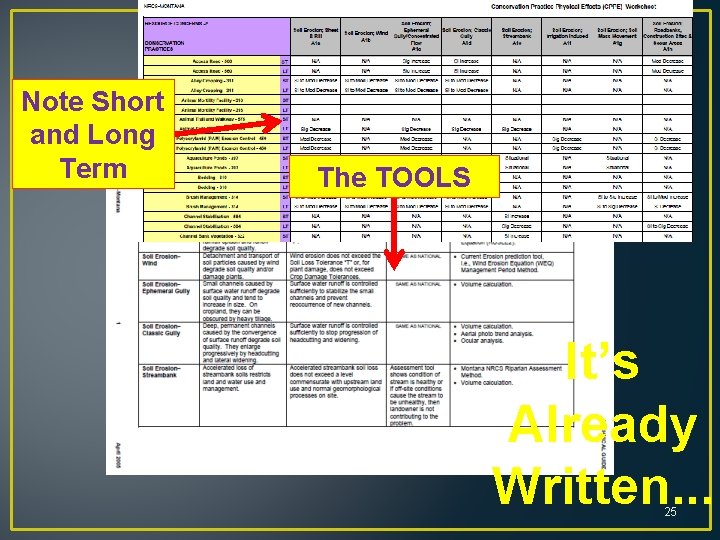
Note Short and Long Term The TOOLS It’s Already Written. . . 25
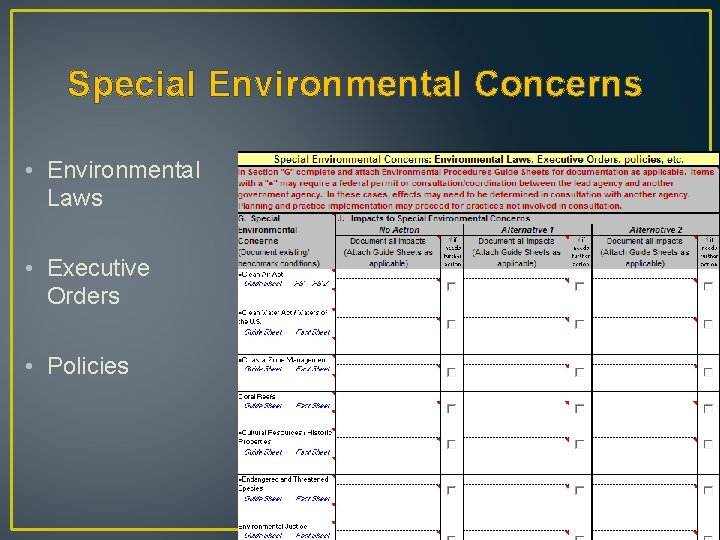
Special Environmental Concerns • Environmental Laws • Executive Orders • Policies 26
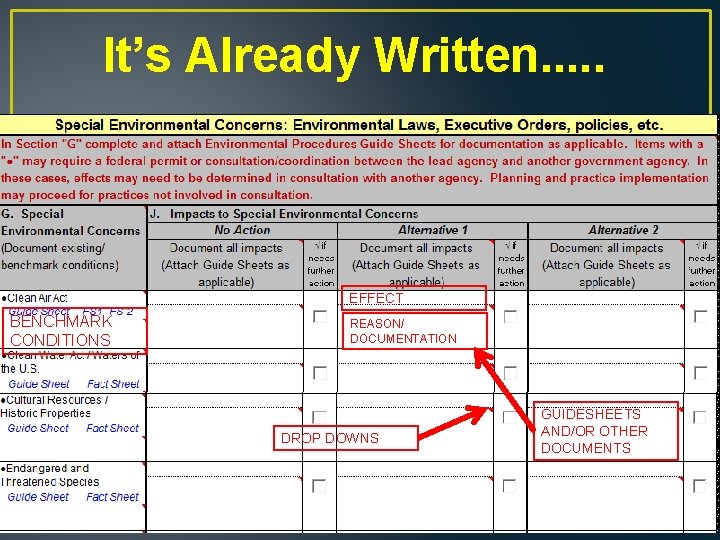
It’s Already Written. . . EFFECT BENCHMARK CONDITIONS REASON/ DOCUMENTATION DROP DOWNS GUIDESHEETS AND/OR OTHER DOCUMENTS 27
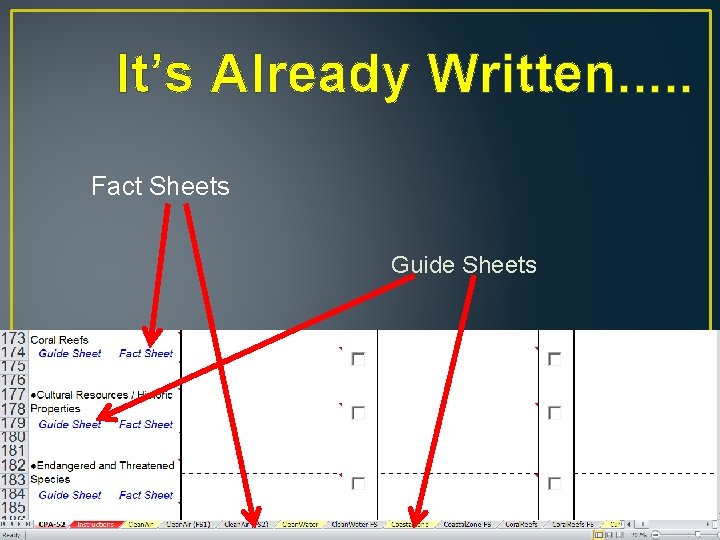
It’s Already Written. . . Fact Sheets Guide Sheets 28
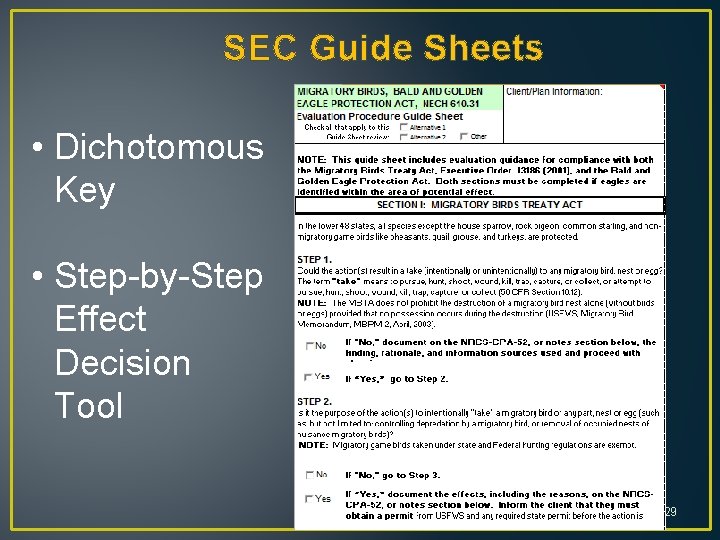
SEC Guide Sheets • Dichotomous Key • Step-by-Step Effect Decision Tool 29
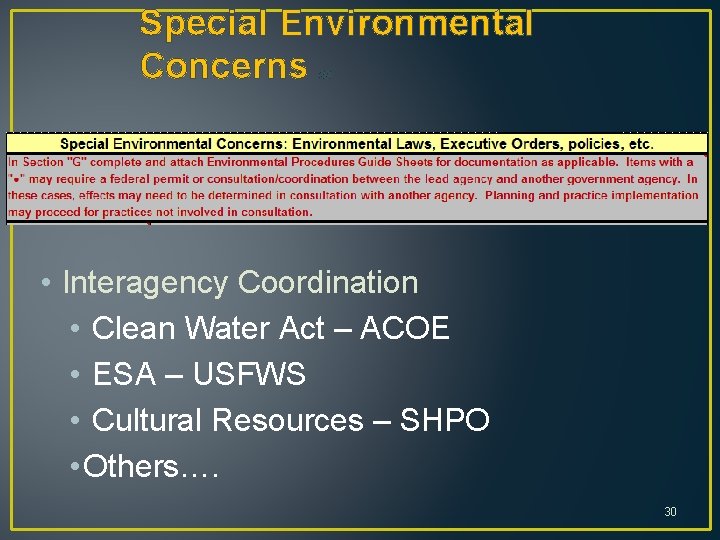
Special Environmental Concerns 30 • Interagency Coordination • Clean Water Act – ACOE • ESA – USFWS • Cultural Resources – SHPO • Others…. 30
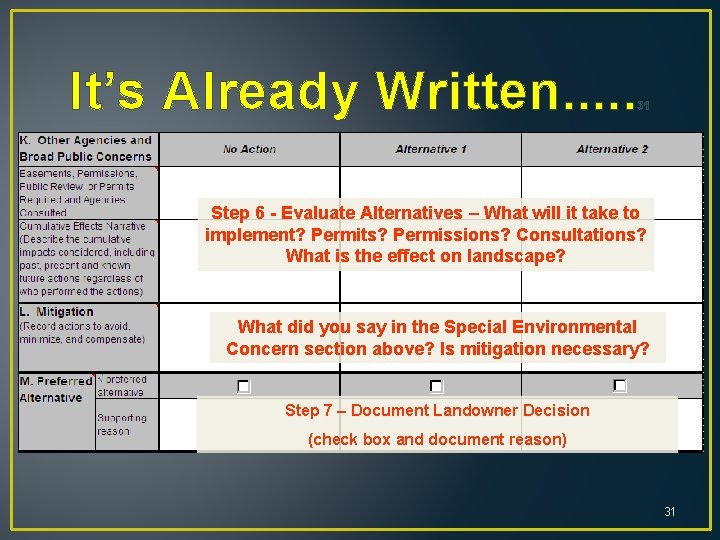
It’s Already Written. . . 31 Step 6 - Evaluate Alternatives – What will it take to implement? Permits? Permissions? Consultations? What is the effect on landscape? What did you say in the Special Environmental Concern section above? Is mitigation necessary? Step 7 – Document Landowner Decision (check box and document reason) 31
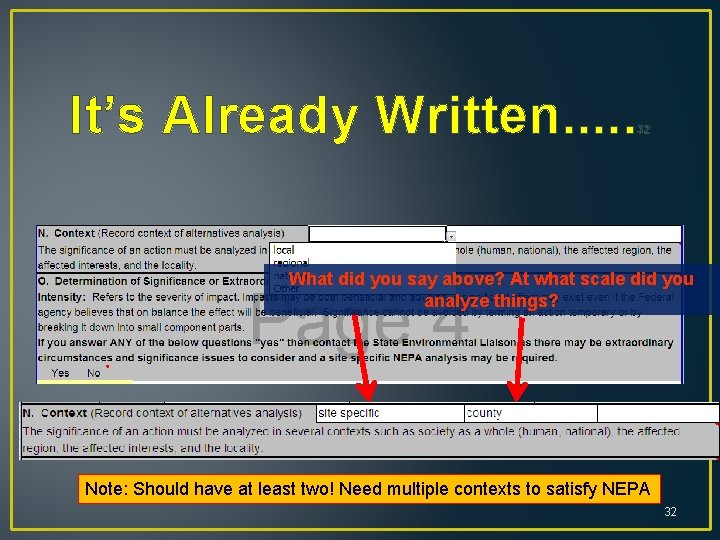
It’s Already Written. . . 32 What did you say above? At what scale did you analyze things? Note: Should have at least two! Need multiple contexts to satisfy NEPA 32
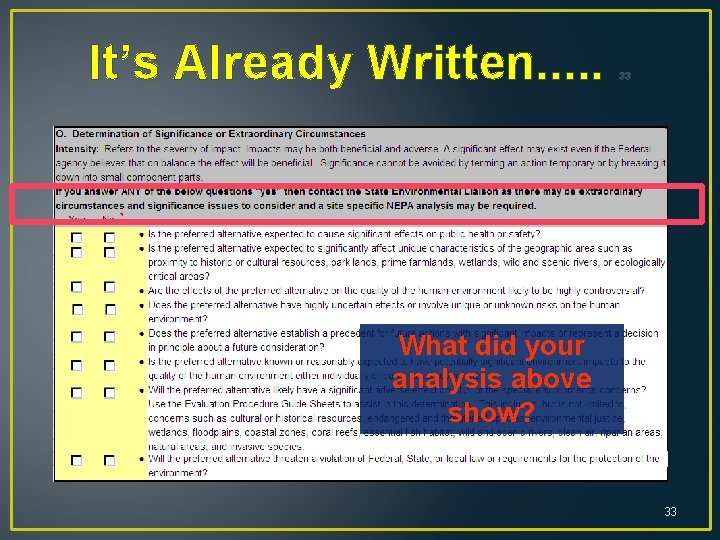
It’s Already Written. . . 33 What did your analysis above show? 33
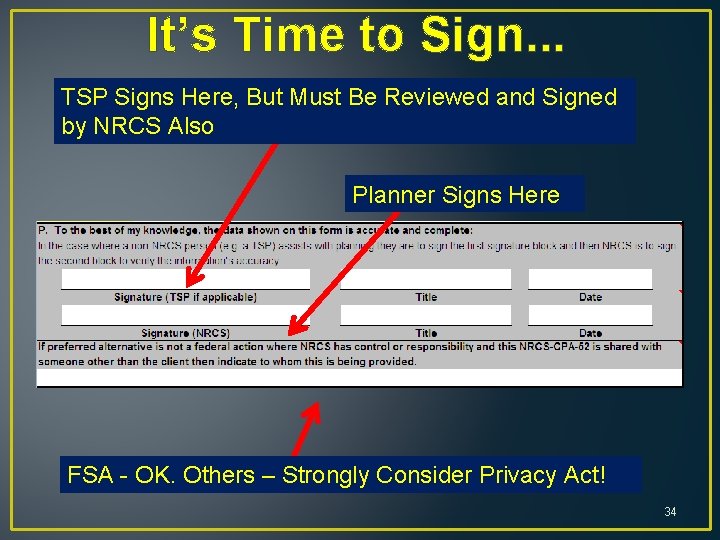
It’s Time to Sign. . . TSP Signs Here, But Must Be Reviewed and Signed by NRCS Also Planner Signs Here FSA - OK. Others – Strongly Consider Privacy Act! 34
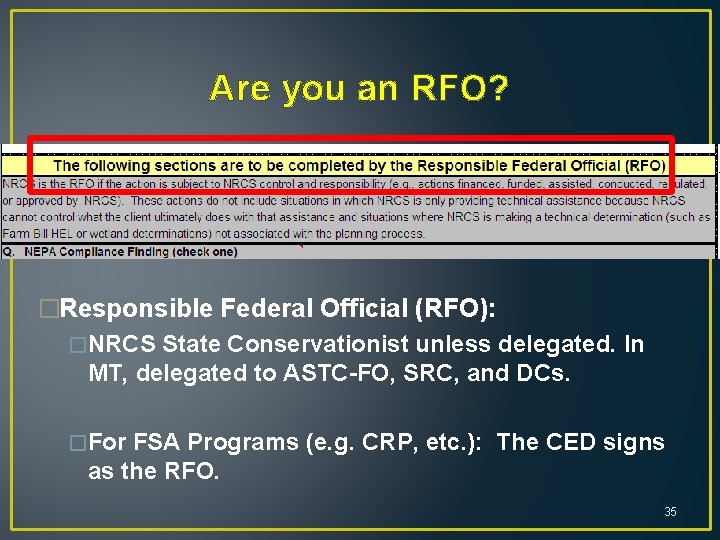
Are you an RFO? �Responsible Federal Official (RFO): �NRCS State Conservationist unless delegated. In MT, delegated to ASTC-FO, SRC, and DCs. �For FSA Programs (e. g. CRP, etc. ): The CED signs as the RFO. 35
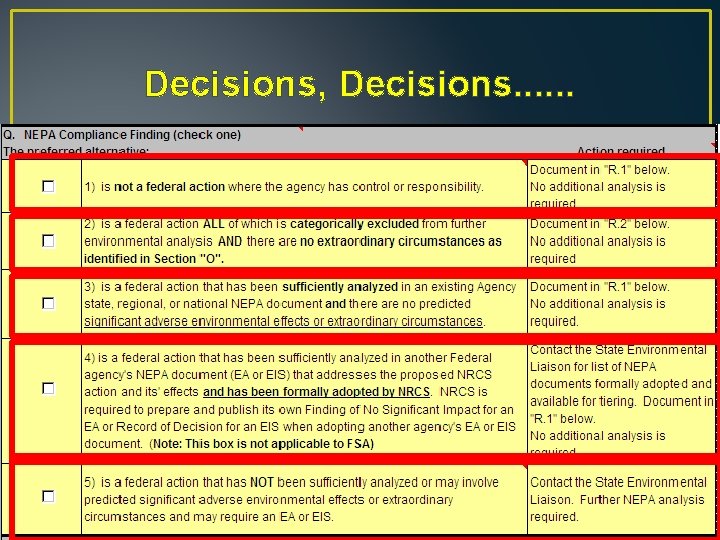
Decisions, Decisions. . . 36
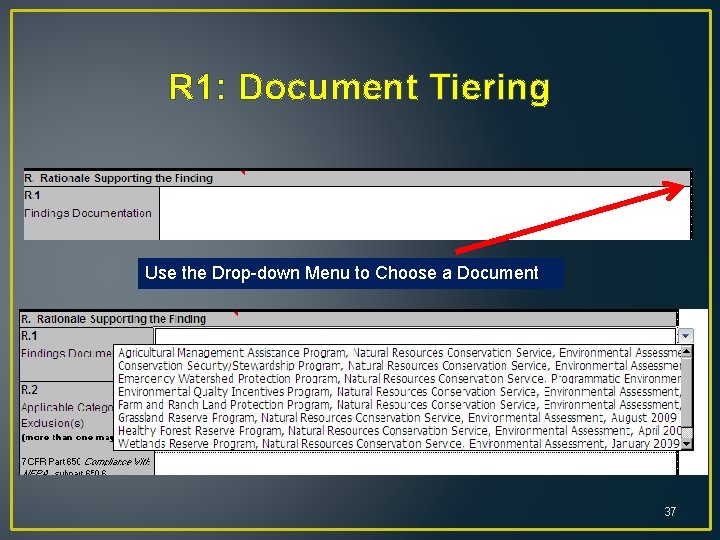
R 1: Document Tiering Use the Drop-down Menu to Choose a Document 37
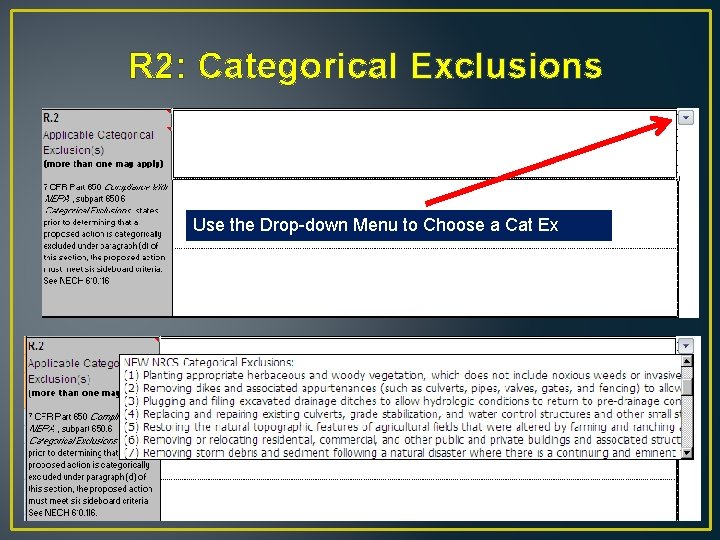
R 2: Categorical Exclusions Use the Drop-down Menu to Choose a Cat Ex 38
NRCS Categorical Exclusions • A Cat Ex is defined as “a category of actions which do not individually or cumulatively have a significant effect on the human environment. . . and. . . for which, therefore, neither an environmental assessment nor an environmental impact statement is required. ” (40 CFR 1508. 4) • Preferred by NHQ as they carry more ‘legal weight’ than Programmatic EAs and EISs (i. e. , check box #2 over #3 when possible). • Caveat: Must meet “Sideboard Criteria” and test for “Extraordinary Circumstances (Section ‘O’)” 39
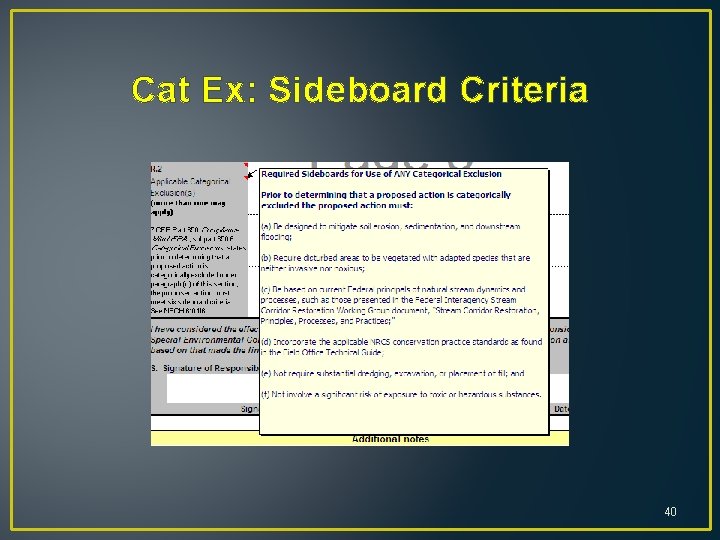
Cat Ex: Sideboard Criteria 40
When Can’t I Use Cat Exes? • Mixing Actions: Proposed plan involves actions listed as CE’s and other actions that are not CE’d – Cannot CE entire action. • Segmenting: Cannot look at actions individually if they are interdependent parts of the plan - “segmenting” an action into smaller component parts to avoid the requisite and appropriate level of 41
When Can’t I Use Cat Exes? (cont) • Additional Requirements: Need appropriate NEPA doc. For plans/activities that, according to other laws/regulations/NRCS policy, require additional analysis through an EA/EIS (e. g. , watershed planning or other conservation and easements program plans) • Adverse Impacts: When significant adverse impacts are anticipated and measures cannot be implemented to fully mitigate the impact, CE’s cannot be invoked, even if the impacts are short-term or are off-set by beneficial impacts. (This includes NRCS policy on rare, threatened, and endangered species of plants and animals; floodplain management, Clean Water Act, etc. ) 42
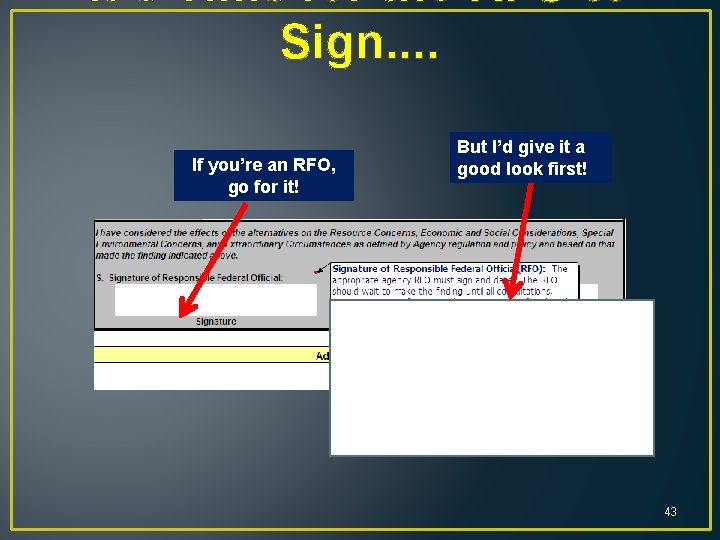
It’s Time for the RFO to Sign. . If you’re an RFO, go for it! But I’d give it a good look first! 43
Whew, I’m glad that’s over with. . Well, for now anyway. . 44
And Finally. . . When Should a 52 be Reinitiated/Revisited? • When outstanding environmental effects determinations are not being resolved as intended. • When NRCS makes “substantial changes” to the proposed action • When there is “significant new circumstances or information” 45
Questions? ? Jeff Combs Biologist, Environmental Compliance State Office Jeffrey. Combs@mt. usda. gov (406) 587 -6747 46
Non-Discrimination Policy • • • • Non-Discrimination Policy The U. S. Department of Agriculture (USDA) prohibits discrimination against its customers, employees and applicants for employment on the bases of race, color, national origin, age, disability, sex, gender identity, religion, reprisal, and where applicable, political beliefs, marital status, familial or parental status, sexual orientation, or all or part of an individual’s income is derived from any public assistance program, or protected genetic information in employment or in any program or activity conducted or funded by the Department. (Not all prohibited bases apply to all programs and/or employment activities. ) To File an Employment Complaint If you wish to file an employment complaint, you must contact your agency’s EEO Counselor within 45 days of the date of the alleged discriminatory act, event, or in the case of a personnel action. Additional information can be found online at http: //www. ascr. usda. gov/complaint_filing_file. html. To File a Program Complaint If you wish to file a Civil Rights program complaint of discrimination, complete the USDA Program Discrimination Complaint Form, found online at http: //www. ascr. usda. gov/complaint_filing_cust. html, or at any USDA office, or call (866) 632 -9992 to request the form. You may also write a letter containing all of the information requested in the form. Send your completed complaint form or letter to us by mail at U. S. Department of Agriculture, Director, Office of Adjudication, 1400 Independence Avenue, S. W. , Washington, D. C. 20250 -9419, by fax at (202) 690 -7442, or email at program. intake@usda. gov. Persons with Disabilities Individuals who are deaf, hard of hearing or have speech disabilities and you wish to file either an EEO or program complaint please contact USDA through the Federal Relay Service at (800) 877 -8339 or (800) 845 -6136 (in Spanish). Persons with disabilities, who wish to file a program complaint, please see information above on how to contact us by mail or by email. If you require alternative means of communication for program information (e. g. , Braille, large print, audiotape, etc. ), please contact USDA’s TARGET Center at (202) 720 -2600 (voice and TDD). Supplemental Nutrition Assistance Program For any other information dealing with Supplemental Nutrition Assistance Program (SNAP) issues, persons should either contact the USDA SNAP Hotline Number at (800) 221 -5689, which is also in Spanish, or call the State Information/Hotline Numbers. All Other Inquiries For any other information not pertaining to civil rights, please refer to the listing of the USDA Agencies and Offices. 47
- Slides: 47