
NQC Program Structure n 3 types of code
- Slides: 8
NQC Program Structure n 3 types of code blocks with their own features and limitations u 1. Tasks u 2. Subroutines u 3. Inline Functions
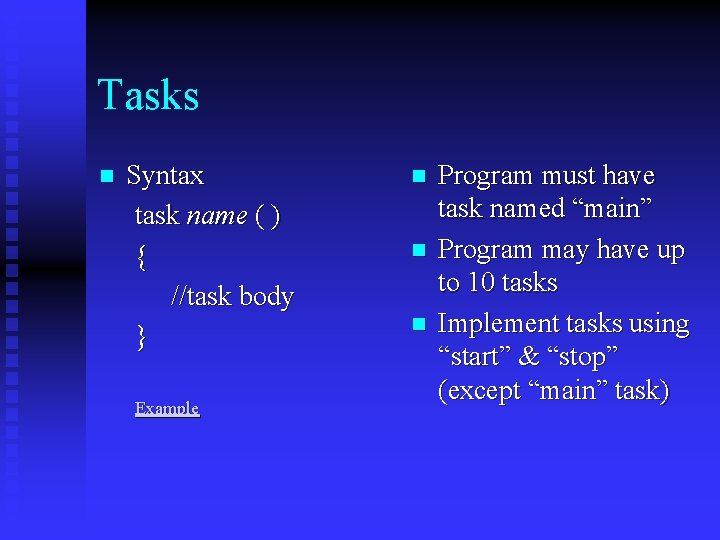
Tasks n Syntax task name ( ) { //task body } Example n n n Program must have task named “main” Program may have up to 10 tasks Implement tasks using “start” & “stop” (except “main” task)
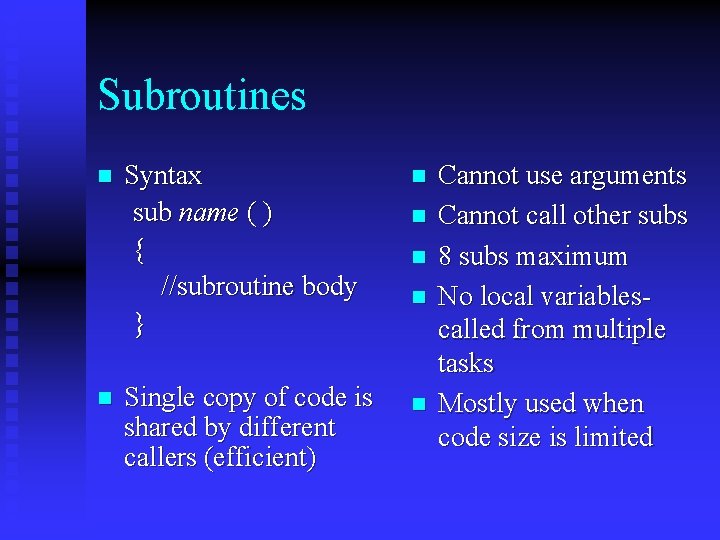
Subroutines n n Syntax sub name ( ) { //subroutine body } Single copy of code is shared by different callers (efficient) n n n Cannot use arguments Cannot call other subs 8 subs maximum No local variablescalled from multiple tasks Mostly used when code size is limited
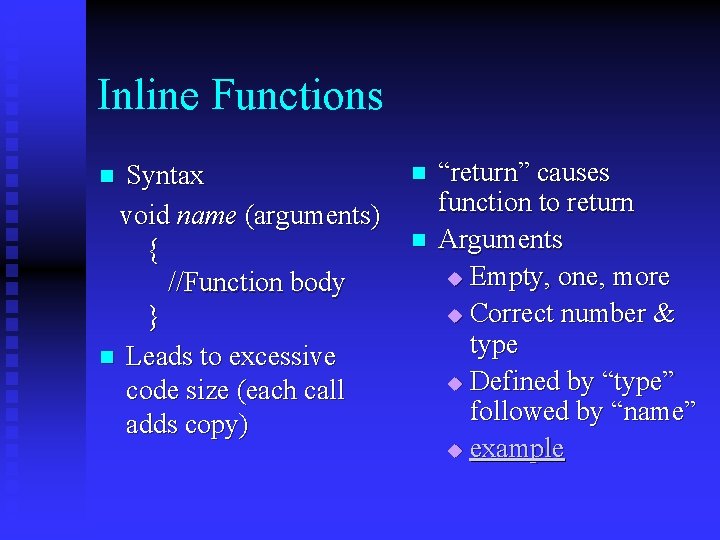
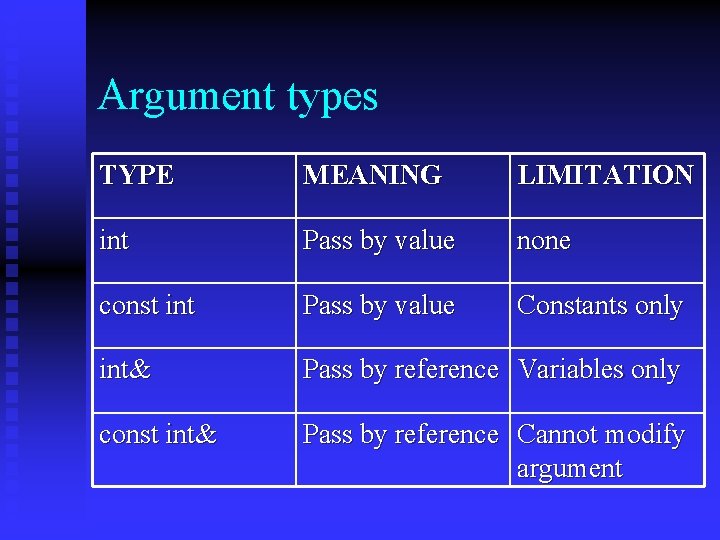
Inline Functions Syntax void name (arguments) { //Function body } n Leads to excessive code size (each call adds copy) n n n “return” causes function to return Arguments u Empty, one, more u Correct number & type u Defined by “type” followed by “name” u example
Argument types TYPE MEANING LIMITATION int Pass by value none const int Pass by value Constants only int& Pass by reference Variables only const int& Pass by reference Cannot modify argument
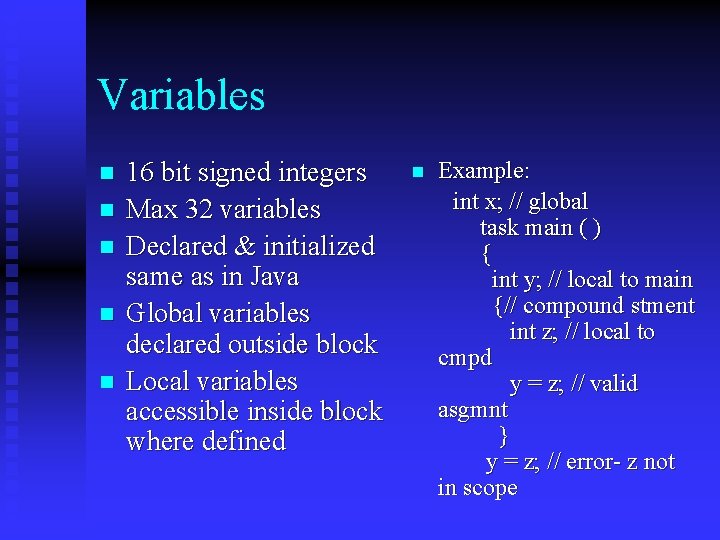
Variables n n n 16 bit signed integers Max 32 variables Declared & initialized same as in Java Global variables declared outside block Local variables accessible inside block where defined n Example: int x; // global task main ( ) { int y; // local to main {// compound stment int z; // local to cmpd y = z; // valid asgmnt } y = z; // error- z not in scope
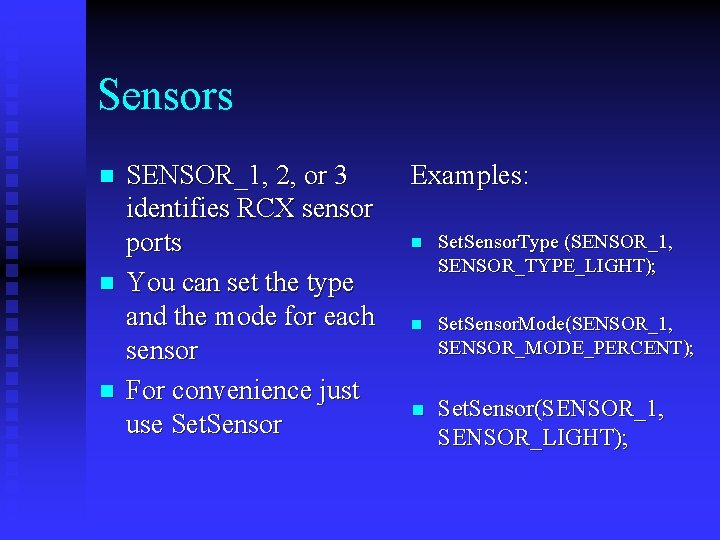
Sensors n n n SENSOR_1, 2, or 3 identifies RCX sensor ports You can set the type and the mode for each sensor For convenience just use Set. Sensor Examples: n Set. Sensor. Type (SENSOR_1, SENSOR_TYPE_LIGHT); n Set. Sensor. Mode(SENSOR_1, SENSOR_MODE_PERCENT); n Set. Sensor(SENSOR_1, SENSOR_LIGHT);
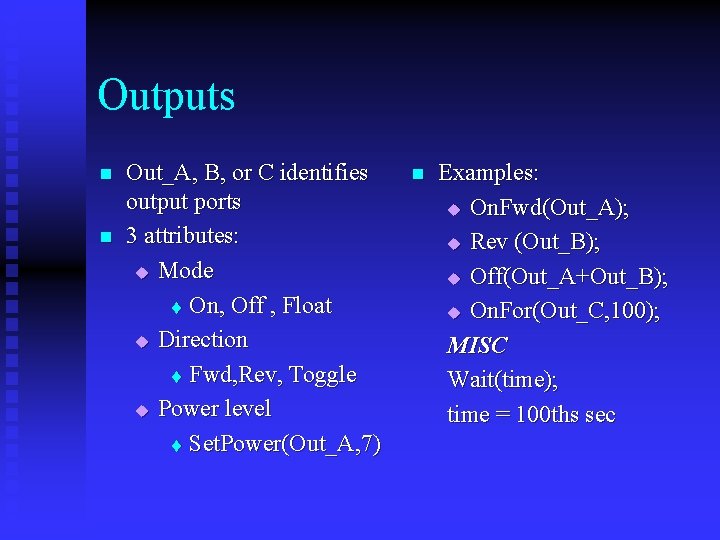
Outputs n n Out_A, B, or C identifies output ports 3 attributes: u Mode t On, Off , Float u Direction t Fwd, Rev, Toggle u Power level t Set. Power(Out_A, 7) n Examples: u On. Fwd(Out_A); u Rev (Out_B); u Off(Out_A+Out_B); u On. For(Out_C, 100); MISC Wait(time); time = 100 ths sec