
NPV and other Investment Criteria Capital Budgeting Decisions
NPV and other Investment Criteria Capital Budgeting Decisions Financial management: lecture 6
Today’s agenda l l Net Present Value (revisit) Other two investment rules Financial management: lecture 6
Net Present Value rule (NPV) l l l NPV is the present value of a project minus its cost If NPV is greater than zero, the firm should go ahead to invest; otherwise forget about this project A hidden assumption: there is no budget constraint or money constraint. Financial management: lecture 6
NPV (continue) In other words: Managers can increase shareholders’ wealth by accepting all projects that are worth more than they cost. Therefore, they should accept all projects with a positive net present value if there is no budget constraint. Financial management: lecture 6
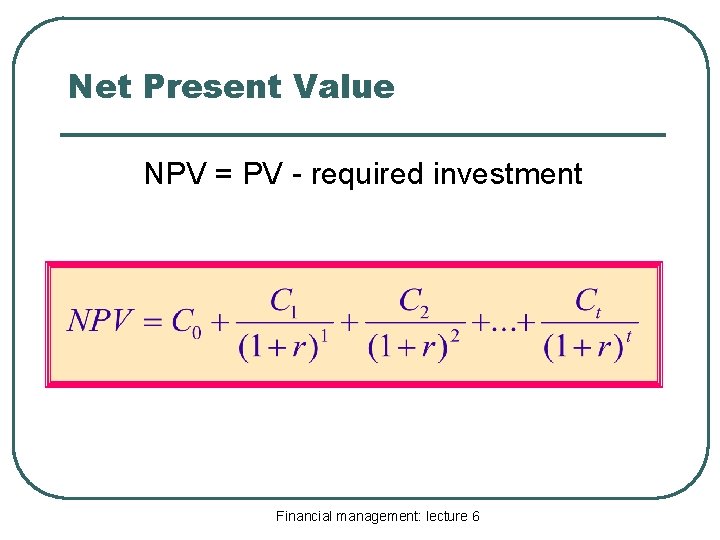
Net Present Value NPV = PV - required investment Financial management: lecture 6
An Example l l An oil well, if explored, can now produce 100, 000 barrels per year. The well will produce forever, but production will decline by 4% per year. Oil prices, however, will increase by 2% per year. The discount rate is 8%. Suppose that the price of oil now is $14 for barrel. If the cost of oil exploration is $12. 8 million, do you want to take this project? Financial management: lecture 6
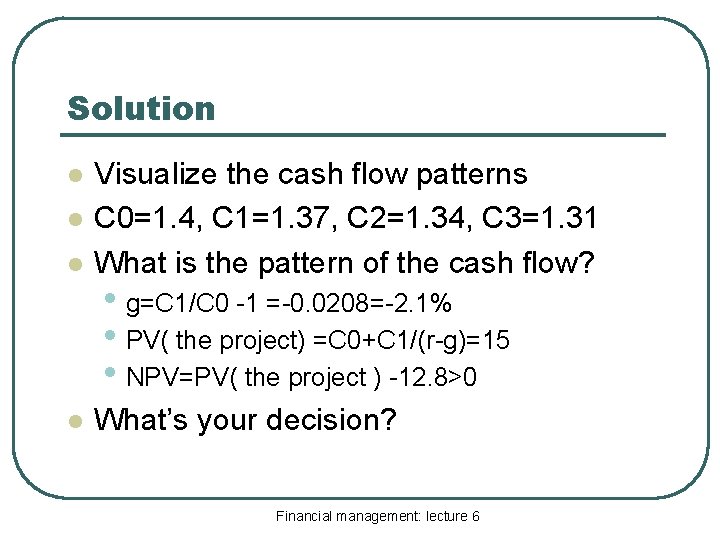
Solution l Visualize the cash flow patterns C 0=1. 4, C 1=1. 37, C 2=1. 34, C 3=1. 31 What is the pattern of the cash flow? l What’s your decision? l l • g=C 1/C 0 -1 =-0. 0208=-2. 1% • PV( the project) =C 0+C 1/(r-g)=15 • NPV=PV( the project ) -12. 8>0 Financial management: lecture 6
Two other investment rules l l IRR rule Payback period rule Financial management: lecture 6
IRR rule Internal Rate of Return (IRR) – Single discount rate at which NPV = 0. IRR rule - Invest in any project offering a IRR that is higher than the opportunity cost of capital or the discount rate. Financial management: lecture 6
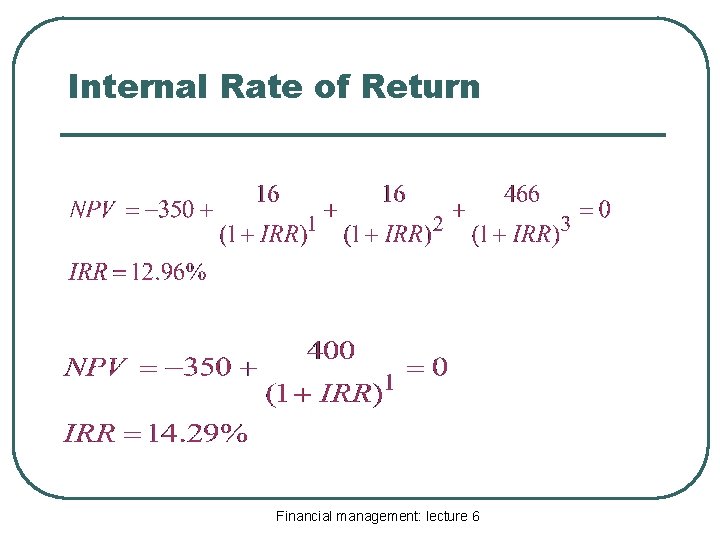
IRR rule Example You can purchase a building for $350, 000. The investment will generate $16, 000 in cash flows (i. e. rent) during the first three years. At the end of three years you will sell the building for $450, 000. What is the IRR on this investment? Financial management: lecture 6
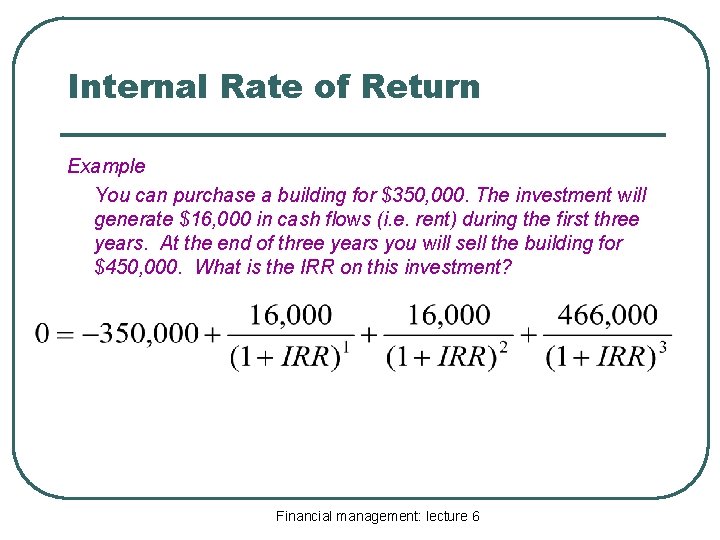
Internal Rate of Return Example You can purchase a building for $350, 000. The investment will generate $16, 000 in cash flows (i. e. rent) during the first three years. At the end of three years you will sell the building for $450, 000. What is the IRR on this investment? Financial management: lecture 6
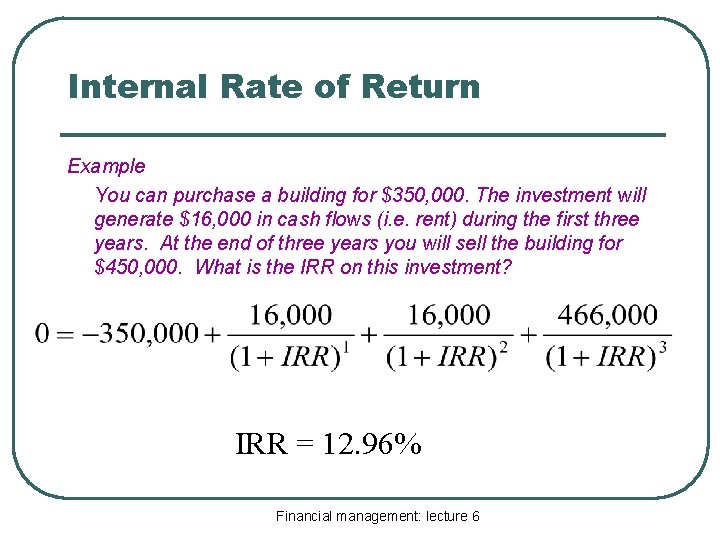
Internal Rate of Return Example You can purchase a building for $350, 000. The investment will generate $16, 000 in cash flows (i. e. rent) during the first three years. At the end of three years you will sell the building for $450, 000. What is the IRR on this investment? IRR = 12. 96% Financial management: lecture 6
Internal Rate of Return IRR=12. 96% Financial management: lecture 6
What’s wrong with IRR? Pitfall 1 - Mutually Exclusive Projects l IRR sometimes ignores the magnitude of the project. l The following two projects illustrate that problem. Example You have two proposals to choose between. The initial proposal (H) has a cash flow that is different from the revised proposal (I). Using IRR, which do you prefer? Financial management: lecture 6
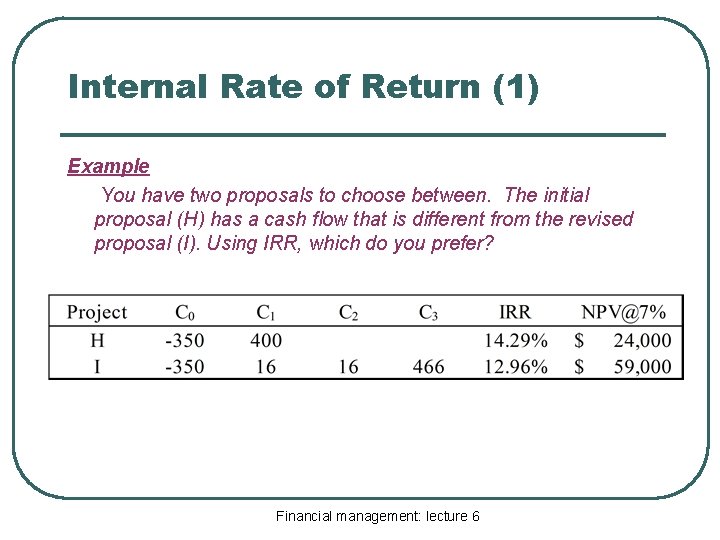
Internal Rate of Return (1) Example You have two proposals to choose between. The initial proposal (H) has a cash flow that is different from the revised proposal (I). Using IRR, which do you prefer? Financial management: lecture 6
Internal Rate of Return Financial management: lecture 6
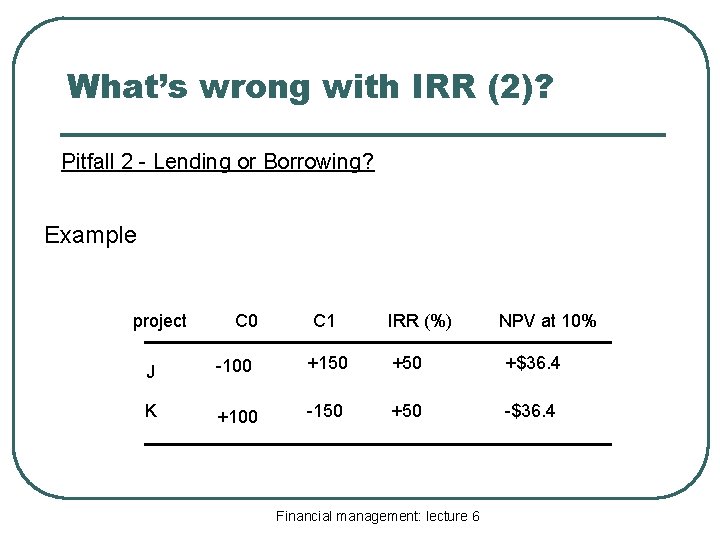
What’s wrong with IRR (2)? Pitfall 2 - Lending or Borrowing? Example project C 0 C 1 IRR (%) NPV at 10% J -100 +150 +$36. 4 K +100 -150 +50 -$36. 4 Financial management: lecture 6
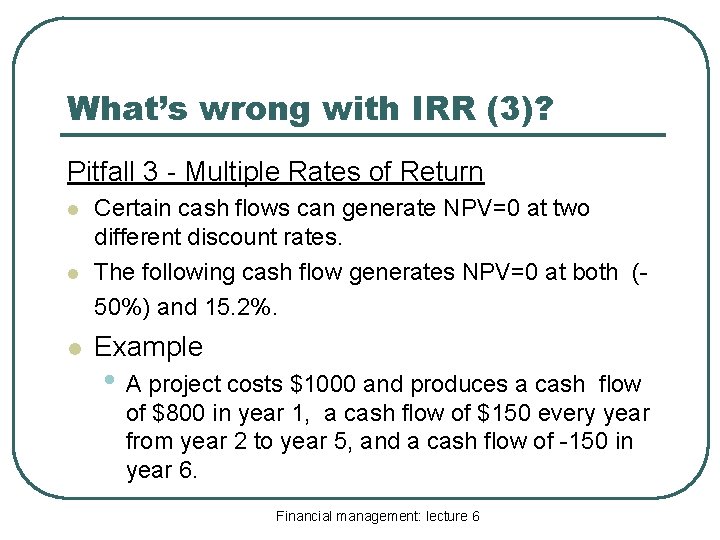
What’s wrong with IRR (3)? Pitfall 3 - Multiple Rates of Return l l l Certain cash flows can generate NPV=0 at two different discount rates. The following cash flow generates NPV=0 at both (50%) and 15. 2%. Example • A project costs $1000 and produces a cash flow of $800 in year 1, a cash flow of $150 every year from year 2 to year 5, and a cash flow of -150 in year 6. Financial management: lecture 6
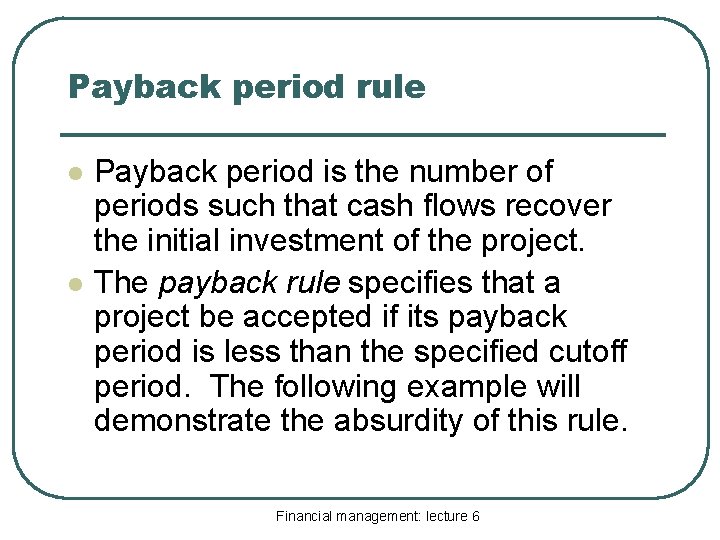
Payback period rule l l Payback period is the number of periods such that cash flows recover the initial investment of the project. The payback rule specifies that a project be accepted if its payback period is less than the specified cutoff period. The following example will demonstrate the absurdity of this rule. Financial management: lecture 6
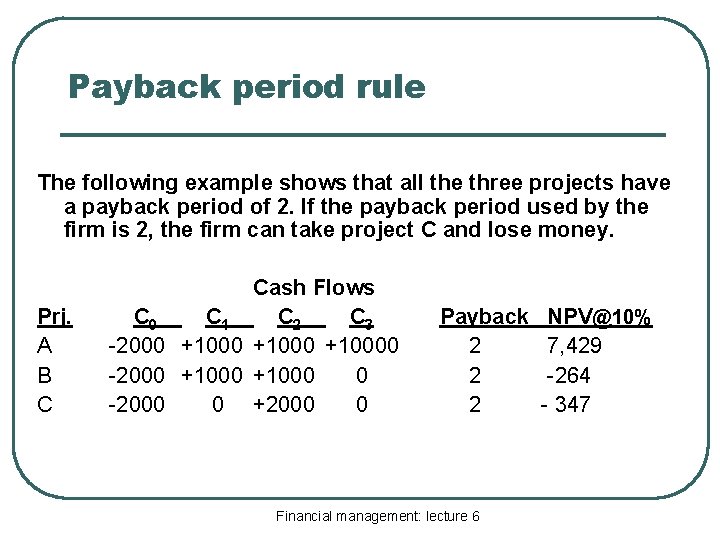
Payback period rule The following example shows that all the three projects have a payback period of 2. If the payback period used by the firm is 2, the firm can take project C and lose money. Prj. A B C Cash Flows C 0 C 1 C 2 C 3 -2000 +10000 -2000 +1000 0 -2000 0 +2000 0 Payback 2 2 2 Financial management: lecture 6 NPV@10% 7, 429 -264 - 347
- Slides: 20