
NPPO ESTABLISHMENT Module 2 IPPC Contracting Parties and
NPPO ESTABLISHMENT Module 2 IPPC Contracting Parties and National Plant Protection Organizations
Module 2 What will I learn? § What is an NPPO? § What is a contracting party? § What is the legal basis for establishing an NPPO? § What are the obligations, responsibilities, rights and benefits of IPPC contracting parties?
What is an NPPO? An NPPO is the ‘Official service established by a government to discharge the functions specified by the IPPC (FAO, 1990; formerly national plant protection organization)’ § The NPPO is the competent and legally responsible body for carrying out the functions outlined in the new revised text of the IPPC (Article IV).
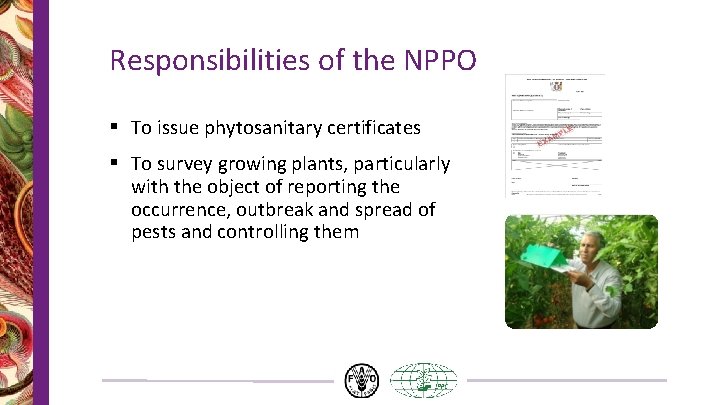
Responsibilities of the NPPO § To issue phytosanitary certificates § To survey growing plants, particularly with the object of reporting the occurrence, outbreak and spread of pests and controlling them
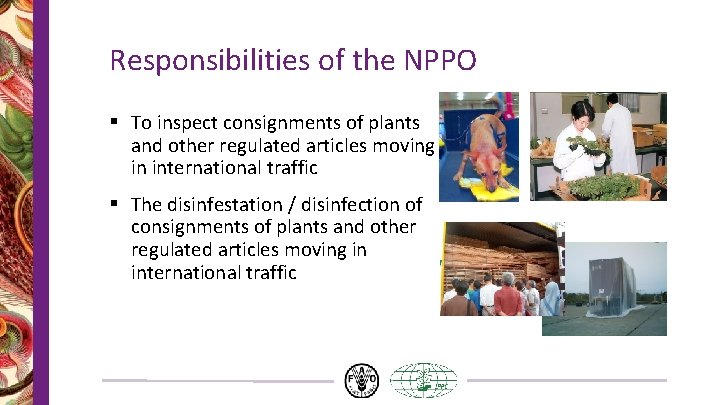
Responsibilities of the NPPO § To inspect consignments of plants and other regulated articles moving in international traffic § The disinfestation / disinfection of consignments of plants and other regulated articles moving in international traffic
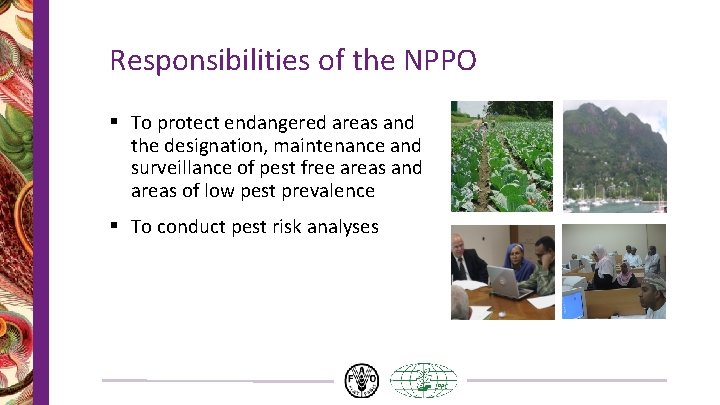
Responsibilities of the NPPO § To protect endangered areas and the designation, maintenance and surveillance of pest free areas and areas of low pest prevalence § To conduct pest risk analyses
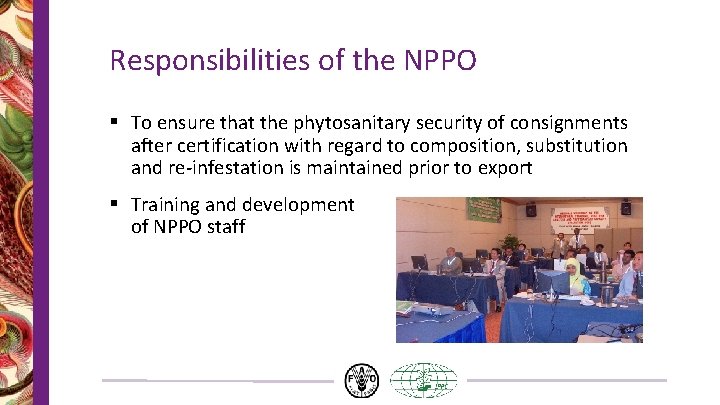
Responsibilities of the NPPO § To ensure that the phytosanitary security of consignments after certification with regard to composition, substitution and re-infestation is maintained prior to export § Training and development of NPPO staff
Contracting parties § Contracting parties are countries / governments that have ratified the IPPC and have accepted the new revised text (1997) of the IPPC. § Contracting parties are required to establish an NPPO as the competent body responsible for national plant protection.
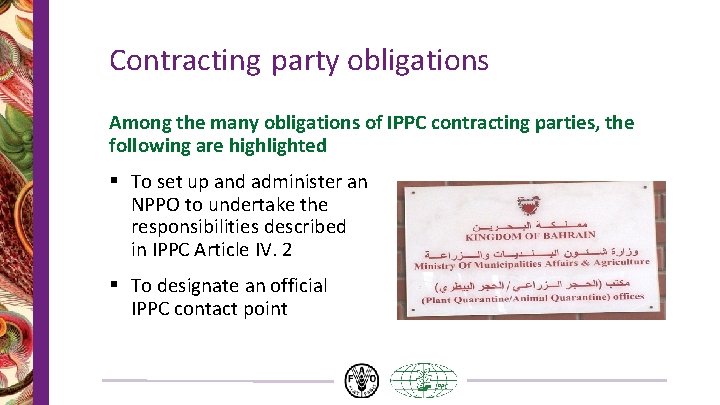
Contracting party obligations Among the many obligations of IPPC contracting parties, the following are highlighted § To set up and administer an NPPO to undertake the responsibilities described in IPPC Article IV. 2 § To designate an official IPPC contact point
Contracting party obligations § To submit a description of the NPPO and of any changes in that organization to the IPPC Secretariat § To provide a description of the NPPO’s organizational arrangements for plant protection to another contracting party, upon request § To perform other functions as required for implementing the IPPC
Contracting party obligations § To issue phytosanitary regulations § Contracting parties shall not require phytosanitary measures for non-regulated pests § To distribute information on regulated pests and the means of their prevention and control § To carry out research and investigation in the field of plant protection
Contracting party obligations § To conduct surveillance for pests and develop and maintain adequate information on pest status in order to support regulatory categorization of pests and the development of appropriate phytosanitary measures § To publish and transmit phytosanitary requirements, restrictions and prohibitions to any other contracting party or parties that they believe may be directly affected by such measures
Contracting party obligations § To make available the rationale for phytosanitary requirements, restrictions and prohibitions to any contracting party upon request § To respect the model phytosanitary certificate as set out in the IPPC § To require that additional declarations are technically justified
Rights of contracting parties Contracting parties have the sovereign right to regulate, in accordance with IPPC principles. This includes: § Prescribing and adopting phytosanitary measures concerning imports § Refusing entry or detaining or requiring treatment, destruction or removal of consignments that do not comply with phytosanitary measures § Prohibiting or restricting the movement of regulated pests, biological control agents and organisms claimed to be beneficial into their territories
Benefits for contracting parties § Increased efficacy in preventing the introduction and spread of pests § Consistency with the WTO SPS Agreement § Most major trading partners and WTO members are contracting parties to the IPPC § Increased credibility of national phytosanitary systems for trading partners
Benefits for contracting parties § Direct and active input into processes of global harmonization, particularly in the development of ISPMs § Opportunities to interact with other international agreements related to trade and environment (e. g. WTO SPS Agreement, CBD, CITES).
Exercise 2. 1 Is there an officially designated NPPO in your country? Do you have an official contact point as required by the IPPC? To what extent and how is your NPPO represented at the Commission on Phytosanitary Measures?
Exercise 2. 2 Consider the responsibilities of an NPPO as defined by the IPPC § Does your NPPO perform all of the defined responsibilities? § Are any responsibilities undertaken by authorized third party service providers?
- Slides: 18