
NPO roles and responsibility in poverty alleviation employment
NPO roles and responsibility in poverty alleviation, employment creation, service and community empowerment NPO WEBINAR 03 NOVEMBER 2020 BUILDING A CARING SOCIETY. TOGETHER. www. dsd. gov. za
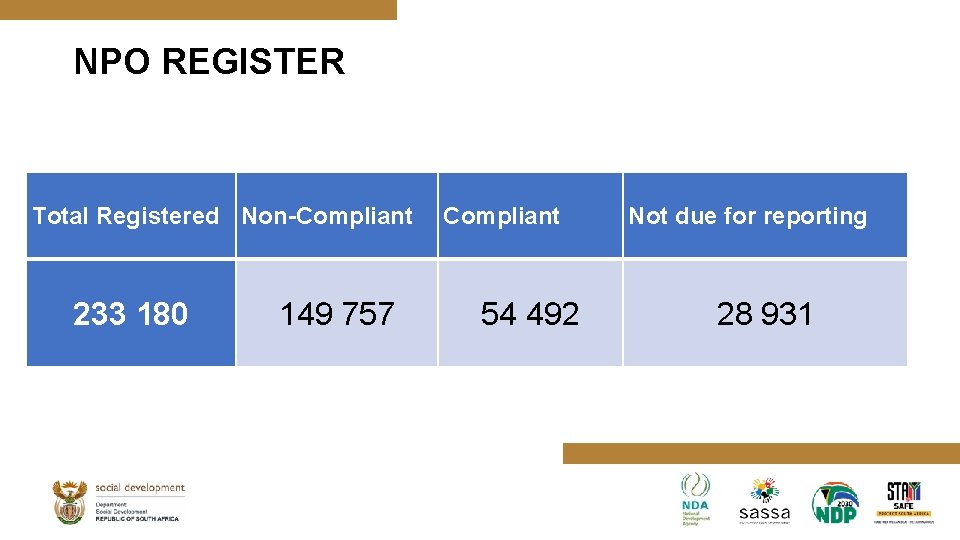
NPO REGISTER Total Registered Non-Compliant 233 180 149 757 Compliant 54 492 Not due for reporting 28 931
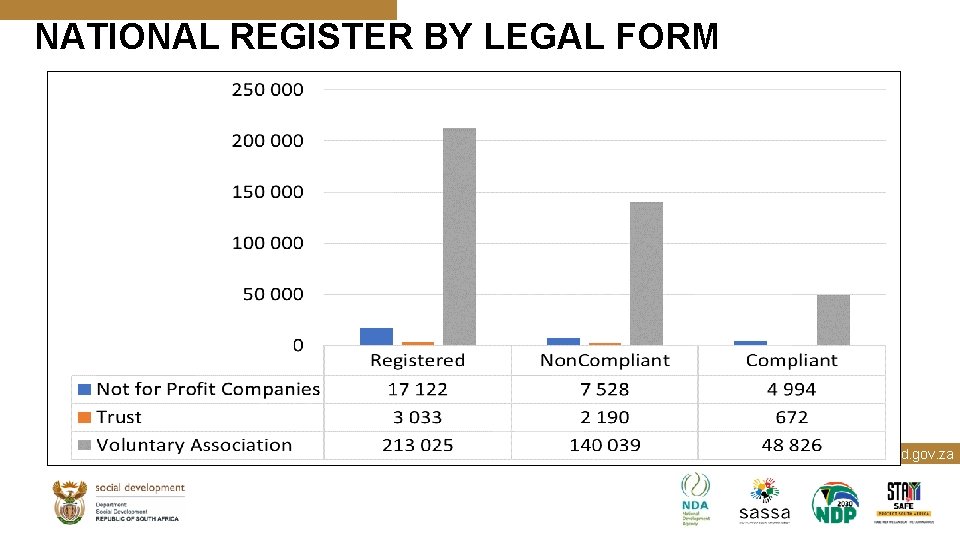
NATIONAL REGISTER BY LEGAL FORM BUILDING A CARING SOCIETY. TOGETHER. www. dsd. gov. za
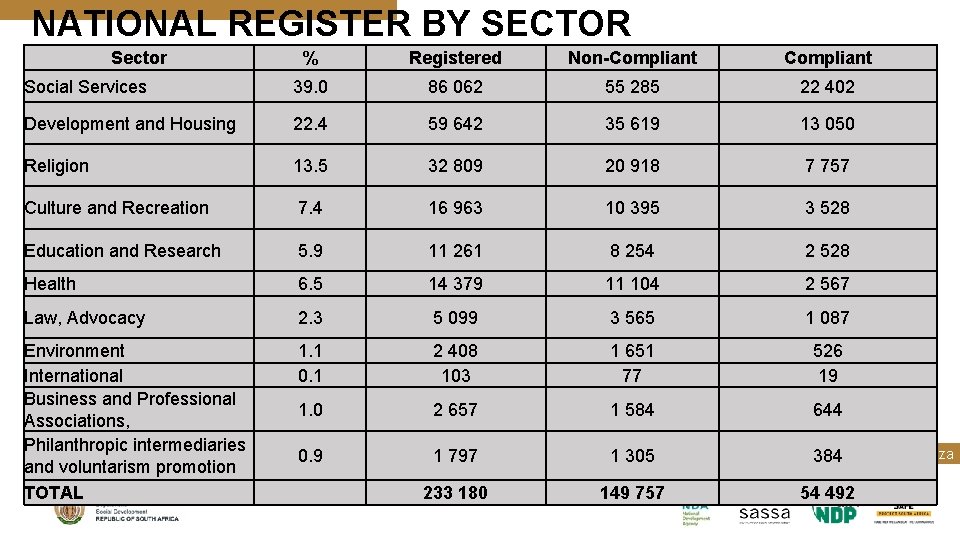
NATIONAL REGISTER BY SECTOR Sector % Registered Non-Compliant Social Services 39. 0 86 062 55 285 22 402 Development and Housing 22. 4 59 642 35 619 13 050 Religion 13. 5 32 809 20 918 7 757 Culture and Recreation 7. 4 16 963 10 395 3 528 Education and Research 5. 9 11 261 8 254 2 528 Health 6. 5 14 379 11 104 2 567 Law, Advocacy 2. 3 5 099 3 565 1 087 2 408 103 1 651 77 526 19 2 657 1 584 644 1 797 1 305 384 233 180 149 757 54 492 Environment 1. 1 International 0. 1 Business and Professional 1. 0 Associations, Philanthropic intermediaries B U I L D I N G 0. 9 A CARING and voluntarism promotion TOTAL SOCIETY. TOGETHER. www. dsd. gov. za
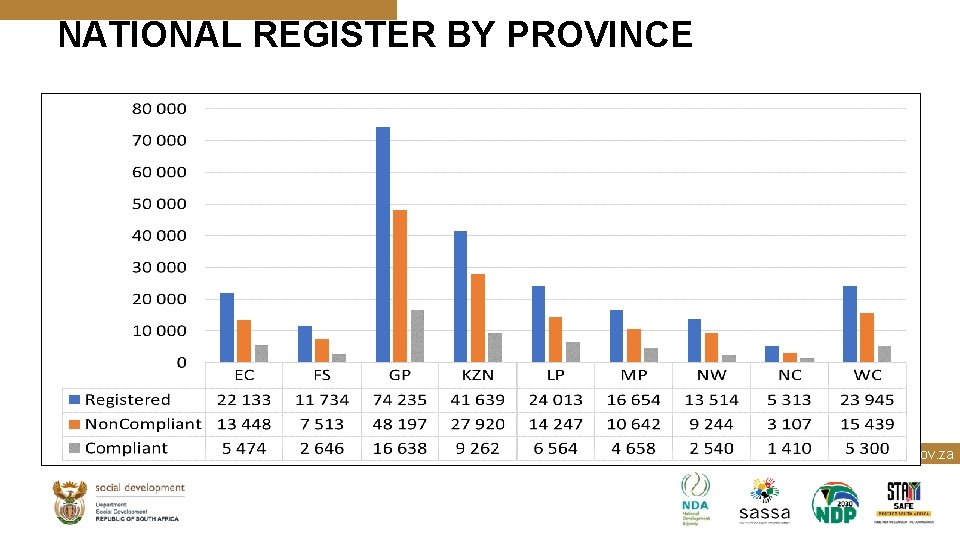
NATIONAL REGISTER BY PROVINCE BUILDING A CARING SOCIETY. TOGETHER. www. dsd. gov. za
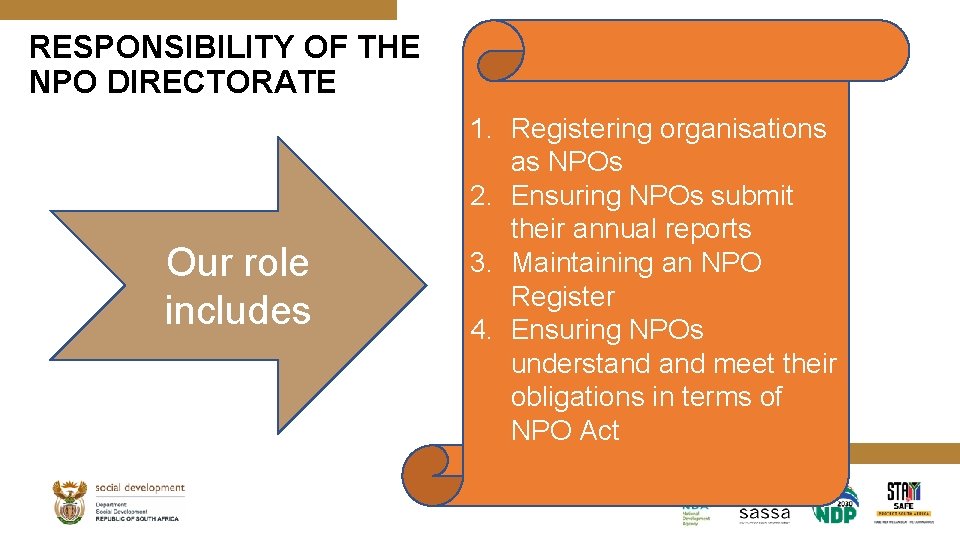
RESPONSIBILITY OF THE NPO DIRECTORATE Our role includes 1. Registering organisations as NPOs 2. Ensuring NPOs submit their annual reports 3. Maintaining an NPO Register 4. Ensuring NPOs understand meet their obligations in terms of NPO Act
THE IMPORTANCE AND ROLE OF NPOS IN SOUTH AFRICA • NPOs in South Africa promote developmental programmes such as social services, education, environment, research, advocacy and good governance etc. • Promote community empowerment and contribute to building healthy communities. • NPOs contribute to socio-economic stability and mobility although very limited (NPOs participate in employment creation)
A STRONG NONPROFIT SECTOR IS KEY TO THRIVING COMMUNITIES • Non-profit organisations (NPOs) have played a critical part in trying to resolve the challenges and inequalities prevalent in South African society, but they are facing a future with increasingly limited funding and support within a fragile economy. • Traditionally the role of NPOs is associated with social development services (As demonstrated in the NPO register, the highest number of NPOs per sector are social services) • For NPOs to survive the in the new context (4 IR, COVID-19, dwindling international support) they need to adapt and find their niche in the new economy or new normal by identifying economic opportunities i. e. Economic Recovery Plan • Perhaps this evolution is needed to ensure NPOs are able to deliver more value over the longer term • NPOs cant depend only on foreign donors and government. • They must directly participate in the economy, produce products that can be used by local community and can be exported. • Can provide alternative to current business practice and cooperatives. • Remember NPOs are allowed to make profit, however the profit cant be shared amongst office bearers but should be invested back to the community
THE CHANGING ROLE OF THE NPO SECTOR • The landscape: • Prior to 1990: NPOs had a key part in defending the rights of disadvantaged communities and delivering public services such as education, health care and welfare where the apartheid state had refused to do so. • Post-1994: (transitional period), the sector followed a more conciliatory and collaborative approach, with numerous NPOs working side by side with government to draft the new constitution and develop a constitutionally aligned legislative framework. I. e. NPO Act • The funding landscape changed, too, in that resources were allocated through bilateral arrangements between the South African government and funders. This impacted on the shape and nature of the relationship between government and NPOs as well as on the capacity of NGOs. • Post-2000: NPOs increasingly focused on service delivery. The period also saw a sharp decline in funding and increasing competition for funds and impairing the sustainability of many organisations.
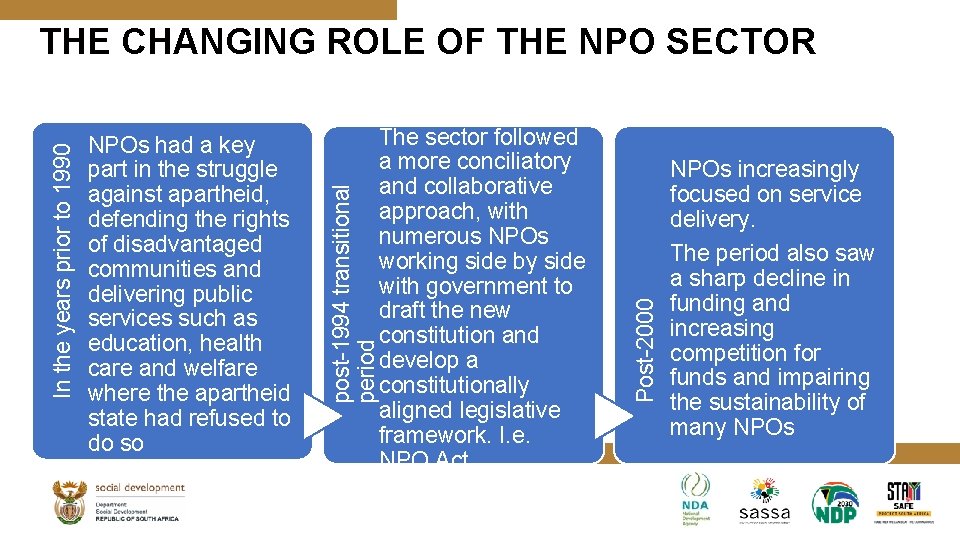
The sector followed a more conciliatory and collaborative approach, with numerous NPOs working side by side with government to draft the new constitution and develop a constitutionally aligned legislative framework. I. e. NPO Act Post-2000 NPOs had a key part in the struggle against apartheid, defending the rights of disadvantaged communities and delivering public services such as education, health care and welfare where the apartheid state had refused to do so post-1994 transitional period In the years prior to 1990 THE CHANGING ROLE OF THE NPO SECTOR NPOs increasingly focused on service delivery. The period also saw a sharp decline in funding and increasing competition for funds and impairing the sustainability of many NPOs
LINKING NPOS WITH ECONOMIC RECOVERY PLAN • A participation of the NPOs in South African economy that is aimed at stimulating equitable and inclusive growth will be ideal. • Currently; the South African economy has experienced stagnation which has put a strain in the effort to tackle the historical structural inequalities, unemployment and poverty. • There is a consensus amongst the social partners that there should be substantial structural change in the economy that would unlock growth and allow for development.
LINKING NPOS WITH ECONOMIC RECOVERY PLAN • How can NPOs locate themselves in the following areas: • Aggressive infrastructure investment; • Employment orientated strategic localization, • Energy security, particularly renewable energy • Support for tourism recovery and growth; • Gender equality and economic inclusion of women and youth; • Green economy interventions; • Mass public employment interventions; • Strengthening food security and supporting sustainable livelihoods
WHY IS THE NPO SECTOR IMPORTANT? • NPOs are close to communities, • NPs can tap into social capital, and are able to mobilise community members in support of national imperatives.
Thank you!!!!!
- Slides: 14