
NPL Quantum Metrology for Fundamental Physics Patrick Gill

- Slides: 32
NPL Quantum Metrology for Fundamental Physics Patrick Gill National Physical Laboratory, UK Quantum Sensors for Fundamental Physics St Catherine’s College, Oxford, 17 th October 2018
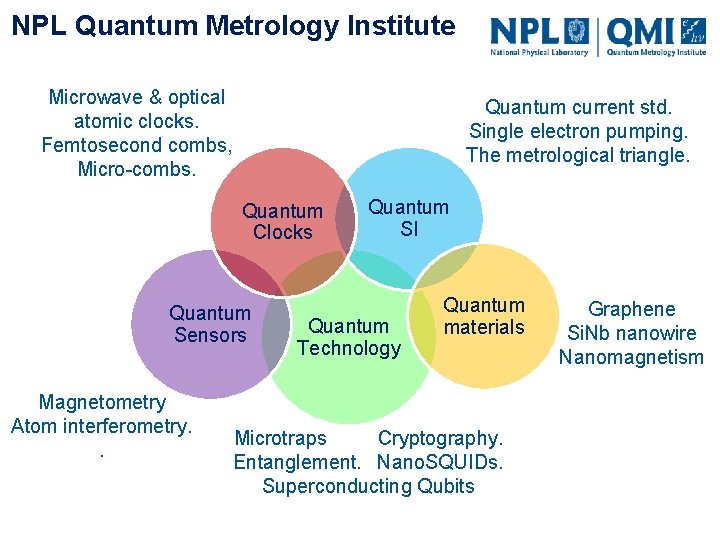
NPL Quantum Metrology Institute Microwave & optical atomic clocks. Femtosecond combs, Micro-combs. Quantum current std. Single electron pumping. The metrological triangle. Quantum Clocks Quantum Sensors Magnetometry Atom interferometry. . Quantum SI Quantum Technology Quantum materials Microtraps Cryptography. Entanglement. Nano. SQUIDs. Superconducting Qubits Graphene Si. Nb nanowire Nanomagnetism
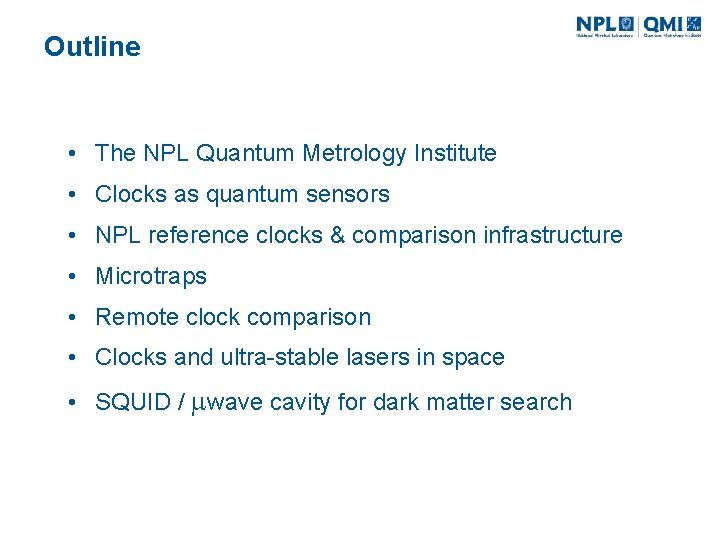
Outline • The NPL Quantum Metrology Institute • Clocks as quantum sensors • NPL reference clocks & comparison infrastructure • Microtraps • Remote clock comparison • Clocks and ultra-stable lasers in space • SQUID / wave cavity for dark matter search
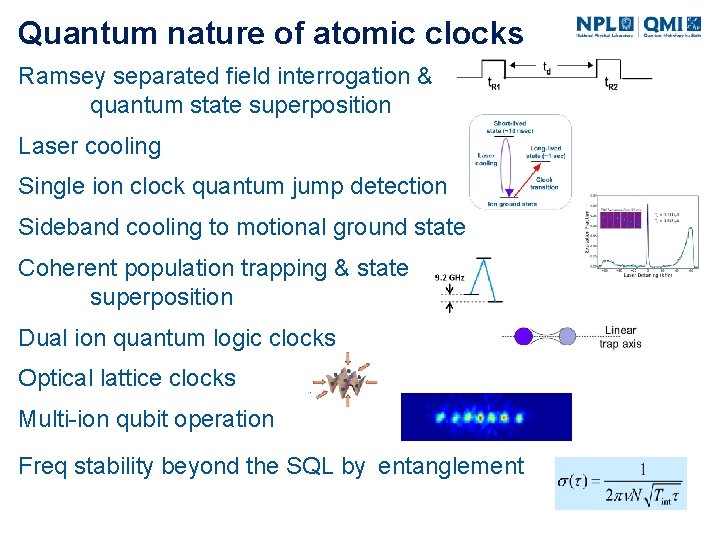
Quantum nature of atomic clocks Ramsey separated field interrogation & quantum state superposition Laser cooling Single ion clock quantum jump detection Sideband cooling to motional ground state Coherent population trapping & state superposition Dual ion quantum logic clocks Optical lattice clocks Multi-ion qubit operation Freq stability beyond the SQL by entanglement
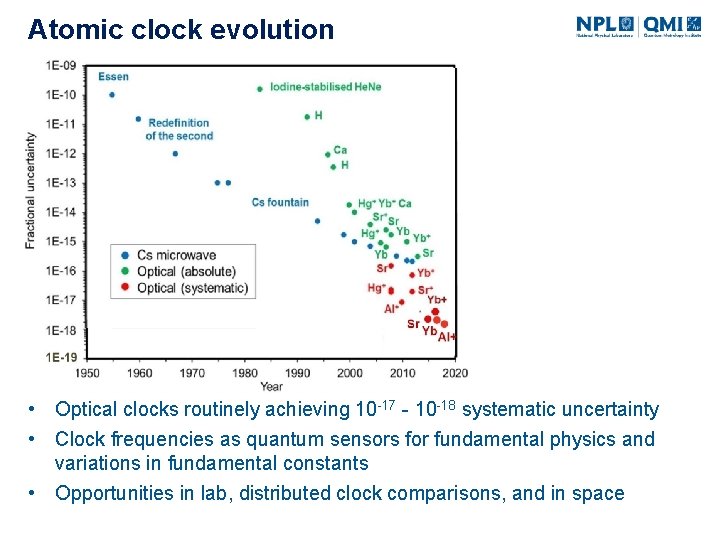
Atomic clock evolution • Optical clocks routinely achieving 10 -17 - 10 -18 systematic uncertainty • Clock frequencies as quantum sensors for fundamental physics and variations in fundamental constants • Opportunities in lab, distributed clock comparisons, and in space
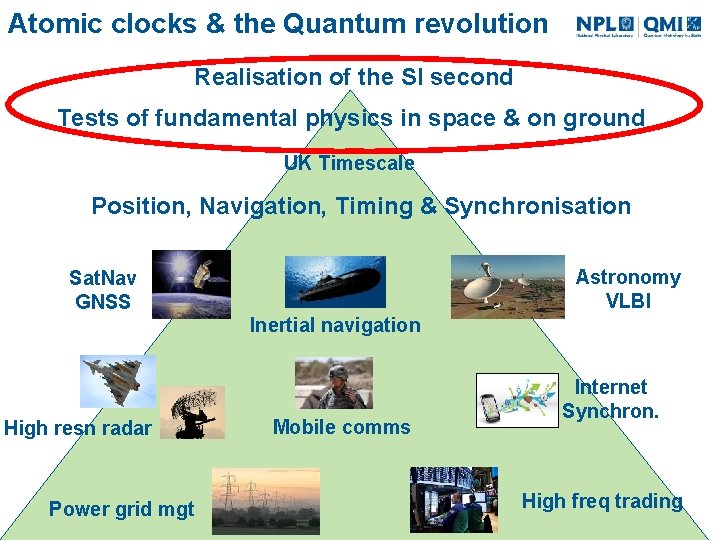
Atomic clocks & the Quantum revolution Realisation of the SI second Tests of fundamental physics in space & on ground UK Timescale Position, Navigation, Timing & Synchronisation Astronomy VLBI Sat. Nav GNSS Inertial navigation High resn radar Power grid mgt Mobile comms Internet Synchron. High freq trading
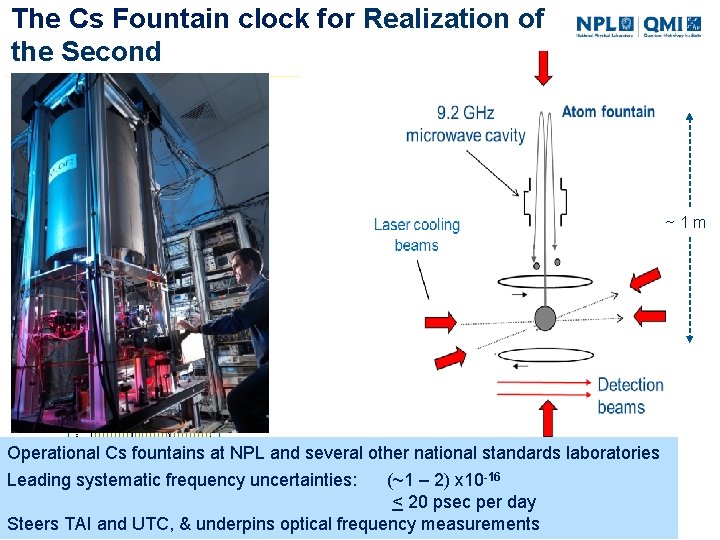
The Cs Fountain clock for Realization of the Second The second the duration Today’s best is realization of 9 192 631 770 periods cloud of Cs atoms laser to few K of thecooled radiation corresponding in magneto-optic trap Atomic fountain to the transition between cold atoms are then levels launched the two hyperfine vertically by laser light of the ground state atoms of the undergo caesium. Ramsey 133 atom. separated field excitation in microwave cavity (CGPM 1967) fraction of excited atoms are detected by laser beams 0, 9 0, 8 arbitrary units 0, 7 0, 6 0, 5 Operational Cs fountains at NPL and several other national standards laboratories 0, 4 0, 3 Leading systematic frequency uncertainties: (~1 – 2) x 10 -16 < 20 psec per day Steers TAI and UTC, & underpins optical frequency measurements 0, 2 0, 1 -1, 5 -1, 0 -0, 5 0, 0 0, 5 f - 9192631770 [Hz] 1, 0 1, 5 ~1 m
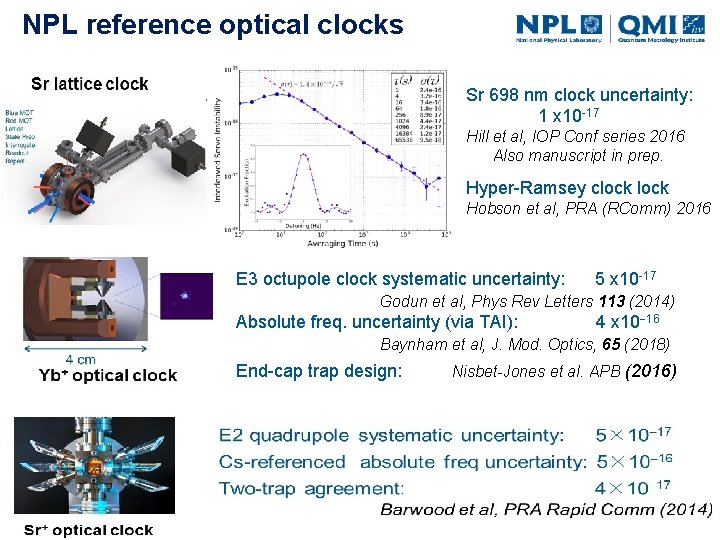
NPL reference optical clocks Sr 698 nm clock uncertainty: 1 x 10 -17 Hill et al, IOP Conf series 2016 Also manuscript in prep. Hyper-Ramsey clock Hobson et al, PRA (RComm) 2016 E 3 octupole clock systematic uncertainty: 5 x 10 -17 Godun et al, Phys Rev Letters 113 (2014) Absolute freq. uncertainty (via TAI): 4 x 10 16 Baynham et al, J. Mod. Optics, 65 (2018) End-cap trap design: Nisbet-Jones et al. APB (2016)
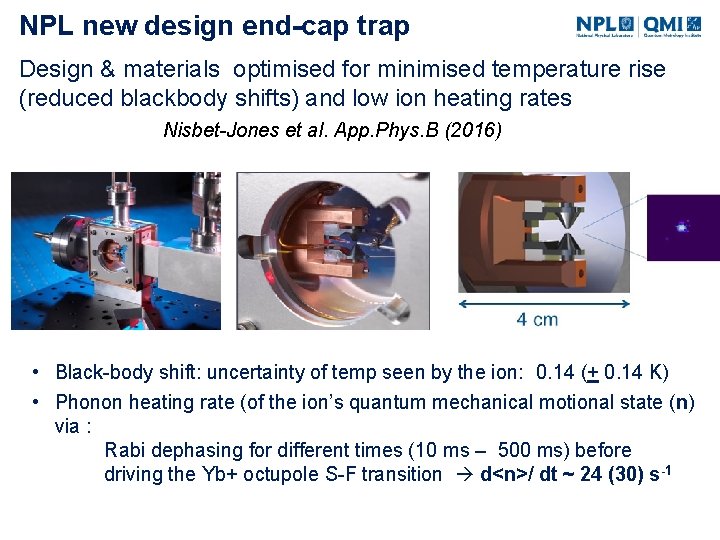
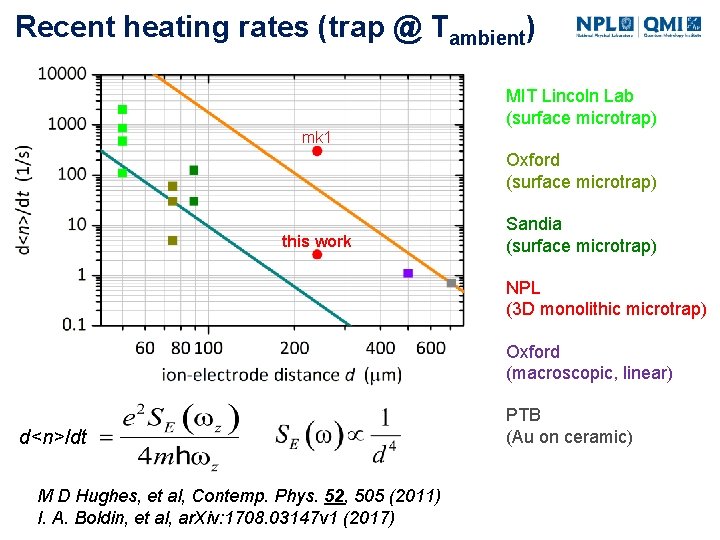
NPL new design end-cap trap Design & materials optimised for minimised temperature rise (reduced blackbody shifts) and low ion heating rates Nisbet-Jones et al. App. Phys. B (2016) • Black-body shift: uncertainty of temp seen by the ion: 0. 14 (+ 0. 14 K) • Phonon heating rate (of the ion’s quantum mechanical motional state (n) via : Rabi dephasing for different times (10 ms – 500 ms) before driving the Yb+ octupole S-F transition d<n>/ dt ~ 24 (30) s-1
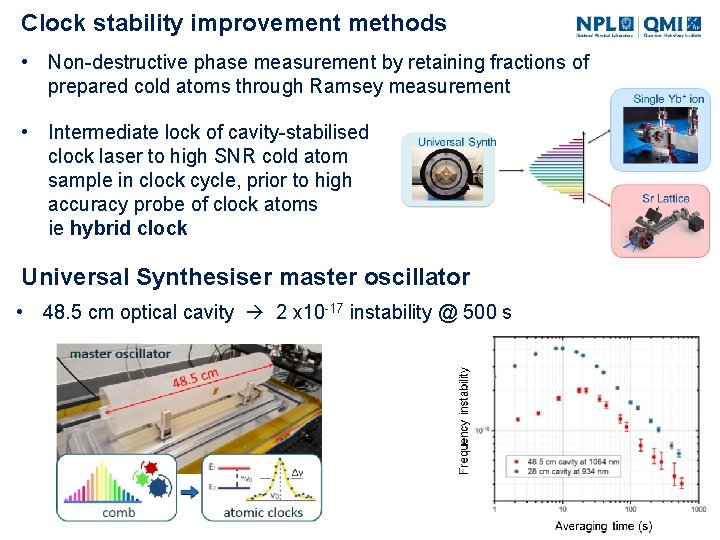
Clock stability improvement methods • Non-destructive phase measurement by retaining fractions of prepared cold atoms through Ramsey measurement • Intermediate lock of cavity-stabilised clock laser to high SNR cold atom sample in clock cycle, prior to high accuracy probe of clock atoms ie hybrid clock Universal Synthesiser master oscillator • 48. 5 cm optical cavity 2 x 10 -17 instability @ 500 s
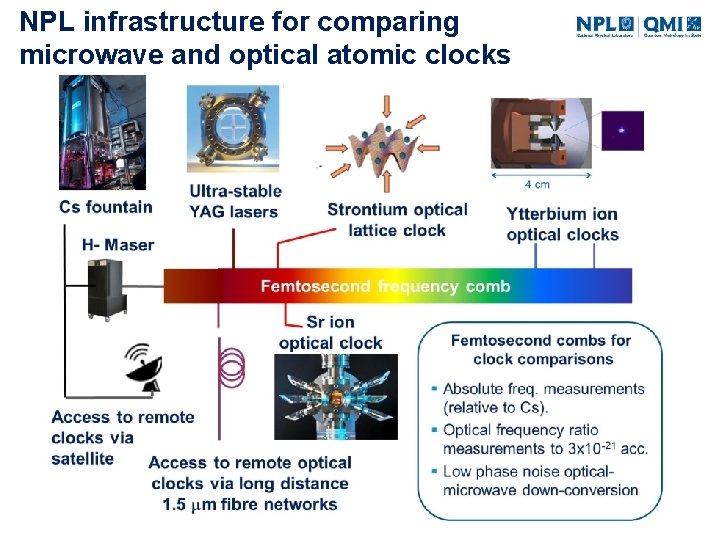
NPL infrastructure for comparing microwave and optical atomic clocks
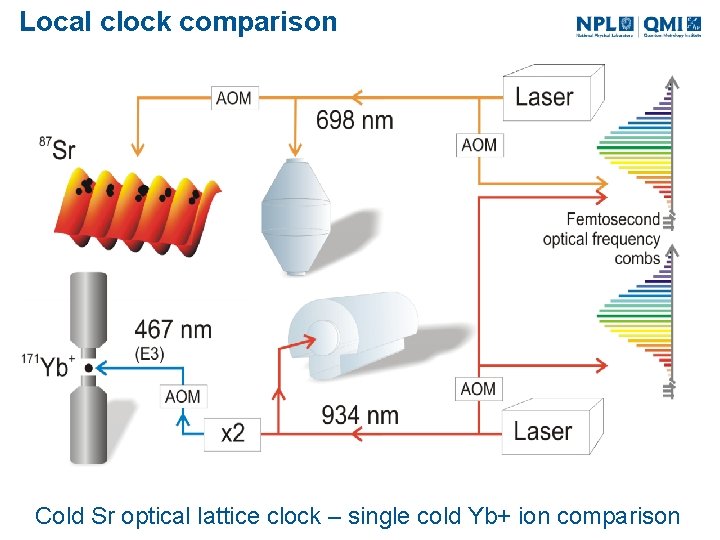
Local clock comparison Cold Sr optical lattice clock – single cold Yb+ ion comparison
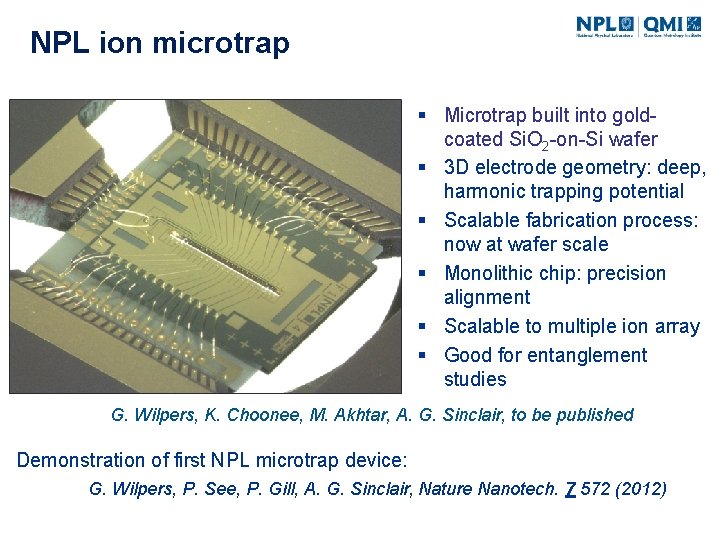
NPL ion microtrap § Microtrap built into goldcoated Si. O 2 -on-Si wafer § 3 D electrode geometry: deep, harmonic trapping potential § Scalable fabrication process: now at wafer scale § Monolithic chip: precision alignment § Scalable to multiple ion array § Good for entanglement studies G. Wilpers, K. Choonee, M. Akhtar, A. G. Sinclair, to be published Demonstration of first NPL microtrap device: G. Wilpers, P. See, P. Gill, A. G. Sinclair, Nature Nanotech. 7 572 (2012)
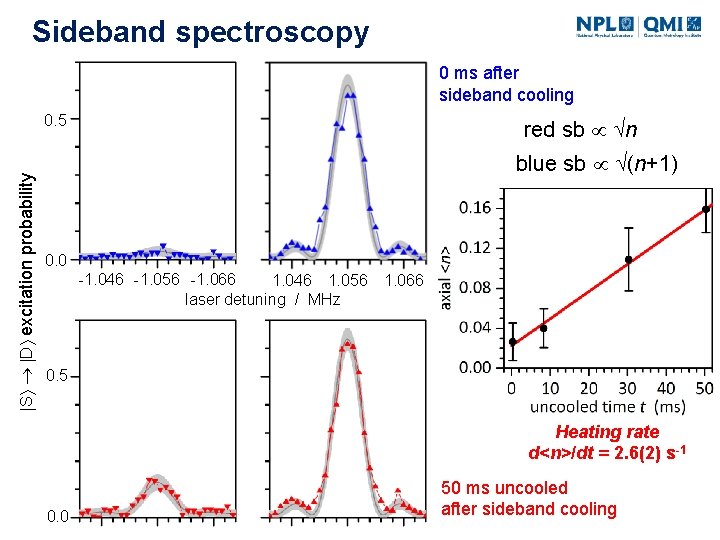
Sideband spectroscopy 0 ms after sideband cooling S D excitation probability 0. 5 red sb n blue sb (n+1) 0. 0 -1. 046 -1. 056 -1. 066 1. 046 1. 056 laser detuning / MHz 1. 066 0. 5 Heating rate d<n>/dt = 2. 6(2) s-1 0. 0 50 ms uncooled after 8 mssideband 30 uncooledcooling
Recent heating rates (trap @ Tambient) MIT Lincoln Lab (surface microtrap) mk 1 Oxford (surface microtrap) this work Sandia (surface microtrap) NPL (3 D monolithic microtrap) Oxford (macroscopic, linear) d<n>/dt M D Hughes, et al, Contemp. Phys. 52, 505 (2011) I. A. Boldin, et al, ar. Xiv: 1708. 03147 v 1 (2017) PTB (Au on ceramic)
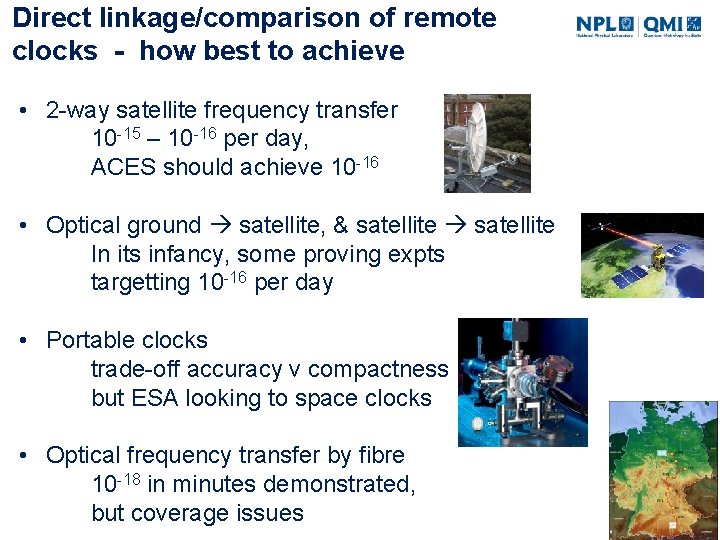
Direct linkage/comparison of remote clocks - how best to achieve • 2 -way satellite frequency transfer 10 -15 – 10 -16 per day, ACES should achieve 10 -16 • Optical ground satellite, & satellite In its infancy, some proving expts targetting 10 -16 per day • Portable clocks trade-off accuracy v compactness but ESA looking to space clocks • Optical frequency transfer by fibre 10 -18 in minutes demonstrated, but coverage issues
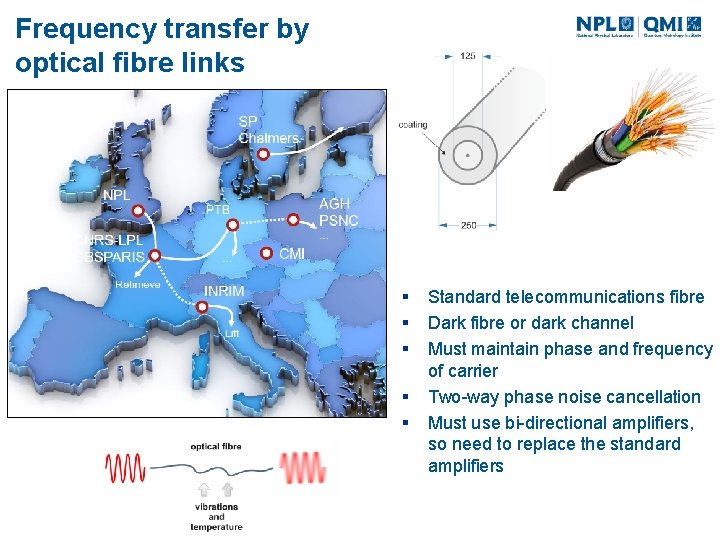
Frequency transfer by optical fibre links § § § Standard telecommunications fibre Dark fibre or dark channel Must maintain phase and frequency of carrier Two-way phase noise cancellation Must use bi-directional amplifiers, so need to replace the standard amplifiers
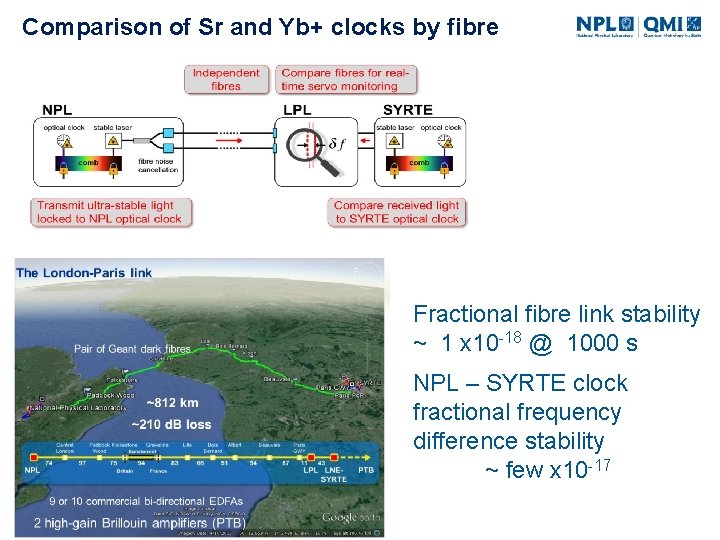
London – Paris Comparison of Sr fibre and link Yb+ clocks by fibre Fractional fibre link stability ~ 1 x 10 -18 @ 1000 s NPL – SYRTE clock fractional frequency difference stability ~ few x 10 -17
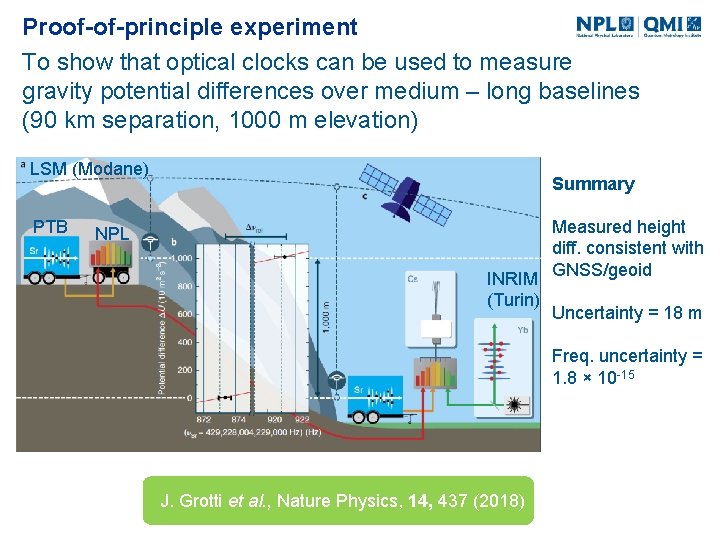
Proof-of-principle experiment To show that optical clocks can be used to measure gravity potential differences over medium – long baselines (90 km separation, 1000 m elevation) LSM (Modane) PTB NPL Summary Measured height diff. consistent with INRIM GNSS/geoid (Turin) Uncertainty = 18 m Freq. uncertainty = 1. 8 × 10 -15 J. Grotti et al. , Nature Physics, 14, 437 (2018)
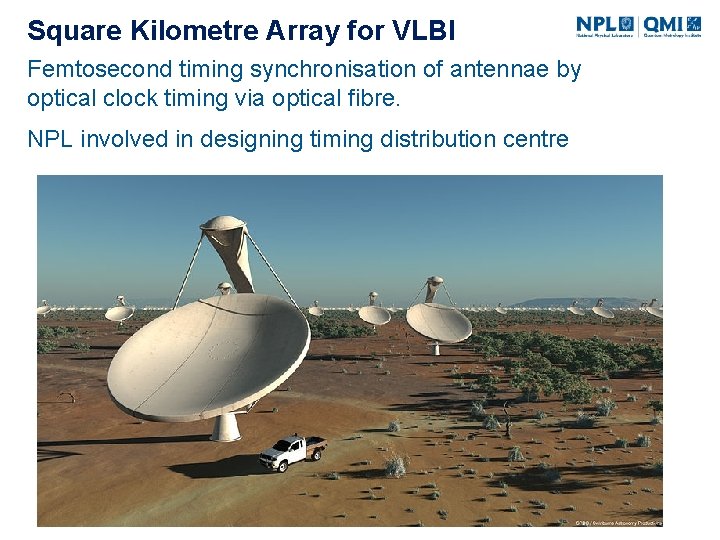
Square Kilometre Array for VLBI Femtosecond timing synchronisation of antennae by optical clock timing via optical fibre. NPL involved in designing timing distribution centre
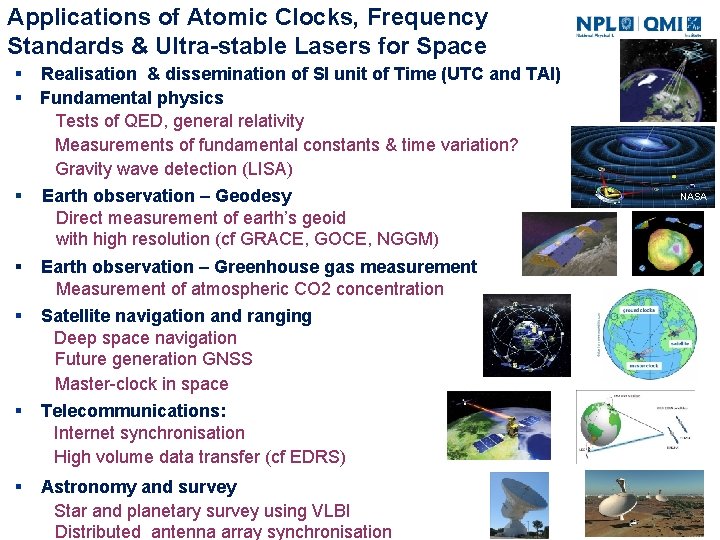
Applications of Atomic Clocks, Frequency Standards & Ultra-stable Lasers for Space § Realisation & dissemination of SI unit of Time (UTC and TAI) § Fundamental physics Tests of QED, general relativity Measurements of fundamental constants & time variation? Gravity wave detection (LISA) § Earth observation – Geodesy Direct measurement of earth’s geoid with high resolution (cf GRACE, GOCE, NGGM) § Earth observation – Greenhouse gas measurement Measurement of atmospheric CO 2 concentration § Satellite navigation and ranging Deep space navigation Future generation GNSS Master-clock in space § Telecommunications: Internet synchronisation High volume data transfer (cf EDRS) § Astronomy and survey Star and planetary survey using VLBI Distributed antenna array synchronisation NASA
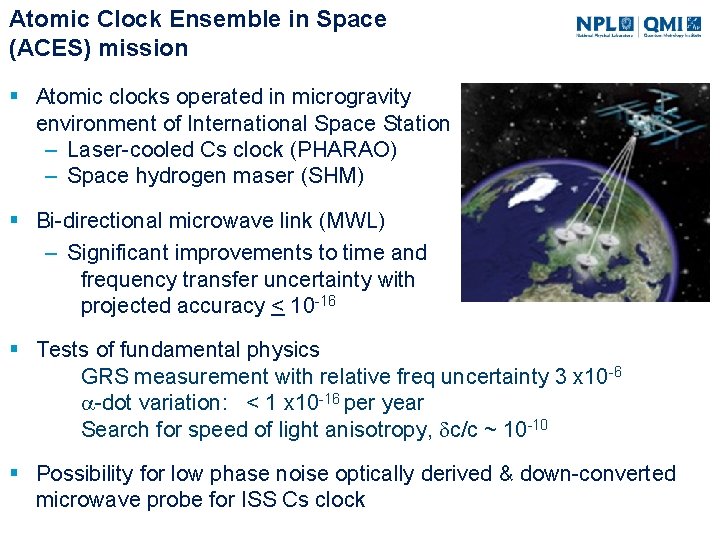
Atomic Clock Ensemble in Space (ACES) mission § Atomic clocks operated in microgravity environment of International Space Station – Laser-cooled Cs clock (PHARAO) – Space hydrogen maser (SHM) § Bi-directional microwave link (MWL) – Significant improvements to time and frequency transfer uncertainty with projected accuracy < 10 -16 § Tests of fundamental physics GRS measurement with relative freq uncertainty 3 x 10 -6 -dot variation: < 1 x 10 -16 per year Search for speed of light anisotropy, c/c ~ 10 -10 § Possibility for low phase noise optically derived & down-converted microwave probe for ISS Cs clock
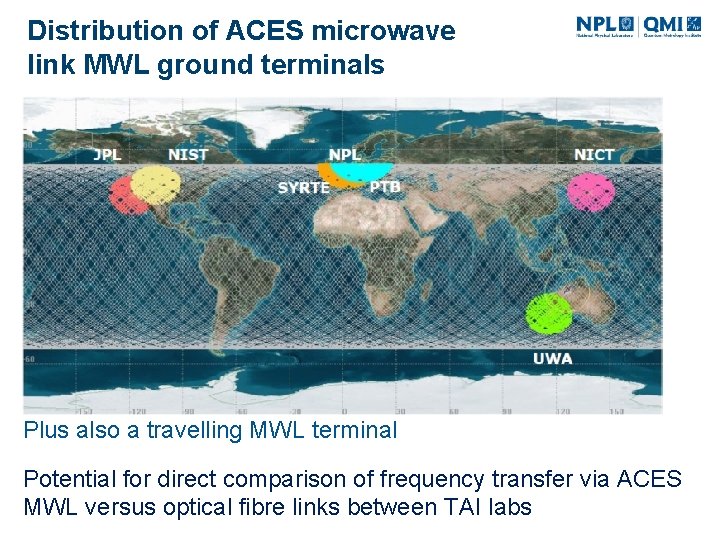
Distribution of ACES microwave link MWL ground terminals Plus also a travelling MWL terminal Potential for direct comparison of frequency transfer via ACES MWL versus optical fibre links between TAI labs
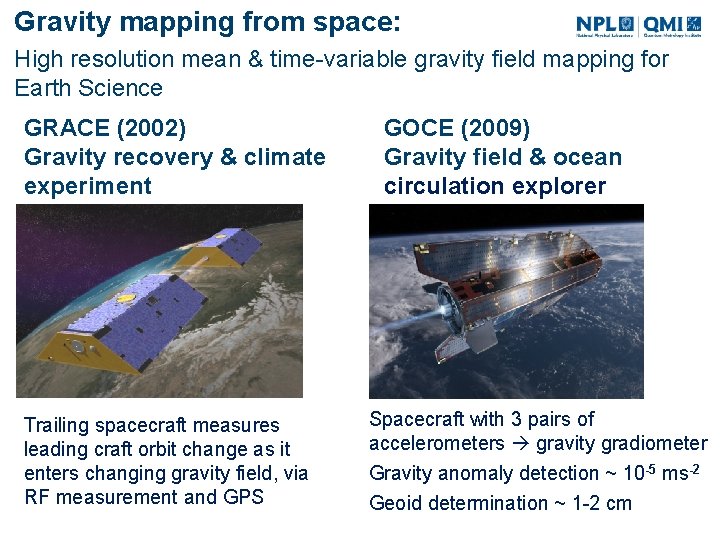
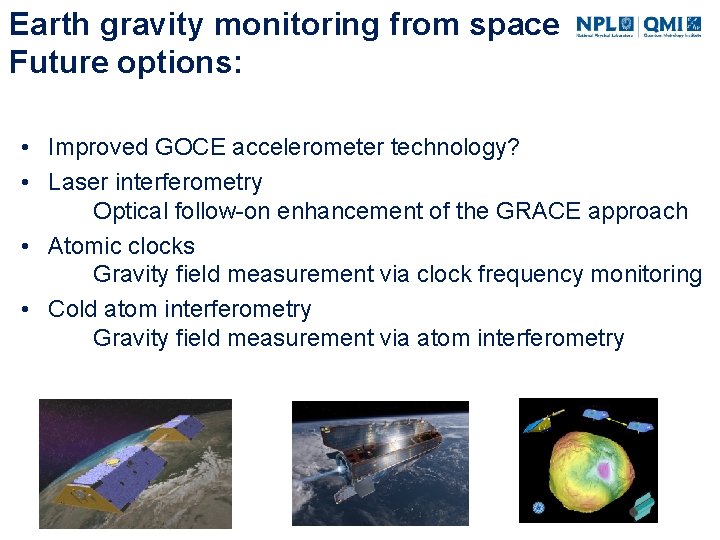
Gravity mapping from space: High resolution mean & time-variable gravity field mapping for Earth Science GRACE (2002) Gravity recovery & climate experiment Trailing spacecraft measures leading craft orbit change as it enters changing gravity field, via RF measurement and GPS GOCE (2009) Gravity field & ocean circulation explorer Spacecraft with 3 pairs of accelerometers gravity gradiometer Gravity anomaly detection ~ 10 -5 ms-2 Geoid determination ~ 1 -2 cm
Earth gravity monitoring from space Future options: • Improved GOCE accelerometer technology? • Laser interferometry Optical follow-on enhancement of the GRACE approach • Atomic clocks Gravity field measurement via clock frequency monitoring • Cold atom interferometry Gravity field measurement via atom interferometry
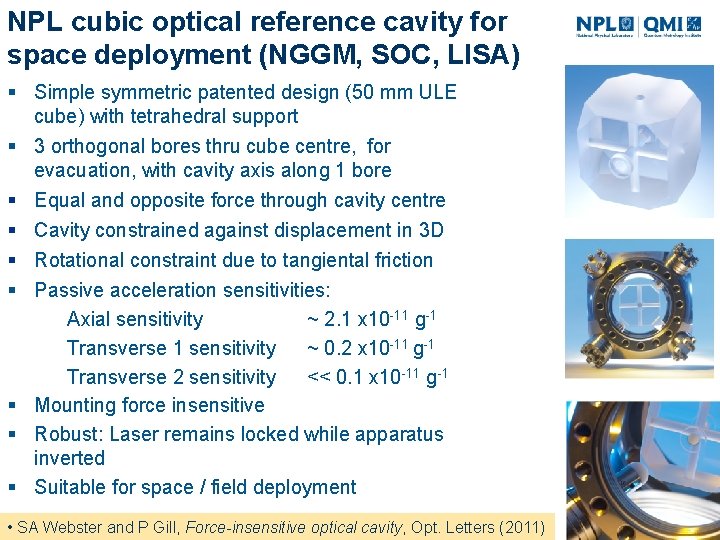
NPL cubic optical reference cavity for space deployment (NGGM, SOC, LISA) § Simple symmetric patented design (50 mm ULE cube) with tetrahedral support § 3 orthogonal bores thru cube centre, for evacuation, with cavity axis along 1 bore § Equal and opposite force through cavity centre § Cavity constrained against displacement in 3 D § Rotational constraint due to tangiental friction § Passive acceleration sensitivities: Axial sensitivity ~ 2. 1 x 10 -11 g-1 Transverse 1 sensitivity ~ 0. 2 x 10 -11 g-1 Transverse 2 sensitivity << 0. 1 x 10 -11 g-1 § Mounting force insensitive § Robust: Laser remains locked while apparatus inverted § Suitable for space / field deployment • SA Webster and P Gill, Force-insensitive optical cavity, Opt. Letters (2011)
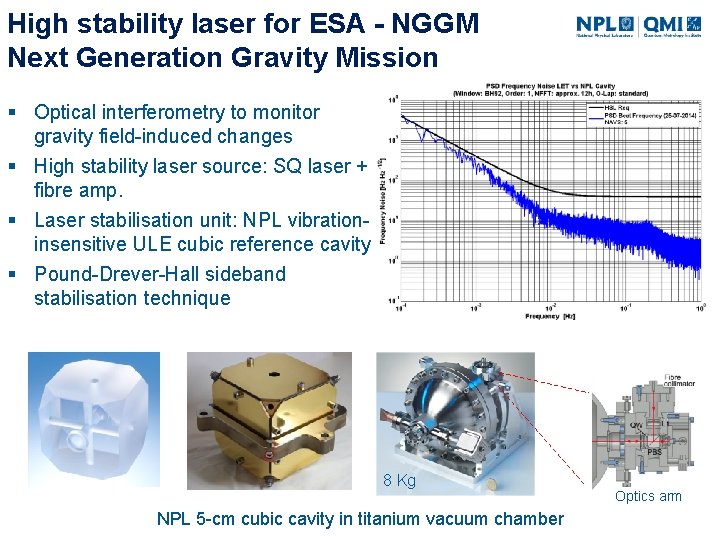
High stability laser for ESA - NGGM Next Generation Gravity Mission § Optical interferometry to monitor gravity field-induced changes § High stability laser source: SQ laser + fibre amp. § Laser stabilisation unit: NPL vibrationinsensitive ULE cubic reference cavity § Pound-Drever-Hall sideband stabilisation technique 8 Kg NPL 5 -cm cubic cavity in titanium vacuum chamber Optics arm
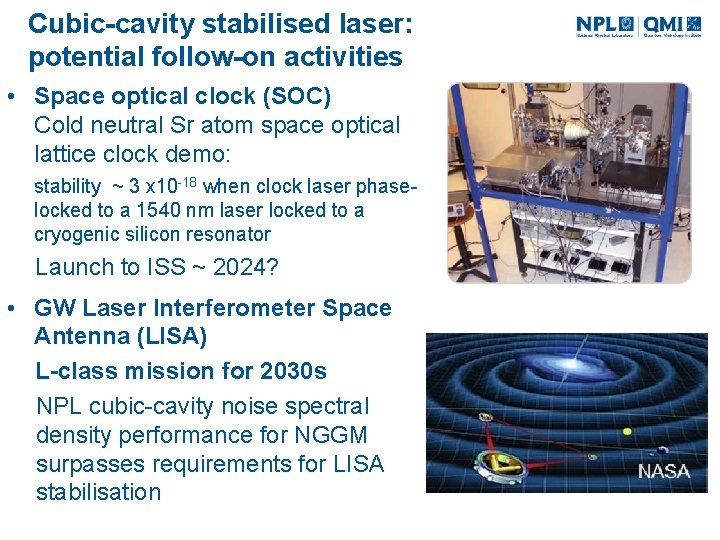
Cubic-cavity stabilised laser: potential follow-on activities • Space optical clock (SOC) Cold neutral Sr atom space optical lattice clock demo: stability ~ 3 x 10 -18 when clock laser phaselocked to a 1540 nm laser locked to a cryogenic silicon resonator Launch to ISS ~ 2024? • GW Laser Interferometer Space Antenna (LISA) L-class mission for 2030 s NPL cubic-cavity noise spectral density performance for NGGM surpasses requirements for LISA stabilisation
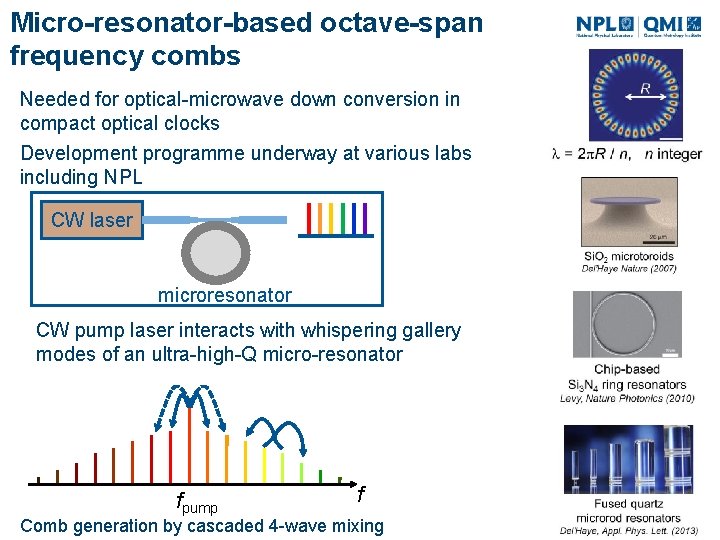
Micro-resonator-based octave-span frequency combs Needed for optical-microwave down conversion in compact optical clocks Development programme underway at various labs including NPL CW laser microresonator CW pump laser interacts with whispering gallery modes of an ultra-high-Q micro-resonator fpump f Comb generation by cascaded 4 -wave mixing
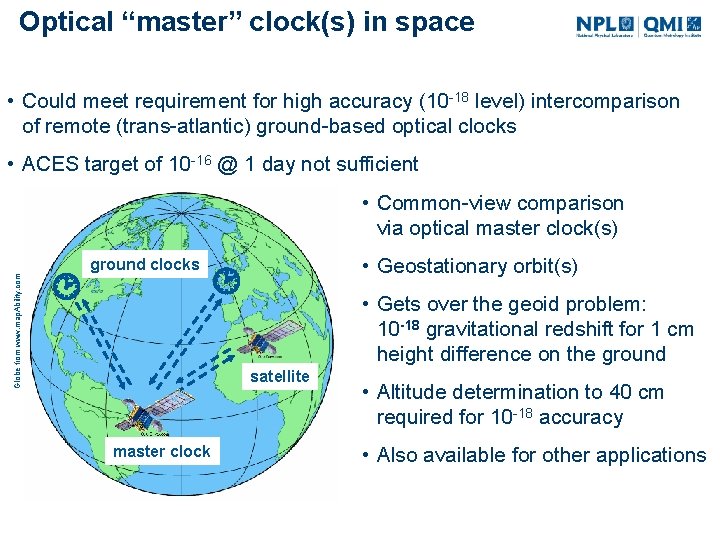
Optical “master” clock(s) in space • Could meet requirement for high accuracy (10 -18 level) intercomparison of remote (trans-atlantic) ground-based optical clocks • ACES target of 10 -16 @ 1 day not sufficient Globe from www. map. Ability. com • Common-view comparison via optical master clock(s) ground clocks • Geostationary orbit(s) • Gets over the geoid problem: 10 -18 gravitational redshift for 1 cm height difference on the ground satellite master clock • Altitude determination to 40 cm required for 10 -18 accuracy • Also available for other applications
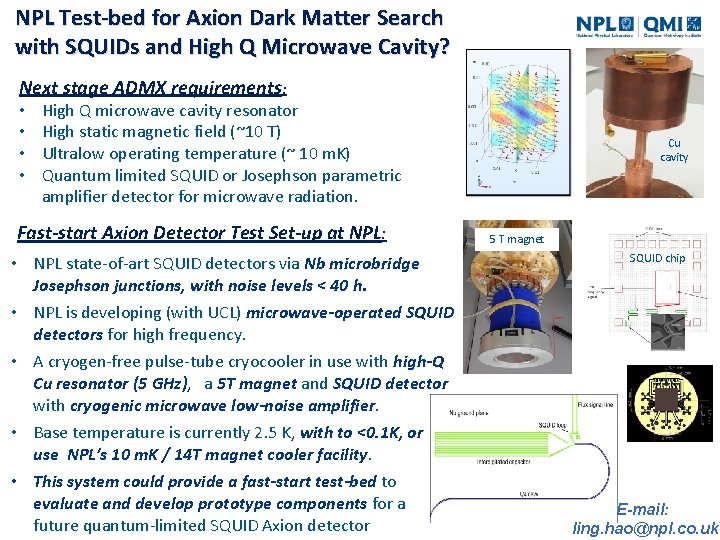
NPL Test-bed for Axion Dark Matter Search with SQUIDs and High Q Microwave Cavity? Next stage ADMX requirements: • • High Q microwave cavity resonator High static magnetic field (~10 T) Ultralow operating temperature (~ 10 m. K) Quantum limited SQUID or Josephson parametric amplifier detector for microwave radiation. Fast-start Axion Detector Test Set-up at NPL: • NPL state-of-art SQUID detectors via Nb microbridge Josephson junctions, with noise levels < 40 h. • NPL is developing (with UCL) microwave-operated SQUID detectors for high frequency. • A cryogen-free pulse-tube cryocooler in use with high-Q Cu resonator (5 GHz), a 5 T magnet and SQUID detector with cryogenic microwave low-noise amplifier. • Base temperature is currently 2. 5 K, with to <0. 1 K, or use NPL’s 10 m. K / 14 T magnet cooler facility. • This system could provide a fast-start test-bed to evaluate and develop prototype components for a future quantum-limited SQUID Axion detector Cu cavity 5 T magnet SQUID chip E-mail: ling. hao@npl. co. uk