
NPDES Permit Applications and Reasonable Potential Considerations Data

NPDES Permit Applications and Reasonable Potential Considerations Data Reporting for NPDES Permit Applications To what level should permit applicants report data? (e. g. , on form 2 C or 4 C? To a fixed censoring point? (Lc, Ld, or Lq) No Report numbers with data qualifier flags? Yes Should the censoring point be: Lq Ld Lc Yes The following will need to be set to establish where to set the flags. For any/all uses identified above, should Lc, Ld, or Lq be based on single lab or interlab or multilab? Should Lq include: precision? If Yes, what precision? ? accuracy? If Yes, what accuracy? ? Yes Where should we set the false positive rate? the false negative rate? Yes Where should we set the false positive rate? ? ? For any/all uses identified above, should Lc, Ld, or Lq be based on a prescriptive or descriptive approach? • For instance, should there be a national standard by method or by analyte? • Others? ? This concludes issues related to how laboratories will report results that will be used for reasonable potential determination. Go to next chart for how these data will be compared to WQBELs to determine reasonable potential.
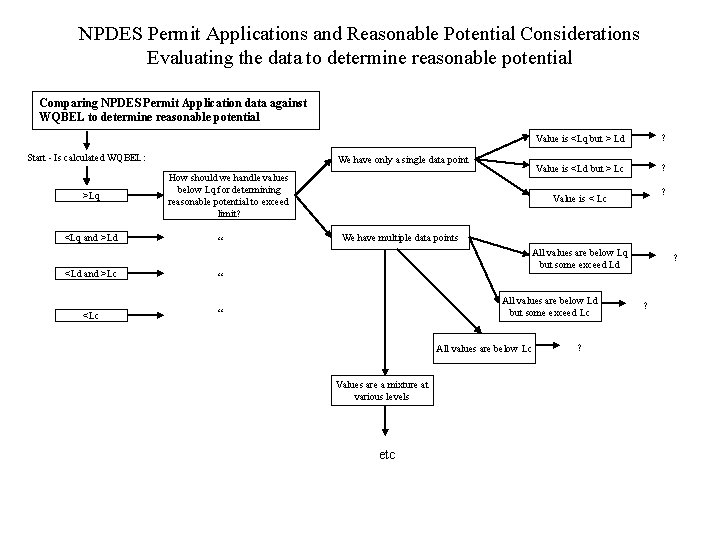
NPDES Permit Applications and Reasonable Potential Considerations Evaluating the data to determine reasonable potential Comparing NPDES Permit Application data against WQBEL to determine reasonable potential Start - Is calculated WQBEL: >Lq <Lq and >Ld <Ld and >Lc <Lc We have only a single data point How should we handle values below Lq for determining reasonable potential to exceed limit? “ Value is <Lq but > Ld ? Value is <Ld but > Lc ? ? Value is < Lc We have multiple data points All values are below Lq but some exceed Ld ? “ All values are below Ld but some exceed Lc “ All values are below Lc Values are a mixture at various levels etc ? ?
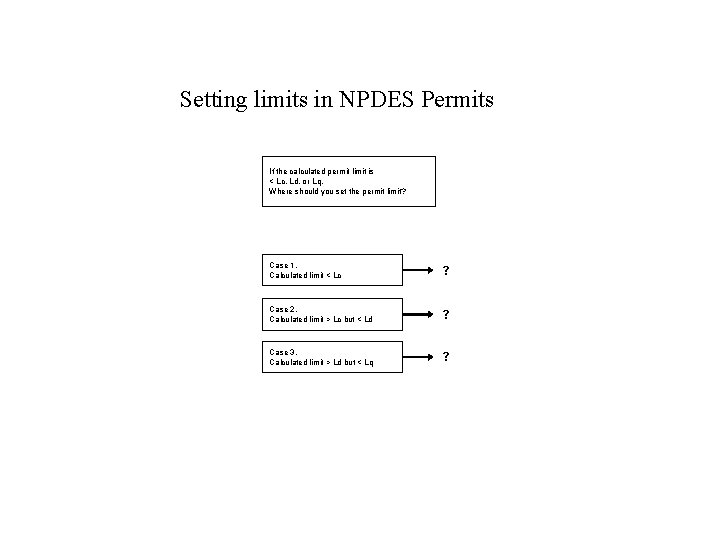
Setting limits in NPDES Permits If the calculated permit limit is < Lc, Ld, or Lq, Where should you set the permit limit? Case 1. Calculated limit < Lc ? Case 2. Calculated limit > Lc but < Ld ? Case 3. Calculated limit > Ld but < Lq ?
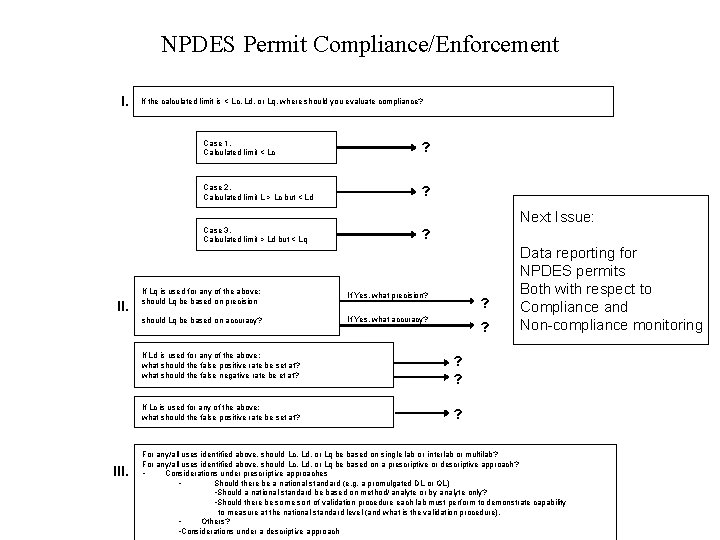
NPDES Permit Compliance/Enforcement I. If the calculated limit is < Lc, Ld, or Lq, where should you evaluate compliance? Case 1. Calculated limit < Lc ? Case 2. Calculated limit L > Lc but < Ld ? Next Issue: Case 3. Calculated limit > Ld but < Lq II. III. ? If Lq is used for any of the above: should Lq be based on precision If Yes, what precision? should Lq be based on accuracy? If Yes, what accuracy? ? ? If Ld is used for any of the above: what should the false positive rate be set at? what should the false negative rate be et at? ? ? If Lc is used for any of the above: what should the false positive rate be set at? ? Data reporting for NPDES permits Both with respect to Compliance and Non-compliance monitoring For any/all uses identified above, should Lc, Ld, or Lq be based on single lab or interlab or multilab? For any/all uses identified above, should Lc, Ld, or Lq be based on a prescriptive or descriptive approach? • Considerations under prescriptive approaches • Should there be a national standard (e. g. a promulgated DL or QL) • Should a national standard be based on method/ analyte or by analyte only? • Should there be some sort of validation procedure each lab must perform to demonstrate capability to measure at the national standard level (and what is the validation procedure). • Others? • Considerations under a descriptive approach
- Slides: 4