
NP Movement Passives Raising When NPs are not
![A Problem • [Johni is likely [ to leave]]. • John is the subject](https://slidetodoc.com/presentation_image_h2/da15f8de67ac91704b6c1388197c5d26/image-4.jpg "A Problem • [Johni is likely [ to leave]]. • John is the subject")
![is likely – [[That John will leave]j is likely ] – It is likely](https://slidetodoc.com/presentation_image_h2/da15f8de67ac91704b6c1388197c5d26/image-5.jpg "is likely – [[That John will leave]j is likely ] – It is likely")
![Passives • Active [The linguist] kissed [the kitten] Agent theme • Passive The kitten](https://slidetodoc.com/presentation_image_h2/da15f8de67ac91704b6c1388197c5d26/image-15.jpg "Passives • Active [The linguist] kissed [the kitten] Agent theme • Passive The kitten")
- Slides: 24
NP Movement Passives, Raising: When NPs are not in their theta positions.
Locality restriction on theta roles • Leave(obligatory agent) agent i • Adrian left • Jo left her pencil • *it left (where it is an expletive) • Must be in same clause • *Johni thinks [that left] • In particular can't mean: Johni thinks hei left.
Locality Condition on Theta Roles • Theta roles must be assigned within the clause same clause as the predicate that assigns them.
A Problem • [Johni is likely [ to leave]]. • John is the subject of is likely. • Is it theta marked by is likely? ? – NO! (cf. it is like that John left) – more arguments for this later • It is theta marked by leave!!! • But it isn’t in the same clause! Yikes!
is likely – [[That John will leave]j is likely ] – It is likely [that John will leave]j Proposition j it is likely [CP that john will leave ]
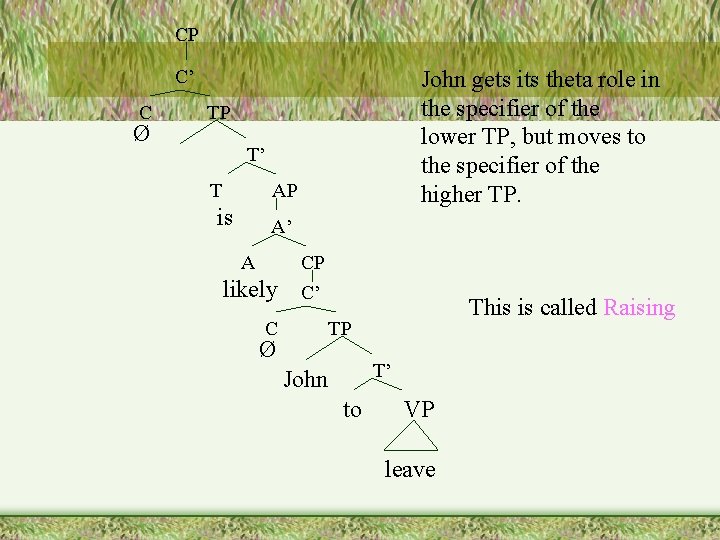
In the wrong place! • John is likely to leave • John is theta marked by leave, but appears in the subject position of is likely, in violation of the locality constraint. • The NP [John] is displaced from its theta position.
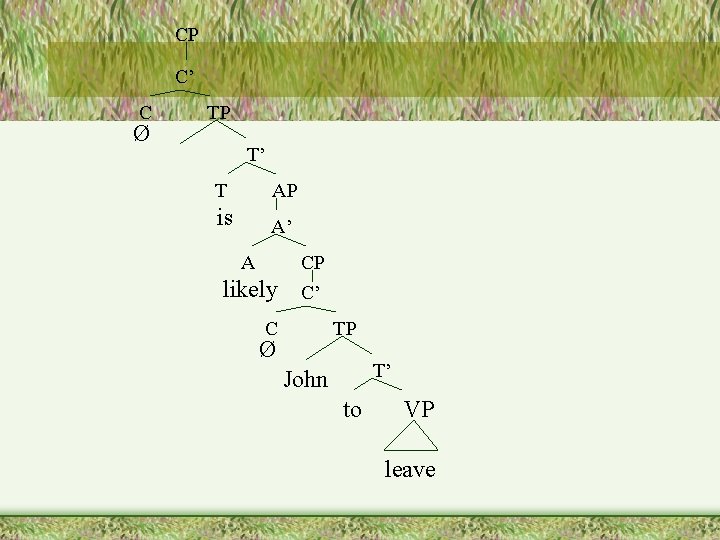
CP C’ C Ø John gets its theta role in the specifier of the lower TP, but moves to the specifier of the higher TP. TP T’ T AP is A’ A likely C Ø CP C’ This is called Raising TP T’ John to VP leave
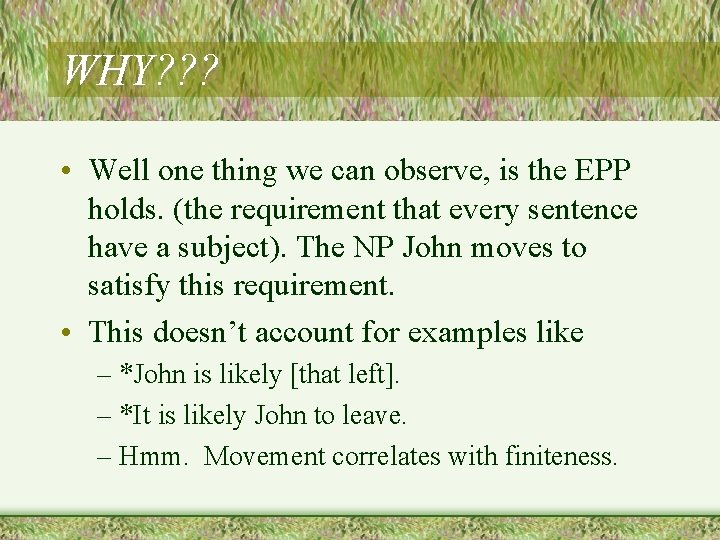
WHY? ? ? • Well one thing we can observe, is the EPP holds. (the requirement that every sentence have a subject). The NP John moves to satisfy this requirement. • This doesn’t account for examples like – *John is likely [that left]. – *It is likely John to leave. – Hmm. Movement correlates with finiteness.
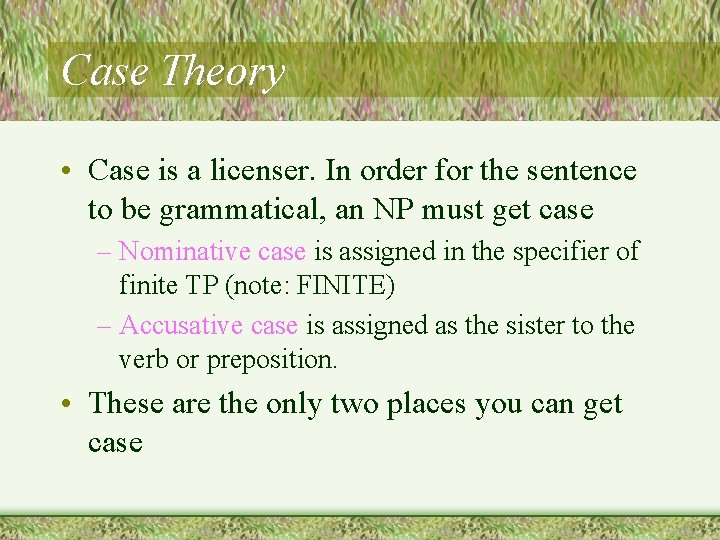
Case Theory • Case is a licenser. In order for the sentence to be grammatical, an NP must get case – Nominative case is assigned in the specifier of finite TP (note: FINITE) – Accusative case is assigned as the sister to the verb or preposition. • These are the only two places you can get case
The Case Filter • The case filter (a constraint that filters trees) – All NPs must be in case positions (spec, TP or sister to V/P)
CP C’ C Ø TP T’ T AP is A’ A likely CP C’ C TP Ø T’ John to VP leave
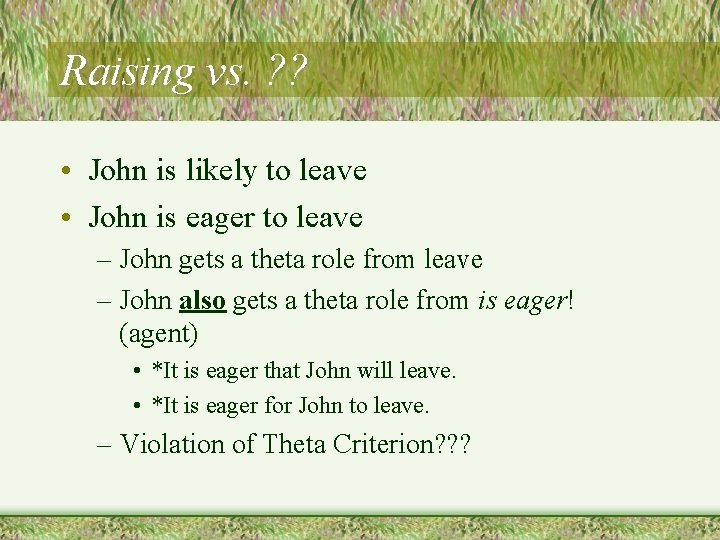
Raising vs. ? ? • John is likely to leave • John is eager to leave – John gets a theta role from leave – John also gets a theta role from is eager! (agent) • *It is eager that John will leave. • *It is eager for John to leave. – Violation of Theta Criterion? ? ?
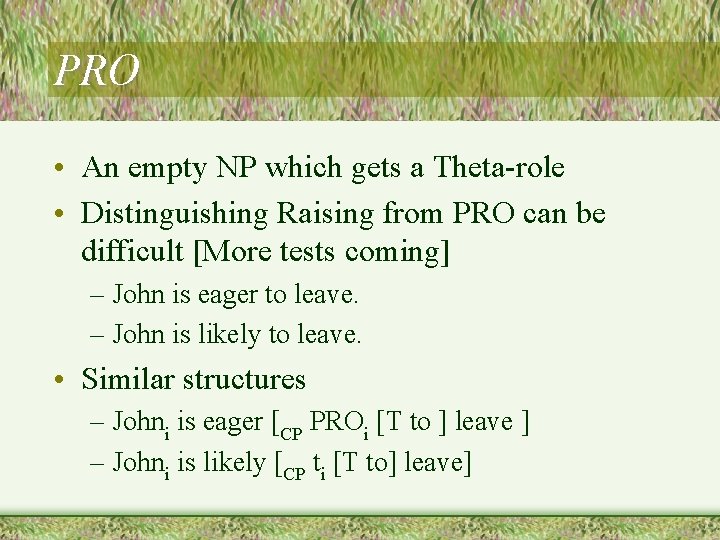
PRO • An empty NP which gets a Theta-role • Distinguishing Raising from PRO can be difficult [More tests coming] – John is eager to leave. – John is likely to leave. • Similar structures – Johni is eager [CP PROi [T to ] leave ] – Johni is likely [CP ti [T to] leave]
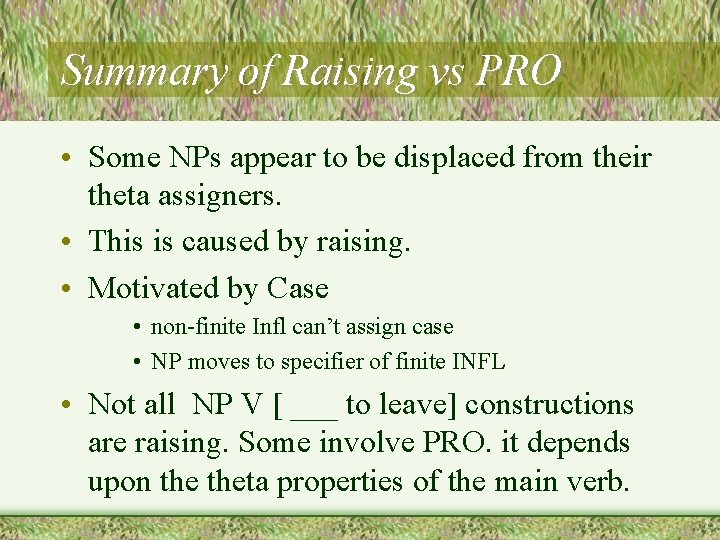
Summary of Raising vs PRO • Some NPs appear to be displaced from their theta assigners. • This is caused by raising. • Motivated by Case • non-finite Infl can’t assign case • NP moves to specifier of finite INFL • Not all NP V [ ___ to leave] constructions are raising. Some involve PRO. it depends upon theta properties of the main verb.
Passives • Active [The linguist] kissed [the kitten] Agent theme • Passive The kitten was kissed (by the linguist) Theme (agent) • Active has agent and patient. • Passive requires only a theme which is the subject
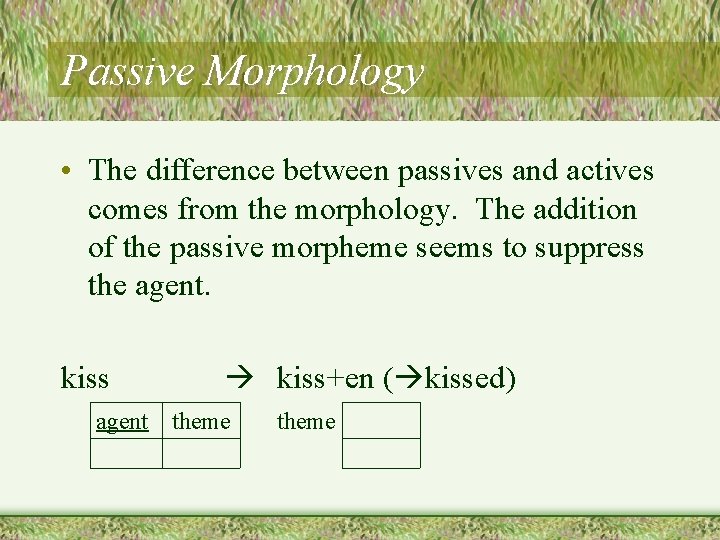
Passive Morphology • The difference between passives and actives comes from the morphology. The addition of the passive morpheme seems to suppress the agent. kiss agent kiss+en ( kissed) theme
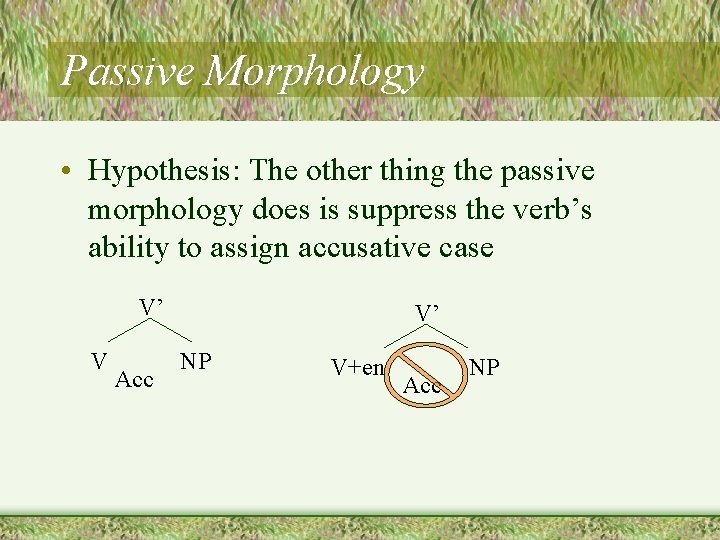
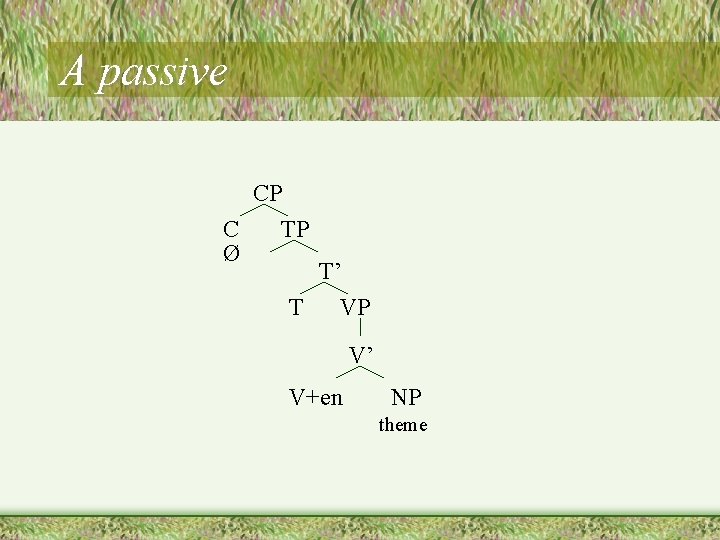
Passive Morphology • Hypothesis: The other thing the passive morphology does is suppress the verb’s ability to assign accusative case V’ V Acc V’ NP V+en Acc NP
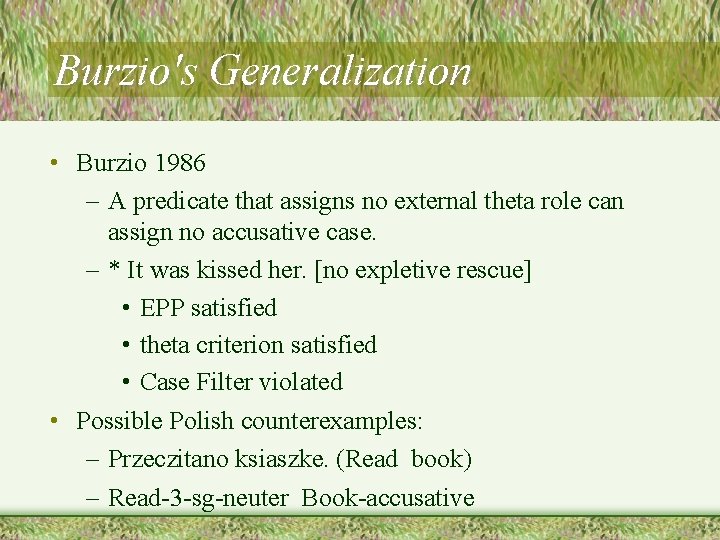
Burzio's Generalization • Burzio 1986 – A predicate that assigns no external theta role can assign no accusative case. – * It was kissed her. [no expletive rescue] • EPP satisfied • theta criterion satisfied • Case Filter violated • Possible Polish counterexamples: – Przeczitano ksiaszke. (Read book) – Read-3 -sg-neuter Book-accusative
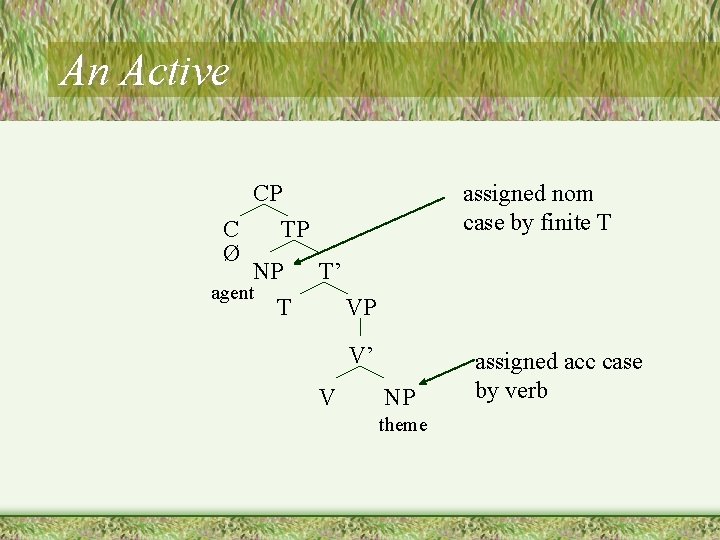
An Active CP C TP Ø NP T’ agent T VP assigned nom case by finite T V’ V NP theme assigned acc case by verb
A passive CP C TP Ø T’ T VP V’ V+en NP theme
Passives: A summary • The passive morpheme • Suppresses agent theta role • Suppresses V’s ability to assign accusative case • The theme NP can’t get case from the passive verb, so it moves (to the specifier of TP, where it can get nominative case. )
Passive: a Hybrid • Lexical Component: An affix that changes Theta-roles • A movement component • Why BOTH? Why not just have the affix directly make the argument external? • Passive out of embedded clauses – Wilma considers [John to be foolish] – John is considered [ t to be foolish]
Non-arguments can be Passive Subjects • Passive out of embedded clauses – Wilma considers [John to be foolish] – John is considered [ t to be foolish] • Consider does not assign a theta-role to John • Foolish does • So if the passive affix made John an external argument, how it could assign the right role in the lexicon?
NP Movement • With both raising and passives, you are moving NPs, and in both situations you do this to get case on a caseless NP. • This transformation is called “NP movement” • The filter that forces NP movement is the case filter.