
NP Complete Problem CS209 Design and Analysis of
NP Complete Problem CS-209: Design and Analysis of Algorithm Instructor: Dr. Maria Anjum
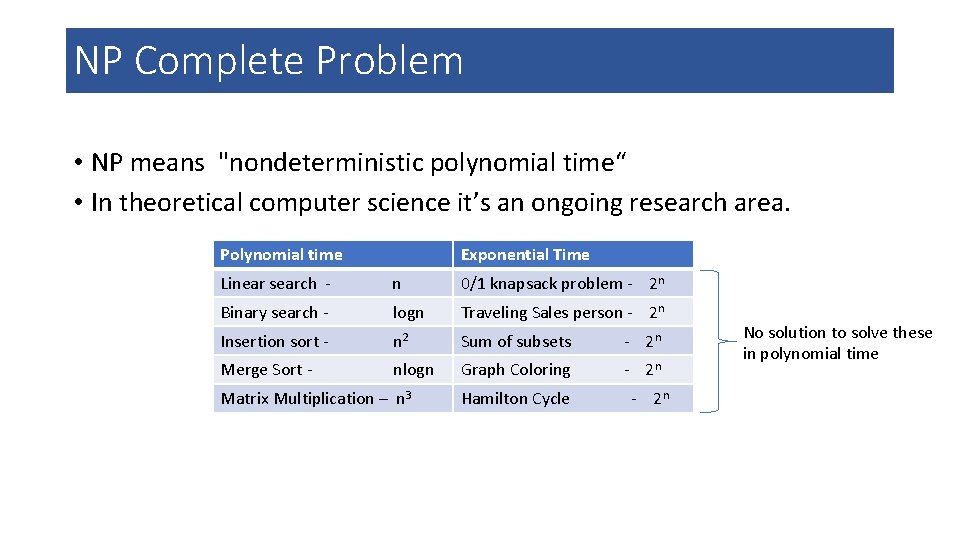
NP Complete Problem • NP means "nondeterministic polynomial time“ • In theoretical computer science it’s an ongoing research area. Polynomial time Exponential Time Linear search - n 0/1 knapsack problem - 2 n Binary search - logn Traveling Sales person - 2 n Insertion sort - n 2 Sum of subsets - 2 n Merge Sort - nlogn Graph Coloring - 2 n Matrix Multiplication – n 3 Hamilton Cycle - 2 n No solution to solve these in polynomial time
NP Complete Problem • Try to solve problems in relation instead of solving them individual. Find relationship among them. • Instead of solving problem in polynomial time (deterministic way), solve them in polynomial time non-deterministic way. Please consult examples from https: //www. youtube. com/watch? v=e 2 c. F 8 a 5 a. Ah. E
NP Complete Problem • Polynomial Time: • First, the polynomial-time computable problems encountered in practice typically require less time. • Experience has shown that once the first polynomial-time algorithm for a problem has been discovered, more efficient algorithms often follow. • Second, for many reasonable models of computation, a problem that can be solved in polynomial time in one model can be solved in polynomial time in another.
NP Complete Problem • Polynomial Time: • Third, the class of polynomial-time solvable problems has nice closure properties, since polynomials are closed under addition, multiplication, and composition. • For example, if the output of one polynomial-time algorithm is fed into the input of another, the composite algorithm is polynomial.

NP Complete Problem •
NP Complete Problem • NP-complete problems are in NP, the set of all decision problems whose solutions can be verified in polynomial time; • NP may be equivalently defined as the set of decision problems that can be solved in polynomial time on a non-deterministic Turing machine. • A problem p in NP is NP-complete if every other problem in NP can be transformed (or reduced) into p in polynomial time. • It is not known whether every problem in NP can be quickly solved—this is called the P versus NP problem. • But if any NP-complete problem can be solved quickly, then every problem in NP can, because the definition of an NP-complete problem states that every problem in NP must be quickly reducible to every NP-complete problem (that is, it can be reduced in polynomial time). • Because of this, it is often said that NP-complete problems are harder or more difficult than NP problems in general. https: //en. wikipedia. org/wiki/NP-completeness
NP Complete Problem • A decision problem C is NP-complete if: 1. C is in NP, and 2. Every problem in NP is reducible to C in polynomial time. • C can be shown to be in NP by demonstrating that a candidate solution to C can be verified in polynomial time. • Note that a problem satisfying condition 2 is said to be NP-hard, whether or not it satisfies condition 1. • A consequence of this definition is that if we had a polynomial time algorithm (on a UTM, or any other Turing-equivalent abstract machine) for C, we could solve all problems in NP in polynomial time. https: //en. wikipedia. org/wiki/NP-completeness
NP Complete Problem - Examples Well-known problems that are NP-complete when expressed as decision problems. • • • Boolean satisfiability problem (SAT) Knapsack problem Hamiltonian path problem Travelling salesman problem (decision version) Subgraph isomorphism problem Subset sum problem Clique problem Vertex cover problem Independent set problem Dominating set problem Graph coloring problem https: //en. wikipedia. org/wiki/NP-completeness
Home Assignment • What are concepts of satisfiability, reduction, according to provided link https: //www. youtube. com/watch? v=e 2 c. F 8 a 5 a. Ah. E • Can you distinguish between P, NP hard and NP complete? • What cook’s say about P and Np, you can check https: //www. youtube. com/watch? v=e 2 c. F 8 a 5 a. Ah. E or consult web.
References • Book Introduction to algorithms, 3 rd edition • https: //en. wikipedia. org/wiki/NP-completeness read overview • https: //www. youtube. com/watch? v=e 2 c. F 8 a 5 a. Ah. E
- Slides: 11