
NOx Source Composition Climate Earth System Lightning Chemistry
- Slides: 20
NOx Source Composition Climate Earth System Lightning, Chemistry and the Impacts on Climate Oliver Wild Department of Environmental Science Lancaster University Royal Meteorological Society: The Electrifying Atmosphere, 12 th Dec 2007
Overview NOx Source Composition Climate Earth System • Formation of nitrogen oxides (NOx) – How, where, how much? • Effects on atmospheric composition – Oxidation, lifetimes, deposition • Implications for climate – Greenhouse gas abundance • Implications for the Earth System – Role in global change
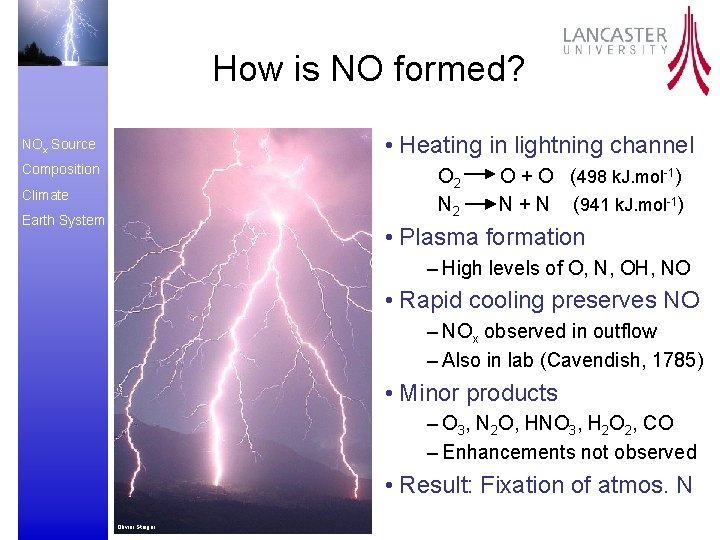
How is NO formed? • Heating in lightning channel NOx Source Composition O 2 N 2 Climate Earth System O + O (498 k. J. mol-1) N + N (941 k. J. mol-1) • Plasma formation – High levels of O, N, OH, NO • Rapid cooling preserves NO – NOx observed in outflow – Also in lab (Cavendish, 1785) • Minor products – O 3, N 2 O, HNO 3, H 2 O 2, CO – Enhancements not observed • Result: Fixation of atmos. N Olivier Staiger
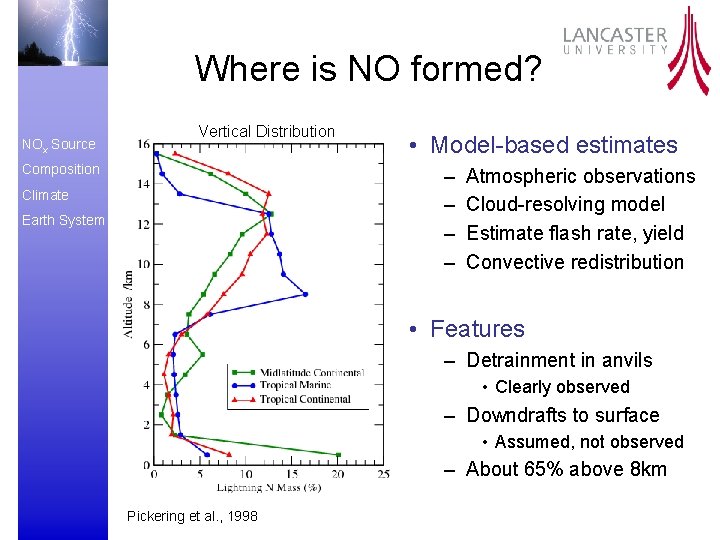
Where is NO formed? NOx Source Vertical Distribution Composition • Model-based estimates – – Climate Earth System Atmospheric observations Cloud-resolving model Estimate flash rate, yield Convective redistribution • Features – Detrainment in anvils • Clearly observed – Downdrafts to surface • Assumed, not observed – About 65% above 8 km Pickering et al. , 1998
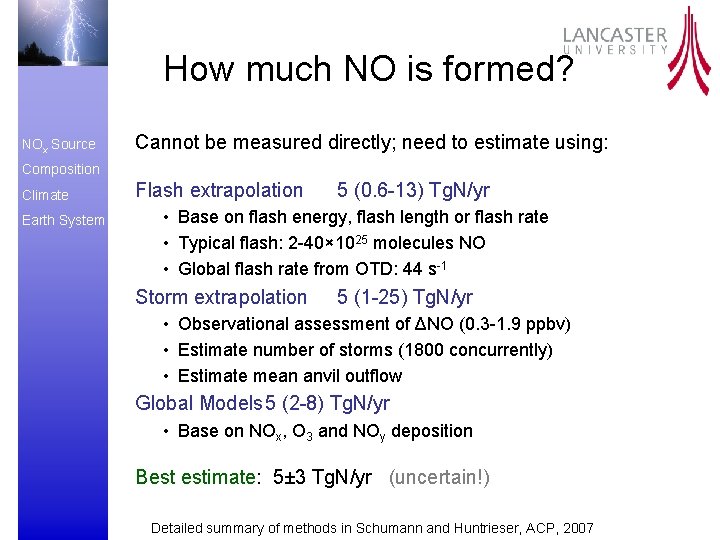
How much NO is formed? NOx Source Cannot be measured directly; need to estimate using: Composition Climate Earth System Flash extrapolation 5 (0. 6 -13) Tg. N/yr • Base on flash energy, flash length or flash rate • Typical flash: 2 -40× 1025 molecules NO • Global flash rate from OTD: 44 s-1 Storm extrapolation 5 (1 -25) Tg. N/yr • Observational assessment of ΔNO (0. 3 -1. 9 ppbv) • Estimate number of storms (1800 concurrently) • Estimate mean anvil outflow Global Models 5 (2 -8) Tg. N/yr • Base on NOx, O 3 and NOy deposition Best estimate: 5± 3 Tg. N/yr (uncertain!) Detailed summary of methods in Schumann and Huntrieser, ACP, 2007
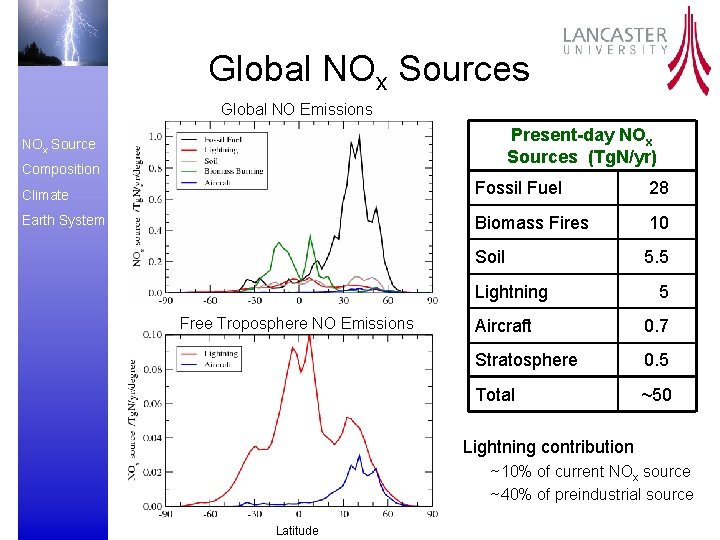
Global NOx Sources Global NO Emissions Present-day NOx Sources (Tg. N/yr) NOx Source Composition Climate Fossil Fuel 28 Earth System Biomass Fires 10 Soil 5. 5 Lightning Free Troposphere NO Emissions 5 Aircraft 0. 7 Stratosphere 0. 5 Total ~50 Lightning contribution ~10% of current NOx source ~40% of preindustrial source Latitude
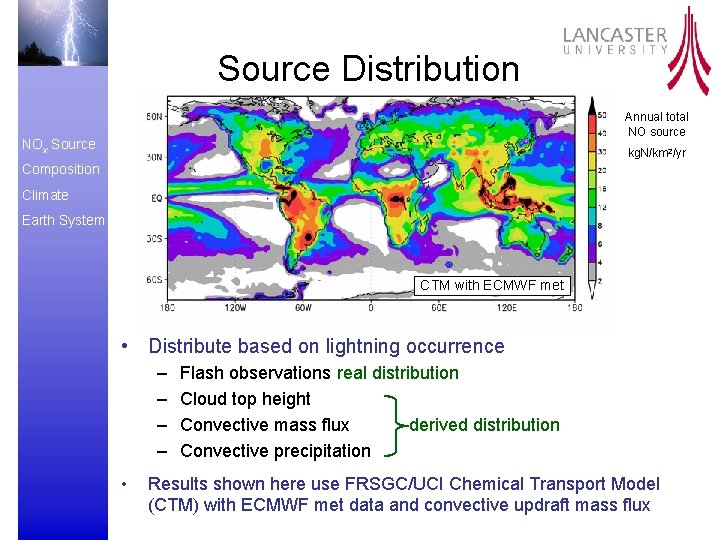
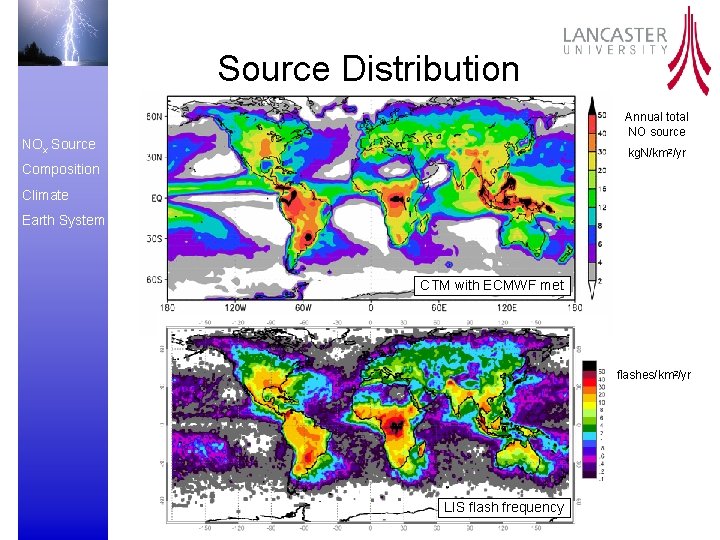
Source Distribution Annual total NO source NOx Source kg. N/km 2/yr Composition Climate Earth System CTM with ECMWF met • Distribute based on lightning occurrence – – • Flash observations real distribution Cloud top height Convective mass flux derived distribution Convective precipitation Results shown here use FRSGC/UCI Chemical Transport Model (CTM) with ECMWF met data and convective updraft mass flux
Source Distribution Annual total NO source NOx Source kg. N/km 2/yr Composition Climate Earth System CTM with ECMWF met flashes/km 2/yr LIS flash frequency
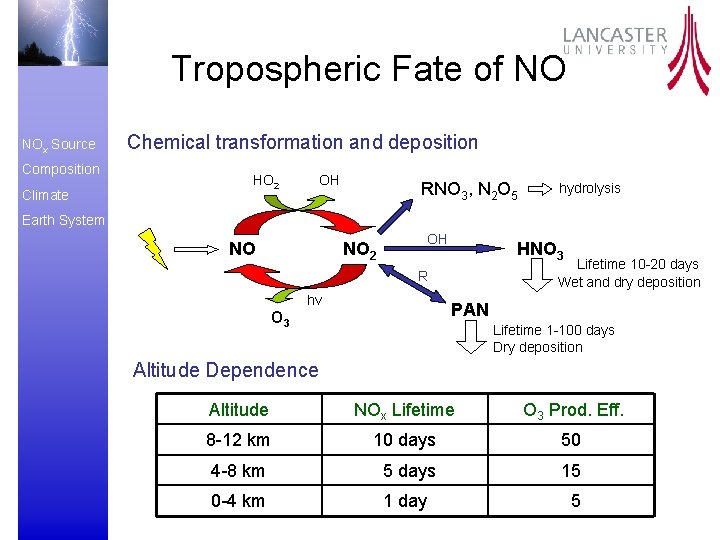
Tropospheric Fate of NO NOx Source Composition Climate Chemical transformation and deposition HO 2 OH RNO 3, N 2 O 5 hydrolysis Earth System NO OH NO 2 HNO 3 Lifetime 10 -20 days Wet and dry deposition R hv PAN O 3 Lifetime 1 -100 days Dry deposition Altitude Dependence Altitude NOx Lifetime O 3 Prod. Eff. 8 -12 km 10 days 50 4 -8 km 5 days 15 0 -4 km 1 day 5
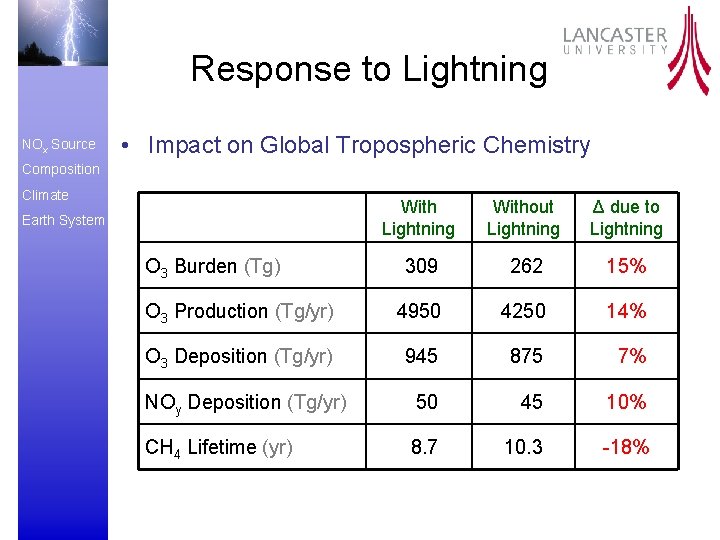
Response to Lightning NOx Source • Impact on Global Tropospheric Chemistry Composition Climate With Lightning Without Lightning Δ due to Lightning 309 262 15% O 3 Production (Tg/yr) 4950 4250 14% O 3 Deposition (Tg/yr) 945 875 7% NOy Deposition (Tg/yr) 50 45 10% CH 4 Lifetime (yr) 8. 7 10. 3 -18% Earth System O 3 Burden (Tg)
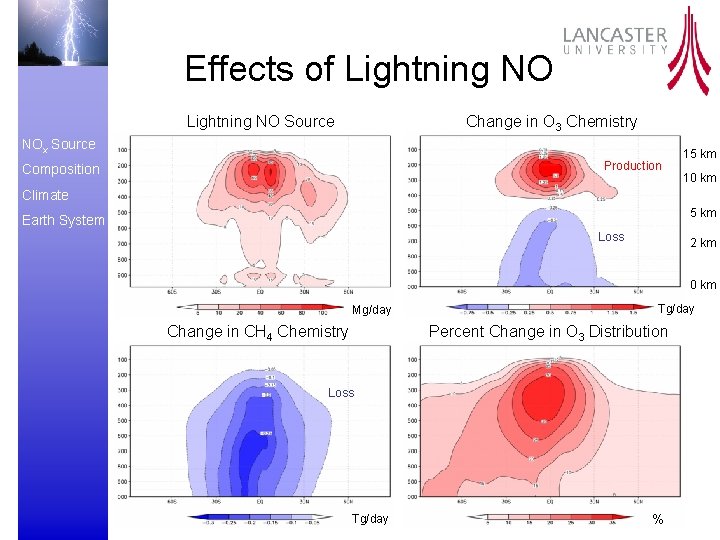
Effects of Lightning NO Source Change in O 3 Chemistry NOx Source Production Composition 15 km 10 km Climate 5 km Earth System Loss 2 km 0 km Tg/day Mg/day Change in CH 4 Chemistry Percent Change in O 3 Distribution Loss • x Tg/day %
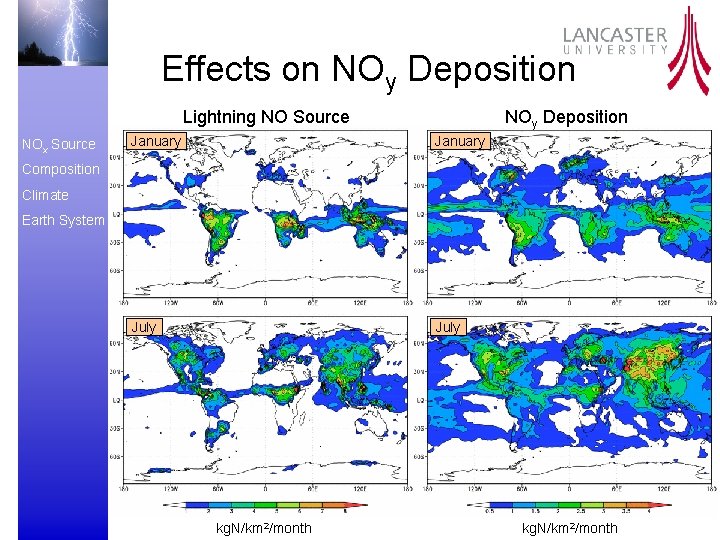
Effects on NOy Deposition Lightning NO Source NOx Source NOy Deposition January July Composition Climate Earth System kg. N/km 2/month
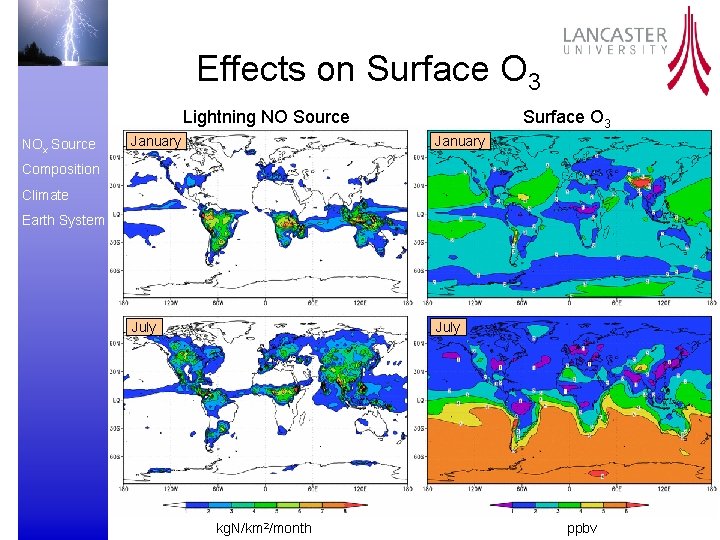
Effects on Surface O 3 Lightning NO Source NOx Source Surface O 3 January July Composition Climate Earth System kg. N/km 2/month ppbv
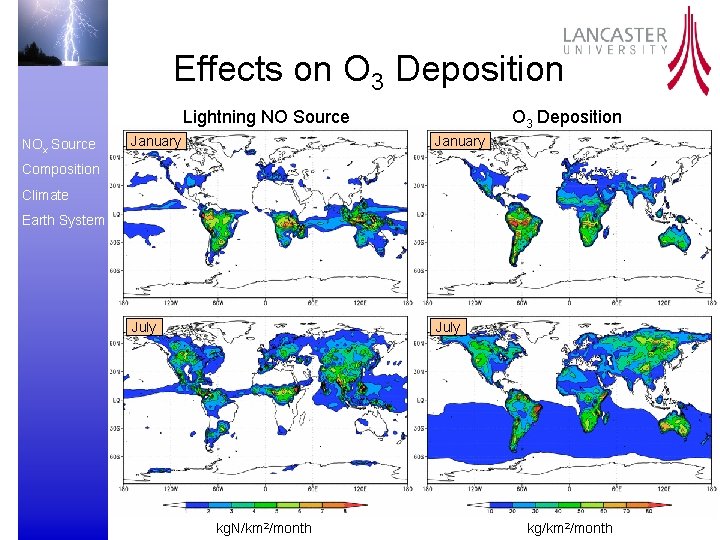
Effects on O 3 Deposition Lightning NO Source NOx Source O 3 Deposition January July Composition Climate Earth System kg. N/km 2/month kg/km 2/month
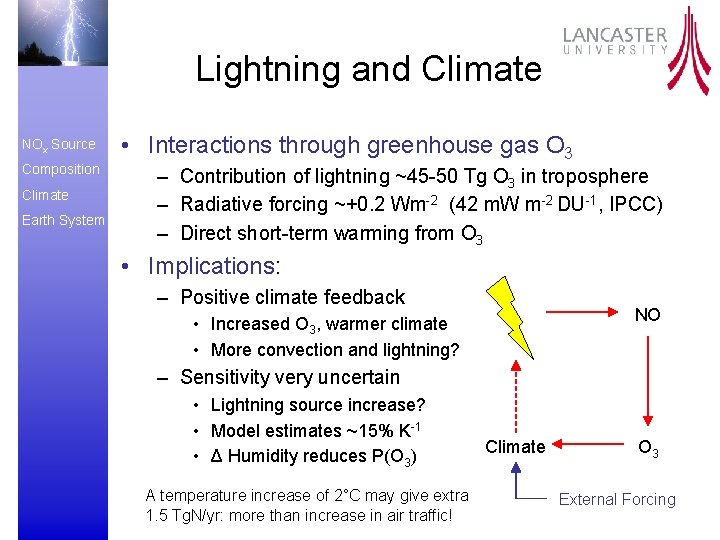
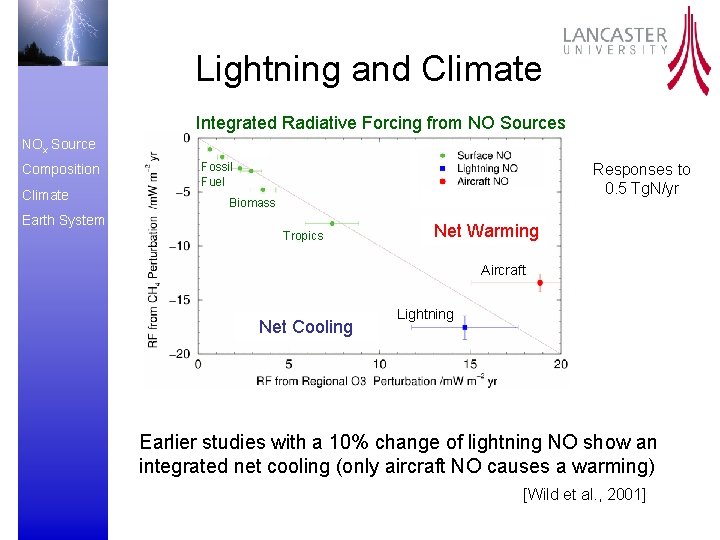
Lightning and Climate NOx Source Composition Climate Earth System • Interactions through greenhouse gas O 3 – Contribution of lightning ~45 -50 Tg O 3 in troposphere – Radiative forcing ~+0. 2 Wm-2 (42 m. W m-2 DU-1, IPCC) – Direct short-term warming from O 3 • Implications: – Positive climate feedback NO • Increased O 3, warmer climate • More convection and lightning? – Sensitivity very uncertain • Lightning source increase? • Model estimates ~15% K-1 • Δ Humidity reduces P(O 3) A temperature increase of 2°C may give extra 1. 5 Tg. N/yr: more than increase in air traffic! Climate O 3 External Forcing
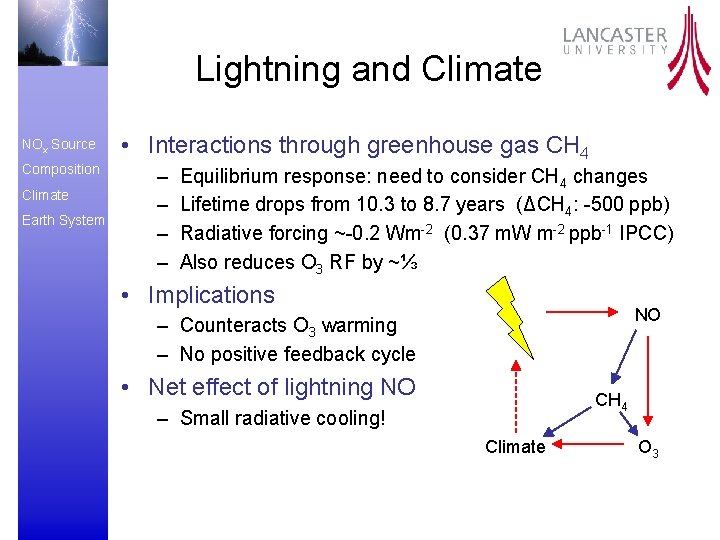
Lightning and Climate NOx Source Composition Climate Earth System • Interactions through greenhouse gas CH 4 – – Equilibrium response: need to consider CH 4 changes Lifetime drops from 10. 3 to 8. 7 years (ΔCH 4: -500 ppb) Radiative forcing ~-0. 2 Wm-2 (0. 37 m. W m-2 ppb-1 IPCC) Also reduces O 3 RF by ~⅓ • Implications NO – Counteracts O 3 warming – No positive feedback cycle • Net effect of lightning NO CH 4 – Small radiative cooling! Climate O 3
Lightning and Climate Integrated Radiative Forcing from NO Sources NOx Source Composition Climate Fossil Fuel Responses to 0. 5 Tg. N/yr Biomass Earth System Tropics Net Warming Aircraft Net Cooling Lightning Earlier studies with a 10% change of lightning NO show an integrated net cooling (only aircraft NO causes a warming) [Wild et al. , 2001]
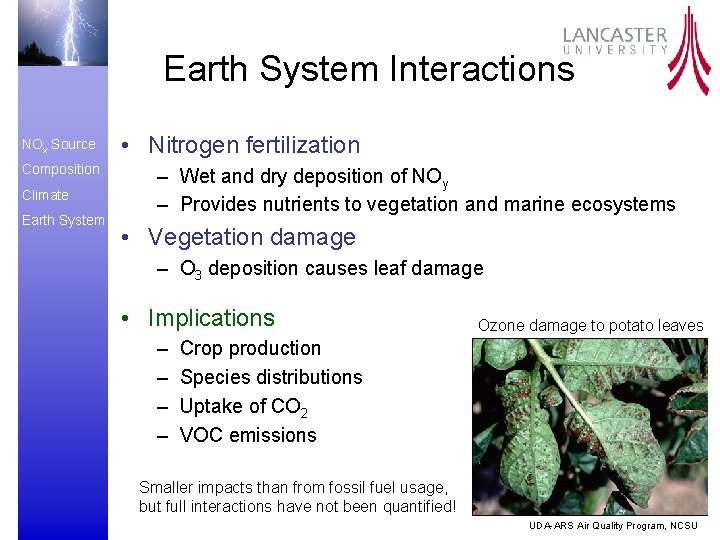
Earth System Interactions NOx Source Composition Climate Earth System • Nitrogen fertilization – Wet and dry deposition of NOy – Provides nutrients to vegetation and marine ecosystems • Vegetation damage – O 3 deposition causes leaf damage • Implications – – Ozone damage to potato leaves Crop production Species distributions Uptake of CO 2 VOC emissions Smaller impacts than from fossil fuel usage, but full interactions have not been quantified! UDA-ARS Air Quality Program, NCSU
Earth System Interactions NOx Source Composition Climate Earth System • Lightning ignition of wildfires – Small effect in tropics due to moist conditions – Accounts for 10 -50% of fires over N. America • Typically more than half of area burned • Implications – Potential feedbacks on climate • Emissions of NOx, CO, VOC, CO 2, aerosols • Direct and indirect effects; albedo changes – Influence on vegetation patterns • Effects on carbon cycling • Sensitivity to climate change
Conclusions NOx Source Composition Climate Earth System • Major environmental impacts – – Important role in tropospheric composition Climate: O 3, CH 4 (net cooling) Vegetation: O 3 and NOy deposition Fire: O 3, NOy, aerosol, vegetation damage • Big challenges remain – Improved quantification of NO emissions • Uncertainties in magnitude, location, response • Better integration of observations and models – Quantification of environmental impacts • Role of lightning in global change • Requires new generation of Earth System Models [e. g. , Met. Office Had. GEM 3, NERC QUEST ESM]