
Novice meets expert what happens when students interview
- Slides: 1
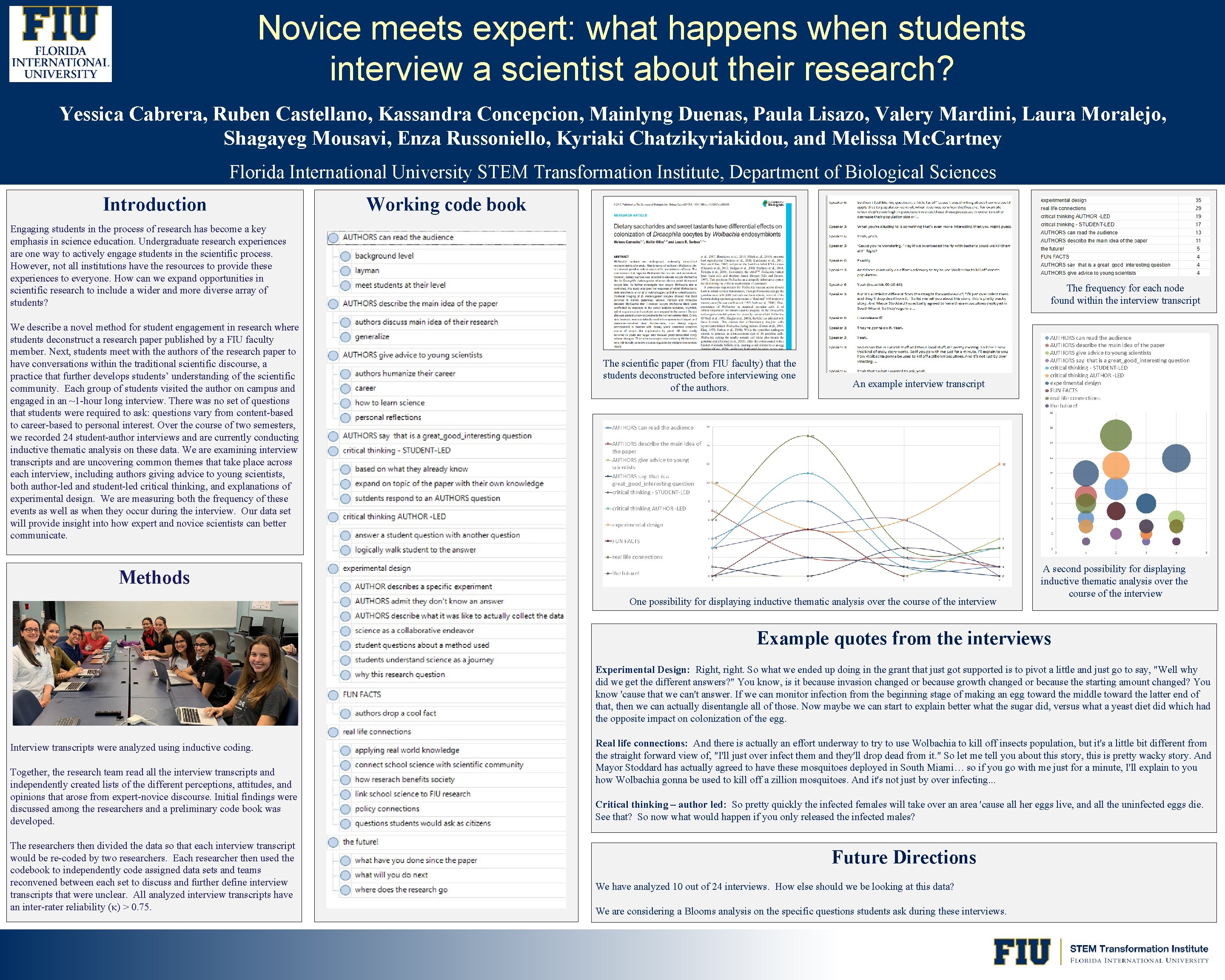
Novice meets expert: what happens when students interview a scientist about their research? Yessica Cabrera, Ruben Castellano, Kassandra Concepcion, Mainlyng Duenas, Paula Lisazo, Valery Mardini, Laura Moralejo, Shagayeg Mousavi, Enza Russoniello, Kyriaki Chatzikyriakidou, and Melissa Mc. Cartney Florida International University STEM Transformation Institute, Department of Biological Sciences Introduction Working code book Engaging students in the process of research has become a key emphasis in science education. Undergraduate research experiences are one way to actively engage students in the scientific process. However, not all institutions have the resources to provide these experiences to everyone. How can we expand opportunities in scientific research to include a wider and more diverse array of students? We describe a novel method for student engagement in research where students deconstruct a research paper published by a FIU faculty member. Next, students meet with the authors of the research paper to have conversations within the traditional scientific discourse, a practice that further develops students’ understanding of the scientific community. Each group of students visited the author on campus and engaged in an ~1 -hour long interview. There was no set of questions that students were required to ask: questions vary from content-based to career-based to personal interest. Over the course of two semesters, we recorded 24 student-author interviews and are currently conducting inductive thematic analysis on these data. We are examining interview transcripts and are uncovering common themes that take place across each interview, including authors giving advice to young scientists, both author-led and student-led critical thinking, and explanations of experimental design. We are measuring both the frequency of these events as well as when they occur during the interview. Our data set will provide insight into how expert and novice scientists can better communicate. The frequency for each node found within the interview transcript The scientific paper (from FIU faculty) that the students deconstructed before interviewing one of the authors. An example interview transcript Methods One possibility for displaying inductive thematic analysis over the course of the interview A second possibility for displaying inductive thematic analysis over the course of the interview Example quotes from the interviews Experimental Design: Right, right. So what we ended up doing in the grant that just got supported is to pivot a little and just go to say, "Well why did we get the different answers? " You know, is it because invasion changed or because growth changed or because the starting amount changed? You know 'cause that we can't answer. If we can monitor infection from the beginning stage of making an egg toward the middle toward the latter end of that, then we can actually disentangle all of those. Now maybe we can start to explain better what the sugar did, versus what a yeast diet did which had the opposite impact on colonization of the egg. Interview transcripts were analyzed using inductive coding. Together, the research team read all the interview transcripts and independently created lists of the different perceptions, attitudes, and opinions that arose from expert-novice discourse. Initial findings were discussed among the researchers and a preliminary code book was developed. The researchers then divided the data so that each interview transcript would be re-coded by two researchers. Each researcher then used the codebook to independently code assigned data sets and teams reconvened between each set to discuss and further define interview transcripts that were unclear. All analyzed interview transcripts have an inter-rater reliability (k) > 0. 75. Real life connections: And there is actually an effort underway to try to use Wolbachia to kill off insects population, but it's a little bit different from the straight forward view of, "I'll just over infect them and they'll drop dead from it. " So let me tell you about this story, this is pretty wacky story. And Mayor Stoddard has actually agreed to have these mosquitoes deployed in South Miami… so if you go with me just for a minute, I'll explain to you how Wolbachia gonna be used to kill off a zillion mosquitoes. And it's not just by over infecting. . . Critical thinking – author led: So pretty quickly the infected females will take over an area 'cause all her eggs live, and all the uninfected eggs die. See that? So now what would happen if you only released the infected males? Future Directions We have analyzed 10 out of 24 interviews. How else should we be looking at this data? We are considering a Blooms analysis on the specific questions students ask during these interviews.