
November 2020 doc IEEE 802 11 201893 r
November 2020 doc. : IEEE 802. 11 -20/1893 r 0 Channel Modeling for WLAN Sensing Indoor Scenario Date: 2020 11 17 Authors: Affiliation Address Meihong Zhang Phone Name zhangmeihong@huawei. com Hailiang Xie Rui Du Xiaohui Peng Danny Kai Pin Tan Huawei Technologies Co. Ltd F 3, Huawei Base, Shenzhen, China Chenchen Liu Yingxiang Sun Jie Xu Rui Wang Shuai Wang Submission CUHK (SZ) SUSTC Slide 1 Meihong Zhang, Huawei
November 2020 doc. : IEEE 802. 11 -20/1893 r 0 1. Abstract • In [1], three options for generating rays used in channel realization generation process were presented, including Option 1: execute ray tracing software for each scenario; Option 2: integrate an abstract target model into existing channel model; Option 3: establish a database which records the results obtained by ray tracing software. • In this contribution, we will show some ray tracing simulation results of a specified indoor scenario (corresponding to option 1 and 3). Submission Slide 2 Meihong Zhang, Huawei
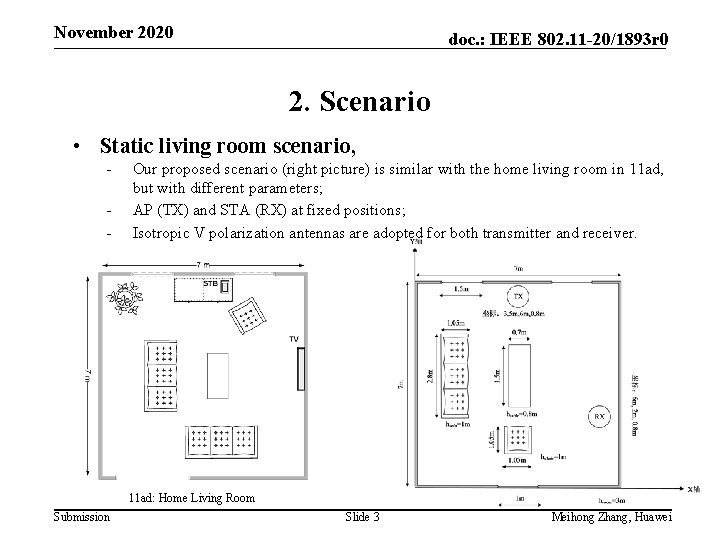
November 2020 doc. : IEEE 802. 11 -20/1893 r 0 2. Scenario • Static living room scenario, Our proposed scenario (right picture) is similar with the home living room in 11 ad, but with different parameters; AP (TX) and STA (RX) at fixed positions; Isotropic V polarization antennas are adopted for both transmitter and receiver. 11 ad: Home Living Room Submission Slide 3 Meihong Zhang, Huawei
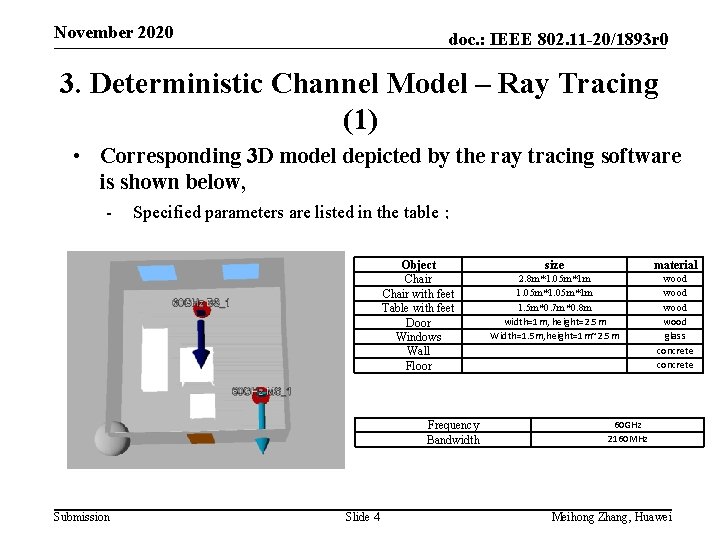
November 2020 doc. : IEEE 802. 11 -20/1893 r 0 3. Deterministic Channel Model – Ray Tracing (1) • Corresponding 3 D model depicted by the ray tracing software is shown below, Specified parameters are listed in the table; Object Chair with feet Table with feet Door Windows Wall Floor Frequency Bandwidth Submission Slide 4 size material 2. 8 m*1. 05 m*1 m 1. 5 m*0. 7 m*0. 8 m width=1 m, height=2. 5 m Width=1. 5 m, height=1 m~2. 5 m wood glass concrete 60 GHz 2160 MHz Meihong Zhang, Huawei
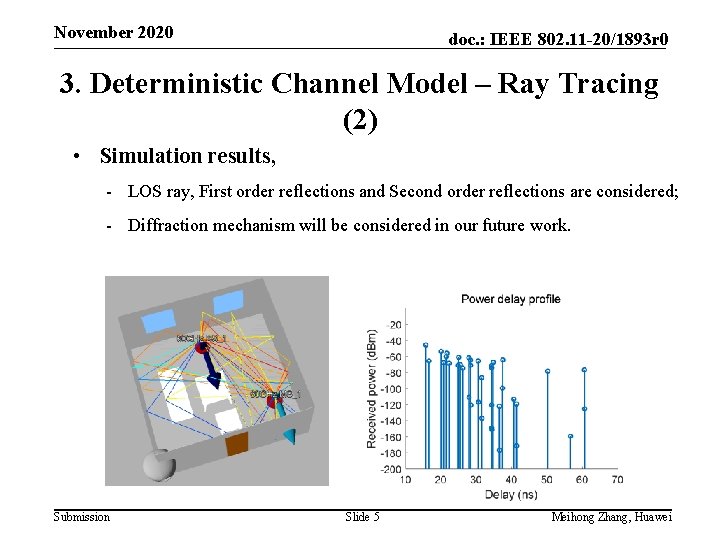
November 2020 doc. : IEEE 802. 11 -20/1893 r 0 3. Deterministic Channel Model – Ray Tracing (2) • Simulation results, LOS ray, First order reflections and Second order reflections are considered; Diffraction mechanism will be considered in our future work. Submission Slide 5 Meihong Zhang, Huawei
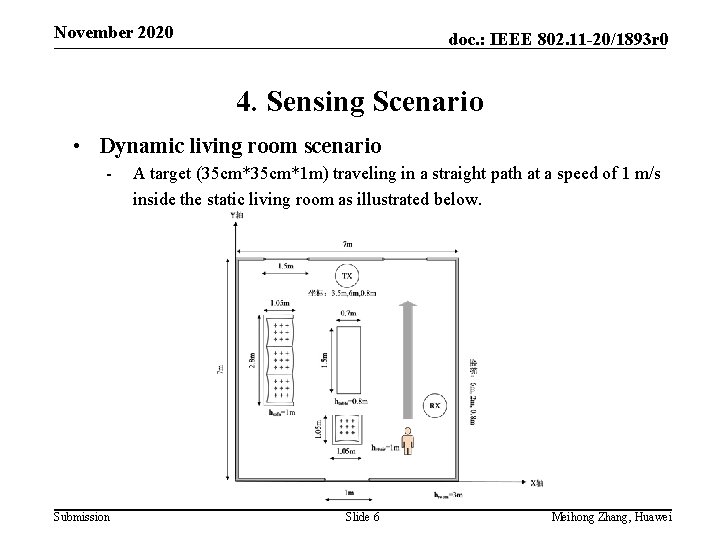
November 2020 doc. : IEEE 802. 11 -20/1893 r 0 4. Sensing Scenario • Dynamic living room scenario Submission A target (35 cm*1 m) traveling in a straight path at a speed of 1 m/s inside the static living room as illustrated below. Slide 6 Meihong Zhang, Huawei
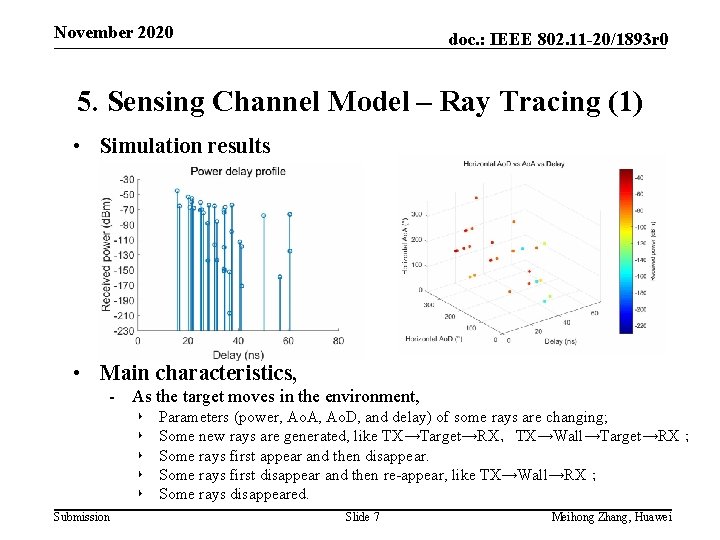
November 2020 doc. : IEEE 802. 11 -20/1893 r 0 5. Sensing Channel Model – Ray Tracing (1) • Simulation results • Main characteristics, As the target moves in the environment, ‣ ‣ ‣ Submission Parameters (power, Ao. A, Ao. D, and delay) of some rays are changing; Some new rays are generated, like TX→Target→RX,TX→Wall→Target→RX; Some rays first appear and then disappear. Some rays first disappear and then re appear, like TX→Wall→RX; Some rays disappeared. Slide 7 Meihong Zhang, Huawei
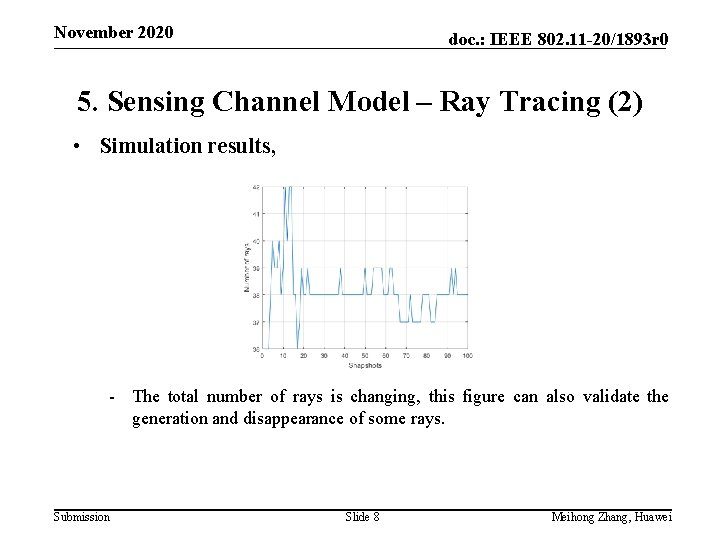
November 2020 doc. : IEEE 802. 11 -20/1893 r 0 5. Sensing Channel Model – Ray Tracing (2) • Simulation results, The total number of rays is changing, this figure can also validate the generation and disappearance of some rays. Submission Slide 8 Meihong Zhang, Huawei
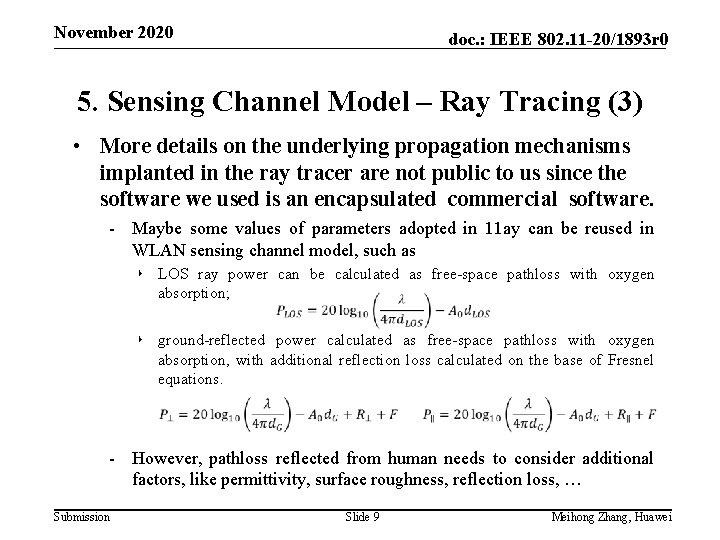
November 2020 doc. : IEEE 802. 11 -20/1893 r 0 5. Sensing Channel Model – Ray Tracing (3) • More details on the underlying propagation mechanisms implanted in the ray tracer are not public to us since the software we used is an encapsulated commercial software. Maybe some values of parameters adopted in 11 ay can be reused in WLAN sensing channel model, such as ‣ LOS ray power can be calculated as free space pathloss with oxygen absorption; ‣ ground reflected power calculated as free space pathloss with oxygen absorption, with additional reflection loss calculated on the base of Fresnel equations. However, pathloss reflected from human needs to consider additional factors, like permittivity, surface roughness, reflection loss, … Submission Slide 9 Meihong Zhang, Huawei
November 2020 doc. : IEEE 802. 11 -20/1893 r 0 6. Conclusion • In this presentation, some ray tracing simulation results of a specified indoor scenario are proposed. • Corresponding to the options we proposed in [1], For option 1, we can execute the ray tracing software for each snapshot just like what we did in this slide when performing the channel realization generation process; For option 3, we can perform the ray tracing simulations offline, then store the parameters (powers, delays and angles) we obtained at each snapshot in the database for future use. Submission Slide 10 Meihong Zhang, Huawei
November 2020 doc. : IEEE 802. 11 -20/1893 r 0 7. Follow Up • We will try to conduct some experimental measurements to validate the accuracy of our ray tracing results. Submission Slide 11 Meihong Zhang, Huawei
![November 2020 doc. : IEEE 802. 11 -20/1893 r 0 8. References [1] 11](http://slidetodoc.com/presentation_image_h2/5b878a042a7e244c2e2aa068e0d9f1da/image-12.jpg "November 2020 doc. : IEEE 802. 11 -20/1893 r 0 8. References [1] 11")
November 2020 doc. : IEEE 802. 11 -20/1893 r 0 8. References [1] 11 20 1334 00 SENS a brief description of the channel realization generation process. pptx Submission Slide 12 Meihong Zhang, Huawei
- Slides: 12