
November 2020 DCN 15 20 0354 00 007
November 2020 DCN 15 -20 -0354 -00 -007 a Project: IEEE P 802. 15 Working Group for Wireless Personal Area Networks (WPANs) Submission Title : Promising Solution for vehicle communication using Optical Camera Communication Date Submitted : November, 2020 Source : Cong Hoan Nguyen and Yeong Min Jang Company : [Kookmin University] Address : [Seoul, Korea] Voice : [+82 -2 -910 -5068], E-Mail: [yjang@kookmin. ac. kr] Re : Abstract : Promising Solution for vehicle communication using Optical Camera Communication. Purpose : To discuss about the need for applying Optical Camera Communication technique on highspeed V 2 V communications. Notice: This document has been prepared to assist the IEEE P 802. 15. It is offered as a basis for discussion and is not binding on the contributing individual(s) or organization(s). The material in this document is subject to change in form and content after further study. The contributor(s) reserve(s) the right to add, amend or withdraw material contained herein. Release : The contributor acknowledges and accepts that this contribution becomes the property of IEEE and may be made publicly available by P 802. 15. Submission Yeong Min Jang Slide 1
November 2020 DCN 15 -20 -0354 -00 -007 a Promising Solution for vehicle communication using Optical Camera Communication Submission Yeong Min Jang Slide 2
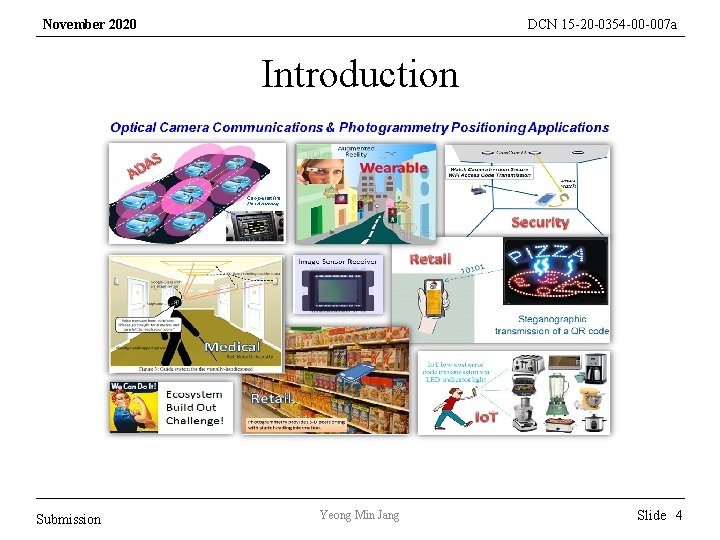
November 2020 DCN 15 -20 -0354 -00 -007 a Introduction Optical Camera Communications (OCC) OCC is modulating an LED light with data bits that can be received by a camera, which then decodes the bits and extracts the data. Today we have millions of devices enabled to receive visible light communications via the camera, but we lack standards to describe the modulation format. This contribution discusses some OCC topics of interest. Submission Yeong Min Jang Slide 3
November 2020 DCN 15 -20 -0354 -00 -007 a Introduction Submission Yeong Min Jang Slide 4

November 2020 DCN 15 -20 -0354 -00 -007 a Optical camera communication for vehicle system • The main parts of Io. V consist of communication between vehicle-to-vehicle (V 2 V), vehicle-to-infrastructure (V 2 I), vehicle-to-cloud (V 2 C), vehicle-to-sensors (V 2 S), and vehicle-to-personal devices (V 2 P). This whole system can be defined as vehicle -to everything (V 2 X) communication. A general architecture of V 2 X is illustrated in figure Submission Yeong Min Jang Slide 5

November 2020 DCN 15 -20 -0354 -00 -007 a Optical camera communication for vehicle system Submission Yeong Min Jang Slide 6
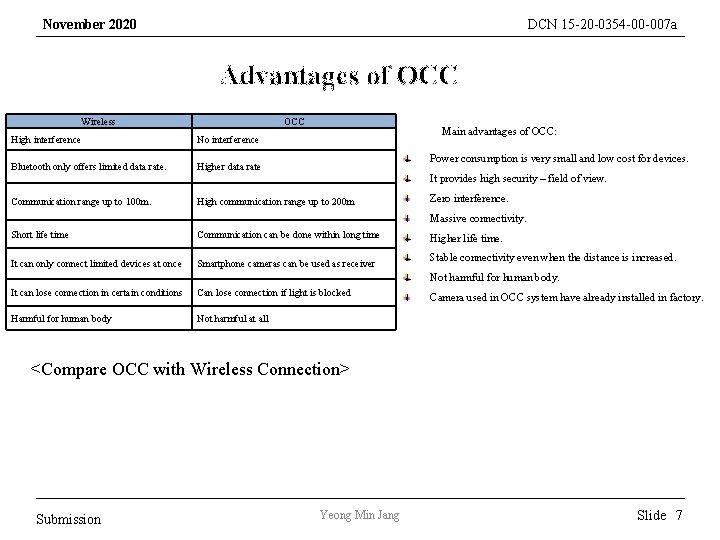
November 2020 DCN 15 -20 -0354 -00 -007 a Advantages of OCC Wireless OCC High interference No interference Bluetooth only offers limited data rate. Higher data rate Main advantages of OCC: Power consumption is very small and low cost for devices. It provides high security – field of view. Communication range up to 100 m. High communication range up to 200 m Zero interference. Massive connectivity. Short life time Communication can be done within long time It can only connect limited devices at once Smartphone cameras can be used as receiver Higher life time. Stable connectivity even when the distance is increased. Not harmful for human body. It can lose connection in certain conditions Can lose connection if light is blocked Harmful for human body Not harmful at all Camera used in OCC system have already installed in factory. <Compare OCC with Wireless Connection> Submission Yeong Min Jang Slide 7
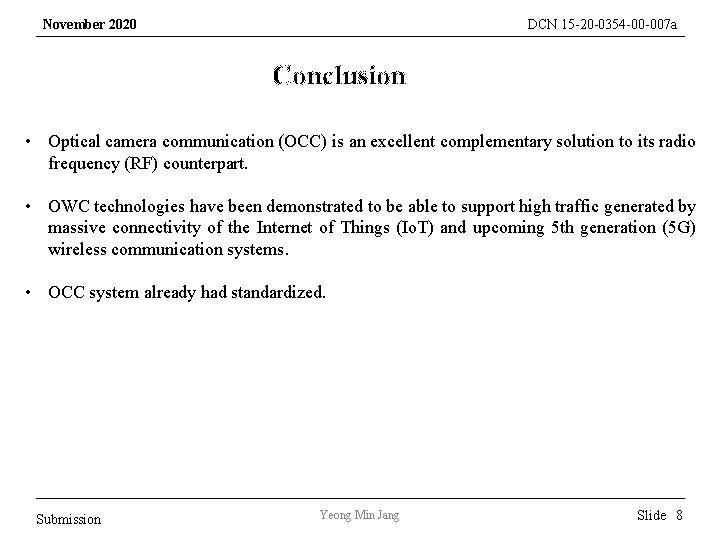
November 2020 DCN 15 -20 -0354 -00 -007 a Conclusion • Optical camera communication (OCC) is an excellent complementary solution to its radio frequency (RF) counterpart. • OWC technologies have been demonstrated to be able to support high traffic generated by massive connectivity of the Internet of Things (Io. T) and upcoming 5 th generation (5 G) wireless communication systems. • OCC system already had standardized. Submission Yeong Min Jang Slide 8
- Slides: 8