
November 2018 doc IEEE 802 11 181972 r
November 2018 doc. : IEEE 802. 11 -18/1972 r 4 Thoughts on RTA Development Date: 2018 -11 -15 Name Affiliation Address Kazuyuki Sakoda Sony 1730 N. First Street, San Jose CA 95112 William Carney Sony Submission Phone Email kazuyuki. sakoda(at)sony. com William. Carney(at)sony. com Slide 1 Kazuyuki Sakoda (Sony)
November 2018 doc. : IEEE 802. 11 -18/1972 r 4 Table of Contents • • • Brief recap on the applications that drive interest in a RTA spec Possible categorization of the targeted improvements Application requirements: Is “Real Time” the only consideration? Operating band of the RTA network s. How can we create innovation spaces for better implementation? Submission Slide 2 Kazuyuki Sakoda (Sony)
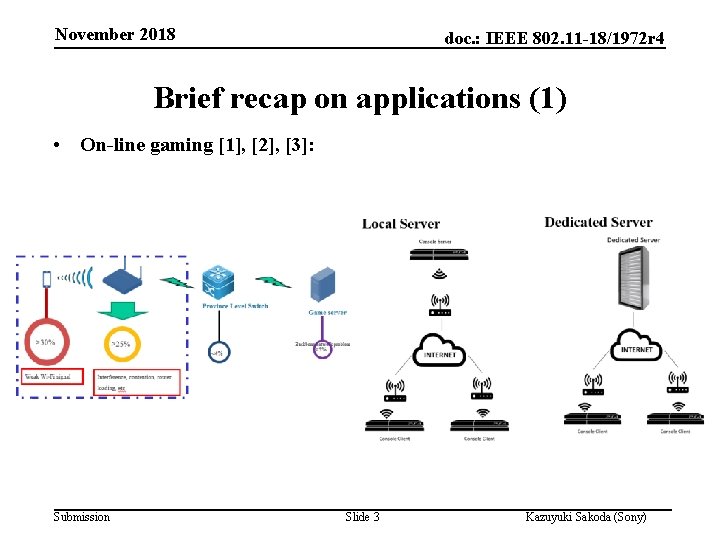
November 2018 doc. : IEEE 802. 11 -18/1972 r 4 Brief recap on applications (1) • On-line gaming [1], [2], [3]: Submission Slide 3 Kazuyuki Sakoda (Sony)
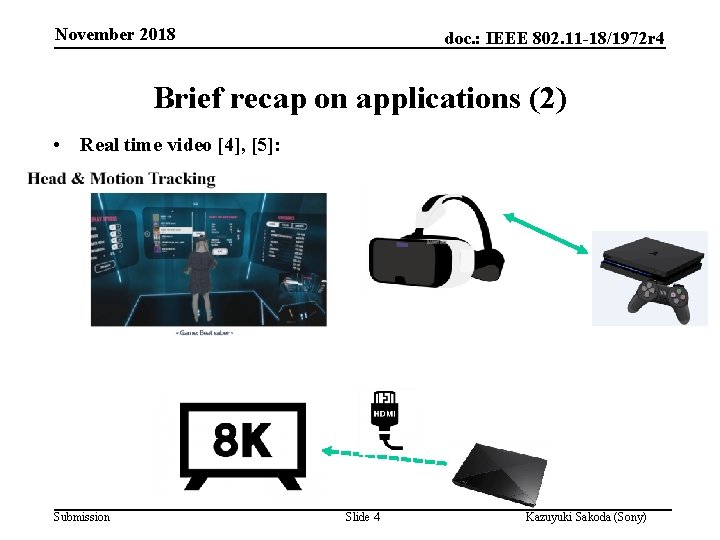
November 2018 doc. : IEEE 802. 11 -18/1972 r 4 Brief recap on applications (2) • Real time video [4], [5]: Submission Slide 4 Kazuyuki Sakoda (Sony)
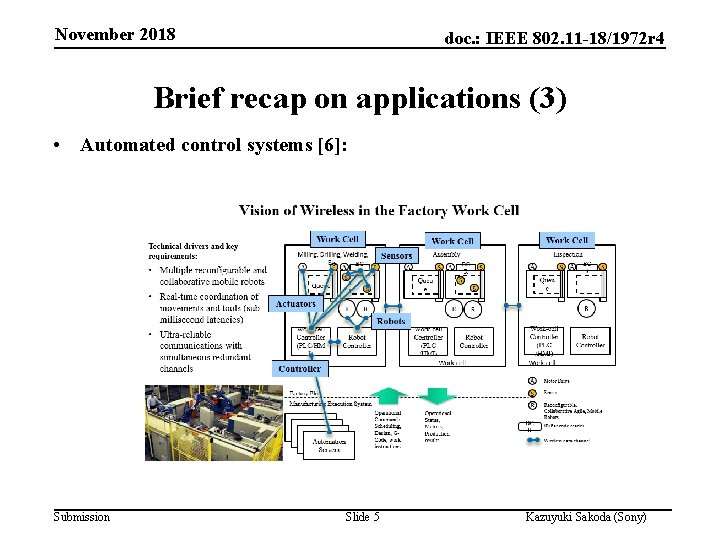
November 2018 doc. : IEEE 802. 11 -18/1972 r 4 Brief recap on applications (3) • Automated control systems [6]: Submission Slide 5 Kazuyuki Sakoda (Sony)
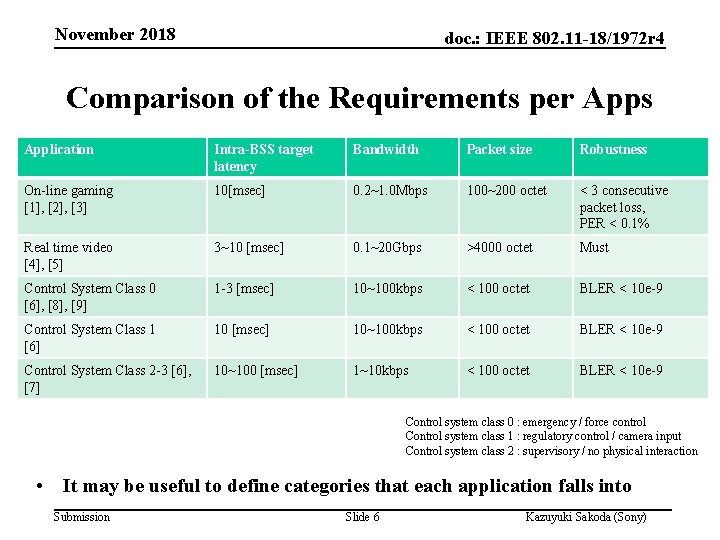
November 2018 doc. : IEEE 802. 11 -18/1972 r 4 Comparison of the Requirements per Apps Application Intra-BSS target latency Bandwidth Packet size Robustness On-line gaming [1], [2], [3] 10[msec] 0. 2~1. 0 Mbps 100~200 octet < 3 consecutive packet loss, PER < 0. 1% Real time video [4], [5] 3~10 [msec] 0. 1~20 Gbps >4000 octet Must Control System Class 0 [6], [8], [9] 1 -3 [msec] 10~100 kbps < 100 octet BLER < 10 e-9 Control System Class 1 [6] 10 [msec] 10~100 kbps < 100 octet BLER < 10 e-9 Control System Class 2 -3 [6], [7] 10~100 [msec] 1~10 kbps < 100 octet BLER < 10 e-9 Control system class 0 : emergency / force control Control system class 1 : regulatory control / camera input Control system class 2 : supervisory / no physical interaction • It may be useful to define categories that each application falls into Submission Slide 6 Kazuyuki Sakoda (Sony)
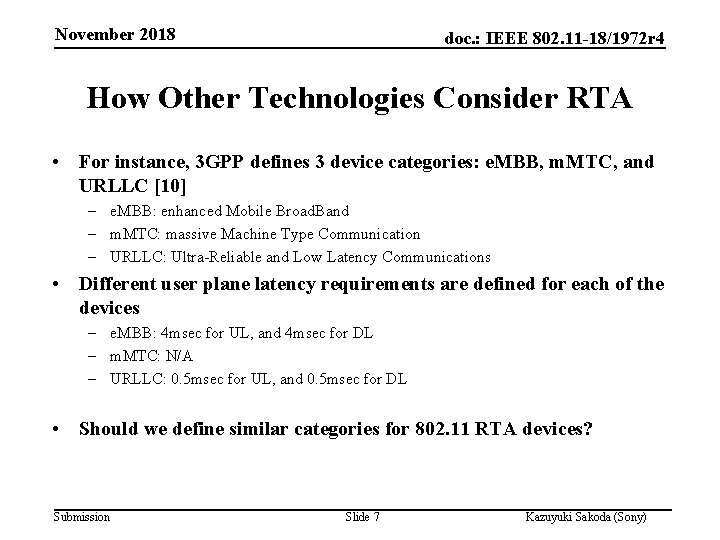
November 2018 doc. : IEEE 802. 11 -18/1972 r 4 How Other Technologies Consider RTA • For instance, 3 GPP defines 3 device categories: e. MBB, m. MTC, and URLLC [10] – e. MBB: enhanced Mobile Broad. Band – m. MTC: massive Machine Type Communication – URLLC: Ultra-Reliable and Low Latency Communications • Different user plane latency requirements are defined for each of the devices – e. MBB: 4 msec for UL, and 4 msec for DL – m. MTC: N/A – URLLC: 0. 5 msec for UL, and 0. 5 msec for DL • Should we define similar categories for 802. 11 RTA devices? Submission Slide 7 Kazuyuki Sakoda (Sony)
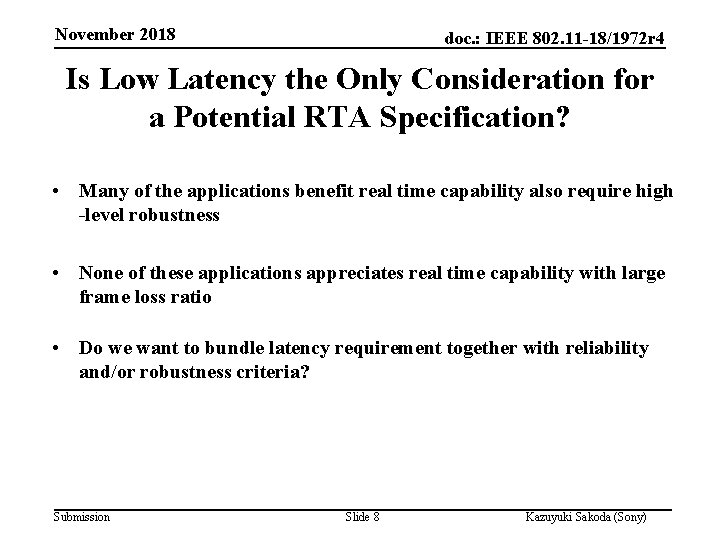
November 2018 doc. : IEEE 802. 11 -18/1972 r 4 Is Low Latency the Only Consideration for a Potential RTA Specification? • Many of the applications benefit real time capability also require high -level robustness • None of these applications appreciates real time capability with large frame loss ratio • Do we want to bundle latency requirement together with reliability and/or robustness criteria? Submission Slide 8 Kazuyuki Sakoda (Sony)
November 2018 doc. : IEEE 802. 11 -18/1972 r 4 RTA: Band Specific or Band Agnostic? • 802. 11 network can be deployed in many frequency bands, i. e. , ~800 MHz, 900 MHz, 2. 4 GHz, 3. 5 GHz, and >40 GHz • The operating frequency band is selected to meet application requirements • Looking through applications in the previous slides, it is possible that applications that appreciate RTA technology can be accommodated in any 802. 11 frequency bands • Should we consider RTA to be band specific technology or band agnostic technology? – 802. 11 ax and EHT are for 2. 4 GHz, 5 GHz, and 6 GHz only Submission Slide 9 Kazuyuki Sakoda (Sony)
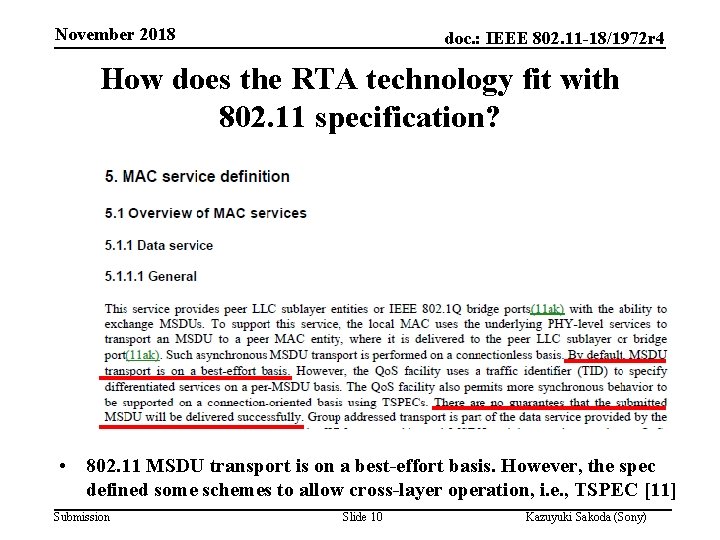
November 2018 doc. : IEEE 802. 11 -18/1972 r 4 How does the RTA technology fit with 802. 11 specification? • 802. 11 MSDU transport is on a best-effort basis. However, the spec defined some schemes to allow cross-layer operation, i. e. , TSPEC [11] Submission Slide 10 Kazuyuki Sakoda (Sony)
November 2018 doc. : IEEE 802. 11 -18/1972 r 4 RTA: A Tool for Cross-Layer Design? • Layering model makes system design easier. However, when the target requirements are extremely precise, a cross-layer design approach is often useful. • Should RTA define APIs for cross-layer operation beyond just defining a latency framework? – It may complicate the end specification, but could allow a more innovative implementation of RTA systems leveraging 802. 11 Submission Slide 11 Kazuyuki Sakoda (Sony)
November 2018 doc. : IEEE 802. 11 -18/1972 r 4 Discussion/Questions 1. Develop a categorization schema of RTA types to guide specification development? 2. Low Latency focus only, or also include Robustness and Reliability? 3. Band Specific or Band Agnostic? 4. Also consider informative content and APIs to facilitate cross-layer system design? Submission Slide 12 Kazuyuki Sakoda (Sony)
November 2018 doc. : IEEE 802. 11 -18/1972 r 4 Straw poll (1) • Do you think it is reasonable to develop a categorization schema of RTA types to guide specification development? – – Submission Yes No Need more information/discussion Don’t know Slide 13 Kazuyuki Sakoda (Sony)
November 2018 doc. : IEEE 802. 11 -18/1972 r 4 Straw poll (2) • Should RTA consider robustness/reliability metric together with latency requirements? – – Submission Yes No Need more information/discussion Don’t know Slide 14 Kazuyuki Sakoda (Sony)
November 2018 doc. : IEEE 802. 11 -18/1972 r 4 Straw poll (3) • Should RTA capability be available with multiple 802. 11 PHY technologies? – – Submission Yes No Need more information/discussion Don’t know Slide 15 Kazuyuki Sakoda (Sony)
November 2018 doc. : IEEE 802. 11 -18/1972 r 4 Straw poll (4) • Should RTA define APIs for cross-layer operation beyond just defining a latency framework? – – Submission Yes No Need more information/discussion Don’t know Slide 16 Kazuyuki Sakoda (Sony)
![November 2018 doc. : IEEE 802. 11 -18/1972 r 4 References • [1] IEEE](http://slidetodoc.com/presentation_image_h2/8a0f424b4c09c35666c5d0c0e28ba73b/image-17.jpg "November 2018 doc. : IEEE 802. 11 -18/1972 r 4 References • [1] IEEE")
November 2018 doc. : IEEE 802. 11 -18/1972 r 4 References • [1] IEEE 802. 11 -18/1234 r 0, “Real-time Mobile game vs Wi-Fi, ” Kate Meng • [2] IEEE 802. 11 -18/1499 r 0, “Real-time Console Game Network Profile, ” Karthik Iyer, et. al. • [3] IEEE 802. 11 -18/1542 r 2, “Time-Aware Traffic Shaping over 802. 11, ” Dave Cavalcanti, et. al. • [4] IEEE 802. 21 -18/0059 r 1, “Introduction to Concept of the ‘Network Enablers for seamless HMD based VR Content Service’ IG, ” Dong-Il Dillon Seo, et. al. • [5] IEEE 802. 11 -18/1970 r, “Old and new latency requirements, ” Kazuyuki Sakoda • [6] IEEE 802. 11 -18/1784 r 0, “Reliable, High Performance Wireless Systems for Factory Automation, ” Richard Candell Submission Slide 17 Kazuyuki Sakoda (Sony)
![November 2018 doc. : IEEE 802. 11 -18/1972 r 4 References • [7] IEEE](http://slidetodoc.com/presentation_image_h2/8a0f424b4c09c35666c5d0c0e28ba73b/image-18.jpg "November 2018 doc. : IEEE 802. 11 -18/1972 r 4 References • [7] IEEE")
November 2018 doc. : IEEE 802. 11 -18/1972 r 4 References • [7] IEEE 802. 11 -18/1618 r 0, “Discussion on Target Applications of RTA, ” Akira Kishida, et. al. • [8] “Momentum Control with Hierarchical Inverse Dynamics on a Torque-Controlled Humanoid, ” Alexander Hrzog, et. al, Journal on Autonomous Robots, Vol. 40 Issue 3, March 2016 • [9] “An autonomous manipulation system based on force control and optimization, ” Ludovic Righetti, et. al. , Autonomous Robots, January 2014, Volume 36, Issue 1– 2 • [10] 3 GPP TR 38. 913 V 15. 0. 0 (2018 -06), “Study on Scenarios and Requirements for Next Generation Access Technologies”, Release 15 • [11] Draft P 802. 11 REVmd_D 1. 4. Submission Slide 18 Kazuyuki Sakoda (Sony)
- Slides: 18