
November 2013 doc IEEE 802 11 131327 r
November 2013 doc. : IEEE 802. 11 -13/1327 r 0 DSRC Coexistence Date: 2013 -11 -11 Authors: Agenda Slide 1 Rich Kennedy, Self
November 2013 doc. : IEEE 802. 11 -13/1327 r 0 Abstract This presentation describes the DSRC technology, the regulatory requirements for sharing the 5. 9 GHz spectrum, and how we propose to move forward with a plan to enable regulators to open this spectrum to allow IEEE 802. 11 technologies to operate in this band. Agenda Slide 2 Rich Kennedy, Self
November 2013 doc. : IEEE 802. 11 -13/1327 r 0 Agenda • • • DSRC basics FCC Part 15 basics Existing 802. 11 sharing mechanisms Sharing with DSRC Project to incorporate sharing in 802. 11 ac Agenda Slide 3 Rich Kennedy, Self
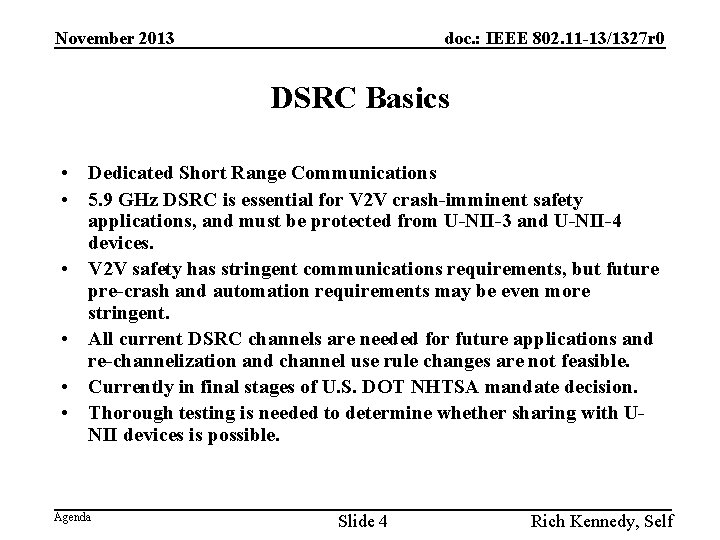
November 2013 doc. : IEEE 802. 11 -13/1327 r 0 DSRC Basics • Dedicated Short Range Communications • 5. 9 GHz DSRC is essential for V 2 V crash-imminent safety applications, and must be protected from U-NII-3 and U-NII-4 devices. • V 2 V safety has stringent communications requirements, but future pre-crash and automation requirements may be even more stringent. • All current DSRC channels are needed for future applications and re-channelization and channel use rule changes are not feasible. • Currently in final stages of U. S. DOT NHTSA mandate decision. • Thorough testing is needed to determine whether sharing with UNII devices is possible. Agenda Slide 4 Rich Kennedy, Self
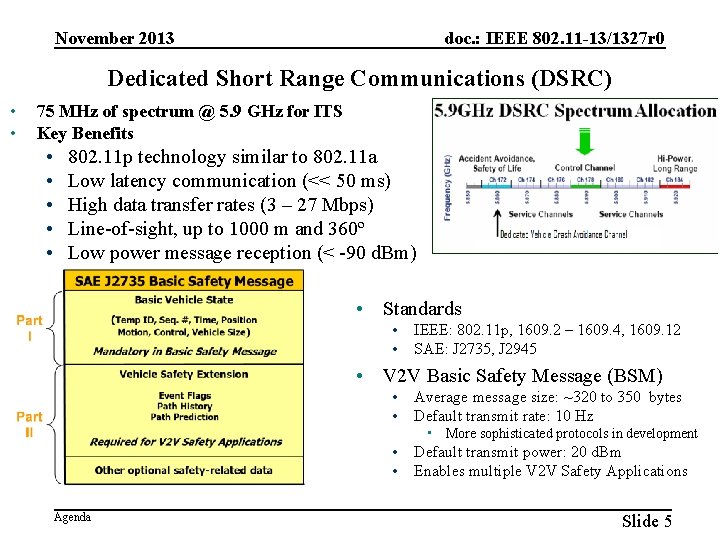
November 2013 doc. : IEEE 802. 11 -13/1327 r 0 Dedicated Short Range Communications (DSRC) • • 75 MHz of spectrum @ 5. 9 GHz for ITS Key Benefits • • • 802. 11 p technology similar to 802. 11 a Low latency communication (<< 50 ms) High data transfer rates (3 – 27 Mbps) Line-of-sight, up to 1000 m and 360º Low power message reception (< -90 d. Bm) • Standards • • IEEE: 802. 11 p, 1609. 2 – 1609. 4, 1609. 12 SAE: J 2735, J 2945 • V 2 V Basic Safety Message (BSM) • • Average message size: ~320 to 350 bytes Default transmit rate: 10 Hz • More sophisticated protocols in development • • Agenda Default transmit power: 20 d. Bm Enables multiple V 2 V Safety Applications Slide 5
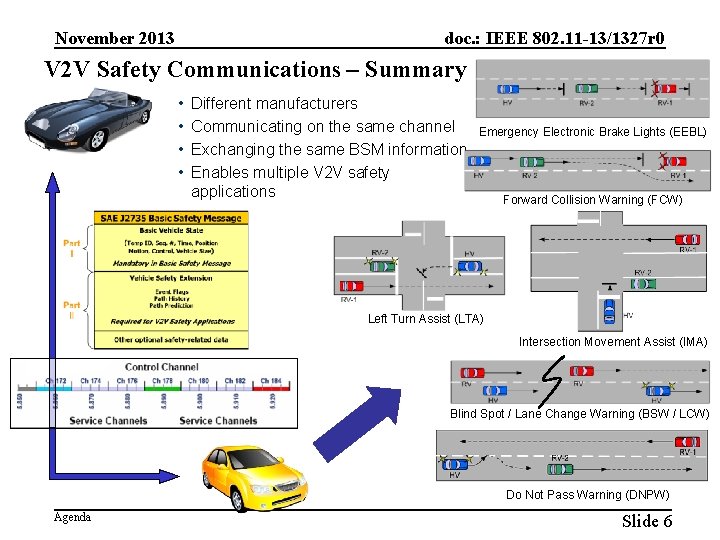
November 2013 doc. : IEEE 802. 11 -13/1327 r 0 V 2 V Safety Communications – Summary • • Different manufacturers Communicating on the same channel Exchanging the same BSM information Enables multiple V 2 V safety applications Emergency Electronic Brake Lights (EEBL) Forward Collision Warning (FCW) Left Turn Assist (LTA) Intersection Movement Assist (IMA) Blind Spot / Lane Change Warning (BSW / LCW) Do Not Pass Warning (DNPW) Agenda Slide 6
November 2013 doc. : IEEE 802. 11 -13/1327 r 0 DSRC Coexistence Tiger Team • What should be the outcome from the group? – Set of coexistence requirements for 802. 11 in the 5 GHz band with ITS safety of life and property communications in the 5. 9 GHz band – Form a group to provide a formal interface to other organizations in the automotive industry, NHTSA, DOT and other ITS players • What is the required milestone timeline – Dependent upon the FCC et al, progress on the rollout of the standards, technologies and laws – Outcome of experiments prior to rulemaking; proof of concepts – CAMP/DOT testing and validating Agenda Slide 7 Rich Kennedy, Self
November 2013 doc. : IEEE 802. 11 -13/1327 r 0 Some Part 15 Basics • 15. 1 “…an intentional, unintentional, or incidental radiator may be operated without an individual license. ” • 15. 5(b) Operation of an intentional, unintentional, or incidental radiator is subject to the conditions that no harmful interference is caused and that interference must be accepted that may be caused by the operation of an authorized radio station, by another intentional or unintentional radiator, by industrial, scientific and medical (ISM) equipment, or by an incidental radiator. Agenda Slide 8 Rich Kennedy, Self
November 2013 doc. : IEEE 802. 11 -13/1327 r 0 Existing 802. 11 Sharing Mechanisms • The success of 802. 11 devices relies on its ability to share with other 802. 11 WLAN devices • Other mechanisms have been devised for sharing with non-802. 11 devices for special cases – DFS to protect radars in the 5 GHz bands • Required in 5250 to 5350 MHz and 5470 to 5725 MHz bands • Detection and avoidance of interference with radars – Geo-location Database to protect broadcast equipment in the TV bands • Approved for unlicensed operation in TV bands • To transmit, devices access a database to determine available, unused channels, based on geographic location and time, and the device transmit power Agenda Slide 9 Rich Kennedy, Self
November 2013 doc. : IEEE 802. 11 -13/1327 r 0 Sharing with DSRC • Study group will determine the best sharing approach – Based on maximizing spectrum utilization – Must meet requirements determined by regulation and approval of the DSRC community – Primary allocation protection is paramount • DSRC community will participate Agenda Slide 10 Rich Kennedy, Self
November 2013 doc. : IEEE 802. 11 -13/1327 r 0 Project to Develop Sharing in 5. 9 GHz • If IEEE 802. 11 is to utilize the 5. 9 GHz band, the sharing mechanism must be added to the standard • A Study Group should be formed to develop a PAR and 5 Criteria to start this project Agenda Slide 11 Rich Kennedy, Self
November 2013 doc. : IEEE 802. 11 -13/1327 r 0 References • Harmful Interference to DSRC Systems: 11 -13/1309 r 0 • DSRC PER versus RSS Profiles: 11 -13/1360 r 0 Agenda Slide 12 Rich Kennedy, Self
- Slides: 12