
November 2000 doc IEEE 802 15 199 r
November 2000 doc. : IEEE 802. 15 -<199 r 2> Project: IEEE P 802. 15 Working Group for Wireless Personal Area Networks (WPANs) Submission Title: TI PHY Submission to TG 3 Date Submitted: November 6, 2000 Source: Anand Dabak Company Texas Instruments Address 12500 TI Blvd, MS 8632, Dallas, TX 75243, USA Voice: 214. 480. 4389, FAX: 972. 761. 6967, E-Mail: dabak@ti. com Re: original document. Abstract: Submission to Task Group 3 for consideration as the High Rate PHY for 802. 15. 3 Purpose: Evaluation of Proposal. Notice: This document has been prepared to assist the IEEE P 802. 15. It is offered as a basis for discussion and is not binding on the contributing individual(s) or organization(s). The material in this document is subject to change in form and content after further study. The contributor(s) reserve(s) the right to add, amend or withdraw material contained herein. Release: The contributor acknowledges and accepts that this contribution becomes the property of IEEE and may be made publicly available by P 802. 15. Submission 1 Anand Dabak, Texas Instruments
November 2000 doc. : IEEE 802. 15 -<199 r 2> Physical Layer Submission to Task Group 3 Anand Dabak Texas Instruments Submission 2 Anand Dabak, Texas Instruments
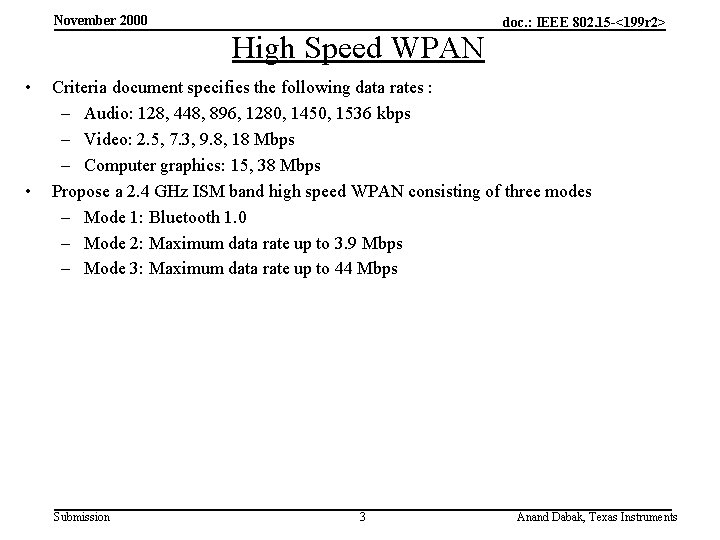
November 2000 High Speed WPAN • • doc. : IEEE 802. 15 -<199 r 2> Criteria document specifies the following data rates : – Audio: 128, 448, 896, 1280, 1450, 1536 kbps – Video: 2. 5, 7. 3, 9. 8, 18 Mbps – Computer graphics: 15, 38 Mbps Propose a 2. 4 GHz ISM band high speed WPAN consisting of three modes – Mode 1: Bluetooth 1. 0 – Mode 2: Maximum data rate up to 3. 9 Mbps – Mode 3: Maximum data rate up to 44 Mbps Submission 3 Anand Dabak, Texas Instruments
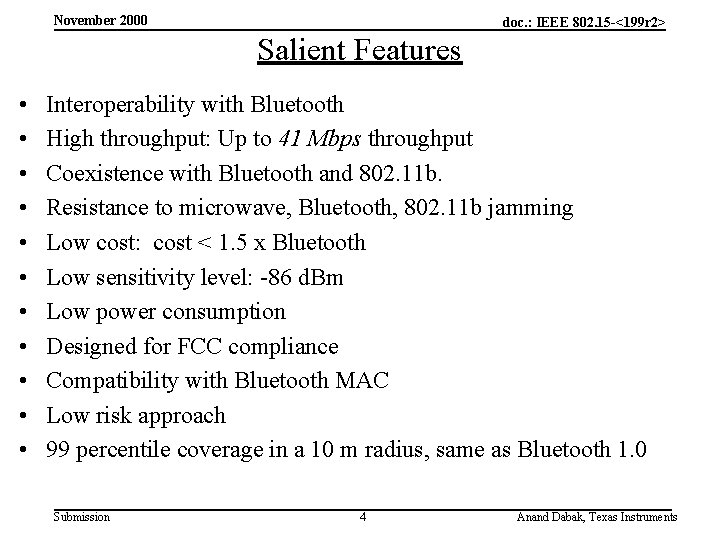
November 2000 doc. : IEEE 802. 15 -<199 r 2> Salient Features • • • Interoperability with Bluetooth High throughput: Up to 41 Mbps throughput Coexistence with Bluetooth and 802. 11 b. Resistance to microwave, Bluetooth, 802. 11 b jamming Low cost: cost < 1. 5 x Bluetooth Low sensitivity level: -86 d. Bm Low power consumption Designed for FCC compliance Compatibility with Bluetooth MAC Low risk approach 99 percentile coverage in a 10 m radius, same as Bluetooth 1. 0 Submission 4 Anand Dabak, Texas Instruments

November 2000 doc. : IEEE 802. 15 -<199 r 2> Mode 3 System Specifications Submission 5 Anand Dabak, Texas Instruments
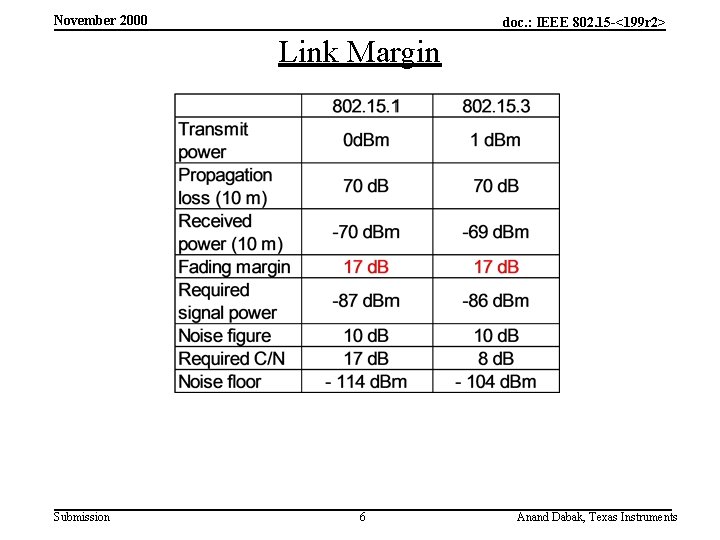
November 2000 doc. : IEEE 802. 15 -<199 r 2> Link Margin Submission 6 Anand Dabak, Texas Instruments
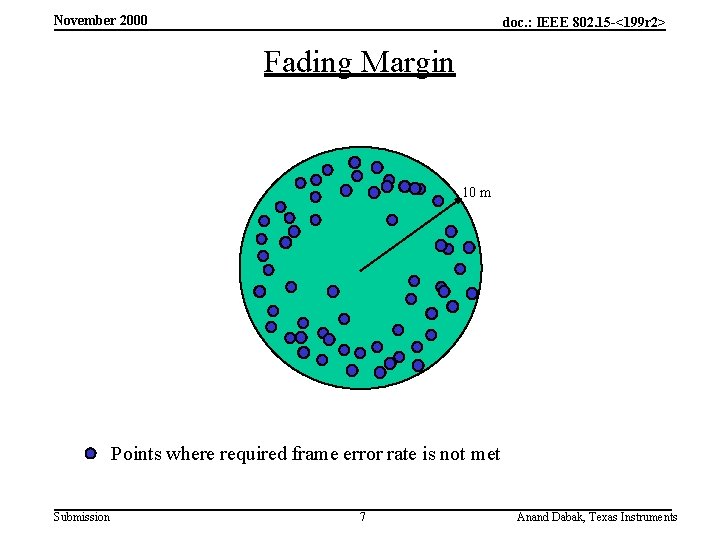
November 2000 doc. : IEEE 802. 15 -<199 r 2> Fading Margin 10 m Points where required frame error rate is not met Submission 7 Anand Dabak, Texas Instruments
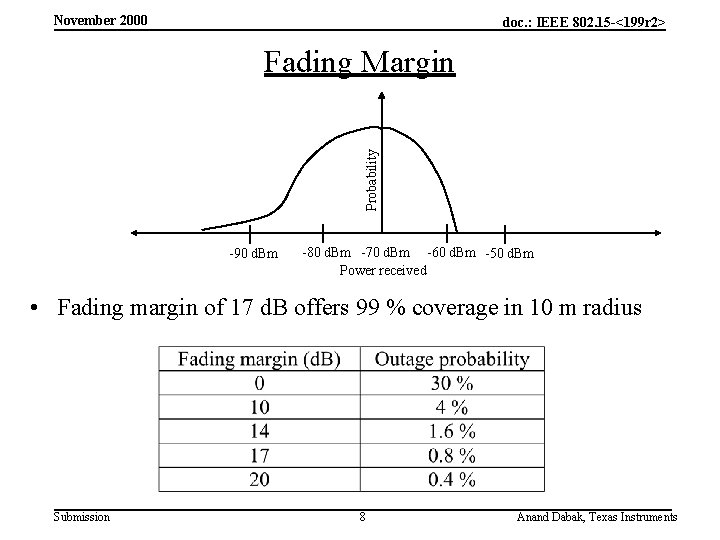
November 2000 doc. : IEEE 802. 15 -<199 r 2> Probability Fading Margin -90 d. Bm -80 d. Bm -70 d. Bm -60 d. Bm -50 d. Bm Power received • Fading margin of 17 d. B offers 99 % coverage in 10 m radius Submission 8 Anand Dabak, Texas Instruments
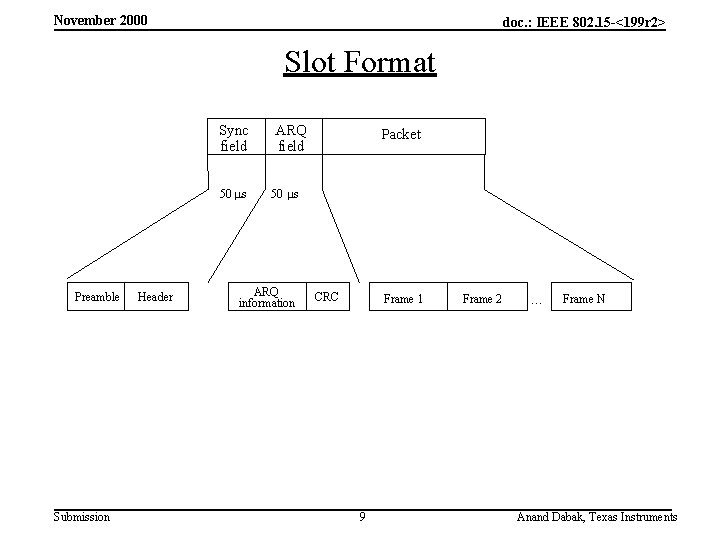
November 2000 doc. : IEEE 802. 15 -<199 r 2> Slot Format Sync field 50 ms Preamble Submission Header ARQ field Packet 50 ms ARQ information CRC Frame 1 9 Frame 2 . . . Frame N Anand Dabak, Texas Instruments
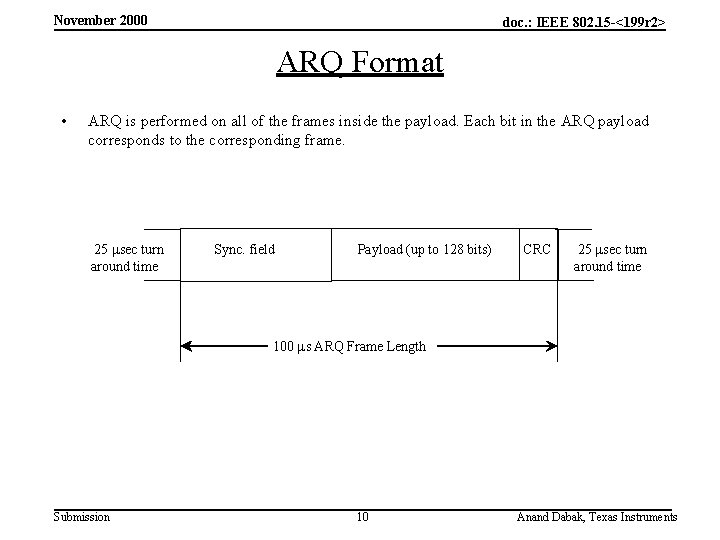
November 2000 doc. : IEEE 802. 15 -<199 r 2> ARQ Format • ARQ is performed on all of the frames inside the payload. Each bit in the ARQ payload corresponds to the corresponding frame. 25 msec turn around time Sync. field Payload (up to 128 bits) CRC 25 msec turn around time 100 ms ARQ Frame Length Submission 10 Anand Dabak, Texas Instruments
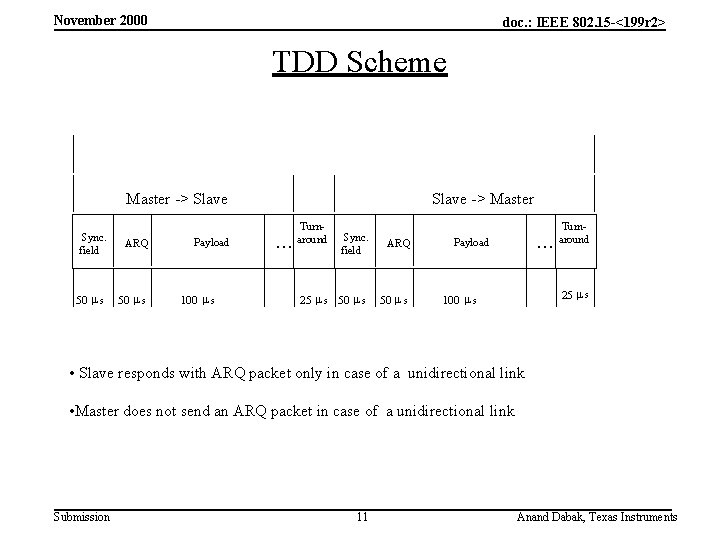
November 2000 doc. : IEEE 802. 15 -<199 r 2> TDD Scheme Master -> Slave Sync. field ARQ 50 m s Payload 100 m s Slave -> Master … Turnaround Sync. field ARQ 25 m s 50 m s … Payload Turnaround 25 m s 100 m s • Slave responds with ARQ packet only in case of a unidirectional link • Master does not send an ARQ packet in case of a unidirectional link Submission 11 Anand Dabak, Texas Instruments
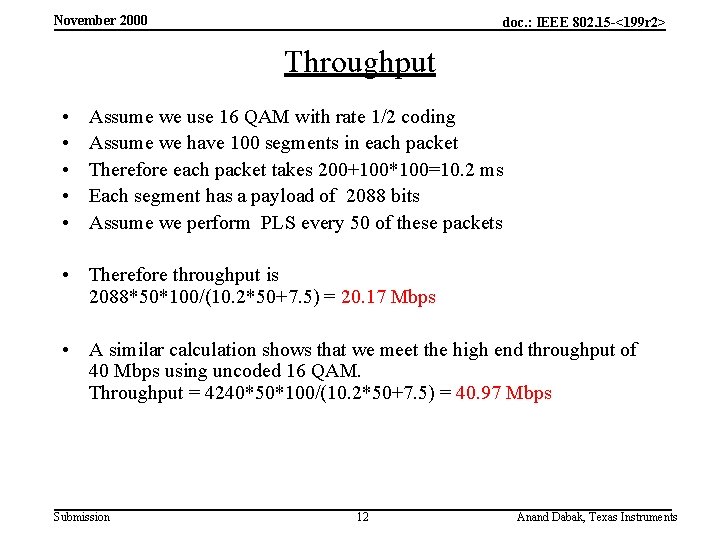
November 2000 doc. : IEEE 802. 15 -<199 r 2> Throughput • • • Assume we use 16 QAM with rate 1/2 coding Assume we have 100 segments in each packet Therefore each packet takes 200+100*100=10. 2 ms Each segment has a payload of 2088 bits Assume we perform PLS every 50 of these packets • Therefore throughput is 2088*50*100/(10. 2*50+7. 5) = 20. 17 Mbps • A similar calculation shows that we meet the high end throughput of 40 Mbps using uncoded 16 QAM. Throughput = 4240*50*100/(10. 2*50+7. 5) = 40. 97 Mbps Submission 12 Anand Dabak, Texas Instruments
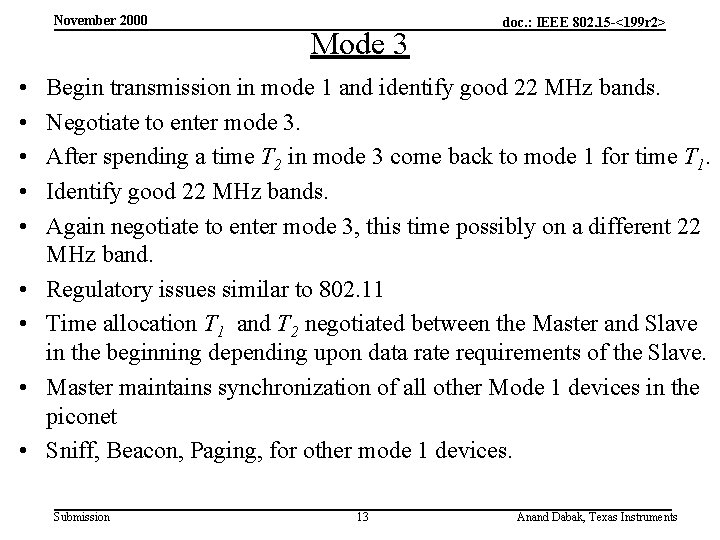
November 2000 • • • Mode 3 doc. : IEEE 802. 15 -<199 r 2> Begin transmission in mode 1 and identify good 22 MHz bands. Negotiate to enter mode 3. After spending a time T 2 in mode 3 come back to mode 1 for time T 1. Identify good 22 MHz bands. Again negotiate to enter mode 3, this time possibly on a different 22 MHz band. Regulatory issues similar to 802. 11 Time allocation T 1 and T 2 negotiated between the Master and Slave in the beginning depending upon data rate requirements of the Slave. Master maintains synchronization of all other Mode 1 devices in the piconet Sniff, Beacon, Paging, for other mode 1 devices. Submission 13 Anand Dabak, Texas Instruments
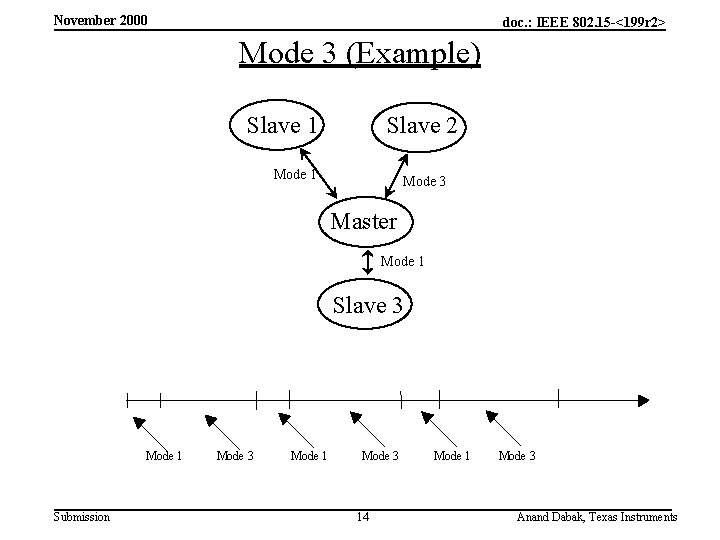
November 2000 doc. : IEEE 802. 15 -<199 r 2> Mode 3 (Example) Slave 1 Slave 2 Mode 1 Mode 3 Master Mode 1 Slave 3 Mode 1 Submission Mode 3 Mode 1 Mode 3 14 Mode 1 Mode 3 Anand Dabak, Texas Instruments
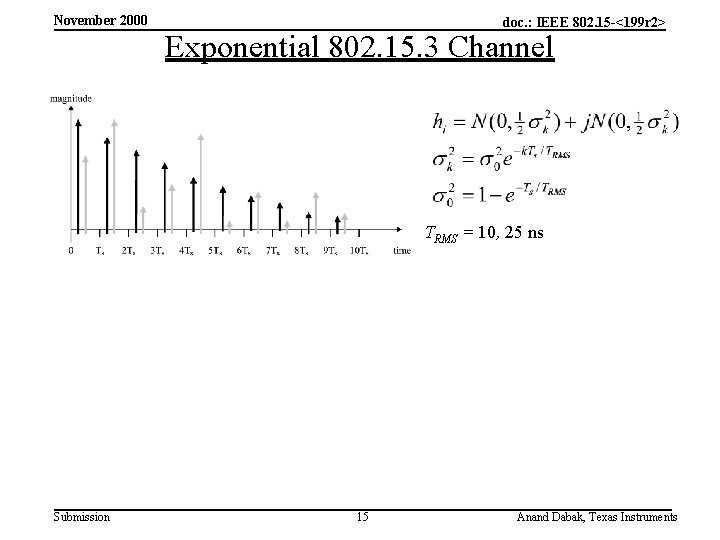
November 2000 doc. : IEEE 802. 15 -<199 r 2> Exponential 802. 15. 3 Channel TRMS = 10, 25 ns Submission 15 Anand Dabak, Texas Instruments
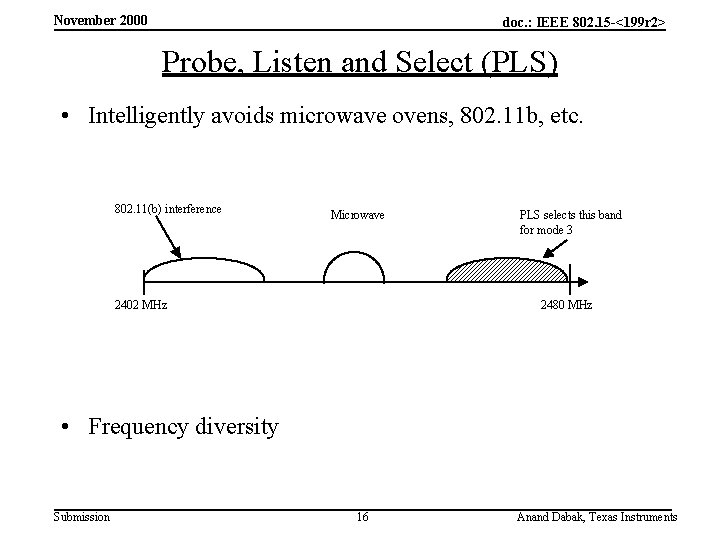
November 2000 doc. : IEEE 802. 15 -<199 r 2> Probe, Listen and Select (PLS) • Intelligently avoids microwave ovens, 802. 11 b, etc. 802. 11(b) interference Microwave 2402 MHz PLS selects this band for mode 3 2480 MHz • Frequency diversity Submission 16 Anand Dabak, Texas Instruments
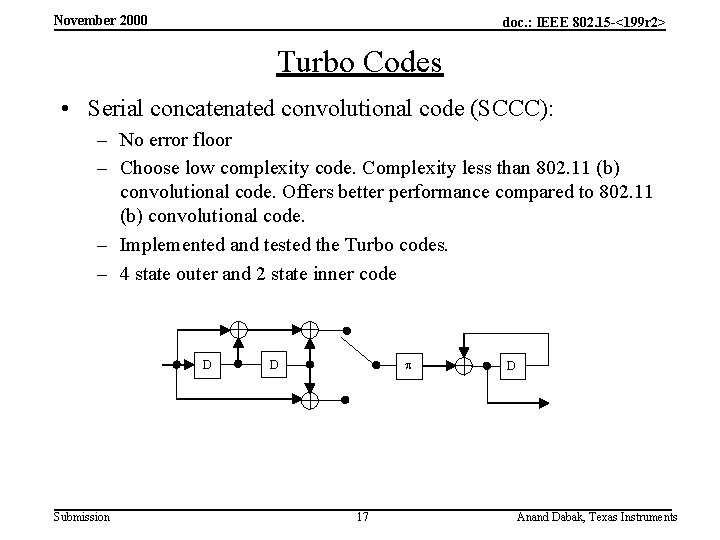
November 2000 doc. : IEEE 802. 15 -<199 r 2> Turbo Codes • Serial concatenated convolutional code (SCCC): – No error floor – Choose low complexity code. Complexity less than 802. 11 (b) convolutional code. Offers better performance compared to 802. 11 (b) convolutional code. – Implemented and tested the Turbo codes. – 4 state outer and 2 state inner code D Submission p D 17 D Anand Dabak, Texas Instruments
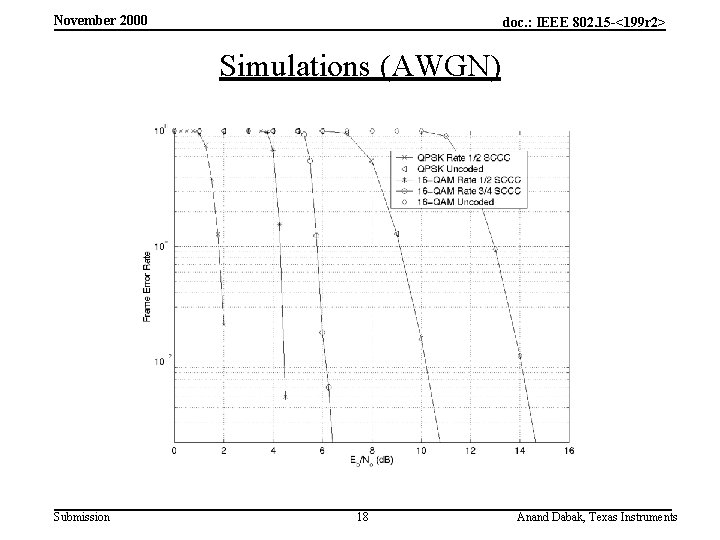
November 2000 doc. : IEEE 802. 15 -<199 r 2> Simulations (AWGN) Submission 18 Anand Dabak, Texas Instruments
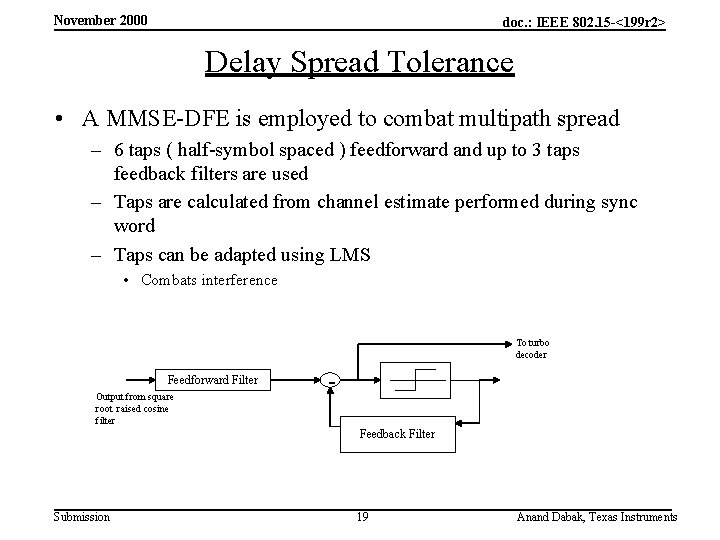
November 2000 doc. : IEEE 802. 15 -<199 r 2> Delay Spread Tolerance • A MMSE-DFE is employed to combat multipath spread – 6 taps ( half-symbol spaced ) feedforward and up to 3 taps feedback filters are used – Taps are calculated from channel estimate performed during sync word – Taps can be adapted using LMS • Combats interference To turbo decoder Feedforward Filter Output from square root raised cosine filter Feedback Filter Submission 19 Anand Dabak, Texas Instruments
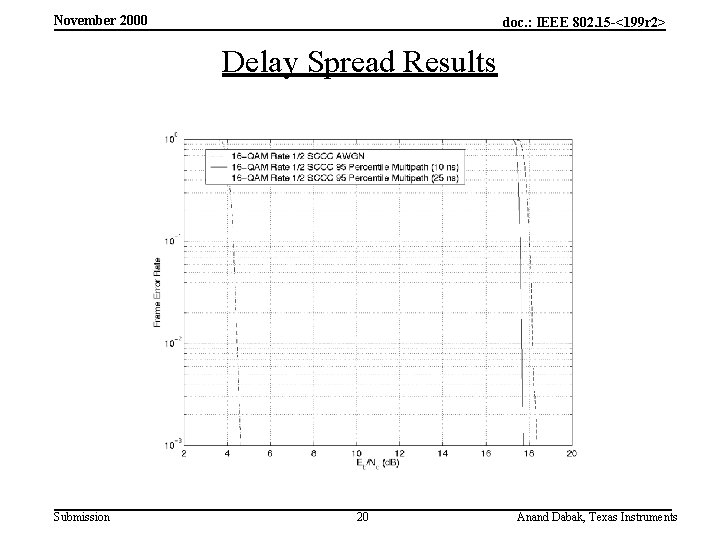
November 2000 doc. : IEEE 802. 15 -<199 r 2> Delay Spread Results Submission 20 Anand Dabak, Texas Instruments
November 2000 doc. : IEEE 802. 15 -<199 r 2> Dual Mode Radio, RF Cost Estimation • 802. 15. 1 and 802. 15. 3 share – – – Antenna filter Tx/Rx Switch LNA Transmit modulator Power amplifier • Additional blocks needed – RF/baseband conversion mixers for 802. 15. 3 – Low pass filters – AGC amplifier (+/- 20 d. B) • The total RF chip area is less than 20 mm 2 in RFBi. CMOS Submission 21 Anand Dabak, Texas Instruments
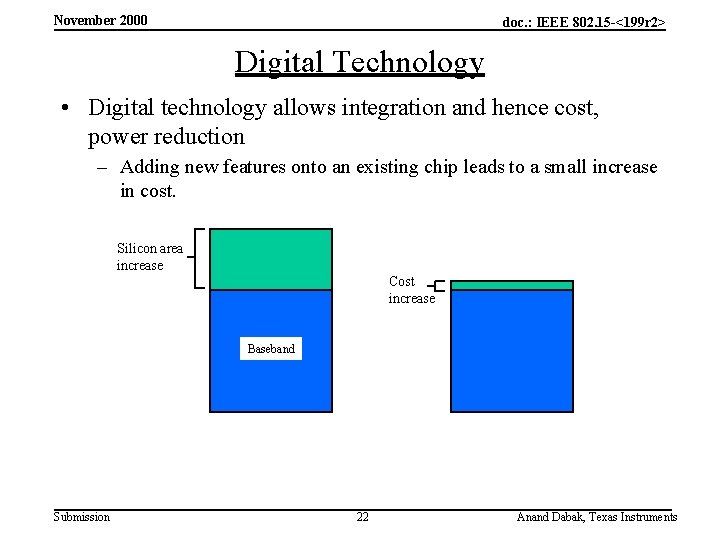
November 2000 doc. : IEEE 802. 15 -<199 r 2> Digital Technology • Digital technology allows integration and hence cost, power reduction – Adding new features onto an existing chip leads to a small increase in cost. Silicon area increase Cost increase Baseband Submission 22 Anand Dabak, Texas Instruments
November 2000 doc. : IEEE 802. 15 -<199 r 2> Baseband Blocks • Baseband blocks – – 2, 8 bit A/D’s at 22 MHz each. 2, 6 bits D/A’s at a speed of 44 MHz. A 16 tap half symbol spaced square root raised cosine filter. A 6 tap half symbol spaced feed forward and up to 3 tap symbol spaced feed back equalizer. – The Turbo decoder size is a total of 50 K gates and 13 Kbytes of RAM. Submission 23 Anand Dabak, Texas Instruments
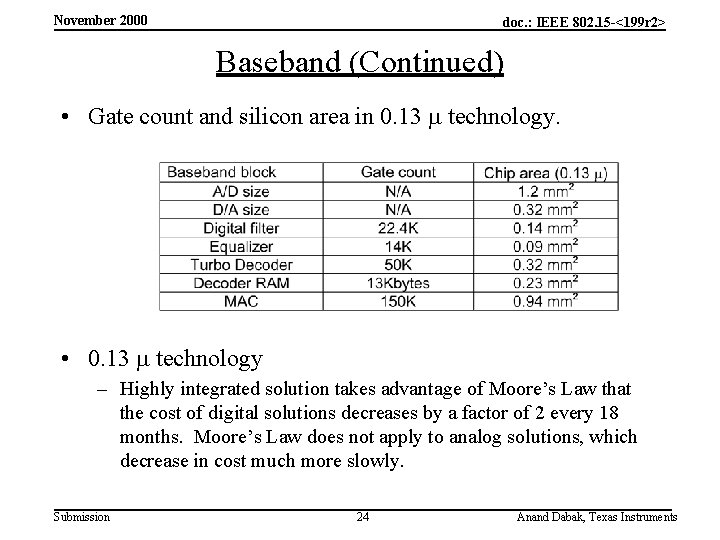
November 2000 doc. : IEEE 802. 15 -<199 r 2> Baseband (Continued) • Gate count and silicon area in 0. 13 m technology. • 0. 13 m technology – Highly integrated solution takes advantage of Moore’s Law that the cost of digital solutions decreases by a factor of 2 every 18 months. Moore’s Law does not apply to analog solutions, which decrease in cost much more slowly. Submission 24 Anand Dabak, Texas Instruments
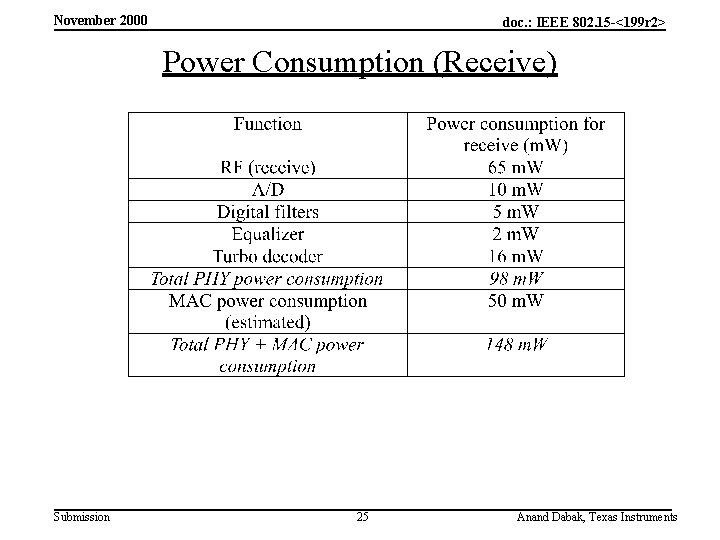
November 2000 doc. : IEEE 802. 15 -<199 r 2> Power Consumption (Receive) Submission 25 Anand Dabak, Texas Instruments
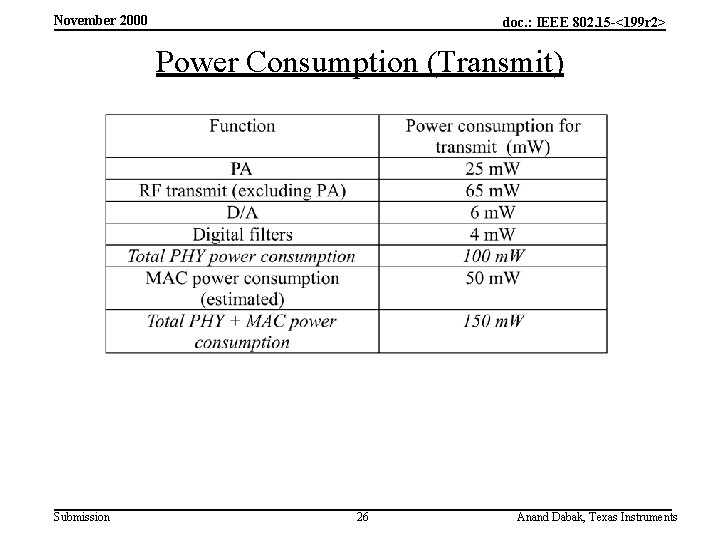
November 2000 doc. : IEEE 802. 15 -<199 r 2> Power Consumption (Transmit) Submission 26 Anand Dabak, Texas Instruments
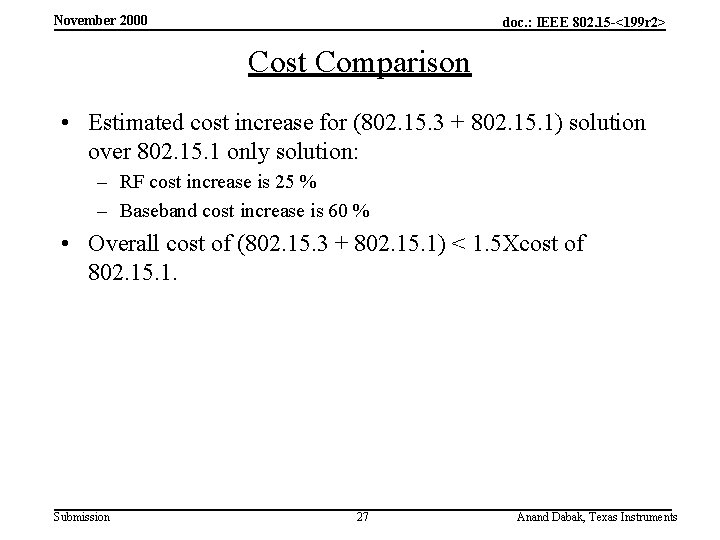
November 2000 doc. : IEEE 802. 15 -<199 r 2> Cost Comparison • Estimated cost increase for (802. 15. 3 + 802. 15. 1) solution over 802. 15. 1 only solution: – RF cost increase is 25 % – Baseband cost increase is 60 % • Overall cost of (802. 15. 3 + 802. 15. 1) < 1. 5 Xcost of 802. 15. 1. Submission 27 Anand Dabak, Texas Instruments
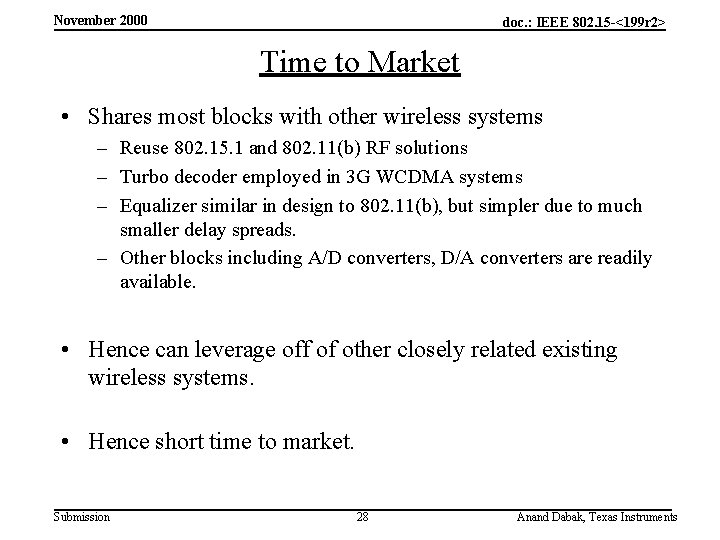
November 2000 doc. : IEEE 802. 15 -<199 r 2> Time to Market • Shares most blocks with other wireless systems – Reuse 802. 15. 1 and 802. 11(b) RF solutions – Turbo decoder employed in 3 G WCDMA systems – Equalizer similar in design to 802. 11(b), but simpler due to much smaller delay spreads. – Other blocks including A/D converters, D/A converters are readily available. • Hence can leverage off of other closely related existing wireless systems. • Hence short time to market. Submission 28 Anand Dabak, Texas Instruments
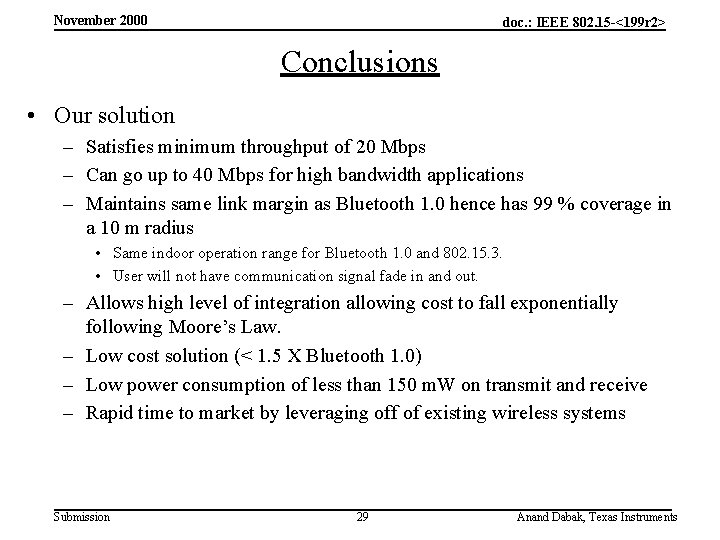
November 2000 doc. : IEEE 802. 15 -<199 r 2> Conclusions • Our solution – Satisfies minimum throughput of 20 Mbps – Can go up to 40 Mbps for high bandwidth applications – Maintains same link margin as Bluetooth 1. 0 hence has 99 % coverage in a 10 m radius • Same indoor operation range for Bluetooth 1. 0 and 802. 15. 3. • User will not have communication signal fade in and out. – Allows high level of integration allowing cost to fall exponentially following Moore’s Law. – Low cost solution (< 1. 5 X Bluetooth 1. 0) – Low power consumption of less than 150 m. W on transmit and receive – Rapid time to market by leveraging off of existing wireless systems Submission 29 Anand Dabak, Texas Instruments
November 2000 Submission doc. : IEEE 802. 15 -<199 r 2> 30 Anand Dabak, Texas Instruments
November 2000 Submission doc. : IEEE 802. 15 -<199 r 2> 31 Anand Dabak, Texas Instruments
- Slides: 31