
November 2000 doc IEEE 802 11 00387 r
November 2000 doc. : IEEE 802. 11 -00/387 r 1 A Scheduling Scheme for Level-2 Enhanced PCF MAC Service Wen-Ping Ying Mike Nakahara Sigong Ho Next. Comm, Inc. Kirkland, Washington Submission 1 W. -P. Ying, M. Nakahara, S. Ho, Next. Comm, Inc.
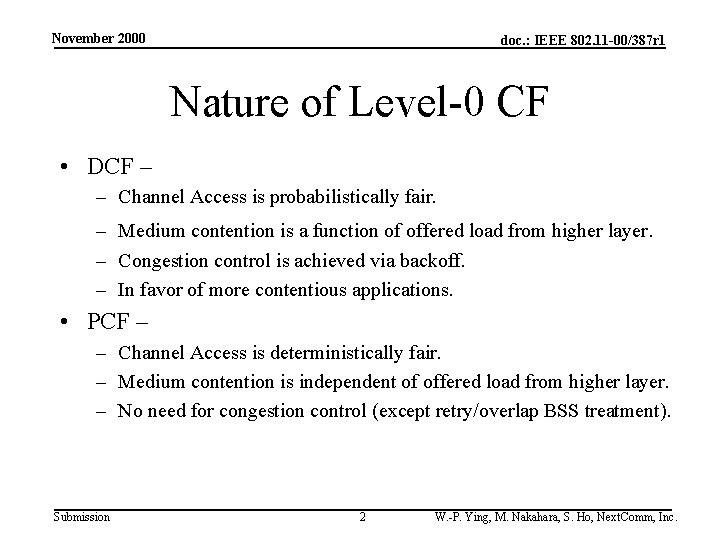
November 2000 doc. : IEEE 802. 11 -00/387 r 1 Nature of Level-0 CF • DCF – – Channel Access is probabilistically fair. – Medium contention is a function of offered load from higher layer. – Congestion control is achieved via backoff. – In favor of more contentious applications. • PCF – – Channel Access is deterministically fair. – Medium contention is independent of offered load from higher layer. – No need for congestion control (except retry/overlap BSS treatment). Submission 2 W. -P. Ying, M. Nakahara, S. Ho, Next. Comm, Inc.
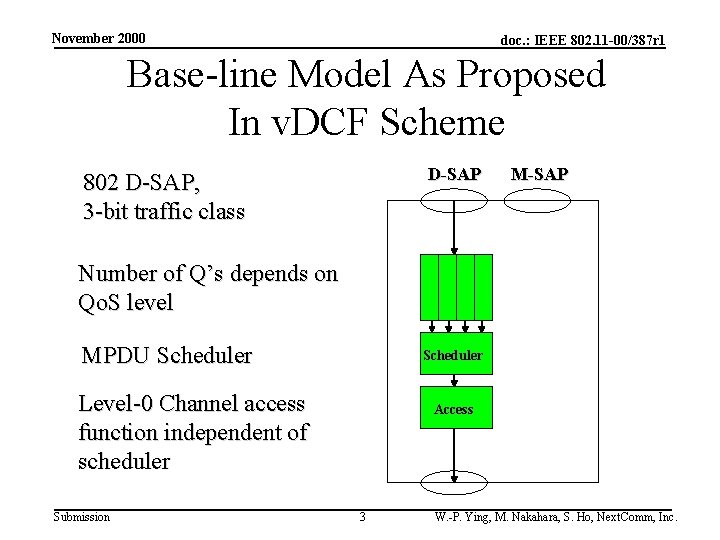
November 2000 doc. : IEEE 802. 11 -00/387 r 1 Base-line Model As Proposed In v. DCF Scheme D-SAP 802 D-SAP, 3 -bit traffic class M-SAP Number of Q’s depends on Qo. S level MPDU Scheduler Level-0 Channel access function independent of scheduler Submission Access 3 W. -P. Ying, M. Nakahara, S. Ho, Next. Comm, Inc.
November 2000 doc. : IEEE 802. 11 -00/387 r 1 Objective of v. DCF Qo. S • To prioritize frames based on a common scheduling algorithm observed by all STAs. • To use the Level-0 channel access mechanism (CSMA/Poll) for delivering prioritized frames. • To have the same behavior as non-Qo. S model when every frame has equal priority. Submission 4 W. -P. Ying, M. Nakahara, S. Ho, Next. Comm, Inc.
November 2000 doc. : IEEE 802. 11 -00/387 r 1 Level-2 PCF Basic Model • Use a similar scheduler as in Level-1 so that switching between CFP and CP will not result in major scheduling mechanism switches. • During CFP – – the random number generation aspect of v. DCF is used as the scheduling mechanism to rank order/prioritize the frames for transmission. – The Level-0 PCF polling determines the channel access opportunity (Tx-Op). • During CP (v. DCF) – – the same random number used in rank ordering determines the relative backoffs and sequence for frame transmission (as specified in v. DCF). – The Level-0 DCF channel sensing determines the channel access opportunity (Tx-Op). • The “Load monitor” information (CW vector) announced by AP during CFP may be adopted by STA so that STA can adjust to the network dynamics when CP begins. Submission 5 W. -P. Ying, M. Nakahara, S. Ho, Next. Comm, Inc.
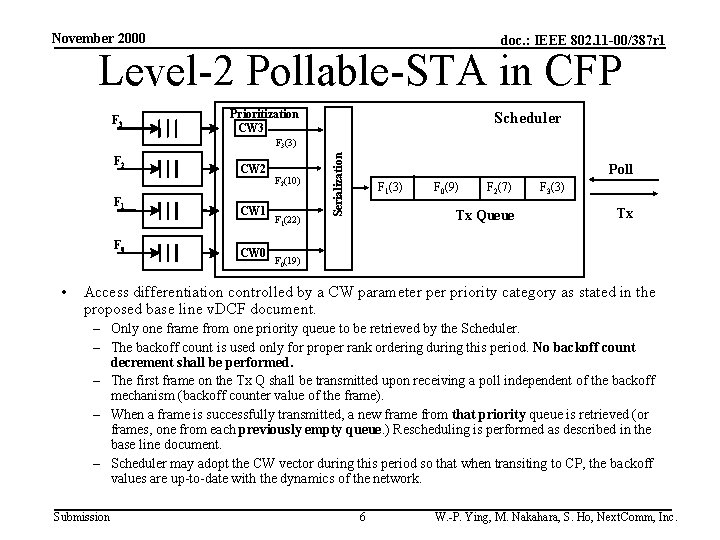
November 2000 doc. : IEEE 802. 11 -00/387 r 1 Level-2 Pollable-STA in CFP F 3 Prioritization CW 3 Scheduler F 2 F 1 F 0 • CW 2 CW 1 CW 0 F 2(10) F 1(22) Serialization F 3(3) Poll F 1(3) F 0(9) F 2(7) Tx Queue F 3(3) Tx F 0(19) Access differentiation controlled by a CW parameter priority category as stated in the proposed base line v. DCF document. – Only one frame from one priority queue to be retrieved by the Scheduler. – The backoff count is used only for proper rank ordering during this period. No backoff count decrement shall be performed. – The first frame on the Tx Q shall be transmitted upon receiving a poll independent of the backoff mechanism (backoff counter value of the frame). – When a frame is successfully transmitted, a new frame from that priority queue is retrieved (or frames, one from each previously empty queue. ) Rescheduling is performed as described in the base line document. – Scheduler may adopt the CW vector during this period so that when transiting to CP, the backoff values are up-to-date with the dynamics of the network. Submission 6 W. -P. Ying, M. Nakahara, S. Ho, Next. Comm, Inc.
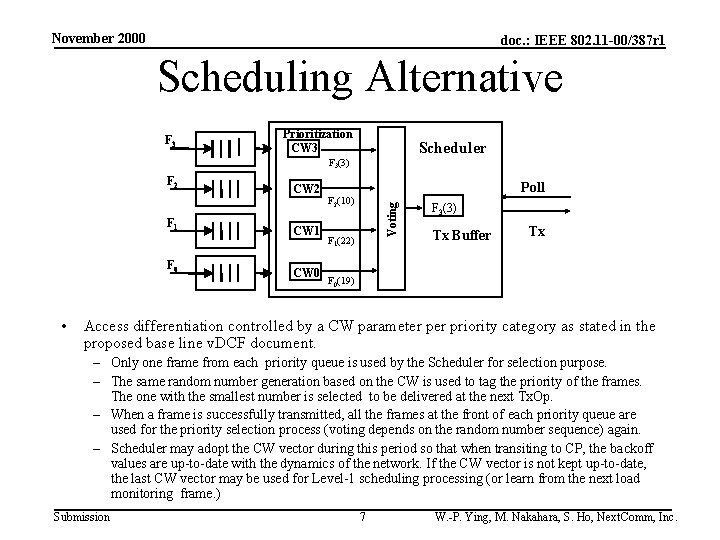
November 2000 doc. : IEEE 802. 11 -00/387 r 1 Scheduling Alternative F 3 Prioritization CW 3 Scheduler F 3(3) F 1 F 0 • CW 2 CW 1 CW 0 Poll F 2(10) Voting F 2 F 1(22) F 3(3) Tx Buffer Tx F 0(19) Access differentiation controlled by a CW parameter priority category as stated in the proposed base line v. DCF document. – Only one frame from each priority queue is used by the Scheduler for selection purpose. – The same random number generation based on the CW is used to tag the priority of the frames. The one with the smallest number is selected to be delivered at the next Tx. Op. – When a frame is successfully transmitted, all the frames at the front of each priority queue are used for the priority selection process (voting depends on the random number sequence) again. – Scheduler may adopt the CW vector during this period so that when transiting to CP, the backoff values are up-to-date with the dynamics of the network. If the CW vector is not kept up-to-date, the last CW vector may be used for Level-1 scheduling processing (or learn from the next load monitoring frame. ) Submission 7 W. -P. Ying, M. Nakahara, S. Ho, Next. Comm, Inc.
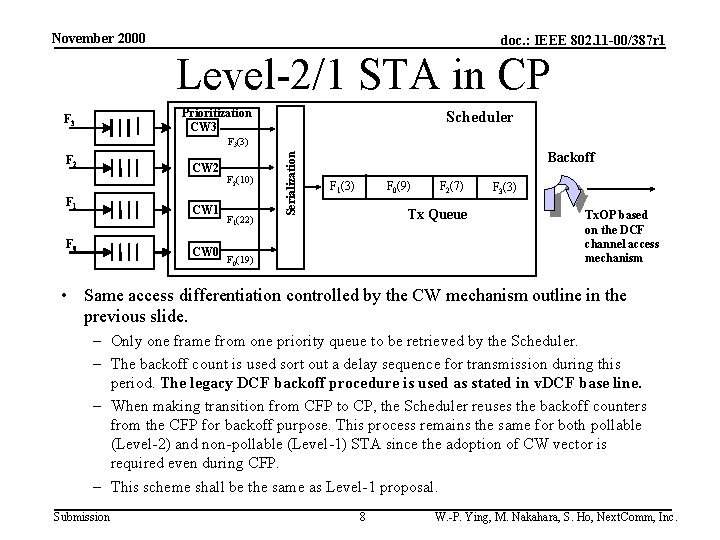
November 2000 doc. : IEEE 802. 11 -00/387 r 1 Level-2/1 STA in CP Prioritization CW 3 F 3 Scheduler F 2 CW 2 F 1 CW 1 F 0 CW 0 F 2(10) F 1(22) Serialization F 3(3) Backoff F 1(3) F 0(9) F 2(7) Tx Queue F 0(19) F 3(3) Tx. OP based on the DCF channel access mechanism • Same access differentiation controlled by the CW mechanism outline in the previous slide. – Only one frame from one priority queue to be retrieved by the Scheduler. – The backoff count is used sort out a delay sequence for transmission during this period. The legacy DCF backoff procedure is used as stated in v. DCF base line. – When making transition from CFP to CP, the Scheduler reuses the backoff counters from the CFP for backoff purpose. This process remains the same for both pollable (Level-2) and non-pollable (Level-1) STA since the adoption of CW vector is required even during CFP. – This scheme shall be the same as Level-1 proposal. Submission 8 W. -P. Ying, M. Nakahara, S. Ho, Next. Comm, Inc.
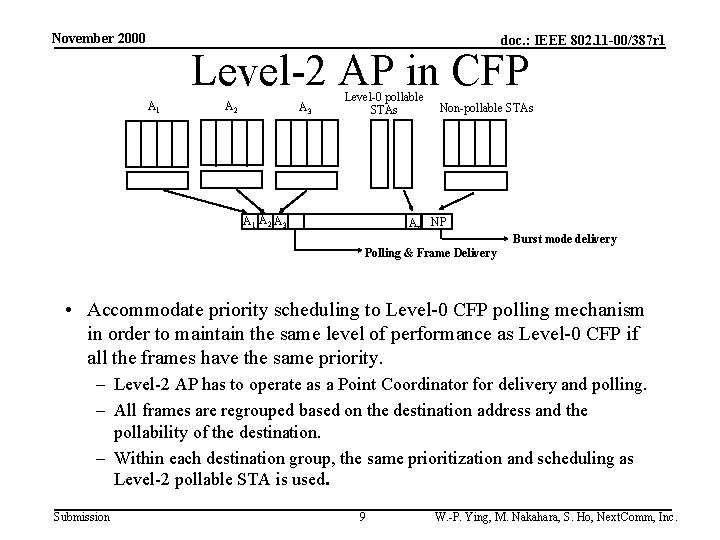
November 2000 doc. : IEEE 802. 11 -00/387 r 1 Level-2 AP in CFP A 1 A 2 A 3 Level-0 pollable STAs A 1 A 2 A 3 Non-pollable STAs An NP Burst mode delivery Polling & Frame Delivery • Accommodate priority scheduling to Level-0 CFP polling mechanism in order to maintain the same level of performance as Level-0 CFP if all the frames have the same priority. – Level-2 AP has to operate as a Point Coordinator for delivery and polling. – All frames are regrouped based on the destination address and the pollability of the destination. – Within each destination group, the same prioritization and scheduling as Level-2 pollable STA is used. Submission 9 W. -P. Ying, M. Nakahara, S. Ho, Next. Comm, Inc.
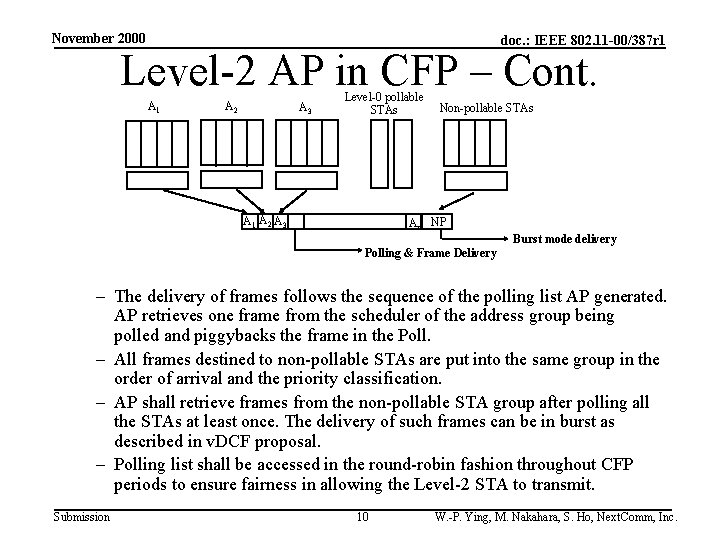
November 2000 doc. : IEEE 802. 11 -00/387 r 1 Level-2 AP in CFP – Cont. A 1 A 2 A 3 Level-0 pollable STAs A 1 A 2 A 3 Non-pollable STAs An NP Burst mode delivery Polling & Frame Delivery – The delivery of frames follows the sequence of the polling list AP generated. AP retrieves one frame from the scheduler of the address group being polled and piggybacks the frame in the Poll. – All frames destined to non-pollable STAs are put into the same group in the order of arrival and the priority classification. – AP shall retrieve frames from the non-pollable STA group after polling all the STAs at least once. The delivery of such frames can be in burst as described in v. DCF proposal. – Polling list shall be accessed in the round-robin fashion throughout CFP periods to ensure fairness in allowing the Level-2 STA to transmit. Submission 10 W. -P. Ying, M. Nakahara, S. Ho, Next. Comm, Inc.
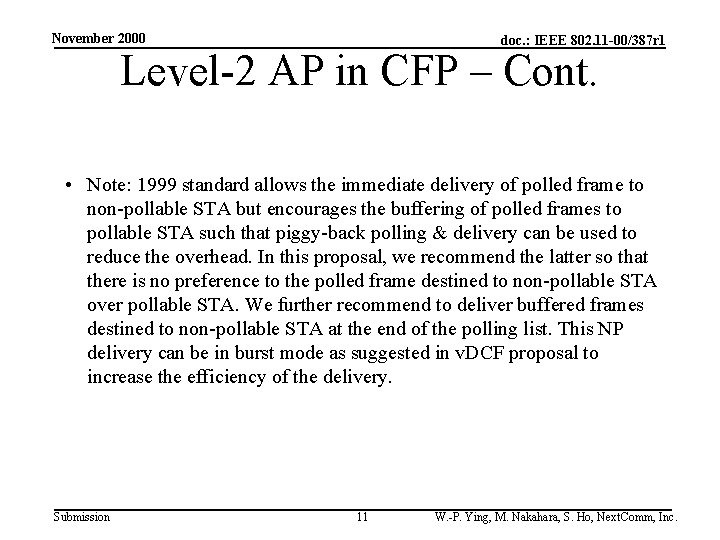
November 2000 doc. : IEEE 802. 11 -00/387 r 1 Level-2 AP in CFP – Cont. • Note: 1999 standard allows the immediate delivery of polled frame to non-pollable STA but encourages the buffering of polled frames to pollable STA such that piggy-back polling & delivery can be used to reduce the overhead. In this proposal, we recommend the latter so that there is no preference to the polled frame destined to non-pollable STA over pollable STA. We further recommend to deliver buffered frames destined to non-pollable STA at the end of the polling list. This NP delivery can be in burst mode as suggested in v. DCF proposal to increase the efficiency of the delivery. Submission 11 W. -P. Ying, M. Nakahara, S. Ho, Next. Comm, Inc.
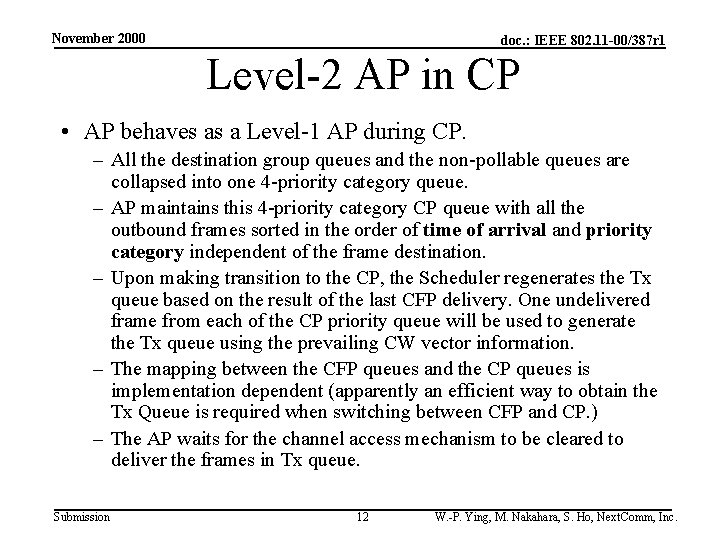
November 2000 doc. : IEEE 802. 11 -00/387 r 1 Level-2 AP in CP • AP behaves as a Level-1 AP during CP. – All the destination group queues and the non-pollable queues are collapsed into one 4 -priority category queue. – AP maintains this 4 -priority category CP queue with all the outbound frames sorted in the order of time of arrival and priority category independent of the frame destination. – Upon making transition to the CP, the Scheduler regenerates the Tx queue based on the result of the last CFP delivery. One undelivered frame from each of the CP priority queue will be used to generate the Tx queue using the prevailing CW vector information. – The mapping between the CFP queues and the CP queues is implementation dependent (apparently an efficient way to obtain the Tx Queue is required when switching between CFP and CP. ) – The AP waits for the channel access mechanism to be cleared to deliver the frames in Tx queue. Submission 12 W. -P. Ying, M. Nakahara, S. Ho, Next. Comm, Inc.
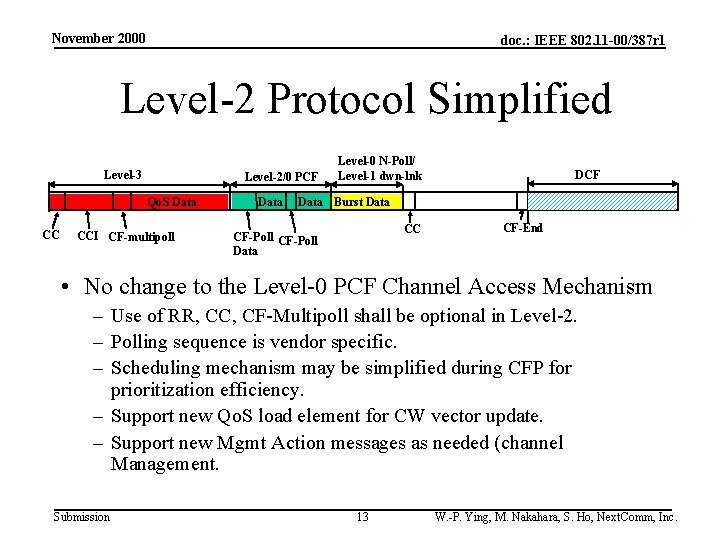
November 2000 doc. : IEEE 802. 11 -00/387 r 1 Level-2 Protocol Simplified Level-3 Level-2/0 PCF Qo. S Data CC CCI CF-multipoll Data Level-0 N-Poll/ Level-1 dwn-lnk DCF Data Burst Data CC CF-Poll Data CF-End • No change to the Level-0 PCF Channel Access Mechanism – Use of RR, CC, CF-Multipoll shall be optional in Level-2. – Polling sequence is vendor specific. – Scheduling mechanism may be simplified during CFP for prioritization efficiency. – Support new Qo. S load element for CW vector update. – Support new Mgmt Action messages as needed (channel Management. Submission 13 W. -P. Ying, M. Nakahara, S. Ho, Next. Comm, Inc.
November 2000 doc. : IEEE 802. 11 -00/387 r 1 Benefit of Level-2 Qo. S • Virtue of Level-0 PCF Polling: – Predictable fair-share among all pollable STAs. – Efficient data transfer. • Less overhead. • Reduced chance of medium contention. • Virtue of Local Prioritization: – Prioritization process is distributed. – For each Level-2 (pollable) STA, frames with higher priority have higher probability to be delivered and received. – No starvation of STA with only low priority frames Submission 14 W. -P. Ying, M. Nakahara, S. Ho, Next. Comm, Inc.
November 2000 doc. : IEEE 802. 11 -00/387 r 1 Conclusion • A Level-2 Qo. S Architecture is proposed for both STA and AP. • When operating during the CP, the Qo. S mechanism is the same as Level-1 Qo. S. • Same Scheduler may be used for both Levels to allow ease of transition between CFP and CP. • Priority Queues on AP change between CFP & CP but stay the same for STA. Submission 15 W. -P. Ying, M. Nakahara, S. Ho, Next. Comm, Inc.
- Slides: 15