
November 16 2020 Reclaiming Black Mesa Mine Kayenta
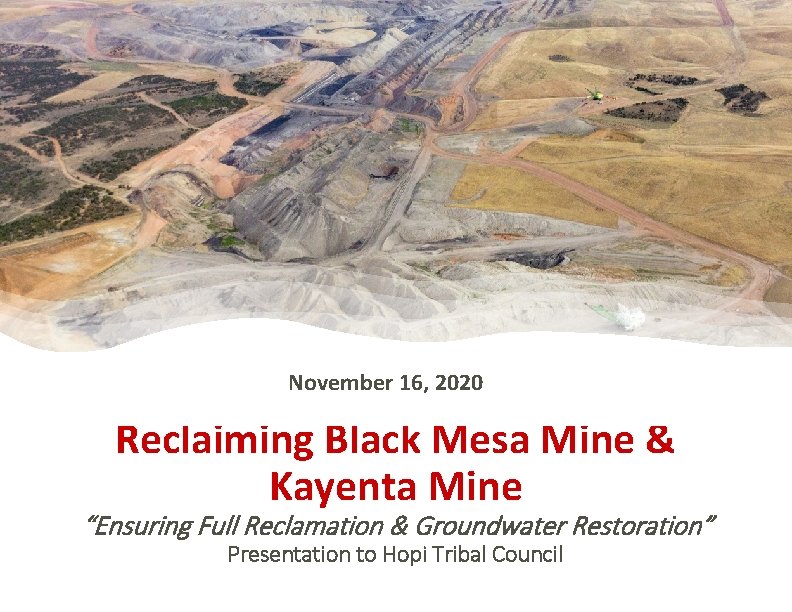
November 16, 2020 Reclaiming Black Mesa Mine & Kayenta Mine “Ensuring Full Reclamation & Groundwater Restoration” Presentation to Hopi Tribal Council
Purpose of the Briefing on Mine Reclamation • After about half a century of coal mining on Black Mesa, mining has essentially come to a close but there is a need to make sure tribal lands, water resources, vegetation, archaeological and cultural resources are reclaimed and rehabilitated in accordance with federal law • Significant damage to the tribe’s natural and cultural resources have been caused through 50 years of mining but it appears the tribe’s federal trustee, Office of Surface Mining, Reclamation and Enforcement (OSMRE) and the Peabody Coal Company want to delay the statutorily mandated reclamation under the Surface Mining Control and Reclamation Act (SMCRA) 2
Purpose of the Briefing on Mine Reclamation • Why the Significant Permit Revision? What does it mean? • It is the only path that ensures full participation and involvement of Hopi and Navajo in an Environmental Impact Statement (EIS) process and full compliance with the National Environmental Policy (NEPA) in the final reclamation and closure of the mine sites • Is the only path to pursue full restoration of the N-Aquifer, which is the primary source of drinking and domestic water on Black Mesa and which has been greatly impacted by the past five decades of mining at the Kayenta Mine and Black Mesa Mine • It is the only path to pursue the return and restoration of numerous cultural resources that were removed, disturbed, or impacted by the mine sites • It is vitally important that the Hopi Tribe immediately impose on OSMRE to treat Peabody Coal’s permanent cessation of coal production in August 2019 as a “Significant Permit Revision” 3
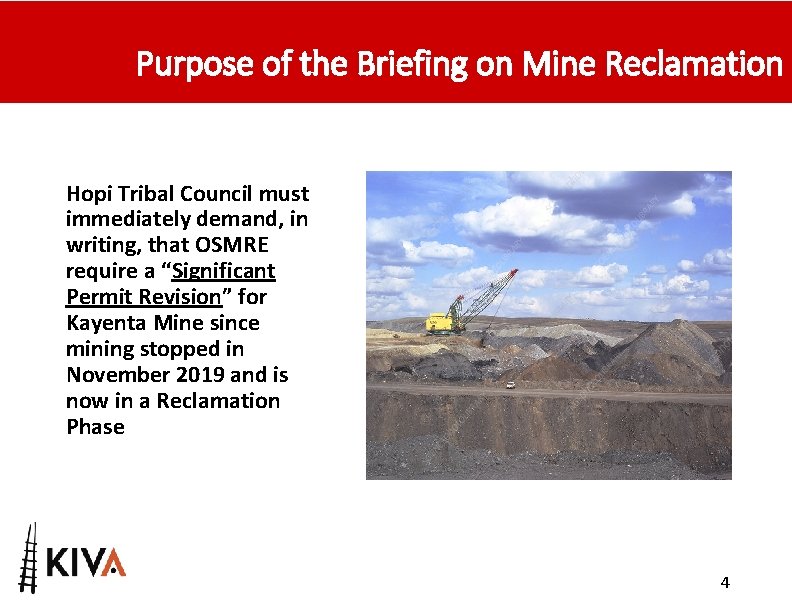
Purpose of the Briefing on Mine Reclamation Hopi Tribal Council must immediately demand, in writing, that OSMRE require a “Significant Permit Revision” for Kayenta Mine since mining stopped in November 2019 and is now in a Reclamation Phase 4
Purpose of the Briefing on Mine Reclamation • Numerous reasons exist why Hopi must insist that OSMRE impose on Peabody Coal to proceed toward full reclamation of the mine sites in accordance with SMCRA: • With the recent closure of Kayenta Mine and Peabody Coal’s shaky financial condition, now may be the last chance for Hopi to hold Peabody accountable and secure justice for Black Mesa • If Peabody’s permit is renewed without a Significant Permit Revision, there will NOT be another opportunity to secure full reclamation and restoration of the N-Aquifer, disturbed lands, or cultural resources • The Hopi Tribal Council can be leaders by writing a letter to OSMRE that makes the administrative request for a “Significant Permit Revision” for Kayenta Mine • Chairman Masayesva and I emphasized the importance of this matter in our June 10, 2020 letter to OSM Director Richard Berry 5
6 Brief History of Mining on Black Mesa
Brief History of Mining on Black Mesa • Coal mining on Black Mesa began in the mid-1960 s after questionable constitutional authority of the tribal council to negotiate leases; and after fraudulent representation by attorney John Boyden • Black Mesa Mine Complex is located on about 64, 858 acres of land leased within the boundaries of the Hopi Tribe and Navajo Nation • 25, 000 acres on exclusive Navajo land • 40, 000 acres owned jointly by the Hopi Tribe and Navajo Nation • Black Mesa Mine was the sole supplier of coal to the Mohave Generating Station; and closed in December 2005 • Peabody requested a Life of Mine Permit in 2004; and OSM published a EIS in 2008 but was successfully challenged by Hopi and Navajo citizens resulting in the federal Department of Hearings and Appeals rescission of the Life-of-Mine permit. The Environmental Impact Statement (EIS) was never completed 7
Brief History of Mining on Black Mesa • Original lease provided for payment of $1. 00 for 40, 000 acres for ten (10) years; and $1. 67 per acre foot per year for mine operations and slurry purposes from depths greater than 1, 000 feet (N-Aquifer) • Leases provided for renegotiation every ten (10) years, but the last Lease Reopener was in 1988 • Peabody had exclusive right to prospect, mine, strip lands, develop water wells for coal and kindred products including other minerals except oil and gas 8
Brief History of Mining on Black Mesa • Peabody mined about 4 million tons annually for the Mohave Generating Station before it closed in 2005 • Peabody mined about 8 million tons of coal annually for the Navajo Generating Station before it closed in 2019 • Consumed around 3. 0 million gallons of pristine groundwater EACH DAY from the N-Aquifer for coal “slurry” transport to the Mohave plant, 275 miles away; and for mining operations • Hopi Tribal Council (and Navajo Nation), in 2005, successfully stopped the slurry operations due to excessive pumping of the Navajo Aquifer 9

Brief History of Mining on Black Mesa • Peabody Coal closed Mohave Generating Station in 2005 because Hopi and Navajo objected to continued use of N-Aquifer water to slurry coal from Black Mesa Mine to Laughlin, NV, some 275 miles away. Mohave Generating Station has been closed for over 15 years • Peabody Coal closed the Kayenta Mine in early 2019. Kayenta Mine has been closed for over a year ago • Navajo Generating Station shut down at the end of 2019 • Neither the Peabody Coal Company and Office of Surface Mining have initiated efforts to reclaim the mined areas in accordance with the Surface Mining Control and Reclamation Act (SMCRA) 10
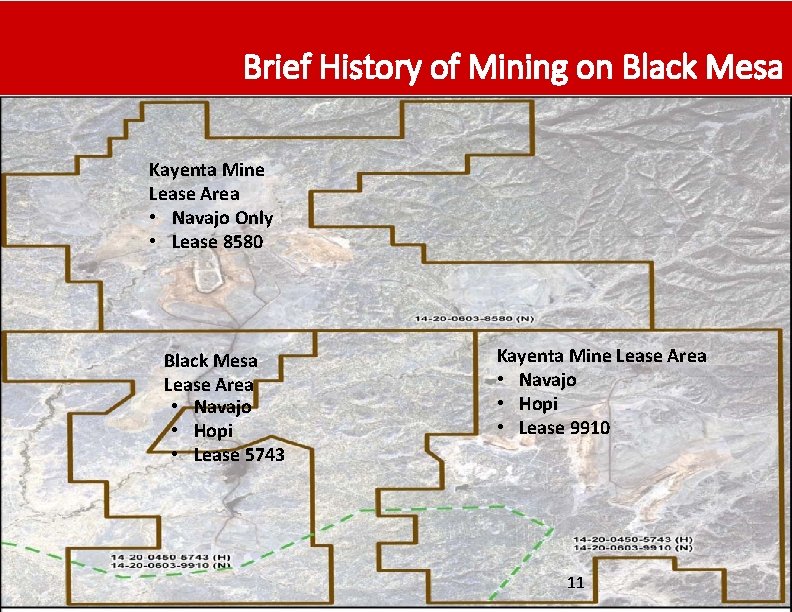
Brief History of Mining on Black Mesa Kayenta Mine Lease Area • Navajo Only • Lease 8580 Black Mesa Lease Area • Navajo • Hopi • Lease 5743 Kayenta Mine Lease Area • Navajo • Hopi • Lease 9910 11
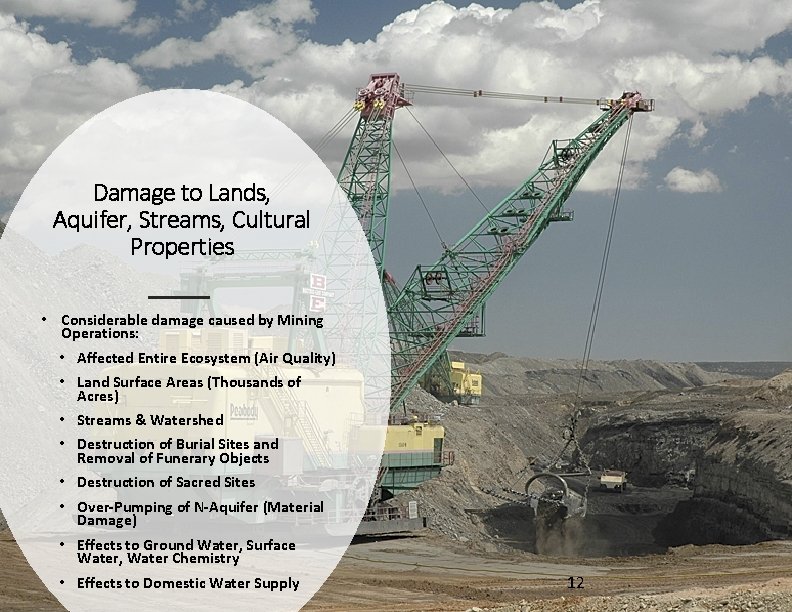
Damage to Lands, Aquifer, Streams, Cultural Properties • Considerable damage caused by Mining Operations: • Affected Entire Ecosystem (Air Quality) • Land Surface Areas (Thousands of Acres) • Streams & Watershed • Destruction of Burial Sites and Removal of Funerary Objects • Destruction of Sacred Sites • Over-Pumping of N-Aquifer (Material Damage) • Effects to Ground Water, Surface Water, Water Chemistry • Effects to Domestic Water Supply 12
Requests to OSM Director Berry • On June 10, 2020 former Hopi tribal chairmen Masayesva and Nuvamsa wrote to Mr. David Berry, Director of OSM Denver, CO to remind OSM of its trust duty to move toward full reclamation and recovery of the Black Mesa mined lands • Masayesva and Nuvamsa requested that OSM initiate a “significant permit revision” under SMCRA that would provide for a comprehensive Environmental Impact Statement (EIS) and full compliance with the National Environmental Policy Act (NEPA) • A “significant permit revision” would afford the Hopi Tribe, Navajo Nation, and other interested members of the public an opportunity to engage OSM over Peabody’s plans to carry out the final reclamation and closure of the mine sites 13
Requests to OSM Director Berry • Masayesva and Nuvamsa asserted that Peabody has yet to provide a detailed timetable for completion of each major step in the reclamation plans including: 1) Backfilling and grading; 2) Protection and restoration of the hydrologic balance for surface and groundwater resources; and 3) Redistribution of topsoil or approved topsoil substitutes 14
Requests to OSM Director Berry • Masayesva and Nuvamsa also expressed tribal concerns of: 1) Restoring springs, some of which are used for religious ceremonial purposes 2) Restoring surface water which flowed through Moenkopi Wash, and which was the main source of irrigation for Moenkopi fields. Moenkopi Wash is now dry due to the construction of over 165 impoundment dams on Peabody’s leasehold under the Nation-wide permit, in violation of Section 404 of the Clean Water Act, which requires individual permits; 3) Ameliorating high levels of arsenic in deep wells at First Mesa and Second Mesa villages due to over-drafting of billions of gallons of water from the Navajo Aquifer for mining uses over the past half century; 15
Requests to OSM Director Berry • Masayesva and Nuvamsa also expressed concerns (continued): 4) Construction of a facility to store all archaeological artifacts and remains of Hopi ancestors who settled on Black Mesa over 1, 000 years ago that were recovered during mining operations. Hundreds of ancient burial sites and funerary sites were destroyed, some placed in storage and must be returned in accordance with Native American Graves Protection and Repatriation Act (NAGPRA) 5) An alternative analysis, a review and reconsideration of the pastmining land use to consider options that might better address the dire economic condition facing the Hopi Tribe (and Navajo Nation) as a result of the premature closure of the Kayenta Mine. 16
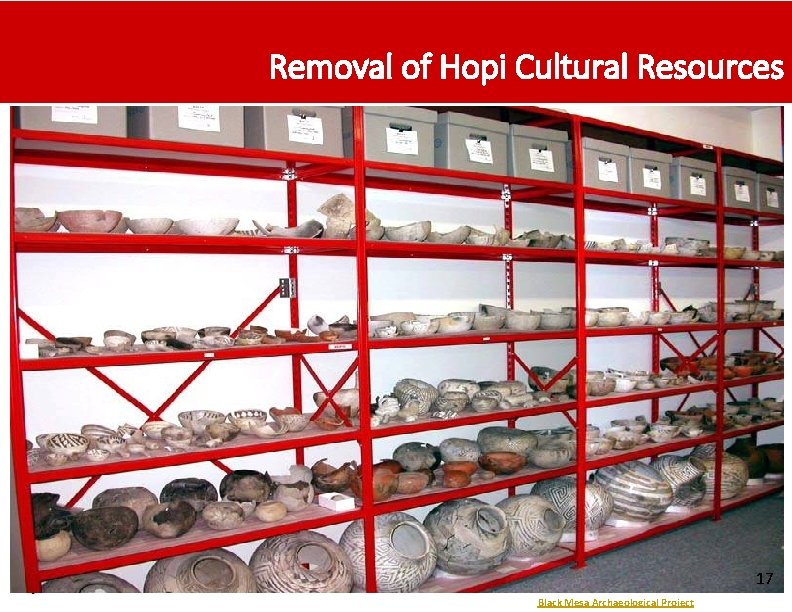
Removal of Hopi Cultural Resources 17 Black Mesa Archaeological Project
Requests to OSM Director Berry • On July 21, 2020, Representative Grijalva (D-AZ) also wrote to Mr. Berry with similar concerns; and inquiring on the status of OSM’s steps to comply with reclamation of mined lands. Representative Grijalva also expressed concern over Peabody’s lack of public permitting process • On September 25, 2020 Mr. Berry responded to Masayesva and Nuvamsa; and to Representative Grijalva stating OSM is “committed to enforcing the full reclamation of land disbursed by surface coal mining activities in accordance with the Surface Mining Control and Reclamation Act (SMCRA) and supporting regulations found at Title 30 of the Code of Federal Regulations”. Copies of this letter were distributed to the Hopi tribal leadership 18
2015 BIA Navajo Region Letter to Peabody Coal ● ● Despite being “pre-law, ” Peabody’s lease with Hopi still requires the land to be reclaimed and returned in “as good condition as received. ” In 2015, the Bureau of Indian Affairs notified Peabody of significant “unacceptable” deficiencies with its reclamation of Black Mesa Mine. 19
Requests to OSM Director Berry • The BIA’s June 9, 2015, letter to Peabody Energy Corporation concerns Indian lands lease relinquishment requirements and mined lands revegetation standards • Above standards require that “lands mined after the 1977 creation of the Surface Mining Control and Reclamation Act (SMCRA), the promulgated federal regulations at 30 CFR 750 include clear guidance defining vegetation success standards”. • The applicability of this regulation on pre-SMCRA mined lands are not clear, resulting in lack of reclamation of “pre-law” lands 20
2015 BIA Letter to Peabody “Considerable acreages remaining as raw ungraded and eroding spoil piles, largely void of vegetation. On other areas where spoils have been rough-graded, these acreages were not topsoiled to promote revegetation and/or were not backfilled/graded in a manner that allowed suitable plant growth material to be present on the surface. … Some of these acreages have been idle for many years, having prominent ‘moonscape’ surface features and heavily eroding slopes. These acreages are determined not to be in accordance with the lease requirements and are therefore not acceptable. ” Bureau of Indian Affairs-Navajo Regional Office (June 9, 2015) 21
Surface Mining Control & Reclamation Act: An Overview On tribal lands, the law is administered by the Office of Surface Mining, Reclamation and Enforcement (OSMRE), an agency of the U. S. Dept of the Interior 22
Surface Mining Control & Reclamation Act: Overview What is SMCRA? The Surface Mining Control and Reclamation Act, or SMCRA is the primary federal law that regulates coal mining and mine reclamation in the United States. Enacted in 1977, the law requires: • Reclamation work to occur “contemporaneously” with mining. • Environmental impacts of mine closure to be analyzed. • Restoration of mined land to conditions capable of supporting prior uses. • Restoration of groundwater “recharge capacity” to pre-mine conditions. • A detailed timetable for completion of each major step of reclamation. • Objective is to leave mined lands in a manner defined as being “as good condition as received” 23
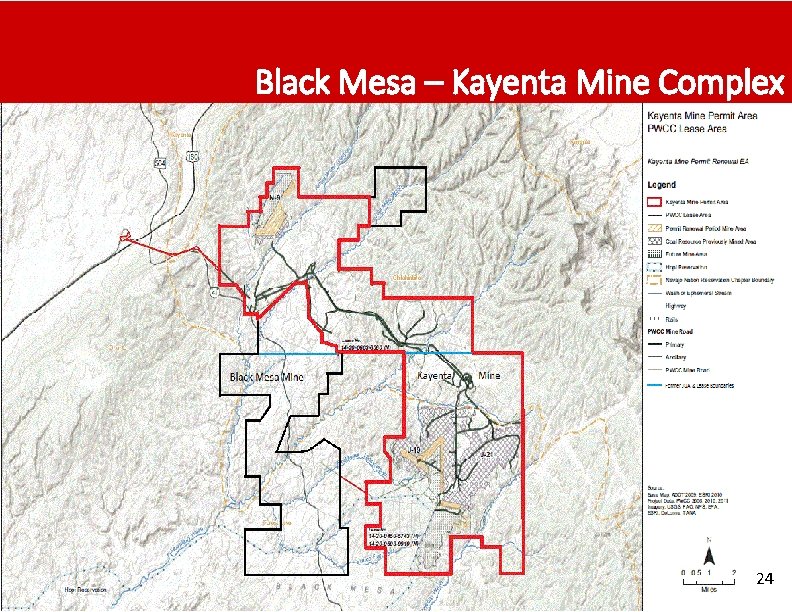
Black Mesa – Kayenta Mine Complex 24
Black Mesa-Kayenta Mine Complex ● ● ● Reclamation at Black Mesa Mine is overseen by the federal Office of Surface Mining, Reclamation and Enforcement (OSMRE). All of Black Mesa Mine was permitted prior to the passage of SMCRA, so it is regulated under what are called “pre-law” mining standards, which are not as stringent as SMCRA requirements. 15 years after closure of Black Mesa Mine, reclamation is still not complete. As of 2018, OSMRE had “terminated jurisdiction” or determined that reclamation is complete, on just 1, 608 acres, or 33% of the 4, 833 acres disturbed by mining. 25
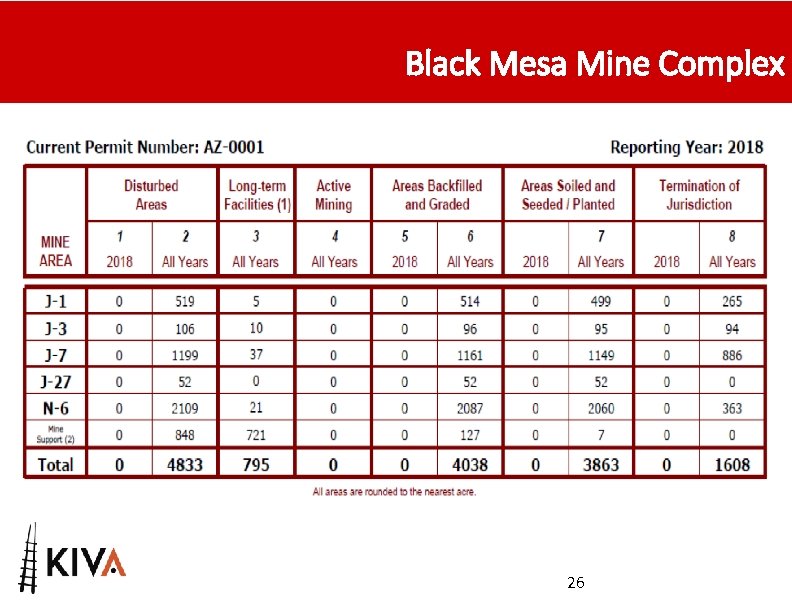
Black Mesa Mine Complex 26
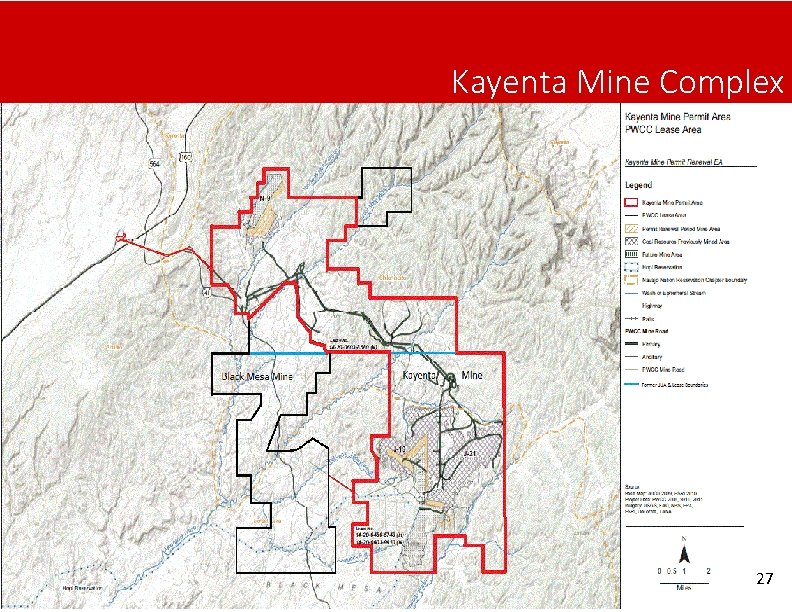
Kayenta Mine Complex 27
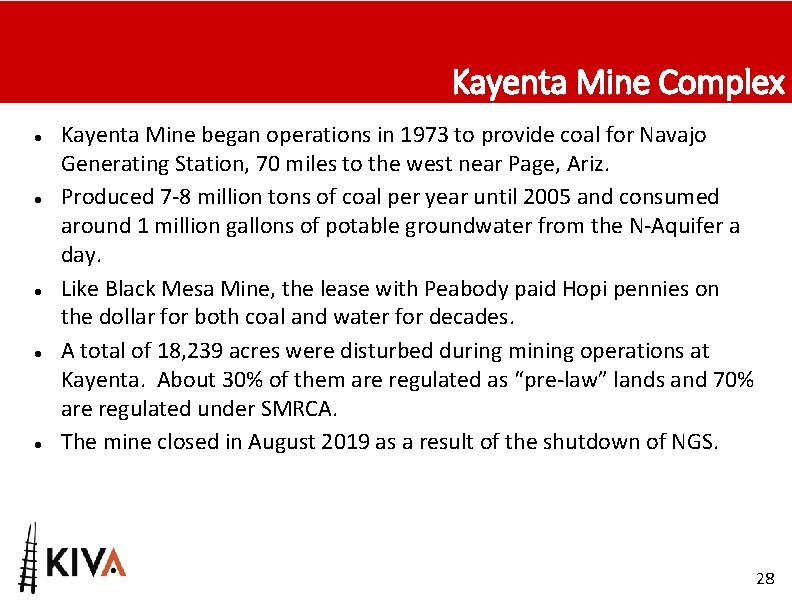
Kayenta Mine Complex ● ● ● Kayenta Mine began operations in 1973 to provide coal for Navajo Generating Station, 70 miles to the west near Page, Ariz. Produced 7 -8 million tons of coal per year until 2005 and consumed around 1 million gallons of potable groundwater from the N-Aquifer a day. Like Black Mesa Mine, the lease with Peabody paid Hopi pennies on the dollar for both coal and water for decades. A total of 18, 239 acres were disturbed during mining operations at Kayenta. About 30% of them are regulated as “pre-law” lands and 70% are regulated under SMRCA. The mine closed in August 2019 as a result of the shutdown of NGS. 28
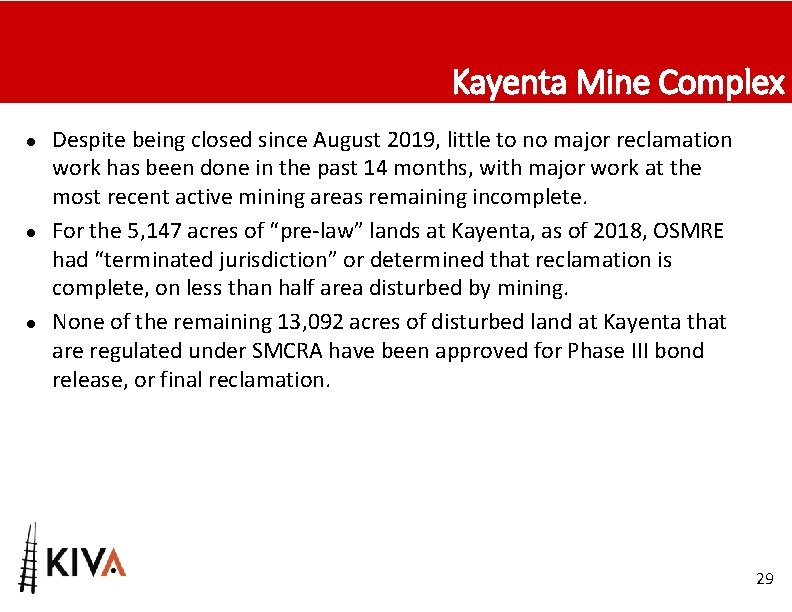
Kayenta Mine Complex ● ● ● Despite being closed since August 2019, little to no major reclamation work has been done in the past 14 months, with major work at the most recent active mining areas remaining incomplete. For the 5, 147 acres of “pre-law” lands at Kayenta, as of 2018, OSMRE had “terminated jurisdiction” or determined that reclamation is complete, on less than half area disturbed by mining. None of the remaining 13, 092 acres of disturbed land at Kayenta that are regulated under SMCRA have been approved for Phase III bond release, or final reclamation. 29
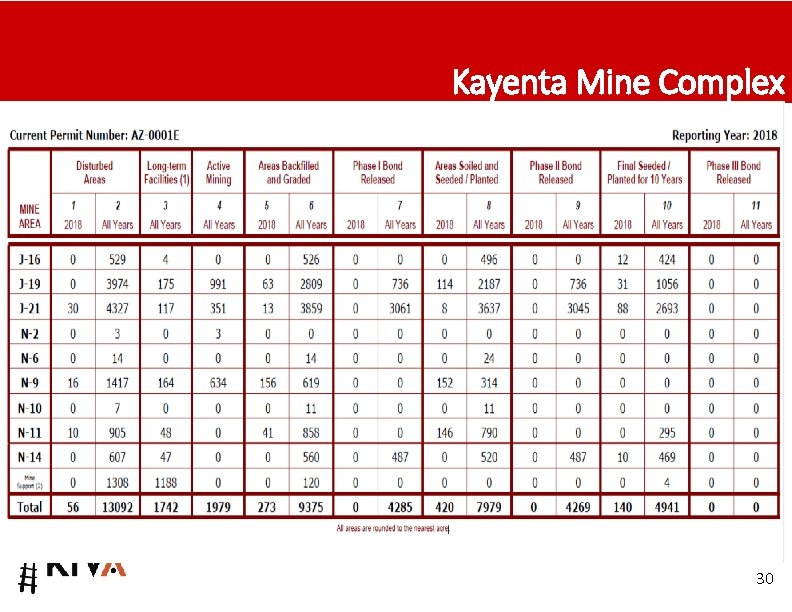
Kayenta Mine Complex 30
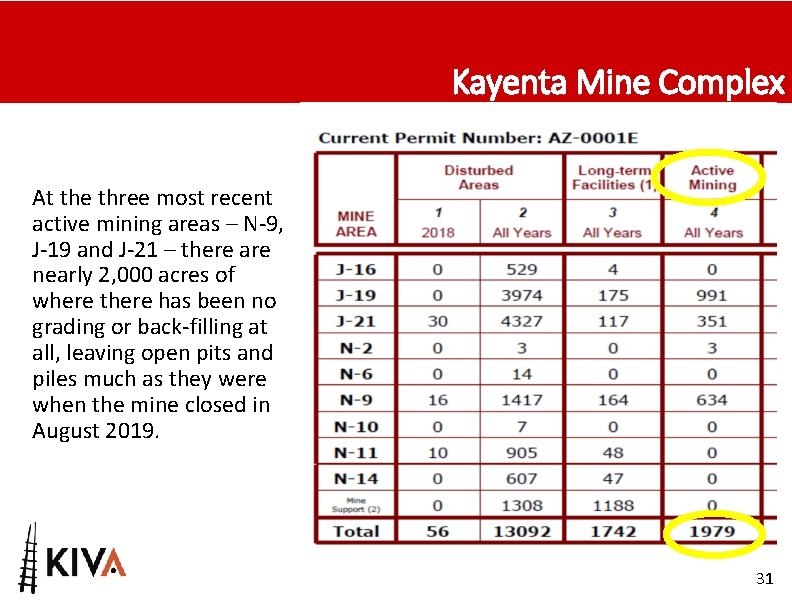
Kayenta Mine Complex At the three most recent active mining areas – N-9, J-19 and J-21 – there are nearly 2, 000 acres of where there has been no grading or back-filling at all, leaving open pits and piles much as they were when the mine closed in August 2019. 31
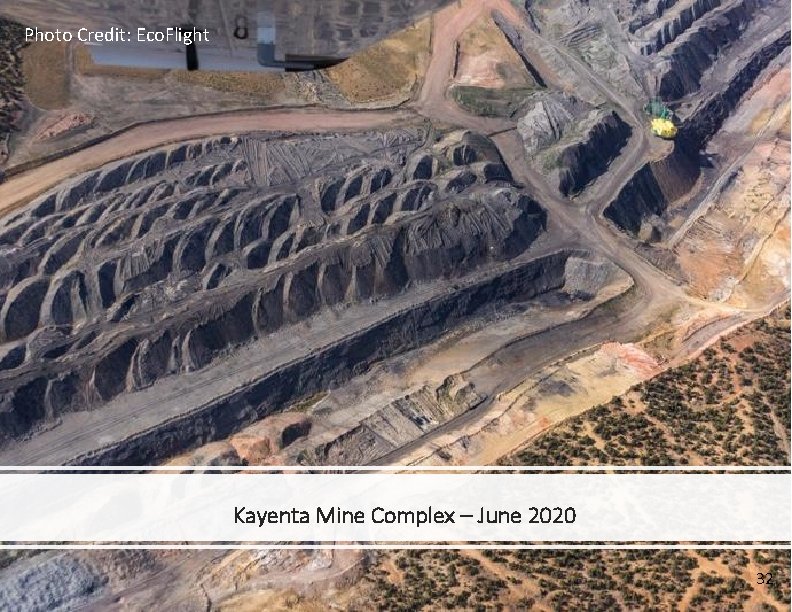
Photo Credit: Eco. Flight Kayenta Mine Complex – June 2020 32
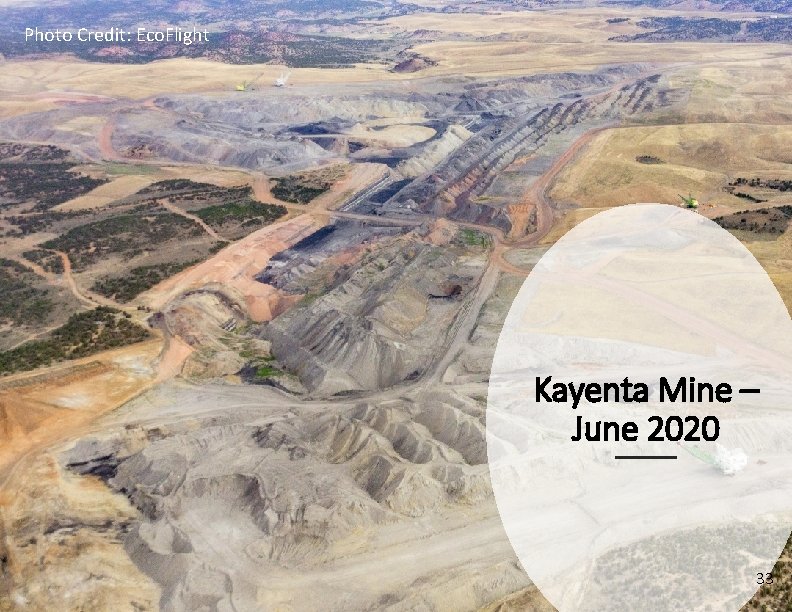
Photo Credit: Eco. Flight Kayenta Mine – June 2020 33
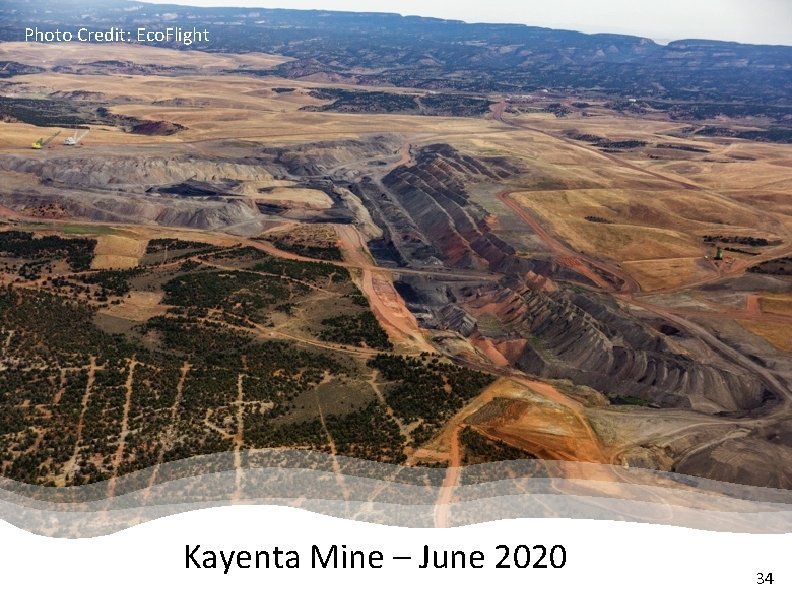
Photo Credit: Eco. Flight Kayenta Mine – June 2020 34
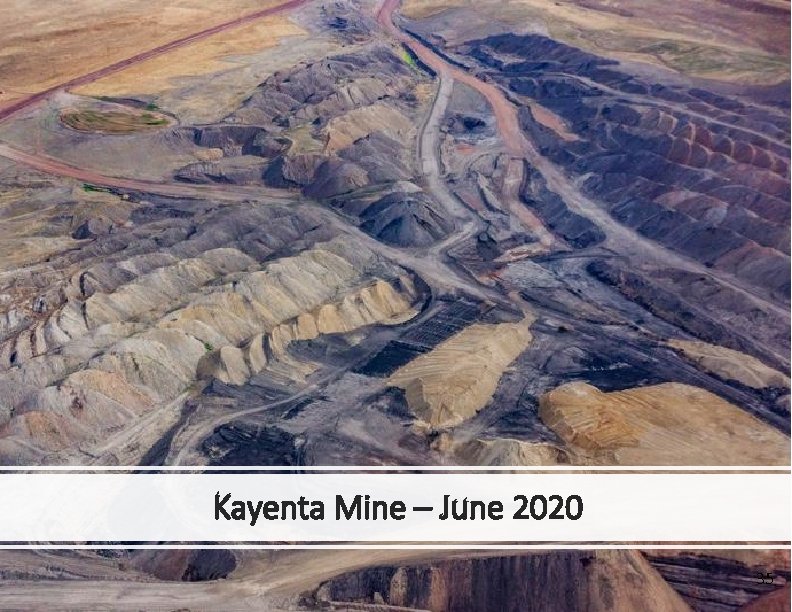
Kayenta Mine – June 2020 35
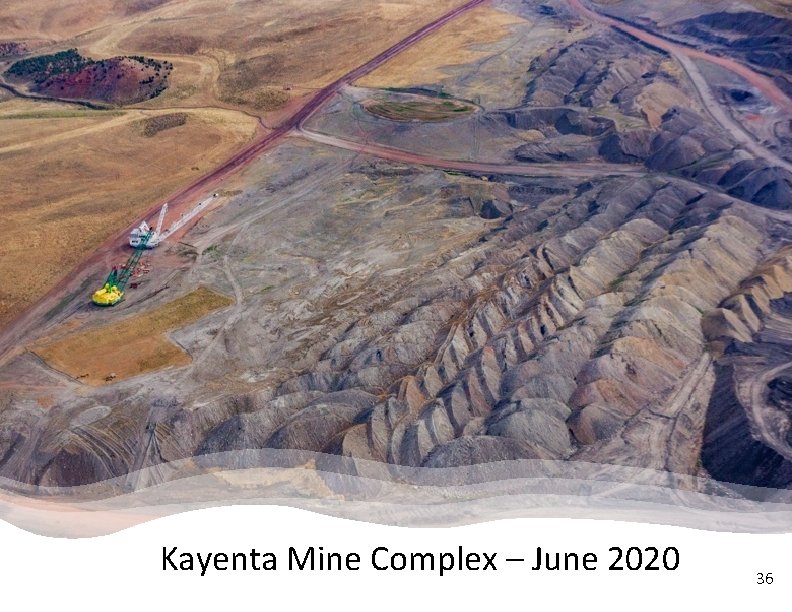
Kayenta Mine Complex – June 2020 36
Kayenta Mine – Reclamation Delays • As of September 2019, there still is no contract between Peabody and the United Mine Workers to conduct reclamation work. • Peabody has applied for numerous “minor” permit revisions that request changes to the current cleanup requirements. • One of the changes Peabody has requested is permission to delay up to 70% of major reclamation work for another 2 -4 years. 37
Kayenta Mine – Reclamation Delays • Of the 1, 850 disturbed acres to be backfilled and/or graded in the next five years, Peabody proposes delaying work on 1, 325 acres, or 71. 6%, until 2022 or later, 800 of those until 2023 or later • For areas requiring top-soiling and seeding, Peabody proposes delaying reseeding on 1, 475 acres of the 1, 925 acres that will need it, or 76. 6%, until 2022 or later 38
Kayenta Mine – Hopi Concerns The Navajo Nation controls surface rights for the majority of Kayenta Mine, but as joint and equal owners of all the coal resources in the two largest mining areas – (J-19 and J-21) – Hopi has a number of specific concerns, most importantly: • Restoration of the N-Aquifer, which is the primary source of drinking and domestic water on Black Mesa and which has been greatly impacted by the past five decades of mining at both Kayenta Mine and Black Mesa Mine. • Return and restoration of numerous cultural resources that were removed, disturbed or impacted by Kayenta Mine. • Other cumulative impacts 39
Coal Mining Impacts on N-Aquifer Assessment by hydrologist Dr. Daniel Higgins of OSMRE’s most recent update on the status of the N-Aquifer, which completely downplays the impact of coal mining on water depletion: • Previous Cumulative Hydrologic Impact Assessments (CHIAs) were based on models/simulations of impacts to groundwater, NOT actual monitoring data • The 2020 “Review and Analysis of Navajo Aquifer Material Damage” continues to rely on inaccurate models instead of USGS monitoring data 40
Coal Mining Impacts on N-Aquifer Assessment by hydrologist Dr. Daniel Higgins (Continued): • OSMRE’s argument that municipal pumping is the main cause of water level declines in N-aquifer wells IS NOT supported by many years of actual well data • Recovery of various N-Aquifer wells has been demonstrated by USGS as Peabody withdrawals have decreased. Therefore, municipal pumping CANNOT be the primary cause of water depletion in the NAquifer • Discovery in the 1989 CHIA Report that Peabody pumped groundwater from the Dakota Aquifer (D-Aquifer) for mine operations, the following: • • 1980 – 137. 8 acre feet 1981 – 178. 3 acre feet 1982 – 217. 8 acre feet 1983 – 203. 7 acre feet • • 1984 – 146. 0 acre feet 1985 – 76. 7 acre feet 1986 – Not reported 1987 – Not reported • 1988 – Not reported • 1989 – Not reported 41
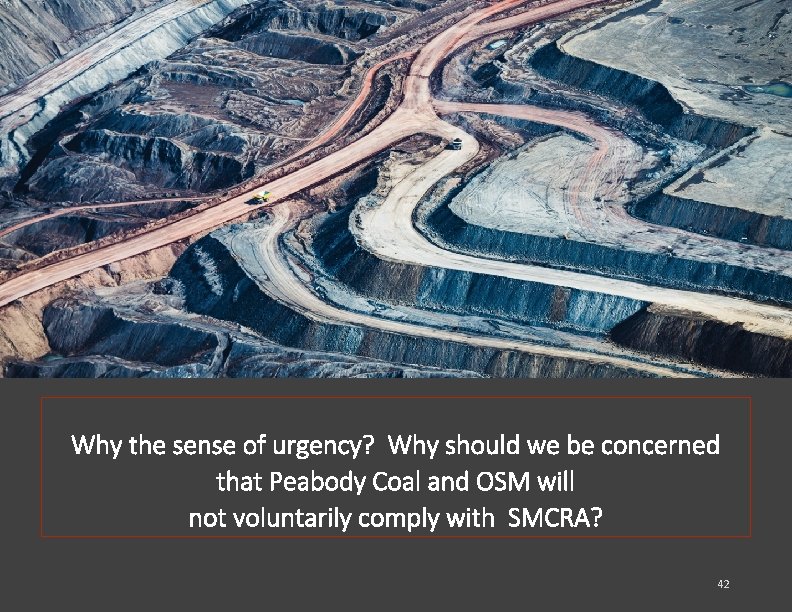
Why the sense of urgency? Why should we be concerned that Peabody Coal and OSM will not voluntarily comply with SMCRA? 42
Deteriorating Financial Condition 43
Peabody’s Deteriorating Financial Condition • In April, declining demand for coal forced Peabody to lay off 170 workers its North Antelope Rochelle Mine (NARM) in Wyoming, the largest coal mine in the U. S. • In July, Peabody was forced to write down the value of NARM by $1. 42 billion • Between July and September, Peabody’s revenue declined 39%. • In October, Argonaut Insurance, which holds $202 million in bonds to secure reclamation at Peabody mines worldwide, filed a lawsuit demanding that Peabody put up as collateral the full amount of the bonds owed because of the company’s “deteriorating” financial condition 44
Peabody’s Deteriorating Financial Condition Because of Peabody’s shaky financial condition and the increasing doubts about its ability to remain viable in the future, it would be prudent for Hopi tribal leaders to hold the company accountable for reclamation and groundwater restoration at Kayenta Mine NOW. If Peabody becomes insolvent, bankruptcy disputes would almost surely delay reclamation work even further. 45
Hopi’s Last Chance for Justice from Peabody “Significant Permit Revision” • Requires full participation and involvement of Hopi and Navajo • Requires a full Environmental Impact Statement, including assessment of groundwater impacts from mining • Hopi Tribal Council should demand that OSMRE hold Peabody accountable for proper reclamation AND restoration of the N-Aquifer • Once Peabody’s permit is renewed, there will not be another opportunity to secure full reclamation and restoration of the aquifer 46
Hopi’s Last Chance for Justice from Peabody “Significant Permit Revision” • Hopi Tribal Council can be leaders by making a simple administrative request to OSMRE for a “Significant Permit Revision” • Without this request, OSMRE will move ahead with a rubber-stamp, 5 -year permit renewal for Kayenta Mine that will allow Peabody to dictate reclamation standards and progress, with little input from Hopi • Renewing the existing permit without any review or substantive changes will allow OSMRE and Peabody to continue claiming that mining has had no material impact in depleting the N-Aquifer • Unless Hopi acts now to address these issues, there will NOT be another chance to bring them up again 47
Benefits of Mine Reclamation • Benefits of reclaiming damaged mined lands has many benefits, including: • • • Restoration and reclamation of surface and subsurface lands Restoration of the ecological balance on Black Mesa Restoration of N-Aquifer, streams, sacred springs Proper reinternment of human remains and funerary artifacts Creation of jobs for tribal members In the alternative, the Hopi Tribe and Navajo Nation may exercise their right to assume OSM’s and Peabody Coal’s reclamation obligations through Public Law 93 -638, Indian Self-Determination and Education Assistance Act, creating jobs for tribal members 48
Benefits of Mine Reclamation • • Reclamation for a mine typically includes lots of earthmoving, topsoil, replacement and heavy equipment operations especially in the first two years; and is the most labor intensive part of reclamation Earthmoving activities include backfilling, grading, topsoil replacement Surface mines are expansive and deep with features like spoil ridges, cut-and-fill slopes, high walls and diversions When done, and only when, can land be backfilled and graded to its original contour 49
Benefits of Mine Reclamation • Benefits of reclaiming damaged mined lands has many benefits, including: • According to a report “Coal Mine Cleanup Works: A Look at the Potential Employment Needs for Mine Reclamation in the West”, by the Western Organization of Resource Councils (WORC): • Could create up to 6, 081 full-time equivalent jobs per year in the critical two to three years (approximately 70% of current mining workforce) in Western states • Could create an estimated 200 jobs per year for the next two to three years for tribal members (Hopi and Navajo) • Kate French, author of the report said, “for the Navajo and Hopi, I think the most important thing to know is that for two to three years, there are hundreds of jobs in clean-up”. 50
Hopi’s Last Chance for Justice from Peabody “Significant Permit Revision” Conclusion By federal law, and as federal trustee to the Hopi people, the Office of Surface Mining Reclamation and Enforcement (OSMRE) has a legal duty and obligation to initiate work to reclaim lands and resources damaged through years of mining activity in compliance with SMCRA. Considerable time has passed since the closure of the Black Mesa Mine and the Kayenta Mine, but OSMRE has failed to meet its legal obligations to reclaim both mines as required under SMCRA 51
Hopi’s Last Chance for Justice from Peabody “Significant Permit Revision” Conclusion Hopi Tribal Council must immediately demand, in writing, that OSMRE require a “Significant Permit Revision” for Kayenta Mine since mining stopped in November 2019 and is now in a Reclamation Phase Hopi Tribe must hold OSMRE and Peabody accountable by writing to OSMRE and providing tribal resolution that will insist the federal government and Peabody Coal to initiate full reclamation in close partnership with Hopi (and Navajo) 52
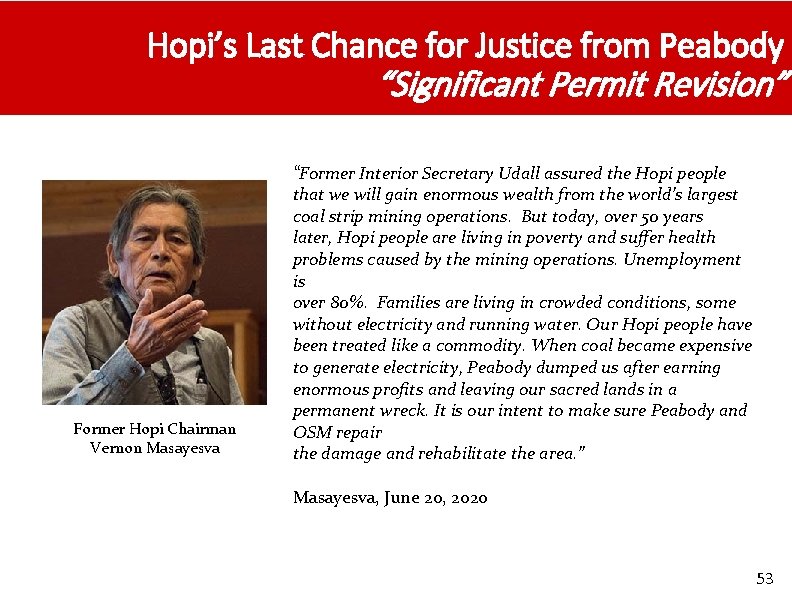
Hopi’s Last Chance for Justice from Peabody “Significant Permit Revision” Former Hopi Chairman Vernon Masayesva “Former Interior Secretary Udall assured the Hopi people that we will gain enormous wealth from the world’s largest coal strip mining operations. But today, over 50 years later, Hopi people are living in poverty and suffer health problems caused by the mining operations. Unemployment is over 80%. Families are living in crowded conditions, some without electricity and running water. Our Hopi people have been treated like a commodity. When coal became expensive to generate electricity, Peabody dumped us after earning enormous profits and leaving our sacred lands in a permanent wreck. It is our intent to make sure Peabody and OSM repair the damage and rehabilitate the area. ” Masayesva, June 20, 2020 53
Acknowledgements This presentation was prepared by Benjamin Nuvamsa (KIVA Institute, LLC, and former Hopi Tribal Chairman), in full collaboration with: • Vernon Masayesva (Black Mesa Trust & Former Hopi Tribal Chairman) • Eric Frankowski (Western Clean Energy) • Rachel Ellis (Northern Arizona University) • Nicole Horseherder (Tó Nizhóní Ání) • Roger Clark (Grand Canyon Trust) • Pamela Eaton (Green West Strategies) • Daniel Higgins (Arizona State University/University of Arizona) • Brad Bartlett (Brad Bartlett Law) • Mark S. Squillace (University of Colorado Law) Any questions regarding this presentation may be directed to Benjamin Nuvamsa at ben@kivainstitute. com. 54
- Slides: 54