
November 11 13 2013 Gas Utility Operations Best
November 11 -13, 2013 Gas Utility Operations Best Practices Program Public Awareness Workshop Washington, DC Group Discussion Summary – Training & Engagement of Stakeholders Facilitator – Christina Sames, AGA
www. aga. org Note: The AGA Operations Best Practices Program is intended to highlight how particular companies may address a specific operational issue and may not include all of the data related to a highlighted practice. The need to implement and the timing of any implementation of highlighted practices will vary with each operator. Each operator serves a unique and defined geographic area and their system infrastructures vary widely based on a multitude of factors, including, condition, engineering practices and materials. Each operator needs to evaluate highlighted practices in light of their system variables. Not all highlighted practices will be applicable to all operators due to the unique set of circumstances that are attendant to their specific systems. Companies are not ranked through this program and no one practice is identified as the best for a particular topic. Copyright & Distribution: Copyright © 2013 American Gas Association. All rights reserved. The AGA Gas Utility Operations Best Practices Program publications are copyrighted, confidential and proprietary to AGA and only available on the member-restricted side of the AGA website. Permission to reproduce or transmit in any form or by any means, electronic or mechanical, including photocopying or recording, or by any information storage and retrieval system any publication or portion of a publication must be obtained in writing from the AGA General Counsel’s Office, GCO@aga. org. AGA Full, Limited and International Members are granted a limited license to reproduce this publication for internal business purposes but not for regulatory or civil matters. 2
Q 1: What practices are used to assure efficient training for all stakeholder groups: Public, First Responders, Public Officials, Contractors and Schools? • Practices: • Use of scenarios to convey key messages (eg, hit line with explosion, message of call before you dig, response scenarios, role of public officials) • Collaboration with others (for efficiency, consistency and reach broader audience) • Invite to operator facility to explain the system • Focus group all messages to make sure message is being understood • Use of fire pit or training facility to show to fight a gas fire 3
Q 1: What practices are used to assure efficient training for all stakeholder groups: Public, First Responders, Public Officials, Contractors and Schools? • Practice: Use of scenarios to convey key messages (eg, hit line with explosion, message of call before you dig, response scenarios, role of public officials) • Benefits • Cost efficiencies • Broader audience • Conveys roles and responsibilities of each stakeholder • Increased engagement • Helps to fill requirement for tabletop drills • Supplements emergency response plan Considerations for Implementation • Must be planned out. Involve stakeholders in the planning of the scenario • Need participation from all stakeholders • Should cover all conditions (storage, transmission, distribution, liquid) • Buy-in from own employees (purpose) • Benefits of keeping it local • If collaborate with other companies, will need to determine contractor/roles Companies that utilize this practice (or parts thereof) 4 Colorado Springs Utilities, Eastern Shore Natural Gas, NJ Natural, National Fuel, Mountaineer Gas, Puget Sound Energy, UGI, Dominion, Atmos
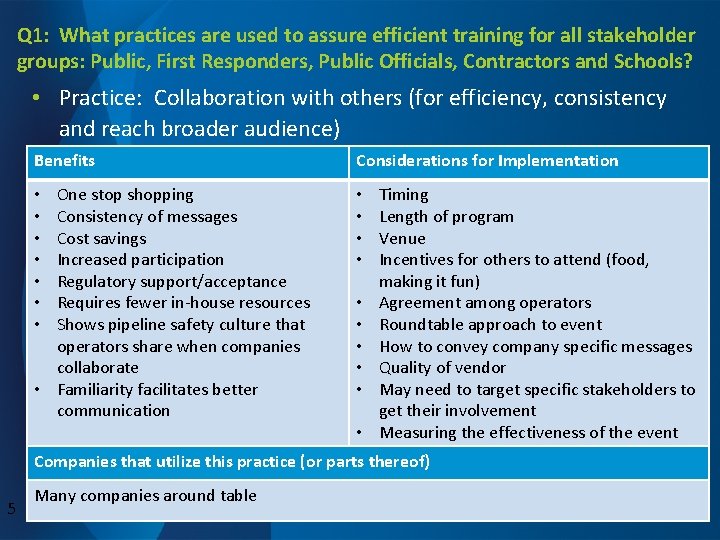
Q 1: What practices are used to assure efficient training for all stakeholder groups: Public, First Responders, Public Officials, Contractors and Schools? • Practice: Collaboration with others (for efficiency, consistency and reach broader audience) • Benefits Considerations for Implementation One stop shopping Consistency of messages Cost savings Increased participation Regulatory support/acceptance Requires fewer in-house resources Shows pipeline safety culture that operators share when companies collaborate • Familiarity facilitates better communication • • • • • Timing Length of program Venue Incentives for others to attend (food, making it fun) Agreement among operators Roundtable approach to event How to convey company specific messages Quality of vendor May need to target specific stakeholders to get their involvement Measuring the effectiveness of the event Companies that utilize this practice (or parts thereof) 5 Many companies around table
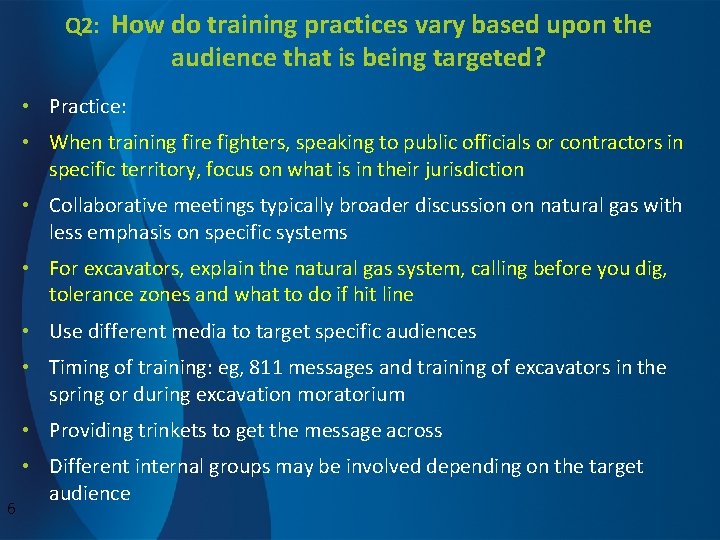
Q 2: How do training practices vary based upon the audience that is being targeted? • Practice: • When training fire fighters, speaking to public officials or contractors in specific territory, focus on what is in their jurisdiction • Collaborative meetings typically broader discussion on natural gas with less emphasis on specific systems • For excavators, explain the natural gas system, calling before you dig, tolerance zones and what to do if hit line • Use different media to target specific audiences • Timing of training: eg, 811 messages and training of excavators in the spring or during excavation moratorium • Providing trinkets to get the message across 6 • Different internal groups may be involved depending on the target audience
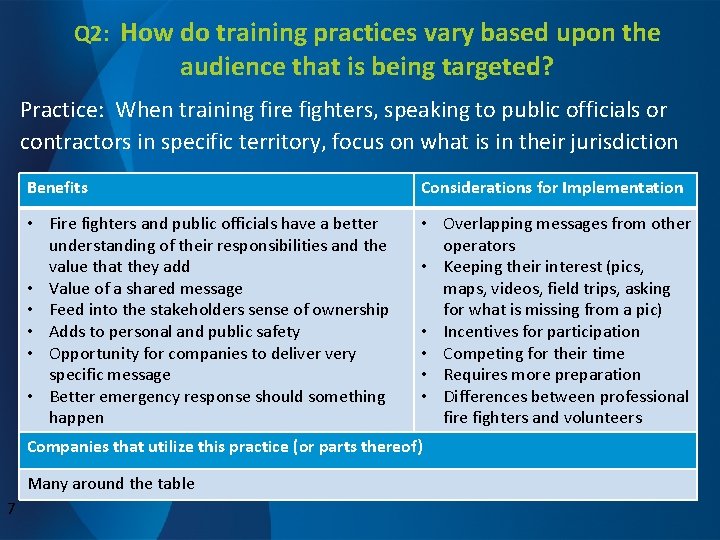
Q 2: How do training practices vary based upon the audience that is being targeted? Practice: When training fire fighters, speaking to public officials or contractors in specific territory, focus on what is in their jurisdiction Benefits Considerations for Implementation • Fire fighters and public officials have a better understanding of their responsibilities and the value that they add • Value of a shared message • Feed into the stakeholders sense of ownership • Adds to personal and public safety • Opportunity for companies to deliver very specific message • Better emergency response should something happen • Overlapping messages from other operators • Keeping their interest (pics, maps, videos, field trips, asking for what is missing from a pic) • Incentives for participation • Competing for their time • Requires more preparation • Differences between professional fire fighters and volunteers Companies that utilize this practice (or parts thereof) Many around the table 7
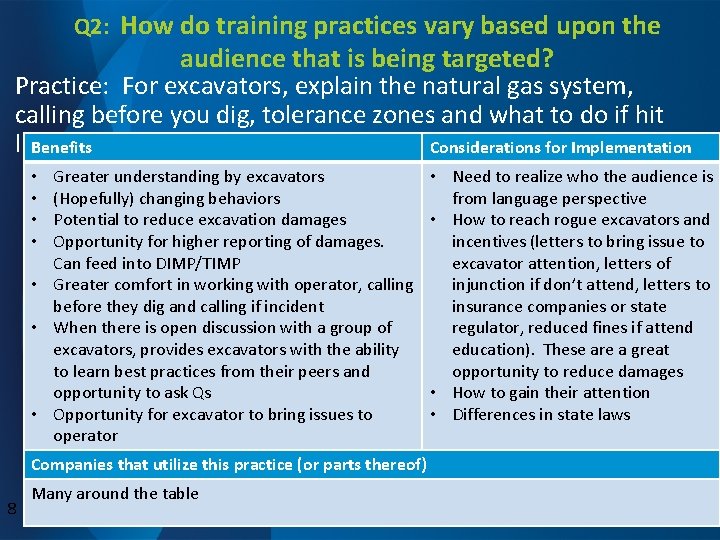
Q 2: How do training practices vary based upon the audience that is being targeted? Practice: For excavators, explain the natural gas system, calling before you dig, tolerance zones and what to do if hit line Benefits Considerations for Implementation Greater understanding by excavators (Hopefully) changing behaviors Potential to reduce excavation damages Opportunity for higher reporting of damages. Can feed into DIMP/TIMP • Greater comfort in working with operator, calling before they dig and calling if incident • When there is open discussion with a group of excavators, provides excavators with the ability to learn best practices from their peers and opportunity to ask Qs • Opportunity for excavator to bring issues to operator • • Companies that utilize this practice (or parts thereof) 8 Many around the table • Need to realize who the audience is from language perspective • How to reach rogue excavators and incentives (letters to bring issue to excavator attention, letters of injunction if don’t attend, letters to insurance companies or state regulator, reduced fines if attend education). These are a great opportunity to reduce damages • How to gain their attention • Differences in state laws
Q 4: What practices are most effective in fostering relationships with public officials? • Practices: • Using existing employee relationships with public officials; fostering new relationships • Official group within company charged with fostering relationships • Encouraging employees to have seat at the table: Local emergency planning committee, state emergency response committee • Presentations at meetings conducted by public officials (conference of mayors, law enforcement, etc) • Establishing company as good corporate citizen – Charity supporting emergency responders, sponsoring local events, giving back to the community • Keeping current with local officials after elections; tracking program 9
Q 6: What practices are used in sharing locations of pipelines with public officials? • Practices: • National Pipeline Mapping System (for transmission) • Share gate stations and regulator station locations with emergency responders through training • Face to face meeting with emergency responders (cavern locations, propane-air plants, peek shaving facilities) • Presentations to utilities board and city council • Maps to cities and municipalities • Through websites • Through table top drills 10
Q 7: What communication vehicles resonant most and obtain the most audience penetration? • Practices: • Videos of incidents and adding messages you want to get across. Using an incident to convey safety information (partnering with media) • Public: You Tube, Twitter, Blogs, Facebook. Example: Reporting or real time incidents with information • Scratch and sniff mailing and letting media know that information is being sent (smelly bill this month) • School age children: e. Smart Kids, National Education Foundation, kid section on website, outreach to schools/providing materials to teachers, partner with a fire house open house, partner with libraries and literacy programs. Note: want badge for boy scout and girl scout • Workers and excavators: e. Learning, face to face meetings, CGA • Emergency responders: Training, CEUs, table top exercises, 11 unannounced drills
Q 9: Do demographics and the use of foreign languages/ translation impact your program (cost/resonance)? • Yes: 4 • No: Most • Comments: • A number of companies are creating messages in multiple languages. Some provide only portions of the message in another language • Use of local demographics to determine need • May want to utilize employees that are involved with specific cultures to determine how best to reach these communities 12
Q 10: How do you document training? • Practice: • Sign in sheets • Turning point technology • Web-based sign in • Survey monkey • Internal database that tracks communications Q 10: Who is doing the documentation? • Practice: • Trainer, vendors, done by individual Q 10: Are you using off-the- shelf software or a customized program. • Software/Program: Most using a combination 13
www. aga. org The American Gas Association, founded in 1918, represents more than 200 local energy companies that deliver clean natural gas throughout the United States. There are more than 71 million residential, commercial and industrial natural gas customers in the United States, of which 92% — more than 65 million customers — receive their gas from AGA members. Today, natural gas meets almost one-fourth of the United States’ energy needs. 14
- Slides: 14