
NOVEL WAFER BONDING TECHNOLOGY SURVEY PoWen Chen Department
NOVEL WAFER BONDING TECHNOLOGY SURVEY Po-Wen Chen Department of Electrical Engineering and Graduate Institute of Electronics Engineering National Taiwan University, Taipei, Taiwan, R. O. C. Department of Electrical Engineering, National Taiwan University
Outline • Introduction • Wafer bonding application • TEM inspection of our bonding achievement Department of Electrical Engineering, National Taiwan University
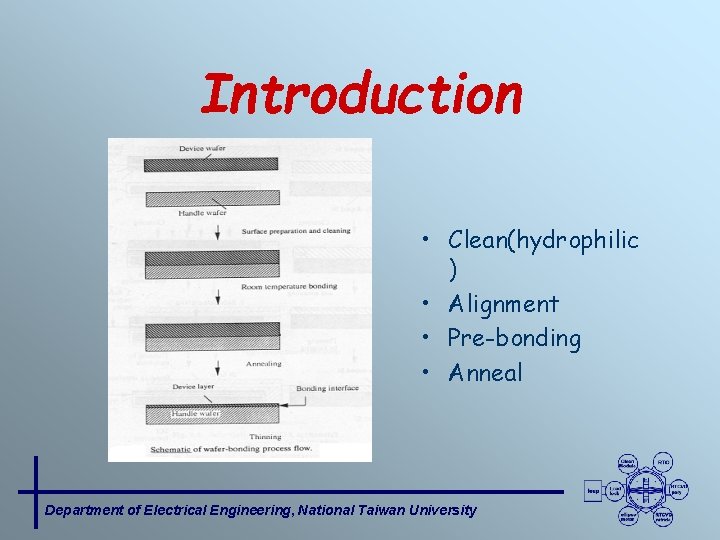
Introduction • Clean(hydrophilic ) • Alignment • Pre-bonding • Anneal Department of Electrical Engineering, National Taiwan University
Wafer Bonding • Anodic Bonding • Silicon Direct Bonding/Fusion Bonding • Intermediate-Layer Bonding Department of Electrical Engineering, National Taiwan University

Anodic Bonding • Rely on charge migration • Silicon and glass with alkali metal –Glass with 3. 5% Na 2 O • Negative voltage to glass to attract and neutralize Na+ • Due to electric field , O 2 transported to glass-silicon interface form Si. O 2 • Electrostatic attraction between glass-silicon interface Department of Electrical Engineering, National Taiwan University
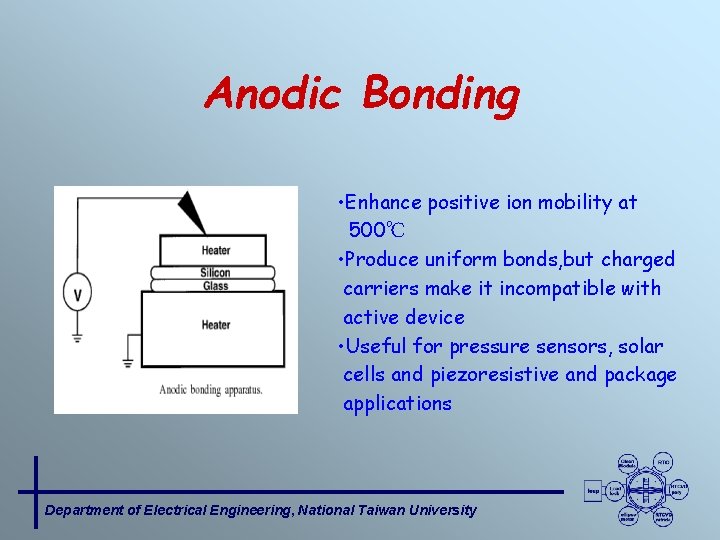
Anodic Bonding • Enhance positive ion mobility at 500℃ • Produce uniform bonds, but charged carriers make it incompatible with active device • Useful for pressure sensors, solar cells and piezoresistive and package applications Department of Electrical Engineering, National Taiwan University
Silicon Direct Bonding/Fusion Bonding • Join silicon wafer by – Create and contact hydrophobic or hydrophilic surfaces – Anneal at high temperature • Hydrophobic case – HF dip before contact – More challenging than hydrophilic wafer , but ultimately better? • Hydrophilic case – SC 1(standard cleaning) before bonding Department of Electrical Engineering, National Taiwan University

Silicon Direct Bonding/Fusion Bonding • After. SC 1 , the mirror polished silicon wafer filled with hydroxyl radicals(OH- ) • OH- on polished silicon face permit a good initial contact bond Department of Electrical Engineering, National Taiwan University
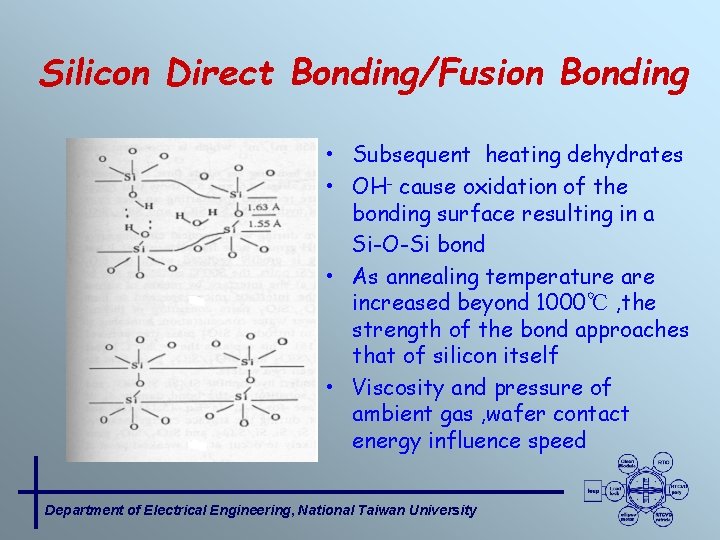
Silicon Direct Bonding/Fusion Bonding • Subsequent heating dehydrates • OH- cause oxidation of the bonding surface resulting in a Si-O-Si bond • As annealing temperature are increased beyond 1000℃ , the strength of the bond approaches that of silicon itself • Viscosity and pressure of ambient gas , wafer contact energy influence speed Department of Electrical Engineering, National Taiwan University

Silicon Direct Bonding/Fusion Bonding • Press in the middle of wafer to create a preliminary point of contact • While mechanical spacer maintain wafer physically separated • Retract spacer to form a single bonding wave from center to wafer • Spacer integrity is important – Multiple bonding waves promote warpage and voids – Gas trapped in pocket form by multiple waves Department of Electrical Engineering, National Taiwan University

Silicon Direct Bonding/Fusion Bonding • From room temperature 110 C – Slow fracture effect and interface water rearrangement • From 110 C to 150 C – Polymerization of silanol groups across the interface • From 150 C to 800 C – Bonding energy limited by contacted area • From 800 C and above – Complete bonding via oxide flow Department of Electrical Engineering, National Taiwan University
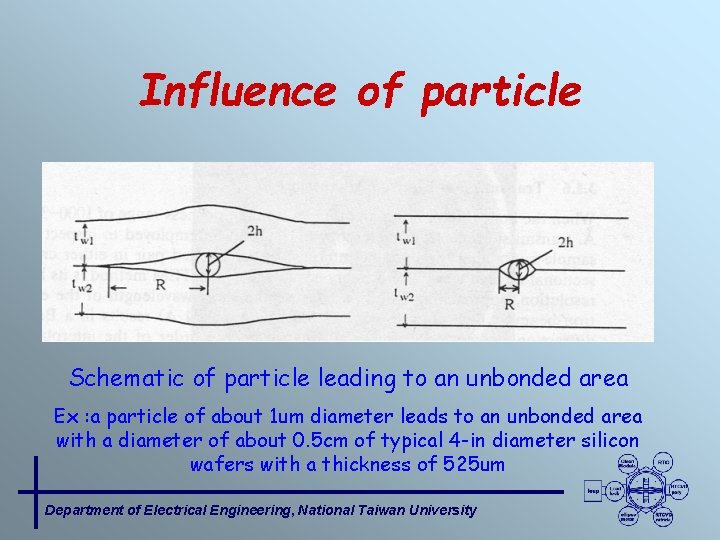
Influence of particle Schematic of particle leading to an unbonded area Ex : a particle of about 1 um diameter leads to an unbonded area with a diameter of about 0. 5 cm of typical 4 -in diameter silicon wafers with a thickness of 525 um Department of Electrical Engineering, National Taiwan University
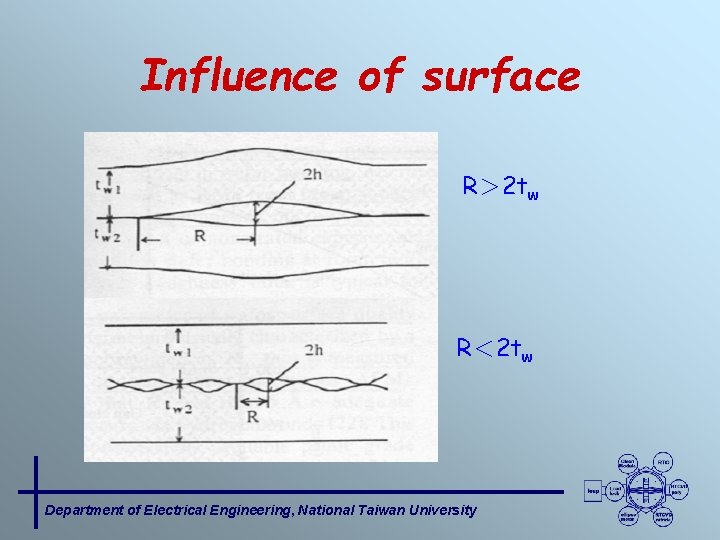
Influence of surface R> 2 tw R< 2 tw Department of Electrical Engineering, National Taiwan University
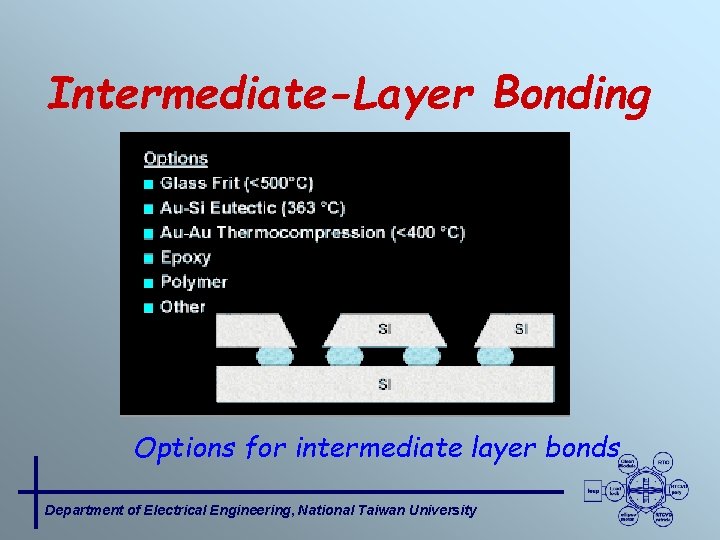
Intermediate-Layer Bonding Options for intermediate layer bonds Department of Electrical Engineering, National Taiwan University
Intermediate-Layer Bonding Eutectic and glass-frit bonding techniques – Deposition of intermediate metallic and glass films • Eutectic bond – Examine a two component phase diagram • Little solubility between the component , reveal eutectic point located at the lowest melting temperature • Alloy – Formed by solid-liquid inter-diffusion at contact interface – Followed by solidification upon cooling • Gold and silicon – 363℃, 2. 85%Si, 97. 1%Au by weight • Good eutectic bond – Remove silicon oxide films that hamper gold diffuse into silicon Department of Electrical Engineering, National Taiwan University
Intermediate-Layer Bonding • Before bonding – Exposure to ultraviolet light to remove organic contaminants • Low temperature – Reach eutectic point make this technique attractive for active device processes • Glass frit bond – Create hermetic seals using relatively low temperature – Thin glass layer is deposited and pre-glazed – Wafer brought into contact at rated melting temperature of glass , less than 600℃ – Pressure is applied to maintain contact – Lead borate with significant lead oxide content is often used Department of Electrical Engineering, National Taiwan University
Checking for wafer-to-wafer bonding integrity • Three dominant methods for imaging a bonded pair of silicon wafer – Infrared transmission – Ultrasonic – X-ray topography Department of Electrical Engineering, National Taiwan University
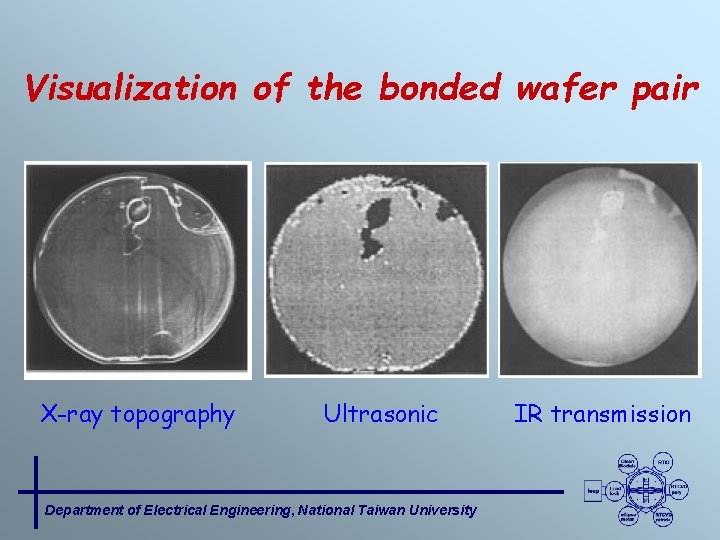
Visualization of the bonded wafer pair X-ray topography Ultrasonic Department of Electrical Engineering, National Taiwan University IR transmission
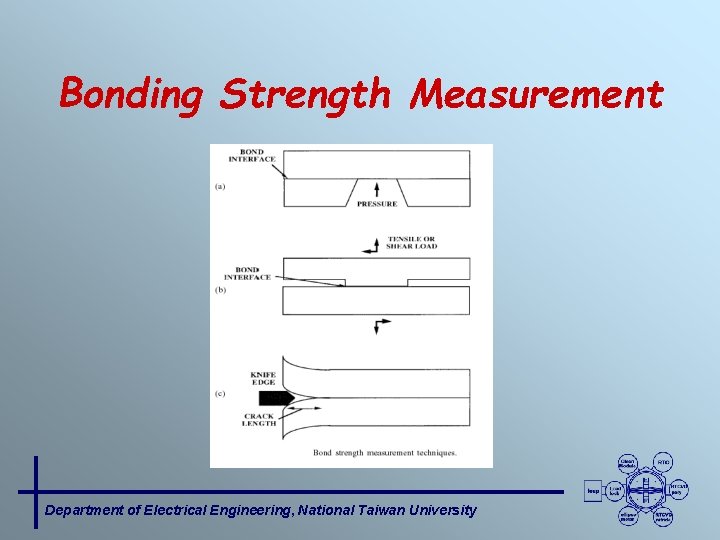
Bonding Strength Measurement Department of Electrical Engineering, National Taiwan University
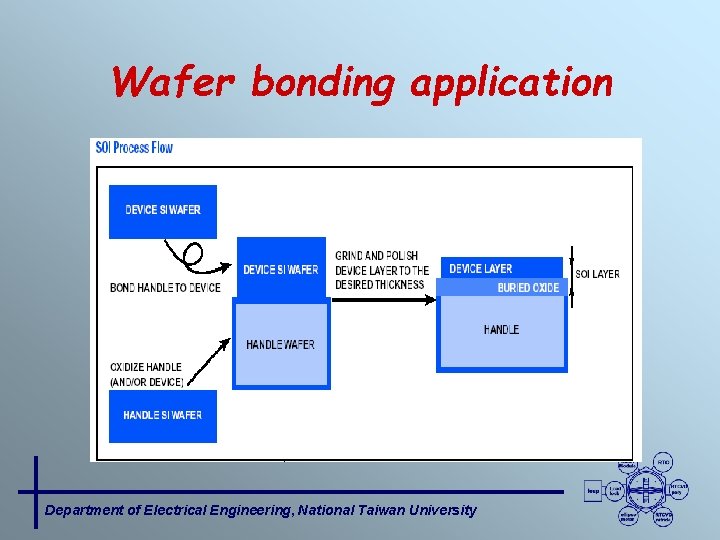
Wafer bonding application Department of Electrical Engineering, National Taiwan University
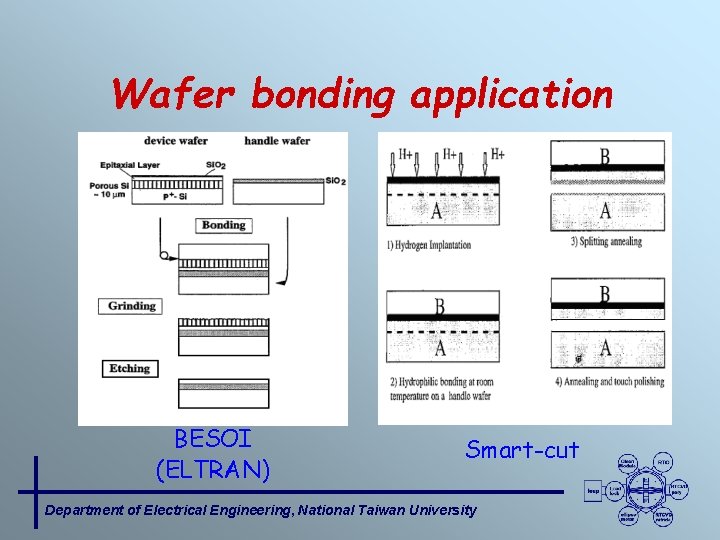
Wafer bonding application BESOI (ELTRAN) Smart-cut Department of Electrical Engineering, National Taiwan University
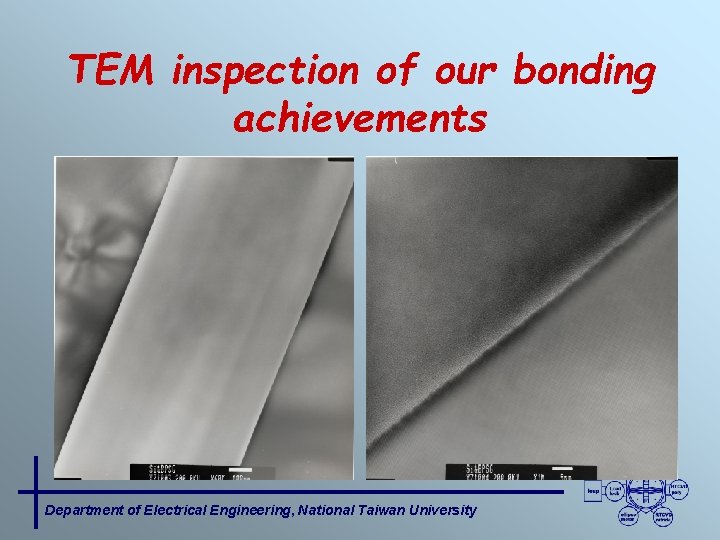
TEM inspection of our bonding achievements Department of Electrical Engineering, National Taiwan University
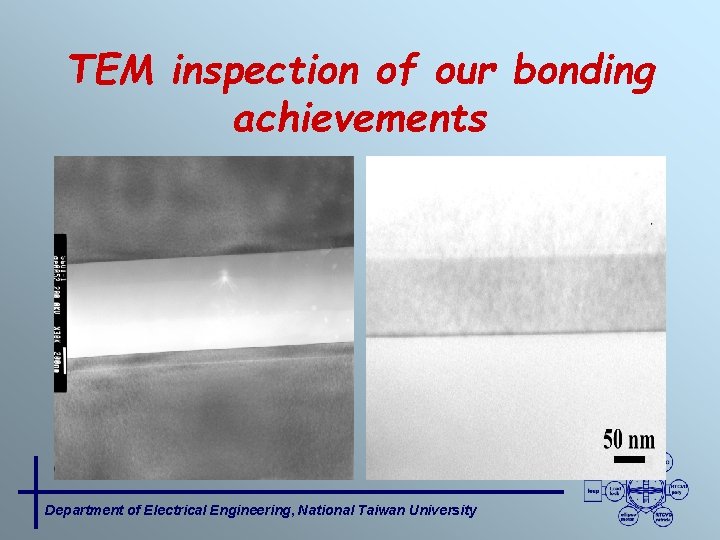
TEM inspection of our bonding achievements Department of Electrical Engineering, National Taiwan University
- Slides: 23