
Novel Study Unit LOST HORIZON Meaning of the









- Slides: 21
Novel Study Unit: LOST HORIZON
Meaning of the Title: Lost Horizon is a reference to a faraway paradise that can be obtained, but is usually lost by those who need it most.
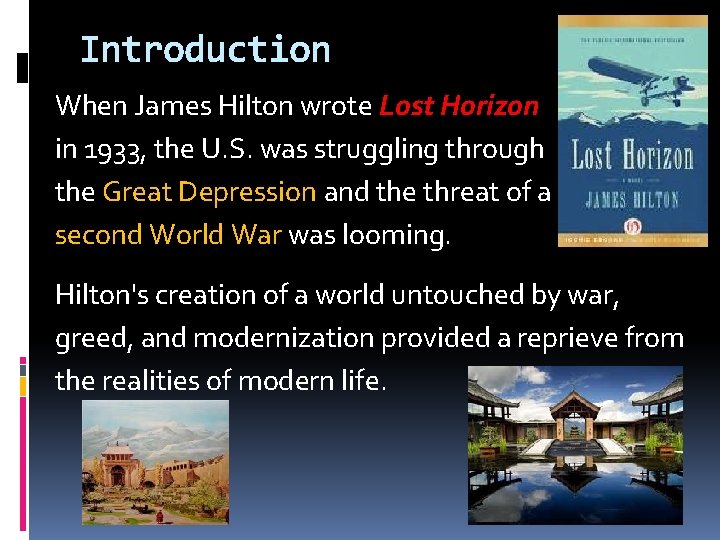
Introduction When James Hilton wrote Lost Horizon in 1933, the U. S. was struggling through the Great Depression and the threat of a second World War was looming. Hilton's creation of a world untouched by war, greed, and modernization provided a reprieve from the realities of modern life.
LITERARY / HISTORICAL INFORMATION The year 1930 was a pivotal one in world history. The Stock Market had crashed in 1929 and the Great Depression had set in. England was losing her empire very rapidly, and there was trouble in Afghanistan which was experiencing Civil War. There was a great deal of unemployment everywhere in the world, and the humiliation Germany faced after WWI was leading to the rise of a little known politician named Adolph Hitler. Times were hard all over the world, and there was great fear that the “War to End All Wars” may have been given that name prematurely.
All of these events were felt to have influenced Hilton’s view of the world as he wrote Lost Horizon. He was almost clairvoyant in how his character of the High Lama predicts a world bent on a path to self destruction. Perhaps, he sincerely hoped that there was a Shangri-La whose purpose was to be the hope of mankind when everything in the doomed outside world fell apart. Shangri-La became widely used in society as a description of a utopia or an isolated land of happiness. President Franklin Roosevelt called the presidential retreat in Maryland Shangri-La, though the name was later changed to Camp David. Later, a Tibetan county in China officially changed its name to Shangri-La because they believe it was an inspiration for the novel.
SETTING The setting of the story is predominately in the countries of Afghanistan and Tibet with emphasis on the mysterious Valley of Blue Moon also known as Shangri-La. The Prologue takes place in Germany and the Epilogue takes place in Delhi, India. The year is 1930, but there are flashbacks to historical times as well.
Shangri-La is a fictional place described in the 1933 novel Lost Horizon by British author James Hilton describes Shangri-La as a mystical, harmonious valley, gently guided from a lamasery, enclosed in the western end of the Kunlun Mountains. Shangri-La has become synonymous with any earthly paradise but particularly a mythical Himalayan utopia — a permanently happy land, isolated from the outside world. In the novel Lost Horizon, the people who live at Shangri-La are almost immortal, living years beyond the normal lifespan and only very slowly aging in appearance.
Shangri-La The word also evokes the imagery of exoticism of the Orient. In the ancient Tibetan scriptures, existence of seven such places is mentioned as Nghe-Beyul Khimpalung. Khembalung is one of several beyuls ("hidden lands" similar to Shangri-La) believed to have been created by Padmasambhava in the 8 th century as idyllic, sacred places of refuge for Buddhists during times of strife (Reinhard 1978). The use of the term Shangri-La is frequently cited as a modern reference to Shambhala, a mythical kingdom in Tibetan Buddhist tradition, which was sought by Eastern and Western explorers.
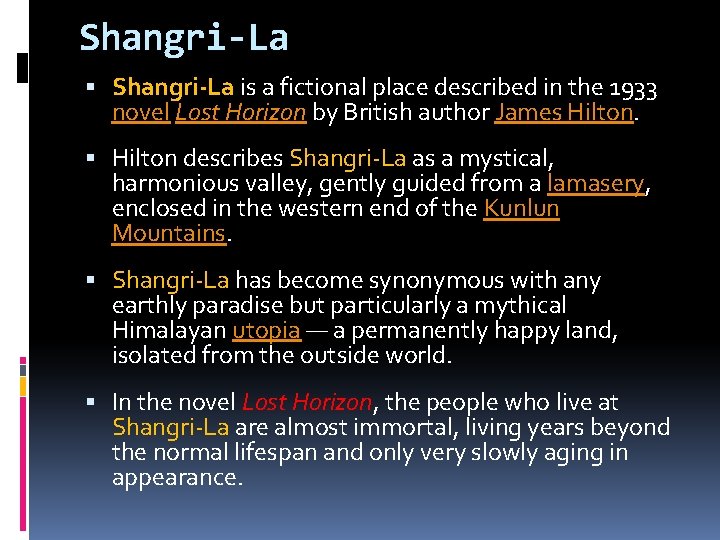
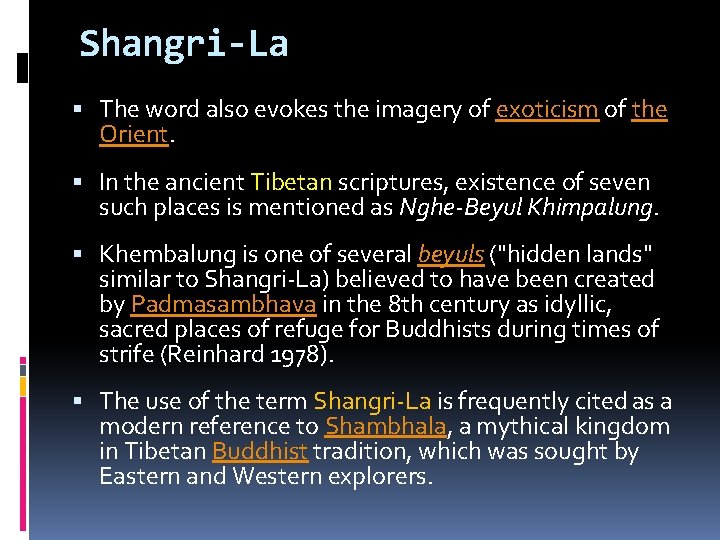
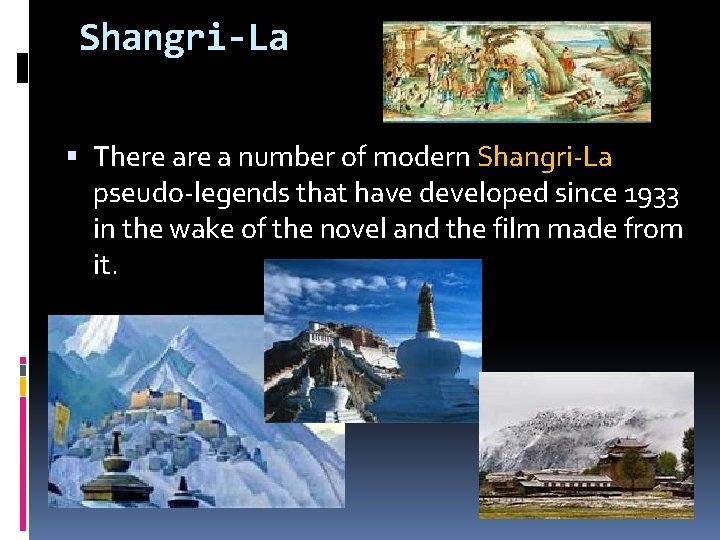
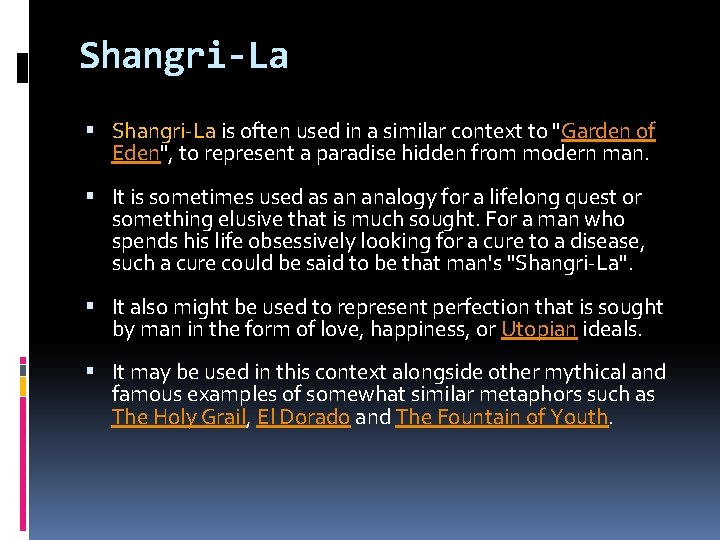
Shangri-La There a number of modern Shangri-La pseudo-legends that have developed since 1933 in the wake of the novel and the film made from it.
Shangri-La • The Nazis had an enthusiasm for Shangri-La, where they hoped to find an ancient master race similar to the Nordic race, unspoiled by Buddhism. They sent one expedition to Tibet, led by Ernst Schäfer in 1938. In 1938, Ernst Schafer purportedly discovered an ancient Buddhist statue in Tibet called the "Iron Man, " carved from a valuable meteorite. His expedition was supported by the Nazis, in particular by Heinrich Himmler, the head of the SS. Himmler was said to believe the Aryan race originated in Tibet and was eager to recover objects from the area. Brought back to Germany, the statue became part of a private collection and disappeared from view until 2007. Further analysis showed that it was a rare ataxite class, a type of meteorite not often found on Earth. The statue is believed to portray the god Vaisravana. Speculation that it belongs to the pre-Buddhist Bon culture that existed in Asia about 1, 000 years ago is increasingly giving way to a consensus that it was most likely created in Europe in the 20 th century. That is carved from material from the chinga meteorite is not in contention.
Shangri-La is often used in a similar context to "Garden of Eden", to represent a paradise hidden from modern man. It is sometimes used as an analogy for a lifelong quest or something elusive that is much sought. For a man who spends his life obsessively looking for a cure to a disease, such a cure could be said to be that man's "Shangri-La". It also might be used to represent perfection that is sought by man in the form of love, happiness, or Utopian ideals. It may be used in this context alongside other mythical and famous examples of somewhat similar metaphors such as The Holy Grail, El Dorado and The Fountain of Youth.
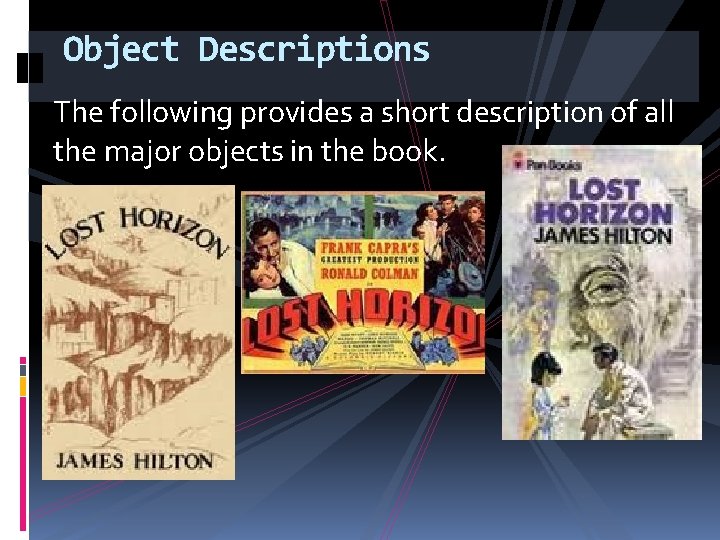
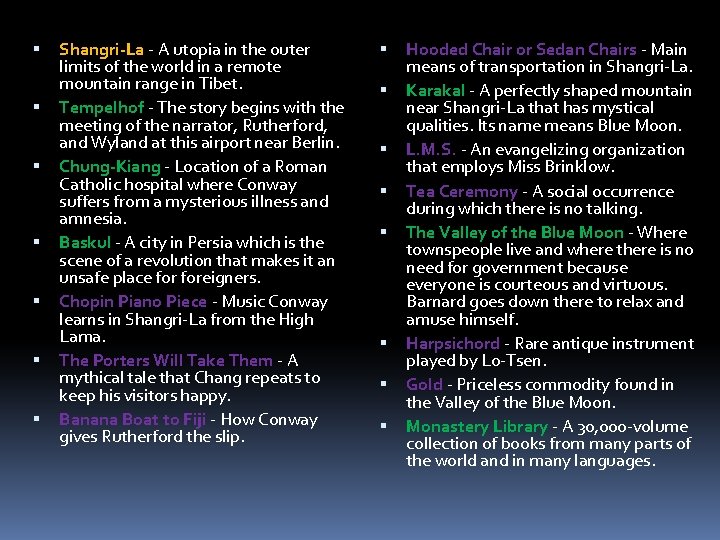
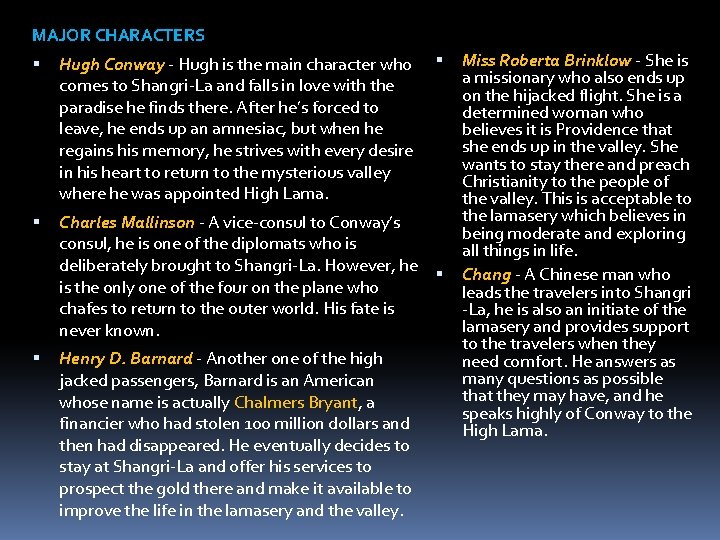
Object Descriptions The following provides a short description of all the major objects in the book.
Shangri-La - A utopia in the outer limits of the world in a remote mountain range in Tibet. Tempelhof - The story begins with the meeting of the narrator, Rutherford, and Wyland at this airport near Berlin. Chung-Kiang - Location of a Roman Catholic hospital where Conway suffers from a mysterious illness and amnesia. Baskul - A city in Persia which is the scene of a revolution that makes it an unsafe place foreigners. Chopin Piano Piece - Music Conway learns in Shangri-La from the High Lama. The Porters Will Take Them - A mythical tale that Chang repeats to keep his visitors happy. Banana Boat to Fiji - How Conway gives Rutherford the slip. Hooded Chair or Sedan Chairs - Main means of transportation in Shangri-La. Karakal - A perfectly shaped mountain near Shangri-La that has mystical qualities. Its name means Blue Moon. L. M. S. - An evangelizing organization that employs Miss Brinklow. Tea Ceremony - A social occurrence during which there is no talking. The Valley of the Blue Moon - Where townspeople live and where there is no need for government because everyone is courteous and virtuous. Barnard goes down there to relax and amuse himself. Harpsichord - Rare antique instrument played by Lo-Tsen. Gold - Priceless commodity found in the Valley of the Blue Moon. Monastery Library - A 30, 000 -volume collection of books from many parts of the world and in many languages.
CHARACTER LIST The following is a list and description of the major and minor characters in the novel.
MAJOR CHARACTERS Hugh Conway - Hugh is the main character who comes to Shangri-La and falls in love with the paradise he finds there. After he’s forced to leave, he ends up an amnesiac, but when he regains his memory, he strives with every desire in his heart to return to the mysterious valley where he was appointed High Lama. Charles Mallinson - A vice-consul to Conway’s consul, he is one of the diplomats who is deliberately brought to Shangri-La. However, he is the only one of the four on the plane who chafes to return to the outer world. His fate is never known. Henry D. Barnard - Another one of the high jacked passengers, Barnard is an American whose name is actually Chalmers Bryant, a financier who had stolen 100 million dollars and then had disappeared. He eventually decides to stay at Shangri-La and offer his services to prospect the gold there and make it available to improve the life in the lamasery and the valley. Miss Roberta Brinklow - She is a missionary who also ends up on the hijacked flight. She is a determined woman who believes it is Providence that she ends up in the valley. She wants to stay there and preach Christianity to the people of the valley. This is acceptable to the lamasery which believes in being moderate and exploring all things in life. Chang - A Chinese man who leads the travelers into Shangri -La, he is also an initiate of the lamasery and provides support to the travelers when they need comfort. He answers as many questions as possible that they may have, and he speaks highly of Conway to the High Lama.
Perrault - He is the French friar who comes to the lamasery in 1719 and is still alive in 1930. He comes to know Conway and believes that he is the successor he has been waiting for. He tells Conway the story of Shangri-La and teaches him many lessons about the purpose of the lamasery, and why the four travelers had been brought there. Lo-Tsen - An upper-class Manchu, Lo. Tsen is seemingly a young girl who is very beautiful and attracts the attentions of all the men around her. She seems to show them little romantic interest and acts content to play piano and be a part of the mystery of Shangri-La. Later, however, she falls in love with Mallinson and loses her youth when she follows him out of the valley. MINOR CHARACTERS Rutherford - A novelist who is a friend of the narrator, he is the first to hear Conway’s story and writes it down after listening to Conway for twenty-four straight hours. He later goes in search of the man when he once again disappears. The Narrator - This character, a neurologist, remains nameless, but ties the plot together by reading the manuscript Rutherford had written to tell Conway’s story.