
Novel Si Ge Processes for Electrostatically Actuated MEMS
- Slides: 11
Novel Si. Ge Processes for Electrostatically Actuated MEMS Resonators Carrie W. Low Roger T. Howe Tsu-Jae King RTH 35 Industrial Advisory Board Meeting September 2005 © 2005 University of California Prepublication Data Fall 2005
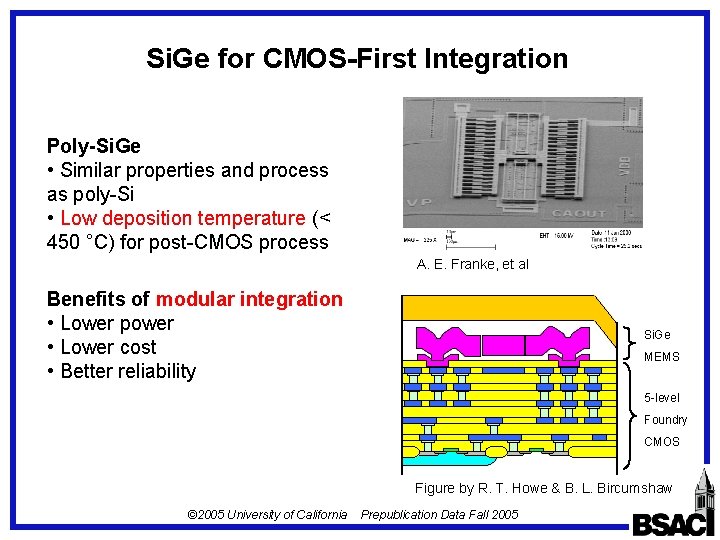
Si. Ge for CMOS-First Integration Poly-Si. Ge • Similar properties and process as poly-Si • Low deposition temperature (< 450 °C) for post-CMOS process A. E. Franke, et al Benefits of modular integration • Lower power • Lower cost • Better reliability Si. Ge MEMS 5 -level Foundry CMOS Figure by R. T. Howe & B. L. Bircumshaw © 2005 University of California Prepublication Data Fall 2005
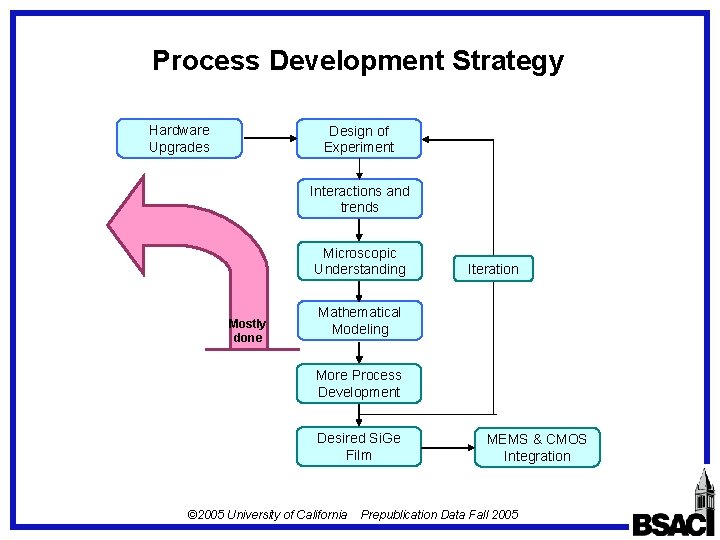
Process Development Strategy Hardware Upgrades Design of Experiment Interactions and trends Microscopic Understanding Mostly done Iteration Mathematical Modeling More Process Development Desired Si. Ge Film © 2005 University of California MEMS & CMOS Integration Prepublication Data Fall 2005
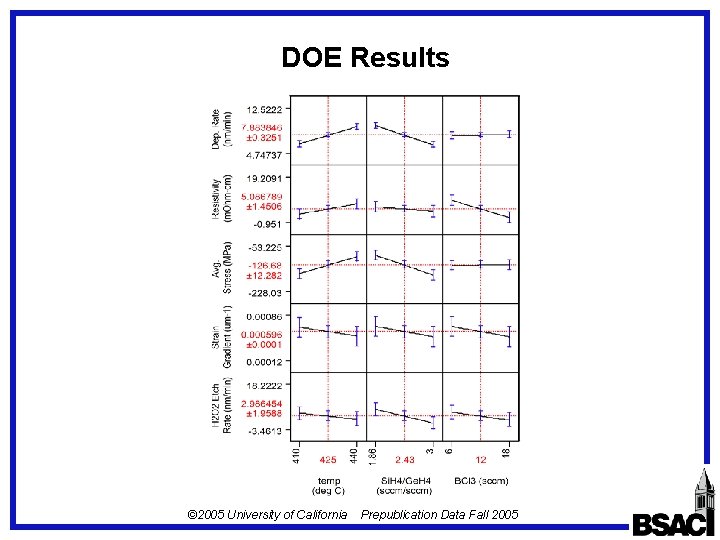
DOE Results © 2005 University of California Prepublication Data Fall 2005
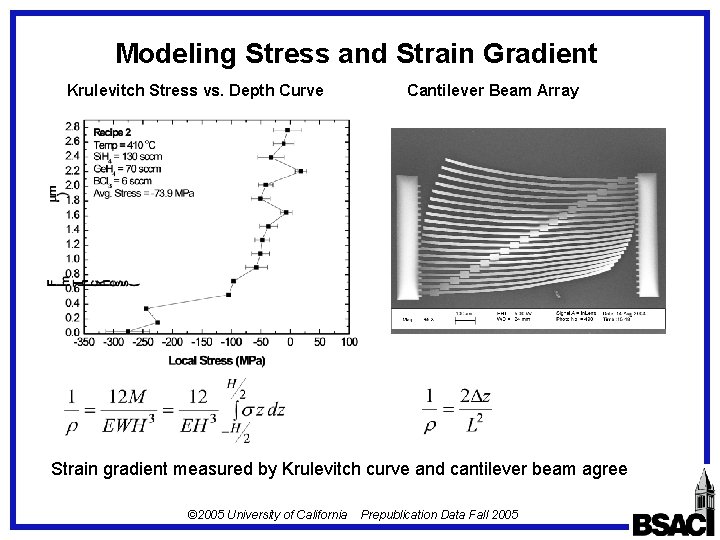
Modeling Stress and Strain Gradient Krulevitch Stress vs. Depth Curve Cantilever Beam Array Strain gradient measured by Krulevitch curve and cantilever beam agree © 2005 University of California Prepublication Data Fall 2005
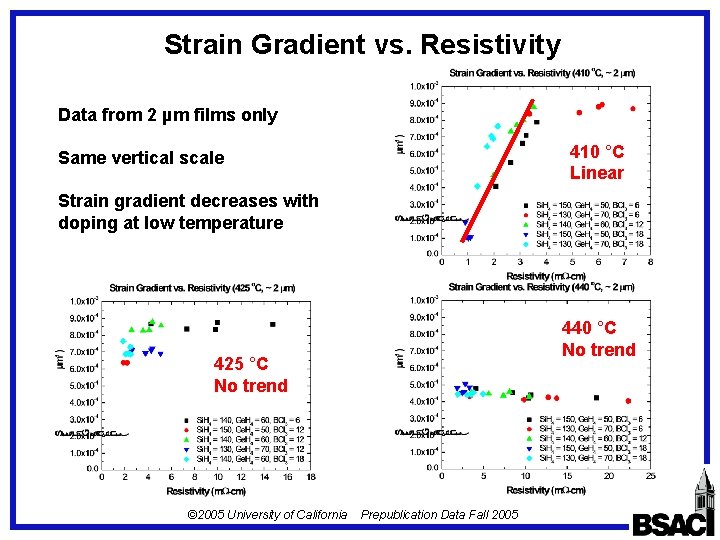
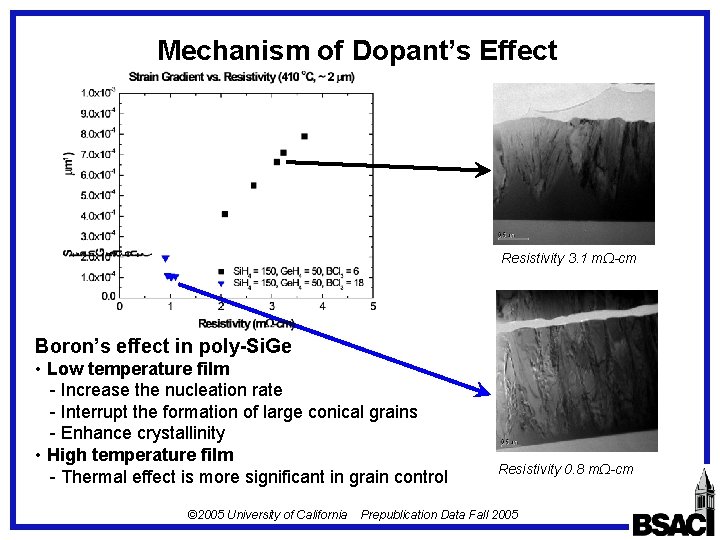
Strain Gradient vs. Resistivity Data from 2 µm films only 410 °C Linear Same vertical scale Strain gradient decreases with doping at low temperature 440 °C No trend 425 °C No trend © 2005 University of California Prepublication Data Fall 2005
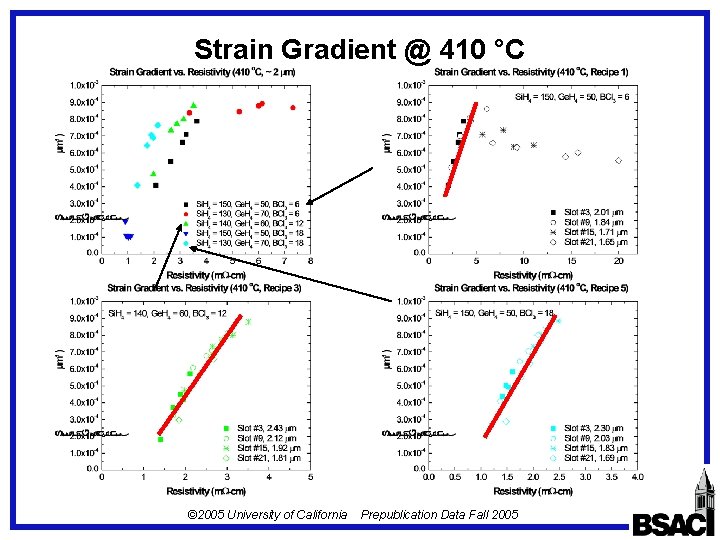
Strain Gradient @ 410 °C © 2005 University of California Prepublication Data Fall 2005
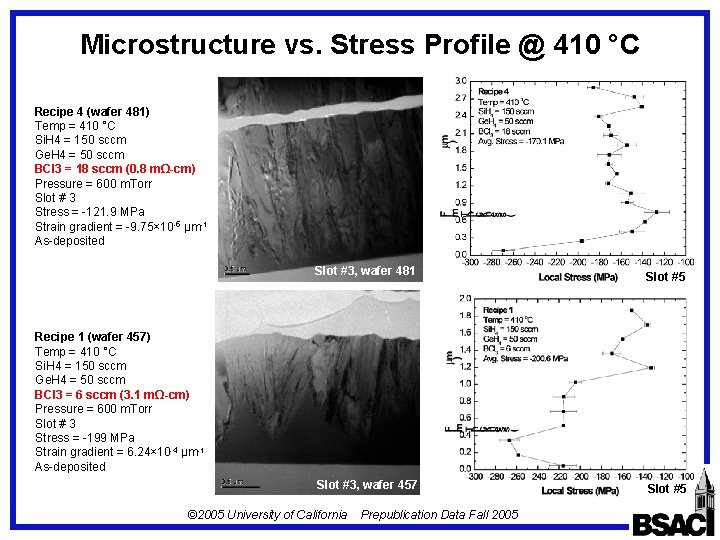
Microstructure vs. Stress Profile @ 410 °C Recipe 4 (wafer 481) Temp = 410 °C Si. H 4 = 150 sccm Ge. H 4 = 50 sccm BCl 3 = 18 sccm (0. 8 mΩ-cm) Pressure = 600 m. Torr Slot # 3 Stress = -121. 9 MPa Strain gradient = -9. 75× 10 -5 µm-1 As-deposited Slot #3, wafer 481 Slot #5 Slot #3, wafer 457 Slot #5 Recipe 1 (wafer 457) Temp = 410 °C Si. H 4 = 150 sccm Ge. H 4 = 50 sccm BCl 3 = 6 sccm (3. 1 mΩ-cm) Pressure = 600 m. Torr Slot # 3 Stress = -199 MPa Strain gradient = 6. 24× 10 -4 µm-1 As-deposited © 2005 University of California Prepublication Data Fall 2005
Mechanism of Dopant’s Effect Resistivity 3. 1 mΩ-cm Boron’s effect in poly-Si. Ge • Low temperature film - Increase the nucleation rate - Interrupt the formation of large conical grains - Enhance crystallinity • High temperature film - Thermal effect is more significant in grain control © 2005 University of California Resistivity 0. 8 mΩ-cm Prepublication Data Fall 2005
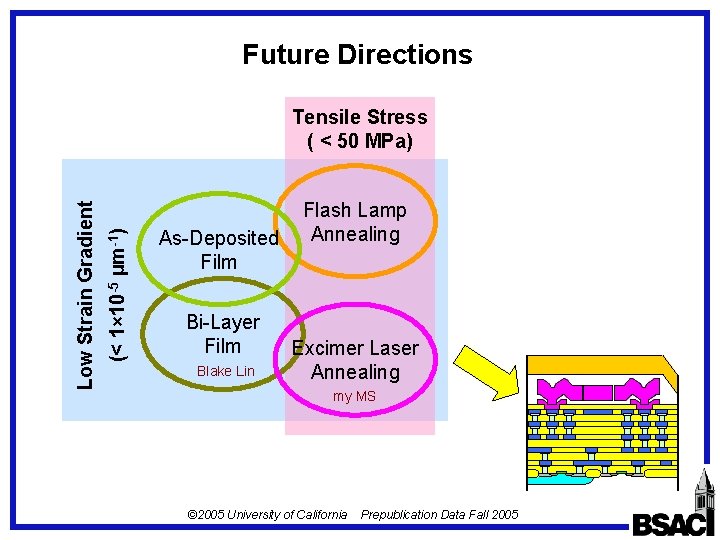
Future Directions (< 1× 10 -5 µm-1) Low Strain Gradient Tensile Stress ( < 50 MPa) As-Deposited Film Bi-Layer Film Blake Lin Flash Lamp Annealing Excimer Laser Annealing my MS © 2005 University of California Prepublication Data Fall 2005
Conclusions • Si. Ge reactor has been significantly improved • BCl 3 -doped Si. Ge process is well characterized • Desired film properties could be achieved in multiple directions • Collaboration with industry for a real push towards an integrated process © 2005 University of California Prepublication Data Fall 2005