
Novel Influenza Vaccines Fusion of HA with bacterial
Novel Influenza Vaccines: Fusion of HA with bacterial flagellin drives strong HAI titers and allows for efficient bacterial expression Scott Umlauf, Ph. D. Senior Director, Product Development Flu-2015 June 8, 2015 CONFIDENTIAL 1
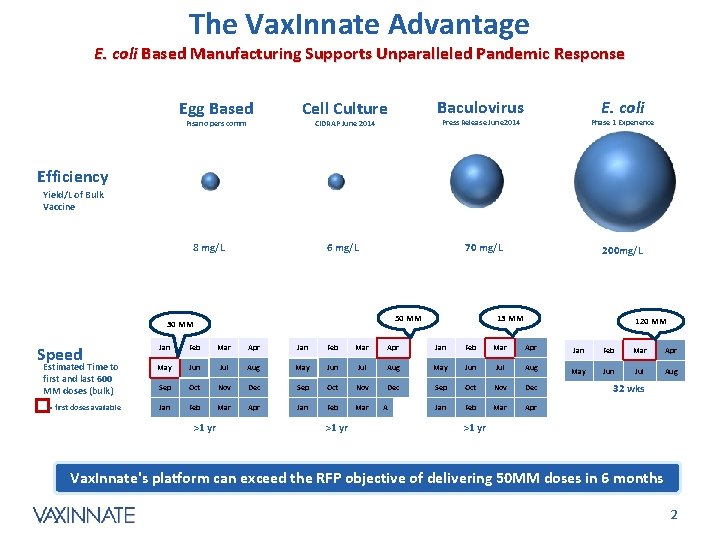
The Vax. Innate Advantage E. coli Based Manufacturing Supports Unparalleled Pandemic Response Egg Based Pisano pers comm Cell Culture Baculovirus 6 mg/L 70 mg/L E. coli Phase 1 Experience Press Release June 2014 CIDRAP June 2014 Efficiency Yield/L of Bulk Vaccine 8 mg/L 50 MM 30 MM Speed 200 mg/L 13 MM 120 MM Jan Feb Mar Apr Estimated Time to first and last 600 MM doses (bulk) May Jun Jul Aug Sep Oct Nov Dec = first doses available Jan Feb Mar Apr >1 yr A 32 wks >1 yr Vax. Innate's platform can exceed the RFP objective of delivering 50 MM doses in 6 months CONFIDENTIAL 2
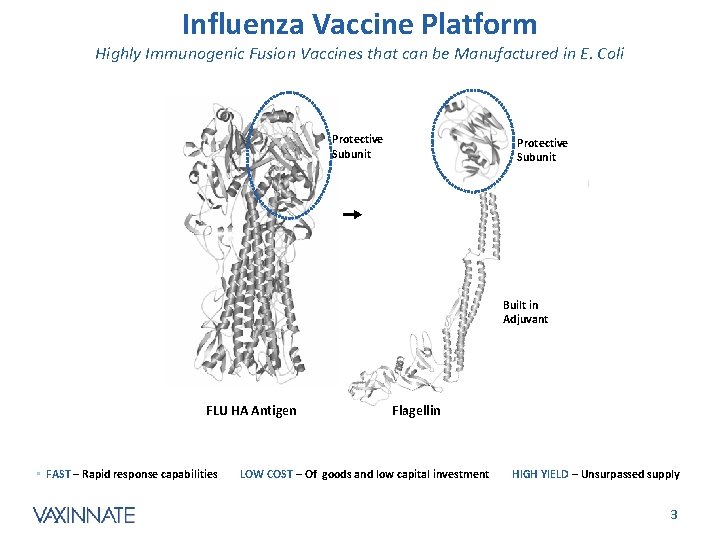
Influenza Vaccine Platform Highly Immunogenic Fusion Vaccines that can be Manufactured in E. Coli Protective Subunit Built in Adjuvant FLU HA Antigen • FAST – Rapid response capabilities Flagellin LOW COST – Of goods and low capital investment HIGH YIELD – Unsurpassed supply CONFIDENTIAL 3
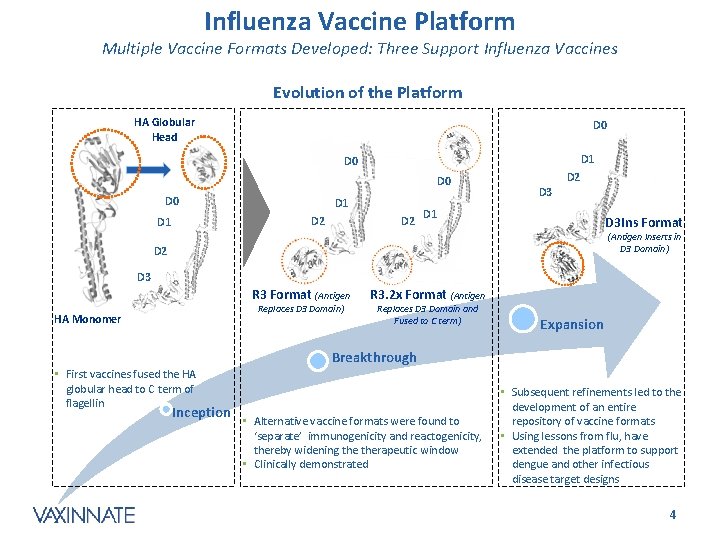
Influenza Vaccine Platform Multiple Vaccine Formats Developed: Three Support Influenza Vaccines Evolution of the Platform HA Globular Head D 0 D 1 D 0 D 0 D 1 D 2 D 3 D 2 D 1 D 3 Ins Format (Antigen Inserts in D 3 Domain) D 2 D 3 R 3 Format (Antigen Replaces D 3 Domain) HA Monomer R 3. 2 x Format (Antigen Replaces D 3 Domain and Fused to C term) Expansion Breakthrough • First vaccines fused the HA globular head to C term of flagellin Inception • Alternative vaccine formats were found to ‘separate’ immunogenicity and reactogenicity, thereby widening therapeutic window • Clinically demonstrated • Subsequent refinements led to the development of an entire repository of vaccine formats • Using lessons from flu, have extended the platform to support dengue and other infectious disease target designs CONFIDENTIAL 4
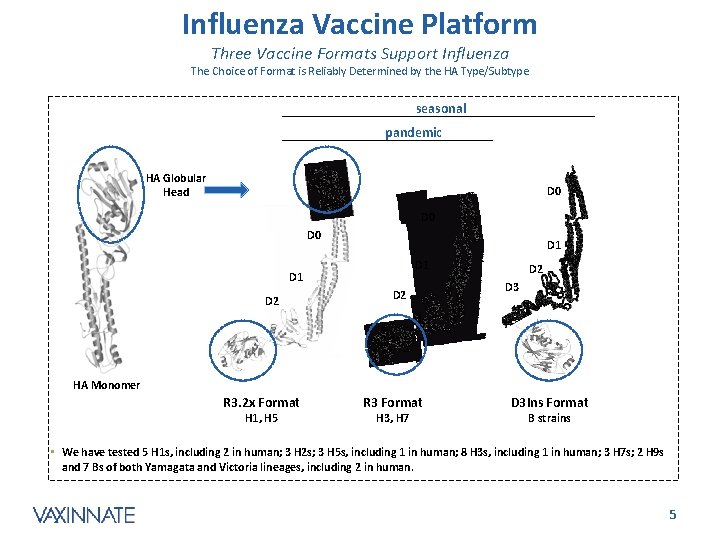
Influenza Vaccine Platform Three Vaccine Formats Support Influenza The Choice of Format is Reliably Determined by the HA Type/Subtype seasonal pandemic HA Globular Head D 0 D 0 D 1 D 1 D 2 D 2 D 3 HA Monomer R 3. 2 x Format H 1, H 5 R 3 Format H 3, H 7 D 3 Ins Format B strains • We have tested 5 H 1 s, including 2 in human; 3 H 2 s; 3 H 5 s, including 1 in human; 8 H 3 s, including 1 in human; 3 H 7 s; 2 H 9 s and 7 Bs of both Yamagata and Victoria lineages, including 2 in human. CONFIDENTIAL 5
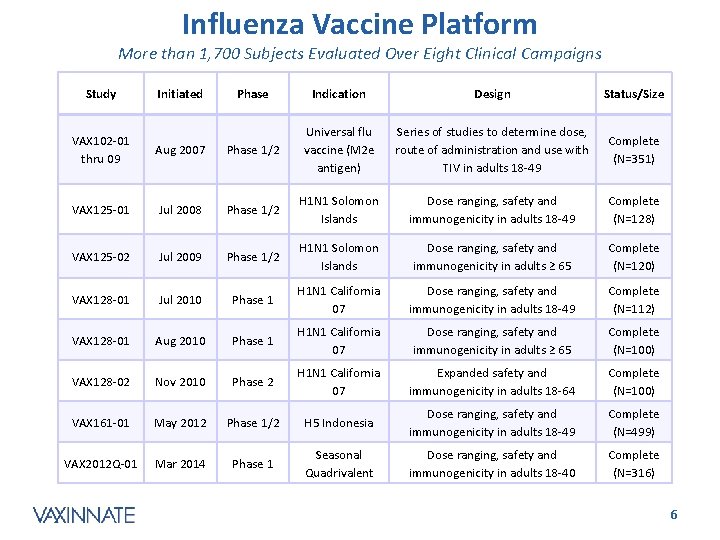
Influenza Vaccine Platform More than 1, 700 Subjects Evaluated Over Eight Clinical Campaigns Study Initiated Phase Indication Design Status/Size Series of studies to determine dose, route of administration and use with TIV in adults 18 -49 Complete (N=351) VAX 102 -01 thru 09 Aug 2007 Phase 1/2 Universal flu vaccine (M 2 e antigen) VAX 125 -01 Jul 2008 Phase 1/2 H 1 N 1 Solomon Islands Dose ranging, safety and immunogenicity in adults 18 -49 Complete (N=128) VAX 125 -02 Jul 2009 Phase 1/2 H 1 N 1 Solomon Islands Dose ranging, safety and immunogenicity in adults ≥ 65 Complete (N=120) VAX 128 -01 Jul 2010 Phase 1 H 1 N 1 California 07 Dose ranging, safety and immunogenicity in adults 18 -49 Complete (N=112) VAX 128 -01 Aug 2010 Phase 1 H 1 N 1 California 07 Dose ranging, safety and immunogenicity in adults ≥ 65 Complete (N=100) VAX 128 -02 Nov 2010 Phase 2 H 1 N 1 California 07 Expanded safety and immunogenicity in adults 18 -64 Complete (N=100) VAX 161 -01 May 2012 Phase 1/2 H 5 Indonesia Dose ranging, safety and immunogenicity in adults 18 -49 Complete (N=499) VAX 2012 Q-01 Mar 2014 Phase 1 Seasonal Quadrivalent Dose ranging, safety and immunogenicity in adults 18 -40 Complete (N=316) CONFIDENTIAL 6
Clinical Rationale for Format and Dose Selection CONFIDENTIAL 7
Influenza Vaccine Platform Key Observations from the VAX 102 Program • Vax. Innate's first clinical experience was based on the conserved influenza antigen, M 2 • The vaccine utilized the ‘C term’ format. Four copies of the M 2 ectodomain were fused to the C terminus of flagellin to form STF 2. 4 x. M 2 e, VAX 102 • This initial Phase I study was designed as a dose escalating study with dose groups of 10, 33 and 100 mg • Mid-way into the 10 mg dose group a small number of subjects presented with a cluster of symptoms that were consistent with a pro-inflammatory response due to innate immune stimulation • Fever, aches, nausea and chills were among systemic symptoms reported; there was a rapid onset of these symptoms • Symptoms were related to rises in the acute phase reactant CRP (regulated by IL 6) • Lower doses were equally immunogenic but well tolerated. • Immunogenicity and reactogenicity therefore were ‘separable’ in that there is a dose window that is immunogenic but not reactogenic CONFIDENTIAL 8
Influenza Vaccine Platform Models for Optimizing the Therapeutic Window • A rabbit model of reactogenicity was established in which the following measures were evaluated in the first 24 hr post immunization: Ø food consumption Ø Temperature Ø CRP: C reactive protein • The goal was to use changes in these measures to help establish the dose range for evaluation in the clinic • The model was consistent with the observed therapeutic window for VAX 102, suggesting that it could be used to guide initial clinical dose selection A rabbit model for predicting therapeutic window was established CONFIDENTIAL 9
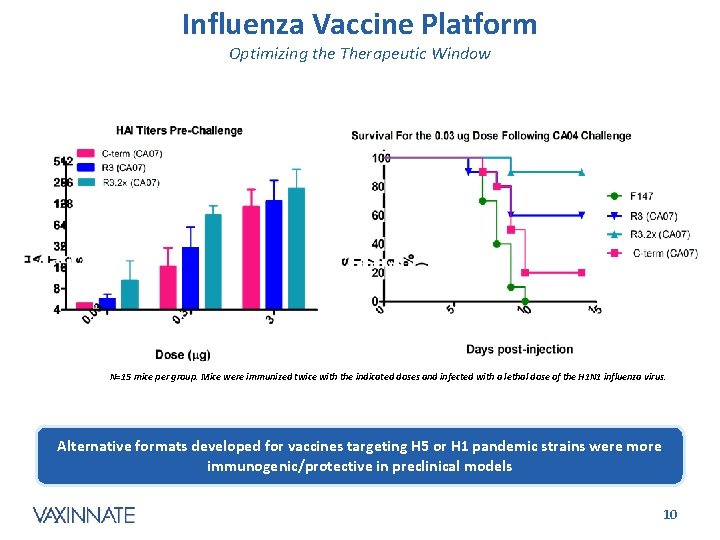
Influenza Vaccine Platform Optimizing the Therapeutic Window N=15 mice per group. Mice were immunized twice with the indicated doses and infected with a lethal dose of the H 1 N 1 influenza virus. Alternative formats developed for vaccines targeting H 5 or H 1 pandemic strains were more immunogenic/protective in preclinical models CONFIDENTIAL 10
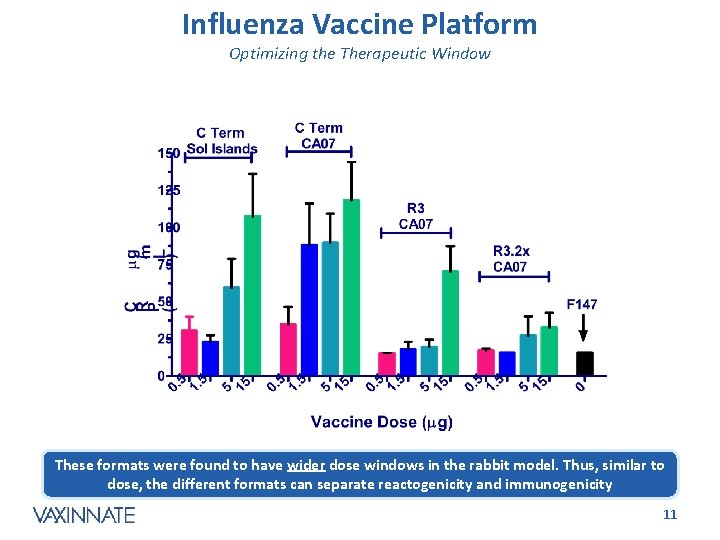
Influenza Vaccine Platform Optimizing the Therapeutic Window These formats were found to have wider dose windows in the rabbit model. Thus, similar to dose, the different formats can separate reactogenicity and immunogenicity CONFIDENTIAL 11
VAX 128 -01 A Phase I Study to Evaluate the Safety and Immunogenicity of the Different Formats of VAX 128 in Healthy Adults 18 -49 Years of Age and in Community Living Adults ≥ 65 Years of Age Study Design • • • Dose escalation study (adaptive, 3 subjects per group initially with a max of 12) Compares general tolerability and immunogenicity of VAX 128 A (C term), VAX 128 B (R 3) and VAX 128 C (R 3. 2 x) constructs Age groups 18 -49 years and >65 years evaluated Vaccine dose was formulated at the clinical site All doses given in 0. 5 ml IM Vaccine buffer used as control Safety recorded for first 7 days by clinic visit and diary Serum specimen for CRP 24 hrs post-vaccination Immune response (HAI) measured on day 0, 7, 14 and 28 Long term follow up at 6 months and one year VAX 128 targets the A/California/07/2009 H 1 strain CONFIDENTIAL 12
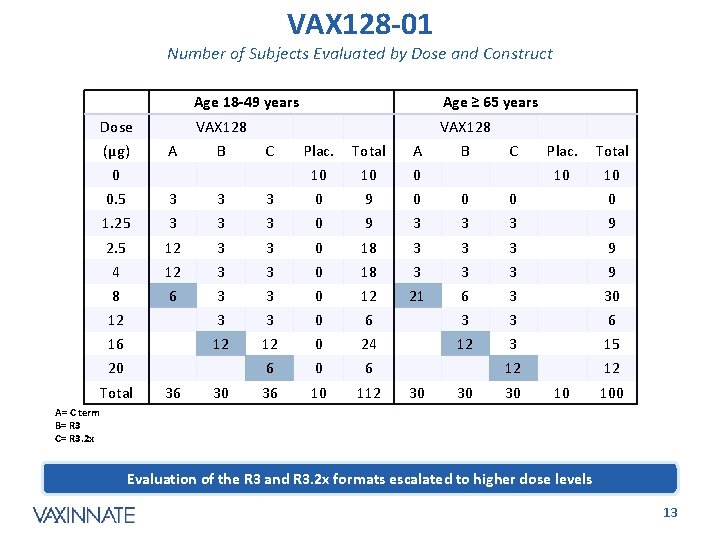
VAX 128 -01 Number of Subjects Evaluated by Dose and Construct Dose (µg) A Age 18 -49 years Age ≥ 65 years VAX 128 B C 0 Plac. Total A 10 10 0 B C Plac. Total 10 10 0. 5 3 3 3 0 9 0 0 1. 25 3 3 3 0 9 3 3 3 9 2. 5 12 3 3 0 18 3 3 3 9 4 12 3 3 0 18 3 3 3 9 8 6 3 3 0 12 21 6 3 30 12 3 3 0 6 3 3 6 16 12 12 0 24 12 3 15 6 0 6 12 12 36 10 112 20 Total 36 30 30 10 100 A= C term B= R 3 C= R 3. 2 x Evaluation of the R 3 and R 3. 2 x formats escalated to higher dose levels CONFIDENTIAL 13
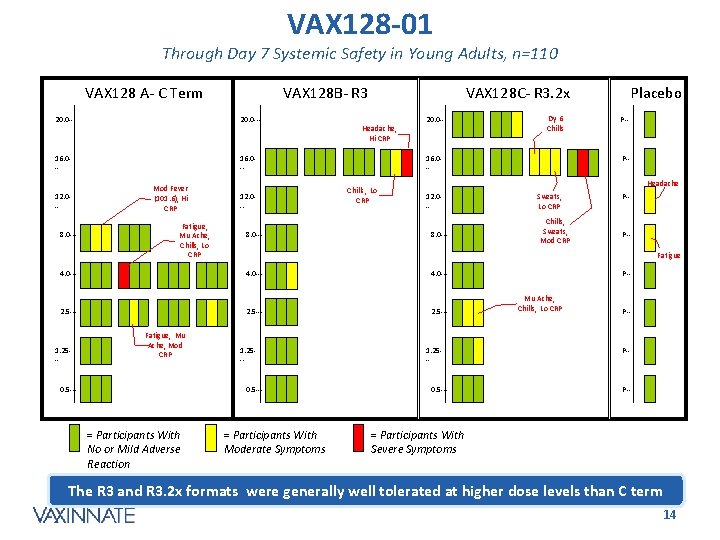
VAX 128 -01 Through Day 7 Systemic Safety in Young Adults, n=110 VAX 128 A- C Term VAX 128 B- R 3 20. 0 --- 16. 0 -- 12. 0 -8. 0 --- Mod Fever (101. 6), Hi CRP Fatigue, Mu Ache, Chills, Lo CRP 12. 0 -8. 0 --- VAX 128 C- R 3. 2 x Headache, Hi CRP 20. 0 --- 16. 0 -Chills, Lo CRP 8. 0 --- 4. 0 --- 2. 5 --- 0. 5 --- 1. 25 -- 0. 5 --- = Participants With No or Mild Adverse Reaction P-- Sweats, Lo CRP Chills, Sweats, Mod CRP P-- P-Fatigue 4. 0 --- 1. 25 -- P-- Headache 12. 0 -- 4. 0 --- Fatigue, Mu Ache, Mod CRP Dy 6 Chills Placebo = Participants With Moderate Symptoms 1. 25 -- 0. 5 --- P-Mu Ache, Chills, Lo CRP P-- P-- = Participants With Severe Symptoms The R 3 and R 3. 2 x formats were generally well tolerated at higher dose levels than C term CONFIDENTIAL 14
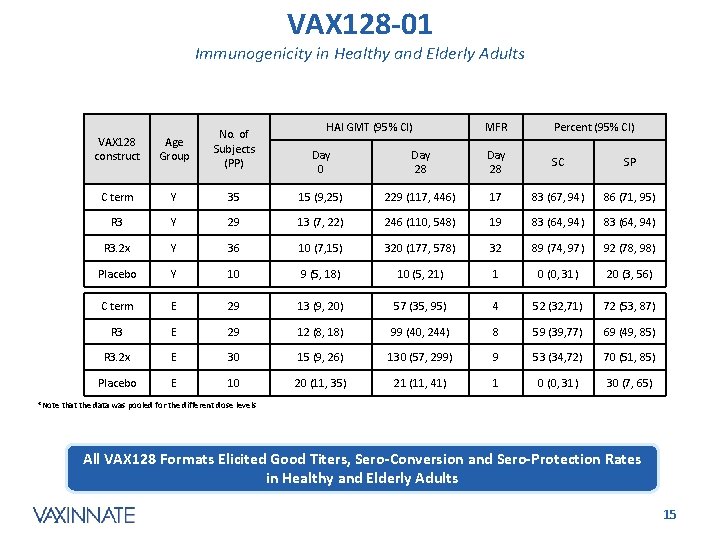
VAX 128 -01 Immunogenicity in Healthy and Elderly Adults HAI GMT (95% CI) MFR Percent (95% CI) Day 28 SC SP VAX 128 construct Age Group No. of Subjects (PP) C term Y 35 15 (9, 25) 229 (117, 446) 17 83 (67, 94) 86 (71, 95) R 3 Y 29 13 (7, 22) 246 (110, 548) 19 83 (64, 94) R 3. 2 x Y 36 10 (7, 15) 320 (177, 578) 32 89 (74, 97) 92 (78, 98) Placebo Y 10 9 (5, 18) 10 (5, 21) 1 0 (0, 31) 20 (3, 56) C term E 29 13 (9, 20) 57 (35, 95) 4 52 (32, 71) 72 (53, 87) R 3 E 29 12 (8, 18) 99 (40, 244) 8 59 (39, 77) 69 (49, 85) R 3. 2 x E 30 15 (9, 26) 130 (57, 299) 9 53 (34, 72) 70 (51, 85) Placebo E 10 20 (11, 35) 21 (11, 41) 1 0 (0, 31) 30 (7, 65) Day 0 *Note that the data was pooled for the different dose levels All VAX 128 Formats Elicited Good Titers, Sero-Conversion and Sero-Protection Rates in Healthy and Elderly Adults CONFIDENTIAL 15
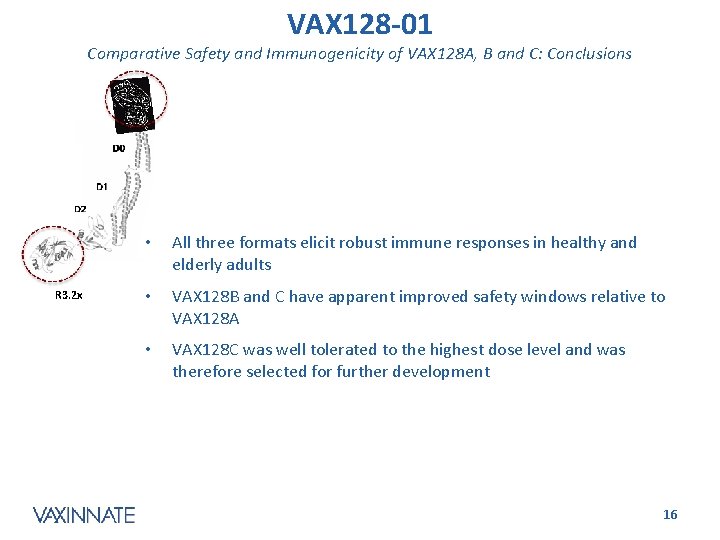
VAX 128 -01 Comparative Safety and Immunogenicity of VAX 128 A, B and C: Conclusions R 3. 2 x • All three formats elicit robust immune responses in healthy and elderly adults • VAX 128 B and C have apparent improved safety windows relative to VAX 128 A • VAX 128 C was well tolerated to the highest dose level and was therefore selected for further development CONFIDENTIAL 16
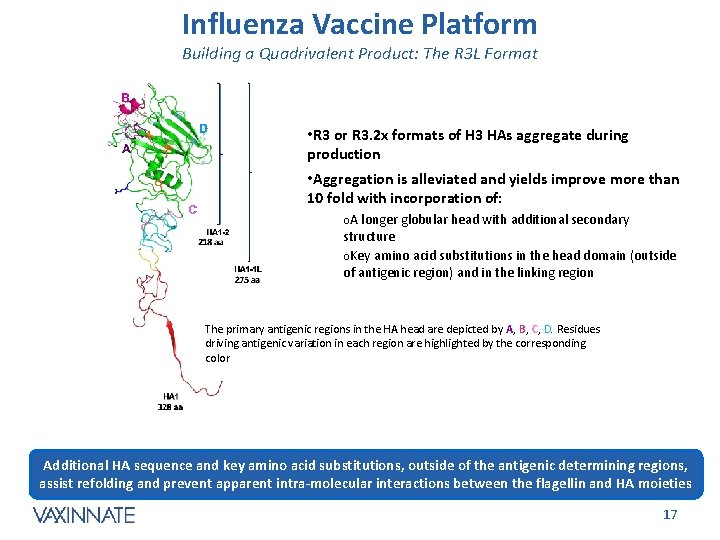
Influenza Vaccine Platform Building a Quadrivalent Product: The R 3 L Format • R 3 or R 3. 2 x formats of H 3 HAs aggregate during production • Aggregation is alleviated and yields improve more than 10 fold with incorporation of: o. A longer globular head with additional secondary structure o. Key amino acid substitutions in the head domain (outside of antigenic region) and in the linking region The primary antigenic regions in the HA head are depicted by A, B, C, D. Residues driving antigenic variation in each region are highlighted by the corresponding color Additional HA sequence and key amino acid substitutions, outside of the antigenic determining regions, assist refolding and prevent apparent intra-molecular interactions between the flagellin and HA moieties CONFIDENTIAL 17
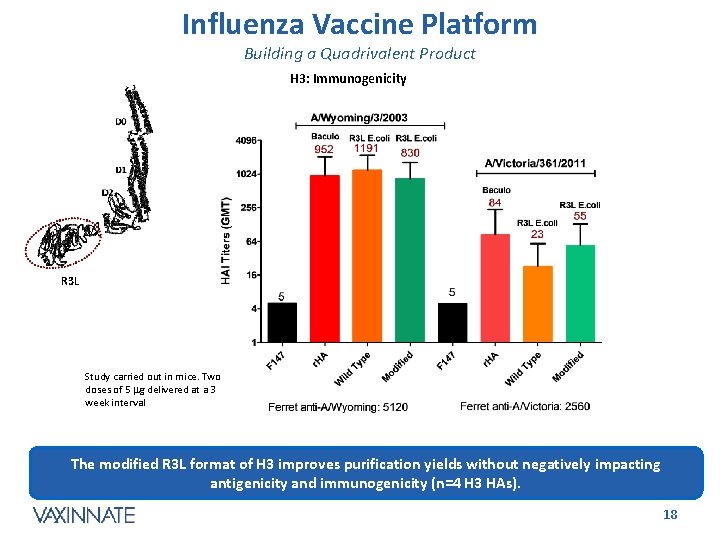
Influenza Vaccine Platform Building a Quadrivalent Product H 3: Immunogenicity R 3 L Study carried out in mice. Two doses of 5 mg delivered at a 3 week interval The modified R 3 L format of H 3 improves purification yields without negatively impacting antigenicity and immunogenicity (n=4 H 3 HAs). CONFIDENTIAL 18
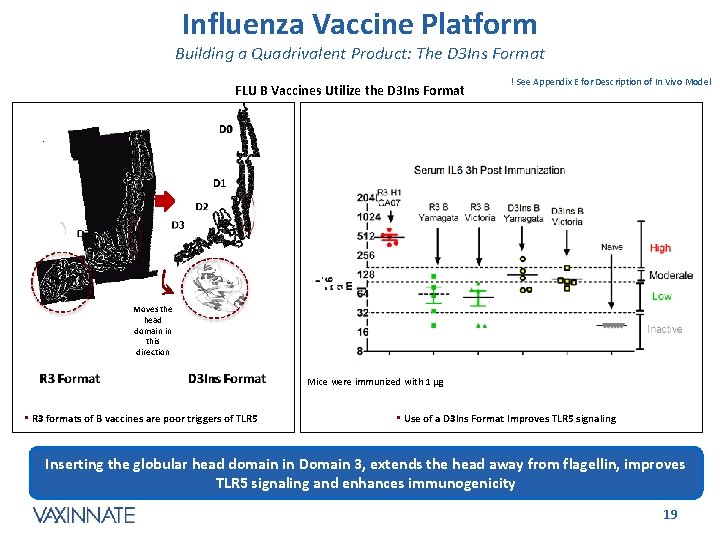
Influenza Vaccine Platform Building a Quadrivalent Product: The D 3 Ins Format FLU B Vaccines Utilize the D 3 Ins Format ! See Appendix E for Description of In Vivo Model Moves the head domain in this direction Mice were immunized with 1 mg • R 3 formats of B vaccines are poor triggers of TLR 5 • Use of a D 3 Ins Format Improves TLR 5 signaling Inserting the globular head domain in Domain 3, extends the head away from flagellin, improves TLR 5 signaling and enhances immunogenicity CONFIDENTIAL 19
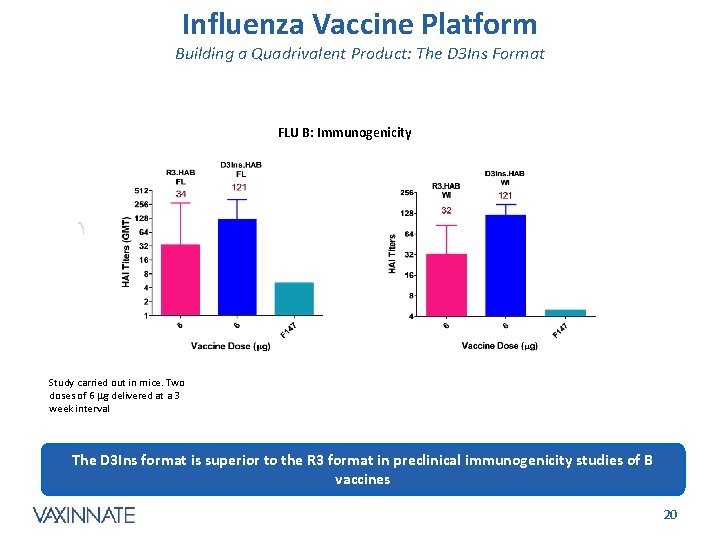
Influenza Vaccine Platform Building a Quadrivalent Product: The D 3 Ins Format FLU B: Immunogenicity Study carried out in mice. Two doses of 6 mg delivered at a 3 week interval The D 3 Ins format is superior to the R 3 format in preclinical immunogenicity studies of B vaccines CONFIDENTIAL 20
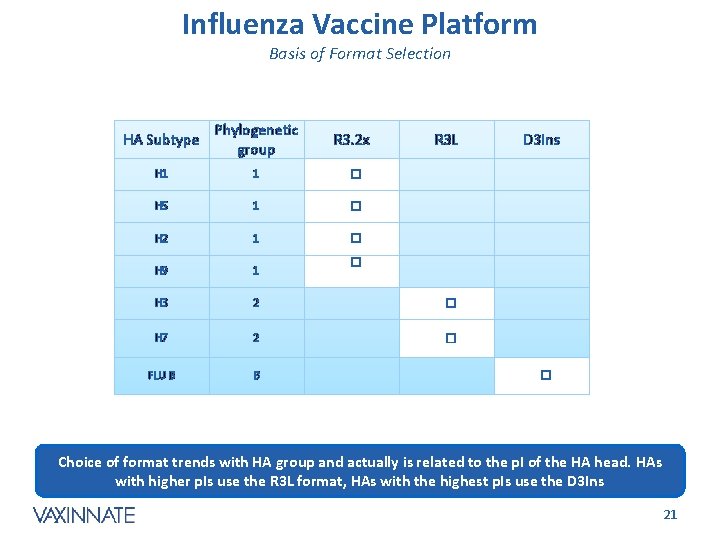
Influenza Vaccine Platform Basis of Format Selection HA Subtype Phylogenetic group H 1 1 � H 5 1 � H 2 1 � H 9 1 H 3 2 � H 7 2 � FLU B B R 3. 2 x R 3 L D 3 Ins � � Choice of format trends with HA group and actually is related to the p. I of the HA head. HAs with higher p. Is use the R 3 L format, HAs with the highest p. Is use the D 3 Ins CONFIDENTIAL 21
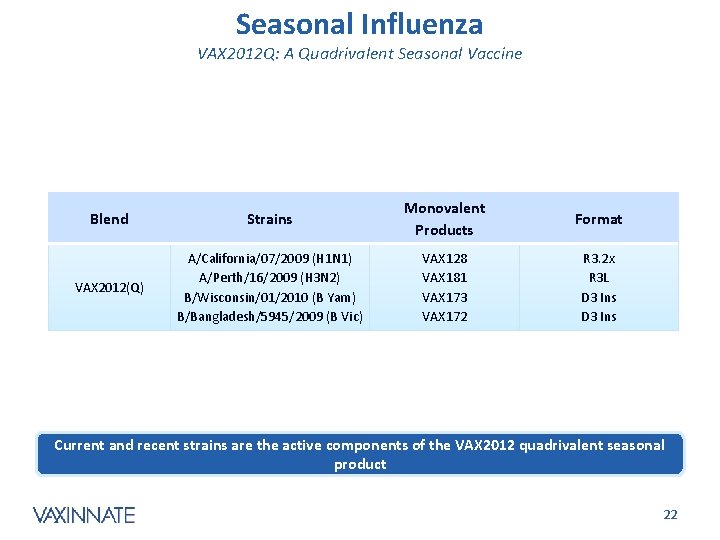
Seasonal Influenza VAX 2012 Q: A Quadrivalent Seasonal Vaccine Blend Strains Monovalent Products Format VAX 2012(Q) A/California/07/2009 (H 1 N 1) A/Perth/16/2009 (H 3 N 2) B/Wisconsin/01/2010 (B Yam) B/Bangladesh/5945/2009 (B Vic) VAX 128 VAX 181 VAX 173 VAX 172 R 3. 2 x R 3 L D 3 Ins Current and recent strains are the active components of the VAX 2012 quadrivalent seasonal product CONFIDENTIAL 22
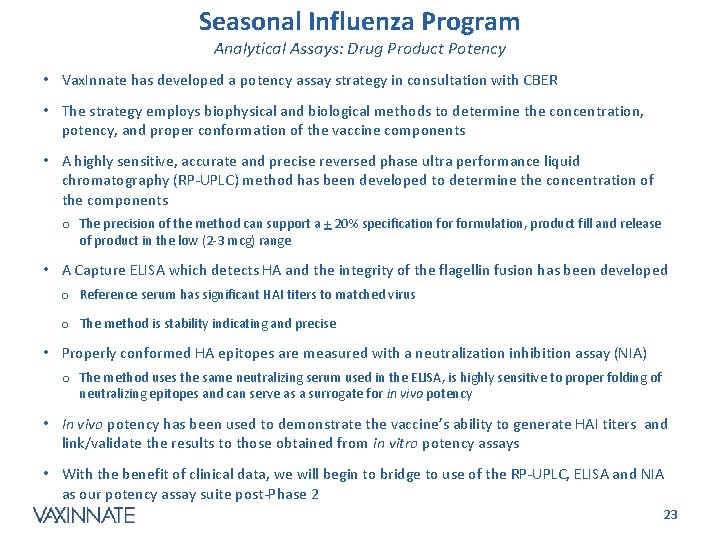
Seasonal Influenza Program Analytical Assays: Drug Product Potency • Vax. Innate has developed a potency assay strategy in consultation with CBER • The strategy employs biophysical and biological methods to determine the concentration, potency, and proper conformation of the vaccine components • A highly sensitive, accurate and precise reversed phase ultra performance liquid chromatography (RP-UPLC) method has been developed to determine the concentration of the components o The precision of the method can support a + 20% specification formulation, product fill and release of product in the low (2 -3 mcg) range • A Capture ELISA which detects HA and the integrity of the flagellin fusion has been developed o Reference serum has significant HAI titers to matched virus o The method is stability indicating and precise • Properly conformed HA epitopes are measured with a neutralization inhibition assay (NIA) o The method uses the same neutralizing serum used in the ELISA, is highly sensitive to proper folding of neutralizing epitopes and can serve as a surrogate for in vivo potency • In vivo potency has been used to demonstrate the vaccine’s ability to generate HAI titers and link/validate the results to those obtained from in vitro potency assays • With the benefit of clinical data, we will begin to bridge to use of the RP-UPLC, ELISA and NIA as our potency assay suite post-Phase 2 CONFIDENTIAL 23
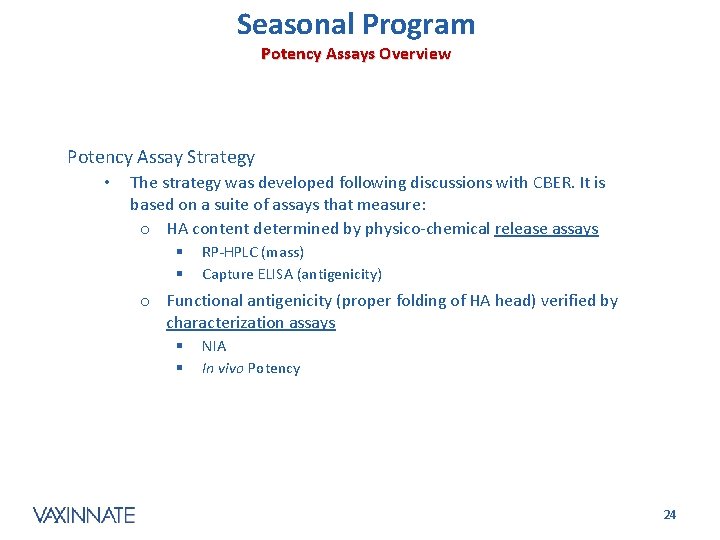
Seasonal Program Potency Assays Overview Potency Assay Strategy • The strategy was developed following discussions with CBER. It is based on a suite of assays that measure: o HA content determined by physico-chemical release assays § § RP-HPLC (mass) Capture ELISA (antigenicity) o Functional antigenicity (proper folding of HA head) verified by characterization assays § § NIA In vivo Potency CONFIDENTIAL 24
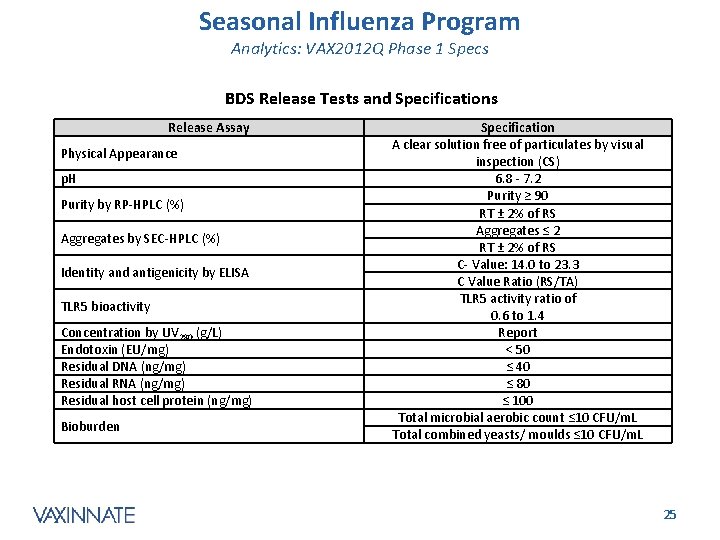
Seasonal Influenza Program Analytics: VAX 2012 Q Phase 1 Specs BDS Release Tests and Specifications Release Assay Physical Appearance p. H Purity by RP-HPLC (%) Aggregates by SEC-HPLC (%) Identity and antigenicity by ELISA TLR 5 bioactivity Concentration by UV 280 (g/L) Endotoxin (EU/mg) Residual DNA (ng/mg) Residual RNA (ng/mg) Residual host cell protein (ng/mg) Bioburden Specification A clear solution free of particulates by visual inspection (CS) 6. 8 - 7. 2 Purity ≥ 90 RT ± 2% of RS Aggregates ≤ 2 RT ± 2% of RS C- Value: 14. 0 to 23. 3 C Value Ratio (RS/TA) TLR 5 activity ratio of 0. 6 to 1. 4 Report < 50 ≤ 40 ≤ 80 ≤ 100 Total microbial aerobic count ≤ 10 CFU/m. L Total combined yeasts/ moulds ≤ 10 CFU/m. L CONFIDENTIAL 25
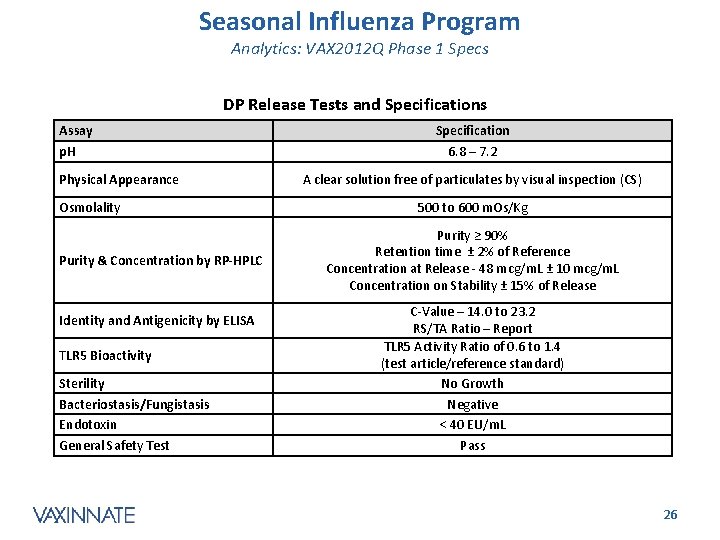
Seasonal Influenza Program Analytics: VAX 2012 Q Phase 1 Specs DP Release Tests and Specifications Assay p. H Physical Appearance Osmolality Purity & Concentration by RP-HPLC Identity and Antigenicity by ELISA TLR 5 Bioactivity Sterility Bacteriostasis/Fungistasis Endotoxin General Safety Test Specification 6. 8 – 7. 2 A clear solution free of particulates by visual inspection (CS) 500 to 600 m. Os/Kg Purity ≥ 90% Retention time ± 2% of Reference Concentration at Release - 48 mcg/m. L ± 10 mcg/m. L Concentration on Stability ± 15% of Release C-Value – 14. 0 to 23. 2 RS/TA Ratio – Report TLR 5 Activity Ratio of 0. 6 to 1. 4 (test article/reference standard) No Growth Negative < 40 EU/m. L Pass CONFIDENTIAL 26
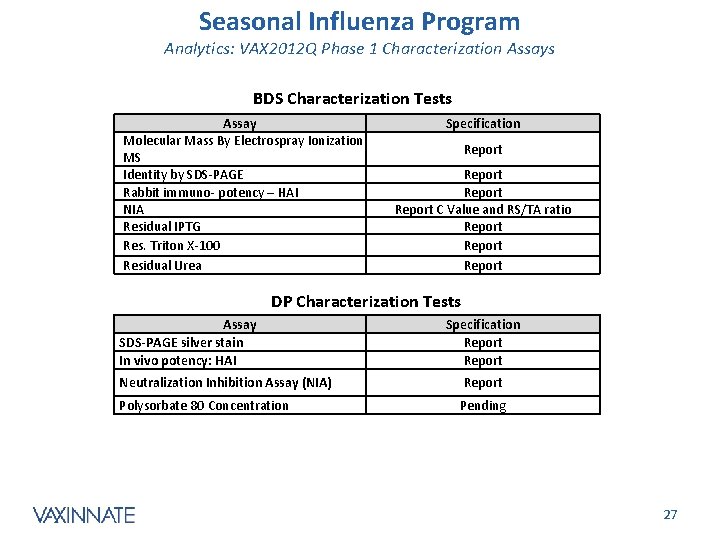
Seasonal Influenza Program Analytics: VAX 2012 Q Phase 1 Characterization Assays BDS Characterization Tests Assay Molecular Mass By Electrospray Ionization MS Identity by SDS-PAGE Rabbit immuno- potency – HAI NIA Residual IPTG Res. Triton X-100 Residual Urea Specification Report C Value and RS/TA ratio Report DP Characterization Tests Assay SDS-PAGE silver stain In vivo potency: HAI Specification Report Neutralization Inhibition Assay (NIA) Report Polysorbate 80 Concentration Pending CONFIDENTIAL 27
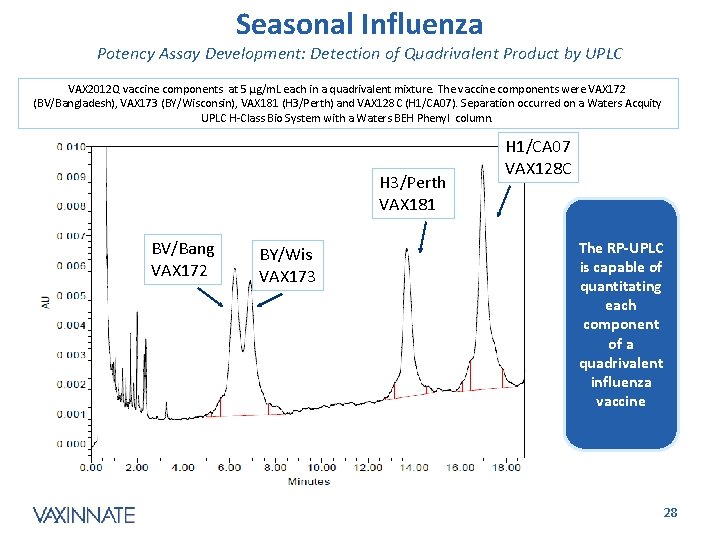
Seasonal Influenza Potency Assay Development: Detection of Quadrivalent Product by UPLC VAX 2012 Q vaccine components at 5 µg/m. L each in a quadrivalent mixture. The vaccine components were VAX 172 (BV/Bangladesh), VAX 173 (BY/Wisconsin), VAX 181 (H 3/Perth) and VAX 128 C (H 1/CA 07). Separation occurred on a Waters Acquity UPLC H-Class Bio System with a Waters BEH Phenyl column. H 3/Perth VAX 181 BV/Bang VAX 172 BY/Wis VAX 173 H 1/CA 07 VAX 128 C The RP-UPLC is capable of quantitating each component of a quadrivalent influenza vaccine CONFIDENTIAL 28
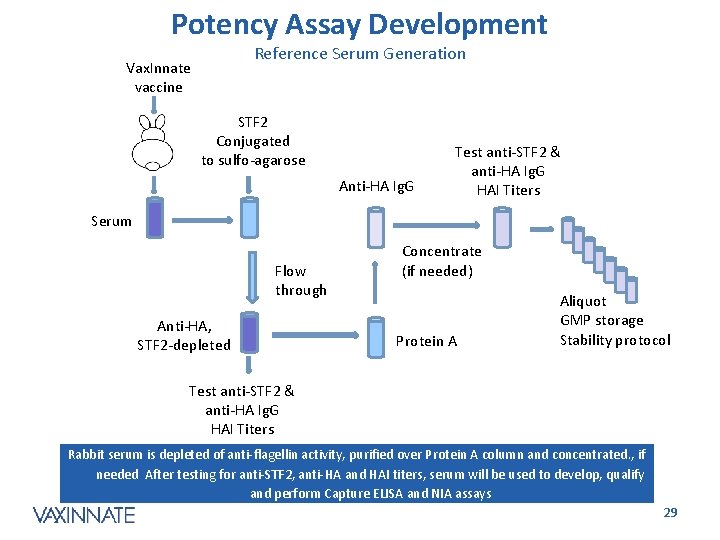
Potency Assay Development Reference Serum Generation Vax. Innate vaccine STF 2 Conjugated to sulfo-agarose Anti-HA Ig. G Test anti-STF 2 & anti-HA Ig. G HAI Titers Serum Flow through Anti-HA, STF 2 -depleted Concentrate (if needed) Protein A Aliquot GMP storage Stability protocol Test anti-STF 2 & anti-HA Ig. G HAI Titers Rabbit serum is depleted of anti-flagellin activity, purified over Protein A column and concentrated. , if needed After testing for anti-STF 2, anti-HA and HAI titers, serum will be used to develop, qualify and perform Capture ELISA and NIA assays CONFIDENTIAL 29
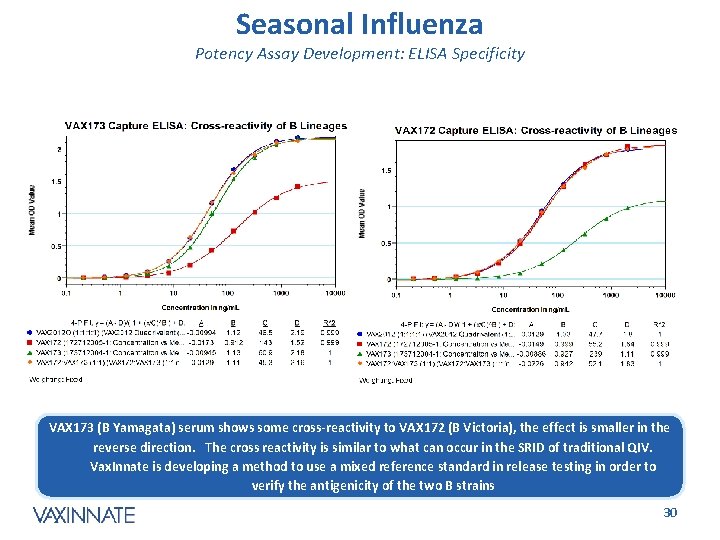
Seasonal Influenza Potency Assay Development: ELISA Specificity VAX 173 (B Yamagata) serum shows some cross-reactivity to VAX 172 (B Victoria), the effect is smaller in the reverse direction. The cross reactivity is similar to what can occur in the SRID of traditional QIV. Vax. Innate is developing a method to use a mixed reference standard in release testing in order to verify the antigenicity of the two B strains CONFIDENTIAL 30
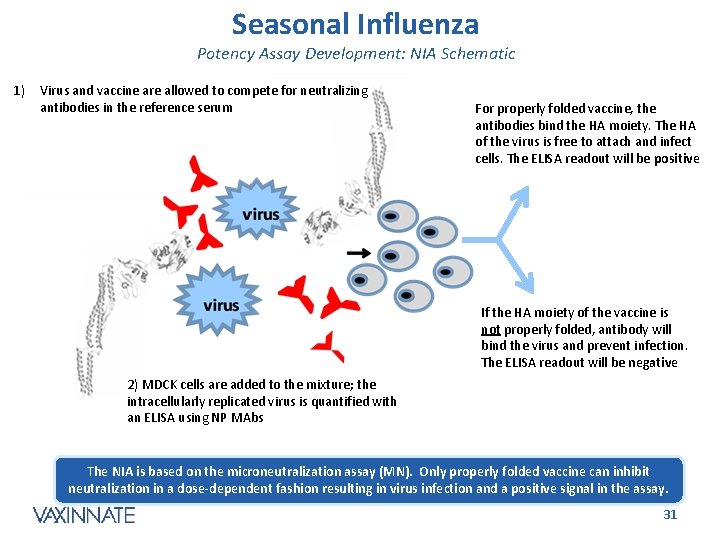
Seasonal Influenza Potency Assay Development: NIA Schematic 1) Virus and vaccine are allowed to compete for neutralizing antibodies in the reference serum For properly folded vaccine, the antibodies bind the HA moiety. The HA of the virus is free to attach and infect cells. The ELISA readout will be positive If the HA moiety of the vaccine is not properly folded, antibody will bind the virus and prevent infection. The ELISA readout will be negative 2) MDCK cells are added to the mixture; the intracellularly replicated virus is quantified with an ELISA using NP MAbs The NIA is based on the microneutralization assay (MN). Only properly folded vaccine can inhibit neutralization in a dose-dependent fashion resulting in virus infection and a positive signal in the assay. CONFIDENTIAL 31
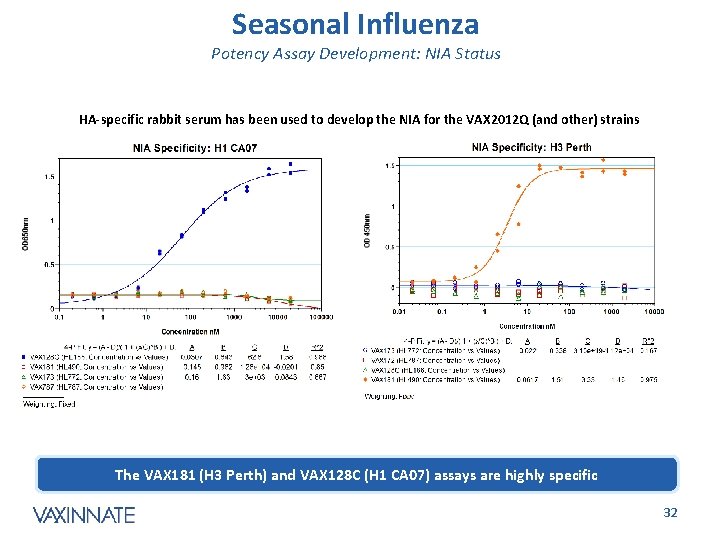
Seasonal Influenza Potency Assay Development: NIA Status HA-specific rabbit serum has been used to develop the NIA for the VAX 2012 Q (and other) strains The VAX 181 (H 3 Perth) and VAX 128 C (H 1 CA 07) assays are highly specific CONFIDENTIAL 32
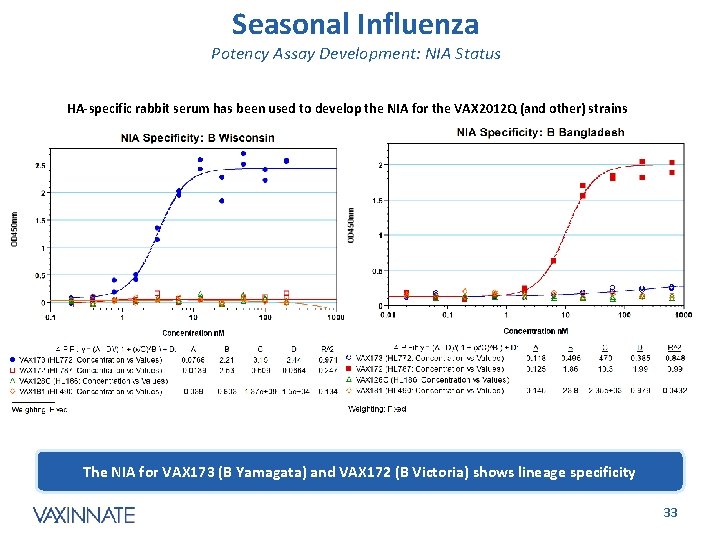
Seasonal Influenza Potency Assay Development: NIA Status HA-specific rabbit serum has been used to develop the NIA for the VAX 2012 Q (and other) strains The NIA for VAX 173 (B Yamagata) and VAX 172 (B Victoria) shows lineage specificity CONFIDENTIAL 33
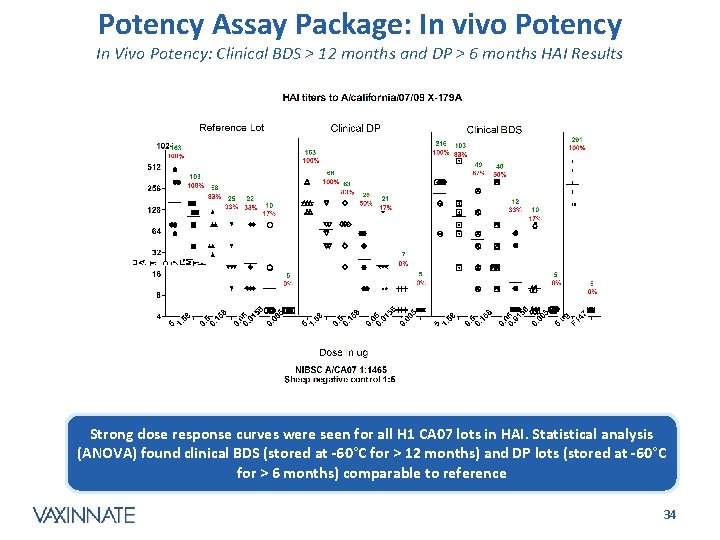
Potency Assay Package: In vivo Potency In Vivo Potency: Clinical BDS > 12 months and DP > 6 months HAI Results Strong dose response curves were seen for all H 1 CA 07 lots in HAI. Statistical analysis (ANOVA) found clinical BDS (stored at -60°C for > 12 months) and DP lots (stored at -60°C for > 6 months) comparable to reference CONFIDENTIAL 34
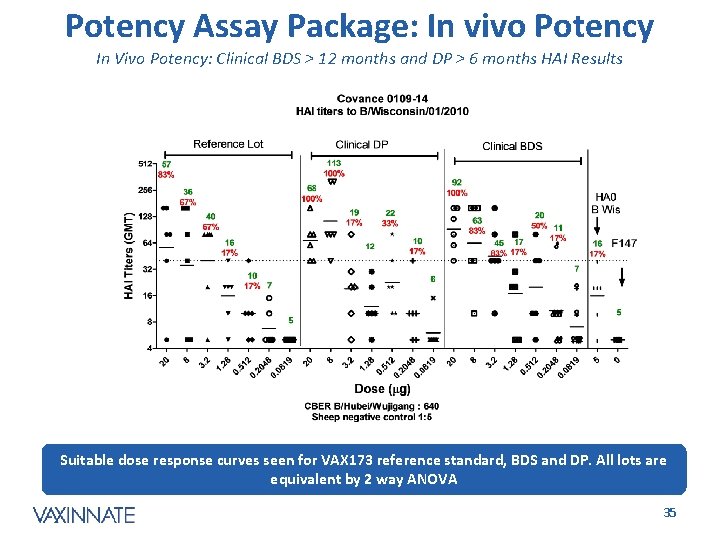
Potency Assay Package: In vivo Potency In Vivo Potency: Clinical BDS > 12 months and DP > 6 months HAI Results Suitable dose response curves seen for VAX 173 reference standard, BDS and DP. All lots are equivalent by 2 way ANOVA CONFIDENTIAL 35
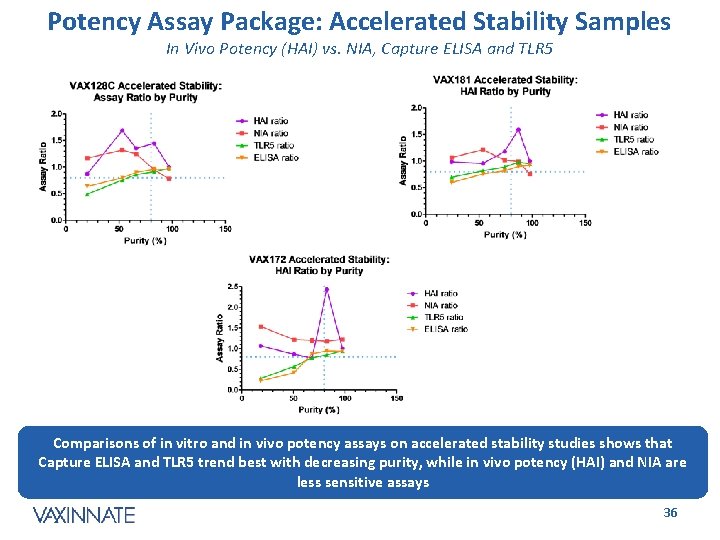
Potency Assay Package: Accelerated Stability Samples In Vivo Potency (HAI) vs. NIA, Capture ELISA and TLR 5 Comparisons of in vitro and in vivo potency assays on accelerated stability studies shows that Capture ELISA and TLR 5 trend best with decreasing purity, while in vivo potency (HAI) and NIA are less sensitive assays CONFIDENTIAL 36
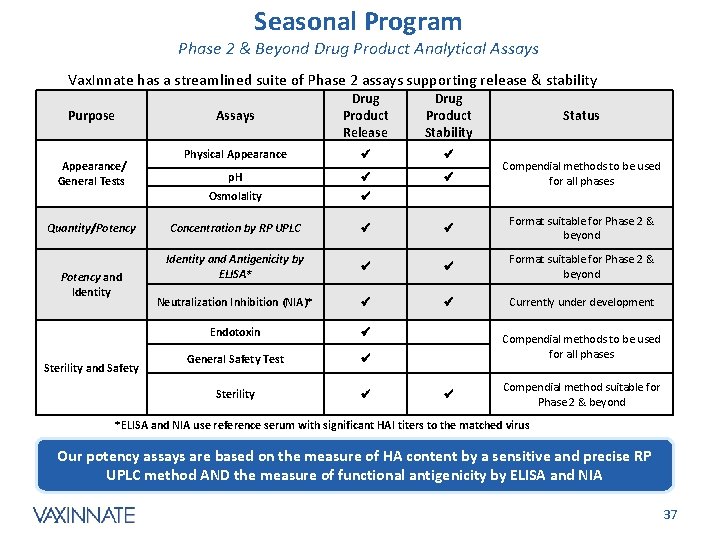
Seasonal Program Phase 2 & Beyond Drug Product Analytical Assays Vax. Innate has a streamlined suite of Phase 2 assays supporting release & stability Purpose Appearance/ General Tests Quantity/Potency and Identity Sterility and Safety Assays Drug Product Release Drug Product Stability Physical Appearance p. H Compendial methods to be used for all phases Osmolality Concentration by RP UPLC Format suitable for Phase 2 & beyond Identity and Antigenicity by ELISA* Format suitable for Phase 2 & beyond Neutralization Inhibition (NIA)* Currently under development Endotoxin General Safety Test Sterility Status Compendial methods to be used for all phases Compendial method suitable for Phase 2 & beyond *ELISA and NIA use reference serum with significant HAI titers to the matched virus Our potency assays are based on the measure of HA content by a sensitive and precise RP UPLC method AND the measure of functional antigenicity by ELISA and NIA CONFIDENTIAL 37
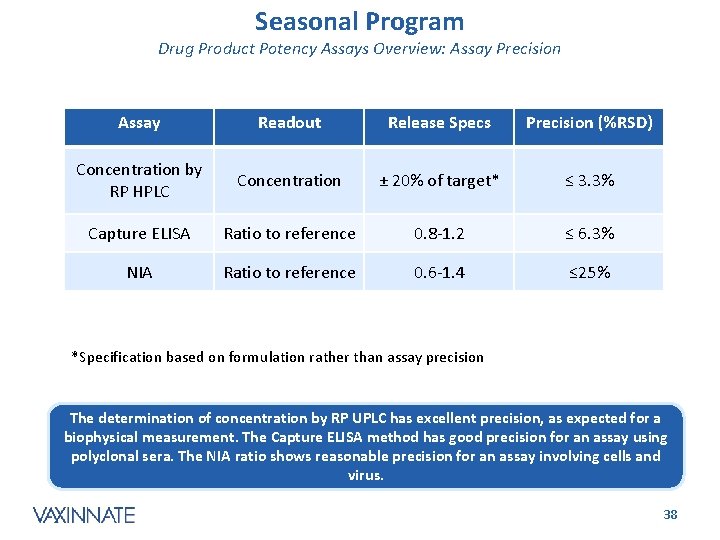
Seasonal Program Drug Product Potency Assays Overview: Assay Precision Assay Readout Release Specs Precision (%RSD) Concentration by RP HPLC Concentration ± 20% of target* ≤ 3. 3% Capture ELISA Ratio to reference 0. 8 -1. 2 ≤ 6. 3% NIA Ratio to reference 0. 6 -1. 4 ≤ 25% *Specification based on formulation rather than assay precision The determination of concentration by RP UPLC has excellent precision, as expected for a biophysical measurement. The Capture ELISA method has good precision for an assay using polyclonal sera. The NIA ratio shows reasonable precision for an assay involving cells and virus. CONFIDENTIAL 38
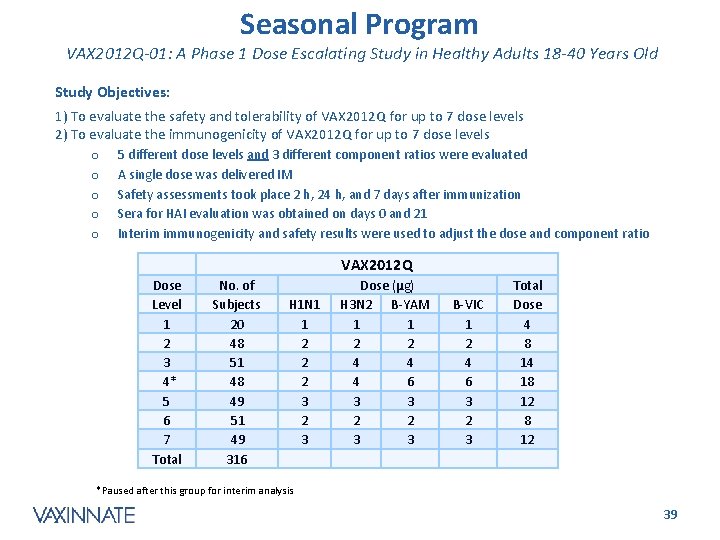
Seasonal Program VAX 2012 Q-01: A Phase 1 Dose Escalating Study in Healthy Adults 18 -40 Years Old Study Objectives: 1) To evaluate the safety and tolerability of VAX 2012 Q for up to 7 dose levels 2) To evaluate the immunogenicity of VAX 2012 Q for up to 7 dose levels o 5 different dose levels and 3 different component ratios were evaluated o A single dose was delivered IM o Safety assessments took place 2 h, 24 h, and 7 days after immunization o Sera for HAI evaluation was obtained on days 0 and 21 o Interim immunogenicity and safety results were used to adjust the dose and component ratio VAX 2012 Q Dose Level 1 2 3 4* 5 6 7 Total No. of Subjects 20 48 51 48 49 51 49 316 H 1 N 1 1 2 2 2 3 Dose (µg) H 3 N 2 B-YAM 1 1 2 2 4 4 4 6 3 3 2 2 3 3 B-VIC 1 2 4 6 3 2 3 Total Dose 4 8 14 18 12 *Paused after this group for interim analysis CONFIDENTIAL 39
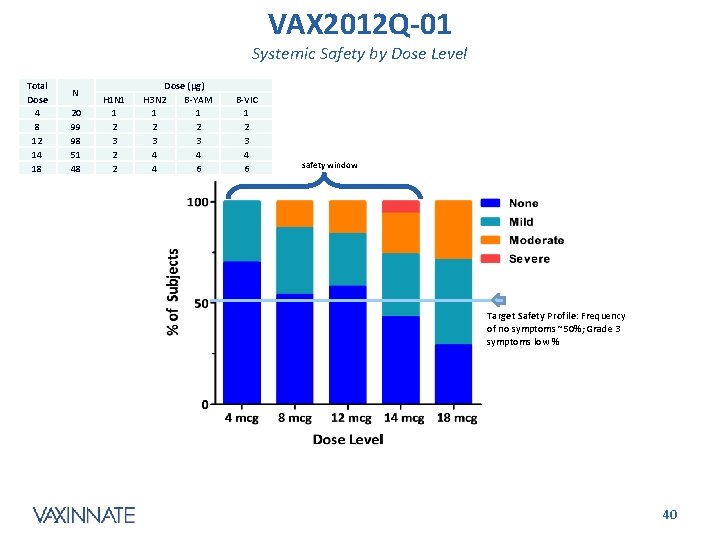
VAX 2012 Q-01 Systemic Safety by Dose Level Total Dose 4 8 12 14 18 N 20 99 98 51 48 H 1 N 1 1 2 3 2 2 Dose (µg) H 3 N 2 B-YAM 1 1 2 2 3 3 4 4 4 6 B-VIC 1 2 3 4 6 safety window Target Safety Profile: Frequency of no symptoms ~50%; Grade 3 symptoms low % CONFIDENTIAL 40
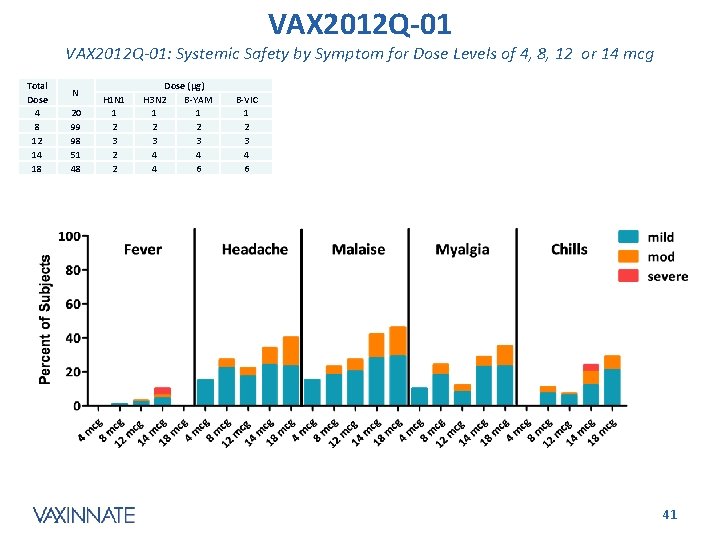
VAX 2012 Q-01: Systemic Safety by Symptom for Dose Levels of 4, 8, 12 or 14 mcg Total Dose 4 8 12 14 18 N 20 99 98 51 48 H 1 N 1 1 2 3 2 2 Dose (µg) H 3 N 2 B-YAM 1 1 2 2 3 3 4 4 4 6 B-VIC 1 2 3 4 6 CONFIDENTIAL 41
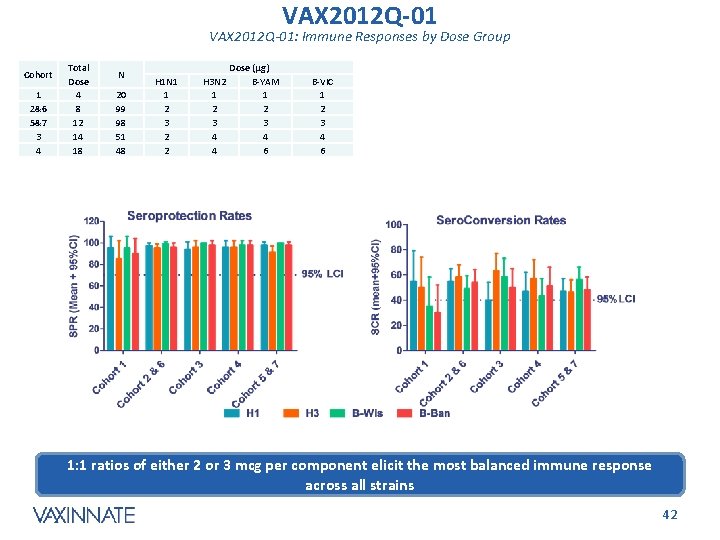
VAX 2012 Q-01: Immune Responses by Dose Group Cohort 1 2&6 5&7 3 4 Total Dose 4 8 12 14 18 N 20 99 98 51 48 H 1 N 1 1 2 3 2 2 Dose (µg) H 3 N 2 B-YAM 1 1 2 2 3 3 4 4 4 6 B-VIC 1 2 3 4 6 1: 1 ratios of either 2 or 3 mcg per component elicit the most balanced immune response across all strains CONFIDENTIAL 42
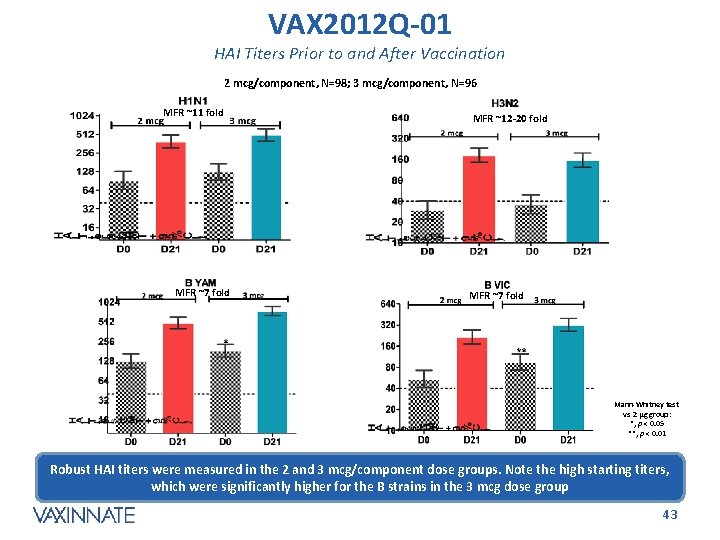
VAX 2012 Q-01 HAI Titers Prior to and After Vaccination 2 mcg/component, N=98; 3 mcg/component, N=96 MFR ~11 fold MFR ~7 fold MFR ~12 -20 fold MFR ~7 fold Mann-Whitney test vs 2 µg group: *, p < 0. 05 **, p < 0. 01 Robust HAI titers were measured in the 2 and 3 mcg/component dose groups. Note the high starting titers, which were significantly higher for the B strains in the 3 mcg dose group CONFIDENTIAL 43
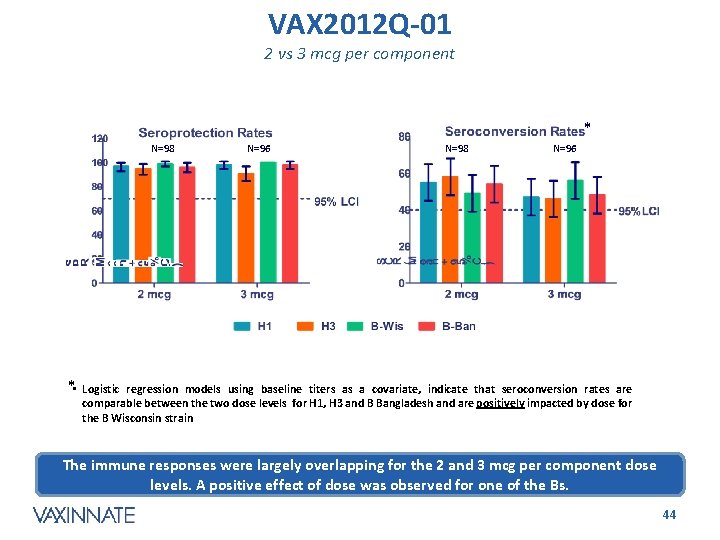
VAX 2012 Q-01 2 vs 3 mcg per component * N=98 N=96 * • Logistic regression models using baseline titers as a covariate, indicate that seroconversion rates are comparable between the two dose levels for H 1, H 3 and B Bangladesh and are positively impacted by dose for the B Wisconsin strain The immune responses were largely overlapping for the 2 and 3 mcg per component dose levels. A positive effect of dose was observed for one of the Bs. CONFIDENTIAL 44
VAX 2012 Q-01: Conclusions & Next Steps • The VAX 2012 Q-01 results provide the clinical proof of concept for Vax. Innate’s recombinant approach to a quadrivalent seasonal product • Doses of 2 or 3 mcg per component of VAX 2012 Q have comparable safety and immunogenicity profiles o SP and SC rates are consistent with serological criteria established by CBER for accelerated licensure • Three mcg per component, and above, has been selected for evaluation in a Phase 1 b dose ranging study in the elderly • Two dose levels (2 and 3 mcg per component) will be evaluated in a Phase 2 dose confirmation study (VAX 2012 Q-03) in healthy adults 18 -64 years old in 1 H 2015 o A US licensed quadrivalent vaccine will be included as a comparator (matched for 2 strains) • The End of Phase 2 meeting is projected to take place in 1 H 2016 o Suitability of the process and analytical validation package, the overall Phase 3 study design and the size of the safety database will be determined CONFIDENTIAL 45
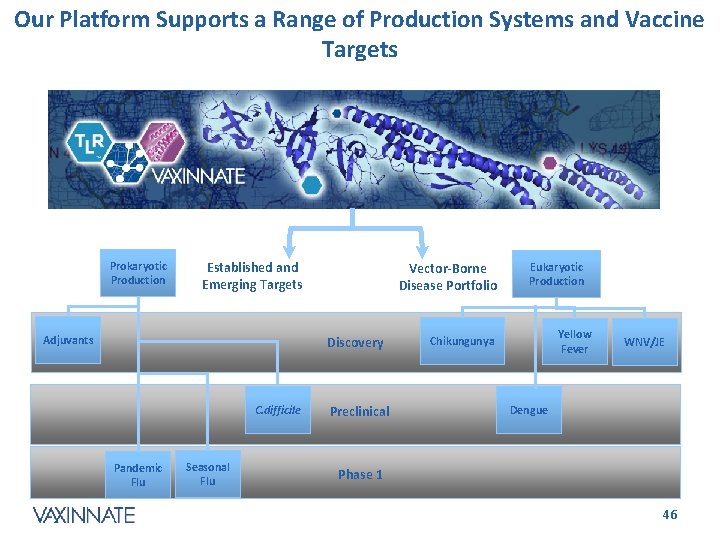
Our Platform Supports a Range of Production Systems and Vaccine Targets Prokaryotic Production Established and Emerging Targets Adjuvants Vector-Borne Disease Portfolio Discovery C. difficile Pandemic Flu Seasonal Flu Preclinical Eukaryotic Production Yellow Fever Chikungunya WNV/JE Dengue Phase 1 CONFIDENTIAL 46
Acknowledgements • Lynda Tussey, Ph. D—CSO • Bruce Weaver—VP Manufacturing Ø Yan Chen—Director Process Development o Youngsun Kim • Devin Wigington—Director QC Ø Kelly Russell Ø Vanessa Diaz • Ge Liu—Senior Director Research Ø Haijun Tian Ø Fu Hou • Immunology Group Ø Rodney Bell Ø John Gathuru, Ph. D. Ø Kalyani Ginjupali Funded by BARDA Contract HHSO 100201100011 C CONFIDENTIAL 47
- Slides: 47