
Novel Extrusion System for the Encapsulation of Drug
- Slides: 9
Novel Extrusion System for the Encapsulation of Drug Delivering Bio-Medical Micro-Robots Presentation BY: Malcolm T. Gibson The University of Arizona Advanced Micro and Nano Systems Laboratory Dept. of Aerospace and Mechanical Engineering
Presentation Objectives • Introduction • Micro-Robotics Research • Encapsulation Methods • The Extrusion System • Drug Delivery Mechanisms • Discoveries • Conclusion • Acknowledgements
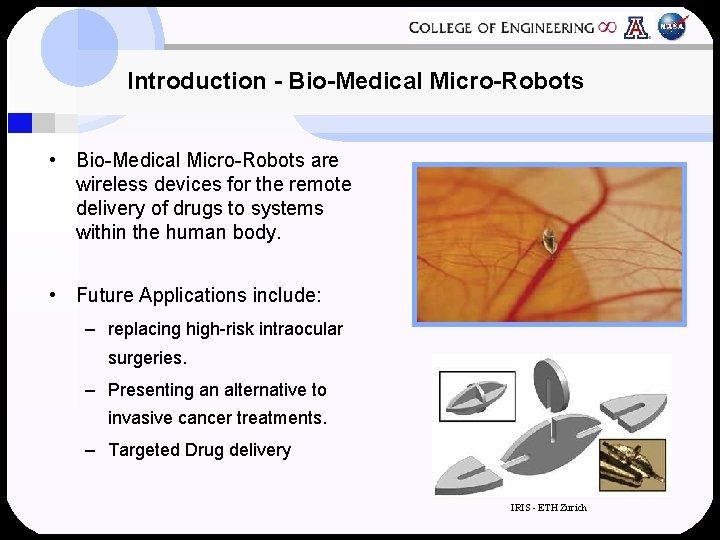
Introduction - Bio-Medical Micro-Robots • Bio-Medical Micro-Robots are wireless devices for the remote delivery of drugs to systems within the human body. • Future Applications include: – replacing high-risk intraocular surgeries. – Presenting an alternative to invasive cancer treatments. – Targeted Drug delivery IRIS - ETH Zurich
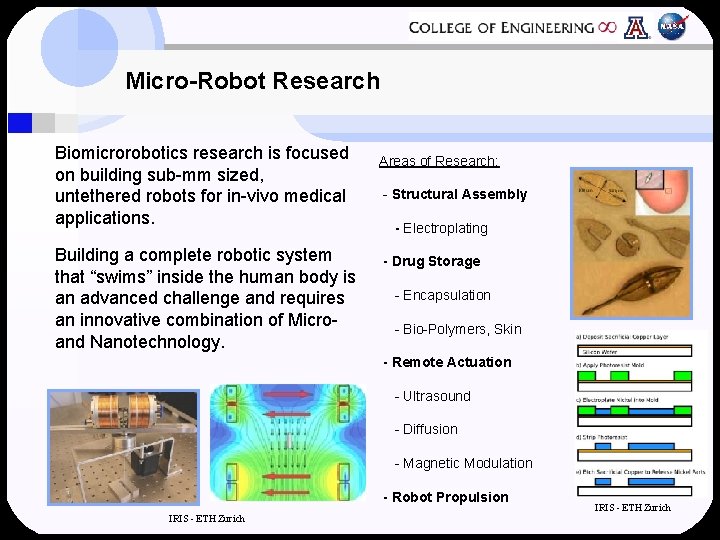
Micro-Robot Research Biomicrorobotics research is focused on building sub-mm sized, untethered robots for in-vivo medical applications. Building a complete robotic system that “swims” inside the human body is an advanced challenge and requires an innovative combination of Microand Nanotechnology. Areas of Research: - Structural Assembly - Electroplating - Drug Storage - Encapsulation - Bio-Polymers, Skin - Remote Actuation - Ultrasound - Diffusion - Magnetic Modulation - Robot Propulsion IRIS - ETH Zurich
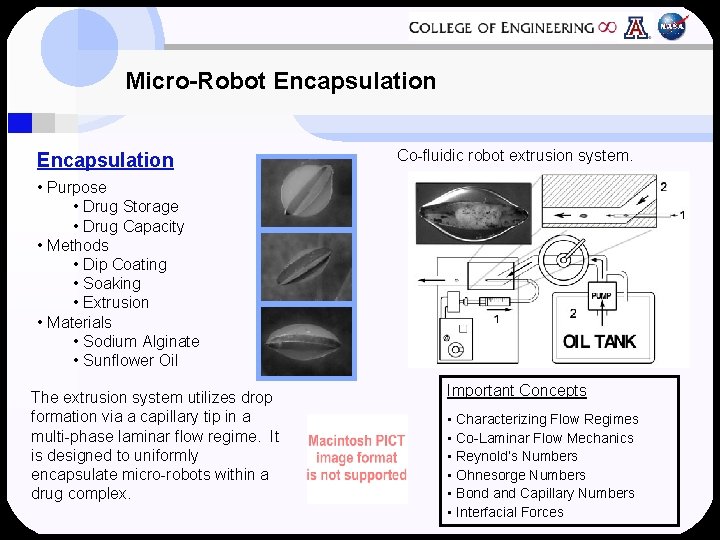
Micro-Robot Encapsulation Co-fluidic robot extrusion system. • Purpose • Drug Storage • Drug Capacity • Methods • Dip Coating • Soaking • Extrusion • Materials • Sodium Alginate • Sunflower Oil The extrusion system utilizes drop formation via a capillary tip in a multi-phase laminar flow regime. It is designed to uniformly encapsulate micro-robots within a drug complex. Important Concepts • Characterizing Flow Regimes • Co-Laminar Flow Mechanics • Reynold’s Numbers • Ohnesorge Numbers • Bond and Capillary Numbers • Interfacial Forces
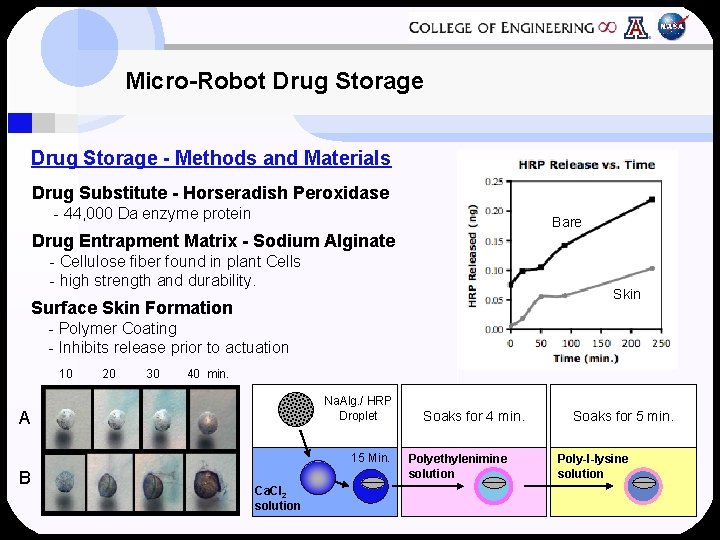
Micro-Robot Drug Storage - Methods and Materials Drug Substitute - Horseradish Peroxidase - 44, 000 Da enzyme protein Bare Drug Entrapment Matrix - Sodium Alginate - Cellulose fiber found in plant Cells - high strength and durability. Skin Surface Skin Formation - Polymer Coating - Inhibits release prior to actuation 10 20 30 40 min. Na. Alg. / HRP Droplet A 15 Min. B Ca. Cl 2 solution Soaks for 4 min. Polyethylenimine solution Soaks for 5 min. Poly-l-lysine solution
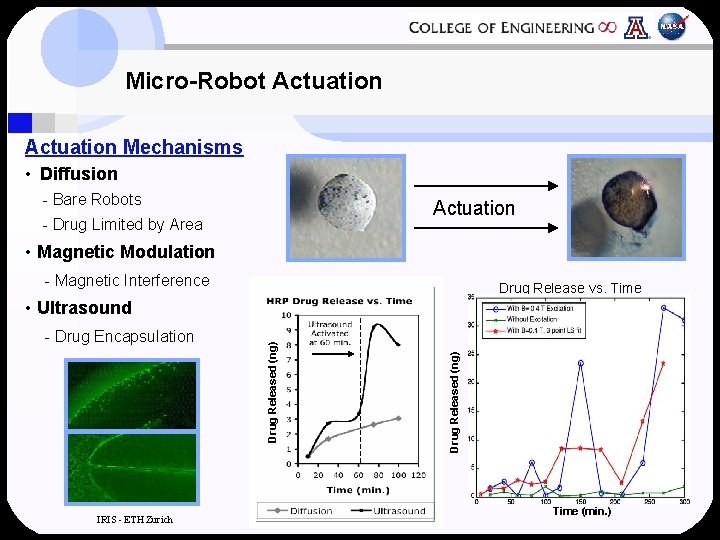
Micro-Robot Actuation Mechanisms • Diffusion - Bare Robots Actuation - Drug Limited by Area • Magnetic Modulation - Magnetic Interference Drug Release vs. Time IRIS - ETH Zurich Drug Released (ng) - Drug Encapsulation Drug Released (ng) • Ultrasound Time (min. )
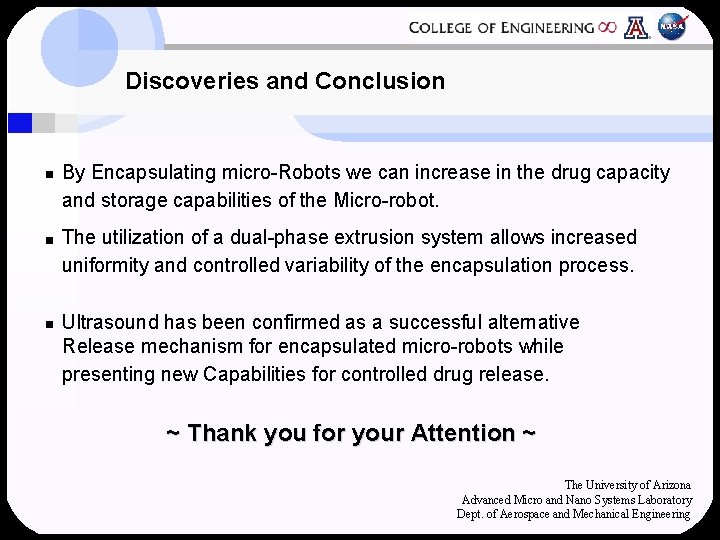
Discoveries and Conclusion § By Encapsulating micro-Robots we can increase in the drug capacity and storage capabilities of the Micro-robot. § The utilization of a dual-phase extrusion system allows increased uniformity and controlled variability of the encapsulation process. § Ultrasound has been confirmed as a successful alternative Release mechanism for encapsulated micro-robots while presenting new Capabilities for controlled drug release. ~ Thank you for your Attention ~ The University of Arizona Advanced Micro and Nano Systems Laboratory Dept. of Aerospace and Mechanical Engineering
Acknowledgement and Thanks to Dr. Eniko T. Enikov Principal Investigator and Mentor Advanced Micro and Nano-Systems laboratory Group For their help and guidance UA/NASA Space Grant Program For their support and research Encouragement ASU/NASA Space Grant Program For Organizing and Hosting the Statewide Symposium The Institute of Robotics and Intelligent Systems (IRIS) ETH Zurich - Switzerland The University of Arizona Advanced Micro and Nano Systems Laboratory Dept. of Aerospace and Mechanical Engineering