
Novel current mirrors application in high side current





- Slides: 15
Novel current mirrors application in high side current sensing in multichannel power supplies L. P. Dimitrov G. M. Mitev Nuclear Electronics Lab. , Institute for Nuclear Research and Nuclear Energy, Bulgarian Academy of Sciences
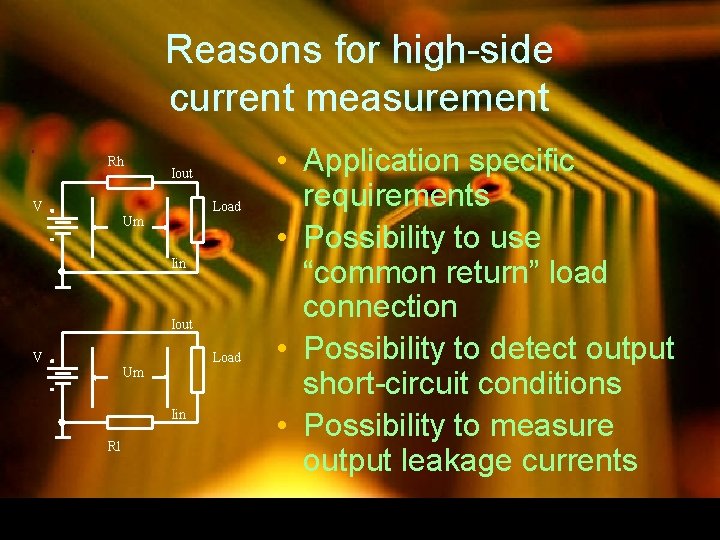
Reasons for high-side current measurement Rh V Iout Load Um Iin Iout V Load Um Iin Rl • Application specific requirements • Possibility to use “common return” load connection • Possibility to detect output short-circuit conditions • Possibility to measure output leakage currents
Problems introduced by high-side current measurement Rh V Iout Load Um Iin • The measurement schematic must be capable of working under the full output voltage • The measurement schematic must have low power consumption
Present high-side current measurement solutions • Complex differential amplifier and level shifter circuits – excellent measurement characteristics – require separate high-voltage power supply, usually drawn from the output • Specialized ICs for current sensing in industrial applications – well suited for measurement of larger currents – poor power efficiency in the sub-m. A range
Goals and tasks • Find a simple and cheap approach for highside current monitoring – evaluate the specifics of using current mirrors for high-side current measurement in detector power supplies – research and analyze suitable schematics – build a test circuit and measure its characteristics
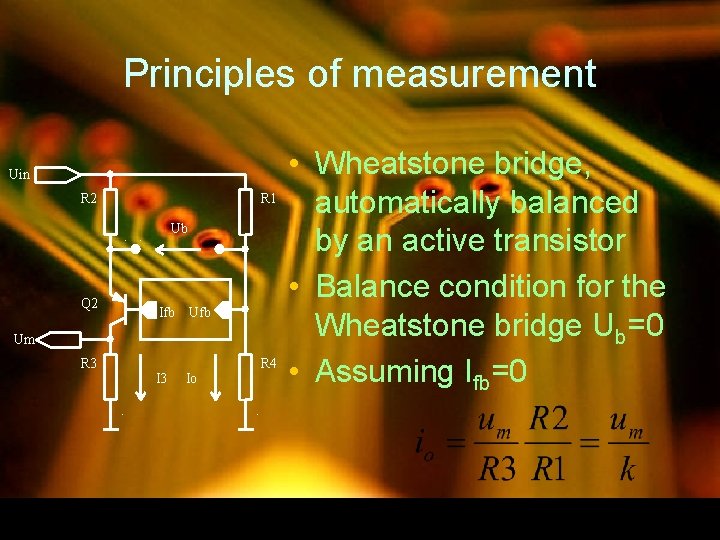
Principles of measurement Uin R 2 R 1 Ub Q 2 Ifb Um R 3 Io R 4 • Wheatstone bridge, automatically balanced by an active transistor • Balance condition for the Wheatstone bridge Ub=0 • Assuming Ifb=0
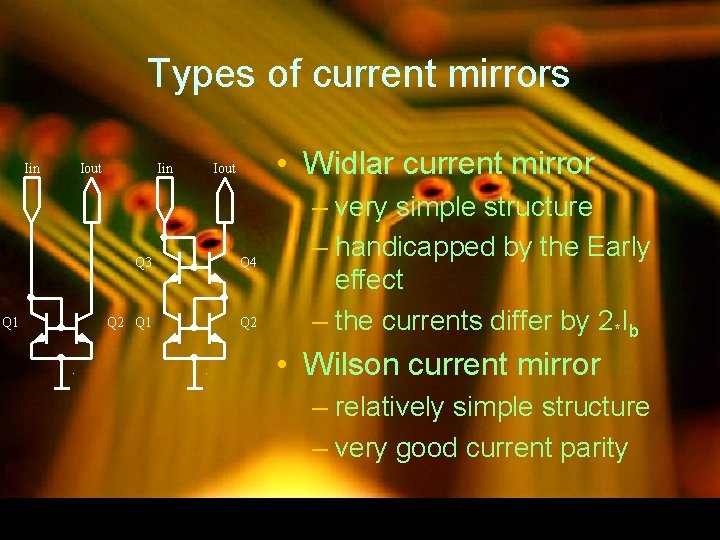
Types of current mirrors Iin Q 1 Iout Iin • Widlar current mirror Iout Q 3 Q 4 Q 2 Q 1 Q 2 – very simple structure – handicapped by the Early effect – the currents differ by 2*Ib • Wilson current mirror – relatively simple structure – very good current parity
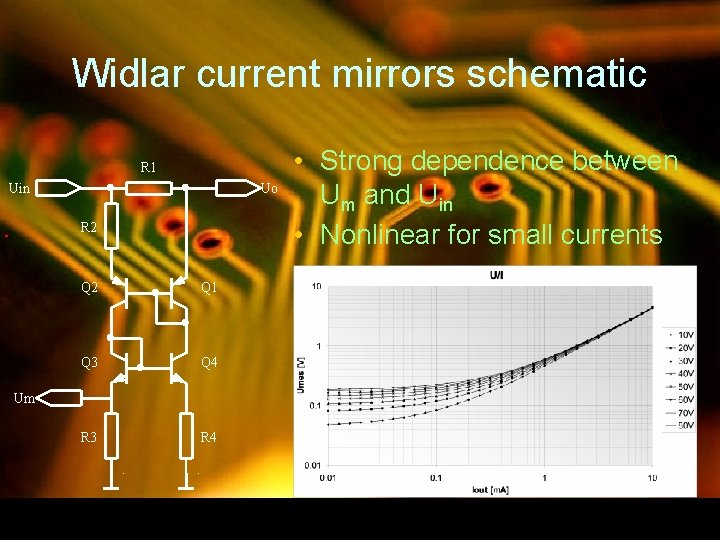
Widlar current mirrors schematic R 1 Uin Uo R 2 Q 1 Q 3 Q 4 R 3 R 4 Um • Strong dependence between Um and Uin • Nonlinear for small currents
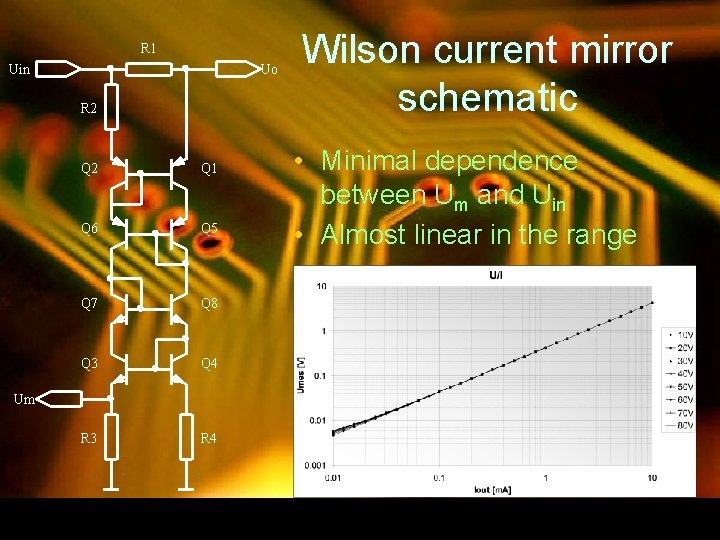
R 1 Uin Uo R 2 Q 1 Q 6 Q 5 Q 7 Q 8 Q 3 Q 4 R 3 R 4 Um Wilson current mirror schematic • Minimal dependence between Um and Uin • Almost linear in the range
Simulation setup • Wheatstone bridge – R 1=100Ω, R 2=15 kΩ – R 2/R 1=150 – R 3=63 kΩ – k=(R 1. R 3)/R 2=420 • Current mirrors – high-side mirror - BC 556 transistor pairs – low-side mirror – BC 546 transistor pairs – R 4=R 3
Test board setup • Wheatstone bridge – R 1=100Ω, R 2=15 kΩ – R 2/R 1=150 – R 3=63 kΩ – k=(R 1. R 3)/R 2=420 • Wilson current mirrors – high-side mirror – FMMT 558 transistor pairs – low-side mirror – FMMT 458 transistor pairs – R 4=R 3
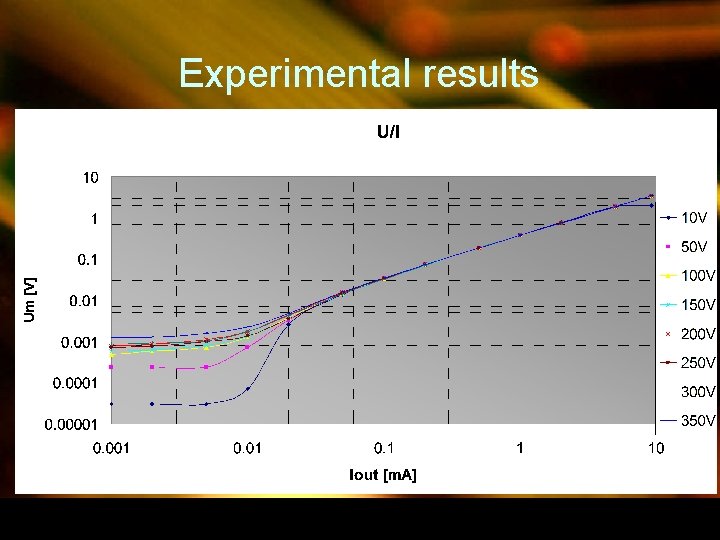
Experimental results
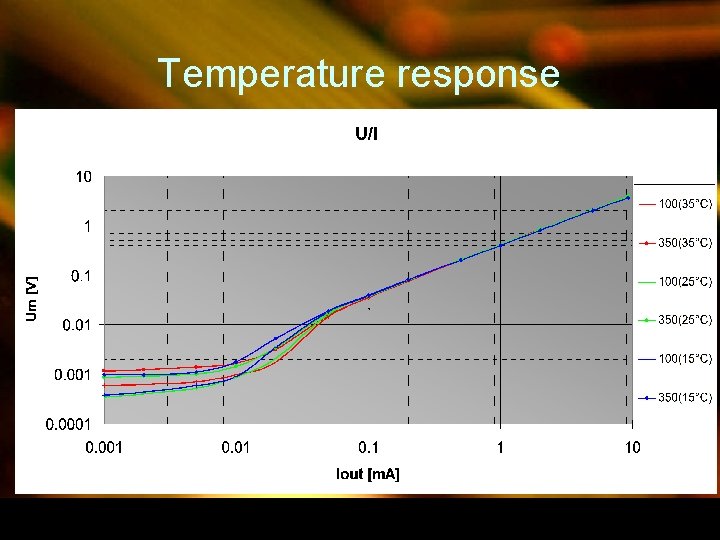
Temperature response
Results analisys • The results clearly show that the Wilson current mirror based schematic is well suited for current measurements in a dynamic range of 2. 5 decades • The thermal response over the working range is negligible • The power consumption of the circuit is very small, determined by the R 2/R 1 ratio
Conclusion • The presented circuit is suitable for highside current monitoring in detector power supplies • It has the potential to reduce the component count, board space and manufacturing costs of power supply units • It provides for increased power efficiency, with little or no sacrifice of measurement accuracy