
Novel approach to production of high specific activity
- Slides: 1
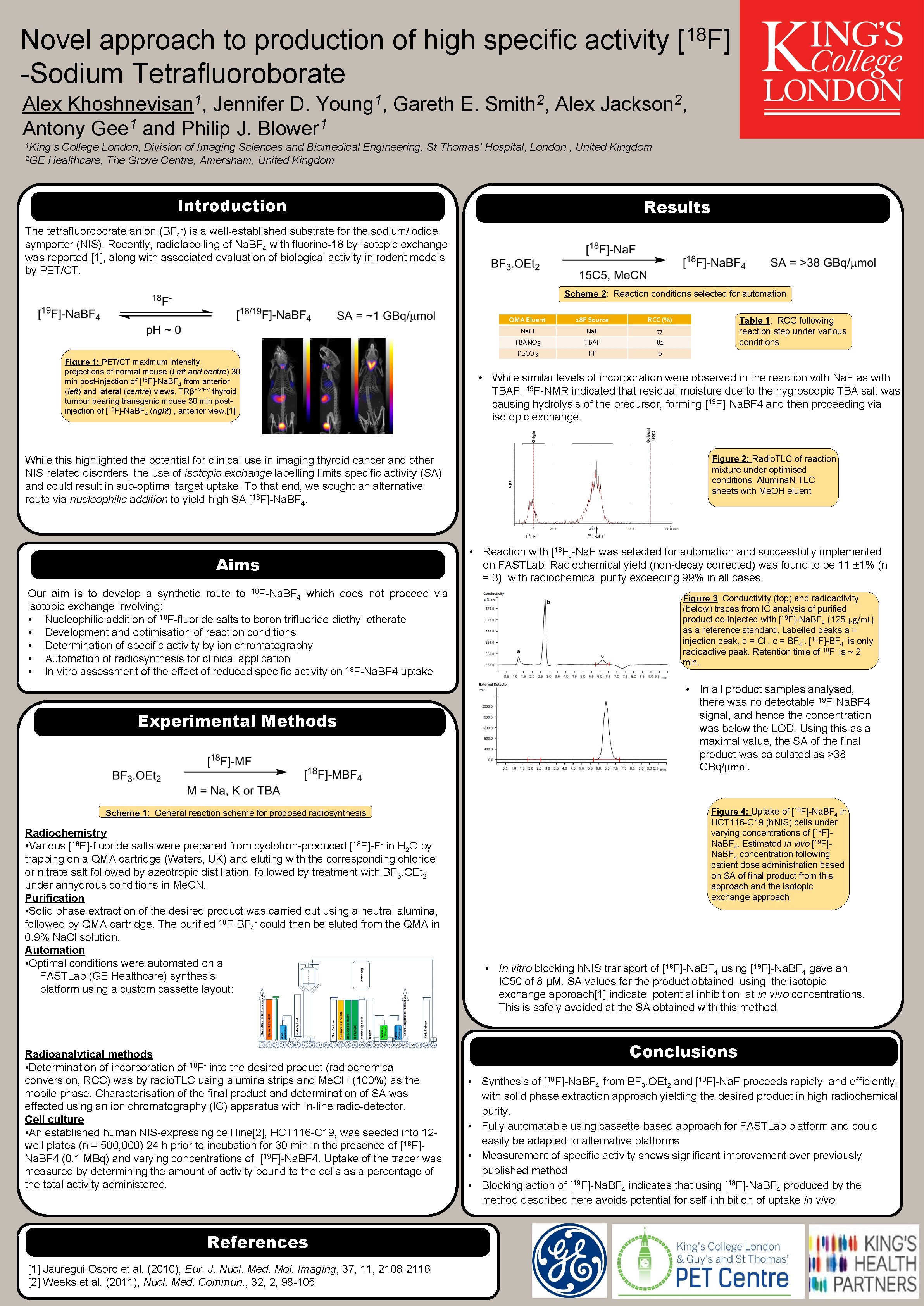
Novel approach to production of high specific activity -Sodium Tetrafluoroborate 1 Khoshnevisan , 1 Young , Alex Jennifer D. 1 1 Antony Gee and Philip J. Blower Gareth E. 2 Smith , Alex 18 [ F] 2 Jackson , 1 King’s College London, Division of Imaging Sciences and Biomedical Engineering, St Thomas’ Hospital, London , United Kingdom 2 GE Healthcare, The Grove Centre, Amersham, United Kingdom Introduction Results The tetrafluoroborate anion (BF 4 -) is a well-established substrate for the sodium/iodide symporter (NIS). Recently, radiolabelling of Na. BF 4 with fluorine-18 by isotopic exchange was reported [1], along with associated evaluation of biological activity in rodent models by PET/CT. Scheme 2: Reaction conditions selected for automation Figure 1: PET/CT maximum intensity projections of normal mouse (Left and centre) 30 min post-injection of [18 F]-Na. BF 4 from anterior (left) and lateral (centre) views. TRβPV/PV thyroid tumour bearing transgenic mouse 30 min postinjection of [18 F]-Na. BF 4 (right) , anterior view. [1] QMA Eluent 18 F Source RCC (%) Na. Cl Na. F 77 TBANO 3 TBAF 81 K 2 CO 3 KF 0 • While similar levels of incorporation were observed in the reaction with Na. F as with TBAF, 19 F-NMR indicated that residual moisture due to the hygroscopic TBA salt was causing hydrolysis of the precursor, forming [19 F]-Na. BF 4 and then proceeding via isotopic exchange. Figure 2: Radio. TLC of reaction mixture under optimised conditions. Alumina. N TLC sheets with Me. OH eluent While this highlighted the potential for clinical use in imaging thyroid cancer and other NIS-related disorders, the use of isotopic exchange labelling limits specific activity (SA) and could result in sub-optimal target uptake. To that end, we sought an alternative route via nucleophilic addition to yield high SA [18 F]-Na. BF 4. Aims • Reaction with [18 F]-Na. F was selected for automation and successfully implemented on FASTLab. Radiochemical yield (non-decay corrected) was found to be 11 ± 1% (n = 3) with radiochemical purity exceeding 99% in all cases. Our aim is to develop a synthetic route to 18 F-Na. BF 4 which does not proceed via isotopic exchange involving: • Nucleophilic addition of 18 F-fluoride salts to boron trifluoride diethyl etherate • Development and optimisation of reaction conditions • Determination of specific activity by ion chromatography • Automation of radiosynthesis for clinical application • In vitro assessment of the effect of reduced specific activity on 18 F-Na. BF 4 uptake Figure 3: Conductivity (top) and radioactivity (below) traces from IC analysis of purified product co-injected with [19 F]-Na. BF 4 (125 μg/m. L) as a reference standard. Labelled peaks a = injection peak, b = Cl-, c = BF 4 -. [18 F]-BF 4 - is only radioactive peak. Retention time of 18 F- is ~ 2 min. • In all product samples analysed, there was no detectable 19 F-Na. BF 4 signal, and hence the concentration was below the LOD. Using this as a maximal value, the SA of the final product was calculated as >38 GBq/μmol. Experimental Methods Experimental methods Scheme 1: General reaction scheme for proposed radiosynthesis Radiochemistry • Various [18 F]-fluoride salts were prepared from cyclotron-produced [18 F]-F- in H 2 O by trapping on a QMA cartridge (Waters, UK) and eluting with the corresponding chloride or nitrate salt followed by azeotropic distillation, followed by treatment with BF 3. OEt 2 under anhydrous conditions in Me. CN. Purification • Solid phase extraction of the desired product was carried out using a neutral alumina, followed by QMA cartridge. The purified 18 F-BF 4 - could then be eluted from the QMA in 0. 9% Na. Cl solution. Automation • Optimal conditions were automated on a FASTLab (GE Healthcare) synthesis platform using a custom cassette layout: Radioanalytical methods • Determination of incorporation of 18 F- into the desired product (radiochemical conversion, RCC) was by radio. TLC using alumina strips and Me. OH (100%) as the mobile phase. Characterisation of the final product and determination of SA was effected using an ion chromatography (IC) apparatus with in-line radio-detector. Cell culture • An established human NIS-expressing cell line[2], HCT 116 -C 19, was seeded into 12 well plates (n = 500, 000) 24 h prior to incubation for 30 min in the presence of [18 F]Na. BF 4 (0. 1 MBq) and varying concentrations of [19 F]-Na. BF 4. Uptake of the tracer was measured by determining the amount of activity bound to the cells as a percentage of the total activity administered. References [1] Jauregui-Osoro et al. (2010), Eur. J. Nucl. Med. Mol. Imaging, 37, 11, 2108 -2116 [2] Weeks et al. (2011), Nucl. Med. Commun. , 32, 2, 98 -105 Table 1: RCC following reaction step under various conditions C 1 H M CP TH CE P ME C 2 LV OB Figure 4: Uptake of [18 F]-Na. BF 4 in HCT 116 -C 19 (h. NIS) cells under varying concentrations of [19 F]Na. BF 4. Estimated in vivo [19 F]Na. BF 4 concentration following patient dose administration based on SA of final product from this approach and the isotopic exchange approach • In vitro blocking h. NIS transport of [18 F]-Na. BF 4 using [19 F]-Na. BF 4 gave an IC 50 of 8 μM. SA values for the product obtained using the isotopic exchange approach[1] indicate potential inhibition at in vivo concentrations. This is safely avoided at the SA obtained with this method. Conclusions • Synthesis of [18 F]-Na. BF 4 from BF 3. OEt 2 and [18 F]-Na. F proceeds rapidly and efficiently, with solid phase extraction approach yielding the desired product in high radiochemical purity. • Fully automatable using cassette-based approach for FASTLab platform and could easily be adapted to alternative platforms • Measurement of specific activity shows significant improvement over previously published method • Blocking action of [19 F]-Na. BF 4 indicates that using [18 F]-Na. BF 4 produced by the method described here avoids potential for self-inhibition of uptake in vivo.