
Nouns Ms Williams 6 th Grade ELA Objective
Nouns Ms. Williams 6 th Grade ELA
Objective �I CAN identify nouns correctly in sentences.
Nouns – Pg. 84 �A noun names a person, place, thing, or idea. A noun can be a single word or two or more words used together. �Person: mother, woman, student �Place: neighborhood, kitchen, farm �Thing: table, quilt, sewing machine �Idea: pleasure, friendship, happiness
Guided Practice Name the noun or nouns in each sentence. 1. Quilts are difficult to make. 2. Sometimes families work together to make a quilt. 3. Grandmother chooses pretty fabrics for her quilts. 4. Many patterns can be made using colors and shapes. 5. Some patterns have stripes, and other patterns have stars.
Independent Practice – Pg. 85 Write each sentence. Circle the noun or nouns. 1. People can sew quilts by hand. 2. Sewing machines can be used, too. 3. Mother stitches two pieces of fabric together. 4. A quilt needs stuffing between the layers of fabric. 5. Cotton is an excellent stuffing material for a quilt.
Objective �I CAN correctly identify and use singular and plural nouns in sentences.
Singular and Plural Nouns – Pg. 86 �A singular noun names one person, place, thing, or idea. A plural noun names more than one. �The lake was cool and refreshing. �All lakes can freeze during winter.
Plural Nouns �To form plural nouns: �Add –s to most singular nouns. �Add –es to singular nouns that end with s, ss, x, ch, sh � Car – cars circus – circuses class – classes �If a singular noun ends with a consonant and y, y change the y to i and add –es to make a plural noun. If it ends with a vowel and y, y add –s. –s � Family – families journey - journeys
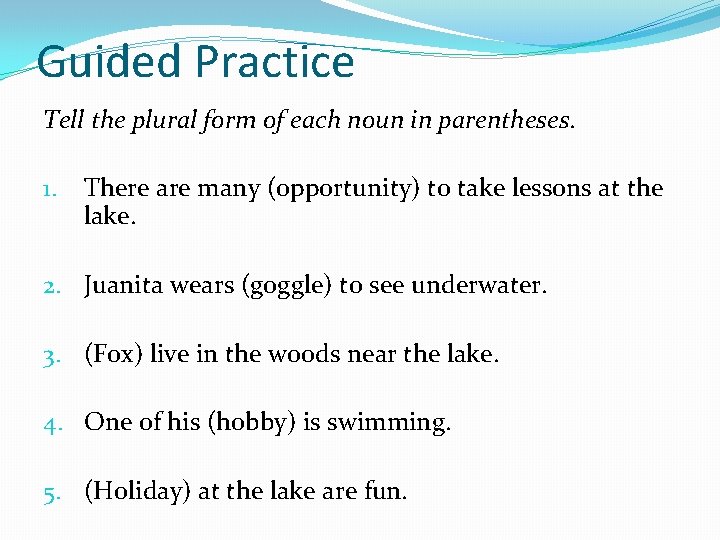
Guided Practice Tell the plural form of each noun in parentheses. 1. There are many (opportunity) to take lessons at the lake. 2. Juanita wears (goggle) to see underwater. 3. (Fox) live in the woods near the lake. 4. One of his (hobby) is swimming. 5. (Holiday) at the lake are fun.
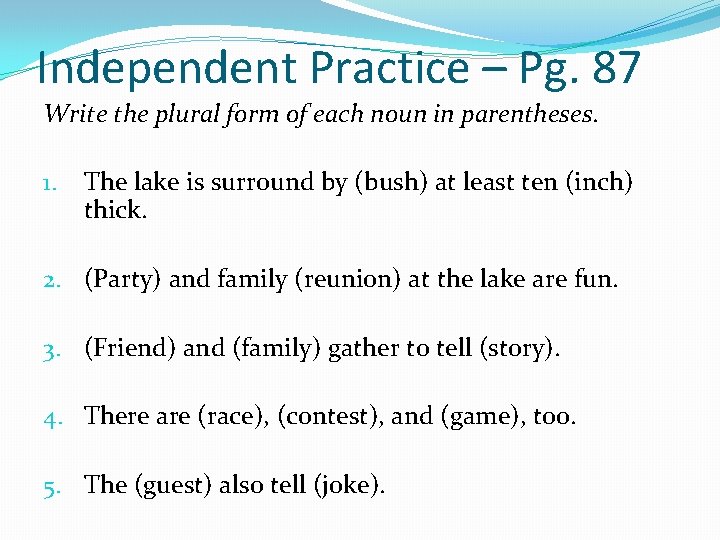
Independent Practice – Pg. 87 Write the plural form of each noun in parentheses. 1. The lake is surround by (bush) at least ten (inch) thick. 2. (Party) and family (reunion) at the lake are fun. 3. (Friend) and (family) gather to tell (story). 4. There are (race), (contest), and (game), too. 5. The (guest) also tell (joke).
Objective �I CAN correctly identify and use irregular plural nouns in sentences.
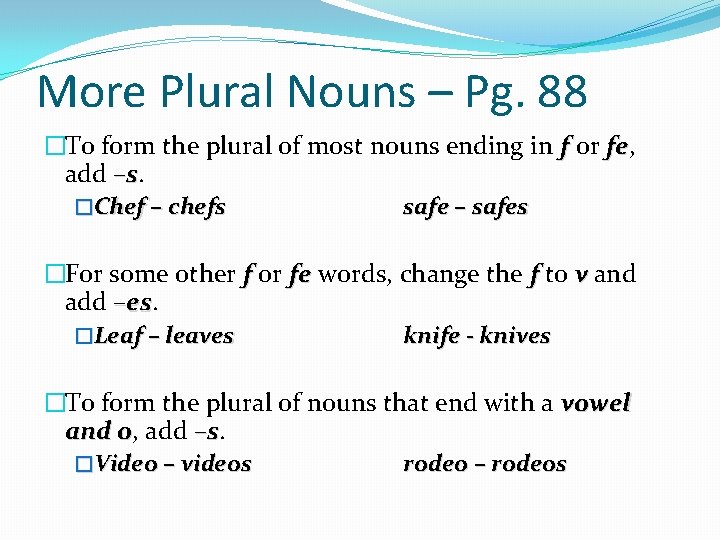
More Plural Nouns – Pg. 88 �To form the plural of most nouns ending in f or fe, fe add –s. –s �Chef – chefs safe – safes �For some other f or fe words, change the f to v and add –es �Leaf – leaves knife - knives �To form the plural of nouns that end with a vowel and o, o add –s. –s �Video – videos rodeo – rodeos
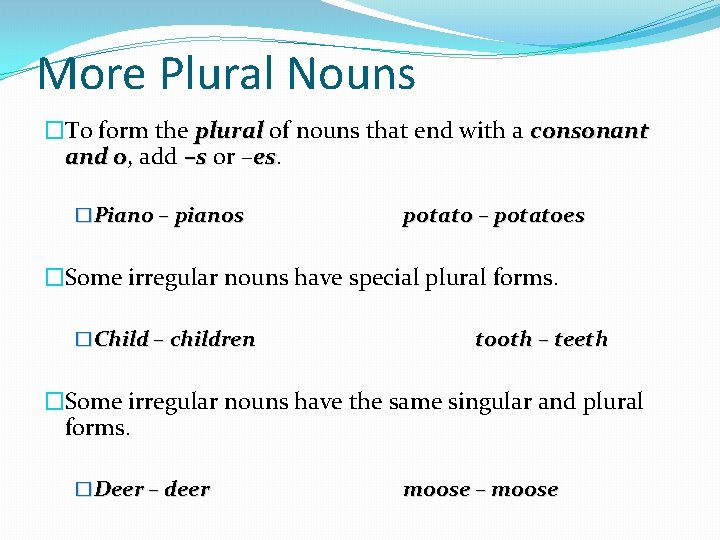
More Plural Nouns �To form the plural of nouns that end with a consonant and o, o add –s or –es. es �Piano – pianos potato – potatoes �Some irregular nouns have special plural forms. �Child – children tooth – teeth �Some irregular nouns have the same singular and plural forms. �Deer – deer moose – moose
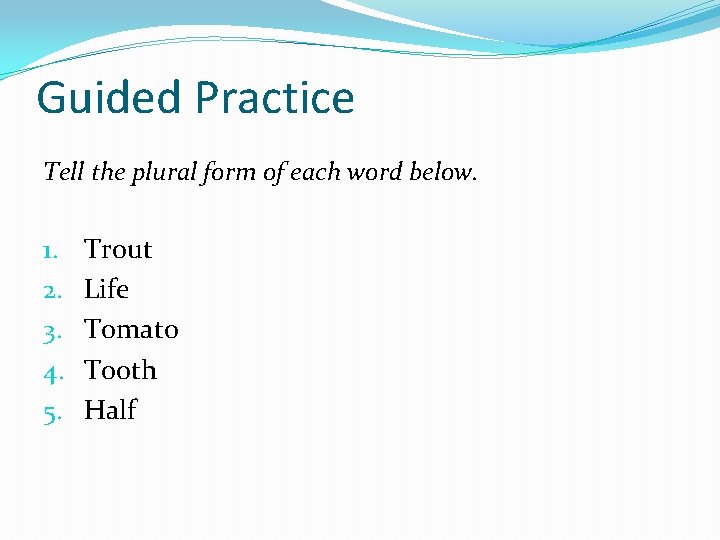
Guided Practice Tell the plural form of each word below. 1. 2. 3. 4. 5. Trout Life Tomato Tooth Half
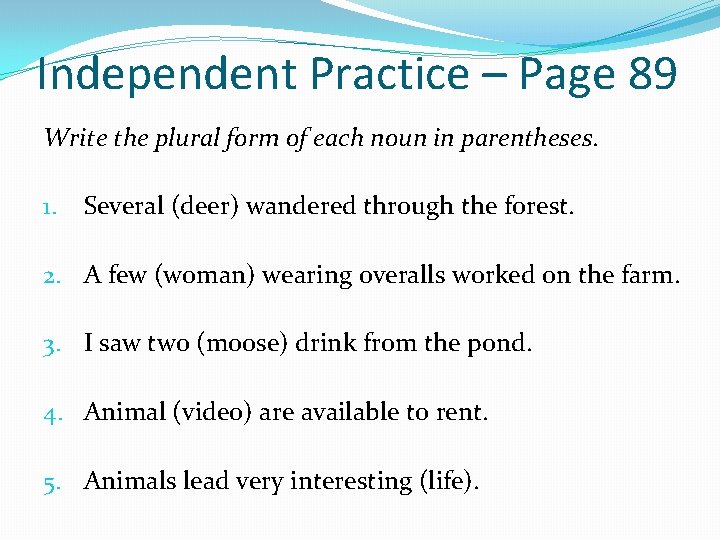
Independent Practice – Page 89 Write the plural form of each noun in parentheses. 1. Several (deer) wandered through the forest. 2. A few (woman) wearing overalls worked on the farm. 3. I saw two (moose) drink from the pond. 4. Animal (video) are available to rent. 5. Animals lead very interesting (life).
Objectives �I CAN identify common and proper nouns in sentences.
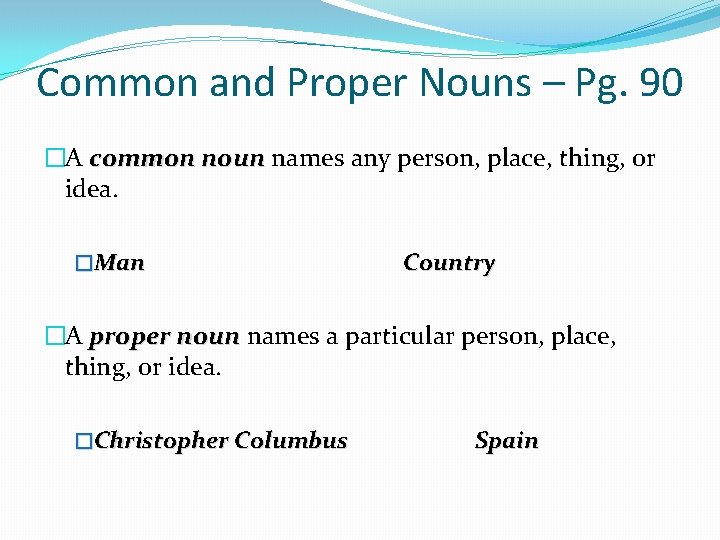
Common and Proper Nouns – Pg. 90 �A common noun names any person, place, thing, or idea. �Man Country �A proper noun names a particular person, place, thing, or idea. �Christopher Columbus Spain
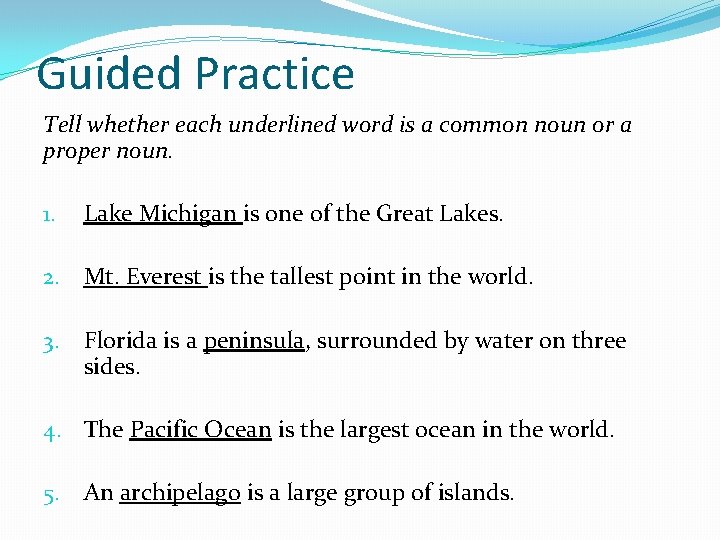
Guided Practice Tell whether each underlined word is a common noun or a proper noun. 1. Lake Michigan is one of the Great Lakes. 2. Mt. Everest is the tallest point in the world. 3. Florida is a peninsula, surrounded by water on three sides. 4. The Pacific Ocean is the largest ocean in the world. 5. An archipelago is a large group of islands.
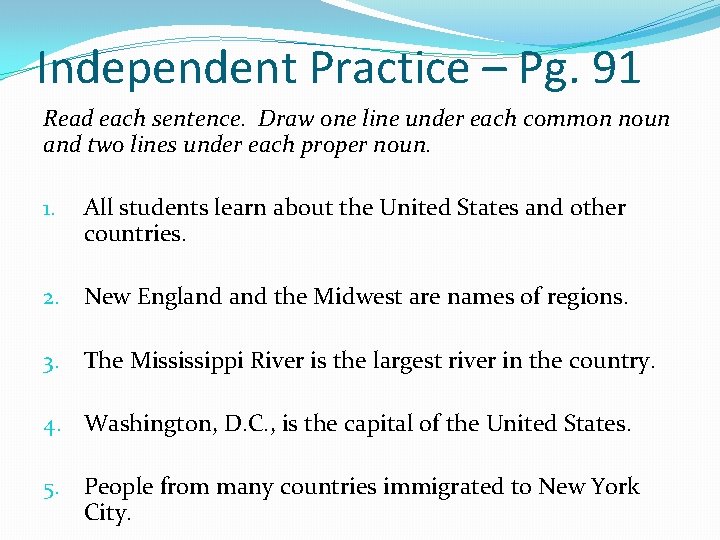
Independent Practice – Pg. 91 Read each sentence. Draw one line under each common noun and two lines under each proper noun. 1. All students learn about the United States and other countries. 2. New England the Midwest are names of regions. 3. The Mississippi River is the largest river in the country. 4. Washington, D. C. , is the capital of the United States. 5. People from many countries immigrated to New York City.
Objectives �I CAN correctly identify possessive nouns in sentences.
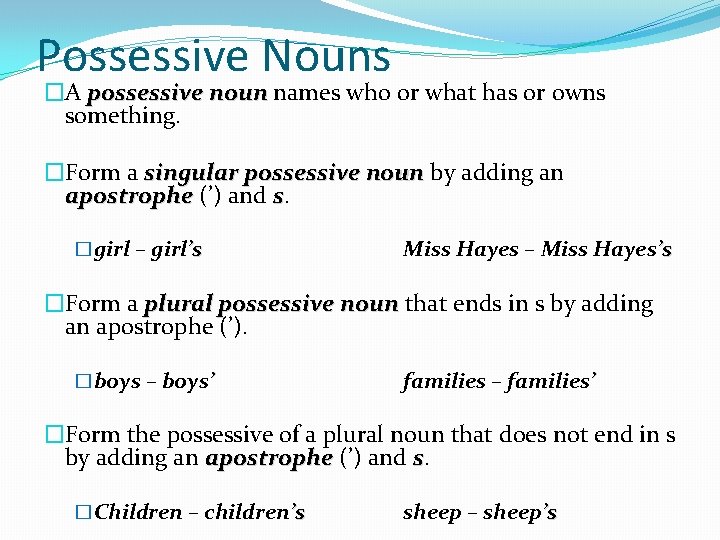
Possessive Nouns �A possessive noun names who or what has or owns something. �Form a singular possessive noun by adding an apostrophe (’) and s. �girl – girl’s Miss Hayes – Miss Hayes’s �Form a plural possessive noun that ends in s by adding an apostrophe (’). �boys – boys’ families – families’ �Form the possessive of a plural noun that does not end in s by adding an apostrophe (’) and s. �Children – children’s sheep – sheep’s
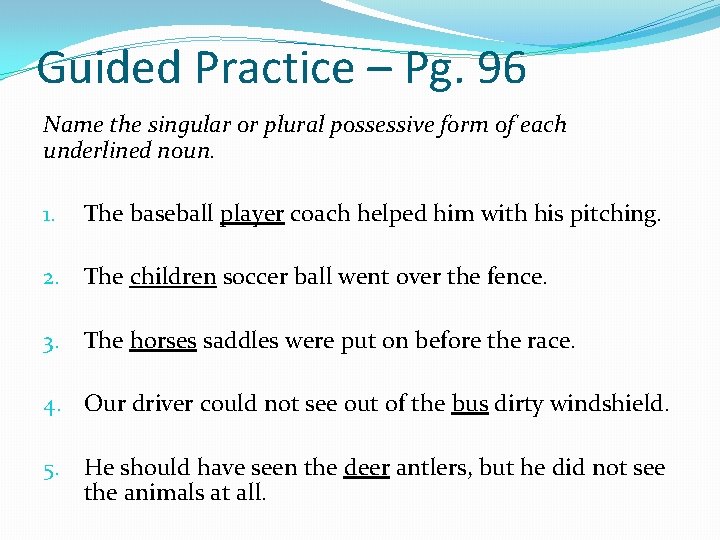
Guided Practice – Pg. 96 Name the singular or plural possessive form of each underlined noun. 1. The baseball player coach helped him with his pitching. 2. The children soccer ball went over the fence. 3. The horses saddles were put on before the race. 4. Our driver could not see out of the bus dirty windshield. 5. He should have seen the deer antlers, but he did not see the animals at all.
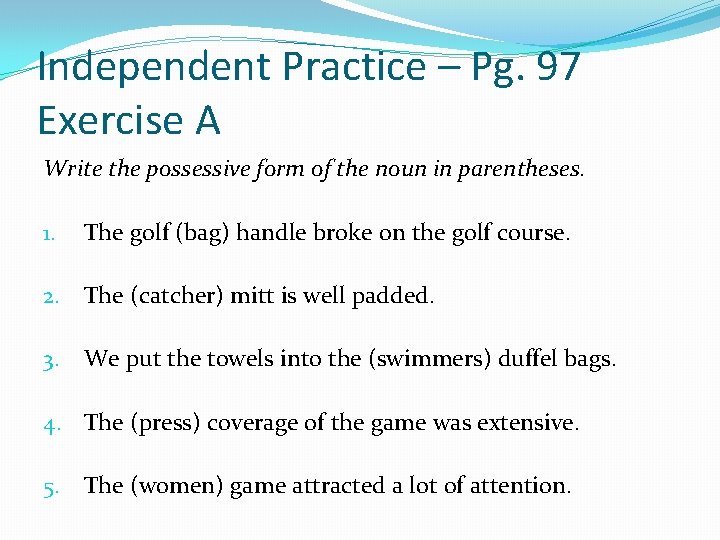
Independent Practice – Pg. 97 Exercise A Write the possessive form of the noun in parentheses. 1. The golf (bag) handle broke on the golf course. 2. The (catcher) mitt is well padded. 3. We put the towels into the (swimmers) duffel bags. 4. The (press) coverage of the game was extensive. 5. The (women) game attracted a lot of attention.
Objectives �I CAN learn capitalization rules and use them correctly.
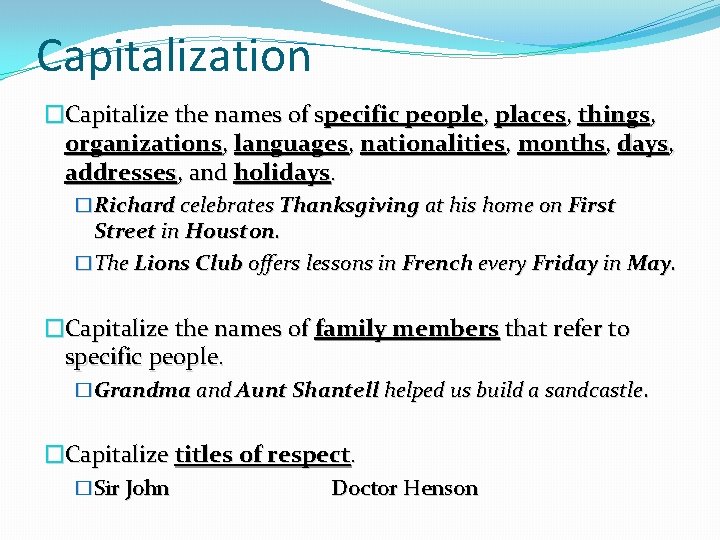
Capitalization �Capitalize the names of specific people, places, things, organizations, languages, nationalities, months, days, addresses, and holidays. �Richard celebrates Thanksgiving at his home on First Street in Houston. �The Lions Club offers lessons in French every Friday in May. �Capitalize the names of family members that refer to specific people. �Grandma and Aunt Shantell helped us build a sandcastle. �Capitalize titles of respect. �Sir John Doctor Henson
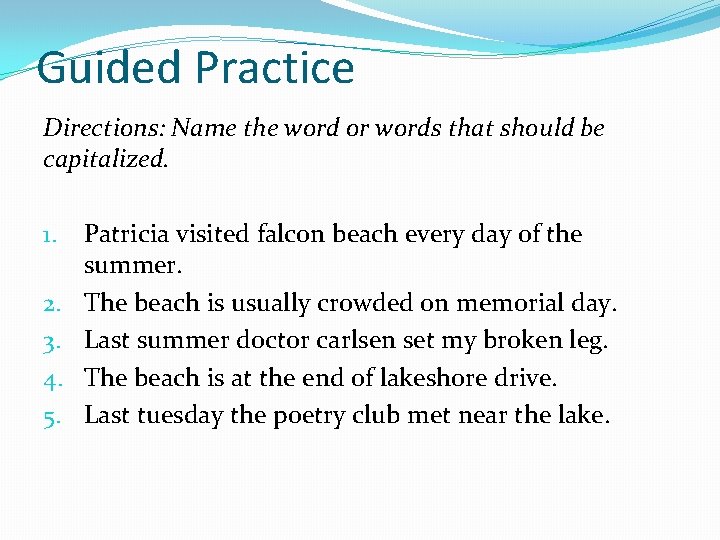
Guided Practice Directions: Name the word or words that should be capitalized. 1. 2. 3. 4. 5. Patricia visited falcon beach every day of the summer. The beach is usually crowded on memorial day. Last summer doctor carlsen set my broken leg. The beach is at the end of lakeshore drive. Last tuesday the poetry club met near the lake.
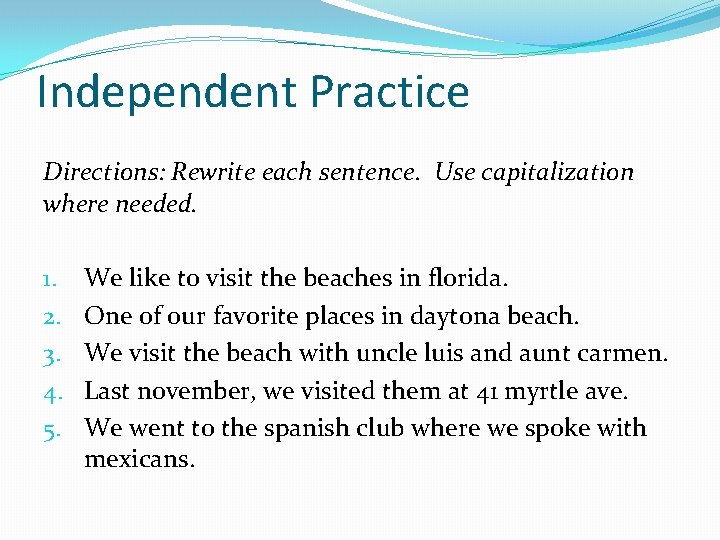
Independent Practice Directions: Rewrite each sentence. Use capitalization where needed. 1. 2. 3. 4. 5. We like to visit the beaches in florida. One of our favorite places in daytona beach. We visit the beach with uncle luis and aunt carmen. Last november, we visited them at 41 myrtle ave. We went to the spanish club where we spoke with mexicans.
Objectives �I CAN correctly identify appositives in sentences.
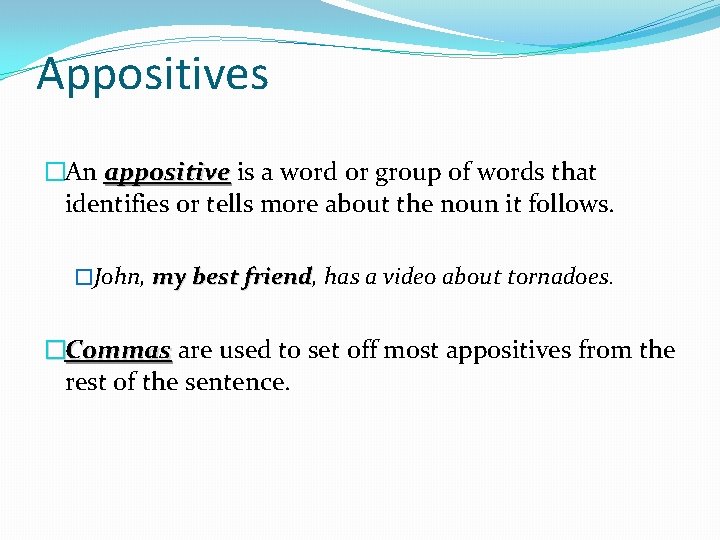
Appositives �An appositive is a word or group of words that identifies or tells more about the noun it follows. �John, my best friend, friend has a video about tornadoes. �Commas are used to set off most appositives from the rest of the sentence.
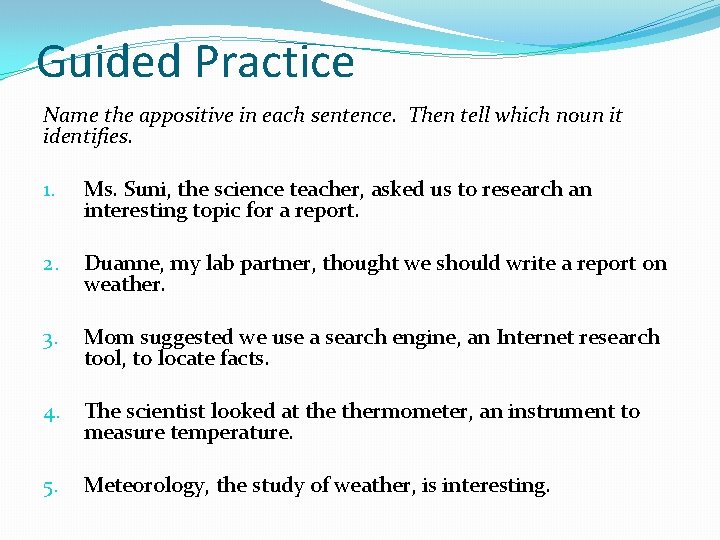
Guided Practice Name the appositive in each sentence. Then tell which noun it identifies. 1. Ms. Suni, the science teacher, asked us to research an interesting topic for a report. 2. Duanne, my lab partner, thought we should write a report on weather. 3. Mom suggested we use a search engine, an Internet research tool, to locate facts. 4. The scientist looked at thermometer, an instrument to measure temperature. 5. Meteorology, the study of weather, is interesting.
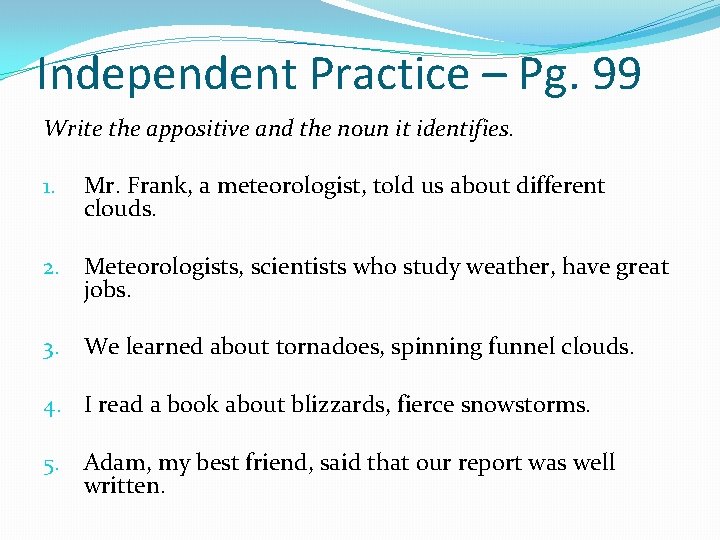
Independent Practice – Pg. 99 Write the appositive and the noun it identifies. 1. Mr. Frank, a meteorologist, told us about different clouds. 2. Meteorologists, scientists who study weather, have great jobs. 3. We learned about tornadoes, spinning funnel clouds. 4. I read a book about blizzards, fierce snowstorms. 5. Adam, my best friend, said that our report was well written.
Objectives �I CAN create sentences with compound subjects and compound objects.
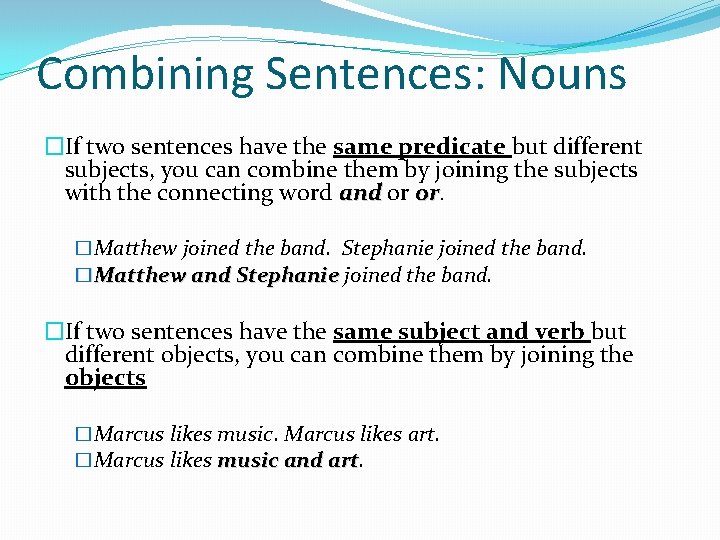
Combining Sentences: Nouns �If two sentences have the same predicate but different subjects, you can combine them by joining the subjects with the connecting word and or or. or �Matthew joined the band. Stephanie joined the band. �Matthew and Stephanie joined the band. �If two sentences have the same subject and verb but different objects, you can combine them by joining the objects �Marcus likes music. Marcus likes art. �Marcus likes music and art
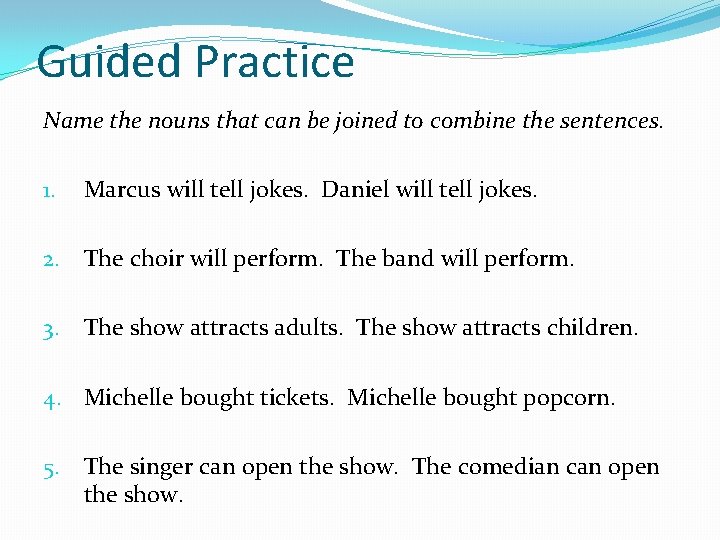
Guided Practice Name the nouns that can be joined to combine the sentences. 1. Marcus will tell jokes. Daniel will tell jokes. 2. The choir will perform. The band will perform. 3. The show attracts adults. The show attracts children. 4. Michelle bought tickets. Michelle bought popcorn. 5. The singer can open the show. The comedian can open the show.
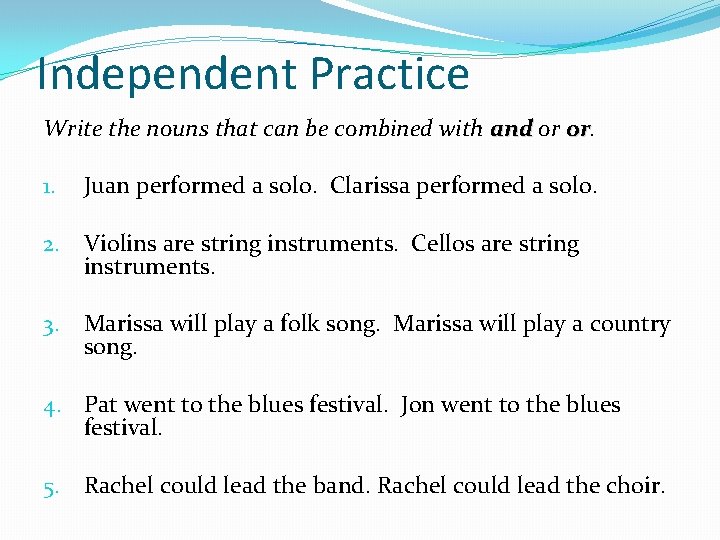
Independent Practice Write the nouns that can be combined with and or or. or 1. Juan performed a solo. Clarissa performed a solo. 2. Violins are string instruments. Cellos are string instruments. 3. Marissa will play a folk song. Marissa will play a country song. 4. Pat went to the blues festival. Jon went to the blues festival. 5. Rachel could lead the band. Rachel could lead the choir.
Objectives �I CAN write the titles of books, magazines, songs, plays, and other works correctly.
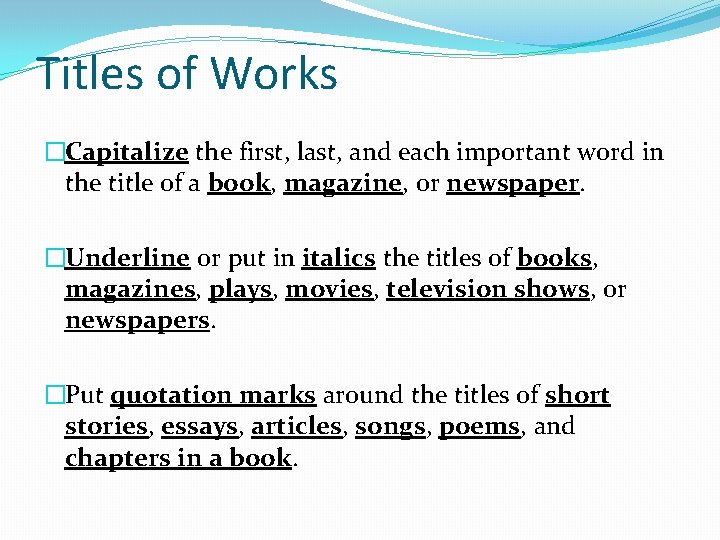
Titles of Works �Capitalize the first, last, and each important word in the title of a book, magazine, or newspaper. �Underline or put in italics the titles of books, magazines, plays, movies, television shows, or newspapers. �Put quotation marks around the titles of short stories, essays, articles, songs, poems, and chapters in a book.
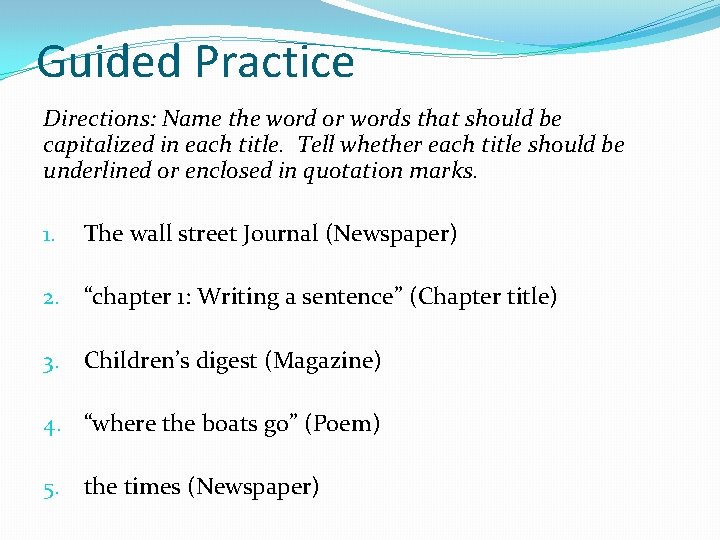
Guided Practice Directions: Name the word or words that should be capitalized in each title. Tell whether each title should be underlined or enclosed in quotation marks. 1. The wall street Journal (Newspaper) 2. “chapter 1: Writing a sentence” (Chapter title) 3. Children’s digest (Magazine) 4. “where the boats go” (Poem) 5. the times (Newspaper)
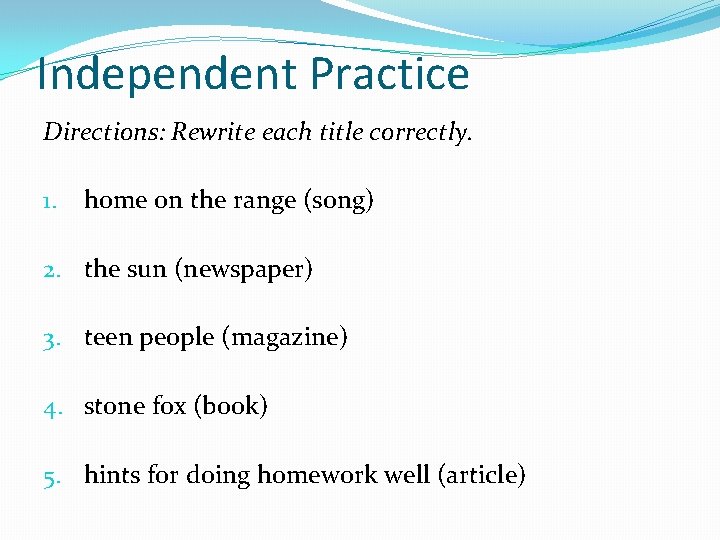
Independent Practice Directions: Rewrite each title correctly. 1. home on the range (song) 2. the sun (newspaper) 3. teen people (magazine) 4. stone fox (book) 5. hints for doing homework well (article)
- Slides: 39