
Noun A noun names a person a place









- Slides: 53
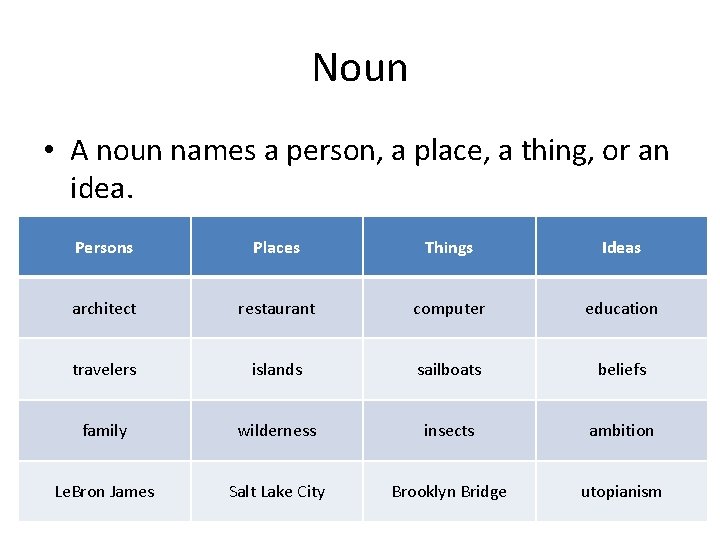
Noun • A noun names a person, a place, a thing, or an idea. Persons Places Things Ideas architect restaurant computer education travelers islands sailboats beliefs family wilderness insects ambition Le. Bron James Salt Lake City Brooklyn Bridge utopianism
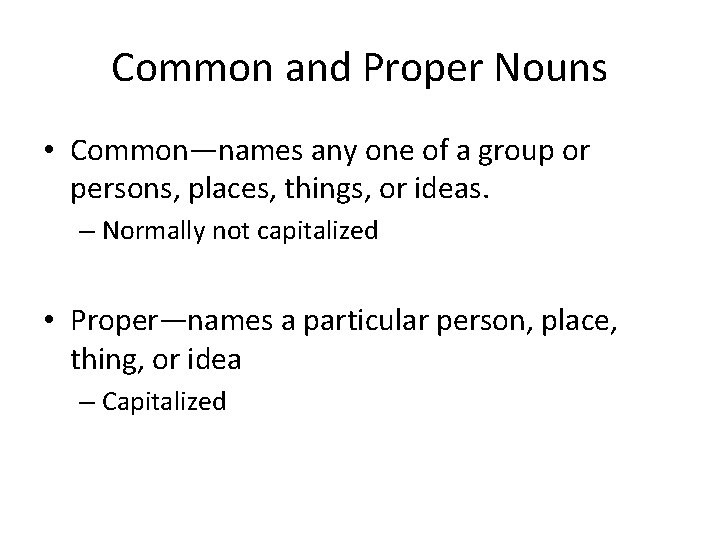
Common and Proper Nouns • Common—names any one of a group or persons, places, things, or ideas. – Normally not capitalized • Proper—names a particular person, place, thing, or idea – Capitalized
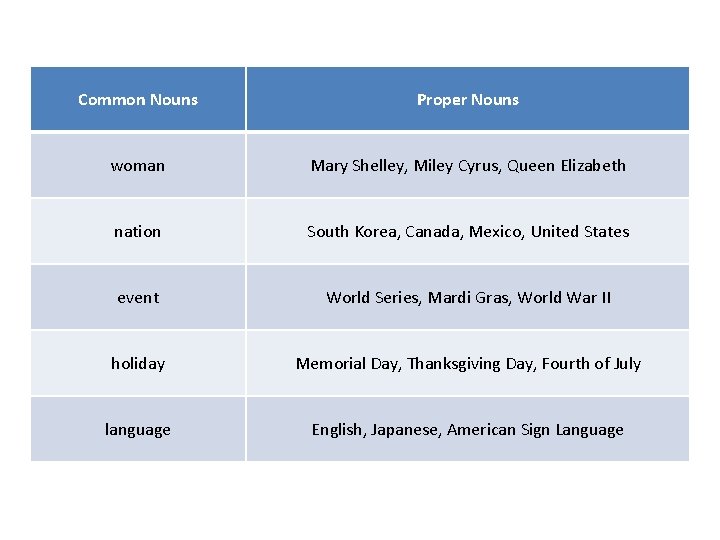
Common Nouns Proper Nouns woman Mary Shelley, Miley Cyrus, Queen Elizabeth nation South Korea, Canada, Mexico, United States event World Series, Mardi Gras, World War II holiday Memorial Day, Thanksgiving Day, Fourth of July language English, Japanese, American Sign Language
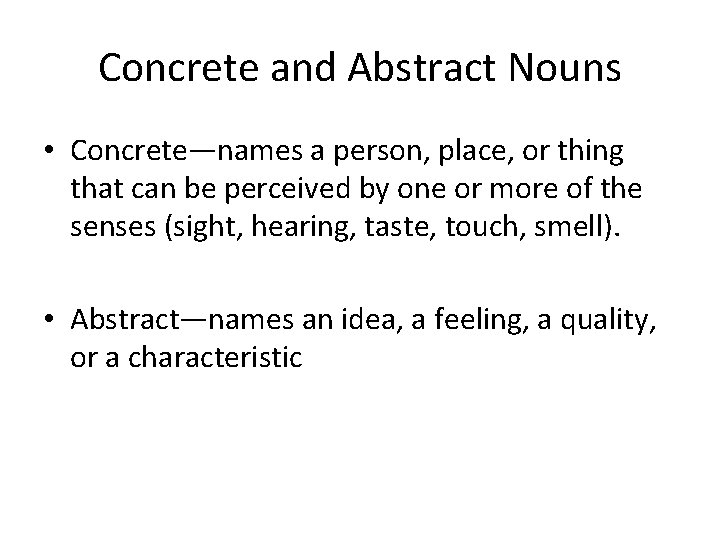
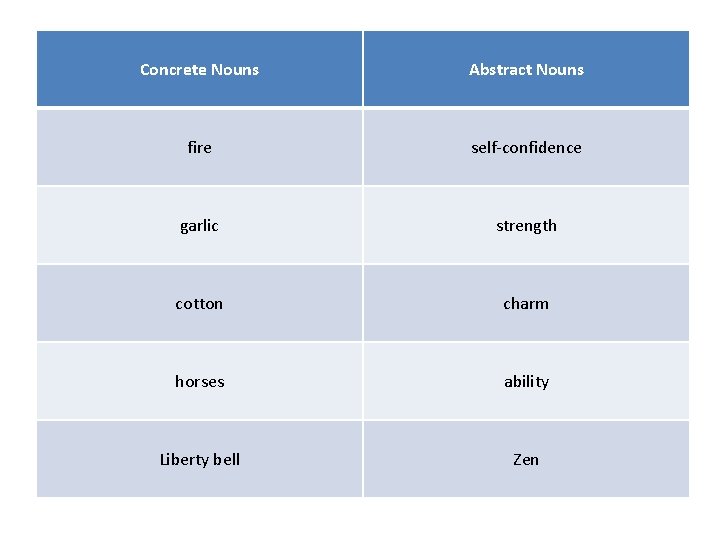
Concrete and Abstract Nouns • Concrete—names a person, place, or thing that can be perceived by one or more of the senses (sight, hearing, taste, touch, smell). • Abstract—names an idea, a feeling, a quality, or a characteristic
Concrete Nouns Abstract Nouns fire self-confidence garlic strength cotton charm horses ability Liberty bell Zen
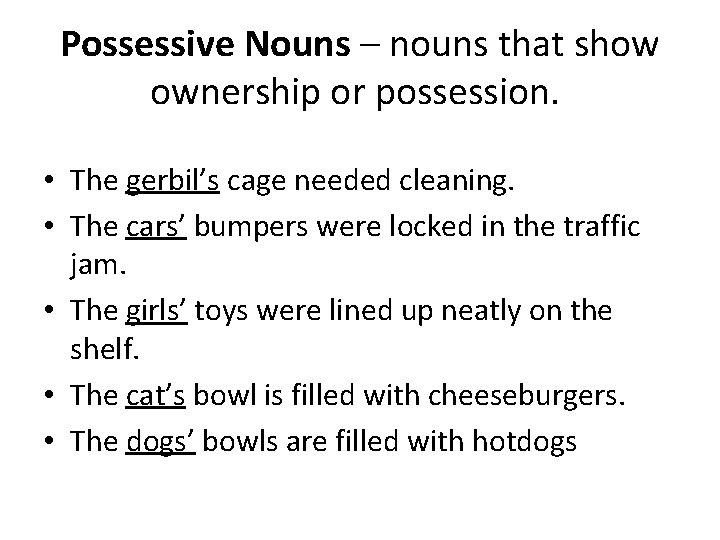
Possessive Nouns – nouns that show ownership or possession. • The gerbil’s cage needed cleaning. • The cars’ bumpers were locked in the traffic jam. • The girls’ toys were lined up neatly on the shelf. • The cat’s bowl is filled with cheeseburgers. • The dogs’ bowls are filled with hotdogs
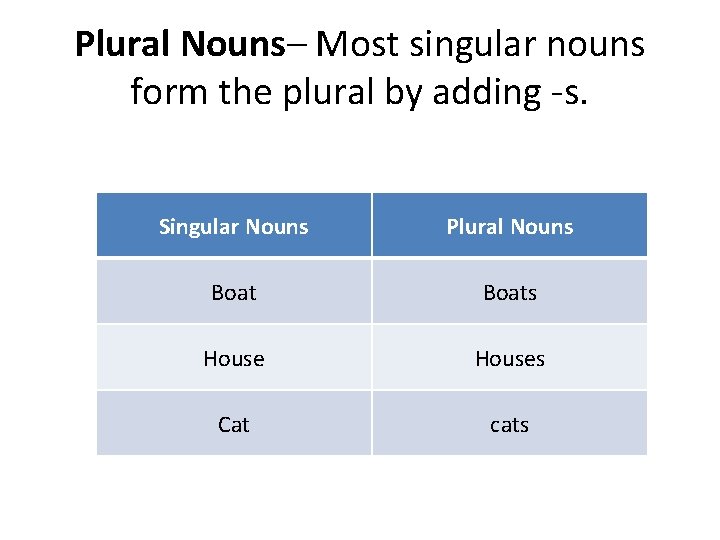
Plural Nouns– Most singular nouns form the plural by adding -s. Singular Nouns Plural Nouns Boats Houses Cat cats
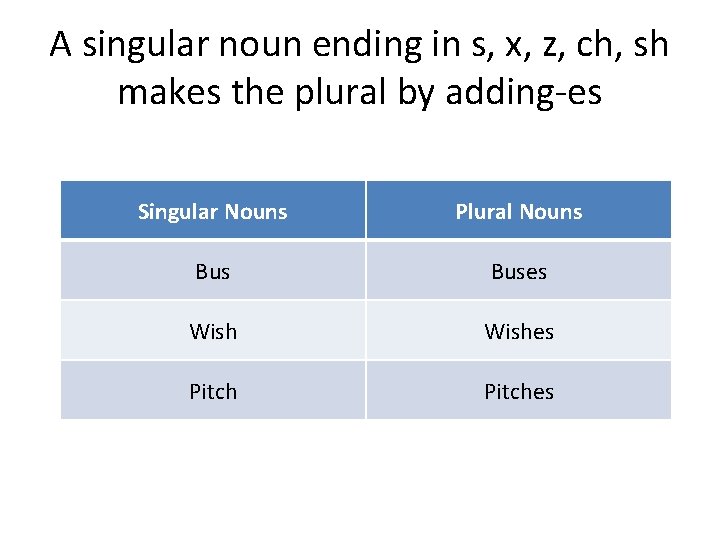
A singular noun ending in s, x, z, ch, sh makes the plural by adding-es Singular Nouns Plural Nouns Buses Wishes Pitches
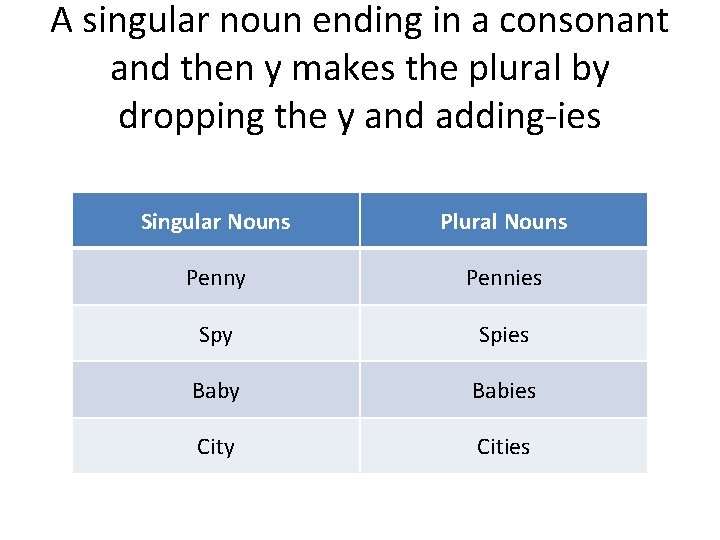
A singular noun ending in a consonant and then y makes the plural by dropping the y and adding-ies Singular Nouns Plural Nouns Penny Pennies Spy Spies Baby Babies City Cities
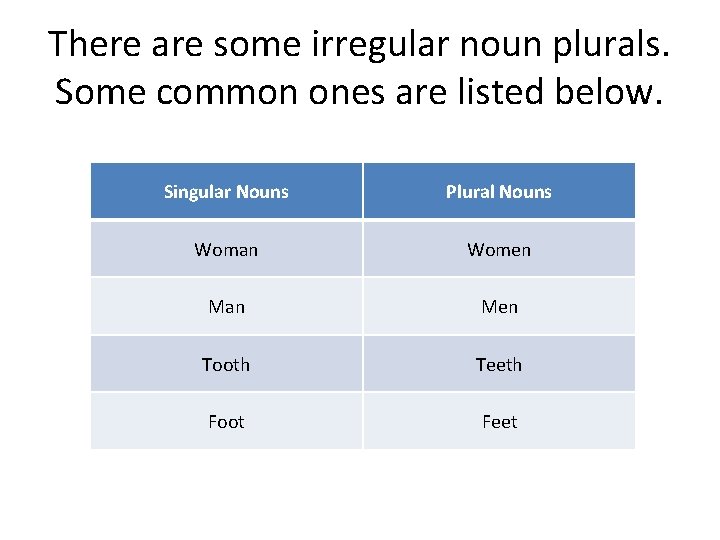
There are some irregular noun plurals. Some common ones are listed below. Singular Nouns Plural Nouns Woman Women Man Men Tooth Teeth Foot Feet
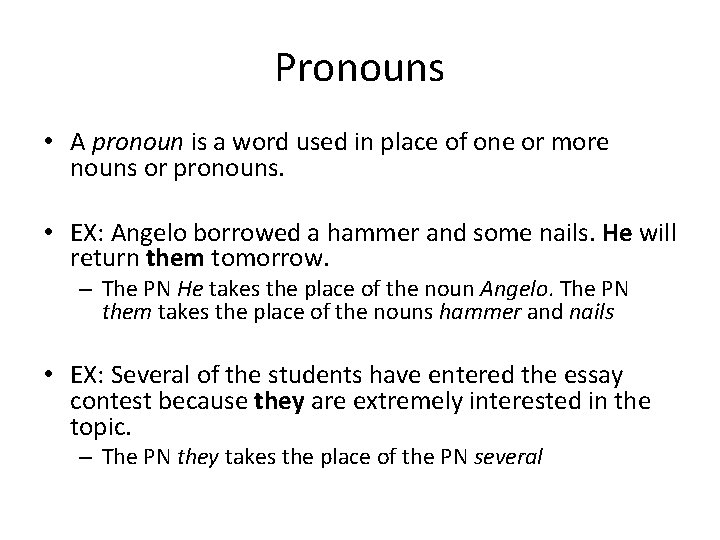
Pronouns • A pronoun is a word used in place of one or more nouns or pronouns. • EX: Angelo borrowed a hammer and some nails. He will return them tomorrow. – The PN He takes the place of the noun Angelo. The PN them takes the place of the nouns hammer and nails • EX: Several of the students have entered the essay contest because they are extremely interested in the topic. – The PN they takes the place of the PN several
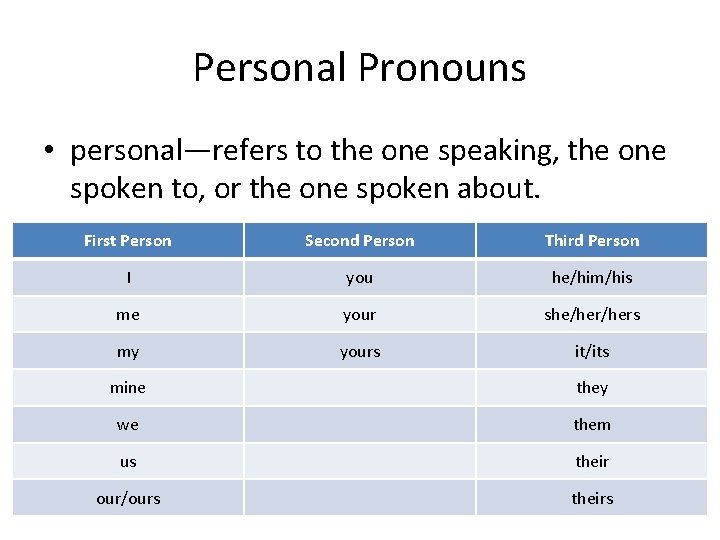
Personal Pronouns • personal—refers to the one speaking, the one spoken to, or the one spoken about. First Person Second Person Third Person I you he/him/his me your she/hers my yours it/its mine they we them us their our/ours theirs
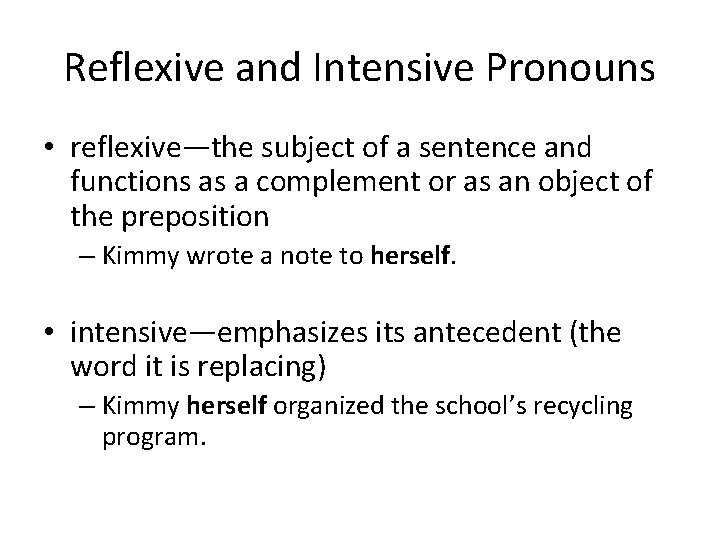
Reflexive and Intensive Pronouns • reflexive—the subject of a sentence and functions as a complement or as an object of the preposition – Kimmy wrote a note to herself. • intensive—emphasizes its antecedent (the word it is replacing) – Kimmy herself organized the school’s recycling program.
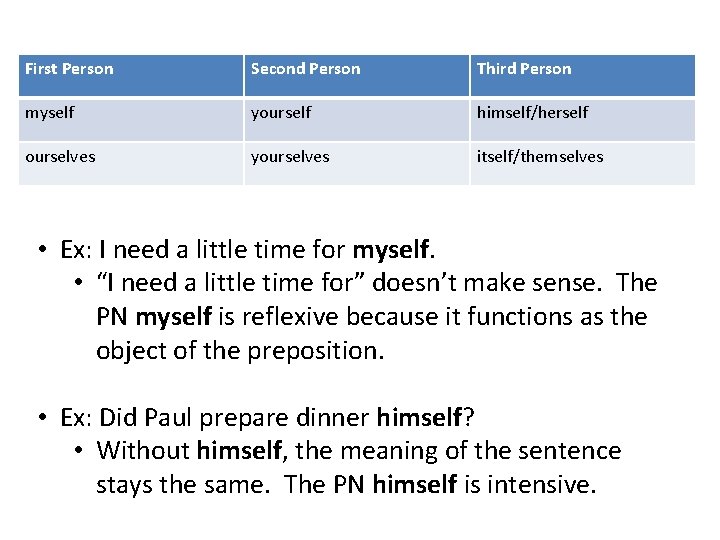
First Person Second Person Third Person myself yourself himself/herself ourselves yourselves itself/themselves • Ex: I need a little time for myself. • “I need a little time for” doesn’t make sense. The PN myself is reflexive because it functions as the object of the preposition. • Ex: Did Paul prepare dinner himself? • Without himself, the meaning of the sentence stays the same. The PN himself is intensive.
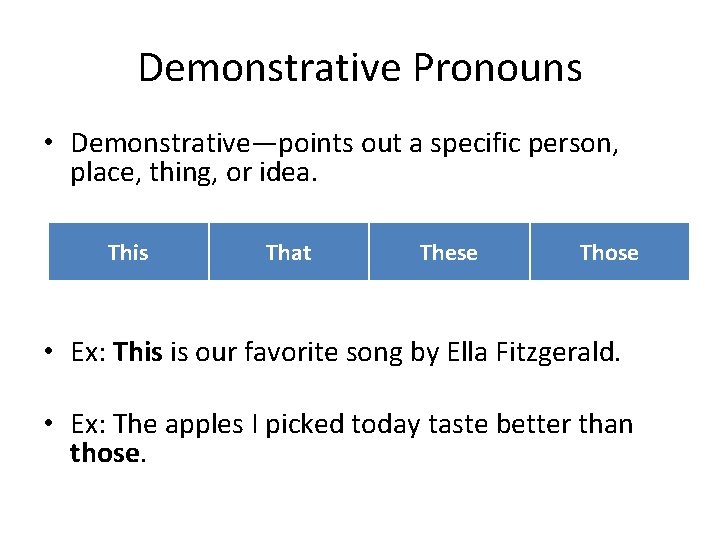
Demonstrative Pronouns • Demonstrative—points out a specific person, place, thing, or idea. This That These Those • Ex: This is our favorite song by Ella Fitzgerald. • Ex: The apples I picked today taste better than those.
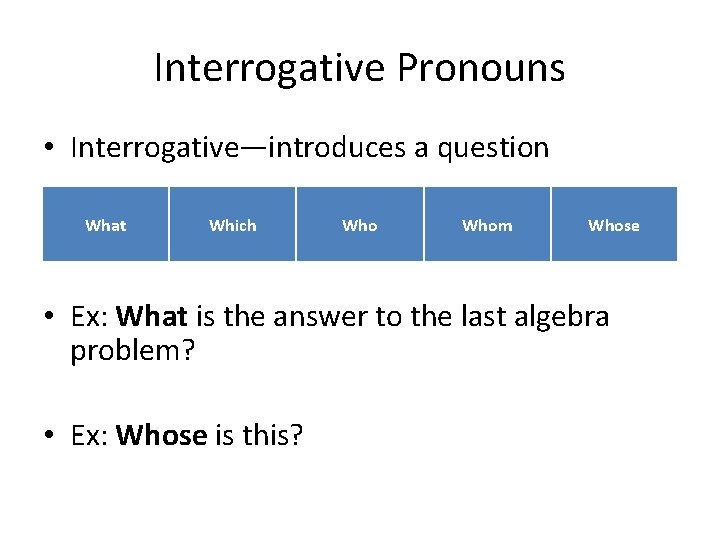
Interrogative Pronouns • Interrogative—introduces a question What Which Whom Whose • Ex: What is the answer to the last algebra problem? • Ex: Whose is this?
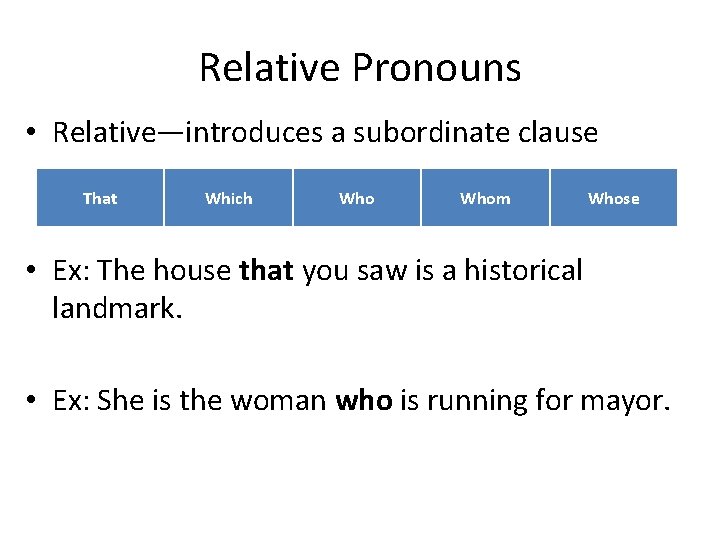
Relative Pronouns • Relative—introduces a subordinate clause That Which Whom Whose • Ex: The house that you saw is a historical landmark. • Ex: She is the woman who is running for mayor.
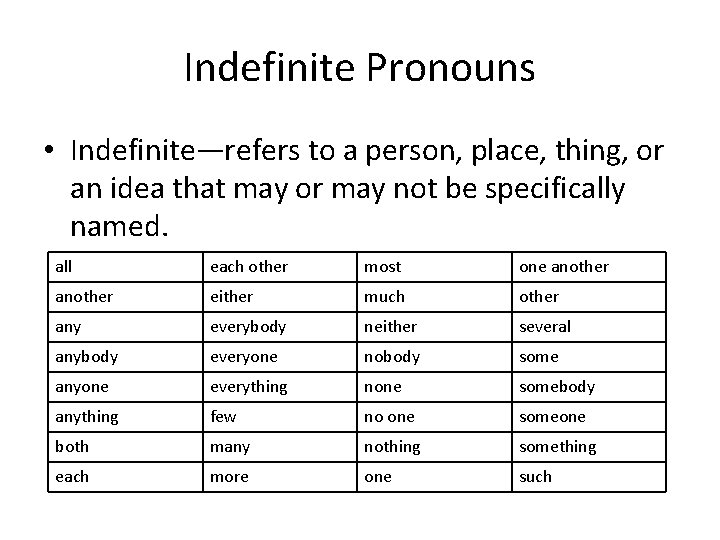
Indefinite Pronouns • Indefinite—refers to a person, place, thing, or an idea that may or may not be specifically named. all each other most one another either much other any everybody neither several anybody everyone nobody some anyone everything none somebody anything few no one someone both many nothing something each more one such
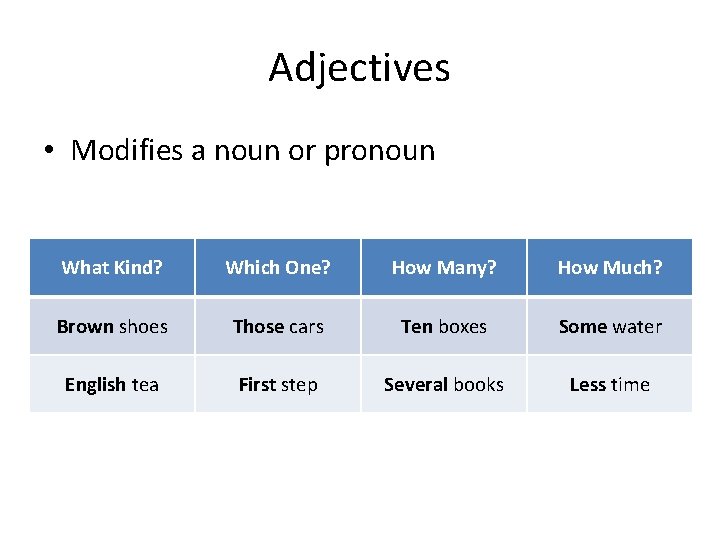
Adjectives • Modifies a noun or pronoun What Kind? Which One? How Many? How Much? Brown shoes Those cars Ten boxes Some water English tea First step Several books Less time
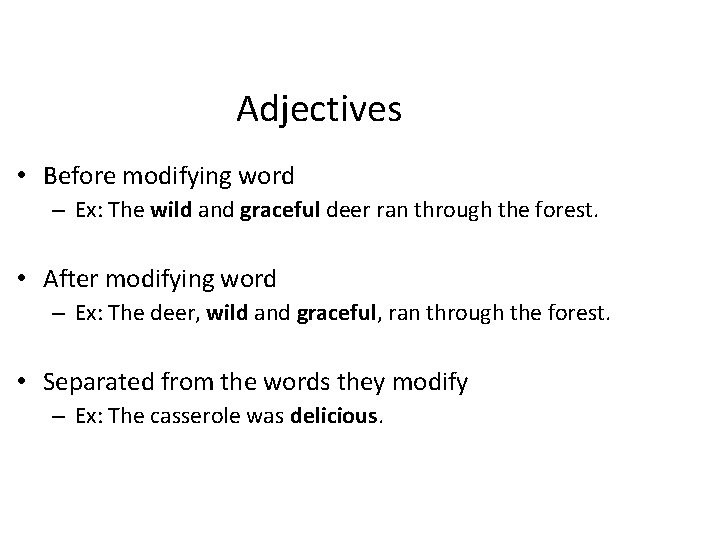
Adjectives • Before modifying word – Ex: The wild and graceful deer ran through the forest. • After modifying word – Ex: The deer, wild and graceful, ran through the forest. • Separated from the words they modify – Ex: The casserole was delicious.
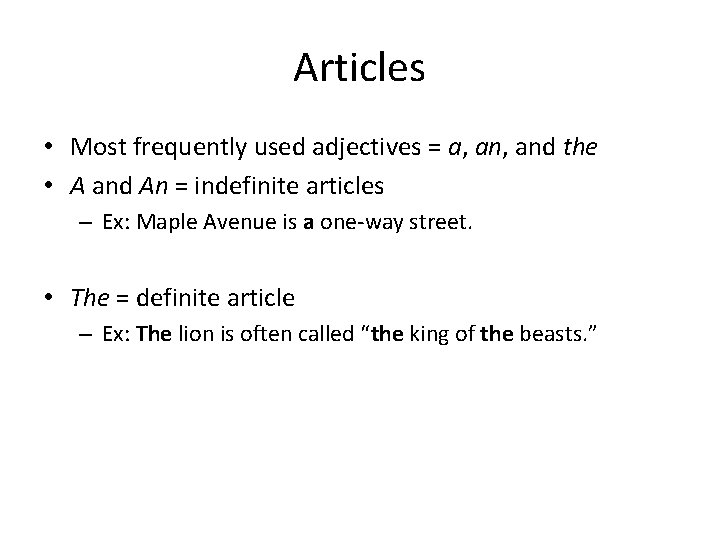
Articles • Most frequently used adjectives = a, and the • A and An = indefinite articles – Ex: Maple Avenue is a one-way street. • The = definite article – Ex: The lion is often called “the king of the beasts. ”
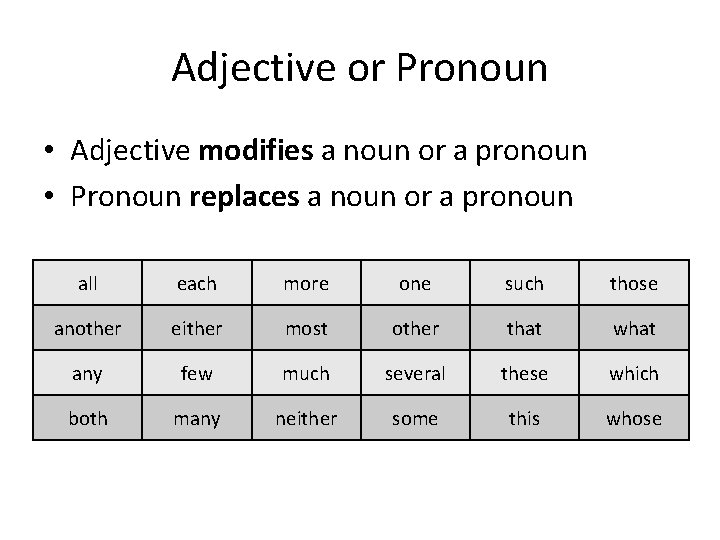
Adjective or Pronoun • Adjective modifies a noun or a pronoun • Pronoun replaces a noun or a pronoun all each more one such those another either most other that what any few much several these which both many neither some this whose
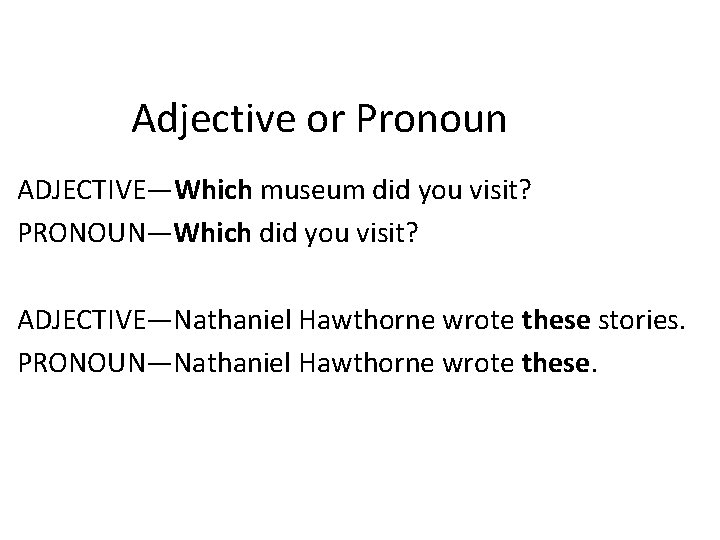
Adjective or Pronoun ADJECTIVE—Which museum did you visit? PRONOUN—Which did you visit? ADJECTIVE—Nathaniel Hawthorne wrote these stories. PRONOUN—Nathaniel Hawthorne wrote these.
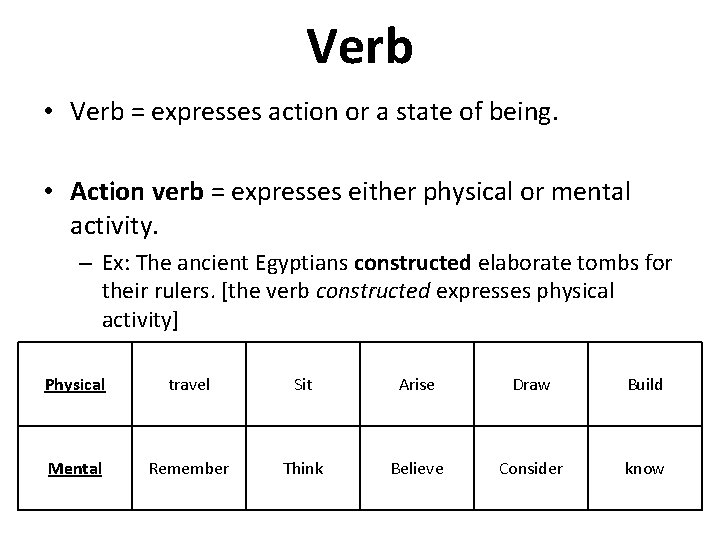
Verb • Verb = expresses action or a state of being. • Action verb = expresses either physical or mental activity. – Ex: The ancient Egyptians constructed elaborate tombs for their rulers. [the verb constructed expresses physical activity] Physical travel Sit Arise Draw Build Mental Remember Think Believe Consider know
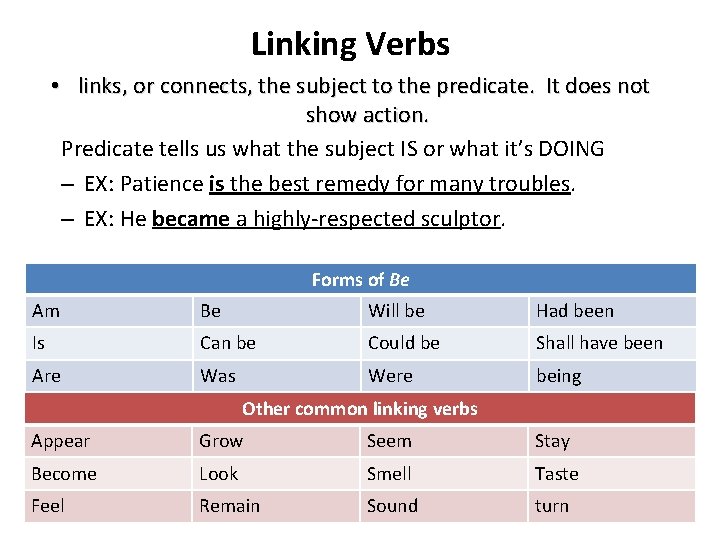
Linking Verbs • links, or connects, the subject to the predicate. It does not show action. Predicate tells us what the subject IS or what it’s DOING – EX: Patience is the best remedy for many troubles. – EX: He became a highly-respected sculptor. Forms of Be Am Be Will be Had been Is Can be Could be Shall have been Are Was Were being Other common linking verbs Appear Grow Seem Stay Become Look Smell Taste Feel Remain Sound turn
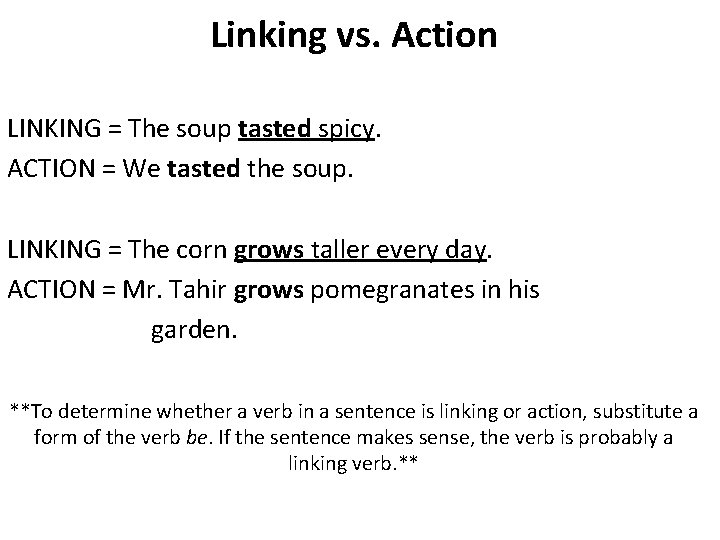
Linking vs. Action LINKING = The soup tasted spicy. ACTION = We tasted the soup. LINKING = The corn grows taller every day. ACTION = Mr. Tahir grows pomegranates in his garden. **To determine whether a verb in a sentence is linking or action, substitute a form of the verb be. If the sentence makes sense, the verb is probably a linking verb. **
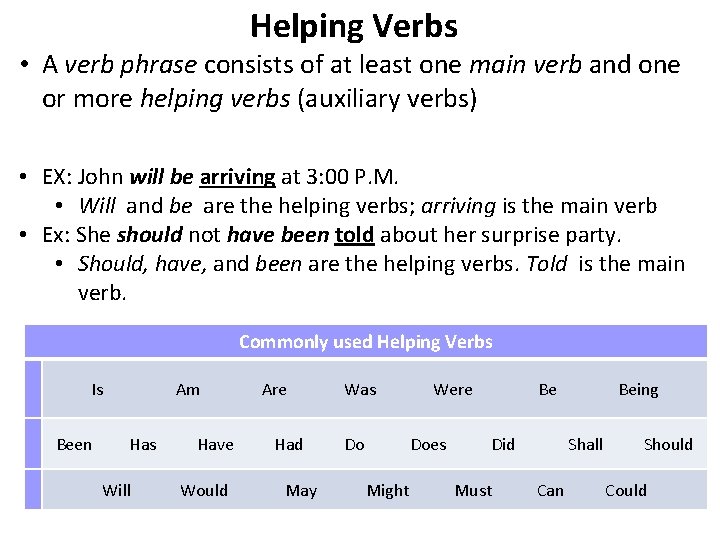
Helping Verbs • A verb phrase consists of at least one main verb and one or more helping verbs (auxiliary verbs) • EX: John will be arriving at 3: 00 P. M. • Will and be are the helping verbs; arriving is the main verb • Ex: She should not have been told about her surprise party. • Should, have, and been are the helping verbs. Told is the main verb. Commonly used Helping Verbs Is Been Am Has Will Have Would Are Had May Was Do Were Does Might Be Did Must Being Shall Can Should Could
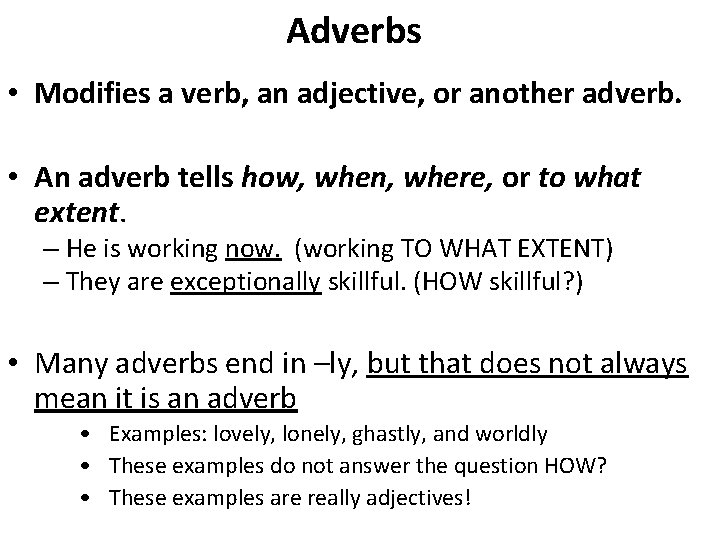
Adverbs • Modifies a verb, an adjective, or another adverb. • An adverb tells how, when, where, or to what extent. – He is working now. (working TO WHAT EXTENT) – They are exceptionally skillful. (HOW skillful? ) • Many adverbs end in –ly, but that does not always mean it is an adverb • Examples: lovely, lonely, ghastly, and worldly • These examples do not answer the question HOW? • These examples are really adjectives!
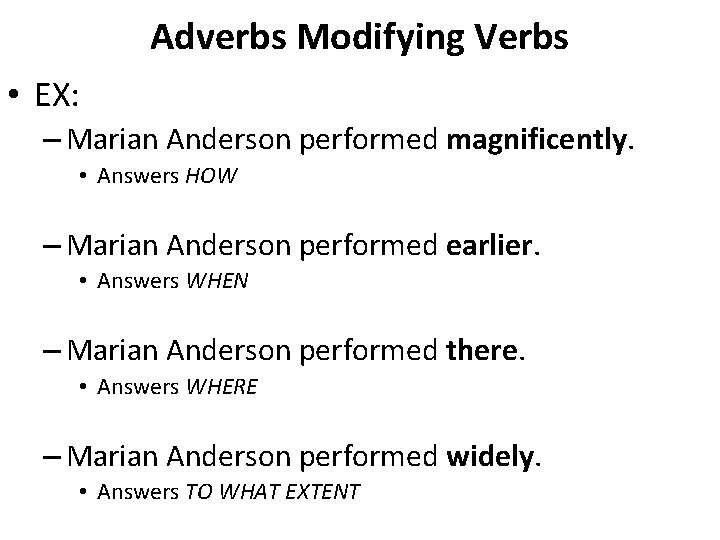
Adverbs Modifying Verbs • EX: – Marian Anderson performed magnificently. • Answers HOW – Marian Anderson performed earlier. • Answers WHEN – Marian Anderson performed there. • Answers WHERE – Marian Anderson performed widely. • Answers TO WHAT EXTENT
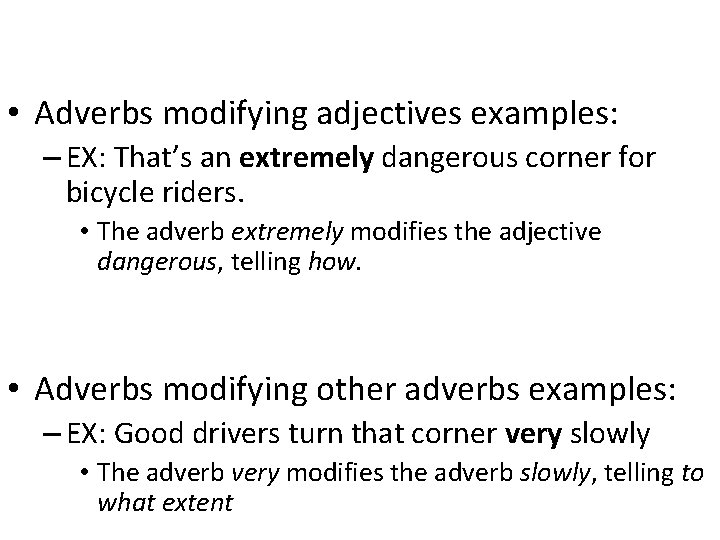
• Adverbs modifying adjectives examples: – EX: That’s an extremely dangerous corner for bicycle riders. • The adverb extremely modifies the adjective dangerous, telling how. • Adverbs modifying other adverbs examples: – EX: Good drivers turn that corner very slowly • The adverb very modifies the adverb slowly, telling to what extent
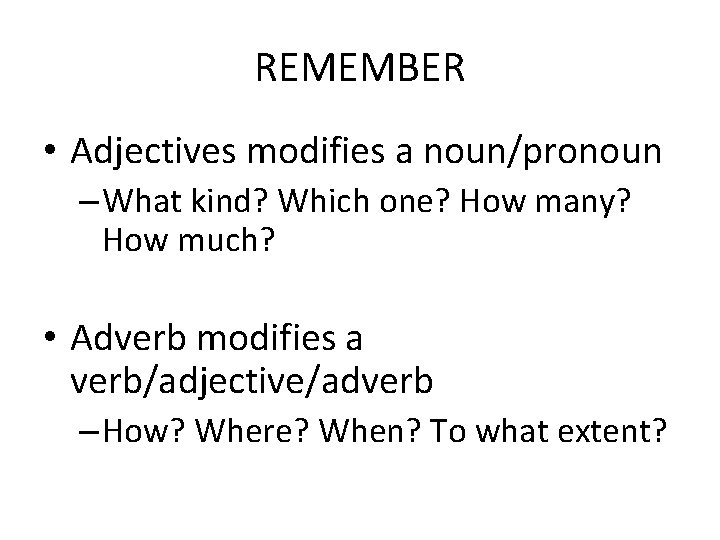
REMEMBER • Adjectives modifies a noun/pronoun – What kind? Which one? How many? How much? • Adverb modifies a verb/adjective/adverb – How? Where? When? To what extent?
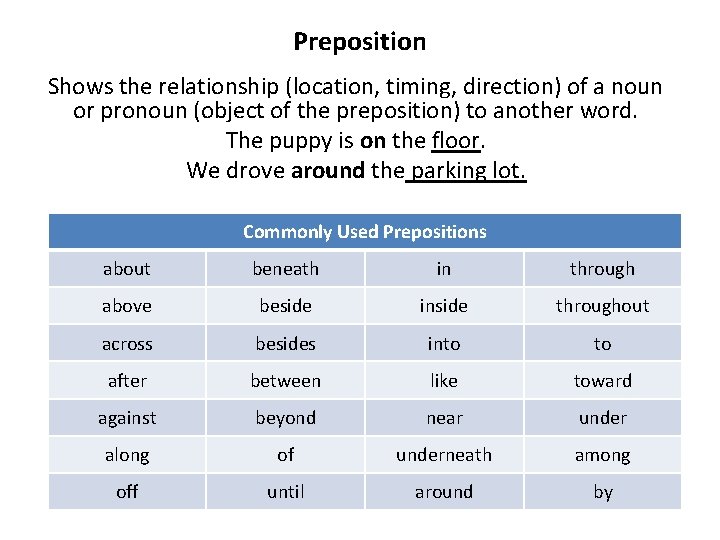
Preposition Shows the relationship (location, timing, direction) of a noun or pronoun (object of the preposition) to another word. The puppy is on the floor. We drove around the parking lot. Commonly Used Prepositions about beneath in through above beside inside throughout across besides into to after between like toward against beyond near under along of underneath among off until around by
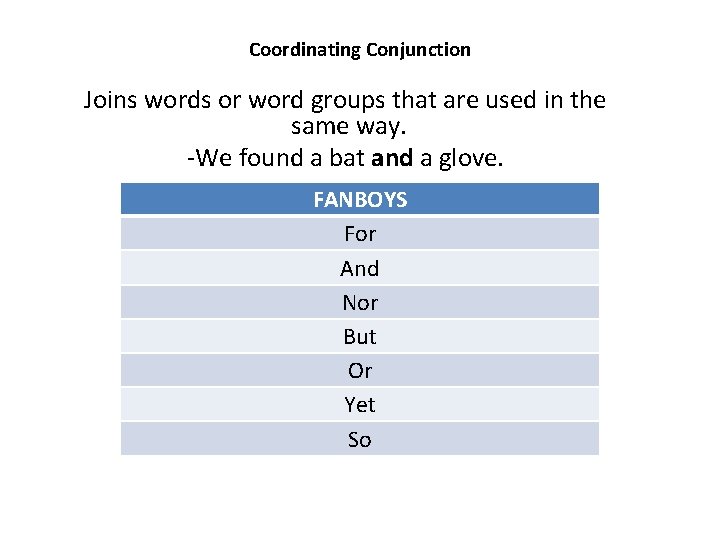
Coordinating Conjunction Joins words or word groups that are used in the same way. -We found a bat and a glove. FANBOYS For And Nor But Or Yet So
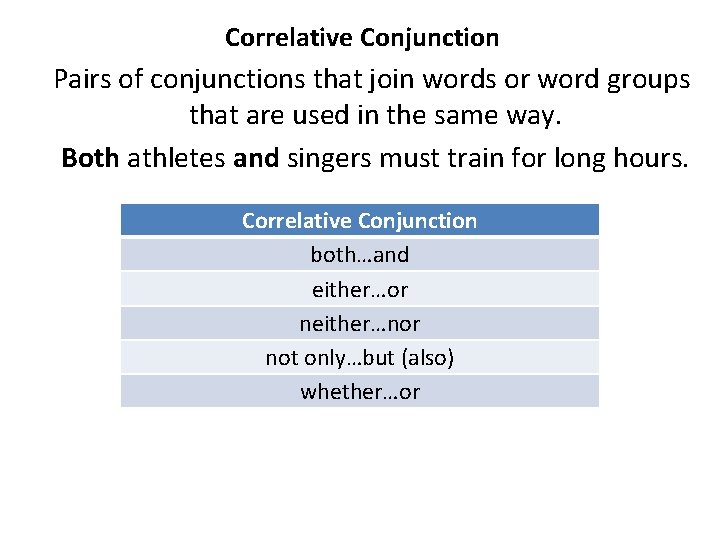
Correlative Conjunction Pairs of conjunctions that join words or word groups that are used in the same way. Both athletes and singers must train for long hours. Correlative Conjunction both…and either…or neither…nor not only…but (also) whether…or
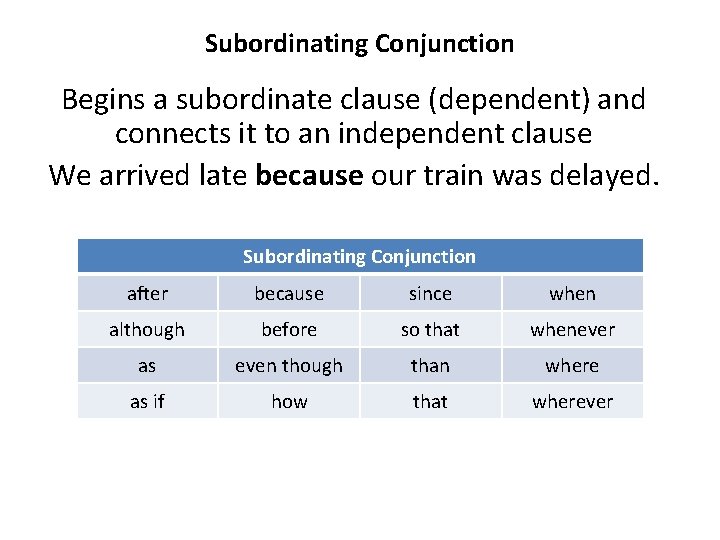
Subordinating Conjunction Begins a subordinate clause (dependent) and connects it to an independent clause We arrived late because our train was delayed. Subordinating Conjunction after because since when although before so that whenever as even though than where as if how that wherever
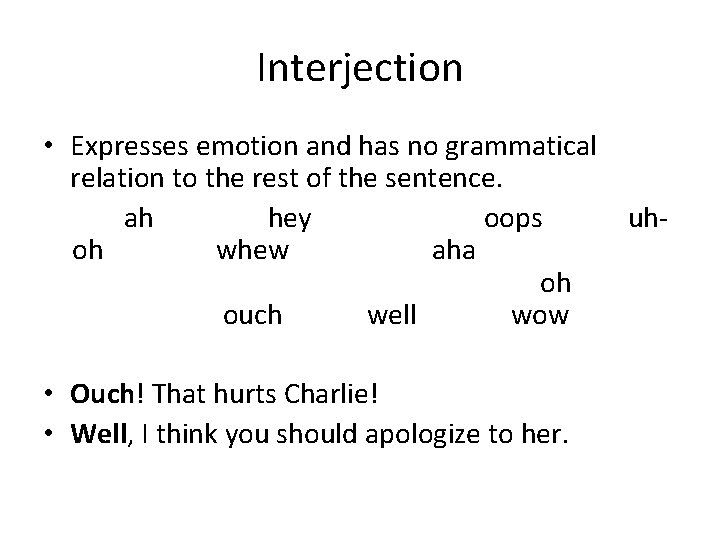
Interjection • Expresses emotion and has no grammatical relation to the rest of the sentence. ah hey oops uhoh whew aha oh ouch well wow • Ouch! That hurts Charlie! • Well, I think you should apologize to her.
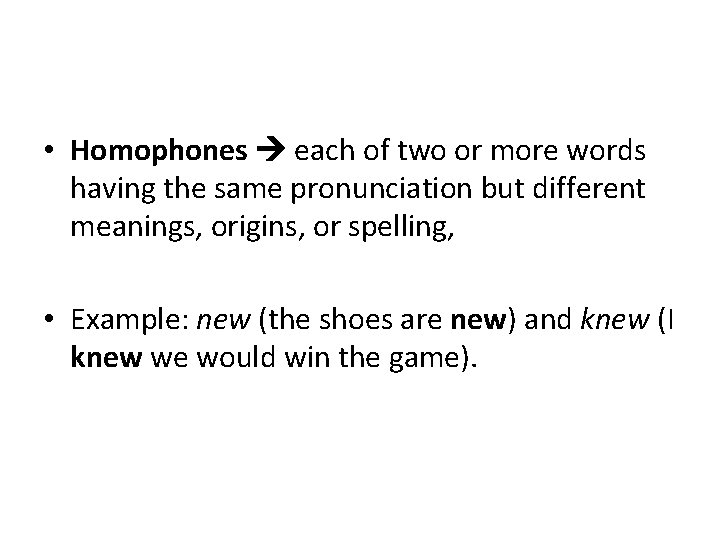
• Homophones each of two or more words having the same pronunciation but different meanings, origins, or spelling, • Example: new (the shoes are new) and knew (I knew we would win the game).
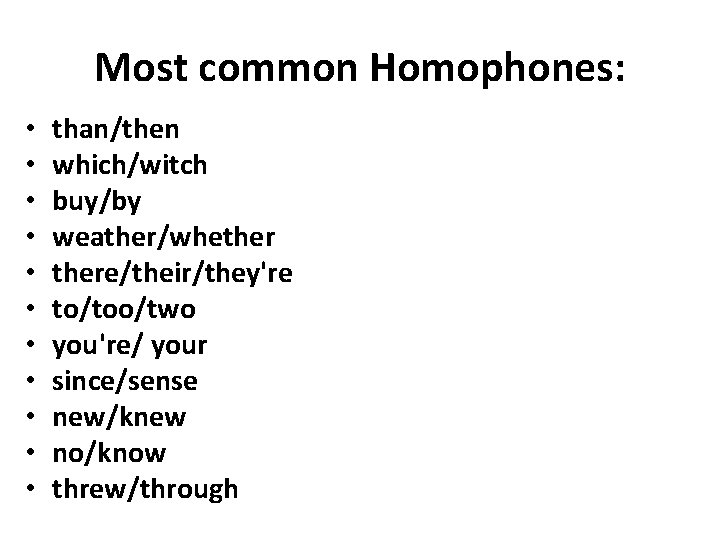
Most common Homophones: • • • than/then which/witch buy/by weather/whethere/their/they're to/too/two you're/ your since/sense new/knew no/know threw/through
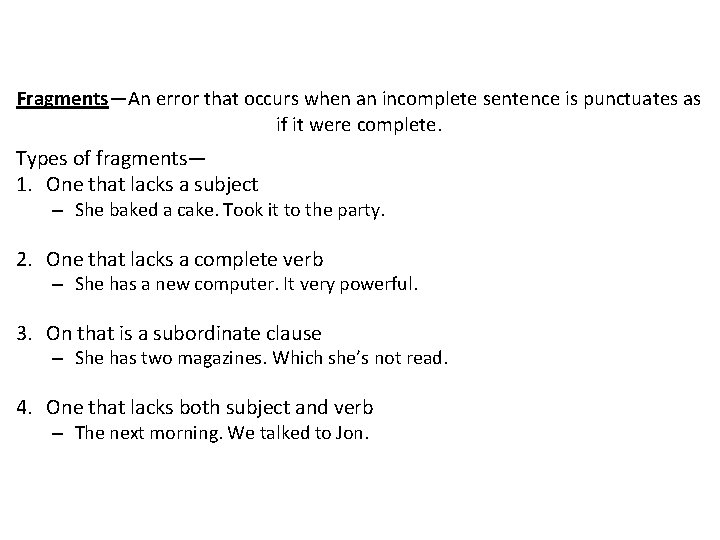
Fragments—An error that occurs when an incomplete sentence is punctuates as if it were complete. Types of fragments— 1. One that lacks a subject – She baked a cake. Took it to the party. 2. One that lacks a complete verb – She has a new computer. It very powerful. 3. On that is a subordinate clause – She has two magazines. Which she’s not read. 4. One that lacks both subject and verb – The next morning. We talked to Jon.
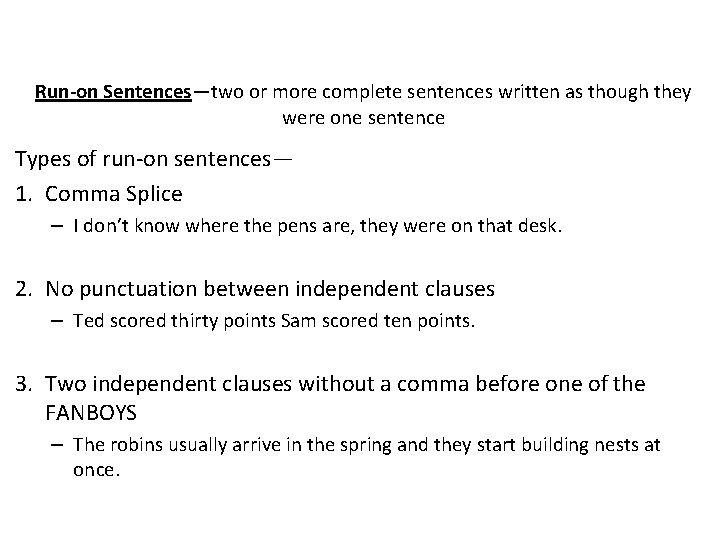
Run-on Sentences—two or more complete sentences written as though they were one sentence Types of run-on sentences— 1. Comma Splice – I don’t know where the pens are, they were on that desk. 2. No punctuation between independent clauses – Ted scored thirty points Sam scored ten points. 3. Two independent clauses without a comma before one of the FANBOYS – The robins usually arrive in the spring and they start building nests at once.
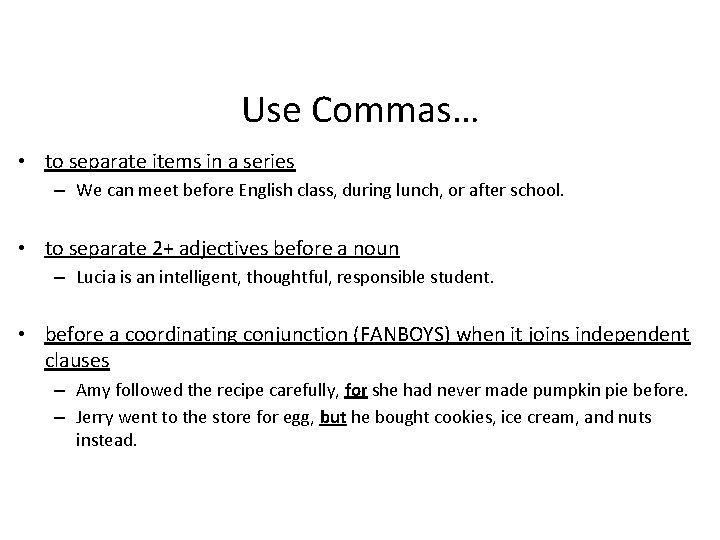
Use Commas… • to separate items in a series – We can meet before English class, during lunch, or after school. • to separate 2+ adjectives before a noun – Lucia is an intelligent, thoughtful, responsible student. • before a coordinating conjunction (FANBOYS) when it joins independent clauses – Amy followed the recipe carefully, for she had never made pumpkin pie before. – Jerry went to the store for egg, but he bought cookies, ice cream, and nuts instead.
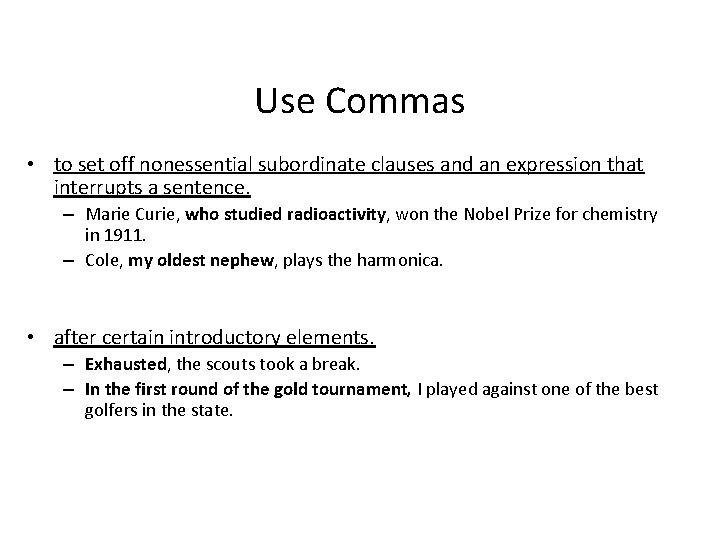
Use Commas • to set off nonessential subordinate clauses and an expression that interrupts a sentence. – Marie Curie, who studied radioactivity, won the Nobel Prize for chemistry in 1911. – Cole, my oldest nephew, plays the harmonica. • after certain introductory elements. – Exhausted, the scouts took a break. – In the first round of the gold tournament, I played against one of the best golfers in the state.
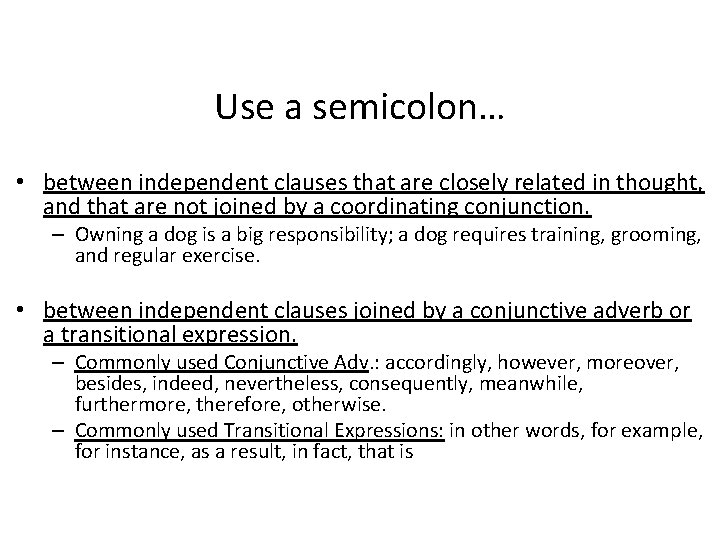
Use a semicolon… • between independent clauses that are closely related in thought, and that are not joined by a coordinating conjunction. – Owning a dog is a big responsibility; a dog requires training, grooming, and regular exercise. • between independent clauses joined by a conjunctive adverb or a transitional expression. – Commonly used Conjunctive Adv. : accordingly, however, moreover, besides, indeed, nevertheless, consequently, meanwhile, furthermore, therefore, otherwise. – Commonly used Transitional Expressions: in other words, for example, for instance, as a result, in fact, that is
Use a semicolon… • between items in a series if the items contain commas. – The collection of short stories includes “The Circuit, ” by Francisco Jimenez; “The Iguana Killer, ” by Alberto Rios; and “Everybody knows Tobie, ” by Daniel Garza.
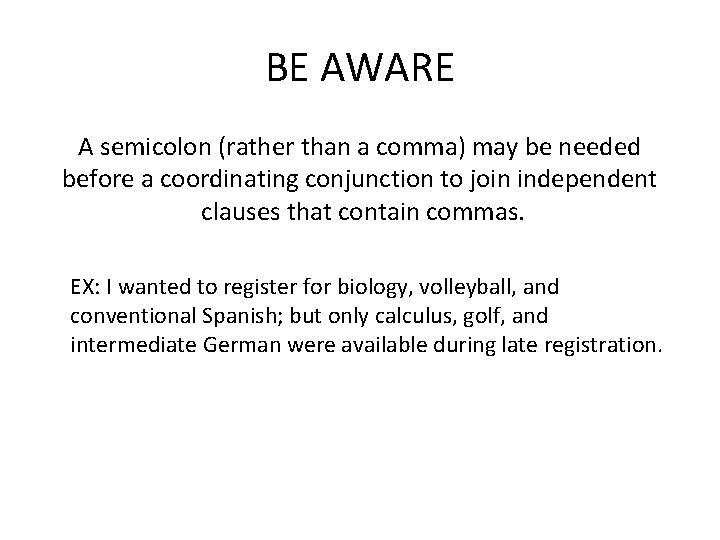
BE AWARE A semicolon (rather than a comma) may be needed before a coordinating conjunction to join independent clauses that contain commas. EX: I wanted to register for biology, volleyball, and conventional Spanish; but only calculus, golf, and intermediate German were available during late registration.