
Nottingham and Nottinghamshire Integrated Care System ICS People




- Slides: 26
Nottingham and Nottinghamshire Integrated Care System (ICS) People and Culture Strategy 2019 - 2029
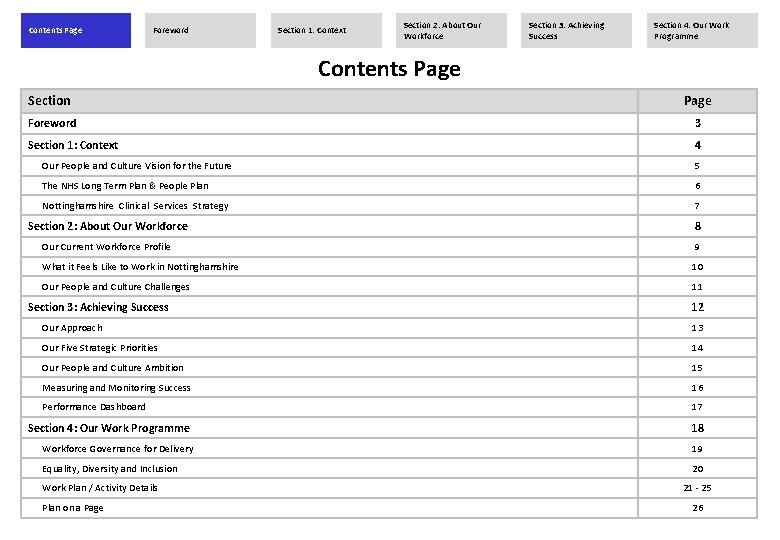
Contents Page Foreword Section 1: Context Section 2: About Our Workforce Section 3: Achieving Success Section 4: Our Work Programme Contents Page Section Page Foreword 3 Section 1: Context 4 Our People and Culture Vision for the Future 5 The NHS Long Term Plan & People Plan 6 Nottinghamshire Clinical Services Strategy 7 Section 2: About Our Workforce 8 Our Current Workforce Profile 9 What it Feels Like to Work in Nottinghamshire 10 Our People and Culture Challenges 11 Section 3: Achieving Success 12 Our Approach 13 Our Five Strategic Priorities 14 Our People and Culture Ambition 15 Measuring and Monitoring Success 16 Performance Dashboard 17 Section 4: Our Work Programme 18 Workforce Governance for Delivery 19 Equality, Diversity and Inclusion 20 Work Plan / Activity Details Plan on a Page 21 - 25 26
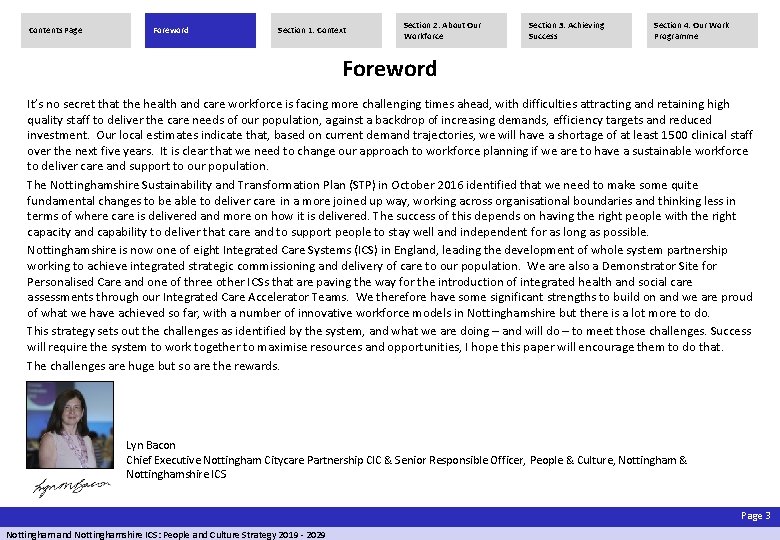
Contents Page Foreword Section 1: Context Section 2: About Our Workforce Section 3: Achieving Success Section 4: Our Work Programme Foreword It’s no secret that the health and care workforce is facing more challenging times ahead, with difficulties attracting and retaining high quality staff to deliver the care needs of our population, against a backdrop of increasing demands, efficiency targets and reduced investment. Our local estimates indicate that, based on current demand trajectories, we will have a shortage of at least 1500 clinical staff over the next five years. It is clear that we need to change our approach to workforce planning if we are to have a sustainable workforce to deliver care and support to our population. The Nottinghamshire Sustainability and Transformation Plan (STP) in October 2016 identified that we need to make some quite fundamental changes to be able to deliver care in a more joined up way, working across organisational boundaries and thinking less in terms of where care is delivered and more on how it is delivered. The success of this depends on having the right people with the right capacity and capability to deliver that care and to support people to stay well and independent for as long as possible. Nottinghamshire is now one of eight Integrated Care Systems (ICS) in England, leading the development of whole system partnership working to achieve integrated strategic commissioning and delivery of care to our population. We are also a Demonstrator Site for Personalised Care and one of three other ICSs that are paving the way for the introduction of integrated health and social care assessments through our Integrated Care Accelerator Teams. We therefore have some significant strengths to build on and we are proud of what we have achieved so far, with a number of innovative workforce models in Nottinghamshire but there is a lot more to do. This strategy sets out the challenges as identified by the system, and what we are doing – and will do – to meet those challenges. Success will require the system to work together to maximise resources and opportunities, I hope this paper will encourage them to do that. The challenges are huge but so are the rewards. Lyn Bacon Chief Executive Nottingham Citycare Partnership CIC & Senior Responsible Officer, People & Culture, Nottingham & Nottinghamshire ICS Page 3 Nottingham and Nottinghamshire ICS: People and Culture Strategy 2019 - 2029
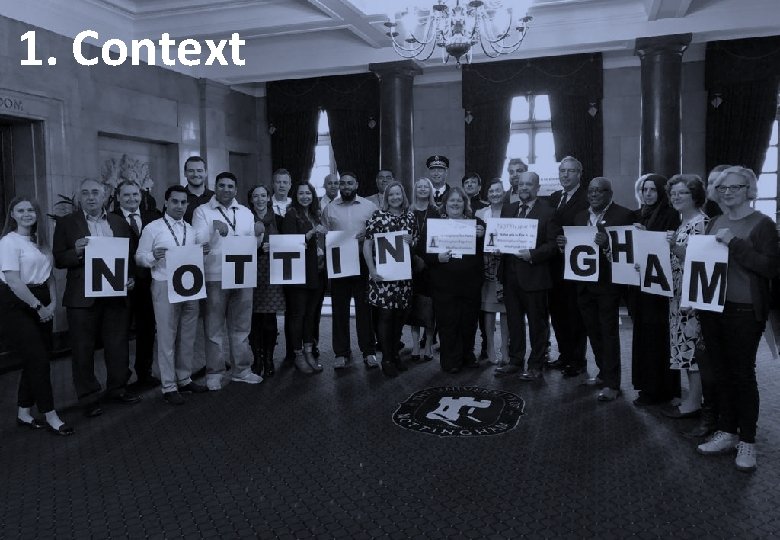
1. Context
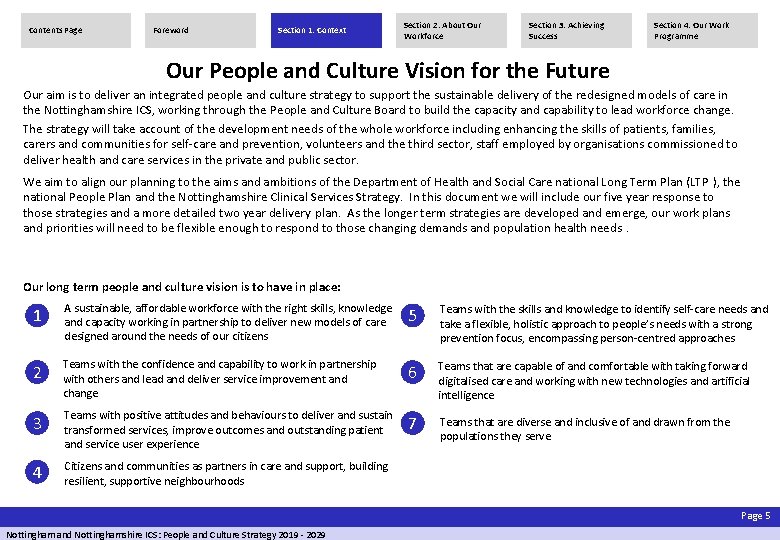
Contents Page Foreword Section 1: Context Section 2: About Our Workforce Section 3: Achieving Success Section 4: Our Work Programme Our People and Culture Vision for the Future Our aim is to deliver an integrated people and culture strategy to support the sustainable delivery of the redesigned models of care in the Nottinghamshire ICS, working through the People and Culture Board to build the capacity and capability to lead workforce change. The strategy will take account of the development needs of the whole workforce including enhancing the skills of patients, families, carers and communities for self-care and prevention, volunteers and the third sector, staff employed by organisations commissioned to deliver health and care services in the private and public sector. We aim to align our planning to the aims and ambitions of the Department of Health and Social Care national Long Term Plan (LTP ), the national People Plan and the Nottinghamshire Clinical Services Strategy. In this document we will include our five year response to those strategies and a more detailed two year delivery plan. As the longer term strategies are developed and emerge, our work plans and priorities will need to be flexible enough to respond to those changing demands and population health needs. Our long term people and culture vision is to have in place: 1 A sustainable, affordable workforce with the right skills, knowledge and capacity working in partnership to deliver new models of care designed around the needs of our citizens 5 Teams with the skills and knowledge to identify self-care needs and take a flexible, holistic approach to people’s needs with a strong prevention focus, encompassing person-centred approaches 2 Teams with the confidence and capability to work in partnership with others and lead and deliver service improvement and change 6 Teams that are capable of and comfortable with taking forward digitalised care and working with new technologies and artificial intelligence 3 Teams with positive attitudes and behaviours to deliver and sustain transformed services, improve outcomes and outstanding patient and service user experience 7 Teams that are diverse and inclusive of and drawn from the populations they serve 4 Citizens and communities as partners in care and support, building resilient, supportive neighbourhoods Page 5 Nottingham and Nottinghamshire ICS: People and Culture Strategy 2019 - 2029
Contents Page Foreword Section 1: Context Section 2: About Our Workforce Section 3: Achieving Success Section 4: Our Work Programme The NHS Long Term Plan The Long Term Plan (LTP) sets out five practical changes to achieve the its ambitions: 1. We will boost ‘out-of-hospital’ care, and finally dissolve the historic divide between primary and community health services 2. The NHS will redesign and reduce pressure on emergency hospital services 3. People will get more control over their own health, and more personalised care when they need it 4. Digitally-enabled primary and outpatient care will go mainstream across the NHS 5. Local NHS organisations will increasingly focus on population health and local partnerships with local authority-funded services, through new Integrated Care Systems (ICSs) everywhere The People Plan will set out the objective to develop and deliver a plan to support the following strategic aims regarding people and culture that this Nottinghamshire strategy will support: Ensure we have enough people, with the right skills and experience, so that staff have the time they need to care for patients in the 21 st Century well with a particular focus on nursing • Ensure our people have rewarding jobs, work in a positive culture, with opportunities to develop their skills and use state of the art equipment, and have support to manage the complex and often stressful nature of delivering healthcare • Strengthen and support good, compassionate and diverse leadership at all levels – managerial and clinical – to meet the complex practical, financial and cultural challenges a successful workforce plan and Long Term Plan will demand • Developing a new operating model for workforce planning with systems taking greater responsibility Nottingham and Nottinghamshire ICS: People and Culture Strategy 2019 - 2029 Source: DOH, 2019 Available from: https: //www. longtermplan. nhs. uk/ Page 6
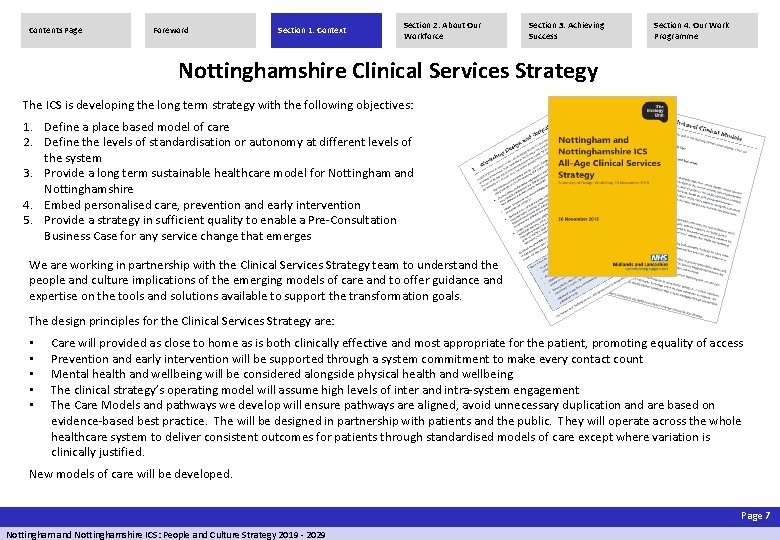
Contents Page Foreword Section 1: Context Section 2: About Our Workforce Section 3: Achieving Success Section 4: Our Work Programme Nottinghamshire Clinical Services Strategy The ICS is developing the long term strategy with the following objectives: 1. Define a place based model of care 2. Define the levels of standardisation or autonomy at different levels of the system 3. Provide a long term sustainable healthcare model for Nottingham and Nottinghamshire 4. Embed personalised care, prevention and early intervention 5. Provide a strategy in sufficient quality to enable a Pre-Consultation Business Case for any service change that emerges We are working in partnership with the Clinical Services Strategy team to understand the people and culture implications of the emerging models of care and to offer guidance and expertise on the tools and solutions available to support the transformation goals. The design principles for the Clinical Services Strategy are: • • • Care will provided as close to home as is both clinically effective and most appropriate for the patient, promoting equality of access Prevention and early intervention will be supported through a system commitment to make every contact count Mental health and wellbeing will be considered alongside physical health and wellbeing The clinical strategy’s operating model will assume high levels of inter and intra-system engagement The Care Models and pathways we develop will ensure pathways are aligned, avoid unnecessary duplication and are based on evidence-based best practice. The will be designed in partnership with patients and the public. They will operate across the whole healthcare system to deliver consistent outcomes for patients through standardised models of care except where variation is clinically justified. New models of care will be developed. Page 7 Nottingham and Nottinghamshire ICS: People and Culture Strategy 2019 - 2029
2. About Our Workforce
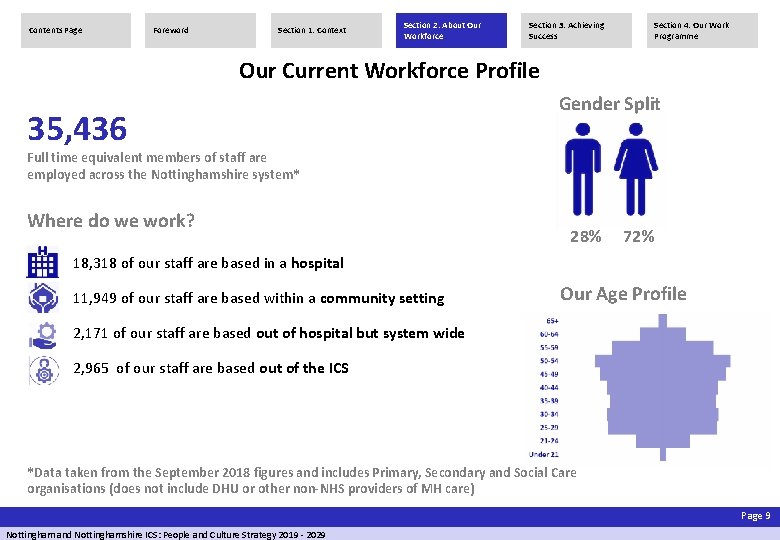
Contents Page Foreword Section 1: Context Section 2: About Our Workforce Section 3: Achieving Success Section 4: Our Work Programme Our Current Workforce Profile 35, 436 Gender Split Full time equivalent members of staff are employed across the Nottinghamshire system* Where do we work? 28% 72% 18, 318 of our staff are based in a hospital 11, 949 of our staff are based within a community setting Our Age Profile 2, 171 of our staff are based out of hospital but system wide 2, 965 of our staff are based out of the ICS *Data taken from the September 2018 figures and includes Primary, Secondary and Social Care organisations (does not include DHU or other non-NHS providers of MH care) Page 9 Nottingham and Nottinghamshire ICS: People and Culture Strategy 2019 - 2029
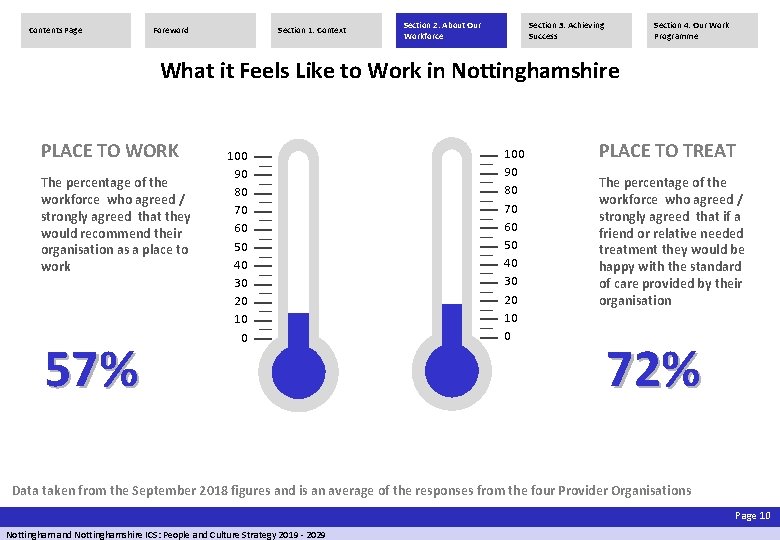
Contents Page Foreword Section 1: Context Section 2: About Our Workforce Section 3: Achieving Success Section 4: Our Work Programme What it Feels Like to Work in Nottinghamshire PLACE TO WORK The percentage of the workforce who agreed / strongly agreed that they would recommend their organisation as a place to work 57% 100 90 80 70 60 50 40 30 20 10 0 PLACE TO TREAT The percentage of the workforce who agreed / strongly agreed that if a friend or relative needed treatment they would be happy with the standard of care provided by their organisation 72% Data taken from the September 2018 figures and is an average of the responses from the four Provider Organisations Page 10 Nottingham and Nottinghamshire ICS: People and Culture Strategy 2019 - 2029
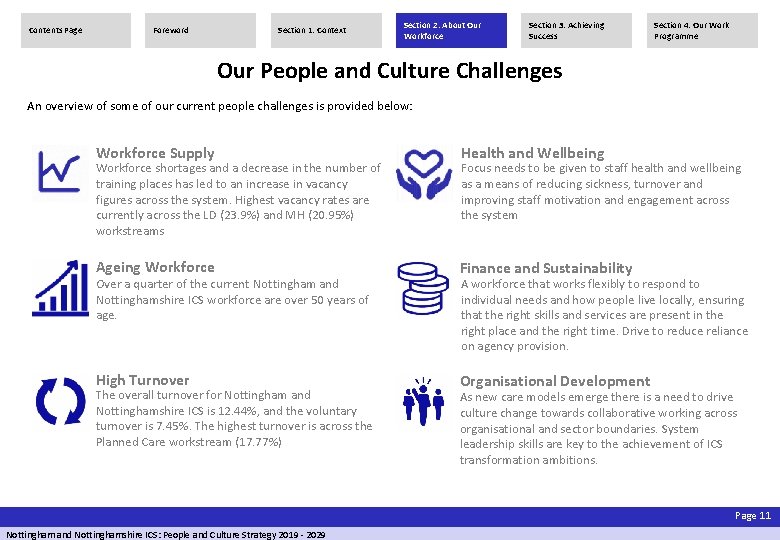
Contents Page Foreword Section 1: Context Section 2: About Our Workforce Section 3: Achieving Success Section 4: Our Work Programme Our People and Culture Challenges An overview of some of our current people challenges is provided below: Workforce Supply Health and Wellbeing Workforce shortages and a decrease in the number of training places has led to an increase in vacancy figures across the system. Highest vacancy rates are currently across the LD (23. 9%) and MH (20. 95%) workstreams Focus needs to be given to staff health and wellbeing as a means of reducing sickness, turnover and improving staff motivation and engagement across the system Ageing Workforce Finance and Sustainability High Turnover Organisational Development Over a quarter of the current Nottingham and Nottinghamshire ICS workforce are over 50 years of age. The overall turnover for Nottingham and Nottinghamshire ICS is 12. 44%, and the voluntary turnover is 7. 45%. The highest turnover is across the Planned Care workstream (17. 77%) A workforce that works flexibly to respond to individual needs and how people live locally, ensuring that the right skills and services are present in the right place and the right time. Drive to reduce reliance on agency provision. As new care models emerge there is a need to drive culture change towards collaborative working across organisational and sector boundaries. System leadership skills are key to the achievement of ICS transformation ambitions. Page 11 Nottingham and Nottinghamshire ICS: People and Culture Strategy 2019 - 2029
2. Our Success Workforce 3. About Achieving
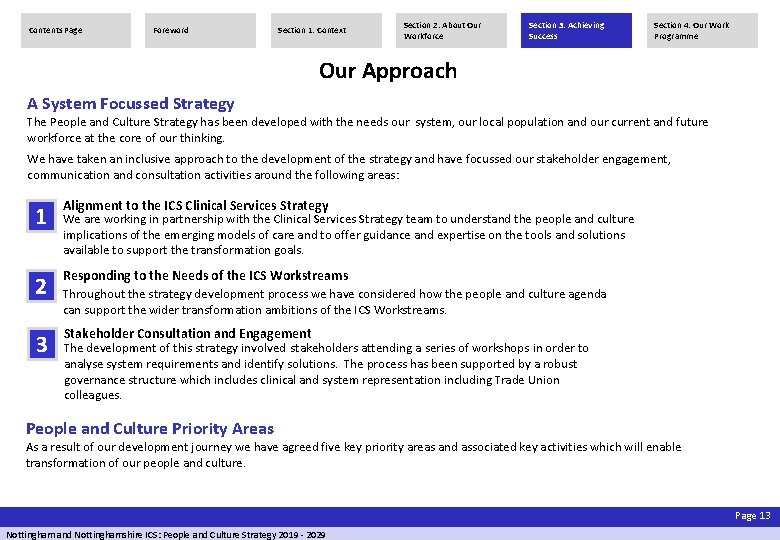
Contents Page Foreword Section 1: Context Section 2: About Our Workforce Section 3: Achieving Success Section 4: Our Work Programme Our Approach A System Focussed Strategy The People and Culture Strategy has been developed with the needs our system, our local population and our current and future workforce at the core of our thinking. We have taken an inclusive approach to the development of the strategy and have focussed our stakeholder engagement, communication and consultation activities around the following areas: 1 Alignment to the ICS Clinical Services Strategy We are working in partnership with the Clinical Services Strategy team to understand the people and culture implications of the emerging models of care and to offer guidance and expertise on the tools and solutions available to support the transformation goals. 2 Responding to the Needs of the ICS Workstreams 3 Stakeholder Consultation and Engagement Throughout the strategy development process we have considered how the people and culture agenda can support the wider transformation ambitions of the ICS Workstreams. The development of this strategy involved stakeholders attending a series of workshops in order to analyse system requirements and identify solutions. The process has been supported by a robust governance structure which includes clinical and system representation including Trade Union colleagues. People and Culture Priority Areas As a result of our development journey we have agreed five key priority areas and associated key activities which will enable transformation of our people and culture. Page 13 Nottingham and Nottinghamshire ICS: People and Culture Strategy 2019 - 2029
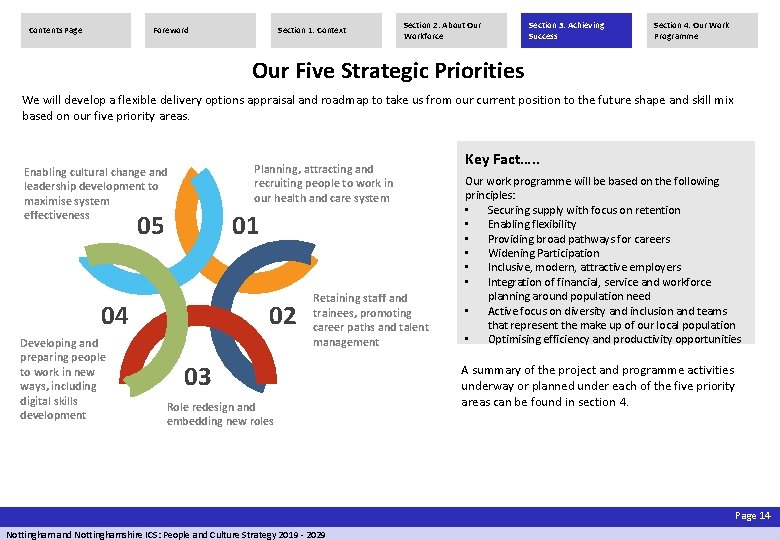
Contents Page Foreword Section 1: Context Section 2: About Our Workforce Section 3: Achieving Success Section 4: Our Work Programme Our Five Strategic Priorities We will develop a flexible delivery options appraisal and roadmap to take us from our current position to the future shape and skill mix based on our five priority areas. 1. development to maximise system effectiveness Planning, attracting and recruiting people to work in our health and care system Enabling cultural change and leadership development to maximise system effectiveness 05 01 04 Developing and preparing people to work in new ways, including digital skills development 02 Retaining staff and trainees, promoting career paths and talent management 03 Role redesign and embedding new roles Key Fact…. . Our work programme will be based on the following principles: • Securing supply with focus on retention • Enabling flexibility • Providing broad pathways for careers • Widening Participation • Inclusive, modern, attractive employers • Integration of financial, service and workforce planning around population need • Active focus on diversity and inclusion and teams that represent the make up of our local population • Optimising efficiency and productivity opportunities A summary of the project and programme activities underway or planned under each of the five priority areas can be found in section 4. Page 14 Nottingham and Nottinghamshire ICS: People and Culture Strategy 2019 - 2029
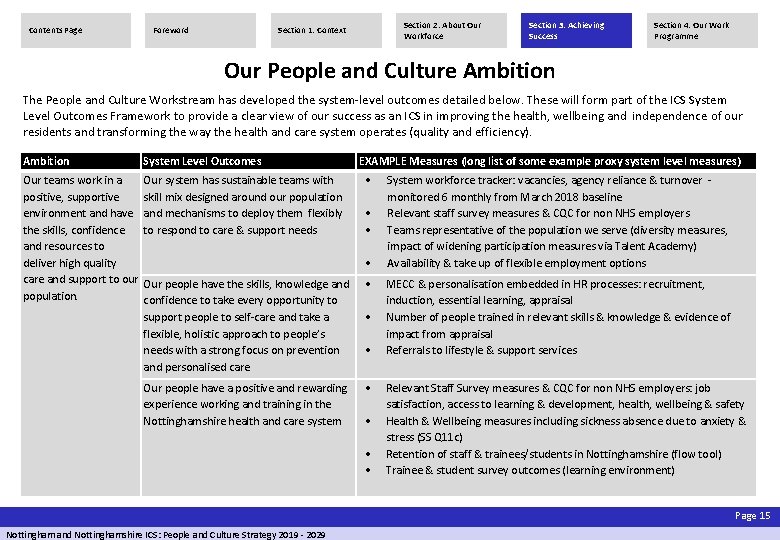
Contents Page Foreword Section 2: About Our Workforce Section 1: Context Section 3: Achieving Success Section 4: Our Work Programme Our People and Culture Ambition The People and Culture Workstream has developed the system-level outcomes detailed below. These will form part of the ICS System Level Outcomes Framework to provide a clear view of our success as an ICS in improving the health, wellbeing and independence of our residents and transforming the way the health and care system operates (quality and efficiency). Ambition System Level Outcomes Our teams work in a positive, supportive environment and have the skills, confidence and resources to deliver high quality care and support to our population. Our system has sustainable teams with skill mix designed around our population and mechanisms to deploy them flexibly to respond to care & support needs EXAMPLE Measures (long list of some example proxy system level measures) Our people have the skills, knowledge and confidence to take every opportunity to support people to self-care and take a flexible, holistic approach to people’s needs with a strong focus on prevention and personalised care Our people have a positive and rewarding experience working and training in the Nottinghamshire health and care system System workforce tracker: vacancies, agency reliance & turnover monitored 6 monthly from March 2018 baseline Relevant staff survey measures & CQC for non NHS employers Teams representative of the population we serve (diversity measures, impact of widening participation measures via Talent Academy) Availability & take up of flexible employment options MECC & personalisation embedded in HR processes: recruitment, induction, essential learning, appraisal Number of people trained in relevant skills & knowledge & evidence of impact from appraisal Referrals to lifestyle & support services Relevant Staff Survey measures & CQC for non NHS employers: job satisfaction, access to learning & development, health, wellbeing & safety Health & Wellbeing measures including sickness absence due to anxiety & stress (SS Q 11 c) Retention of staff & trainees/students in Nottinghamshire (flow tool) Trainee & student survey outcomes (learning environment) Page 15 Nottingham and Nottinghamshire ICS: People and Culture Strategy 2019 - 2029
Contents Page Foreword Section 1: Context Section 2: About Our Workforce Section 3: Achieving Success Section 4: Our Work Programme Measuring and Monitoring Success We have developed a system-wide workforce information database that captures and analyses intelligence on our current staff across health and social care providers. Future activity projections have been applied to this baseline to assess the impact of service demand on the future size and shape of our workforce (the ‘do nothing’ position). Our workforce intelligence system also contains data on the future supply of newly qualified staff from the education system against which to assess demand understand potential shortages. In addition to the baseline of current staff in post, we have initiated a twice-yearly collection of information to support the identification of workforce related risk areas including vacancies, turnover, absence levels and agency/bank usage. This will enable us to understand in more detail where our key shortages are and prioritise action in those service areas or staff groups. We are also developing a population health-led approach to shape the future skills that we will need to deliver future models of care using system dynamics modelling. This approach engages clinicians and managers across the system in developing a range of scenarios to bridge the gap between supply and future demand for skills and provides the opportunity to test the impact of new ways of working and new and innovative roles. All staff will need the skills and confidence to support people to manage their own health and wellbeing through a systematic approach to prevention, promoting independence and personalisation and this will be embedded into our HR systems and processes. Page 16 Nottingham and Nottinghamshire ICS: People and Culture Strategy 2019 - 2029
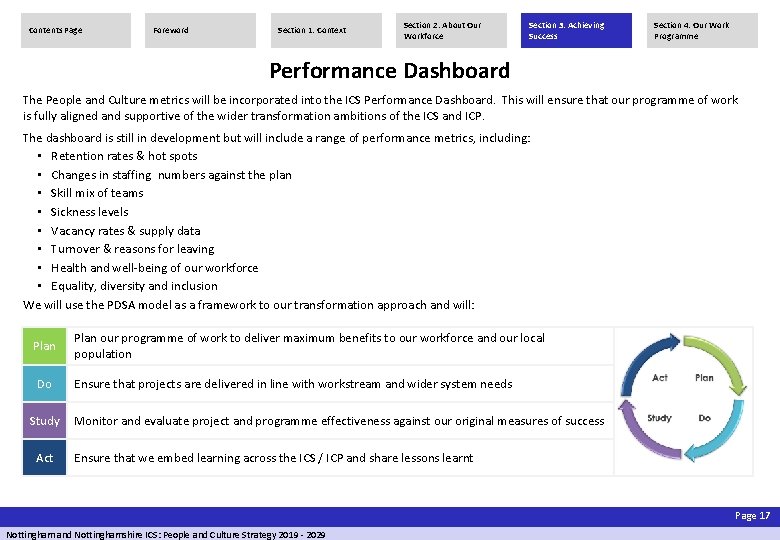
Contents Page Foreword Section 1: Context Section 2: About Our Workforce Section 3: Achieving Success Section 4: Our Work Programme Performance Dashboard The People and Culture metrics will be incorporated into the ICS Performance Dashboard. This will ensure that our programme of work is fully aligned and supportive of the wider transformation ambitions of the ICS and ICP. The dashboard is still in development but will include a range of performance metrics, including: • Retention rates & hot spots • Changes in staffing numbers against the plan • Skill mix of teams • Sickness levels • Vacancy rates & supply data • Turnover & reasons for leaving • Health and well-being of our workforce • Equality, diversity and inclusion We will use the PDSA model as a framework to our transformation approach and will: Plan Do Study Act Plan our programme of work to deliver maximum benefits to our workforce and our local population Ensure that projects are delivered in line with workstream and wider system needs Monitor and evaluate project and programme effectiveness against our original measures of success Ensure that we embed learning across the ICS / ICP and share lessons learnt Page 17 Nottingham and Nottinghamshire ICS: People and Culture Strategy 2019 - 2029
4. Our Work Programme
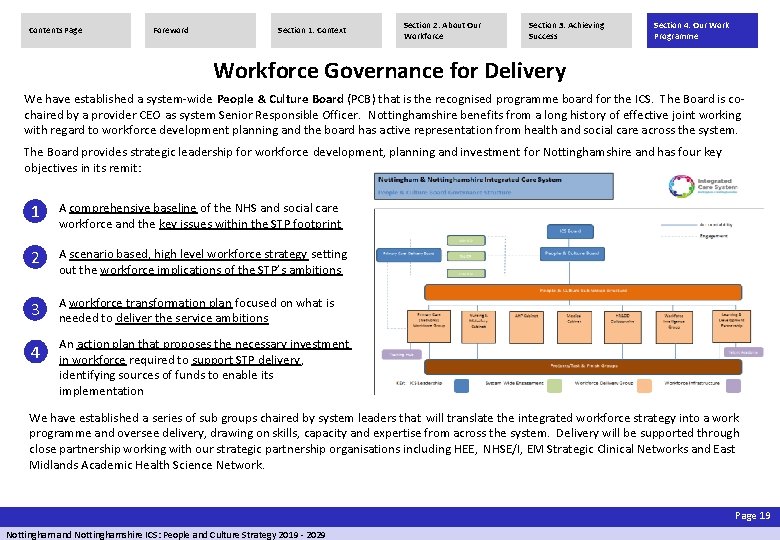
Contents Page Foreword Section 1: Context Section 2: About Our Workforce Section 3: Achieving Success Section 4: Our Work Programme Workforce Governance for Delivery We have established a system-wide People & Culture Board (PCB) that is the recognised programme board for the ICS. The Board is cochaired by a provider CEO as system Senior Responsible Officer. Nottinghamshire benefits from a long history of effective joint working with regard to workforce development planning and the board has active representation from health and social care across the system. The Board provides strategic leadership for workforce development, planning and investment for Nottinghamshire and has four key objectives in its remit: 1 A comprehensive baseline of the NHS and social care workforce and the key issues within the STP footprint 2 A scenario based, high level workforce strategy setting out the workforce implications of the STP’s ambitions 3 A workforce transformation plan focused on what is needed to deliver the service ambitions 4 An action plan that proposes the necessary investment in workforce required to support STP delivery, identifying sources of funds to enable its implementation We have established a series of sub groups chaired by system leaders that will translate the integrated workforce strategy into a work programme and oversee delivery, drawing on skills, capacity and expertise from across the system. Delivery will be supported through close partnership working with our strategic partnership organisations including HEE, NHSE/I, EM Strategic Clinical Networks and East Midlands Academic Health Science Network. Page 19 Nottingham and Nottinghamshire ICS: People and Culture Strategy 2019 - 2029
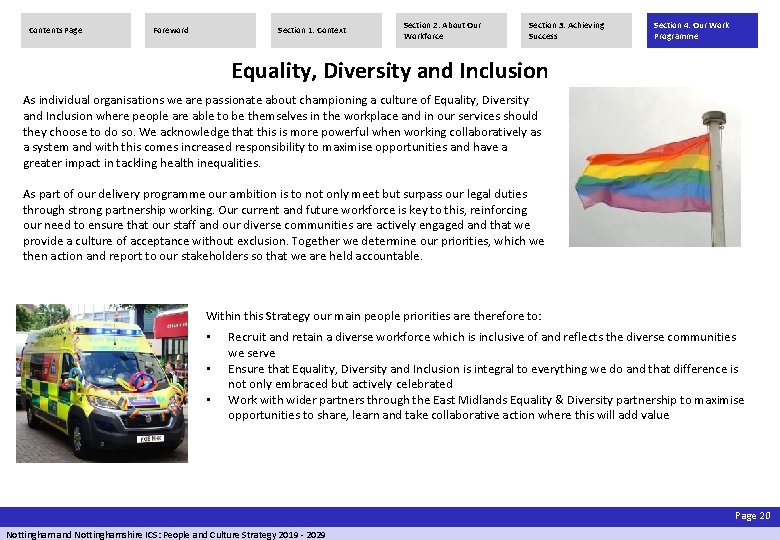
Contents Page Foreword Section 1: Context Section 2: About Our Workforce Section 3: Achieving Success Section 4: Our Work Programme Equality, Diversity and Inclusion As individual organisations we are passionate about championing a culture of Equality, Diversity and Inclusion where people are able to be themselves in the workplace and in our services should they choose to do so. We acknowledge that this is more powerful when working collaboratively as a system and with this comes increased responsibility to maximise opportunities and have a greater impact in tackling health inequalities. As part of our delivery programme our ambition is to not only meet but surpass our legal duties through strong partnership working. Our current and future workforce is key to this, reinforcing our need to ensure that our staff and our diverse communities are actively engaged and that we provide a culture of acceptance without exclusion. Together we determine our priorities, which we then action and report to our stakeholders so that we are held accountable. Within this Strategy our main people priorities are therefore to: • • • Recruit and retain a diverse workforce which is inclusive of and reflects the diverse communities we serve Ensure that Equality, Diversity and Inclusion is integral to everything we do and that difference is not only embraced but actively celebrated Work with wider partners through the East Midlands Equality & Diversity partnership to maximise opportunities to share, learn and take collaborative action where this will add value Page 20 Nottingham and Nottinghamshire ICS: People and Culture Strategy 2019 - 2029
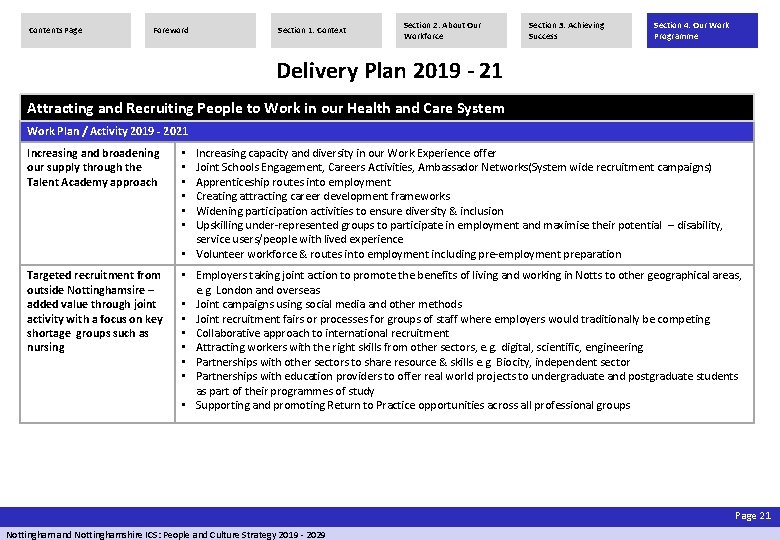
Contents Page Foreword Section 1: Context Section 2: About Our Workforce Section 3: Achieving Success Section 4: Our Work Programme Delivery Plan 2019 - 21 Attracting and Recruiting People to Work in our Health and Care System Work Plan / Activity 2019 - 2021 Increasing and broadening our supply through the Talent Academy approach • • • Increasing capacity and diversity in our Work Experience offer Joint Schools Engagement, Careers Activities, Ambassador Networks(System wide recruitment campaigns) Apprenticeship routes into employment Creating attracting career development frameworks Widening participation activities to ensure diversity & inclusion Upskilling under-represented groups to participate in employment and maximise their potential – disability, service users/people with lived experience • Volunteer workforce & routes into employment including pre-employment preparation Targeted recruitment from outside Nottinghamsire – added value through joint activity with a focus on key shortage groups such as nursing • Employers taking joint action to promote the benefits of living and working in Notts to other geographical areas, e. g. London and overseas • Joint campaigns using social media and other methods • Joint recruitment fairs or processes for groups of staff where employers would traditionally be competing • Collaborative approach to international recruitment • Attracting workers with the right skills from other sectors, e. g. digital, scientific, engineering • Partnerships with other sectors to share resource & skills e. g. Biocity, independent sector • Partnerships with education providers to offer real world projects to undergraduate and postgraduate students as part of their programmes of study • Supporting and promoting Return to Practice opportunities across all professional groups Page 21 Nottingham and Nottinghamshire ICS: People and Culture Strategy 2019 - 2029
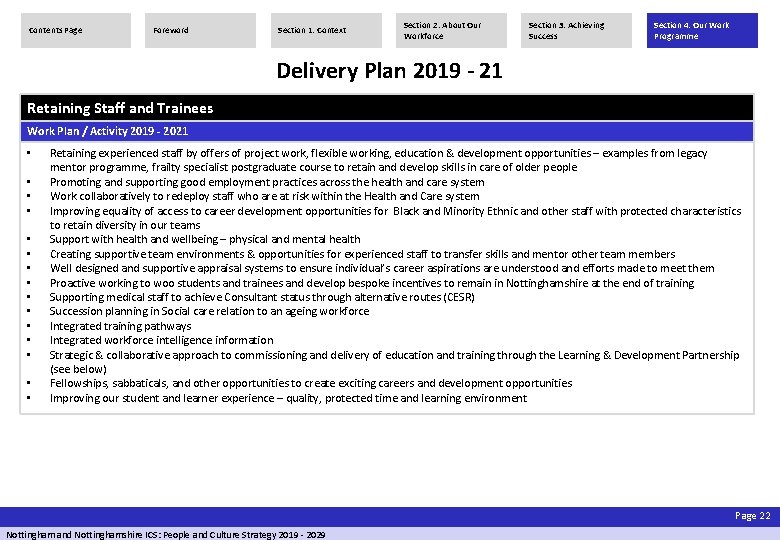
Contents Page Foreword Section 1: Context Section 2: About Our Workforce Section 3: Achieving Success Section 4: Our Work Programme Delivery Plan 2019 - 21 Retaining Staff and Trainees Work Plan / Activity 2019 - 2021 • • • • Retaining experienced staff by offers of project work, flexible working, education & development opportunities – examples from legacy mentor programme, frailty specialist postgraduate course to retain and develop skills in care of older people Promoting and supporting good employment practices across the health and care system Work collaboratively to redeploy staff who are at risk within the Health and Care system Improving equality of access to career development opportunities for Black and Minority Ethnic and other staff with protected characteristics to retain diversity in our teams Support with health and wellbeing – physical and mental health Creating supportive team environments & opportunities for experienced staff to transfer skills and mentor other team members Well designed and supportive appraisal systems to ensure individual’s career aspirations are understood and efforts made to meet them Proactive working to woo students and trainees and develop bespoke incentives to remain in Nottinghamshire at the end of training Supporting medical staff to achieve Consultant status through alternative routes (CESR) Succession planning in Social care relation to an ageing workforce Integrated training pathways Integrated workforce intelligence information Strategic & collaborative approach to commissioning and delivery of education and training through the Learning & Development Partnership (see below) Fellowships, sabbaticals, and other opportunities to create exciting careers and development opportunities Improving our student and learner experience – quality, protected time and learning environment Page 22 Nottingham and Nottinghamshire ICS: People and Culture Strategy 2019 - 2029
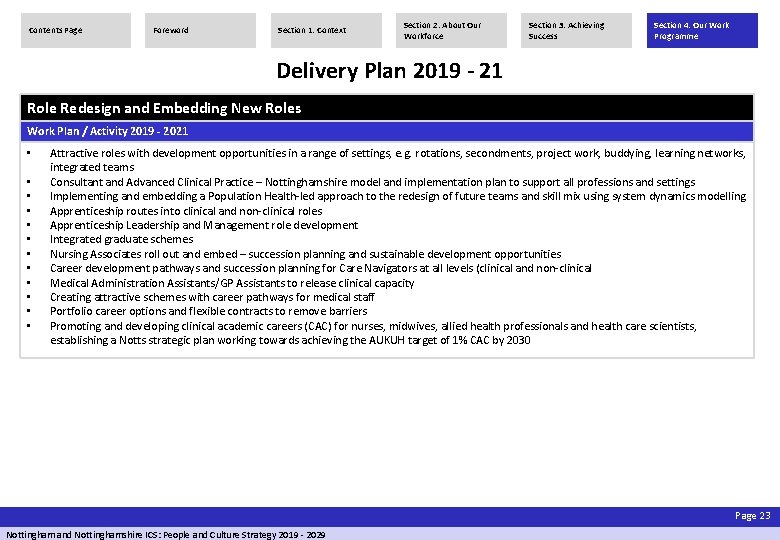
Contents Page Foreword Section 1: Context Section 2: About Our Workforce Section 3: Achieving Success Section 4: Our Work Programme Delivery Plan 2019 - 21 Role Redesign and Embedding New Roles Work Plan / Activity 2019 - 2021 • • • Attractive roles with development opportunities in a range of settings, e. g. rotations, secondments, project work, buddying, learning networks, integrated teams Consultant and Advanced Clinical Practice – Nottinghamshire model and implementation plan to support all professions and settings Implementing and embedding a Population Health-led approach to the redesign of future teams and skill mix using system dynamics modelling Apprenticeship routes into clinical and non-clinical roles Apprenticeship Leadership and Management role development Integrated graduate schemes Nursing Associates roll out and embed – succession planning and sustainable development opportunities Career development pathways and succession planning for Care Navigators at all levels (clinical and non-clinical Medical Administration Assistants/GP Assistants to release clinical capacity Creating attractive schemes with career pathways for medical staff Portfolio career options and flexible contracts to remove barriers Promoting and developing clinical academic careers (CAC) for nurses, midwives, allied health professionals and health care scientists, establishing a Notts strategic plan working towards achieving the AUKUH target of 1% CAC by 2030 Page 23 Nottingham and Nottinghamshire ICS: People and Culture Strategy 2019 - 2029
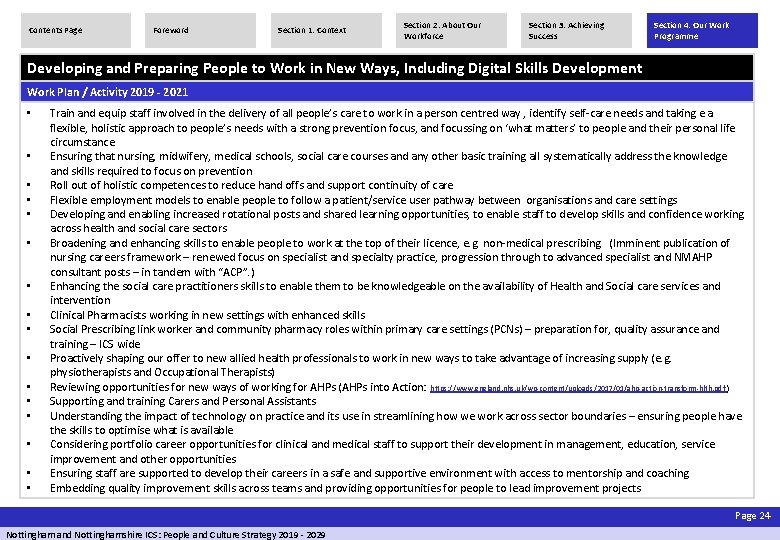
Contents Page Foreword Section 1: Context Section 2: About Our Workforce Section 3: Achieving Success Section 4: Our Work Programme Developing and Preparing People to Work in New Ways, Including Digital Skills Development Work Plan / Activity 2019 - 2021 • • • • Train and equip staff involved in the delivery of all people’s care to work in a person centred way , identify self-care needs and taking e a flexible, holistic approach to people’s needs with a strong prevention focus, and focussing on ‘what matters’ to people and their personal life circumstance Ensuring that nursing, midwifery, medical schools, social care courses and any other basic training all systematically address the knowledge and skills required to focus on prevention Roll out of holistic competences to reduce hand offs and support continuity of care Flexible employment models to enable people to follow a patient/service user pathway between organisations and care settings Developing and enabling increased rotational posts and shared learning opportunities, to enable staff to develop skills and confidence working across health and social care sectors Broadening and enhancing skills to enable people to work at the top of their licence, e. g. non-medical prescribing. (Imminent publication of nursing careers framework – renewed focus on specialist and specialty practice, progression through to advanced specialist and NMAHP consultant posts – in tandem with “ACP”. ) Enhancing the social care practitioners skills to enable them to be knowledgeable on the availability of Health and Social care services and intervention Clinical Pharmacists working in new settings with enhanced skills Social Prescribing link worker and community pharmacy roles within primary care settings (PCNs) – preparation for, quality assurance and training – ICS wide Proactively shaping our offer to new allied health professionals to work in new ways to take advantage of increasing supply (e. g. physiotherapists and Occupational Therapists) Reviewing opportunities for new ways of working for AHPs (AHPs into Action: https: //www. england. nhs. uk/wp-content/uploads/2017/01/ahp-action-transform-hlth. pdf ) Supporting and training Carers and Personal Assistants Understanding the impact of technology on practice and its use in streamlining how we work across sector boundaries – ensuring people have the skills to optimise what is available Considering portfolio career opportunities for clinical and medical staff to support their development in management, education, service improvement and other opportunities Ensuring staff are supported to develop their careers in a safe and supportive environment with access to mentorship and coaching Embedding quality improvement skills across teams and providing opportunities for people to lead improvement projects Page 24 Nottingham and Nottinghamshire ICS: People and Culture Strategy 2019 - 2029
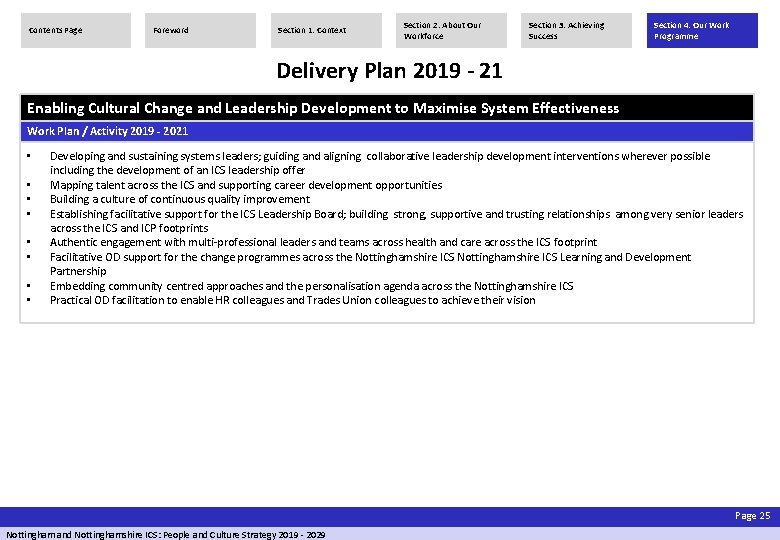
Contents Page Foreword Section 1: Context Section 2: About Our Workforce Section 3: Achieving Success Section 4: Our Work Programme Delivery Plan 2019 - 21 Enabling Cultural Change and Leadership Development to Maximise System Effectiveness Work Plan / Activity 2019 - 2021 • • Developing and sustaining systems leaders; guiding and aligning collaborative leadership development interventions wherever possible including the development of an ICS leadership offer Mapping talent across the ICS and supporting career development opportunities Building a culture of continuous quality improvement Establishing facilitative support for the ICS Leadership Board; building strong, supportive and trusting relationships among very senior leaders across the ICS and ICP footprints Authentic engagement with multi-professional leaders and teams across health and care across the ICS footprint Facilitative OD support for the change programmes across the Nottinghamshire ICS Learning and Development Partnership Embedding community centred approaches and the personalisation agenda across the Nottinghamshire ICS Practical OD facilitation to enable HR colleagues and Trades Union colleagues to achieve their vision Page 25 Nottingham and Nottinghamshire ICS: People and Culture Strategy 2019 - 2029
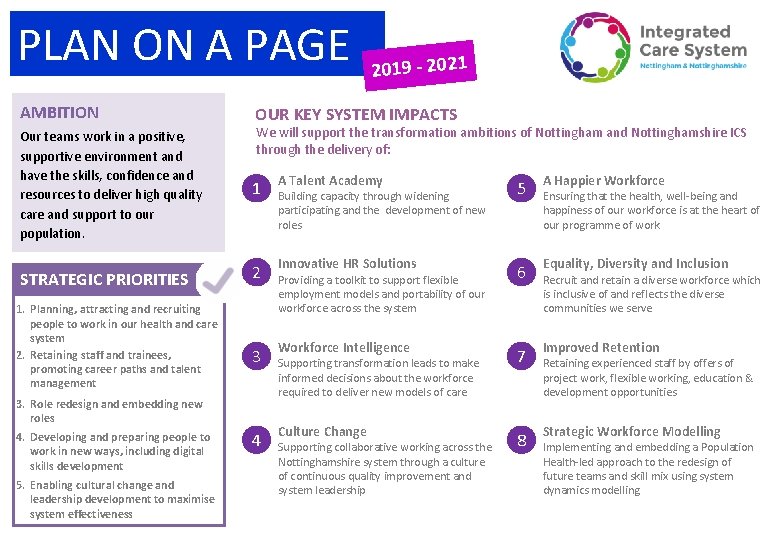
PLAN ON A PAGE AMBITION Our teams work in a positive, supportive environment and have the skills, confidence and resources to deliver high quality care and support to our population. STRATEGIC PRIORITIES 1. Planning, attracting and recruiting people to work in our health and care system 2. Retaining staff and trainees, promoting career paths and talent management OUR KEY SYSTEM IMPACTS We will support the transformation ambitions of Nottingham and Nottinghamshire ICS through the delivery of: 1 A Talent Academy 5 A Happier Workforce 2 Innovative HR Solutions 6 Equality, Diversity and Inclusion 3 Workforce Intelligence 7 Improved Retention 4 Culture Change 8 Strategic Workforce Modelling 3. Role redesign and embedding new STRATEGIC PRIORITIES roles 4. Developing and preparing people to work in new ways, including digital skills development 5. Enabling cultural change and leadership development to maximise system effectiveness 2019 - 2021 Building capacity through widening participating and the development of new roles Providing a toolkit to support flexible employment models and portability of our workforce across the system Supporting transformation leads to make informed decisions about the workforce required to deliver new models of care Supporting collaborative working across the Nottinghamshire system through a culture of continuous quality improvement and system leadership Ensuring that the health, well-being and happiness of our workforce is at the heart of our programme of work Recruit and retain a diverse workforce which is inclusive of and reflects the diverse communities we serve Retaining experienced staff by offers of project work, flexible working, education & development opportunities Implementing and embedding a Population Health-led approach to the redesign of future teams and skill mix using system dynamics modelling