
Nothing but a pack of neurons Developing a
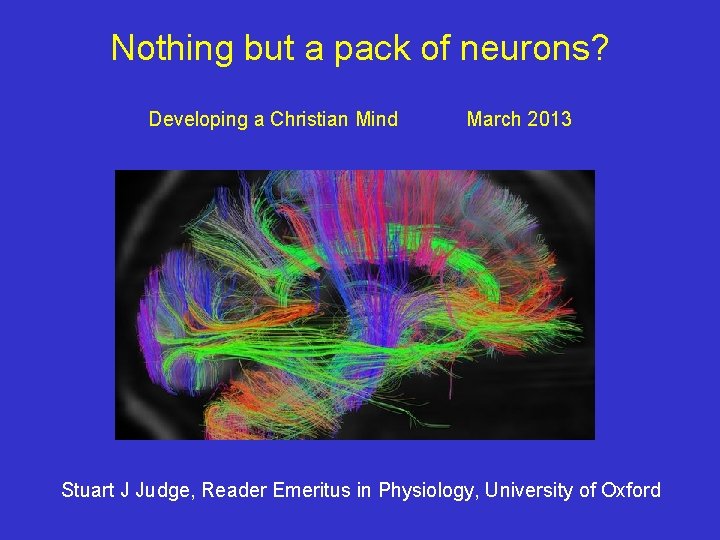
Nothing but a pack of neurons? Developing a Christian Mind March 2013 Stuart J Judge, Reader Emeritus in Physiology, University of Oxford
“… belief in free will and moral choice forms the basis for our concepts of responsibility and culpability, and hence our legal systems … For most of us, they are among our most fundamental assumptions when dealing with other people. Yet, there is an uncomfortable tension between these widely held beliefs and the intellectual views of many scientists. In particular, the rapid progress of neuroscience has been interpreted by some as providing new ammunition for a materialist account of human nature and thus an attack on traditional belief systems. ”
Cartesian dualism Immaterial soul piloting a brain that senses the external (and internal) world and executes action But many aspects of cognition depend on the brain, and are impaired or lost when it is damaged Where it has been possible to define a quantitative procedure for investigating a cognitive task then it has been possible to find neuronal activity that correlates with the cognitive performance
Damage to one part of the cerebral cortex causes difficulties with understanding language, while damage to another part causes no such difficulties but makes it difficult for the person to speak or otherwise express thoughts in a fluent way. Electrical stimulation of certain parts of the cortex deep in the temporal lobe could elicit the recall of memories of events years before, of which the patient sometimes spoke as if they were in some sense re-experienced. Imagining the making of a sequence of finger movements is accompanied by activity in a region known as the supplementary motor cortex. Activation of certain areas deep in the brain can be an extremely powerful motivator - animals will work, sometimes to exhaustion, to receive stimulation at some points. It has been shown that the nerve cells in such areas are normally involved in the processing of signals related to natural rewards such as sight of food when one is hungry.
Strong reductionism A complete knowledge of information processing in the brain will be forthcoming. This will allow us to a) reduce conscious experience to mechanistic terms and b) show that subjective experience is an epiphenomenon that has no causal role and is at best a short-hand way to refer to the underlying neuronal realities.
Science presupposes observers who can make valid observations, communicate them to others, make inferences from them etc. If there is ‘nothing to us but’ neural activity, then there are no observations, no inferences and thus no science. But for us to make genuine observations etc we do not need immaterial parts; all we need is to have those abilities.

One can accept that reductionism is selfdefeating without being a dualist “Suppose we really could succeed in ‘reducing’ rational behaviour to molecular or cellular causation. In that case, we would no longer be able meaningfully to express the truth of what we had succeeded in doing. No such reduction is conceivable. We know what it is to be rational, and what it is to lose that capacity. That knowledge has nothing to do with the question of whethere exist specific and causally sufficient neural states and interactions while I am writing this book, for example. Of course there are. So what? If we could discover them, they may well provide a complete explanation for how my brain operates while ‘I’ am thinking and writing. But they would not lead to the discovery of where ’I’ am to be found. Nor do ‘I’ need to consult my brain states to know what I am doing and intend to do. ” (Noble, The music of life, 2006, p 126)
If our decisions, priorities and goals have neural correlates then it is to be expected that a specific religious commitment, which has behavioural consequences, would have neural correlates too. Likewise, no doubt Richard Dawkins’ brain has areas that go into paroxysms when he comes across scientists who profess a religious commitment, but so what? If the existence of neural correlates underlines the validity of religious commitment or practice, then the same is so for Richard Dawkins beliefs.
Are we nothing but our brains? The view that we are ‘nothing but’ … is an example of reductionism. That we have the mental abilities we do is a fact. However close the relationship between features of brain activity and these capacities, the former do not explain away the latter – but they may illuminate how we do what we do, cognitively, and why mental abilities sometimes fail so disastrously.
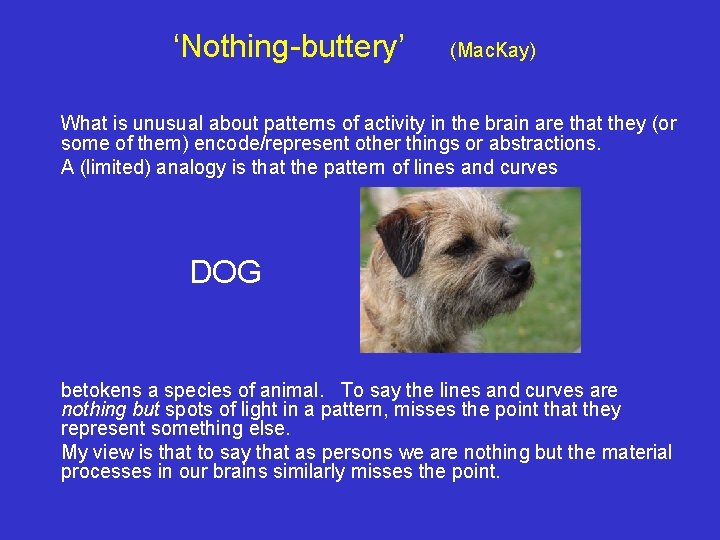
‘Nothing-buttery’ (Mac. Kay) What is unusual about patterns of activity in the brain are that they (or some of them) encode/represent other things or abstractions. A (limited) analogy is that the pattern of lines and curves DOG betokens a species of animal. To say the lines and curves are nothing but spots of light in a pattern, misses the point that they represent something else. My view is that to say that as persons we are nothing but the material processes in our brains similarly misses the point.
What if brain activity and my experience are two correlated stories? The outside view (of the scientist observer) and the inside view of the owner of the brain, with neither view the whole story and a very complex relationship between the two stories – perhaps with patterns of activity across many brain areas being the correlates of everyday experiences such as recognising a letter box.
Comprehensive realism (rather than dual aspect monism) Is consciousness surprising?
Are reason and cause incompatible? To assert a physical cause for our action is necessarily to deny that we did was responsible and rational. To say that I did whatever I did because of some sequence of neuronal transactions is inevitably to remove responsibility for the action. If I strike my wife because I am suffering from a seizure in which my arms flail about, then I am not responsible for such action.
Physiological determinism? “Physiological determinism …[is]… the view that all human activity is determined via neurophysiological states of the brain and central nervous system. … If the environment in which humans live is deterministic, and the human body is merely a complicated machine, can there be any genuinely free action? … Physiological determinism need in no way involve theory that wants do not affect actions: if it did, it could be dismissed out of hand … Any plausible physiological determinism must make room for such facts as that if I [say] wanted to strangle the kitten I would. It follows that whatever story the physiological determinist tells about my present state must contain a proviso that my brain state would be different from what it now is if I wanted something different from what I now want (if, for instance, I wanted to strangle the kitten). Consequently, whatever my present state is, it is not such a state that if I wanted to strangle the kitten I could not. But only such a state would prevent me from strangling the kitten, or deprive me of an opportunity to strangle the kitten. Kenny p 146 -9
It is also possible to show that there is no statement about our unmade decisions that we would be right to believe, even in a deterministic world – such statements are logically indeterminate 1 (neither true nor false). 1 Mac. Kay (1960) Logical Indeterminacy of a free choice. Mind
Logical indeterminacy “ [If] … all you think, believe, hope, experience, and so on is represented by the physical state of some part of your brain, … it follows … that there must be one part of the brain – namely the mechanism that represents what you believe – which must necessarily change if any change takes place in what you believe. Does there then exist a complete specification of that part of your brain, which you would be both correct to believe and mistaken to disbelieve if only you know it? Obviously not. Suppose I had the mean of analysing your brain state and producing a complete description of it which is correct as I see it here and now; then obviously if you were to believe it, that state must change. By the same token even if I could calculate completely the immediate future of your brain from my description (without letting you know), my detailed prediction would have no claim to your assent. What I would be correct (secretly) to believe about your future is something that you would be mistaken to believe!” Mac. Kay, Human Science and Human Dignity, Hodder & Stoughton, 1979, p 52 -3
Brain and Soul “The Lord God formed man of dust from the ground, and breathed into his nostrils the breath of life and he became a living soul” Gen 2: 7 ‘soul’ is the Hebrew ‘nephesh’. Not a separable part of man - indeed the word is also applied to animals. Nephesh is regarded as departing at death, but the word is never used to mean the spirit of the dead. When the Psalmists speak of their soul (nephesh) the reference is not to a separable part of man but to man's whole being.
The ancient Hebrews were monists: Deuteronomy 6: 4 -5 incorporates a four-way parallelism And one of the scribes came up and heard them disputing with one another, and seeing that he answered them well, asked him, "Which commandment is the first of all? " Jesus answered, "The first is, `Hear, O Israel: The Lord our God, the Lord is one; and you shall love the Lord your God with all your heart, and with all your soul, and with all your mind, and with all your strength. ' The second is this, `You shall love your neighbour as yourself. ' (Mark 12: 28 -34 quoting Deuteronomy 6: 4 -5 and elsewhere. )
If everything we do involves our brains, as we are renewed in Christ our brains will change. This is both a work of grace and work for us “Set your minds on things that are above, not on things that are on earth, for you have died … Put to death therefore whatever in you is earthly: fornication, impurity, passion, evil desire and greed … you must get rid of all such things – anger wrath malice slander and abusive language You have stripped off the old self with its practices and have clothed yourselves with the new self, which is being renewed in knowledge according to the image of its creator. ” Colossians 3: 2 -10
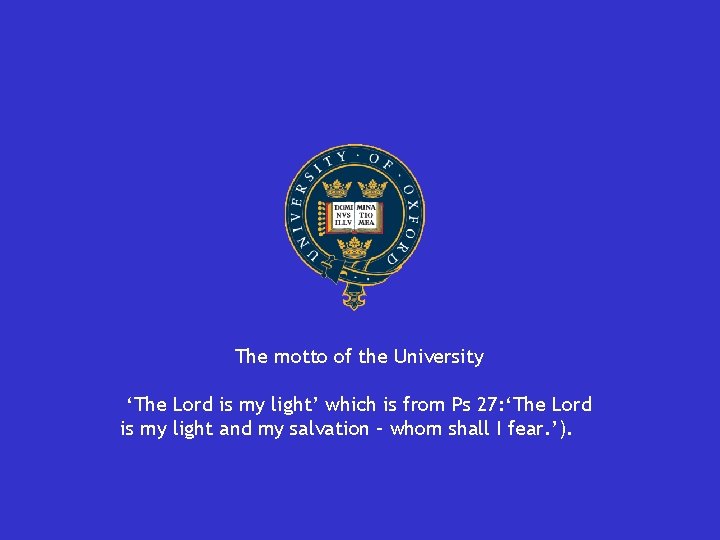
The motto of the University ‘The Lord is my light’ which is from Ps 27: ‘The Lord is my light and my salvation – whom shall I fear. ’).

- Slides: 21