
Notes u No lecture Thursday apologies cs 533
![Mass-spring problems u [anisotropy] u [stretching, Poisson’s ratio] u So we will instead look](https://slidetodoc.com/presentation_image/8b12a97bd3aff281dc1ff99818e110d7/image-2.jpg "Mass-spring problems u [anisotropy] u [stretching, Poisson’s ratio] u So we will instead look")
![Why the half? ? u [Look at 1 D, small deformation] u A=1+ u](https://slidetodoc.com/presentation_image/8b12a97bd3aff281dc1ff99818e110d7/image-6.jpg "Why the half? ? u [Look at 1 D, small deformation] u A=1+ u")
- Slides: 19
Notes u No lecture Thursday (apologies) cs 533 d-term 1 -2005 1
Mass-spring problems u [anisotropy] u [stretching, Poisson’s ratio] u So we will instead look for a generalization of “percent deformation” to multiple dimensions: elasticity theory cs 533 d-term 1 -2005 2
Studying Deformation u Let’s • • • look at a deformable object World space: points x in the object as we see it Object space (or rest pose): points p in some reference configuration of the object (Technically we might not have a rest pose, but usually we do, and it is the simplest parameterization) u So we identify each point x of the continuum with the label p, where x=X(p) u The function X(p) encodes the deformation cs 533 d-term 1 -2005 3
Going back to 1 D u Worked out that d. X/dp-1 was the key quantity for measuring stretching and compression u Nice thing about differentiating: constants (translating whole object) don’t matter u Call A= X/ p the deformation gradient cs 533 d-term 1 -2005 4
Strain u. A isn’t so handy, though it somehow encodes exactly how stretched/compressed we are • Also encodes how rotated we are: who cares? u We want to process A somehow to remove the rotation part u [difference in lengths] u ATA-I is exactly zero when A is a rigid body rotation u Define Green strain cs 533 d-term 1 -2005 5
Why the half? ? u [Look at 1 D, small deformation] u A=1+ u ATA-I = A 2 -1 = 2 + 2 ≈ 2 u Therefore G ≈ , which is what we expect u Note that for large deformation, Green strain grows quadratically - maybe not what you expect! u Whole cottage industry: defining strain differently cs 533 d-term 1 -2005 6
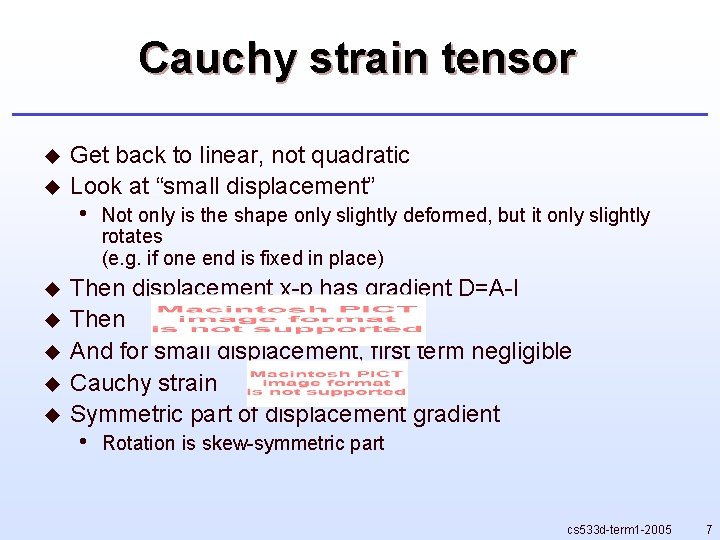
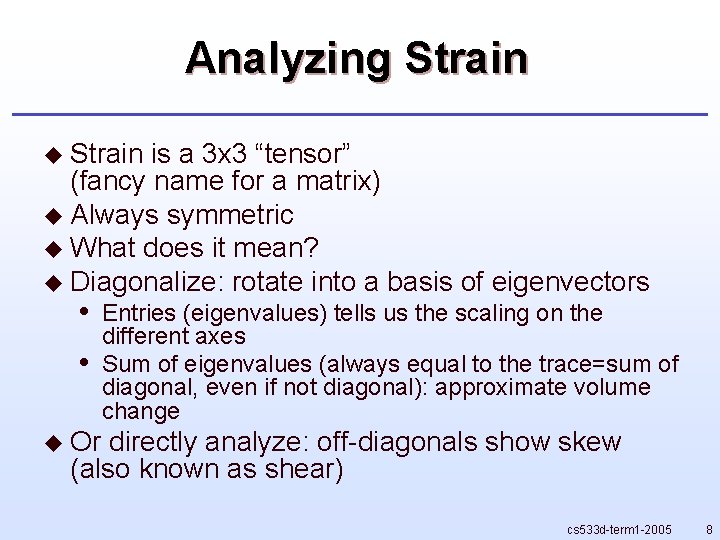
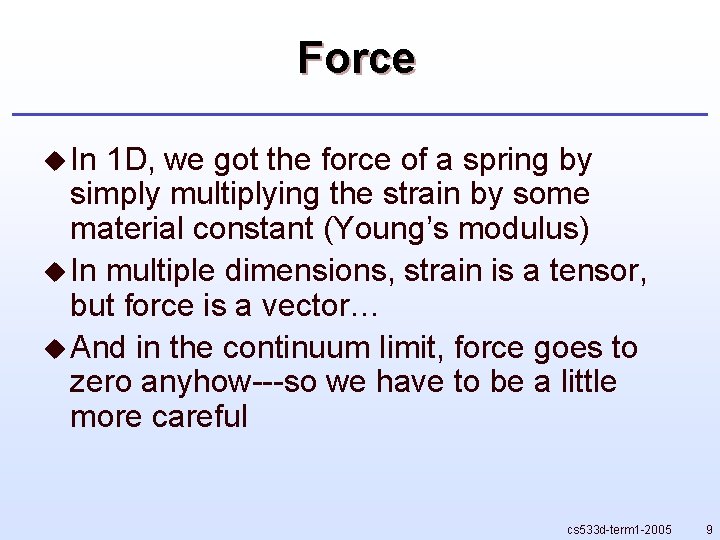
Cauchy strain tensor u u u u Get back to linear, not quadratic Look at “small displacement” • Not only is the shape only slightly deformed, but it only slightly rotates (e. g. if one end is fixed in place) Then displacement x-p has gradient D=A-I Then And for small displacement, first term negligible Cauchy strain Symmetric part of displacement gradient • Rotation is skew-symmetric part cs 533 d-term 1 -2005 7
Analyzing Strain u Strain is a 3 x 3 “tensor” (fancy name for a matrix) u Always symmetric u What does it mean? u Diagonalize: rotate into a basis of eigenvectors • • Entries (eigenvalues) tells us the scaling on the different axes Sum of eigenvalues (always equal to the trace=sum of diagonal, even if not diagonal): approximate volume change u Or directly analyze: off-diagonals show skew (also known as shear) cs 533 d-term 1 -2005 8
Force u In 1 D, we got the force of a spring by simply multiplying the strain by some material constant (Young’s modulus) u In multiple dimensions, strain is a tensor, but force is a vector… u And in the continuum limit, force goes to zero anyhow---so we have to be a little more careful cs 533 d-term 1 -2005 9
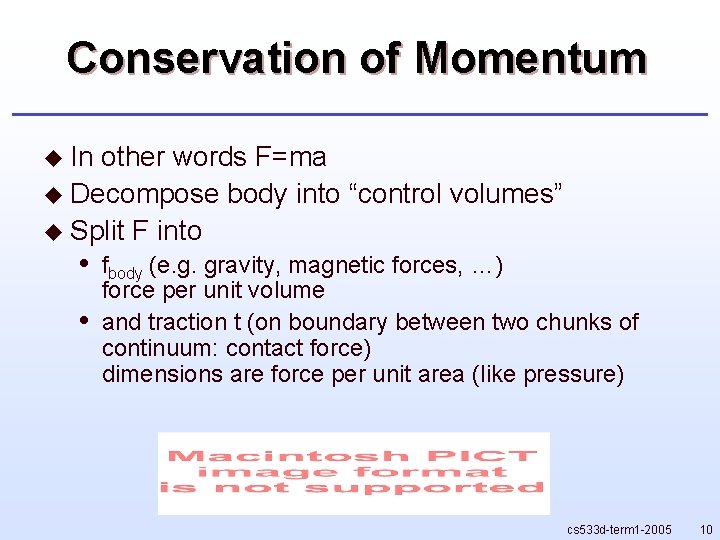
Conservation of Momentum u In other words F=ma u Decompose body into “control volumes” u Split F into • • fbody (e. g. gravity, magnetic forces, …) force per unit volume and traction t (on boundary between two chunks of continuum: contact force) dimensions are force per unit area (like pressure) cs 533 d-term 1 -2005 10
u u u Cauchy’s Fundamental Postulate Traction t is a function of position x and normal n • Ignores rest of boundary (e. g. information like curvature, etc. ) Theorem • If t is smooth (be careful at boundaries of object, e. g. cracks) then t is linear in n: t= (x)n is the Cauchy stress tensor (a matrix) It also is force per unit area Diagonal: normal stress components Off-diagonal: shear stress components cs 533 d-term 1 -2005 11
Cauchy Stress u From conservation of angular momentum can derive that Cauchy stress tensor is symmetric: = T u Thus there are only 6 degrees of freedom (3 D) • In 2 D, only 3 degrees of freedom u What • • is ? That’s the job of constitutive modeling Depends on the material (e. g. water vs. steel vs. silly putty) cs 533 d-term 1 -2005 12
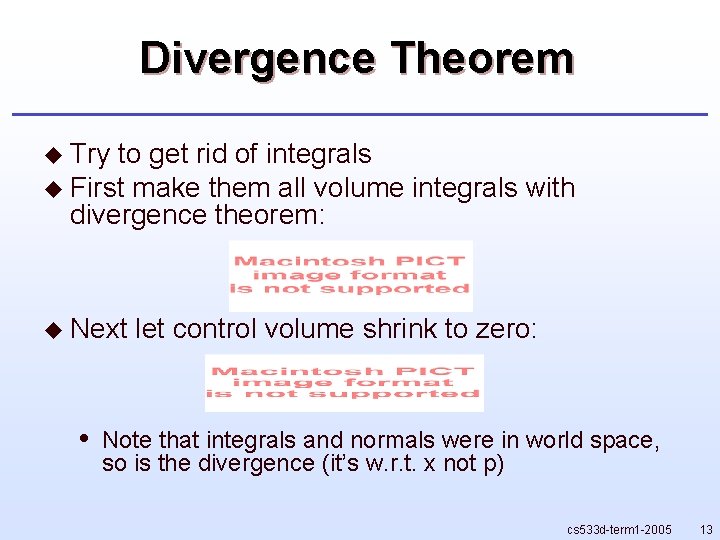
Divergence Theorem u Try to get rid of integrals u First make them all volume integrals with divergence theorem: u Next • let control volume shrink to zero: Note that integrals and normals were in world space, so is the divergence (it’s w. r. t. x not p) cs 533 d-term 1 -2005 13
Constitutive Modeling u This can get very complicated for complicated materials u Let’s start with simple elastic materials u We’ll even leave damping out u Then stress only depends on strain, however we measure it (say G or ) cs 533 d-term 1 -2005 14
Linear elasticity u Very nice thing about Cauchy strain: it’s linear in deformation • No quadratic dependence • Easy and fast to deal with u Natural thing is to make a linear relationship with Cauchy stress u Then the full equation is linear! cs 533 d-term 1 -2005 15
Young’s modulus u Obvious first thing to do: if you pull on material, resists like a spring: =E u E is the Young’s modulus u Let’s check that in 1 D (where we know what should happen with springs) cs 533 d-term 1 -2005 16
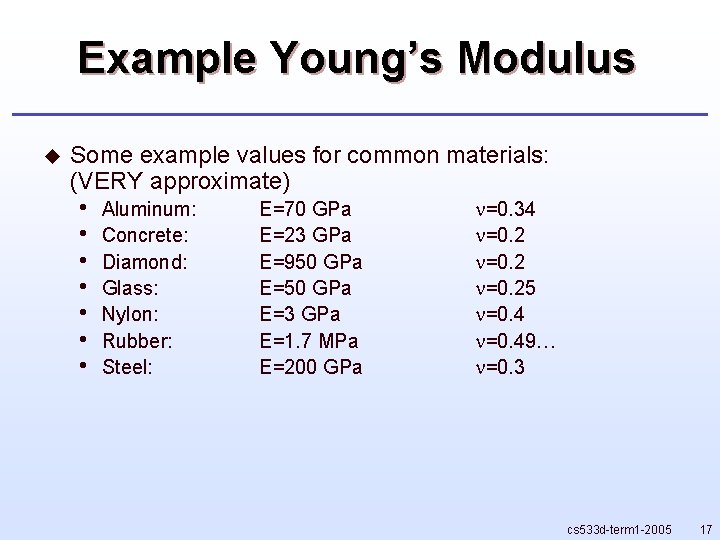
Example Young’s Modulus u Some example values for common materials: (VERY approximate) • • Aluminum: Concrete: Diamond: Glass: Nylon: Rubber: Steel: E=70 GPa E=23 GPa E=950 GPa E=3 GPa E=1. 7 MPa E=200 GPa =0. 34 =0. 25 =0. 49… =0. 3 cs 533 d-term 1 -2005 17
Poisson Ratio u Real materials are essentially incompressible (for large deformation - neglecting foams and other weird composites…) u For small deformation, materials are usually somewhat incompressible u Imagine stretching block in one direction • • Measure the contraction in the perpendicular directions Ratio is , Poisson’s ratio u [draw experiment; ] cs 533 d-term 1 -2005 18
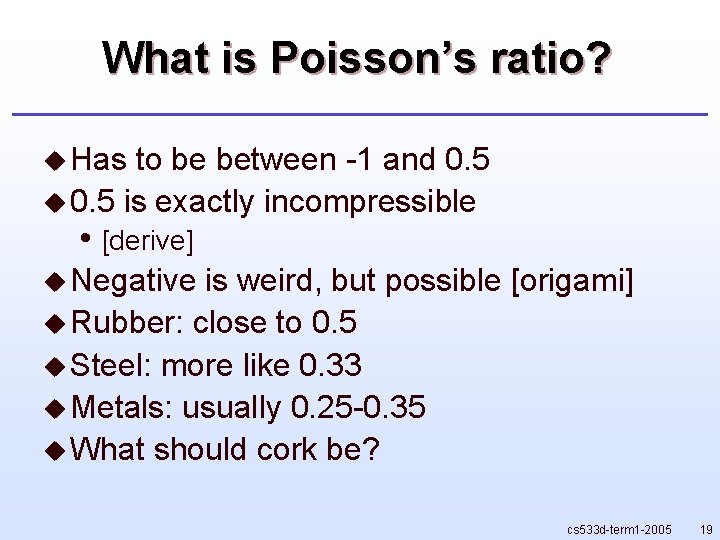
What is Poisson’s ratio? u Has to be between -1 and 0. 5 u 0. 5 is exactly incompressible • [derive] u Negative is weird, but possible [origami] u Rubber: close to 0. 5 u Steel: more like 0. 33 u Metals: usually 0. 25 -0. 35 u What should cork be? cs 533 d-term 1 -2005 19