
Notes Scientific Method Chapter 1 Section 3 How





- Slides: 40
Notes Scientific Method Chapter 1 Section 3: How Scientists Work
http: //www. classzone. com/cz/books/bio_09/resources/h tmls/animated_biology/unit 1/bio_ch 01_0029_ab_expdes. html
Scientific Investigation We will: - Identify and describe the steps of the scientific method - Determine the differences between theory and hypothesis
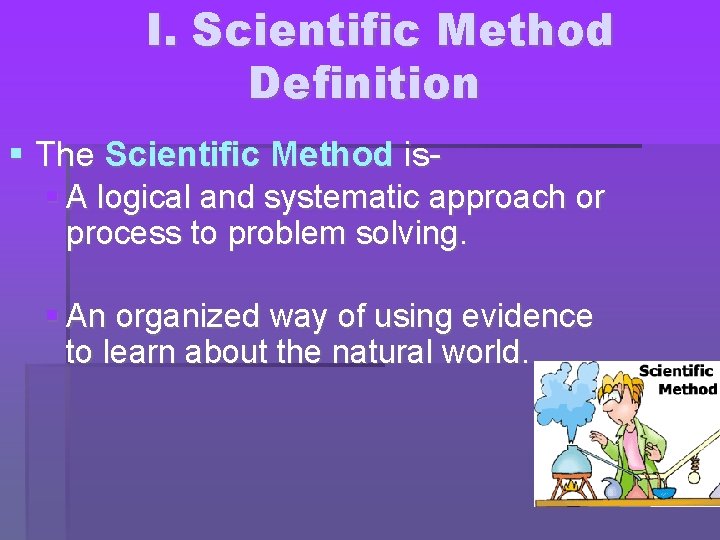
I. Scientific Method Definition The Scientific Method is- A logical and systematic approach or process to problem solving. An organized way of using evidence to learn about the natural world.
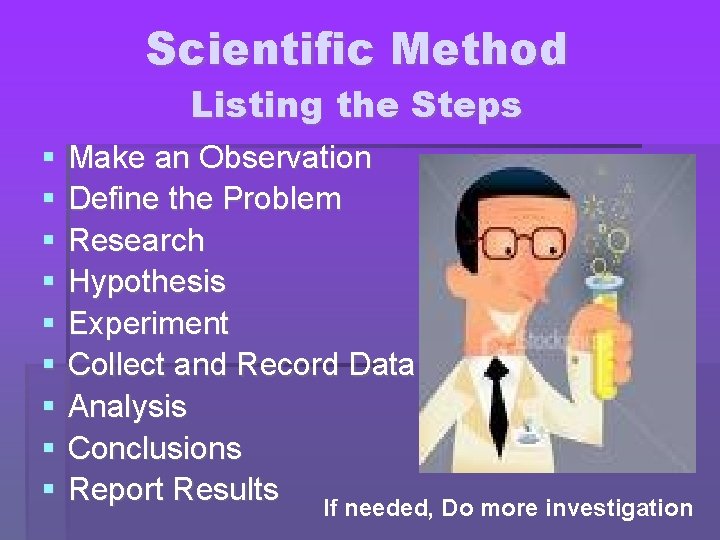
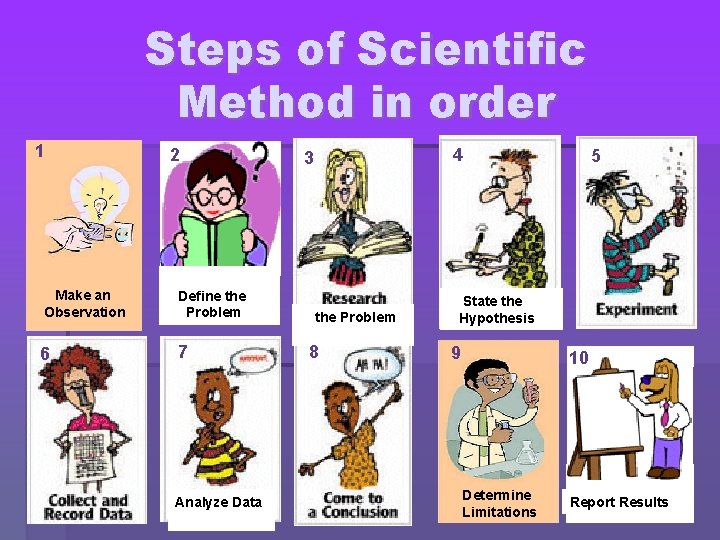
Scientific Method Listing the Steps Make an Observation Define the Problem Research Hypothesis Experiment Collect and Record Data Analysis Conclusions Report Results If needed, Do more investigation
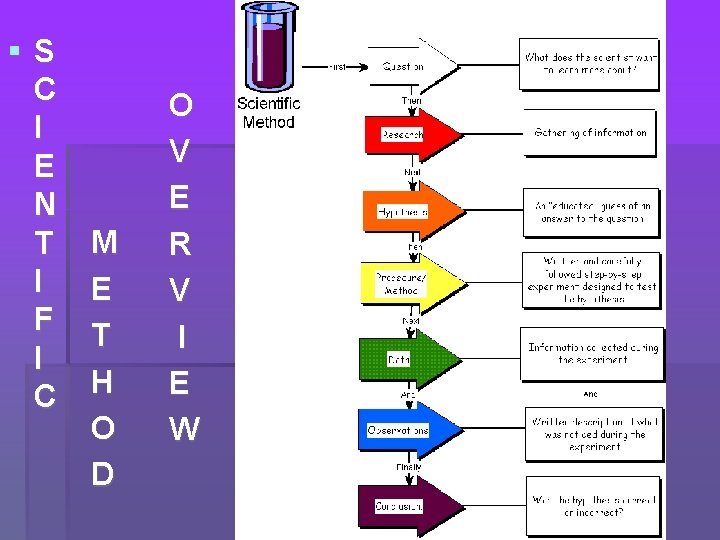
S C I E N T I F I C M E T H O D O V E R V I E W
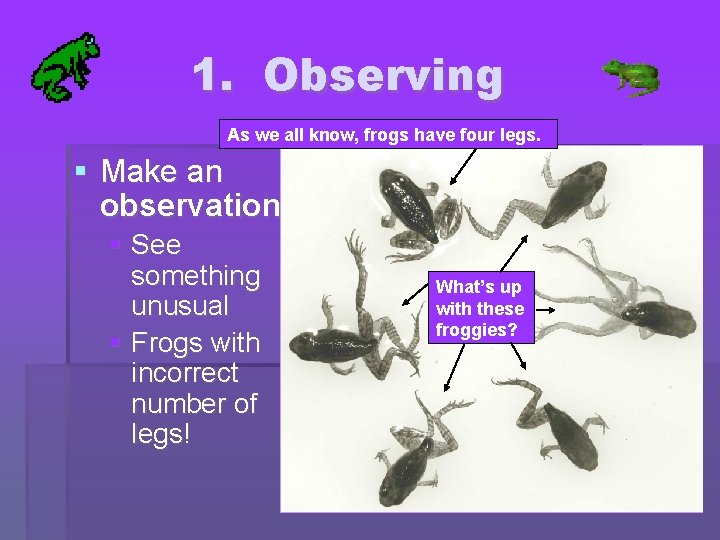
1. Observing As we all know, frogs have four legs. Make an observation See something unusual Frogs with incorrect number of legs! What’s up with these froggies?
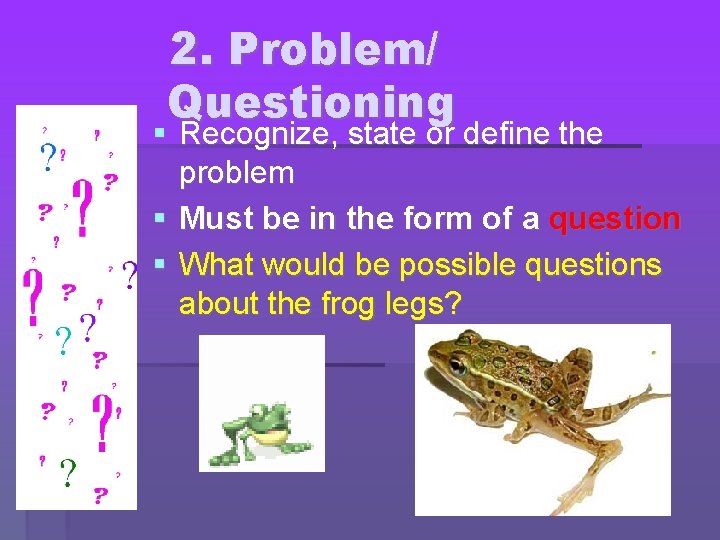
2. Problem/ Questioning Recognize, state or define the problem Must be in the form of a question What would be possible questions about the frog legs?
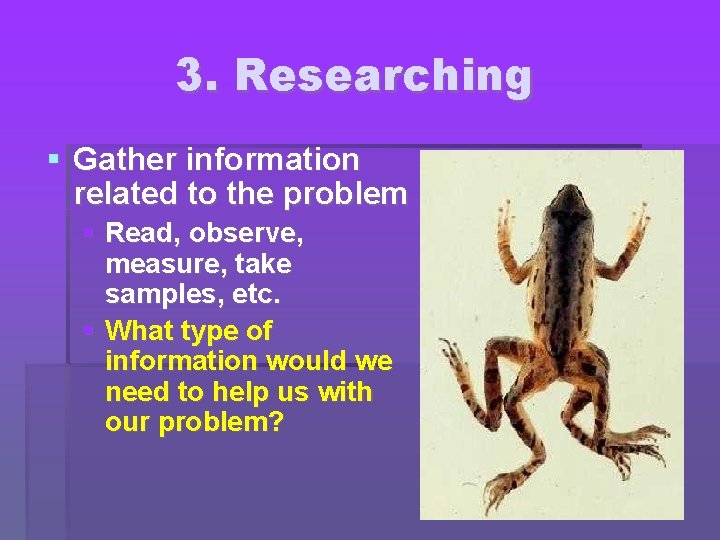
3. Researching Gather information related to the problem Read, observe, measure, take samples, etc. What type of information would we need to help us with our problem?
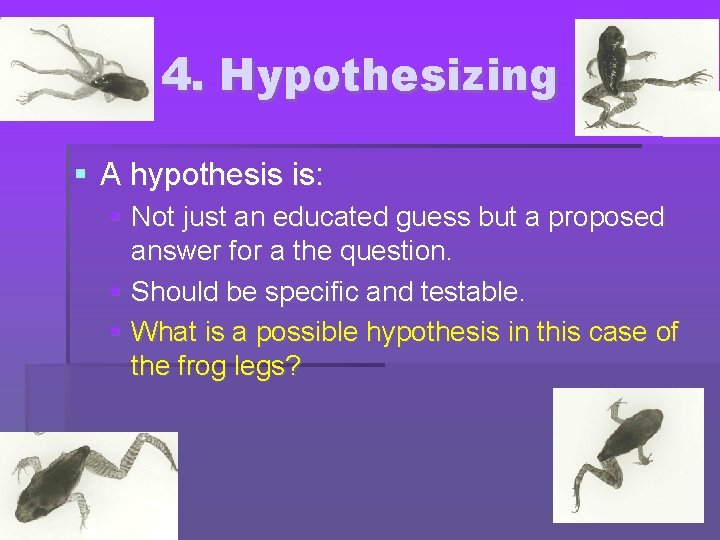
4. Hypothesizing A hypothesis is: Not just an educated guess but a proposed answer for a the question. Should be specific and testable. What is a possible hypothesis in this case of the frog legs?
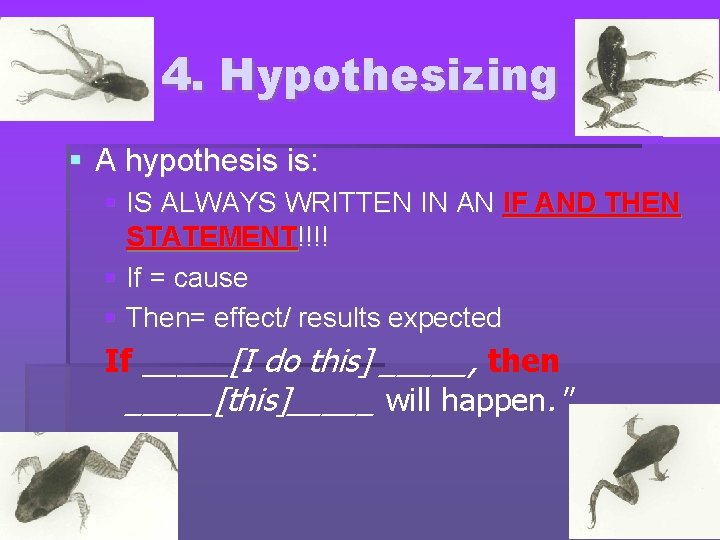
4. Hypothesizing A hypothesis is: IS ALWAYS WRITTEN IN AN IF AND THEN STATEMENT!!!! If = cause Then= effect/ results expected If _____[I do this] _____, then _____[this]_____ will happen. "
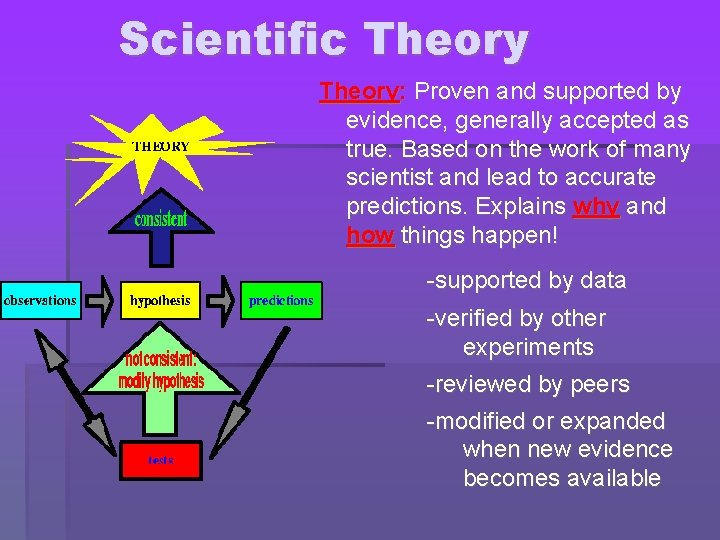
Scientific Theory: Proven and supported by evidence, generally accepted as true. Based on the work of many scientist and lead to accurate predictions. Explains why and how things happen! -supported by data -verified by other experiments -reviewed by peers -modified or expanded when new evidence becomes available
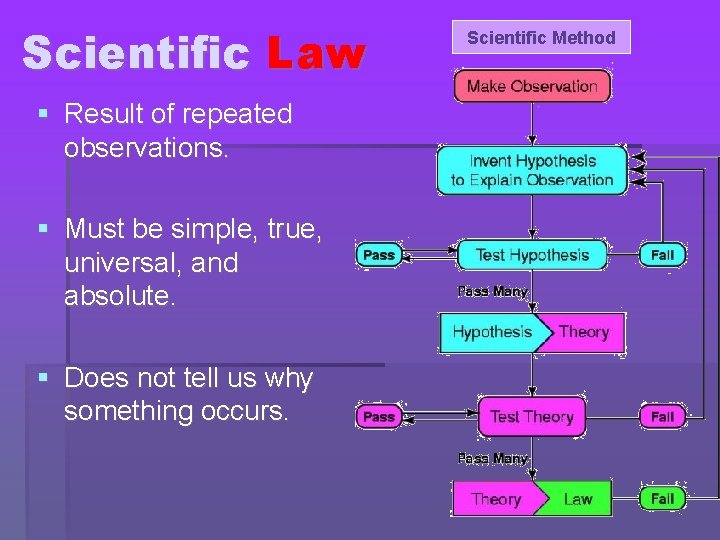
Scientific Law Result of repeated observations. Must be simple, true, universal, and absolute. Does not tell us why something occurs. Scientific Method
5. Experimenting Test the hypothesis Has 3 parts: materials, procedure, and data Then design a controlled experiment
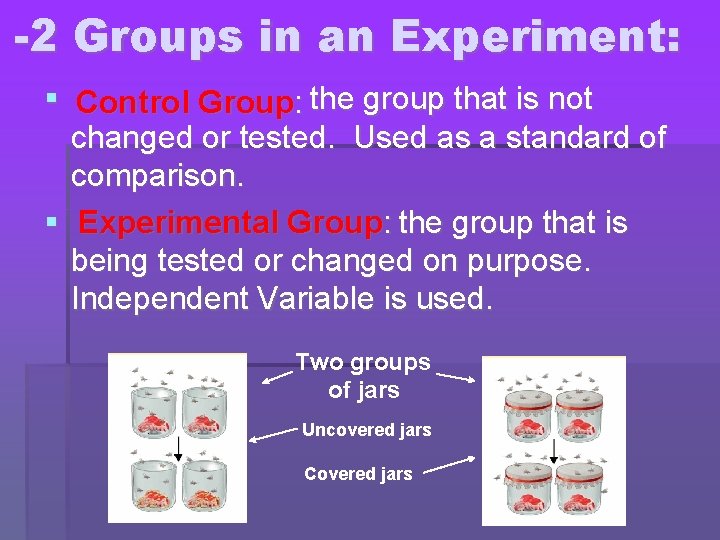
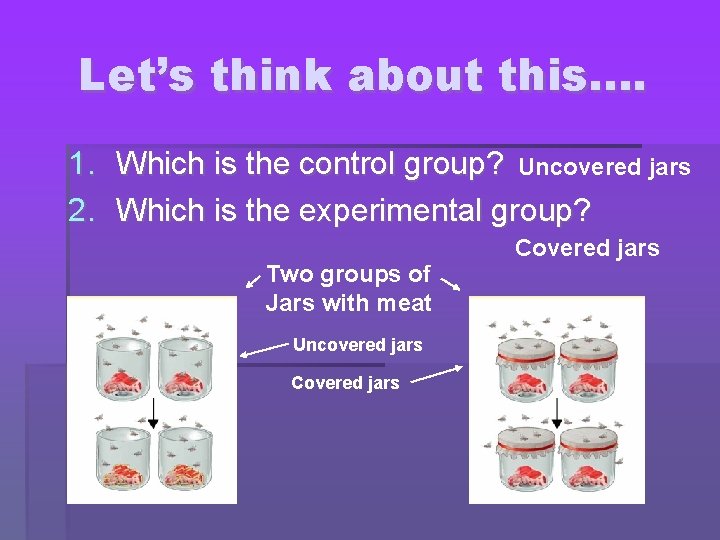
-2 Groups in an Experiment: the group that is not Control Group: changed or tested. Used as a standard of comparison. the group that is Experimental Group: being tested or changed on purpose. Independent Variable is used. Two groups of jars Uncovered jars Covered jars
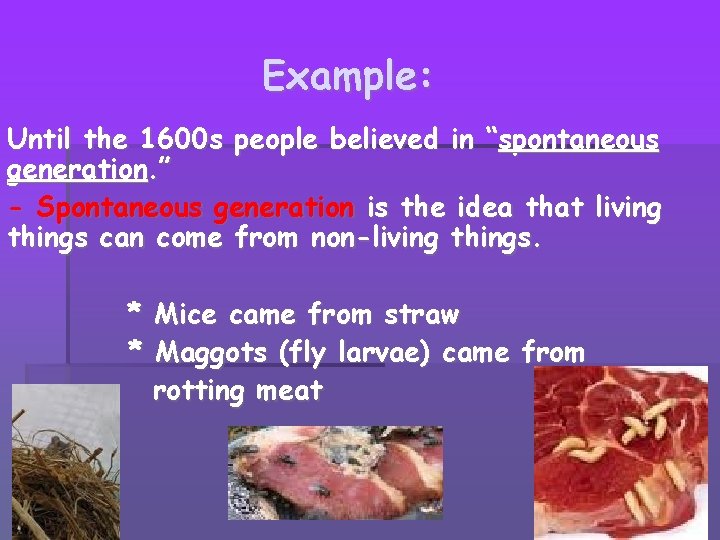
Example: Until the 1600 s people believed in “spontaneous generation. ” - Spontaneous generation is the idea that living things can come from non-living things. * Mice came from straw * Maggots (fly larvae) came from rotting meat
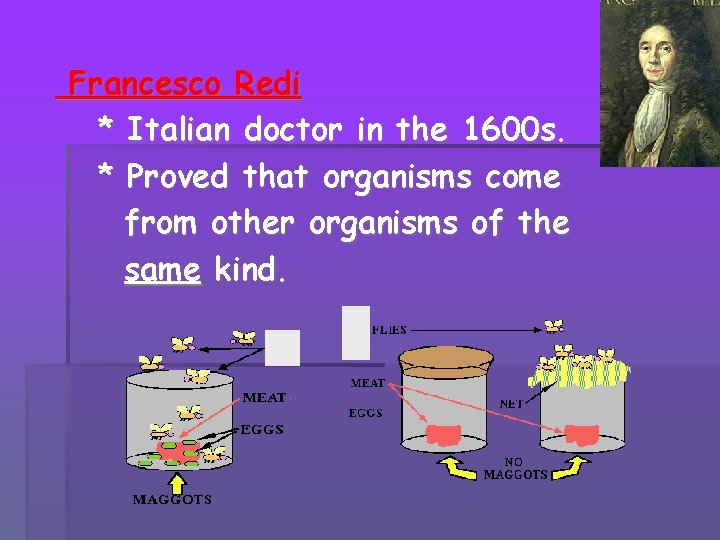
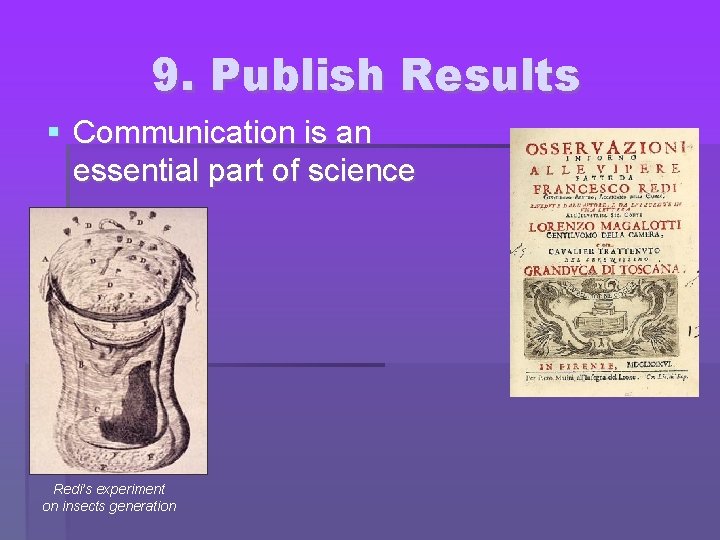
Francesco Redi * Italian doctor in the 1600 s. * Proved that organisms come from other organisms of the same kind.
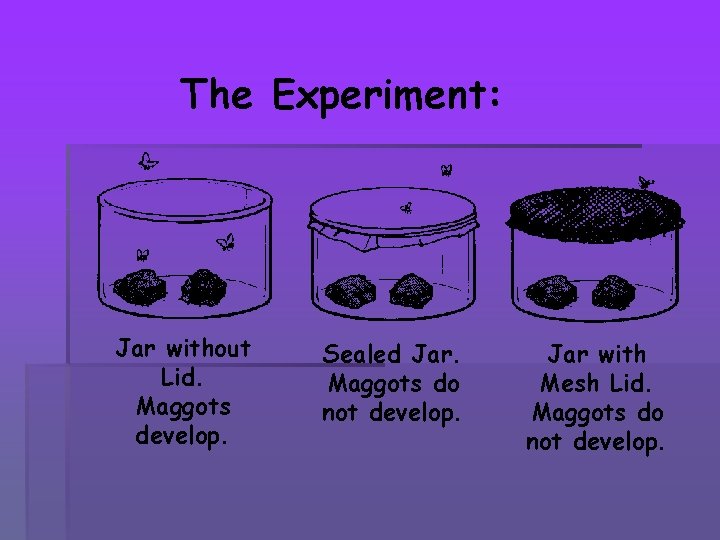
The Experiment: Jar without Lid. Maggots develop. Sealed Jar. Maggots do not develop. Jar with Mesh Lid. Maggots do not develop.
Let’s think about this. … 1. Which is the control group? Uncovered jars 2. Which is the experimental group? Two groups of Jars with meat Uncovered jars Covered jars
Why does every experiment need a Control Group? ? The control is the bases for comparison. So that we know what the “Normal” is. This way you know the results are being caused by what you are testing.
-Variables in an Experiment Variable = factors that can be changed and affect the experimental results. Controlled Variables (constants)= all variables that remain constant/ the same threw the whole experiment. Independent Variable= one variable that is intentionally changed by the scientist. This is what is being tested! Dependent Variable= observed results from the experiment. This is what is measured/ counted. Usually this changes as a result of the Independent Variable.
Lets Practice Together!
Controls and Variables with the Simpsons! Smithers thinks that a special juice will increase the productivity of workers. He creates two groups of 50 workers each and assigns each group the same task (in this case, they're supposed to staple a set of papers). Group A is given the special juice to drink while they work. Group B is not given the special juice. After an hour, Smithers counts how many stacks of papers each group has made. Group A made 1, 587 stacks, Group B made 2, 113 stacks.
Identify the: 1. Control Group 2. Independent Variable 3. Dependent Variable 4. What should Smithers' conclusion be?
Homer notices that his shower is covered in a strange green slime. His friend Barney tells him that coconut juice will get rid of the green slime. Homer decides to check this out by spraying half of the shower with coconut juice. He sprays the other half of the shower with water. After 3 days of "treatment" there is no change in the appearance of the green slime on either side of the shower.
Identify the: 1. Control Group 2. Independent Variable 3. Dependent Variable 4. What should Homers' conclusion be?
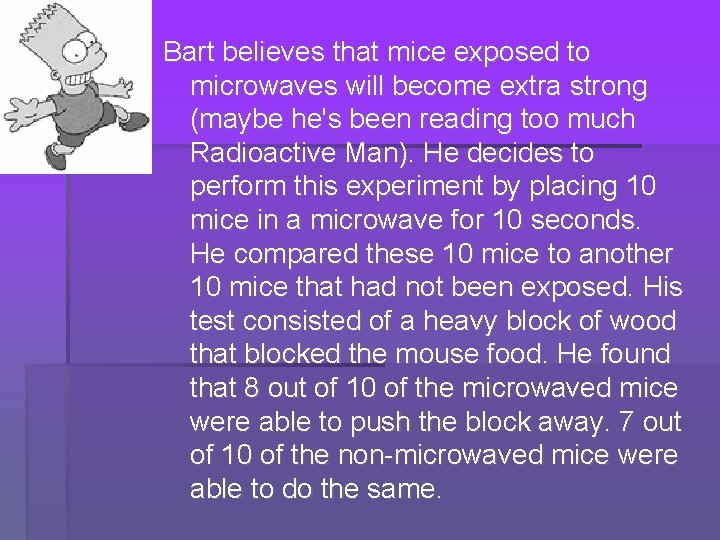
Bart believes that mice exposed to microwaves will become extra strong (maybe he's been reading too much Radioactive Man). He decides to perform this experiment by placing 10 mice in a microwave for 10 seconds. He compared these 10 mice to another 10 mice that had not been exposed. His test consisted of a heavy block of wood that blocked the mouse food. He found that 8 out of 10 of the microwaved mice were able to push the block away. 7 out of 10 of the non-microwaved mice were able to do the same.
Identify the: 1. Control Group 2. Independent Variable 3. Dependent Variable 4. What should Barts' conclusion be?
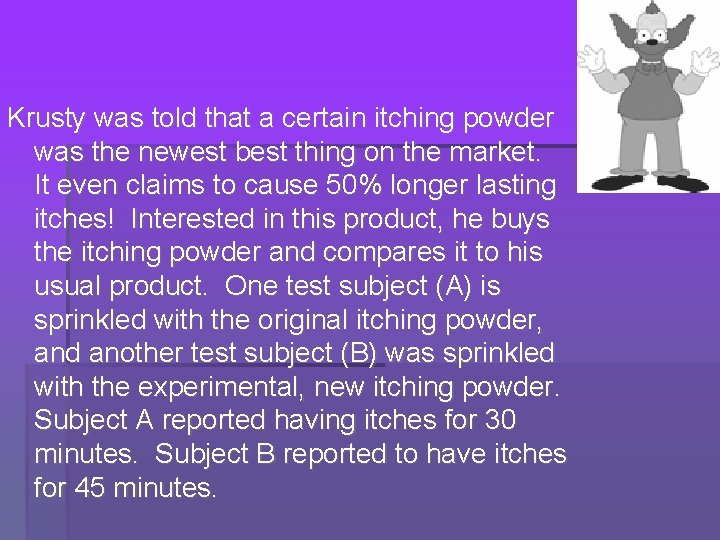
Krusty was told that a certain itching powder was the newest best thing on the market. It even claims to cause 50% longer lasting itches! Interested in this product, he buys the itching powder and compares it to his usual product. One test subject (A) is sprinkled with the original itching powder, and another test subject (B) was sprinkled with the experimental, new itching powder. Subject A reported having itches for 30 minutes. Subject B reported to have itches for 45 minutes.
Identify the: 1. Control Group 2. Independent Variable 3. Dependent Variable 4. Explain whether the data supports the advertisements claims about its product.
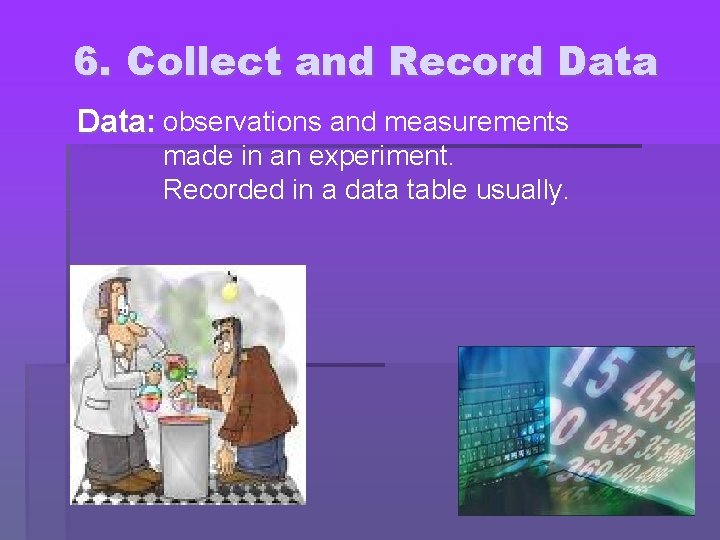
6. Collect and Record Data: observations and measurements made in an experiment. Recorded in a data table usually.
7. Analyze the Data Examine data tables, charts, and graphs Examine experimental notes Look for trends, patterns, and averages What does the data show Put your data into words
8. Draw Conclusions Restate the hypothesis. Accept or Reject the hypothesis. Support your conclusion with specific reasons or numerical data. Explain in words what your experiment showed.
9. Publish Results Communication is an essential part of science Redi’s experiment on insects generation
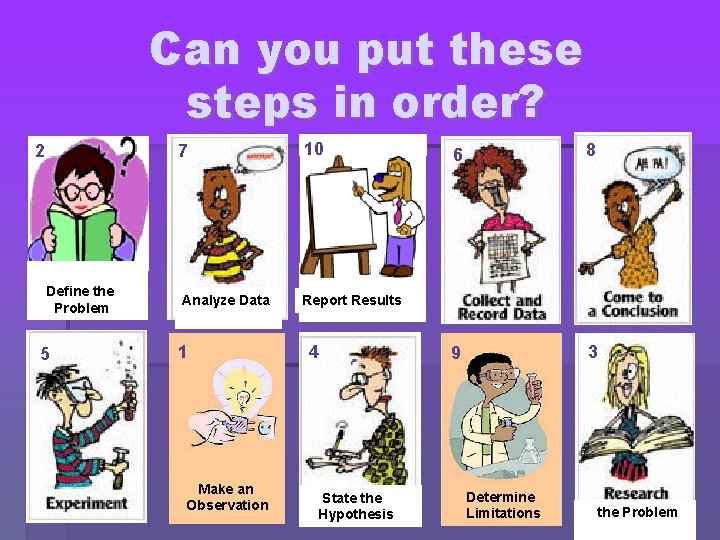
Can you put these steps in order? 2 Define the Problem 5 7 10 Analyze Data Report Results 1 Make an Observation 4 State the Hypothesis 6 8 9 3 Determine Limitations the Problem
Steps of Scientific Method in order 1 2 Make an Observation Define the Problem 6 7 Analyze Data 4 3 the Problem 8 5 State the Hypothesis 9 10 Determine Limitations Report Results
Two students were testing the amount of fertilizer that would best promote the growth of strawberries in a garden. Which of the following could be an unavoidable source of experimental error? a. Length of the study. b. Variation in the strawberry plants. c. The cost of watering the plants. d. Fertilization during the study. B
Next: Take a ten minute break then we will do a handout to practice the scientific method.
Next: Get your white boards for chapter 1 out and we are going to go over some of them. Then you may work on them since they will be due by the end of the unit. Read ahead and look over the notes for chapter 2: Chemistry We will not go over this section in class.
Next: Clean up your experiments by rinsing out your beakers and setting them by the sink. Then turn your papers into me. For next time: Look over chapter 2 notes: Chemistry. We will not go over these notes in class so you will need to do them on your own. Then you are free to go at 11: 45 if you don’t have anymore questions