
Notes Scientific Method Chapter 1 Section 2 How
- Slides: 43
Notes Scientific Method Chapter 1: Section 2 How Scientists Work
How Scientists Work: Solving the Problems § Much of biology deals with solving problems § These problems can be environmental, ecological, health related, etc. § No matter what types of problems are being studied, scientists use the same problem-solving steps called… § The Scientific Method
Scientific Method Definition § The scientific method is§ A logical and systematic approach or process to problem solving. § An organized way of using evidence to learn about the natural world. § According to Wikipedia - Scientific method is a body of techniques for investigating phenomena and acquiring new knowledge, as well as for correcting and integrating previous knowledge. It is based on gathering observable, empirical and measurable evidence subject to specific principles of reasoning, the collection of data through observation and experimentation, and the formulation and testing of hypotheses.
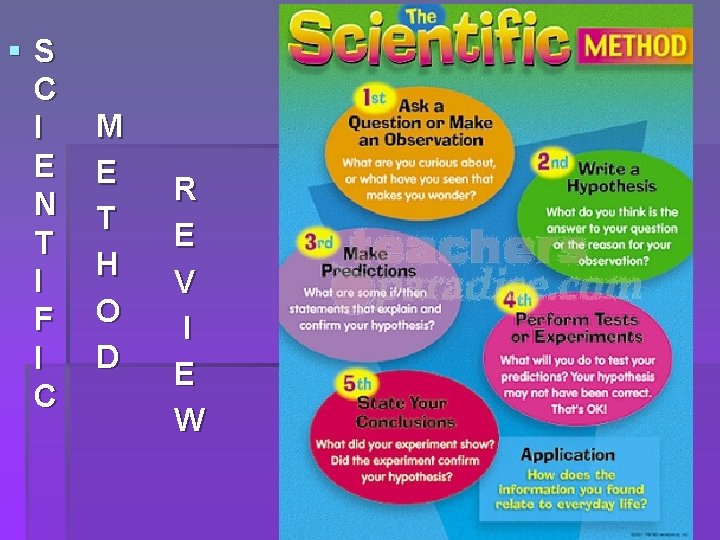
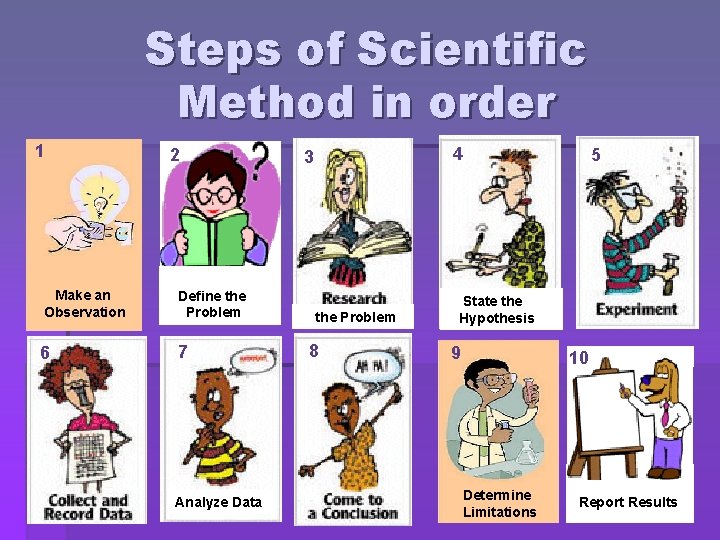
Scientific Method Listing the Steps § § § § § Make an Observation Define the Problem Research the Problem State the Hypothesis Experiment to test Hypothesis Collect and Record Data Analyze Data Draw Conclusions Determine Limitations Report Results If needed, Do more investigation
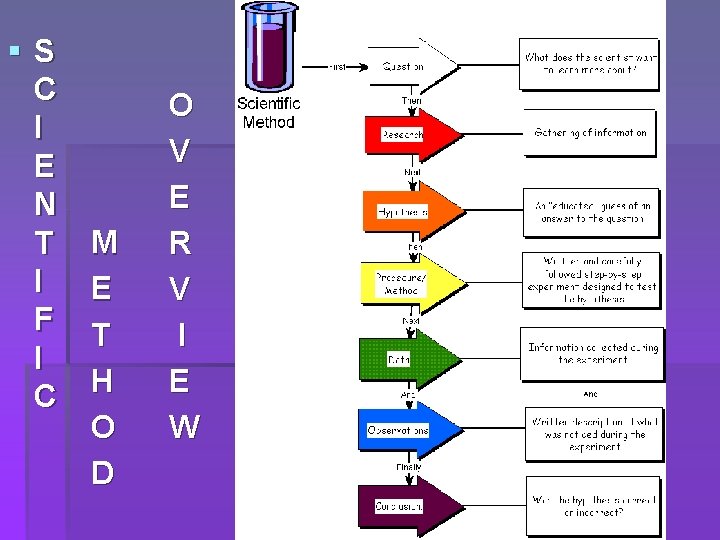
§S C I E N T I F I C M E T H O D O V E R V I E W
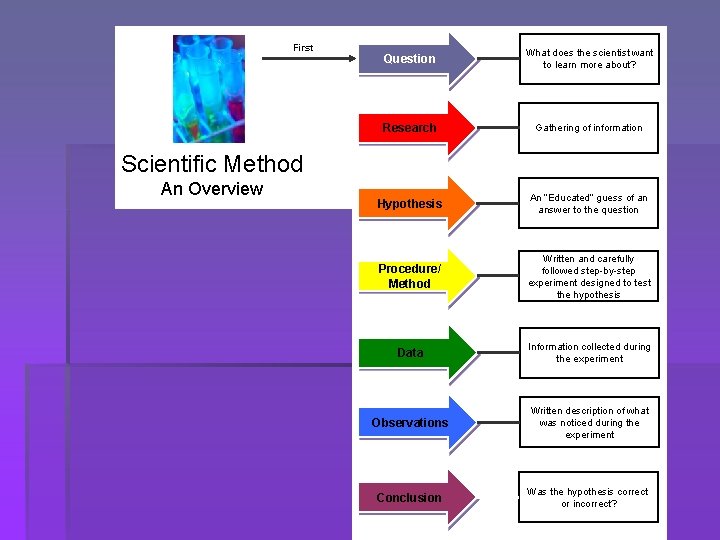
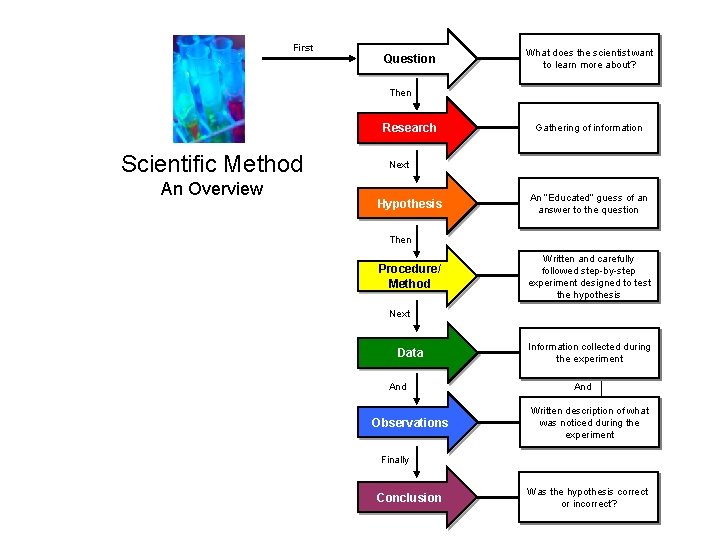
First Question What does the scientist want to learn more about? Then Research Scientific Method An Overview Gathering of information Next Hypothesis An “Educated” guess of an answer to the question Then Procedure/ Method Written and carefully followed step-by-step experiment designed to test the hypothesis Next Data And Observations Information collected during the experiment And Written description of what was noticed during the experiment Finally Conclusion Was the hypothesis correct or incorrect?
First Question What does the scientist want to learn more about? Then Research Scientific Method An Overview Gathering of information Next Hypothesis An “Educated” guess of an answer to the question Then Procedure/ Method Written and carefully followed step-by-step experiment designed to test the hypothesis Next Data And Observations Information collected during the experiment And Written description of what was noticed during the experiment Finally Conclusion Was the hypothesis correct or incorrect?
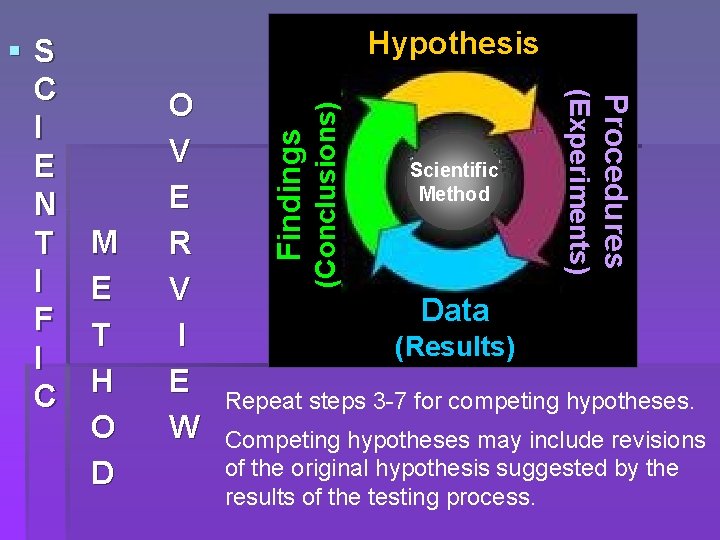
(Conclusions) Scientific Method Procedures M E T H O D O V E R V I E W Findings Hypothesis (Experiments) §S C I E N T I F I C Data (Results) Repeat steps 3 -7 for competing hypotheses. Competing hypotheses may include revisions of the original hypothesis suggested by the results of the testing process.
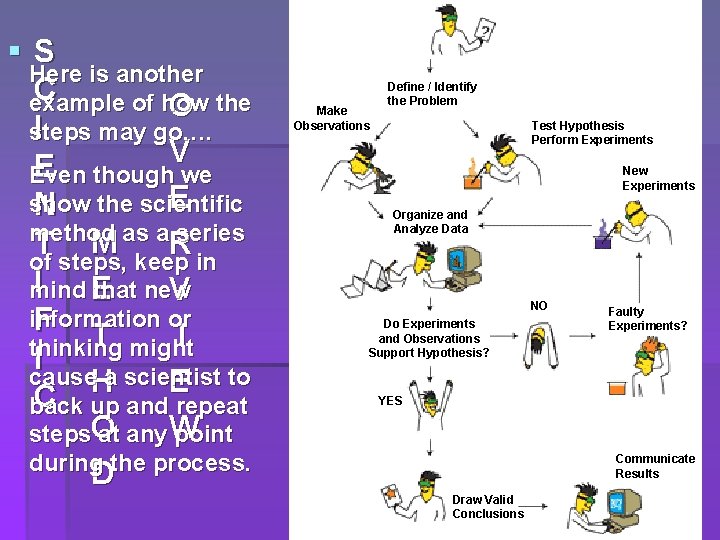
§S Here is another C example of how O the I steps may go…. V E though we Even E show N the scientific method as a series T M R of steps, keep in I E mind that new V information or F T I thinking might I cause. Ha scientist to E C up and repeat back steps. O at any W point during the process. D Make Observations Form a Define / Identify Hypothesis the Problem Test Hypothesis Perform Experiments New Experiments Organize and Analyze Data NO Do Experiments and Observations Support Hypothesis? Faulty Experiments? YES Communicate Results Draw Valid Conclusions
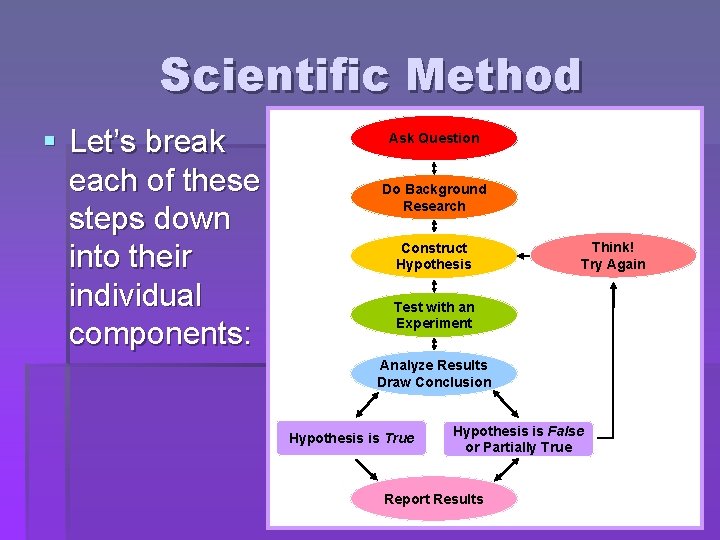
Scientific Method § Let’s break each of these steps down into their individual components: Ask Question Do Background Research Construct Hypothesis Think! Try Again Test with an Experiment Analyze Results Draw Conclusion Hypothesis is True Hypothesis is False or Partially True Report Results
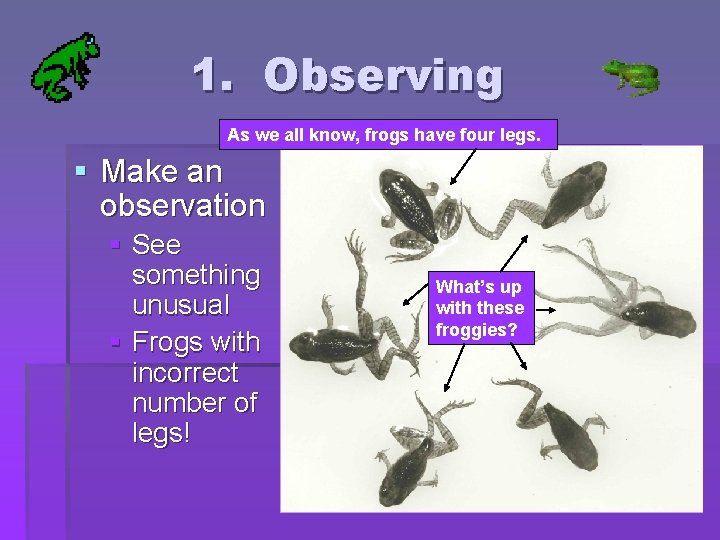
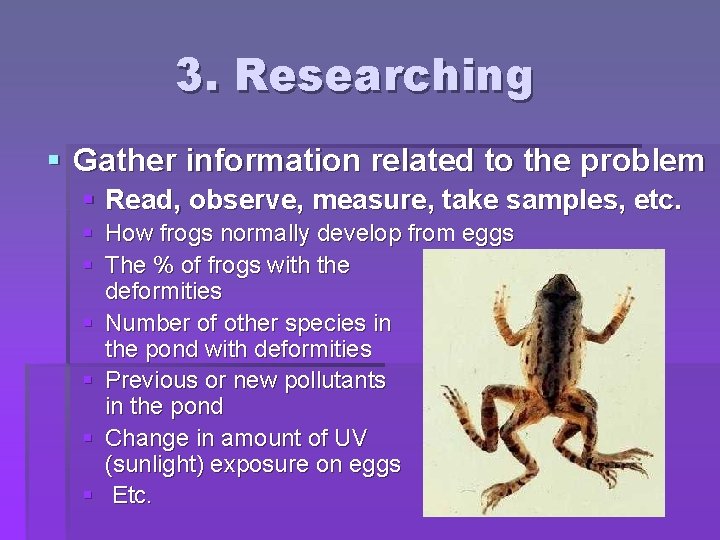
1. Observing As we all know, frogs have four legs. § Make an observation § See something unusual § Frogs with incorrect number of legs! What’s up with these froggies?
2. Questioning § Recognize, state or define the problem § Must be in the form of a question § The obvious question is: § What is causing these deformities?
3. Researching § Gather information related to the problem § Read, observe, measure, take samples, etc. § How frogs normally develop from eggs § The % of frogs with the deformities § Number of other species in the pond with deformities § Previous or new pollutants in the pond § Change in amount of UV (sunlight) exposure on eggs § Etc.
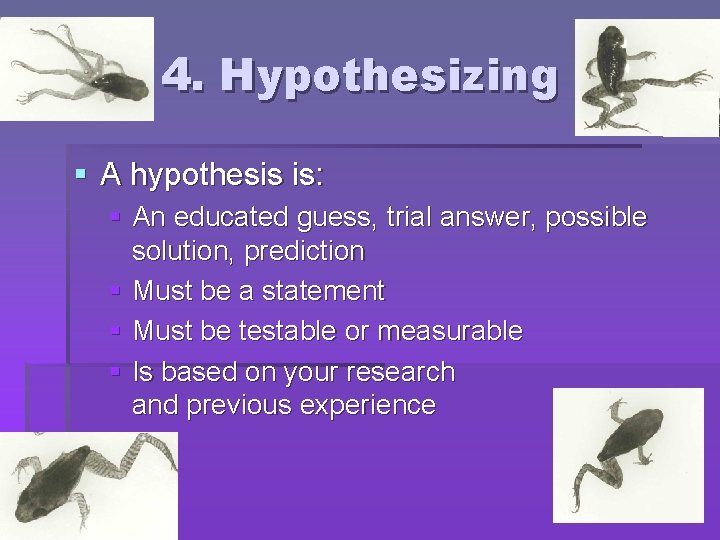
4. Hypothesizing § A hypothesis is: § An educated guess, trial answer, possible solution, prediction § Must be a statement § Must be testable or measurable § Is based on your research and previous experience
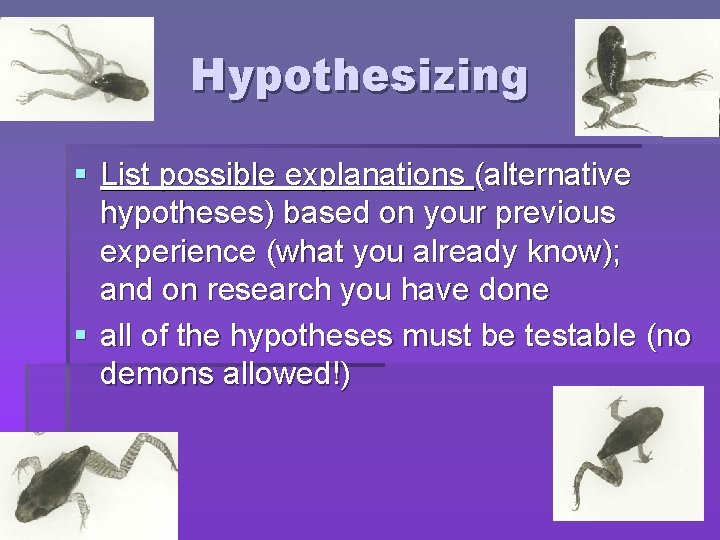
Hypothesizing § List possible explanations (alternative hypotheses) based on your previous experience (what you already know); and on research you have done § all of the hypotheses must be testable (no demons allowed!)
Hypothesizing §Disease Some. Rock possible explanations (hypotheses) Aliens from outer space-etc. )Something Else. Chemical Pollution. Genetic mutation. Ultraviolet Radiation(virus, parasite, Loud + Roll Musicforthis thehypothesis frog deformities: If is true, then: If. Genetic this hypothesis is true, then: Another possibility that we might think of mutation You should be able to to find a likely chemical pollutant in If this hypothesis is true, then: We should be able find the disease-causing Sorry, is. Chemical predation orponds cannibalism, which seems the deformed frog Pollution agent (for example, parasites) at the deformed We should be able to measure unusually high If we mate deformed frogs the offspring You should be able to isolate the chemical from the pond to be the best explanation for certain kinds Okay, this is testable, this isshow not allowed because Ultraviolet Radiation frog ponds levels of UV radiation atdeformities deformed frog sites should similar water of deformities (frogs with missing limbs). We should be able to find the parasites in the use these same levels to but WHY test it? ? ? You should be able to show that the isolated chemical can Disease (virus or parasite or. . . ? ) The deformities should be fairly uniform it is not testable using the If thisthehypothesis is kinds true, of then, at minimum: deformed frogs cause exact same deformities in the lab induce the exact same deformities in the Loud Rock & Roll Music and predictable (get real) These are minimal predictions; you may havepond already We should frogs other We should befind able to useand/or the same parasite to Scientific Method. lab The particular deformities only be Aliens from outer space thought ofthink the fact that chemical pollution should affect induce the exact same kinds ofshould deformities in the critters with evidence that their legs have Can you of other predictions based on this Sheesh! all four limbs equally, or that other organisms from the found in one species Something elseor bitten lab hypothesis? been damaged off as well same ponds should show deformities
5. Experimenting § Testing the hypothesis § Pick the hypothesis that makes the most sense and is easy to test § Then design a controlled experiment
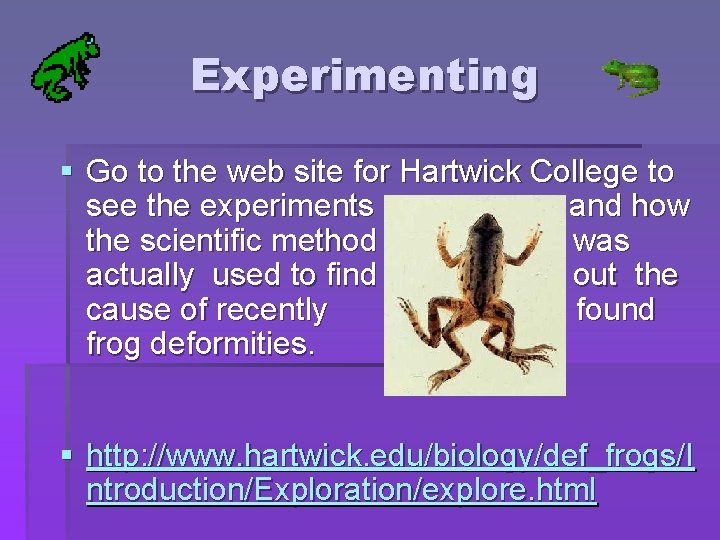
Experimenting § Go to the web site for Hartwick College to see the experiments and how the scientific method was actually used to find out the cause of recently found frog deformities. § http: //www. hartwick. edu/biology/def_frogs/I ntroduction/Exploration/explore. html
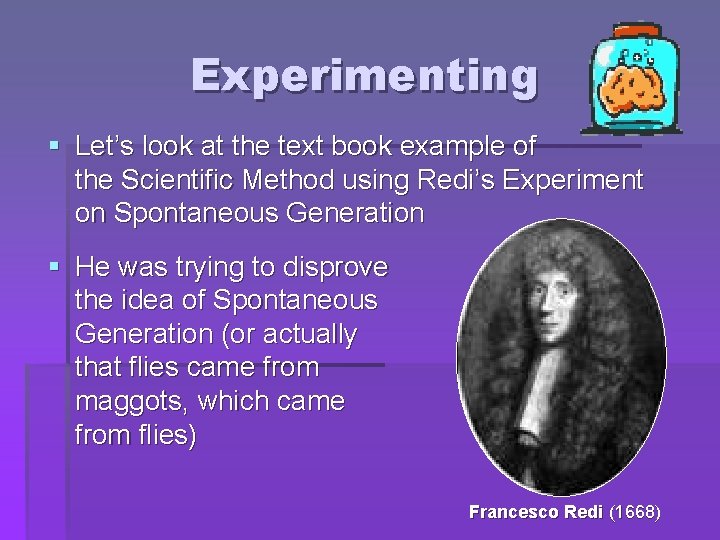
Experimenting § Let’s look at the text book example of the Scientific Method using Redi’s Experiment on Spontaneous Generation § He was trying to disprove the idea of Spontaneous Generation (or actually that flies came from maggots, which came from flies) Francesco Redi (1668)
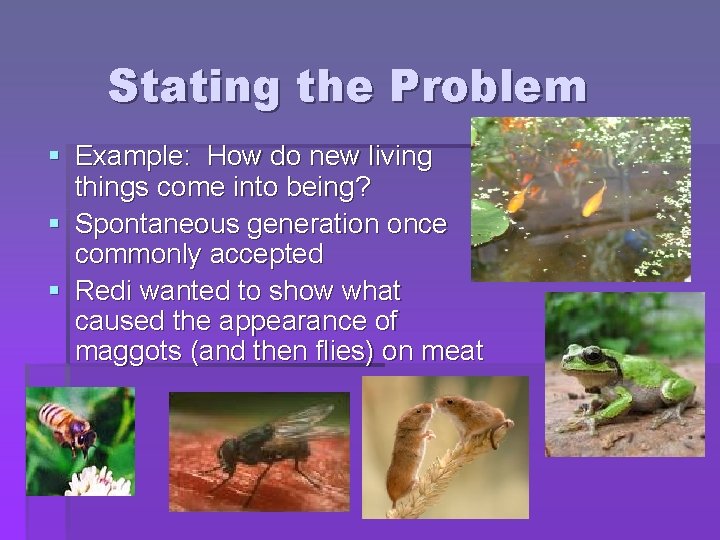
Stating the Problem § Example: How do new living things come into being? § Spontaneous generation once commonly accepted § Redi wanted to show what caused the appearance of maggots (and then flies) on meat
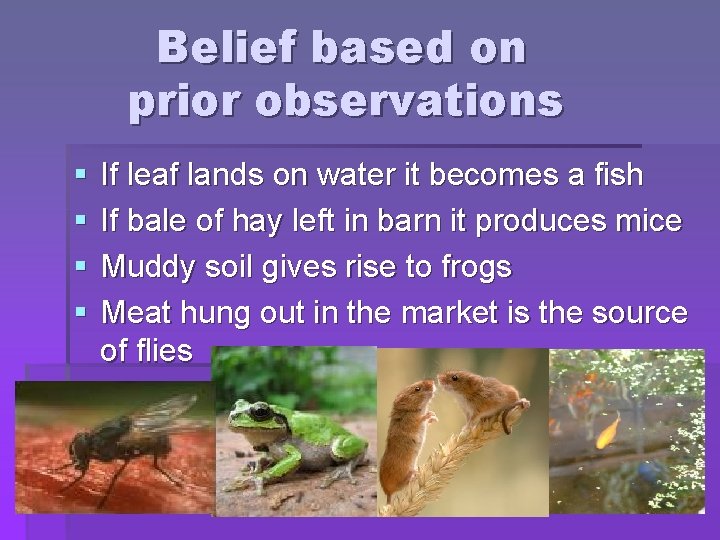
Belief based on prior observations § § If leaf lands on water it becomes a fish If bale of hay left in barn it produces mice Muddy soil gives rise to frogs Meat hung out in the market is the source of flies
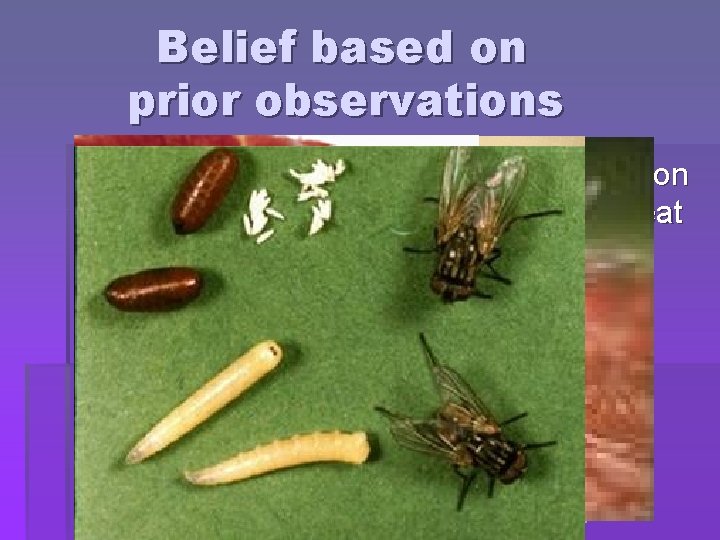
Belief based on prior observations § Redi observed that maggots appeared on meat a few days after flies were on meat § No microscope = no way to see eggs § But Redi believed that maggots came from eggs that were laid by flies
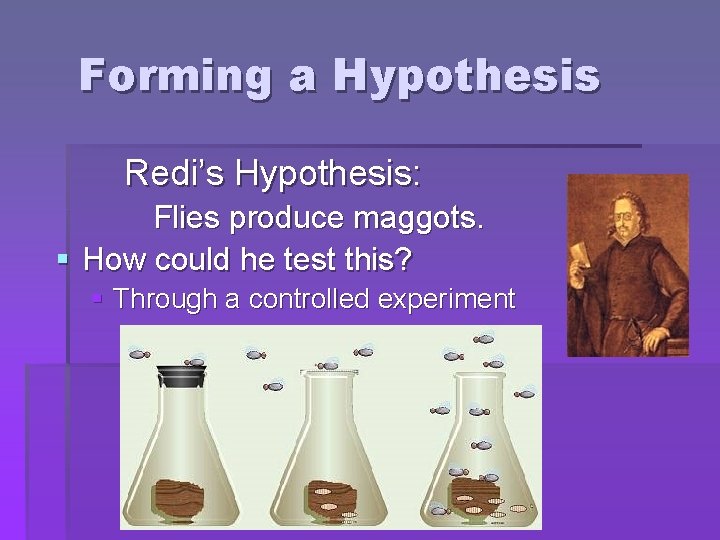
Forming a Hypothesis Redi’s Hypothesis: Flies produce maggots. § How could he test this? § Through a controlled experiment
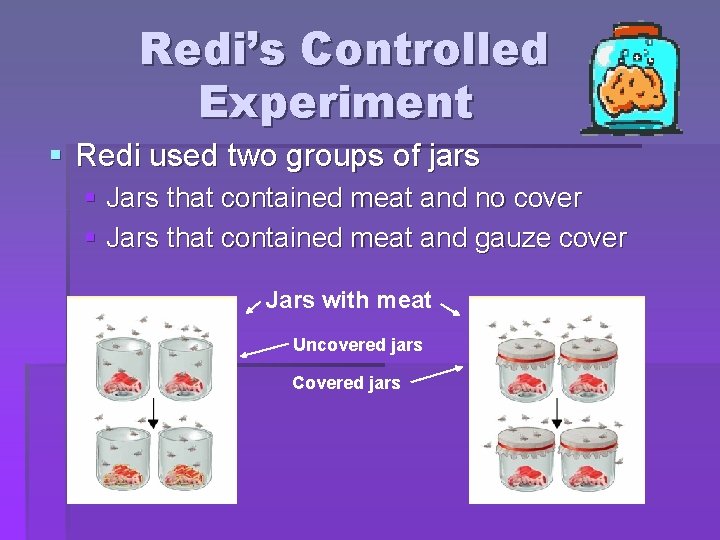
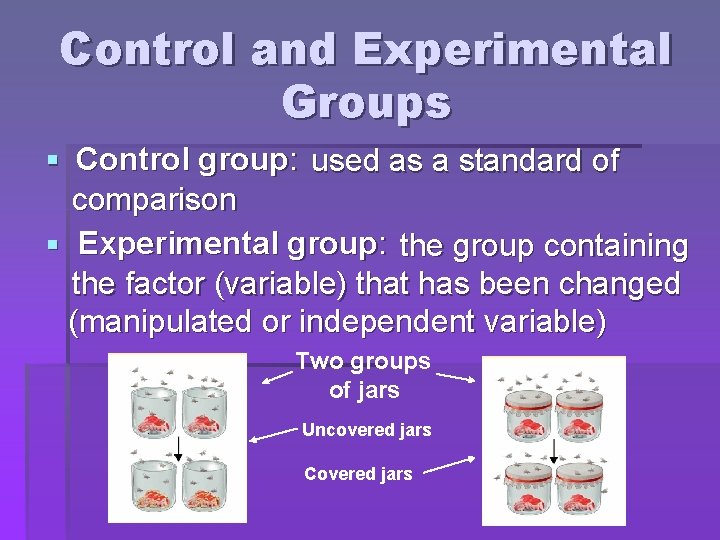
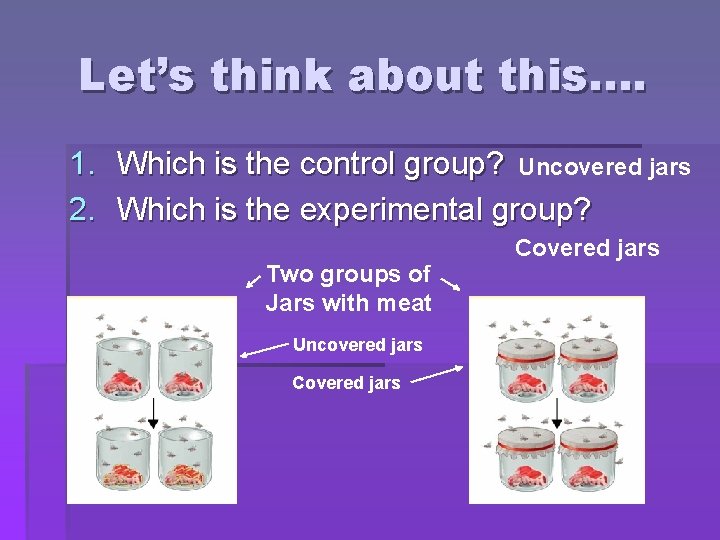
Redi’s Controlled Experiment § Redi used two groups of jars § Jars that contained meat and no cover § Jars that contained meat and gauze cover Jars with meat Uncovered jars Covered jars
Control and Experimental Groups § Control group: used as a standard of comparison § Experimental group: the group containing the factor (variable) that has been changed (manipulated or independent variable) Two groups of jars Uncovered jars Covered jars
Variables in an Experiment § Variables - Factors that can be changed § Controlled Variables - all the variables that remain constant § Manipulated Variable - (also called the Independent Variable) - factor in an experiment that a scientist purposely changes § Responding Variable- (also called the Dependent Variable) - the outcome or results, factor in an experiment that may change because of the manipulated variable…. what a scientist wants to observe
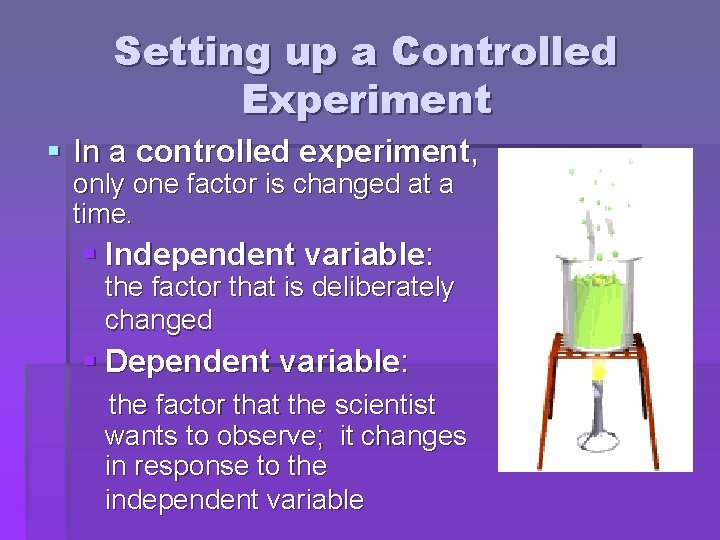
Setting up a Controlled Experiment § In a controlled experiment, only one factor is changed at a time. § Independent variable: the factor that is deliberately changed § Dependent variable: the factor that the scientist wants to observe; it changes in response to the independent variable
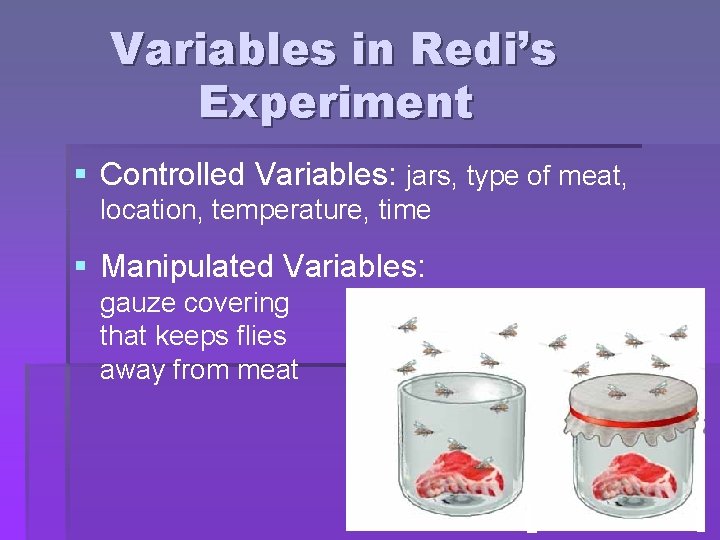
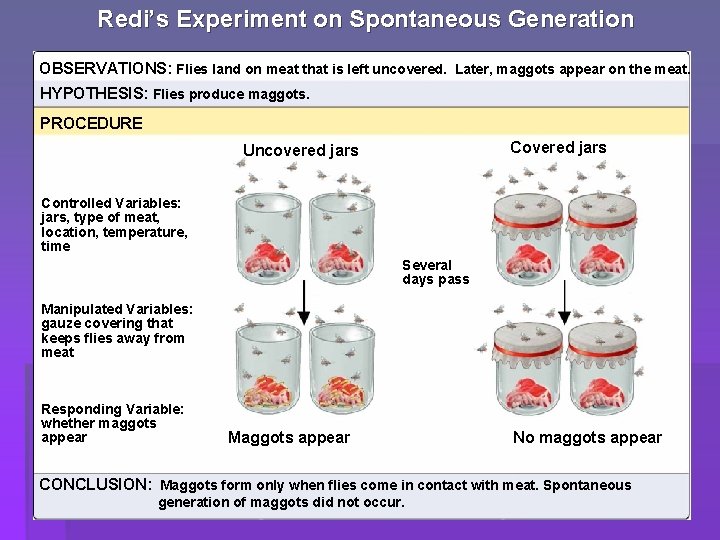
Variables in Redi’s Experiment § Controlled Variables: jars, type of meat, location, temperature, time § Manipulated Variables: gauze covering that keeps flies away from meat
Let’s think about this. … 1. Which is the control group? Uncovered jars 2. Which is the experimental group? Two groups of Jars with meat Uncovered jars Covered jars
Redi’s Experiment on Spontaneous Generation OBSERVATIONS: Flies land on meat that is left uncovered. Later, maggots appear on the meat. HYPOTHESIS: Flies produce maggots. PROCEDURE Covered jars Uncovered jars Controlled Variables: jars, type of meat, location, temperature, time Several days pass Manipulated Variables: gauze covering that keeps flies away from meat Responding Variable: whether maggots appear Maggots appear No maggots appear CONCLUSION: Maggots form only when flies come in contact with meat. Spontaneous generation of maggots did not occur.
6. Collect and Record Data: observations and measurements made in an experiment Types of Recorded Data § Quantitative - observations that involve measurements/numbers; i. e. 3 days, 12 maggots, 4 g, 13 sec, 8 liters § Qualitative - observations that do not involve numbers, are of a descriptive nature i. e. white maggots covered the meat, leaves were all wilting
7. Analyze the Data § Examine data tables, charts, and graphs § Examine experimental notes § Look for trends, patterns, and averages § What does the data show § Put your data into words
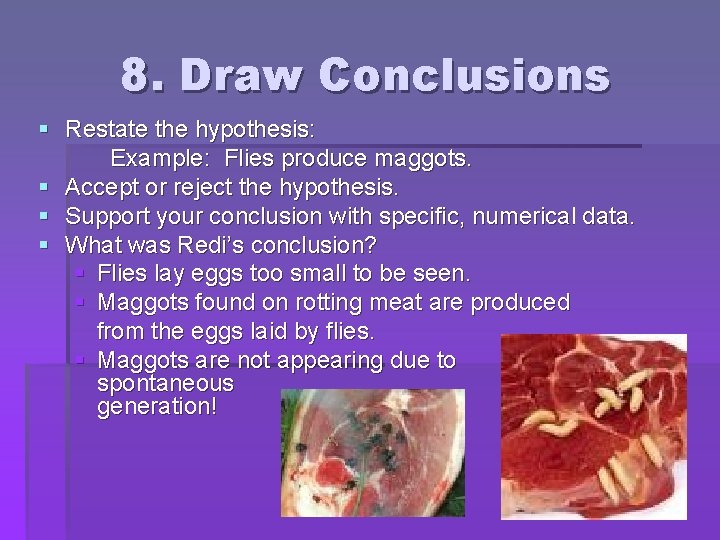
8. Draw Conclusions § Restate the hypothesis: Example: Flies produce maggots. § Accept or reject the hypothesis. § Support your conclusion with specific, numerical data. § What was Redi’s conclusion? § Flies lay eggs too small to be seen. § Maggots found on rotting meat are produced from the eggs laid by flies. § Maggots are not appearing due to spontaneous generation!
9. Determine Limitations § Scientists look for possible flaws in their research § They look for faulty (inaccurate) data § They look for experimental error or bias's § They decide on the validity of their results § They make suggestions for improvement or raise new questions
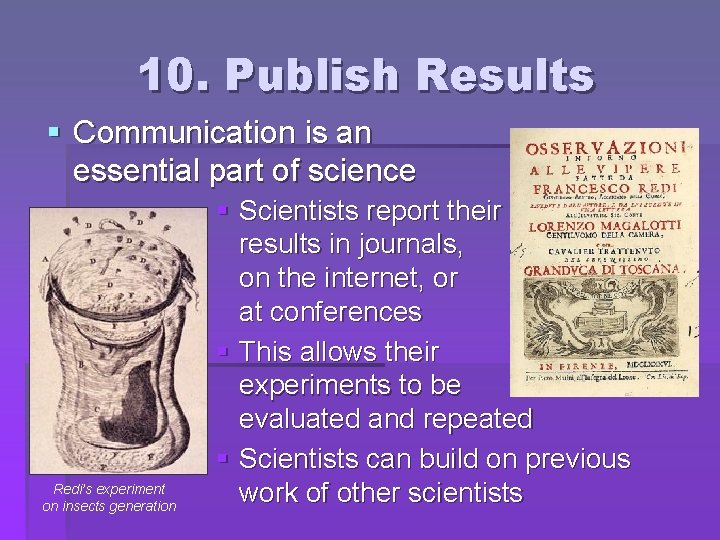
10. Publish Results § Communication is an essential part of science Redi’s experiment on insects generation § Scientists report their results in journals, on the internet, or at conferences § This allows their experiments to be evaluated and repeated § Scientists can build on previous work of other scientists
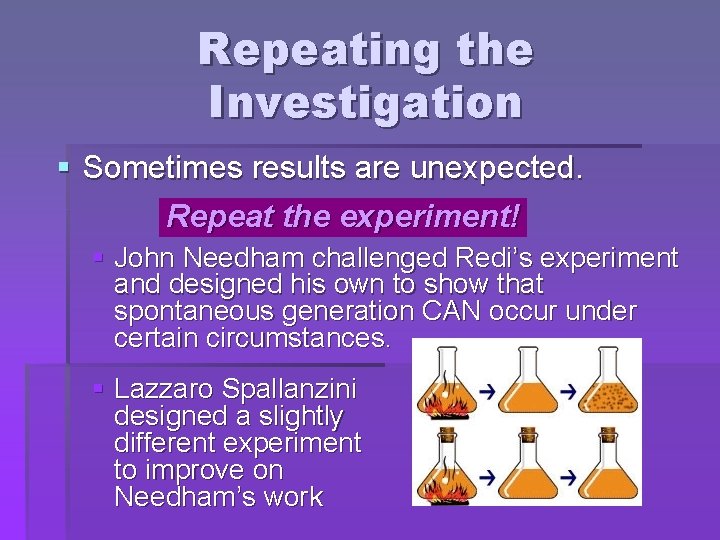
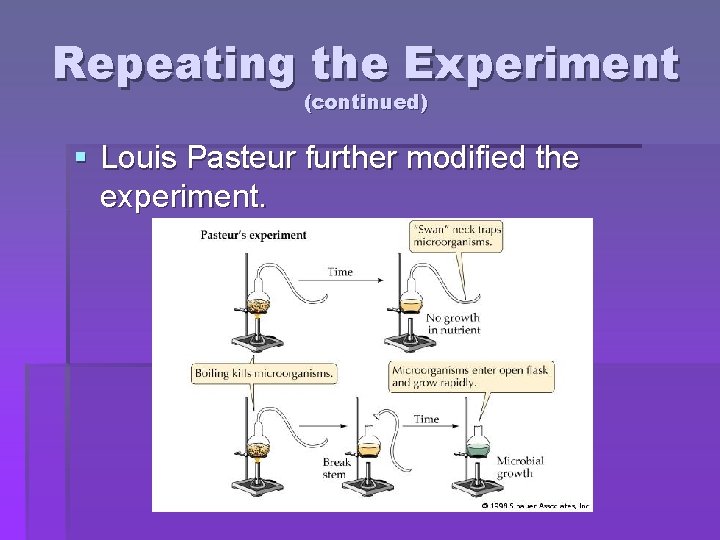
Repeating the Investigation § Sometimes results are unexpected. Repeat the experiment! § John Needham challenged Redi’s experiment and designed his own to show that spontaneous generation CAN occur under certain circumstances. § Lazzaro Spallanzini designed a slightly different experiment to improve on Needham’s work
Repeating the Experiment (continued) § Louis Pasteur further modified the experiment.
Scientific Method How Scientists Work Solving the Problems The reason scientific work is called “RE-search” rather than just "search " is because it is an ongoing process that often times changes our view of the natural world. It is subject to modification in light of new evidence and new ways of thinking.
§S C I E N T I F I C M E T H O D R E V I E W
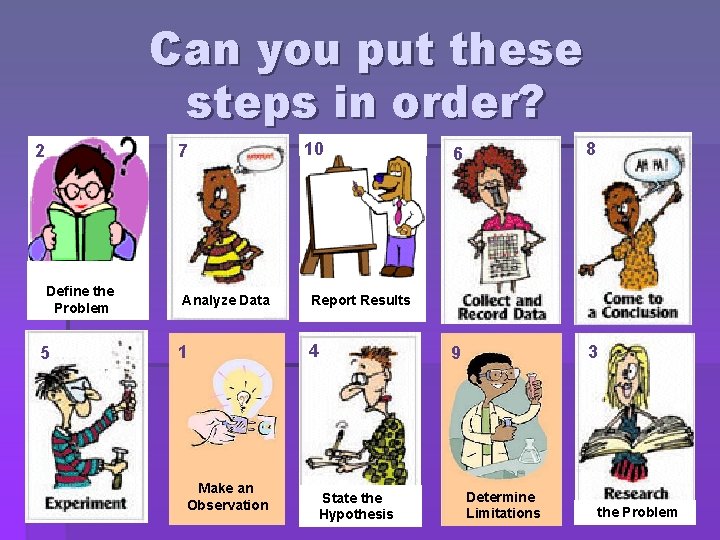
Can you put these steps in order? 2 7 Define the Problem 5 10 Analyze Data Report Results 1 4 Make an Observation State the Hypothesis 6 8 9 3 Determine Limitations the Problem
Steps of Scientific Method in order 1 2 Make an Observation Define the Problem 6 7 Analyze Data 4 3 the Problem 8 5 State the Hypothesis 9 10 Determine Limitations Report Results
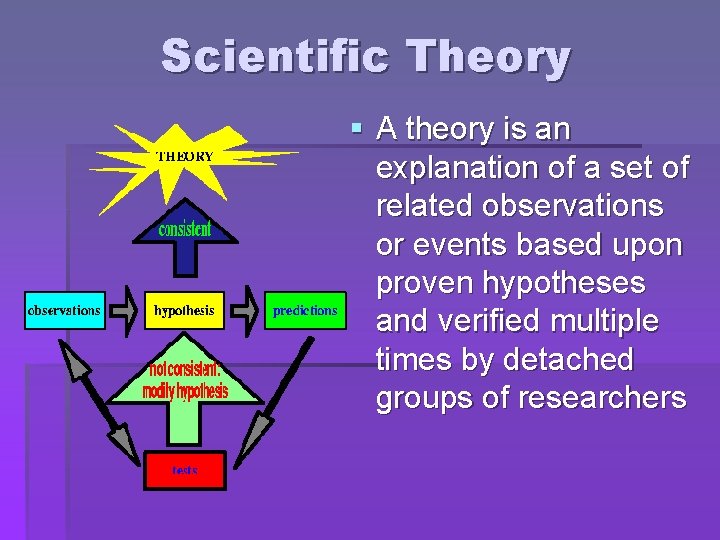
Scientific Theory § A theory is an explanation of a set of related observations or events based upon proven hypotheses and verified multiple times by detached groups of researchers
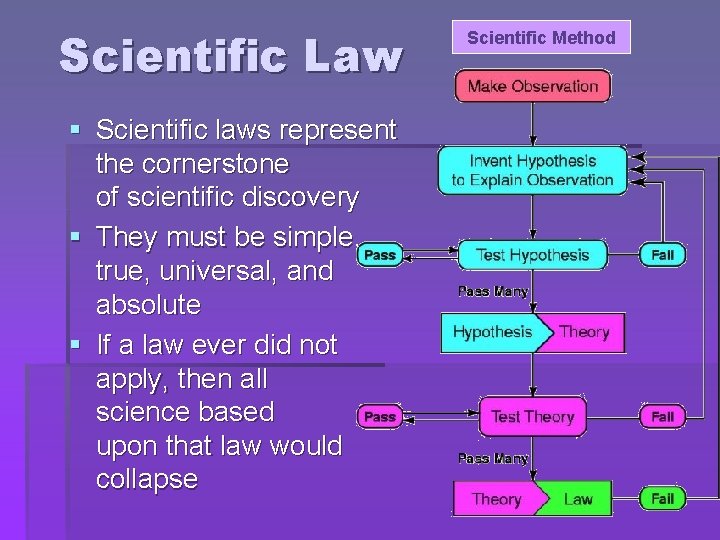
Scientific Law § Scientific laws represent the cornerstone of scientific discovery § They must be simple, true, universal, and absolute § If a law ever did not apply, then all science based upon that law would collapse Scientific Method