
Notes Points Name Period Points Earned Chapter 20



- Slides: 34
Notes Points Name _________________ Period _______ Points Earned Chapter 20 Notes Highlight Key Words/Phrases Points Possible 2 Copy Notes: pictures + color + label 16 Questions: 20 questions + arrows 10 Summary: 2 paragraph(s) 10 Drawings: 2 drawing(s) 4 TOTAL 42 J. Nguyen – Physical Science
Chapter 20 Standard 5 d. Students know properties of ocean water, such as temperature and salinity, can be used to explain the layered structure of the oceans, the generation of horizontal and vertical ocean currents, and the geographic distribution of marine organisms. J. Nguyen – Physical Science
Chapter 20 Ocean Water J. Nguyen – Physical Science
I. 20. 1 Properties of Ocean Water J. Nguyen – Physical Science
A. Dissolved Gases in Dissolved Water 1. The two main gases in water are the same main gases found in the atmosphere: nitrogen and oxygen. 2. Carbon dioxide is also a major gas in the ocean. J. Nguyen – Physical Science
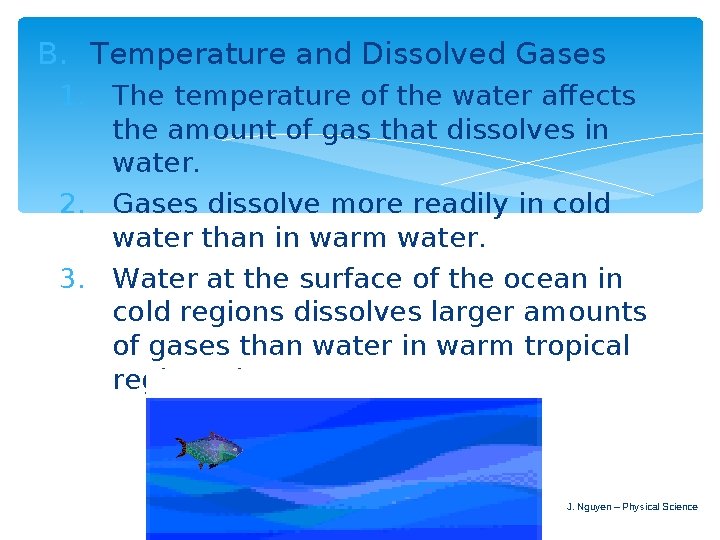
B. Temperature and Dissolved Gases 1. The temperature of the water affects the amount of gas that dissolves in water. 2. Gases dissolve more readily in cold water than in warm water. 3. Water at the surface of the ocean in cold regions dissolves larger amounts of gases than water in warm tropical regions does. J. Nguyen – Physical Science
C. Oceans are a Carbon Sink. 1. Oceans contain more than 60 times as much carbon as the atmosphere. 2. Dissolved CO 2 may be trapped in the oceans for hundreds of thousands of years. 3. Because of this ability to dissolve and contain a large amount of CO 2 , the oceans are referred to as a carbon sink. J. Nguyen – Physical Science
D. Dissolved Solids in the Ocean 1. Ocean water is 96. 5% pure water and 3. 5% dissolved solids. 2. The 6 most common elements in ocean water are chlorine, sodium, sulfur, calcium, and potassium. 3. Chlorine and sodium combine to make the ocean water salty. J. Nguyen – Physical Science
E. Salinity of Ocean Water 1. Salinity is the measure of the amount of dissolved salts and other solids in a given liquid. 2. Salinity is measured by the number of grams of dissolved solids in 1, 000 g of ocean water. a. If 1, 000 g of ocean water contain 35 g of solids, then the salinity is 35 parts salt per 1, 000 parts ocean water or 35 parts per thousand (35%). b. Salinity is expressed as parts per thousand. J. Nguyen – Physical Science
F. Factors that Change Salinity 1. Precipitation (such as rain or snow) and evaporation are factors that affect salinity. 2. Precipitation is composed of only freshwater (pure water - no solids). 3. When ocean surface water evaporates, only water molecules are removed from the ocean, dissolved salts and other solids remain. 4. When the rate of evaporation is higher than the rate of precipitation, the salinity of surface water increases. 5. The higher the evaporation rate, the higher the salinity. 6. The higher the precipitation, the lower the salinity. J. Nguyen – Physical Science
G. Temperature of Ocean Water 1. Temperature of ocean water varies. It depends on: a. b. c. d. depth location amount of solar energy received movement of water J. Nguyen – Physical Science
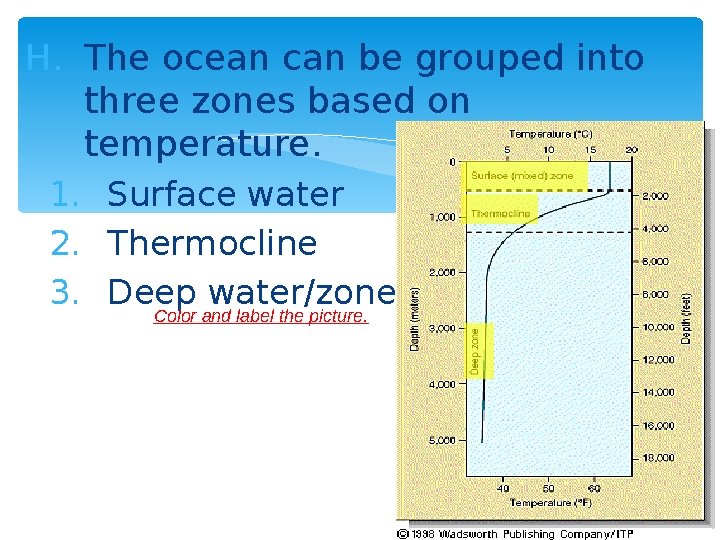
H. The ocean can be grouped into three zones based on temperature. 1. Surface water 2. Thermocline 3. Deep water/zone Color and label the picture. J. Nguyen – Physical Science
I. Surface Water is the uppermost layer. 1. Surface water is water that is between 0 – 300 m. 2. The temperature of this zone is relatively constant and decreases only slightly as depth increases. 3. However, the temperature decreases (colder) as latitude increases. J. Nguyen – Physical Science
J. Thermocline is the second layer. 1. The sun cannot directly heat ocean water below the surface layer so the temperature of the water decreases sharply as depth increases. 2. The layer in a body of water in which water temperature drops with increased depth faster than it does in other layers is called thermocline. 3. The thermocline is an intermediate layer between the less dense top surface layer and the cold, dense water below. J. Nguyen – Physical Science
K. Deep water/zone is the lowest layer. 1. In the deep zones of the ocean, the temperature of the water is usually about 2°C. 2. The colder the water, the denser it is. 3. The density of cold, deep water controls the slow movement of deep ocean currents. 4. Cold, deep water also holds more dissolved gases than warm, shallow ocean water. J. Nguyen – Physical Science
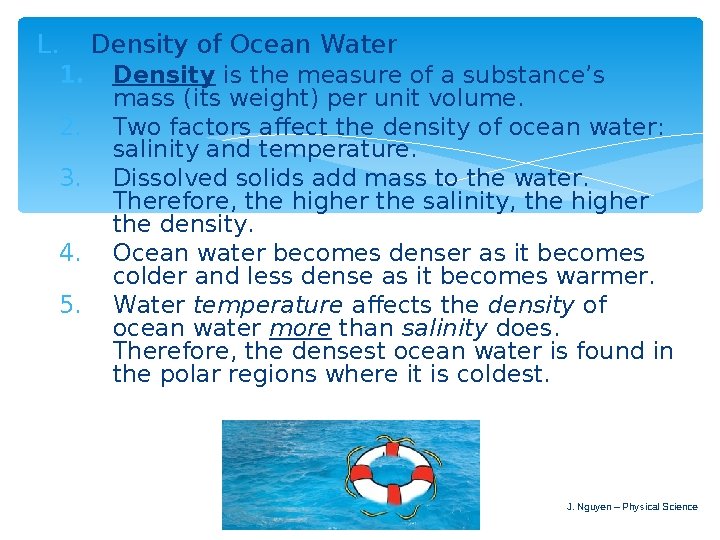
L. 1. 2. 3. 4. 5. Density of Ocean Water Density is the measure of a substance’s mass (its weight) per unit volume. Two factors affect the density of ocean water: salinity and temperature. Dissolved solids add mass to the water. Therefore, the higher the salinity, the higher the density. Ocean water becomes denser as it becomes colder and less dense as it becomes warmer. Water temperature affects the density of ocean water more than salinity does. Therefore, the densest ocean water is found in the polar regions where it is coldest. J. Nguyen – Physical Science
M. Color of the Ocean 1. Much of the surface of the water absorbs the white light from the sun but only the blue wavelength or color is reflected. 2. The reflection of the blue light makes ocean water appear blue. 3. The presence and amount of phytoplankton (microscopic, oceanic plants) can affect the shade of blue of the ocean. J. Nguyen – Physical Science
Write 10 questions for this section. Highlight key words and phrases. Draw a picture. J. Nguyen – Physical Science
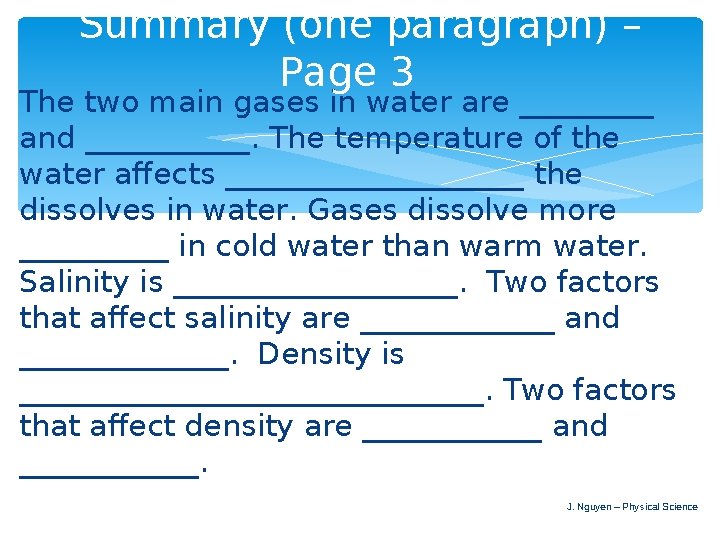
Summary (one paragraph) – Page 3 The two main gases in water are _____ and ______. The temperature of the water affects __________ the dissolves in water. Gases dissolve more _____ in cold water than warm water. Salinity is __________. Two factors that affect salinity are _______ and _______. Density is ________________. Two factors that affect density are ______ and ______. J. Nguyen – Physical Science
II. 20. 2 Life in the Oceans J. Nguyen – Physical Science
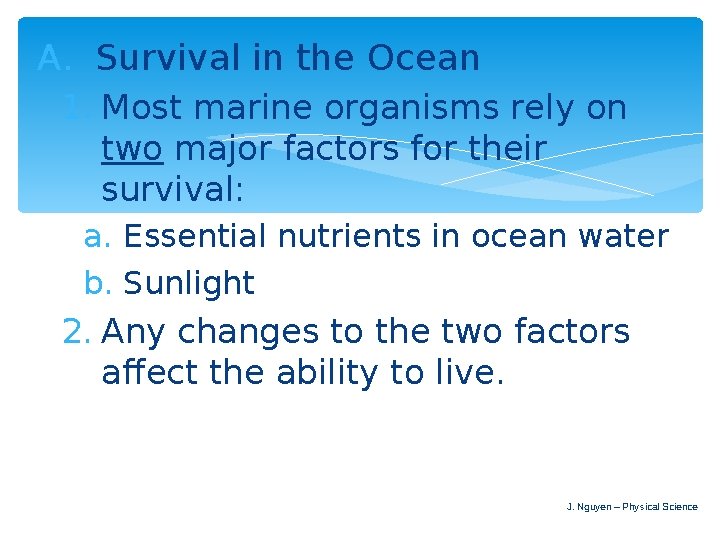
A. Survival in the Ocean 1. Most marine organisms rely on two major factors for their survival: a. Essential nutrients in ocean water b. Sunlight 2. Any changes to the two factors affect the ability to live. J. Nguyen – Physical Science
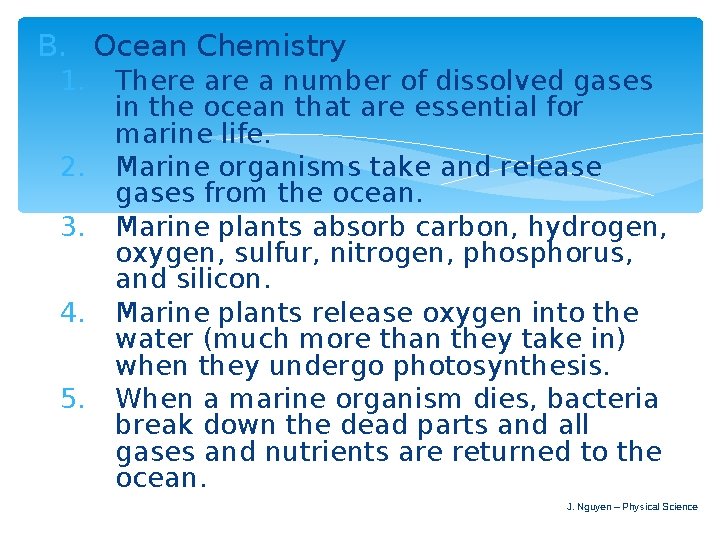
B. Ocean Chemistry 1. 2. 3. 4. 5. There a number of dissolved gases in the ocean that are essential for marine life. Marine organisms take and release gases from the ocean. Marine plants absorb carbon, hydrogen, oxygen, sulfur, nitrogen, phosphorus, and silicon. Marine plants release oxygen into the water (much more than they take in) when they undergo photosynthesis. When a marine organism dies, bacteria break down the dead parts and all gases and nutrients are returned to the ocean. J. Nguyen – Physical Science
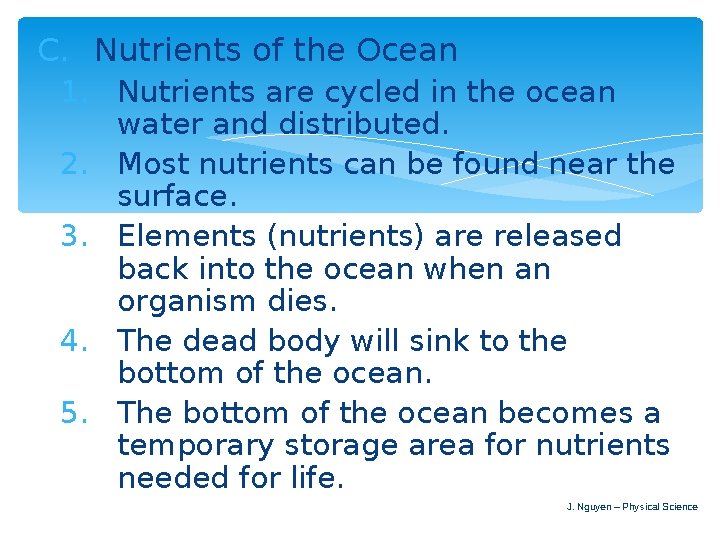
C. Nutrients of the Ocean 1. Nutrients are cycled in the ocean water and distributed. 2. Most nutrients can be found near the surface. 3. Elements (nutrients) are released back into the ocean when an organism dies. 4. The dead body will sink to the bottom of the ocean. 5. The bottom of the ocean becomes a temporary storage area for nutrients needed for life. J. Nguyen – Physical Science
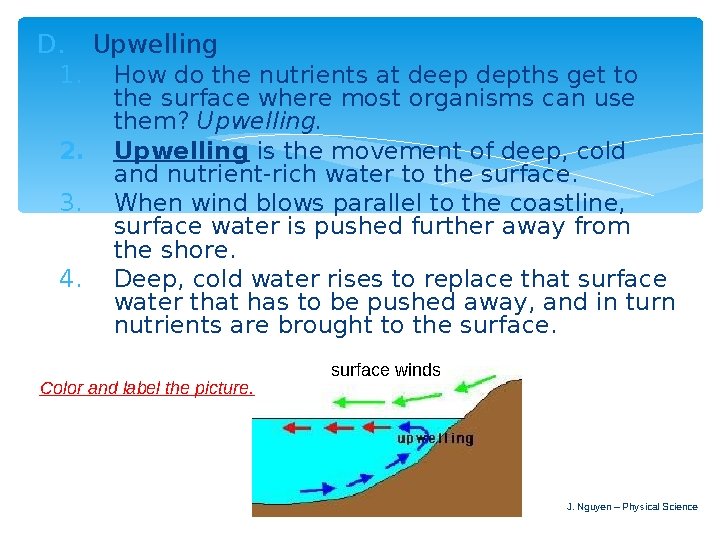
D. 1. 2. 3. 4. Upwelling How do the nutrients at deep depths get to the surface where most organisms can use them? Upwelling is the movement of deep, cold and nutrient-rich water to the surface. When wind blows parallel to the coastline, surface water is pushed further away from the shore. Deep, cold water rises to replace that surface water that has to be pushed away, and in turn nutrients are brought to the surface. Color and label the picture. surface winds J. Nguyen – Physical Science
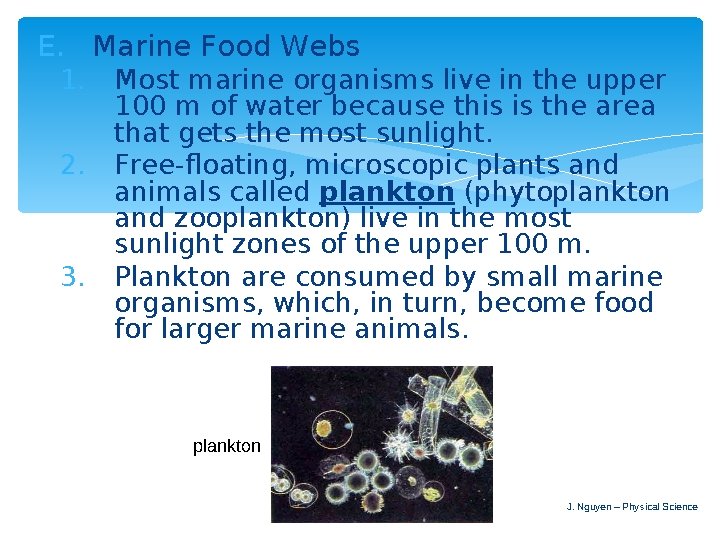
E. Marine Food Webs 1. 2. 3. Most marine organisms live in the upper 100 m of water because this is the area that gets the most sunlight. Free-floating, microscopic plants and animals called plankton (phytoplankton and zooplankton) live in the most sunlight zones of the upper 100 m. Plankton are consumed by small marine organisms, which, in turn, become food for larger marine animals. plankton J. Nguyen – Physical Science
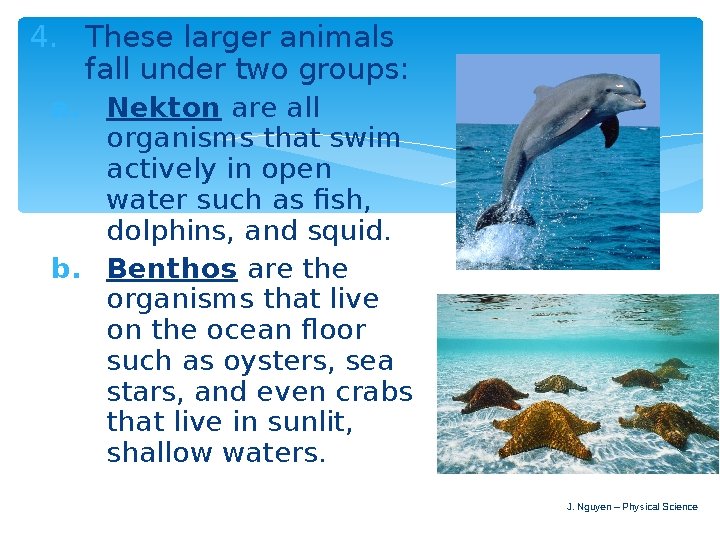
4. These larger animals fall under two groups: a. Nekton are all organisms that swim actively in open water such as fish, dolphins, and squid. b. Benthos are the organisms that live on the ocean floor such as oysters, sea stars, and even crabs that live in sunlit, shallow waters. J. Nguyen – Physical Science
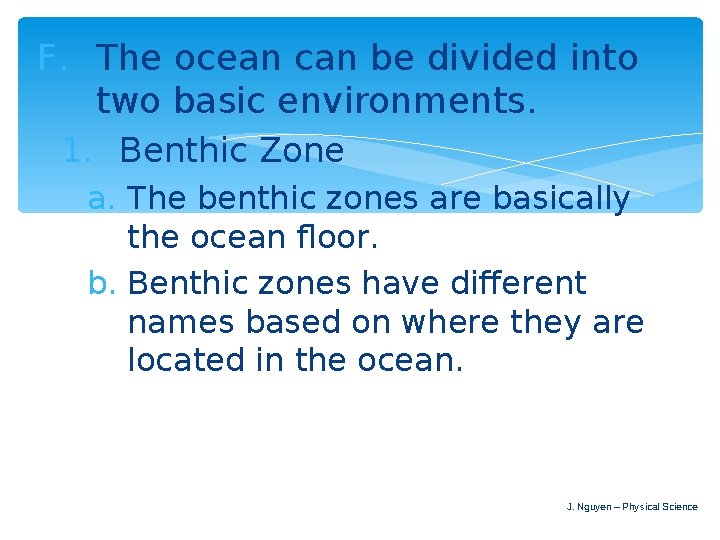
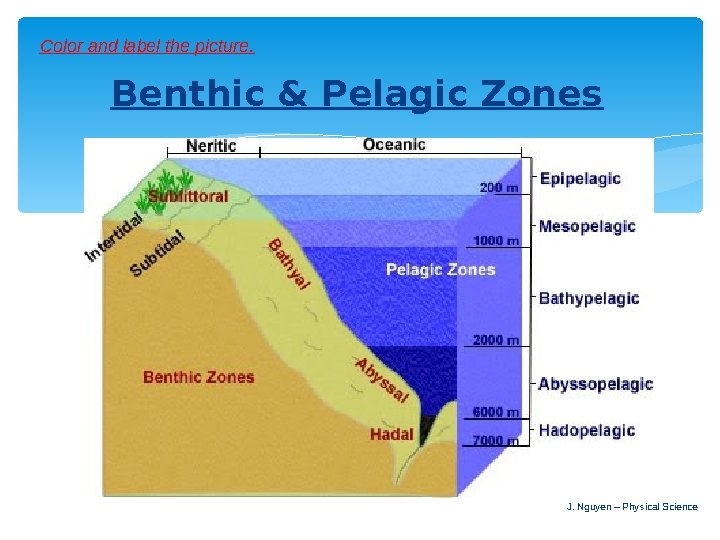
F. The ocean can be divided into two basic environments. 1. Benthic Zone a. The benthic zones are basically the ocean floor. b. Benthic zones have different names based on where they are located in the ocean. J. Nguyen – Physical Science
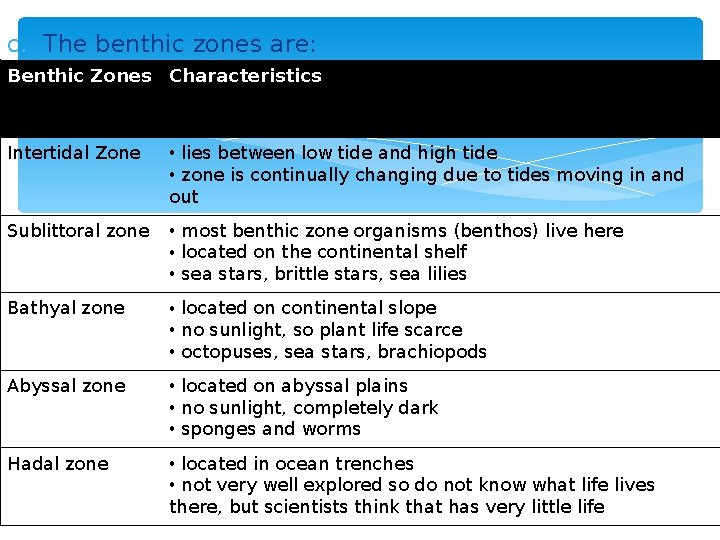
c. The benthic zones are: Benthic Zones Characteristics Intertidal Zone • lies between low tide and high tide • zone is continually changing due to tides moving in and out Sublittoral zone • most benthic zone organisms (benthos) live here • located on the continental shelf • sea stars, brittle stars, sea lilies Bathyal zone • located on continental slope • no sunlight, so plant life scarce • octopuses, sea stars, brachiopods Abyssal zone • located on abyssal plains • no sunlight, completely dark • sponges and worms Hadal zone • located in ocean trenches • not very well explored so do not know what life lives there, but scientists think that has very little life
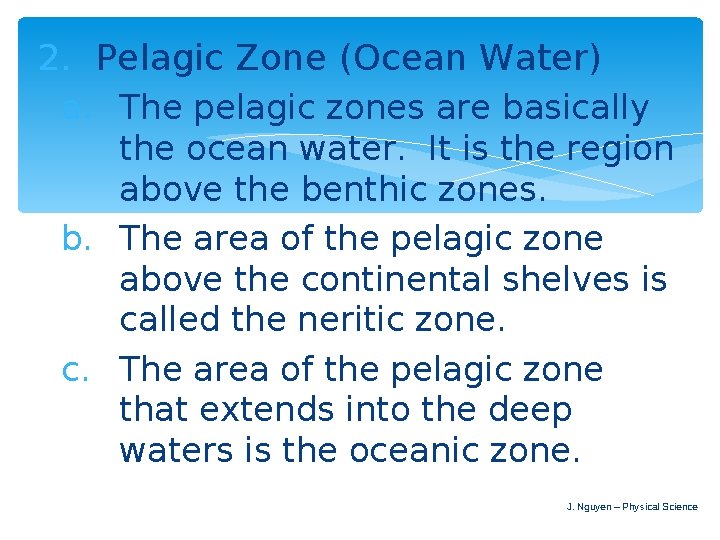
2. Pelagic Zone (Ocean Water) a. The pelagic zones are basically the ocean water. It is the region above the benthic zones. b. The area of the pelagic zone above the continental shelves is called the neritic zone. c. The area of the pelagic zone that extends into the deep waters is the oceanic zone. J. Nguyen – Physical Science
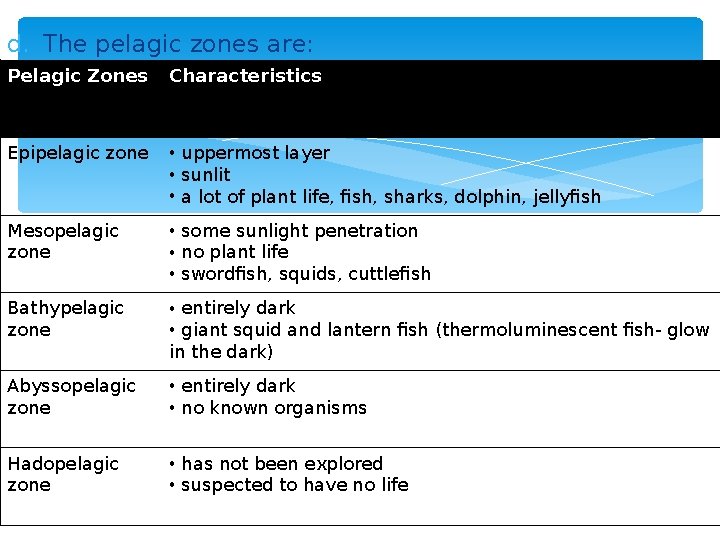
d. The pelagic zones are: Pelagic Zones Characteristics Epipelagic zone • uppermost layer • sunlit • a lot of plant life, fish, sharks, dolphin, jellyfish Mesopelagic zone • some sunlight penetration • no plant life • swordfish, squids, cuttlefish Bathypelagic zone • entirely dark • giant squid and lantern fish (thermoluminescent fish- glow in the dark) Abyssopelagic zone • entirely dark • no known organisms Hadopelagic zone • has not been explored • suspected to have no life
Color and label the picture. Benthic & Pelagic Zones J. Nguyen – Physical Science
Write 10 questions for this section. You should have a total of 20 questions. Highlight key words and phrases. Draw a picture. J. Nguyen – Physical Science
Summary (one paragraph) – Page 6 Most marine organisms rely on two factors for survival: _______ and ________. Nutrients are _______ in the ocean water and ______. Upwelling is __________________. Plankton is _______________. Nekton are _____________ whereas benthos are _______________. The benthic zone is ______________. The pelagic zone is ______________. J. Nguyen – Physical Science
Notes Points Name _________________ Period _______ Points Earned Chapter 20 Notes Highlight Key Words/Phrases Points Possible 2 Copy Notes: pictures + color + label 16 Questions: 20 questions + arrows 10 Summary: 2 paragraph(s) 10 Drawings: 2 drawing(s) 4 TOTAL 42 J. Nguyen – Physical Science