
Notes One Unit Five Characteristics of Gases Pressure



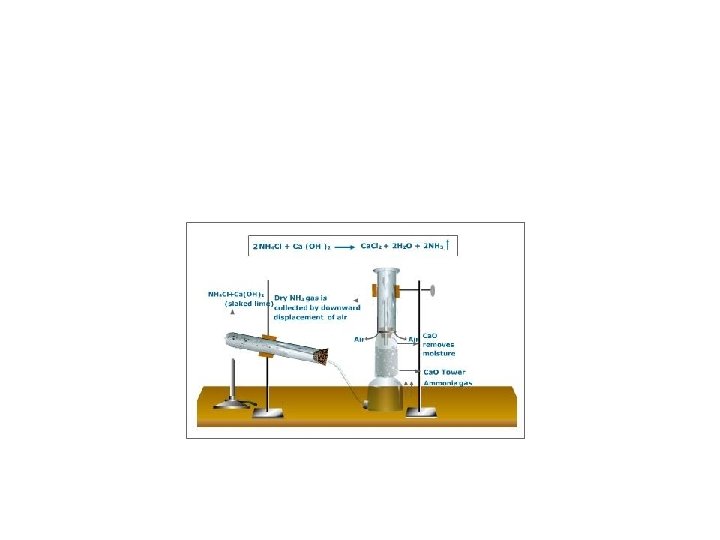
- Slides: 77
Notes One Unit Five Characteristics of Gases Pressure of fluids Standard Temperature and Pressure Converting Pressures Gas Laws Pages 422 -440
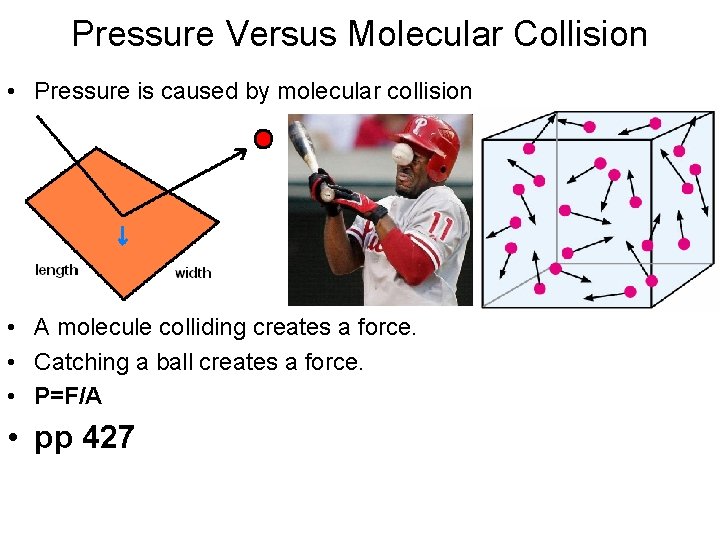
Pressure Versus Molecular Collision • Pressure is caused by molecular collision • A molecule colliding creates a force. • Catching a ball creates a force. • P=F/A • pp 427
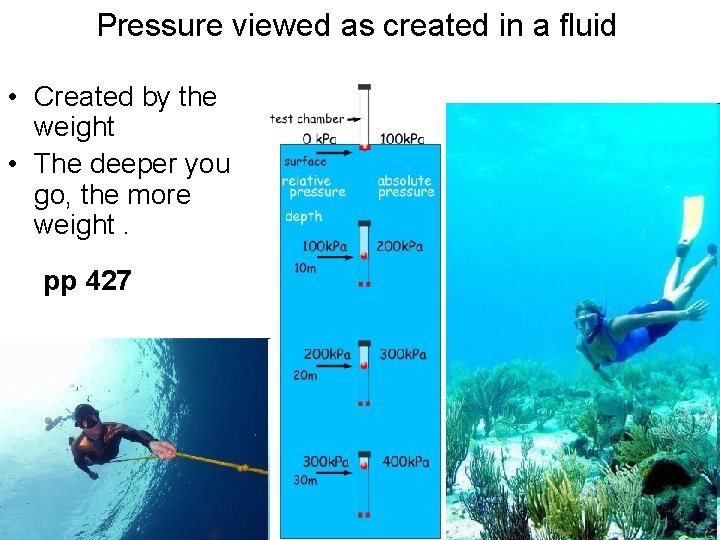
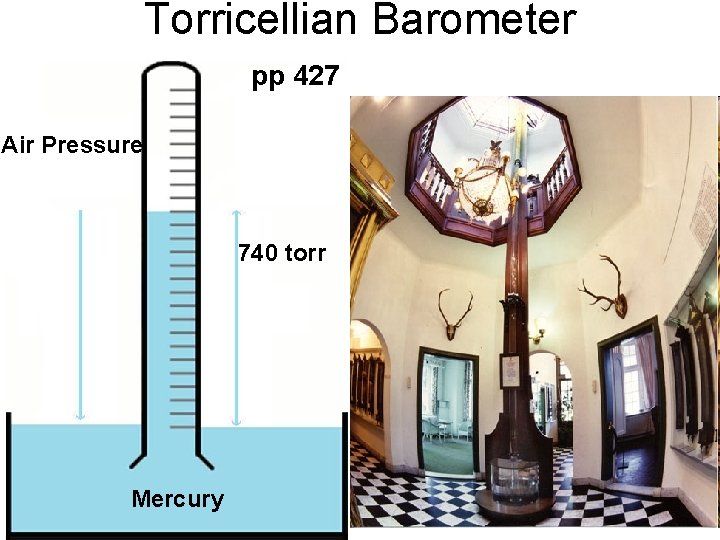
Pressure viewed as created in a fluid • Created by the weight • The deeper you go, the more weight. pp 427
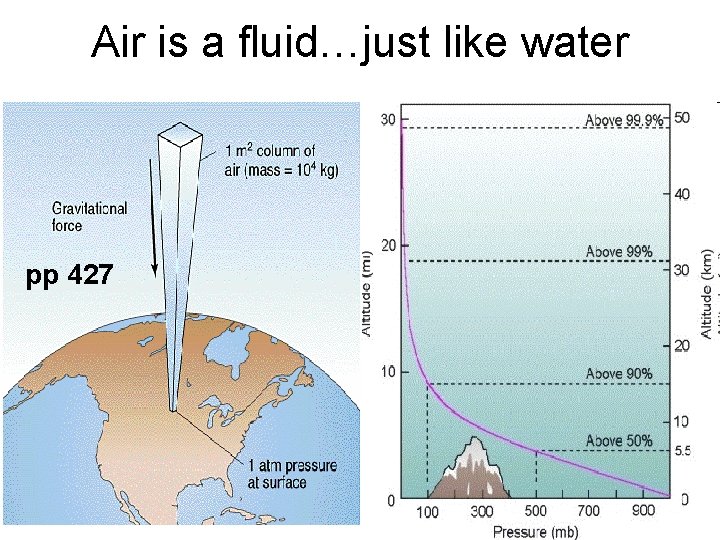
Air is a fluid…just like water pp 427
Torricellian Barometer pp 427 Air Pressure 780 760 torr 740 torr Mercury
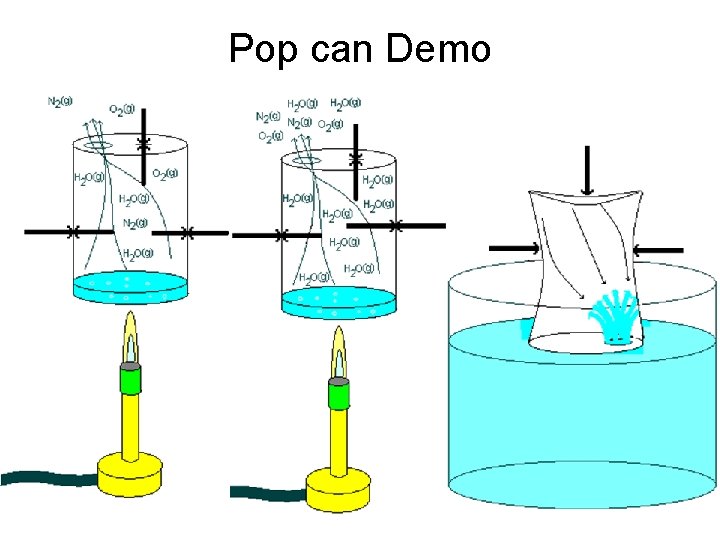
Pop can Demo
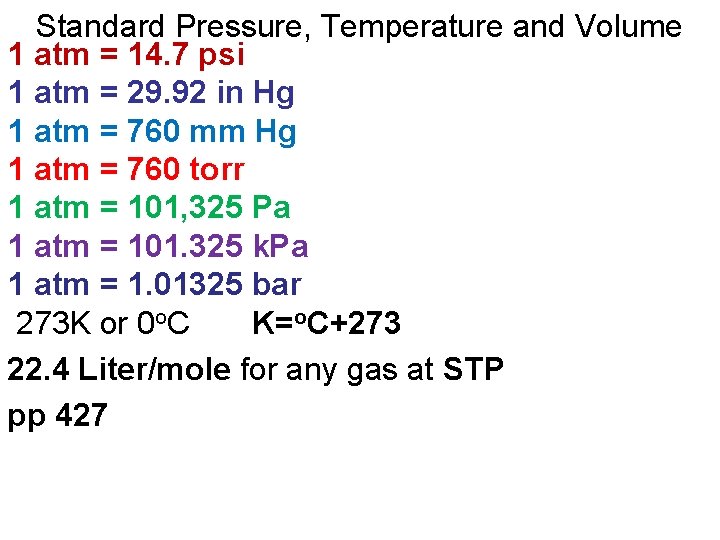
Standard Pressure, Temperature and Volume 1 atm = 14. 7 psi 1 atm = 29. 92 in Hg 1 atm = 760 mm Hg 1 atm = 760 torr 1 atm = 101, 325 Pa 1 atm = 101. 325 k. Pa 1 atm = 1. 01325 bar 273 K or 0 o. C K=o. C+273 22. 4 Liter/mole for any gas at STP pp 427
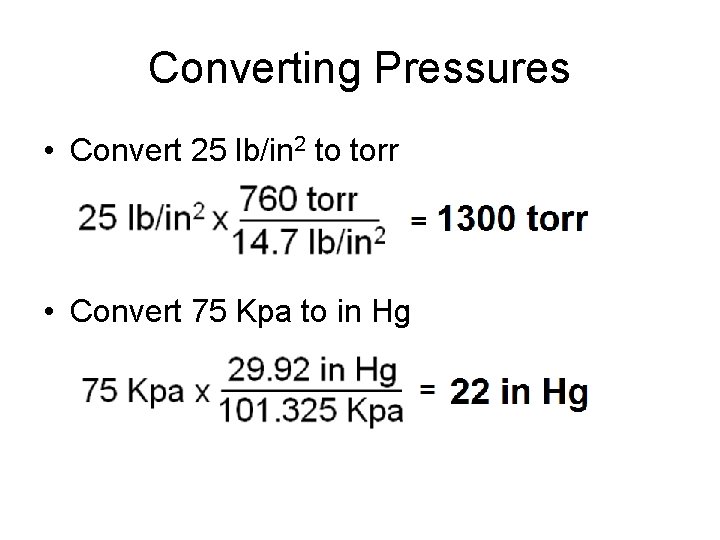
Converting Pressures • Convert 25 lb/in 2 to torr • Convert 75 Kpa to in Hg
Starter The pressure of a gas is measured as 49 torr. Convert this pressure to atmospheres, kilo. Pascals, and mm. Hg.
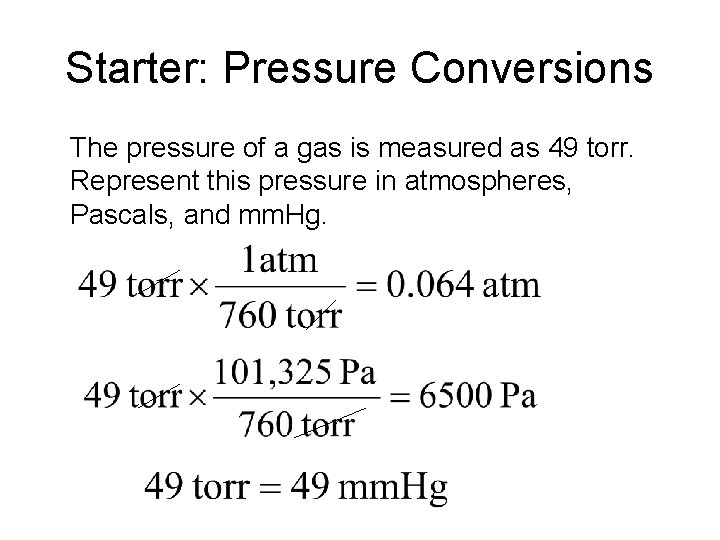
Starter: Pressure Conversions The pressure of a gas is measured as 49 torr. Represent this pressure in atmospheres, Pascals, and mm. Hg.
Physical Properties of Gases Gas Laws: Relationships between volume, temperature, pressure, and amount of gas.
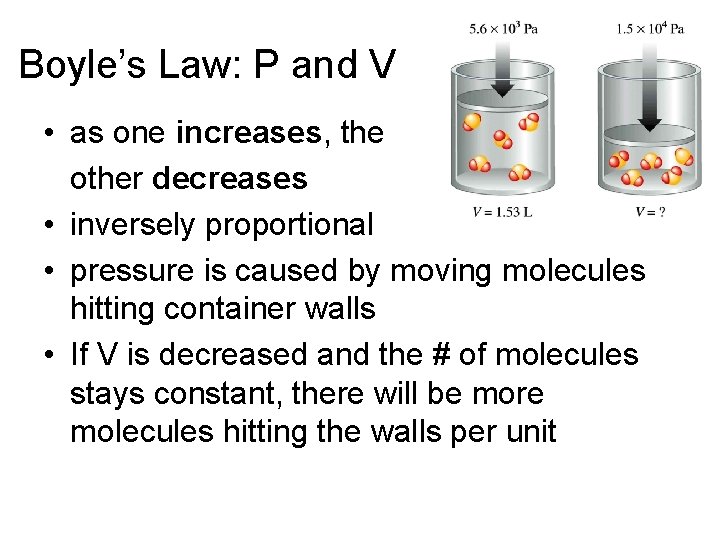
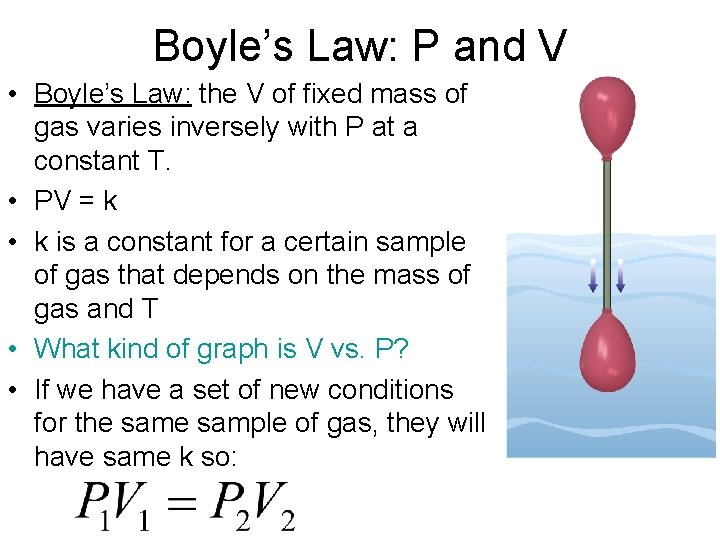
Boyle’s Law: P and V • as one increases, the other decreases • inversely proportional • pressure is caused by moving molecules hitting container walls • If V is decreased and the # of molecules stays constant, there will be more molecules hitting the walls per unit
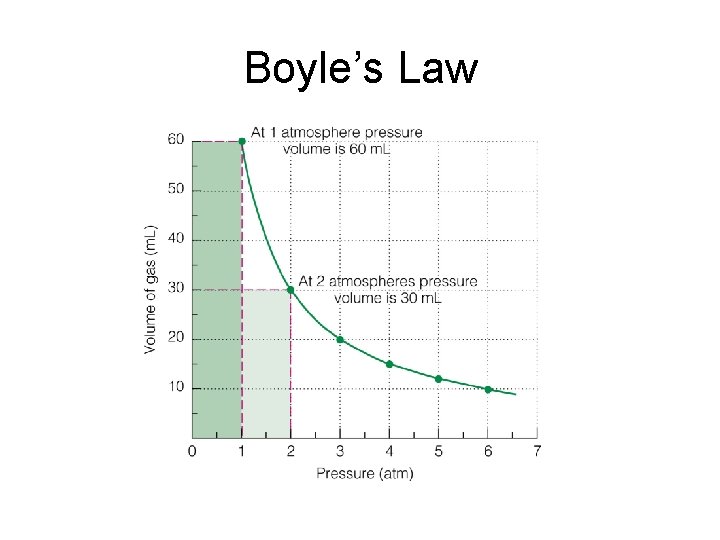
Boyle’s Law: P and V • Boyle’s Law: the V of fixed mass of gas varies inversely with P at a constant T. • PV = k • k is a constant for a certain sample of gas that depends on the mass of gas and T • What kind of graph is V vs. P? • If we have a set of new conditions for the sample of gas, they will have same k so:
Boyle’s Law
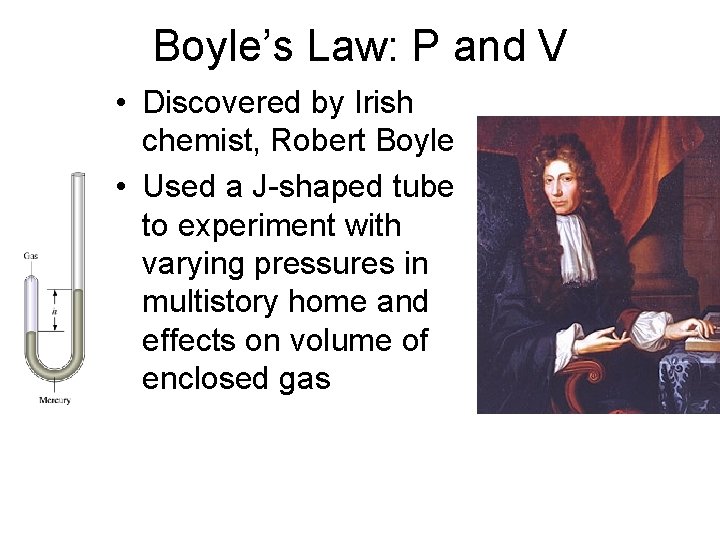
Boyle’s Law: P and V • Discovered by Irish chemist, Robert Boyle • Used a J-shaped tube to experiment with varying pressures in multistory home and effects on volume of enclosed gas
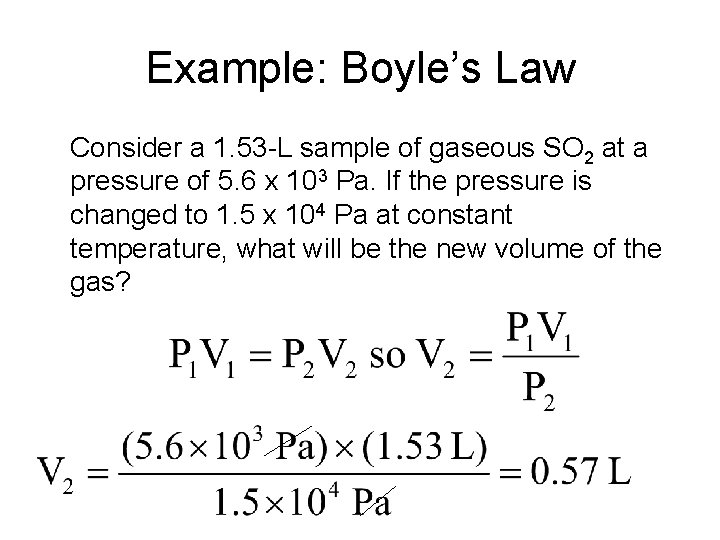
Example: Boyle’s Law Consider a 1. 53 -L sample of gaseous SO 2 at a pressure of 5. 6 x 10³ Pa. If the pressure is changed to 1. 5 x 10⁴ Pa at constant temperature, what will be the new volume of the gas?
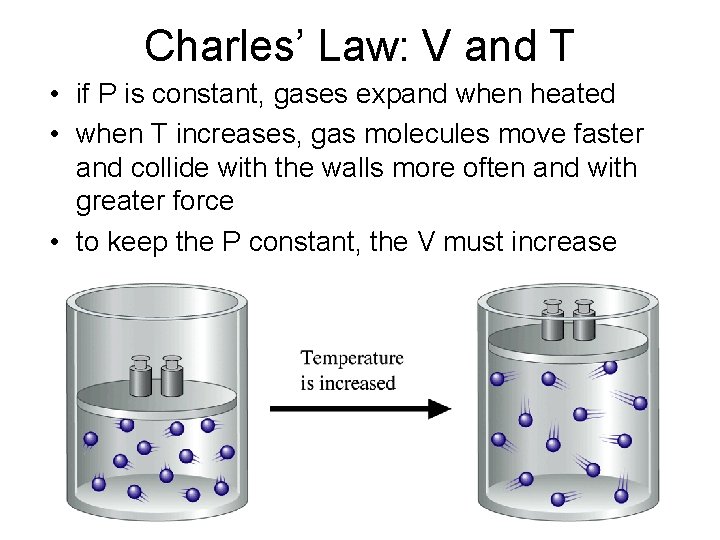
Charles’ Law: V and T • if P is constant, gases expand when heated • when T increases, gas molecules move faster and collide with the walls more often and with greater force • to keep the P constant, the V must increase
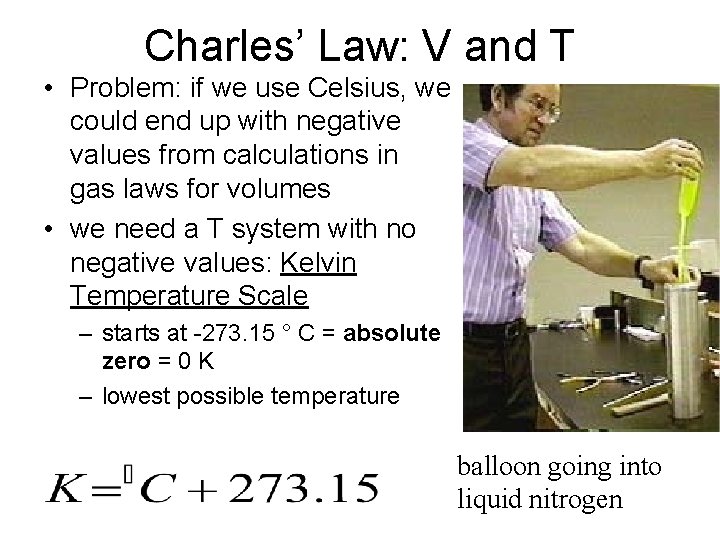
Charles’ Law: V and T • Problem: if we use Celsius, we could end up with negative values from calculations in gas laws for volumes • we need a T system with no negative values: Kelvin Temperature Scale – starts at -273. 15 ° C = absolute zero = 0 K – lowest possible temperature balloon going into liquid nitrogen
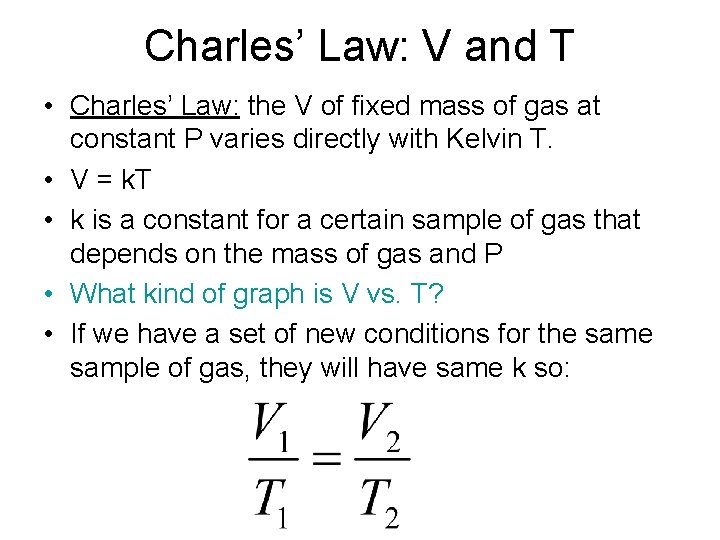
Charles’ Law: V and T • Charles’ Law: the V of fixed mass of gas at constant P varies directly with Kelvin T. • V = k. T • k is a constant for a certain sample of gas that depends on the mass of gas and P • What kind of graph is V vs. T? • If we have a set of new conditions for the sample of gas, they will have same k so:
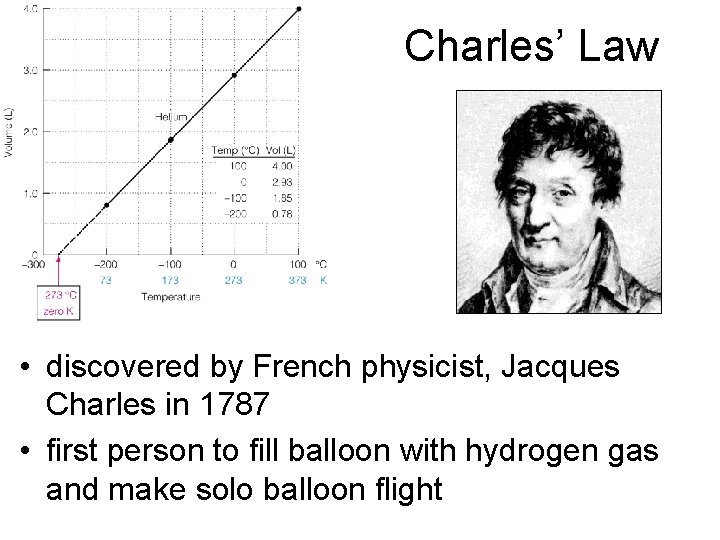
Charles’ Law • discovered by French physicist, Jacques Charles in 1787 • first person to fill balloon with hydrogen gas and make solo balloon flight
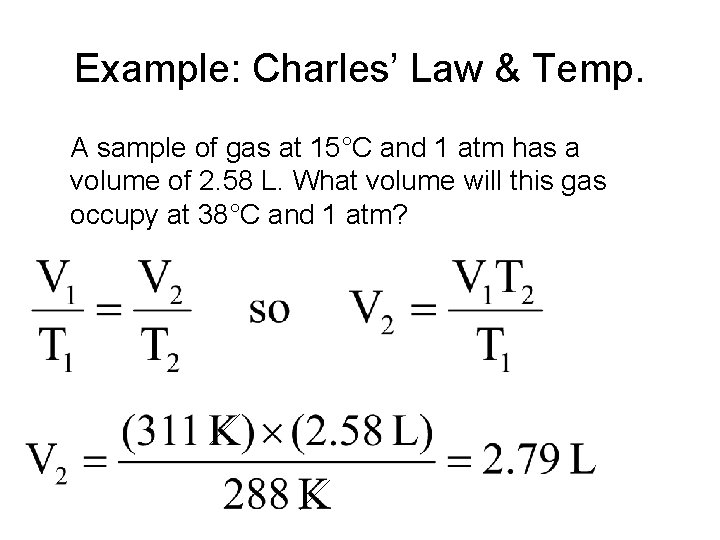
Example: Charles’ Law & Temp. A sample of gas at 15°C and 1 atm has a volume of 2. 58 L. What volume will this gas occupy at 38°C and 1 atm?
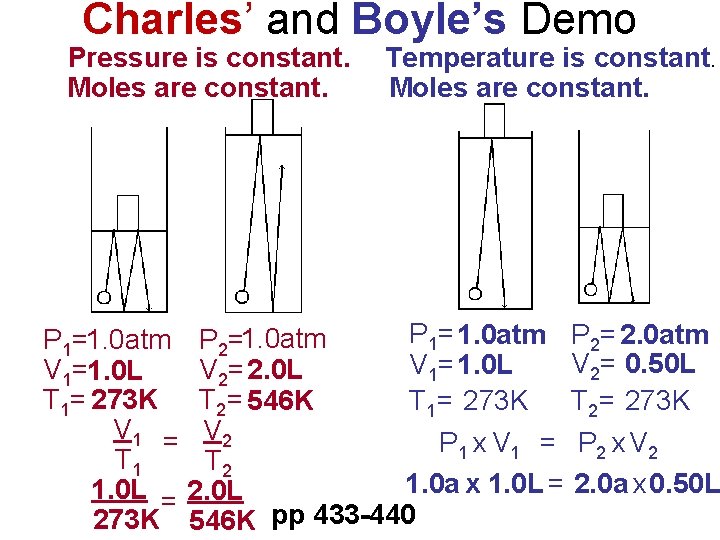
Charles’ and Boyle’s Demo Pressure is constant. Moles are constant. Temperature is constant. Moles are constant. P 1= 1. 0 atm P 2= 2. 0 atm P 1=1. 0 atm P 2=1. 0 atm V 2= 0. 50 L V 1=1. 0 L V 2= 2. 0 L T 1= 273 K T 2= 546 K T 1= 273 K T 2= 273 K V 1 = V 2 P 1 x V 1 = P 2 x V 2 T 1 T 2 1. 0 a x 1. 0 L = 2. 0 a x 0. 50 L 1. 0 L = 2. 0 L 273 K 546 K pp 433 -440
The Combined Gas Law
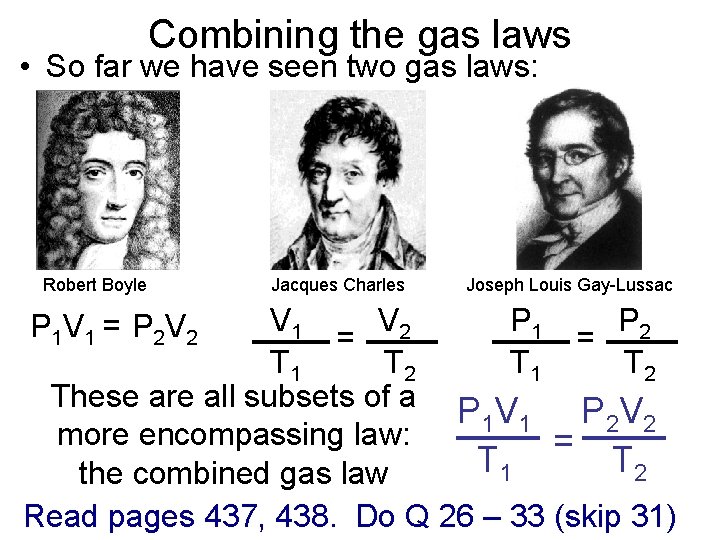
Combining the gas laws • So far we have seen two gas laws: Robert Boyle Jacques Charles Joseph Louis Gay-Lussac V 1 V 2 P 1 P 2 = = T 1 T 2 These are all subsets of a P V P 2 V 2 1 1 more encompassing law: = T 1 T 2 the combined gas law Read pages 437, 438. Do Q 26 – 33 (skip 31) P 1 V 1 = P 2 V 2
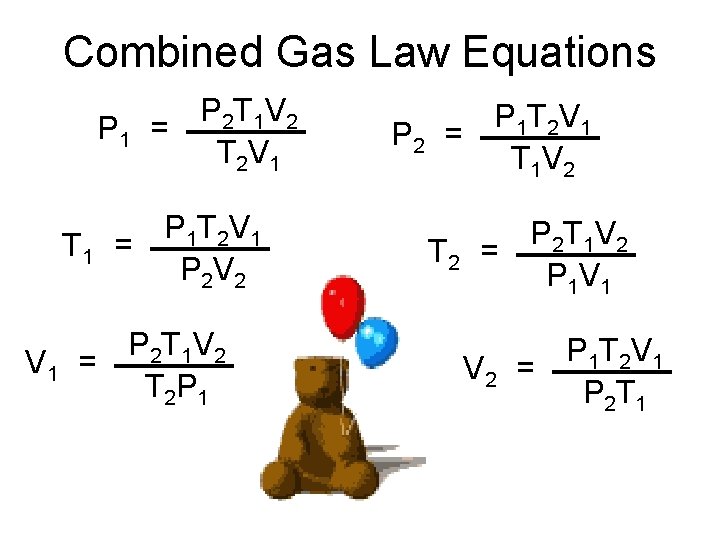
Combined Gas Law Equations P 2 T 1 V 2 P 1 = T 2 V 1 T 1 P 1 T 2 V 1 = P 2 V 2 P 2 T 1 V 2 V 1 = T 2 P 1 P 1 T 2 V 1 P 2 = T 1 V 2 T 2 P 2 T 1 V 2 = P 1 V 1 P 1 T 2 V 1 V 2 = P 2 T 1
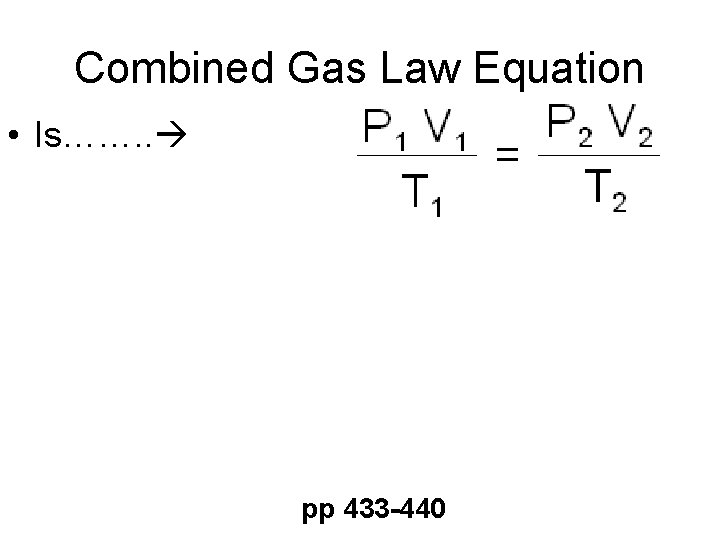
Combined Gas Law Equation • Is……. . pp 433 -440
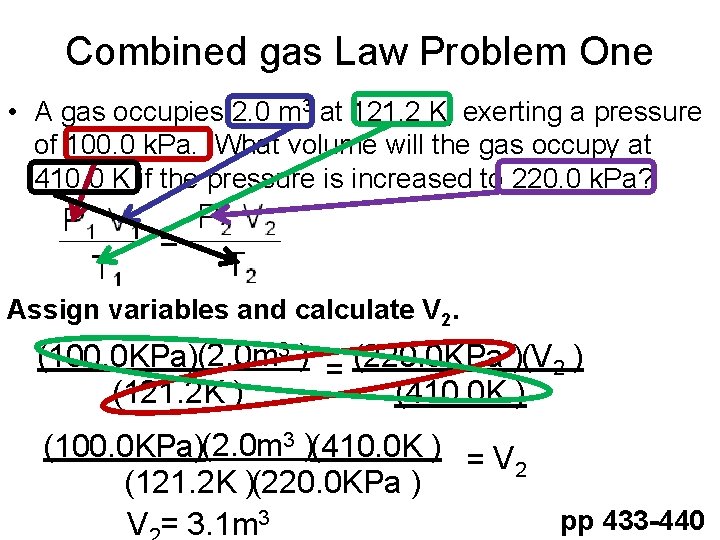
Combined gas Law Problem One • A gas occupies 2. 0 m 3 at 121. 2 K, exerting a pressure of 100. 0 k. Pa. What volume will the gas occupy at 410. 0 K if the pressure is increased to 220. 0 k. Pa? Assign variables and calculate V 2. (100. 0 KPa)(2. 0 m 3 ) = (220. 0 KPa )(V 2 ) (121. 2 K ) (410. 0 K ) (100. 0 KPa)(2. 0 m 3 )(410. 0 K ) = V 2 (121. 2 K )(220. 0 KPa ) V = 3. 1 m 3 pp 433 -440
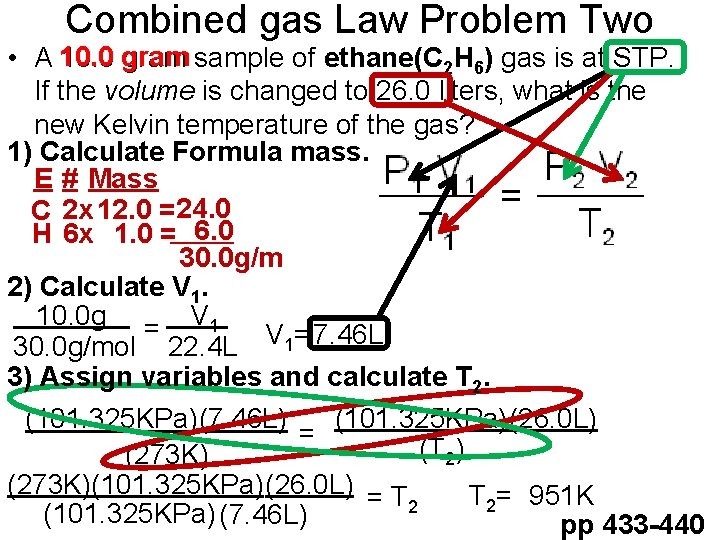
Combined gas Law Problem Two • A 10. 0 gram sample of ethane(C 2 H 6) gas is at STP. If the volume is changed to 26. 0 liters, what is the new Kelvin temperature of the gas? 1) Calculate Formula mass. E # Mass C 2 x 12. 0 = 24. 0 H 6 x 1. 0 = 6. 0 30. 0 g/m 2) Calculate V 1. 10. 0 g = V 1 30. 0 g/mol 22. 4 L V 1=7. 46 L 3) Assign variables and calculate T 2. (101. 325 KPa)(26. 0 L) (101. 325 KPa)(7. 46 L) = (T 2) (273 K)(101. 325 KPa)(26. 0 L) = T T 2= 951 K 2 (101. 325 KPa) (7. 46 L) pp 433 -440
Notes Two Unit Five Grahams’ Law Calculation Review Mass-Mass Calculation Mass-Volume Calculation @STP Volume-Mass Calculation @STP Pages 441 -450
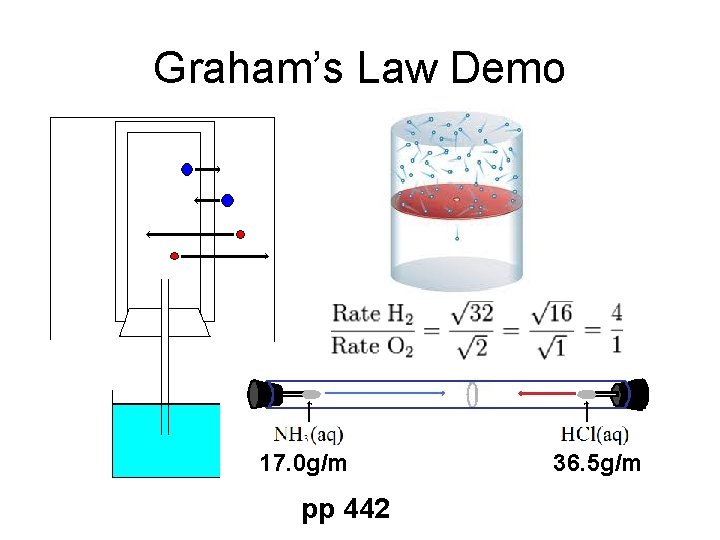
Graham’s Law Demo 17. 0 g/m pp 442 36. 5 g/m
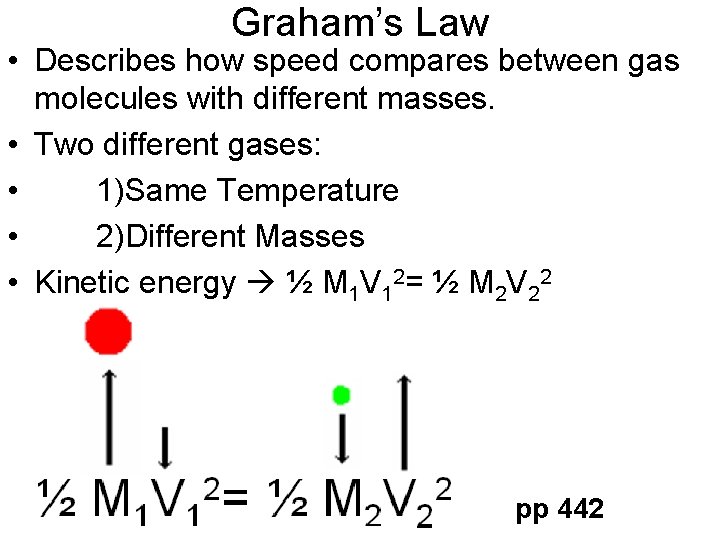
Graham’s Law • Describes how speed compares between gas molecules with different masses. • Two different gases: • 1)Same Temperature • 2)Different Masses • Kinetic energy ½ M 1 V 12= ½ M 2 V 22 pp 442
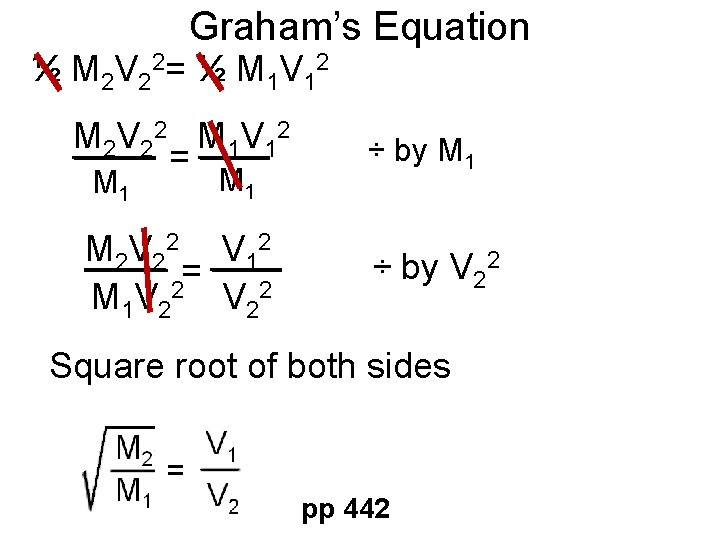
Graham’s Equation ½ M 2 V 22= ½ M 1 V 12 M 2 V 2 2 M 1 V 1 2 = M 1 M 2 V 22 V 122 V = 12 2 M 1 V 2 ÷ by M 1 ÷ by V 22 Square root of both sides pp 442
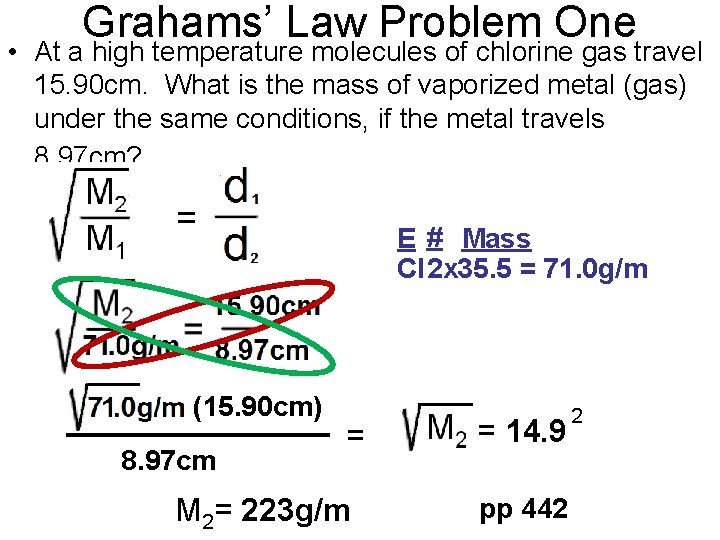
Grahams’ Law Problem One • At a high temperature molecules of chlorine gas travel 15. 90 cm. What is the mass of vaporized metal (gas) under the same conditions, if the metal travels 8. 97 cm? E # Mass Cl 2 x 35. 5 = 71. 0 g/m (15. 90 cm) 8. 97 cm = M 2= 223 g/m = 14. 9 pp 442 2
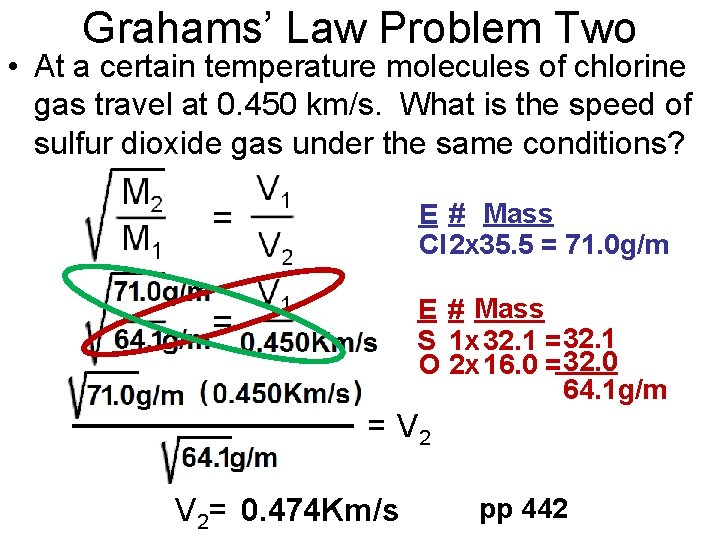
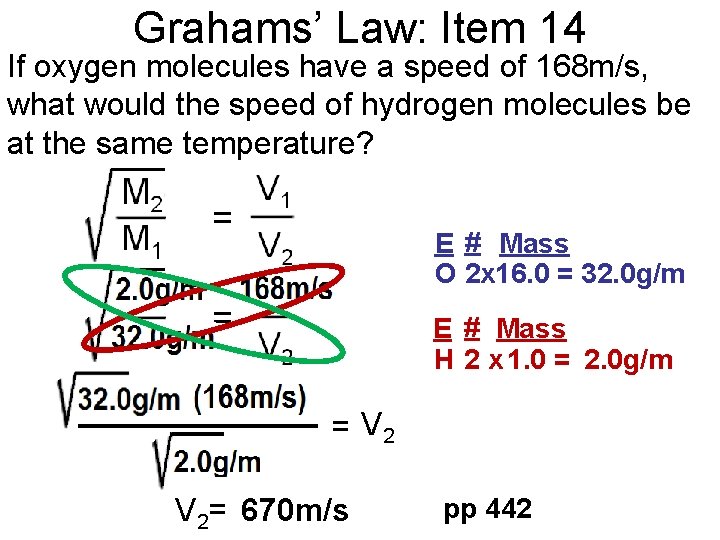
Grahams’ Law Problem Two • At a certain temperature molecules of chlorine gas travel at 0. 450 km/s. What is the speed of sulfur dioxide gas under the same conditions? E # Mass Cl 2 x 35. 5 = 71. 0 g/m E # Mass S 1 x 32. 1 = 32. 1 O 2 x 16. 0 = 32. 0 64. 1 g/m = V 2= 0. 474 Km/s pp 442
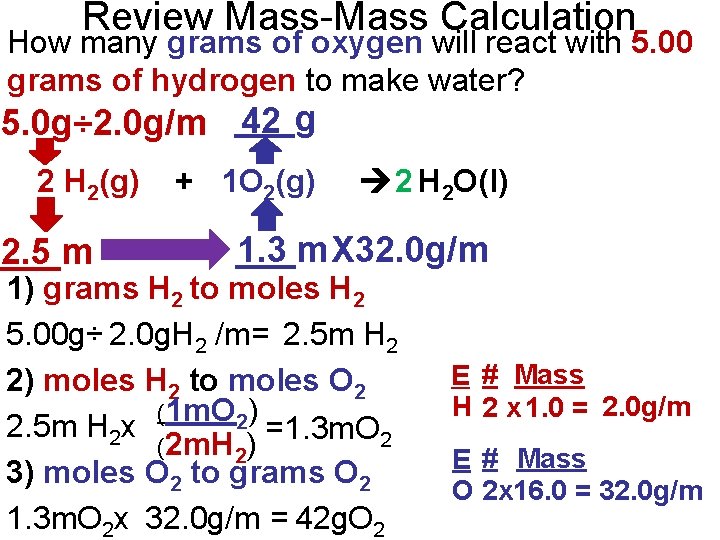
Review Mass-Mass Calculation How many grams of oxygen will react with 5. 00 grams of hydrogen to make water? 42 5. 0 g÷ 2. 0 g/m ___g 2 H 2(g) ___m 2. 5 + 1 O 2(g) 2 H 2 O(l) ___m 1. 3 X 32. 0 g/m 1) grams H 2 to moles H 2 5. 00 g÷ 2. 0 g. H 2 /m= 2. 5 m H 2 2) moles H 2 to moles O 2 (1 m. O 2) 2. 5 m H 2 x =1. 3 m. O 2 (2 m. H 2) 3) moles O 2 to grams O 2 1. 3 m. O 2 x 32. 0 g/m = 42 g. O 2 E # Mass H 2 x 1. 0 = 2. 0 g/m E # Mass O 2 x 16. 0 = 32. 0 g/m
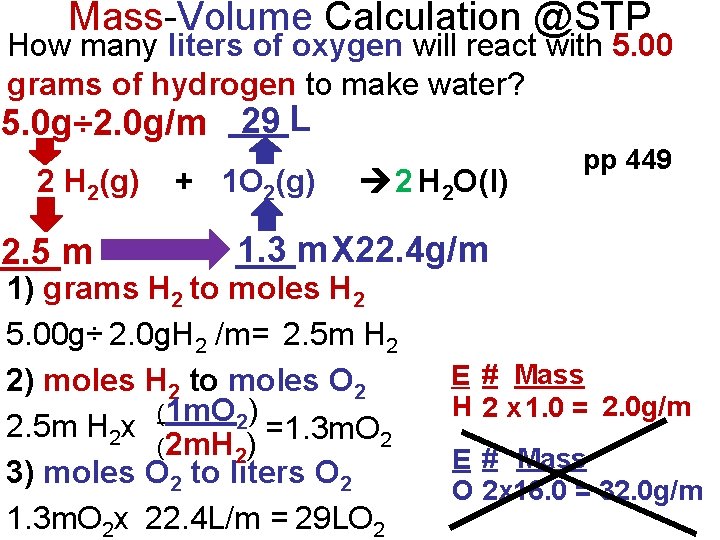
Mass-Volume Calculation @STP How many liters of oxygen will react with 5. 00 grams of hydrogen to make water? 29 5. 0 g÷ 2. 0 g/m ___L 2 H 2(g) ___m 2. 5 + 1 O 2(g) 2 H 2 O(l) pp 449 ___m 1. 3 X 22. 4 g/m 1) grams H 2 to moles H 2 5. 00 g÷ 2. 0 g. H 2 /m= 2. 5 m H 2 2) moles H 2 to moles O 2 (1 m. O 2) 2. 5 m H 2 x =1. 3 m. O 2 (2 m. H 2) 3) moles O 2 to liters O 2 1. 3 m. O 2 x 22. 4 L/m = 29 LO 2 E # Mass H 2 x 1. 0 = 2. 0 g/m E # Mass O 2 x 16. 0 = 32. 0 g/m
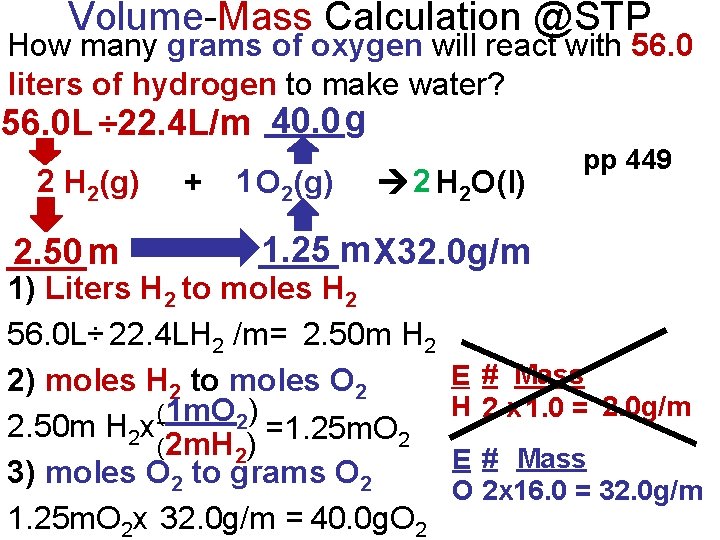
Volume-Mass Calculation @STP How many grams of oxygen will react with 56. 0 liters of hydrogen to make water? 40. 0 56. 0 L ÷ 22. 4 L/m ____g 2 H 2(g) ____m 2. 50 + 1 O 2(g) 2 H 2 O(l) pp 449 ____m 1. 25 X 32. 0 g/m 1) Liters H 2 to moles H 2 56. 0 L÷ 22. 4 LH 2 /m= 2. 50 m H 2 2) moles H 2 to moles O 2 (1 m. O 2) 2. 50 m H 2 x =1. 25 m. O 2 (2 m. H 2) 3) moles O 2 to grams O 2 1. 25 m. O 2 x 32. 0 g/m = 40. 0 g. O 2 E # Mass H 2 x 1. 0 = 2. 0 g/m E # Mass O 2 x 16. 0 = 32. 0 g/m
Notes Three Unit Five • Kinetic theory of gases • Molar volume @ Non-STP Conditions • R is Universal Gas Constant Pages 452 -459
The Ideal Gas Law PV = n. RT
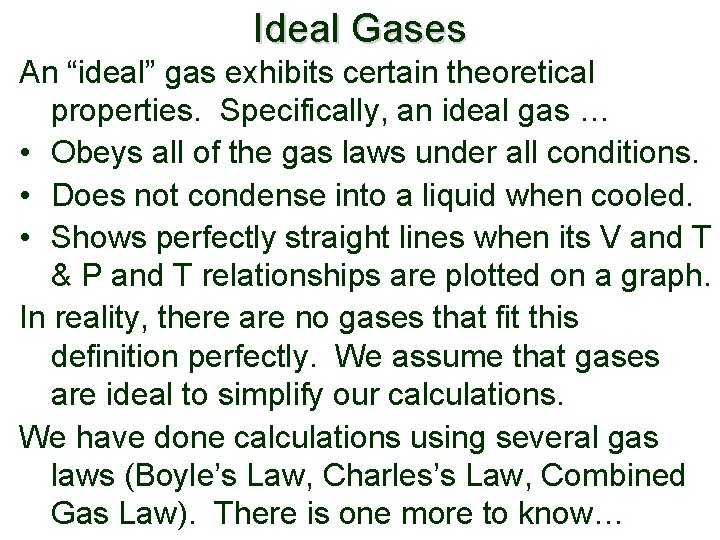
Ideal Gases An “ideal” gas exhibits certain theoretical properties. Specifically, an ideal gas … • Obeys all of the gas laws under all conditions. • Does not condense into a liquid when cooled. • Shows perfectly straight lines when its V and T & P and T relationships are plotted on a graph. In reality, there are no gases that fit this definition perfectly. We assume that gases are ideal to simplify our calculations. We have done calculations using several gas laws (Boyle’s Law, Charles’s Law, Combined Gas Law). There is one more to know…
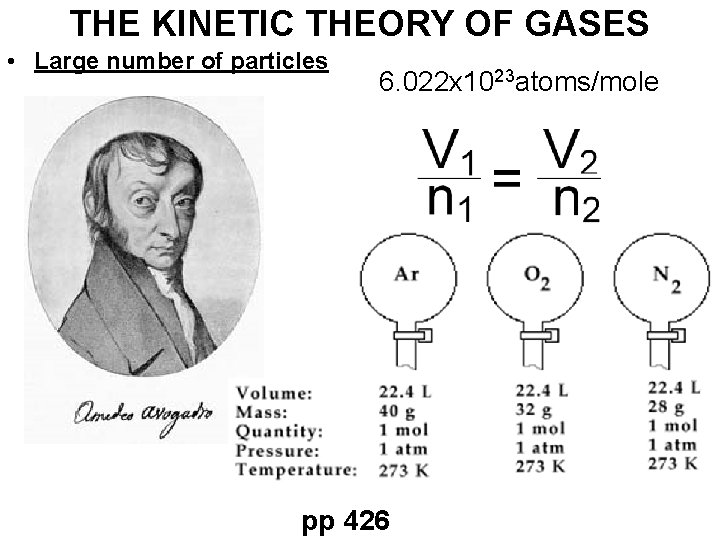
THE KINETIC THEORY OF GASES • Large number of particles 6. 022 x 1023 atoms/mole pp 426
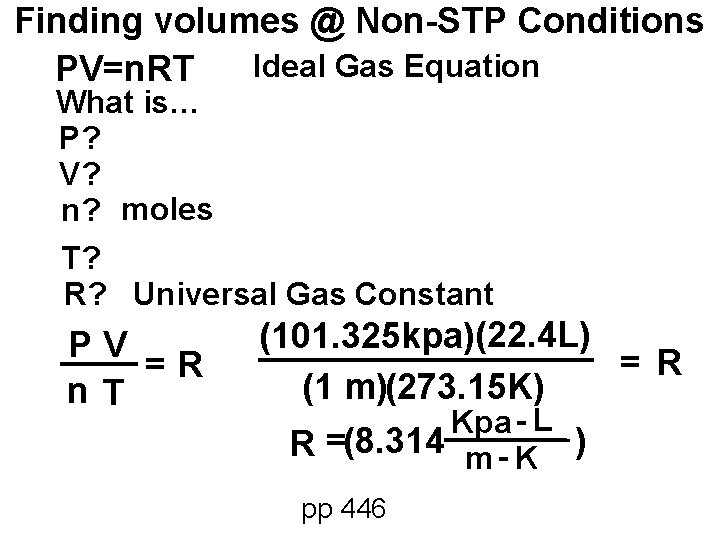
Finding volumes @ Non-STP Conditions Ideal Gas Equation PV=n. RT What is… P? V? n? moles T? R? Universal Gas Constant PV =R n. T (101. 325 kpa)(22. 4 L) = R (1 m)(273. 15 K) Kpa - L R =(8. 314 m - K ) pp 446
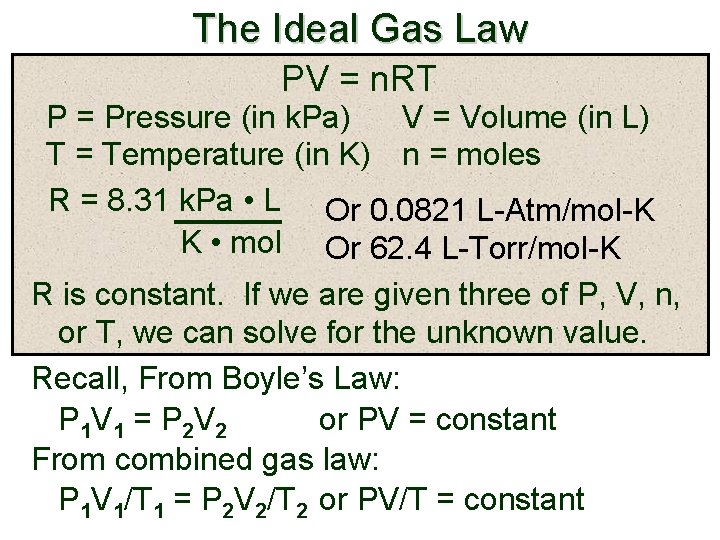
The Ideal Gas Law PV = n. RT P = Pressure (in k. Pa) V = Volume (in L) T = Temperature (in K) n = moles R = 8. 31 k. Pa • L Or 0. 0821 L-Atm/mol-K K • mol Or 62. 4 L-Torr/mol-K R is constant. If we are given three of P, V, n, or T, we can solve for the unknown value. Recall, From Boyle’s Law: P 1 V 1 = P 2 V 2 or PV = constant From combined gas law: P 1 V 1/T 1 = P 2 V 2/T 2 or PV/T = constant
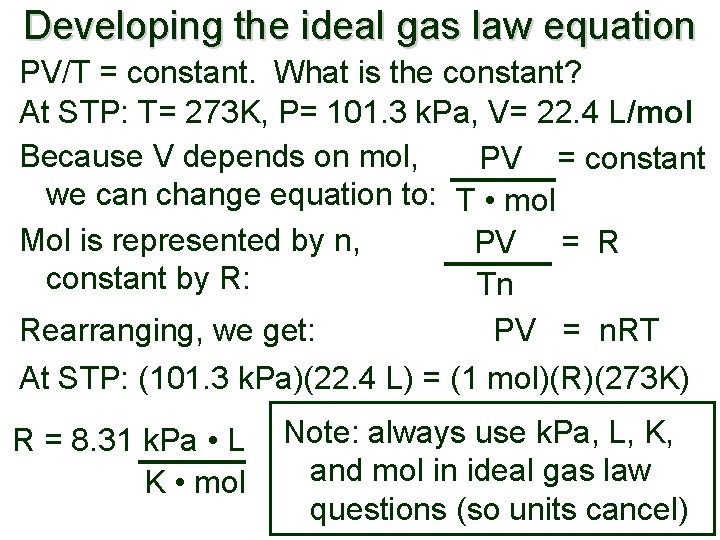
Developing the ideal gas law equation PV/T = constant. What is the constant? At STP: T= 273 K, P= 101. 3 k. Pa, V= 22. 4 L/mol Because V depends on mol, PV = constant we can change equation to: T • mol Mol is represented by n, PV = R constant by R: Tn Rearranging, we get: PV = n. RT At STP: (101. 3 k. Pa)(22. 4 L) = (1 mol)(R)(273 K) R = 8. 31 k. Pa • L K • mol Note: always use k. Pa, L, K, and mol in ideal gas law questions (so units cancel)
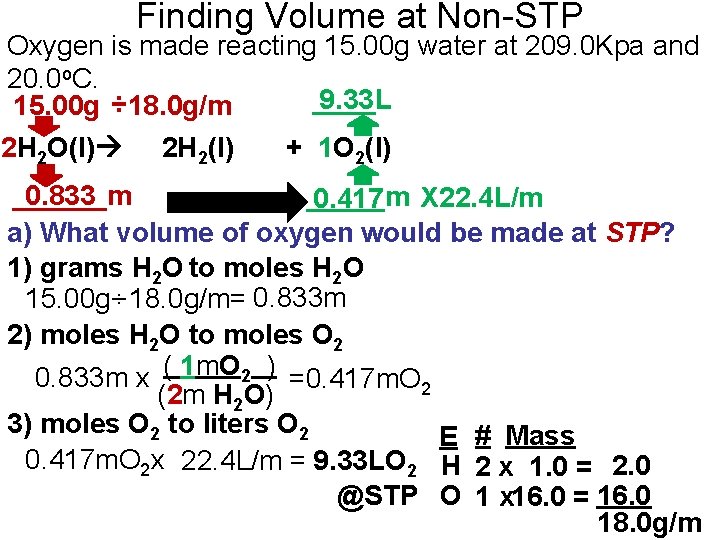
Finding Volume at Non-STP Oxygen is made reacting 15. 00 g water at 209. 0 Kpa and 20. 0 o. C. ____L 9. 33 15. 00 g ÷ 18. 0 g/m 2 H 2 O(l) 2 H 2(l) + 1 O 2(l) ______m 0. 833 _____m 0. 417 X 22. 4 L/m a) What volume of oxygen would be made at STP? 1) grams H 2 O to moles H 2 O 15. 00 g÷ 18. 0 g/m= 0. 833 m 2) moles H 2 O to moles O 2 0. 833 m x ( 1 m. O 2 ) =0. 417 m. O 2 (2 m H 2 O) 3) moles O 2 to liters O 2 E # Mass 0. 417 m. O 2 x 22. 4 L/m = 9. 33 LO 2 H 2 x 1. 0 = 2. 0 @STP O 1 x 16. 0 = 16. 0 18. 0 g/m
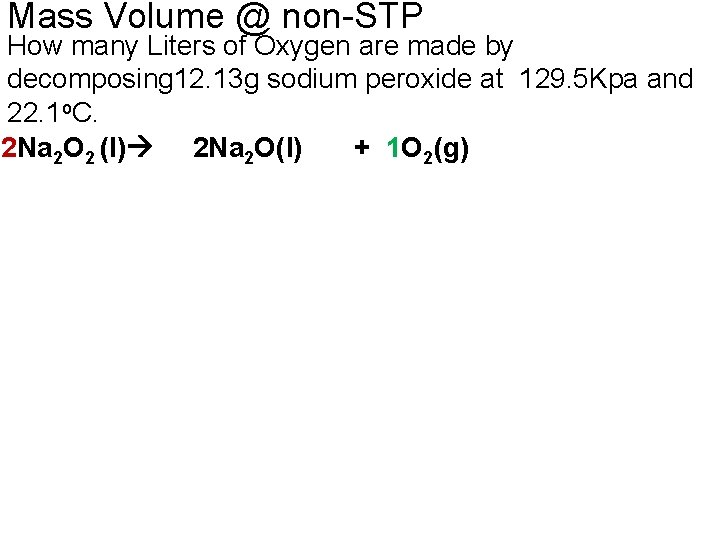
Mass Volume @ non-STP How many Liters of Oxygen are made by decomposing 12. 13 g sodium peroxide at 129. 5 Kpa and 22. 1 o. C. 2 Na 2 O 2 (l) 2 Na 2 O(l) + 1 O 2(g)
Molar Volume Lab • Molar Volume Lab Data • Molar Volume Lab Calculations
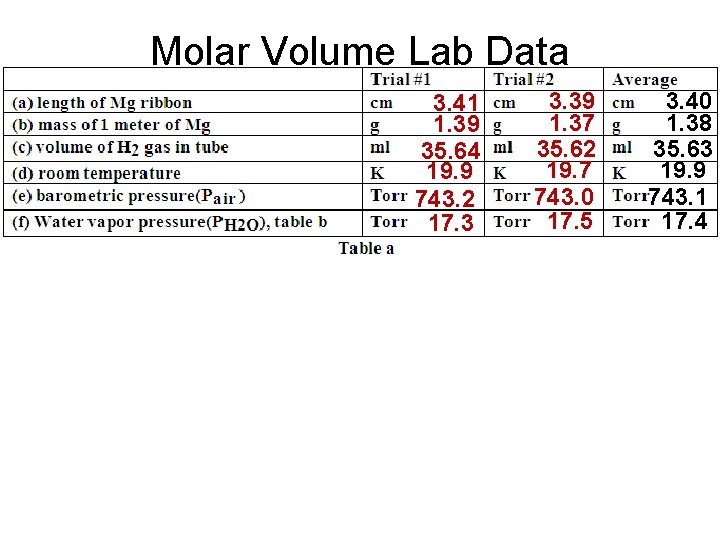
Molar Volume Lab Data 3. 41 1. 39 35. 64 19. 9 743. 2 17. 3 3. 39 1. 37 35. 62 19. 7 743. 0 17. 5 3. 40 1. 38 35. 63 19. 9 743. 1 17. 4
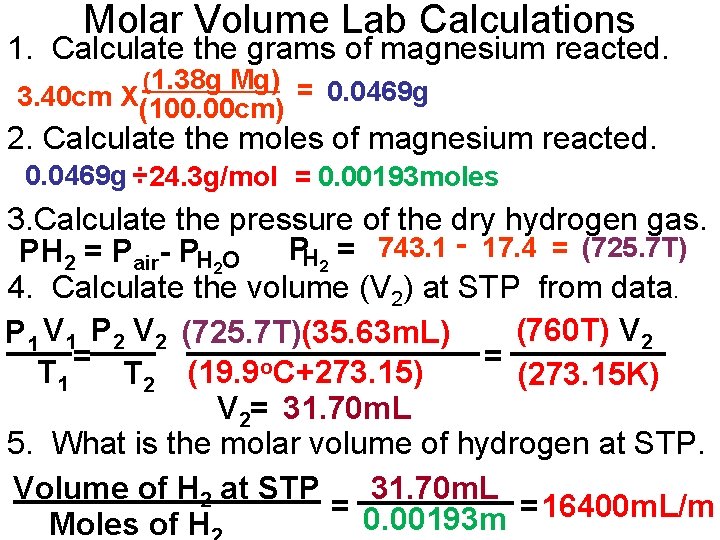
Molar Volume Lab Calculations 1. Calculate the grams of magnesium reacted. (1. 38 g Mg) = 0. 0469 g 3. 40 cm X (100. 00 cm) 2. Calculate the moles of magnesium reacted. 0. 0469 g ÷ 24. 3 g/mol = 0. 00193 moles 3. Calculate the pressure of the dry hydrogen gas. PH 2 = Pair- PH 2 O PH 2 = 743. 1 - 17. 4 = (725. 7 T) 4. Calculate the volume (V 2) at STP from data. (760 T) V 2 P 1 V 1 P 2 V 2 (725. 7 T)(35. 63 m. L) = = o T 1 T 2 (19. 9 C+273. 15) (273. 15 K) V 2= 31. 70 m. L 5. What is the molar volume of hydrogen at STP. Volume of H 2 at STP 31. 70 m. L = 0. 00193 m =16400 m. L/m Moles of H
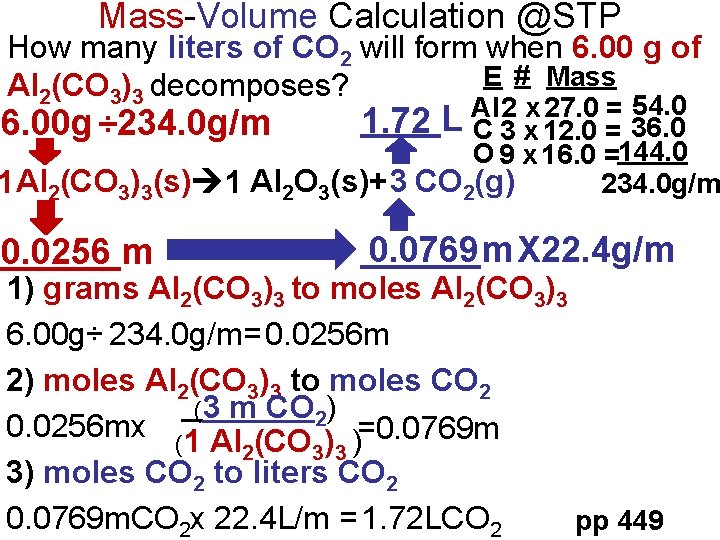
Mass-Volume Calculation @STP How many liters of CO 2 will form when 6. 00 g of E # Mass Al 2(CO 3)3 decomposes? 54. 0 Al 2 x 27. 0 = ____L 1. 72 C 3 x 12. 0 = 36. 00 g ÷ 234. 0 g/m O 9 x 16. 0 =144. 0 1 Al 2(CO 3)3(s) 1 Al 2 O 3(s)+ 3 CO 2(g) 234. 0 g/m ______m 0. 0256 ______m 0. 0769 X 22. 4 g/m 1) grams Al 2(CO 3)3 to moles Al 2(CO 3)3 6. 00 g÷ 234. 0 g/m= 0. 0256 m 2) moles Al 2(CO 3)3 to moles CO 2 (3 m CO 2) 0. 0256 mx (1 Al (CO ) )=0. 0769 m 2 3 3 3) moles CO 2 to liters CO 2 0. 0769 m. CO 2 x 22. 4 L/m = 1. 72 LCO 2 pp 449
Unit Five • Combined Quiz Review Unit Eight
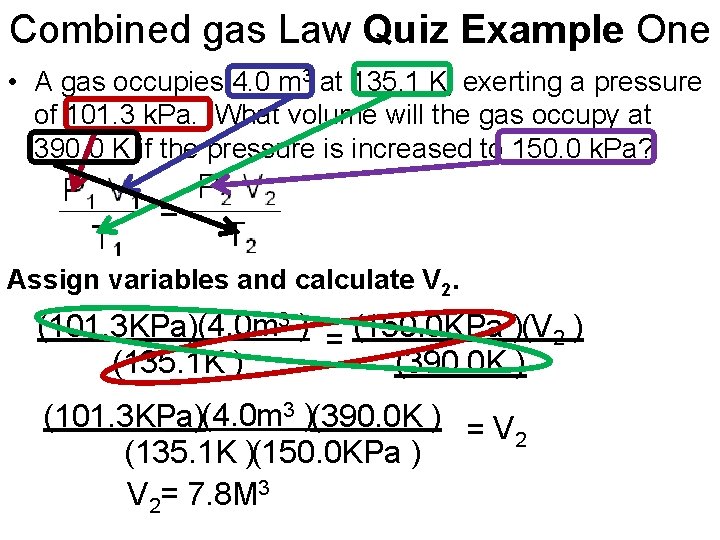
Combined gas Law Quiz Example One • A gas occupies 4. 0 m 3 at 135. 1 K, exerting a pressure of 101. 3 k. Pa. What volume will the gas occupy at 390. 0 K if the pressure is increased to 150. 0 k. Pa? Assign variables and calculate V 2. (101. 3 KPa)(4. 0 m 3 ) = (150. 0 KPa )(V 2 ) (135. 1 K ) (390. 0 K ) (101. 3 KPa)(4. 0 m 3 )(390. 0 K ) = V 2 (135. 1 K )(150. 0 KPa ) V 2= 7. 8 M 3
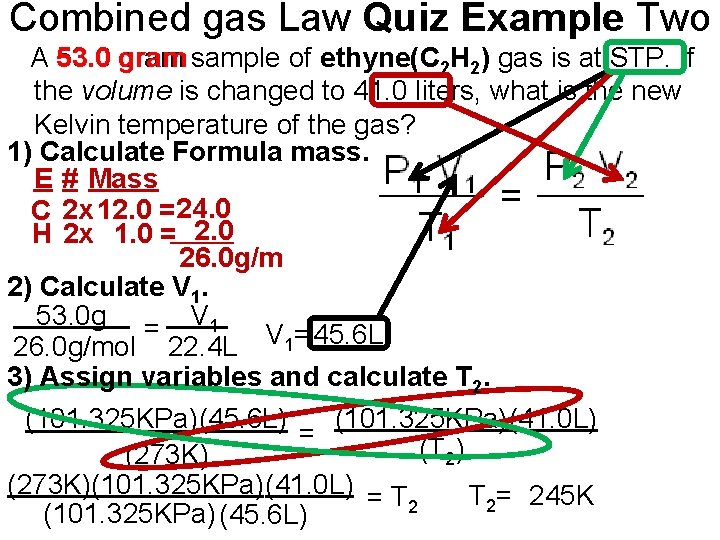
Combined gas Law Quiz Example Two A 53. 0 gram sample of ethyne(C 2 H 2) gas is at STP. If the volume is changed to 41. 0 liters, what is the new Kelvin temperature of the gas? 1) Calculate Formula mass. E # Mass C 2 x 12. 0 = 24. 0 H 2 x 1. 0 = 2. 0 26. 0 g/m 2) Calculate V 1. 53. 0 g = V 1 26. 0 g/mol 22. 4 L V 1=45. 6 L 3) Assign variables and calculate T 2. (101. 325 KPa)(41. 0 L) (101. 325 KPa)(45. 6 L) = (T 2) (273 K)(101. 325 KPa)(41. 0 L) = T T 2= 245 K 2 (101. 325 KPa) (45. 6 L)
Seven Rows Eight Rows
Seven Rows Eight Rows
Seven Rows Eight Rows
Seven Rows Eight Rows
Seven Rows Eight Rows
Seven Rows Eight Rows
Quiz Two Notes • Mass-Volume Calculation @STP • Grahams’ Law Problem
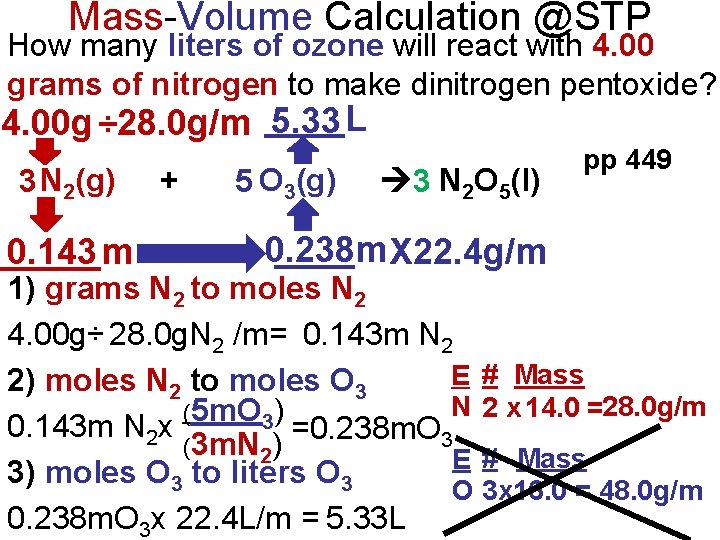
Mass-Volume Calculation @STP How many liters of ozone will react with 4. 00 grams of nitrogen to make dinitrogen pentoxide? 5. 33 4. 00 g ÷ 28. 0 g/m ____L 3 N 2(g) _____m 0. 143 + 5 O 3(g) 3 N 2 O 5(l) 0. 238 ____m X 22. 4 g/m pp 449 1) grams N 2 to moles N 2 4. 00 g÷ 28. 0 g. N 2 /m= 0. 143 m N 2 E # Mass 2) moles N 2 to moles O 3 N 2 x 14. 0 =28. 0 g/m (5 m. O 3) 0. 143 m N 2 x =0. 238 m. O 3 (3 m. N 2) E # Mass 3) moles O 3 to liters O 3 x 16. 0 = 48. 0 g/m 0. 238 m. O 3 x 22. 4 L/m = 5. 33 L
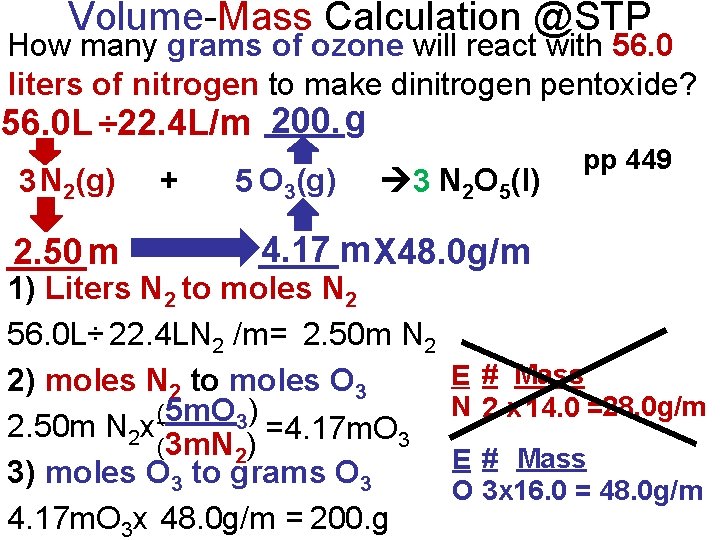
Volume-Mass Calculation @STP How many grams of ozone will react with 56. 0 liters of nitrogen to make dinitrogen pentoxide? 200. 56. 0 L ÷ 22. 4 L/m ____g 3 N 2(g) ____m 2. 50 + 5 O 3(g) 3 N 2 O 5(l) pp 449 ____m 4. 17 X 48. 0 g/m 1) Liters N 2 to moles N 2 56. 0 L÷ 22. 4 LN 2 /m= 2. 50 m N 2 2) moles N 2 to moles O 3 (5 m. O 3) 2. 50 m N 2 x =4. 17 m. O 3 (3 m. N 2) 3) moles O 3 to grams O 3 4. 17 m. O 3 x 48. 0 g/m = 200. g E # Mass N 2 x 14. 0 =28. 0 g/m E # Mass O 3 x 16. 0 = 48. 0 g/m
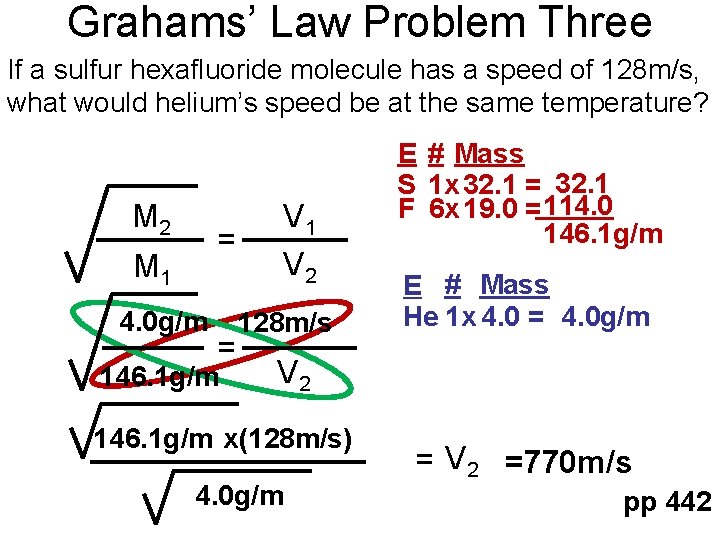
Grahams’ Law Problem Three If a sulfur hexafluoride molecule has a speed of 128 m/s, what would helium’s speed be at the same temperature? M 2 = M 1 4. 0 g/m = 146. 1 g/m V 1 V 2 128 m/s E # Mass S 1 x 32. 1 = 32. 1 F 6 x 19. 0 = 114. 0 146. 1 g/m E # Mass He 1 x 4. 0 = 4. 0 g/m V 2 146. 1 g/m x(128 m/s) 4. 0 g/m = V 2 =770 m/s pp 442
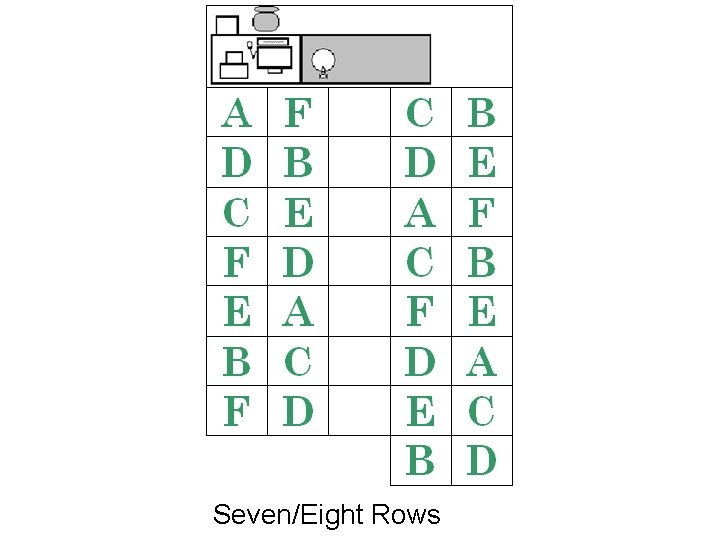
Seven/Eight Rows
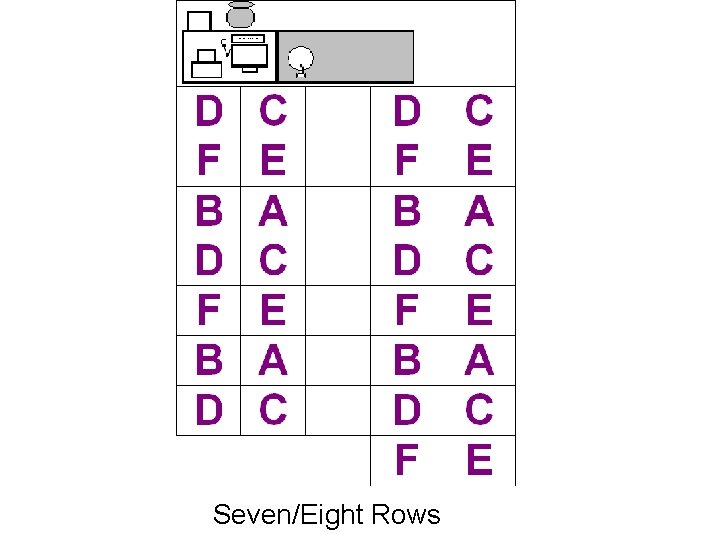
Seven/Eight Rows
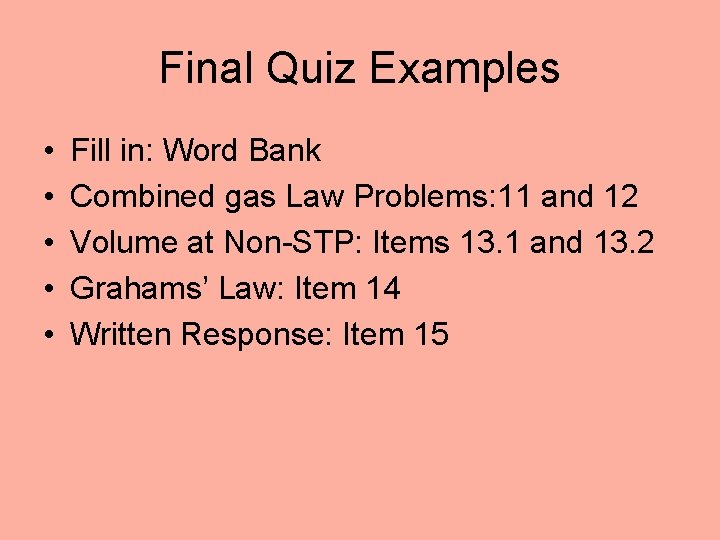
Final Quiz Examples • • • Fill in: Word Bank Combined gas Law Problems: 11 and 12 Volume at Non-STP: Items 13. 1 and 13. 2 Grahams’ Law: Item 14 Written Response: Item 15
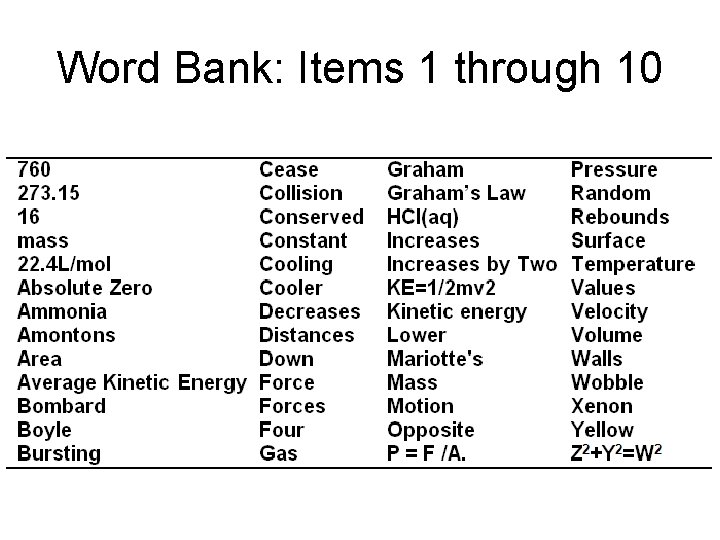
Word Bank: Items 1 through 10
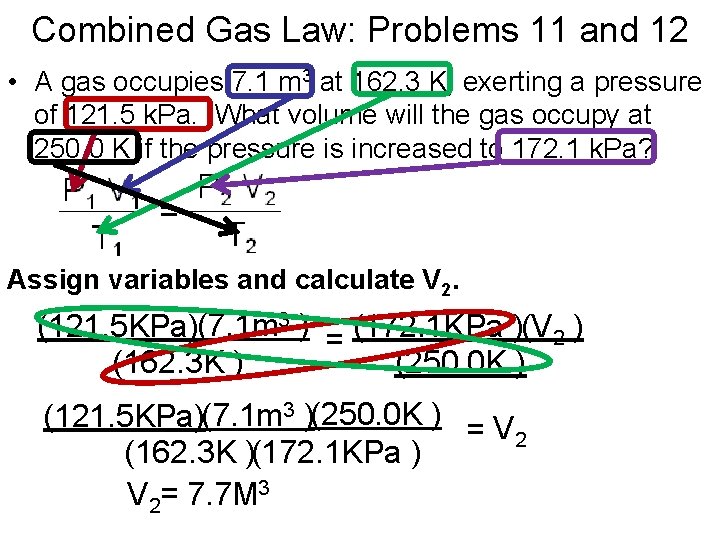
Combined Gas Law: Problems 11 and 12 • A gas occupies 7. 1 m 3 at 162. 3 K, exerting a pressure of 121. 5 k. Pa. What volume will the gas occupy at 250. 0 K if the pressure is increased to 172. 1 k. Pa? Assign variables and calculate V 2. (121. 5 KPa)(7. 1 m 3 ) = (172. 1 KPa )(V 2 ) (162. 3 K ) (250. 0 K ) (121. 5 KPa)(7. 1 m 3 )(250. 0 K ) = V 2 (162. 3 K )(172. 1 KPa ) V 2= 7. 7 M 3
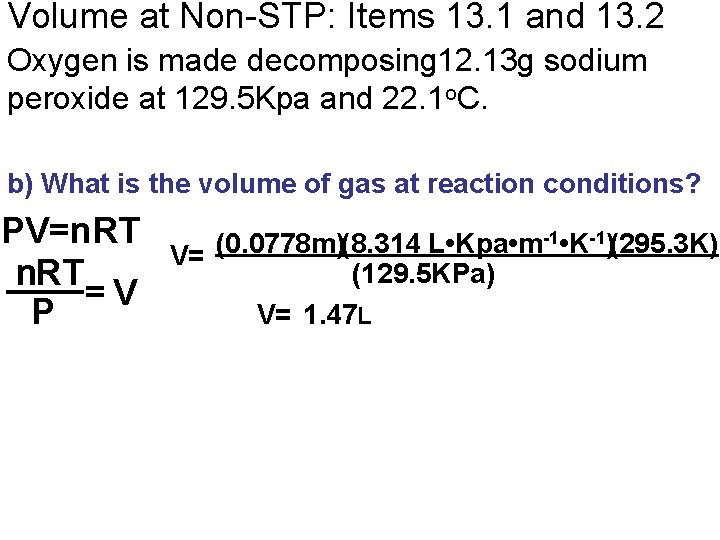
Volume at Non-STP: Items 13. 1 and 13. 2 Oxygen is made decomposing 12. 13 g sodium peroxide at 129. 5 Kpa and 22. 1 o. C. b) What is the volume of gas at reaction conditions? PV=n. RT n. R T =V P -1 • K-1)(295. 3 K) (0. 0778 m)(8. 314 L • Kpa • m V= (129. 5 KPa) V= 1. 47 L
Grahams’ Law: Item 14 If oxygen molecules have a speed of 168 m/s, what would the speed of hydrogen molecules be at the same temperature? E # Mass O 2 x 16. 0 = 32. 0 g/m E # Mass H 2 x 1. 0 = 2. 0 g/m = V 2= 670 m/s pp 442
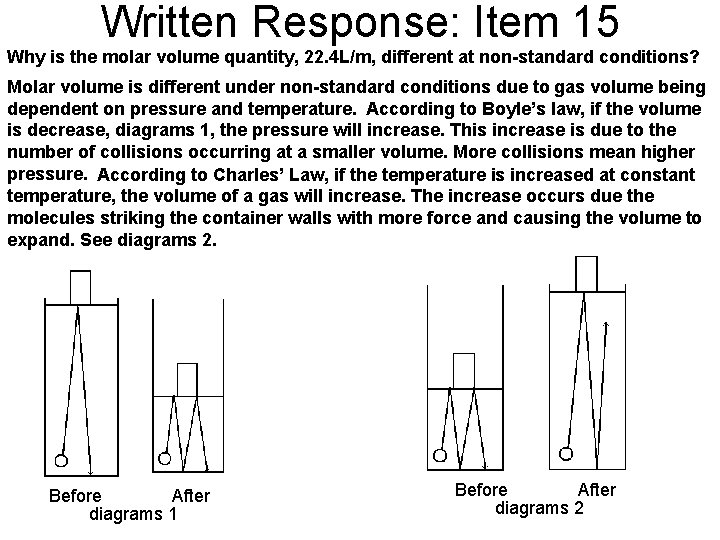
Written Response: Item 15 Why is the molar volume quantity, 22. 4 L/m, different at non-standard conditions? Molar volume is different under non-standard conditions due to gas volume being dependent on pressure and temperature. According to Boyle’s law, if the volume is decrease, diagrams 1, the pressure will increase. This increase is due to the number of collisions occurring at a smaller volume. More collisions mean higher pressure. According to Charles’ Law, if the temperature is increased at constant temperature, the volume of a gas will increase. The increase occurs due the molecules striking the container walls with more force and causing the volume to expand. See diagrams 2. Before After diagrams 1 Before After diagrams 2
end
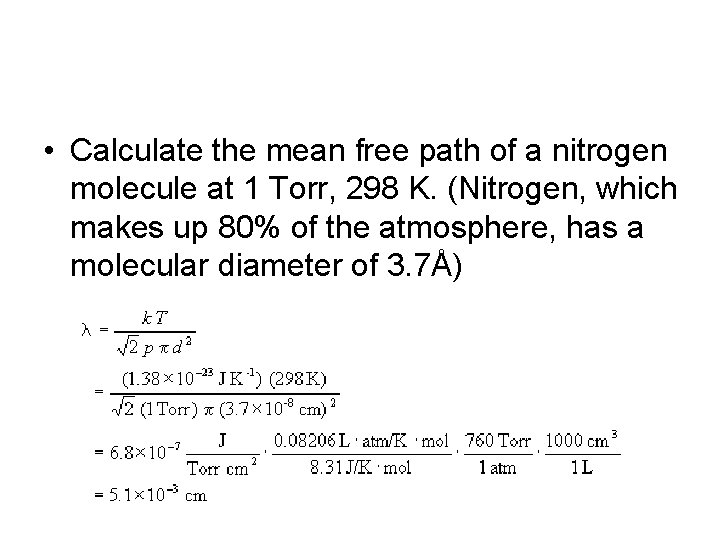
• Calculate the mean free path of a nitrogen molecule at 1 Torr, 298 K. (Nitrogen, which makes up 80% of the atmosphere, has a molecular diameter of 3. 7Å)
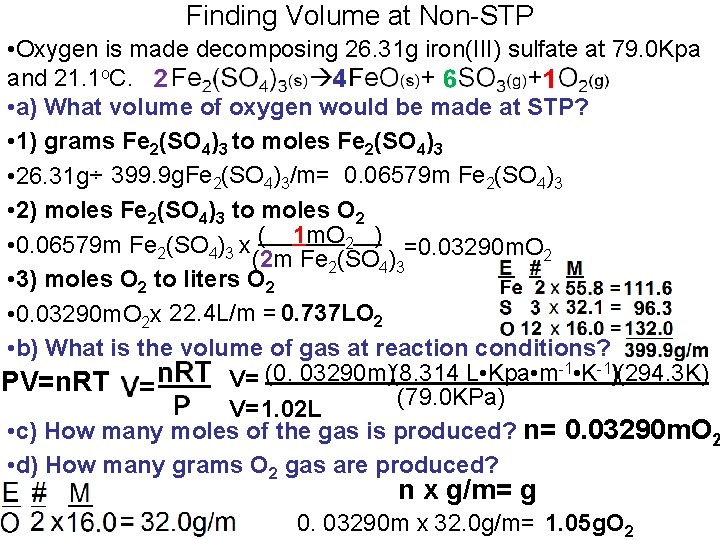
Finding Volume at Non-STP • Oxygen is made decomposing 26. 31 g iron(III) sulfate at 79. 0 Kpa and 21. 1 o. C. 1 Fe 2(SO 4)3(s) 2 Fe. O(s)+ 3 SO 3(g)+ 0. 5 O 2(g) • a) What volume of oxygen would be made at STP? • 1) grams Fe 2(SO 4)3 to moles Fe 2(SO 4)3 • 26. 31 g÷ 399. 9 g. Fe 2(SO 4)3/m= 0. 06579 m Fe 2(SO 4)3 • 2) moles Fe 2(SO 4)3 to moles O 2 • 0. 06579 m Fe 2(SO 4)3 x ( 1 m. O 2 ) =0. 03290 m. O 2 (2 m Fe 2(SO 4)3 • 3) moles O 2 to liters O 2 • 0. 03290 m. O 2 x 22. 4 L/m = 0. 737 LO 2 • b) What is the volume of gas at reaction conditions? -1 • K-1)(294. 3 K) (0. 03290 m)(8. 314 L • Kpa • m V= PV=n. RT (79. 0 KPa) V=1. 02 L • c) How many moles of the gas is produced? n= 0. 03290 m. O 2 • d) How many grams O 2 gas are produced? n x g/m= g 0. 03290 m x 32. 0 g/m= 1. 05 g. O 2