
Notes on Power Point Deck Notes on format

![Welcome to the Program [Local Dignitary] • Two-time Olympic gold medalist 6 © Copyright](https://slidetodoc.com/presentation_image/2e48fadc3c8023ce5e54fc3d3fcf87e2/image-6.jpg "Welcome to the Program [Local Dignitary] • Two-time Olympic gold medalist 6 © Copyright")
![Lesson 1 The Challenges Facing Farmers • [Fact about situation of smallholder farmers worldwide]](https://slidetodoc.com/presentation_image/2e48fadc3c8023ce5e54fc3d3fcf87e2/image-18.jpg "Lesson 1 The Challenges Facing Farmers • [Fact about situation of smallholder farmers worldwide]")
![Lesson 2 Step 1: Selecting a Site & Obtaining Clearance [need SME input] 35](https://slidetodoc.com/presentation_image/2e48fadc3c8023ce5e54fc3d3fcf87e2/image-35.jpg "Lesson 2 Step 1: Selecting a Site & Obtaining Clearance [need SME input] 35")
![Lesson 2 Case Study: The Village of [Anywhere] • Many of the activities in](https://slidetodoc.com/presentation_image/2e48fadc3c8023ce5e54fc3d3fcf87e2/image-50.jpg "Lesson 2 Case Study: The Village of [Anywhere] • Many of the activities in")
- Slides: 62
Notes on Power. Point Deck Notes on format: • This Power. Point deck follows a format that has proven effective in a wide range of contexts, from primary and secondary education to higher learning and corporate training. 1 • Objectives are presented at the beginning of the course and each lesson and repeated at the end (provides context and reinforces most important points of each lesson) • Objectives are written using action verbs from Bloom’s taxonomy, so that mastery of skills and concepts can be demonstrated by participants and objectively verified by the facilitator • Questions for participants are included throughout the presentation, to gauge participants’ engagement and understanding and encourage two-way interaction between the facilitator and participants even if it does not arise organically. © Copyright 2014. All rights reserved.
Notes on Power. Point Deck (Cont. ) How much content should we include on Power. Point slides? • In theory, Power. Point slides should only include visual aids, supplementary information, key takeaways / bullet points to support the facilitator’s delivery • Processing redundant spoken and written information, increases cognitive load (irritating for participants who read quickly, overwhelming for participants who read slowly). • Reduces engagement if facilitator simply reads text from slides – destroys sense that an authentic dialog is taking place • In practice, having more information on slides can provide support to facilitators not thoroughly familiar with course outline and materials / not well-rehearsed in their delivery. • We can tailor the slide content to suit the preparedness level of the typical facilitators for this program. 2 © Copyright 2014. All rights reserved.
Notes on Power. Point Deck (Cont. ) Clicker Response Questions • If this proposal is accepted, I will install the necessary extensions for the presentation to accept real-time input from clicker devices. For now, placeholder slides are used wherever such questions would be asked. Notes & Highlighting • Notes are included on most of the slides. • In cases where more information is required from SME, text is highlighted red 3 © Copyright 2014. All rights reserved.
Notes on Power. Point Deck (Cont. ) Intellectual Property • This presentation includes photos downloaded from the internet as placeholders. These should be replaced in the final product with images for which the client has secured all necessary rights and permissions. We cannot be held liable for any copyright infringements if the client uses the presentation in its current form. • Sonata Learning branding can be removed at client’s request. • If you wish to use this Power. Point template for purposes other than this course, we simply ask for a one-time consideration of USD$100 for the designer. Please press “Shift+F 5” to view this presentation full screen. 4 © Copyright 2014. All rights reserved.
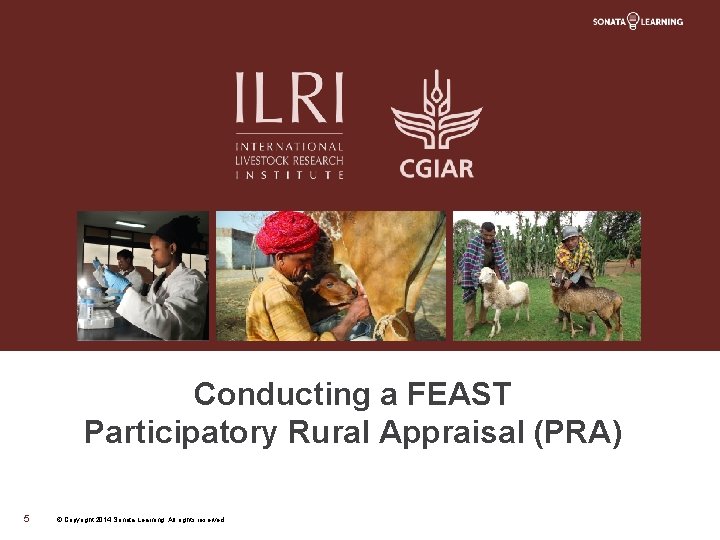
Conducting a FEAST Participatory Rural Appraisal (PRA) 5 © Copyright 2014 Sonata Learning. All rights reserved.
Welcome to the Program [Local Dignitary] • Two-time Olympic gold medalist 6 © Copyright 2014. All rights reserved. Iddo Dror, Ph. D • Head of Capacity Development at ILRI
Introduction • Introductions • Course Overview © Copyright 2014. All rights reserved.
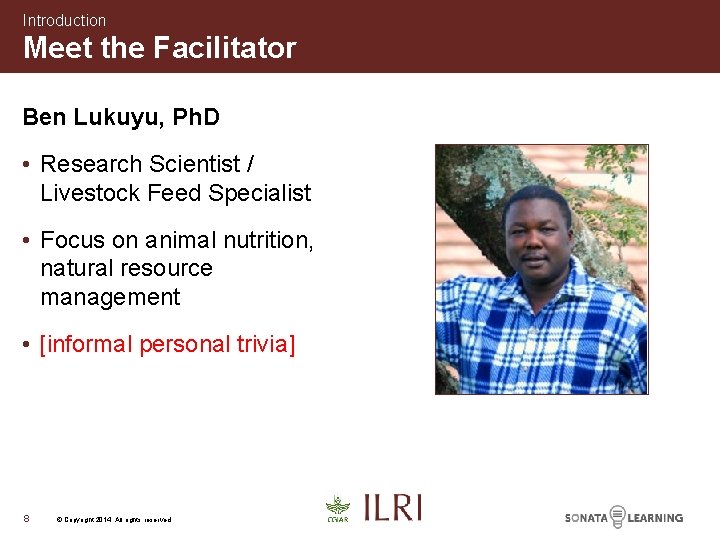
Introduction Meet the Facilitator Ben Lukuyu, Ph. D • Research Scientist / Livestock Feed Specialist • Focus on animal nutrition, natural resource management • [informal personal trivia] 8 © Copyright 2014. All rights reserved.
Introduction Course Agenda • X days, Y hours per day • One lunch break plus two coffee breaks per day • Presentations, Discussions, Group Activities and Computer Activities • Participants will be assessed based on [assessments / criteria] 9 © Copyright 2014. All rights reserved.
Introduction Day 1 Agenda Day 1 • Introductions • The PRA Concept • Preparing for a PRA – Activity: Selecting Farmers for Group Interviews • [Coffee Break] • Etc. • Conclusion Day 1 10 © Copyright 2014. All rights reserved.
Introduction Personal Introductions Introduce yourself to your classmates: • What is your name? • Where are you from? • [Icebreaker: Share one interesting fact about yourself. ] 11 © Copyright 2014. All rights reserved.
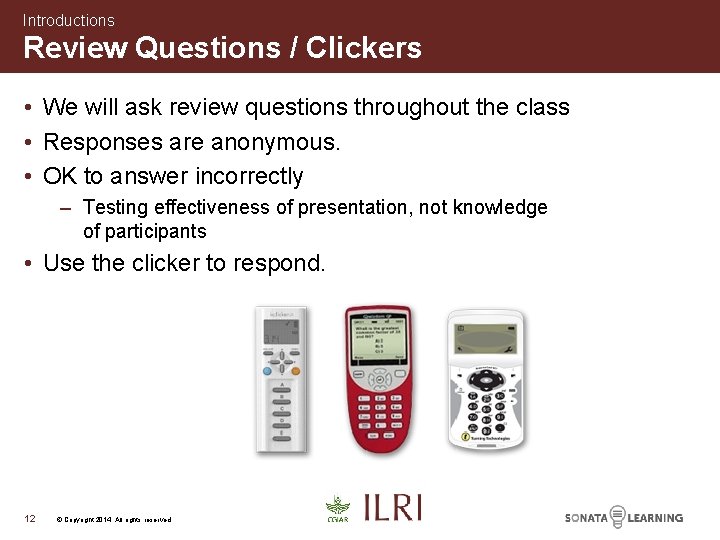
Introductions Review Questions / Clickers • We will ask review questions throughout the class • Responses are anonymous. • OK to answer incorrectly – Testing effectiveness of presentation, not knowledge of participants • Use the clicker to respond. 12 © Copyright 2014. All rights reserved.
Introduction Survey Question Have you ever used the FEAST tool / PRA methodology before? 13 © Copyright 2014. All rights reserved.
Introduction Course Objectives By the end of this course, you will be able to: • Apply the Participatory Rural Appraisal (PRA) methodology to help local farmers design intervention strategies to improve livestock feed resources • Collect and analyze data to assess local resources using the Feed Assessment Tool (FEAST) 14 © Copyright 2014. All rights reserved.
Questions? 15 © Copyright 2014. All rights reserved.
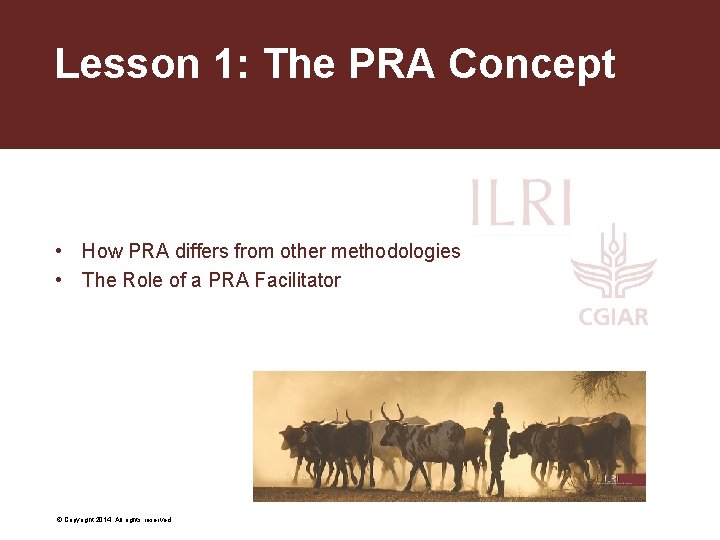
Lesson 1: The PRA Concept • How PRA differs from other methodologies • The Role of a PRA Facilitator © Copyright 2014. All rights reserved.
Lesson 1 Lesson Objectives By the end of this lesson, you will be able to: • Relate how the PRA methodology is different from other interventions to improve livestock feed • Describe the role of a PRA Facilitator 17 © Copyright 2014. All rights reserved.
Lesson 1 The Challenges Facing Farmers • [Fact about situation of smallholder farmers worldwide] • [Fact about situation of local smallholder farmers] 18 © Copyright 2014. All rights reserved.
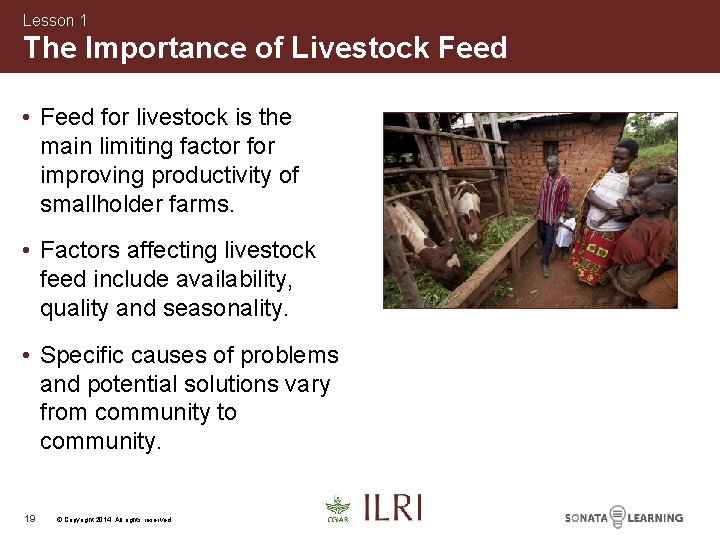
Lesson 1 The Importance of Livestock Feed • Feed for livestock is the main limiting factor for improving productivity of smallholder farms. • Factors affecting livestock feed include availability, quality and seasonality. • Specific causes of problems and potential solutions vary from community to community. 19 © Copyright 2014. All rights reserved.
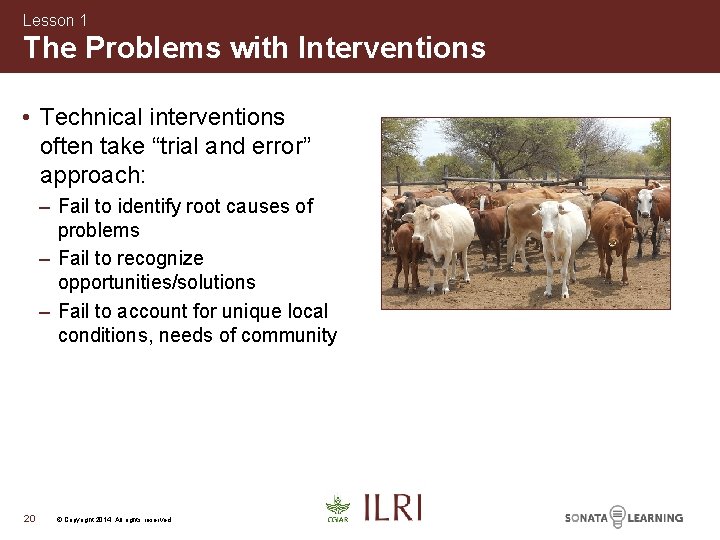
Lesson 1 The Problems with Interventions • Technical interventions often take “trial and error” approach: – Fail to identify root causes of problems – Fail to recognize opportunities/solutions – Fail to account for unique local conditions, needs of community 20 © Copyright 2014. All rights reserved.
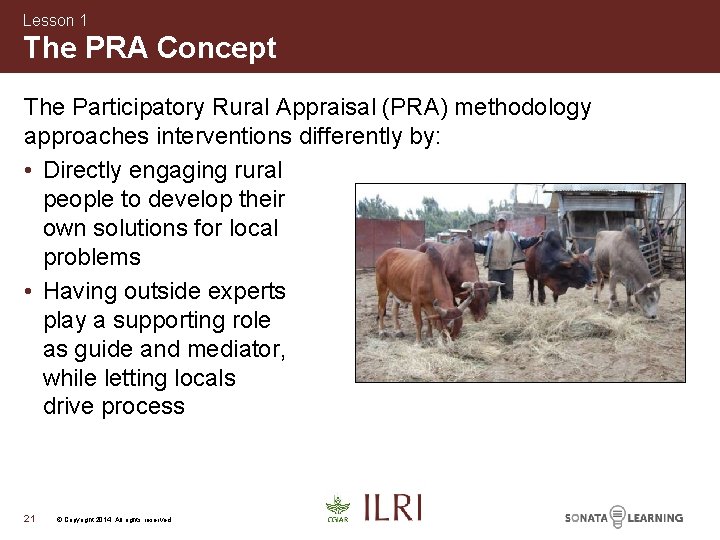
Lesson 1 The PRA Concept The Participatory Rural Appraisal (PRA) methodology approaches interventions differently by: • Directly engaging rural people to develop their own solutions for local problems • Having outside experts play a supporting role as guide and mediator, while letting locals drive process 21 © Copyright 2014. All rights reserved.
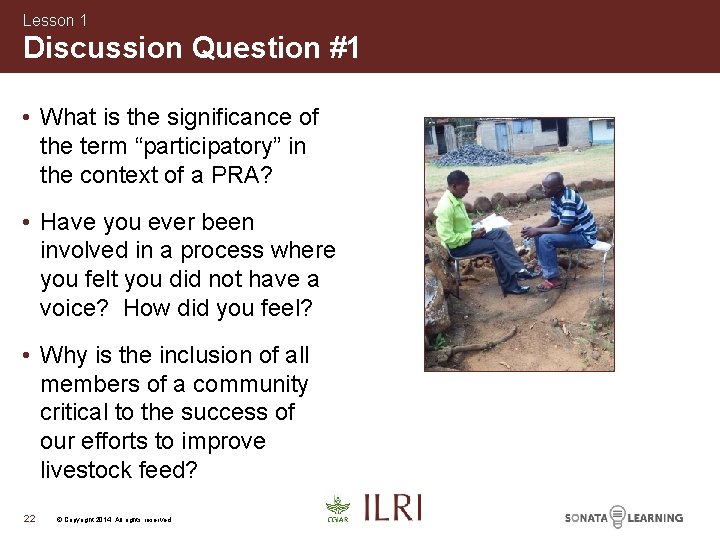
Lesson 1 Discussion Question #1 • What is the significance of the term “participatory” in the context of a PRA? • Have you ever been involved in a process where you felt you did not have a voice? How did you feel? • Why is the inclusion of all members of a community critical to the success of our efforts to improve livestock feed? 22 © Copyright 2014. All rights reserved.
Lesson 1 What is a PRA? Participatory Rural Appraisal (PRA) is a systematic methodology to help members of a community: • Examine issues that concern local farmers • Identify and problems and opportunities • Prioritize problems • Evaluate options for solving problems • Develop and carry out interventions to address problems 23 © Copyright 2014. All rights reserved.
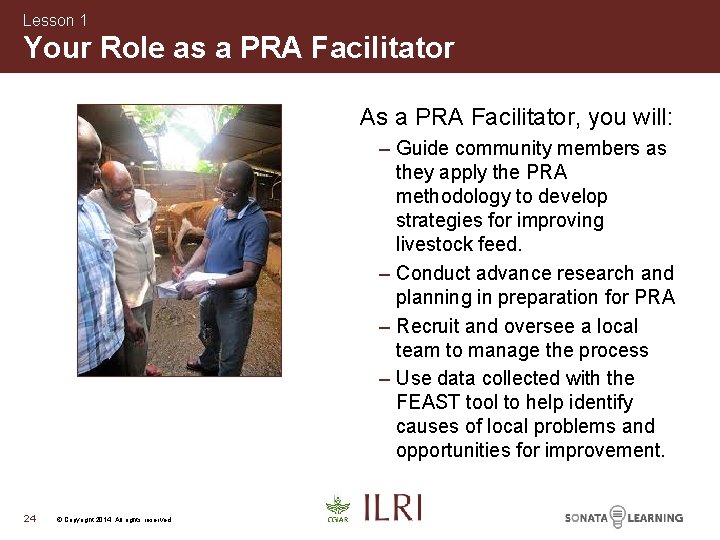
Lesson 1 Your Role as a PRA Facilitator As a PRA Facilitator, you will: – Guide community members as they apply the PRA methodology to develop strategies for improving livestock feed. – Conduct advance research and planning in preparation for PRA – Recruit and oversee a local team to manage the process – Use data collected with the FEAST tool to help identify causes of local problems and opportunities for improvement. 24 © Copyright 2014. All rights reserved.
Lesson 1 Discussion Question #2 • Have you served as a PRA facilitator before? To what extent did the farmers lead the process? • Have you worked on other types of interventions before? How would you compare the experience to a PRA? 25 © Copyright 2014. All rights reserved.
Lesson 1 Review Question #1 What is the main responsibility of a PRA Facilitator? [responses: – To tell local farmers how to solve their problems – To know everything about livestock feed – To help local farmers develop strategies for improving livestock feed – To inspect local supplies of livestock feed 26 © Copyright 2014. All rights reserved.
Lesson 1 Review Question #2 How is a PRA different from typical interventions? [responses: – The PRA process is driven by local farmers with a Facilitator acting as a guide – A PRA is controlled by government experts – In a PRA, a set of standard strategies are applied to all villages, worldwide. – A PRA does not deal with problems of livestock feed 27 © Copyright 2014. All rights reserved.
Lesson 1 Lesson Objectives Review You should now be able to: • Compare how the PRA methodology differs from other approaches to improving livestock feed • Describe the role of a PRA Facilitator 28 © Copyright 2014. All rights reserved.
Questions? 29 © Copyright 2014. All rights reserved.
Lesson 2: Preparing for a PRA • Welcome / Introductions • Course Overview • Your Role as a PRA Technician © Copyright 2014. All rights reserved.
Lesson 2 Lesson Objectives By the end of this lesson, you will be able to: • List the key steps facilitators take to prepare for a PRA • Explain the benefits of planning • Select groups of farmers to participate in the PRA that are representative of the entire community 31 © Copyright 2014. All rights reserved.
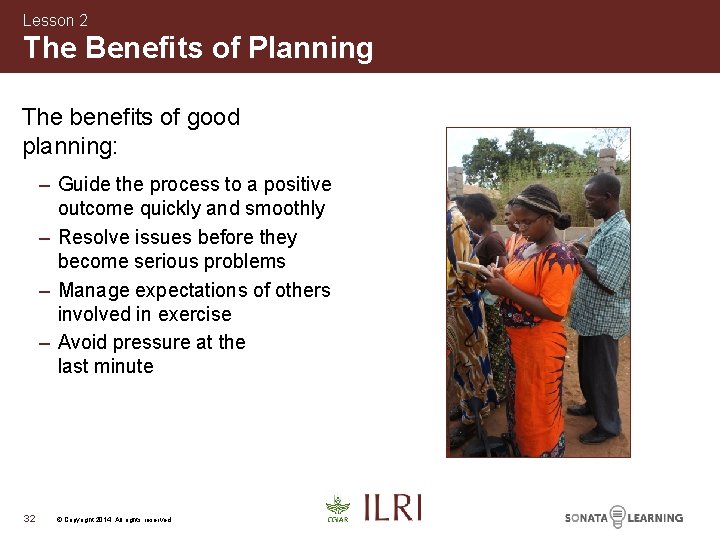
Lesson 2 The Benefits of Planning The benefits of good planning: – Guide the process to a positive outcome quickly and smoothly – Resolve issues before they become serious problems – Manage expectations of others involved in exercise – Avoid pressure at the last minute 32 © Copyright 2014. All rights reserved.
Lesson 2 Discussion Question #1 • Can you recount any experiences, either while working on a PRA or in some other part of your life, where planning made things go more smoothly? • Can you recall any experiences where a lack of planning led to needless trouble? 33 © Copyright 2014. All rights reserved.
Lesson 2 Key Steps in Planning for a FEAST PRA 1. Select site and obtain clearance from local administrative officials 2. Conduct preliminary scoping exercise with local stakeholders in advance 3. Recruit PRA team and assemble farmers for PRA exercise 34 © Copyright 2014. All rights reserved. 4. Plan for PRA data collection logistics 5. Select farmers for individual interviews 6. [this step was redundant in source material]
Lesson 2 Step 1: Selecting a Site & Obtaining Clearance [need SME input] 35 © Copyright 2014. All rights reserved.
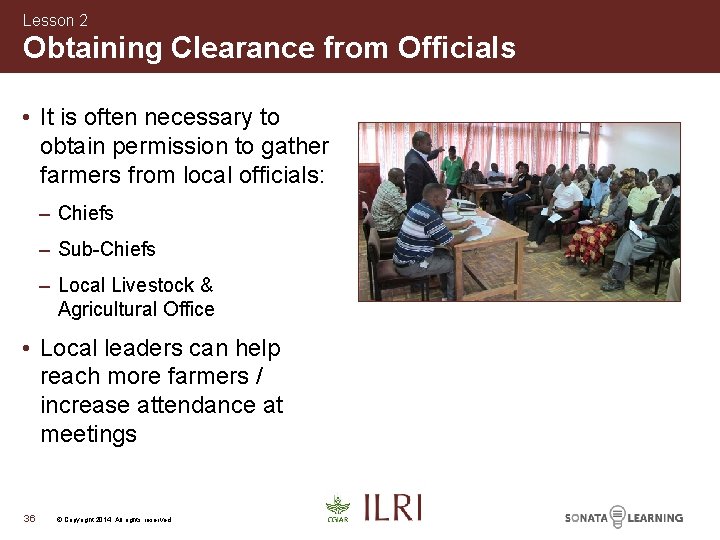
Lesson 2 Obtaining Clearance from Officials • It is often necessary to obtain permission to gather farmers from local officials: – Chiefs – Sub-Chiefs – Local Livestock & Agricultural Office • Local leaders can help reach more farmers / increase attendance at meetings 36 © Copyright 2014. All rights reserved.
Lesson 2 Discussion Question #2 • If you have participated in PRA’s before, how did you obtain clearance from the local officials? • Who did you obtain clearance from? • Were there any issues / concerns? 37 © Copyright 2014. All rights reserved.
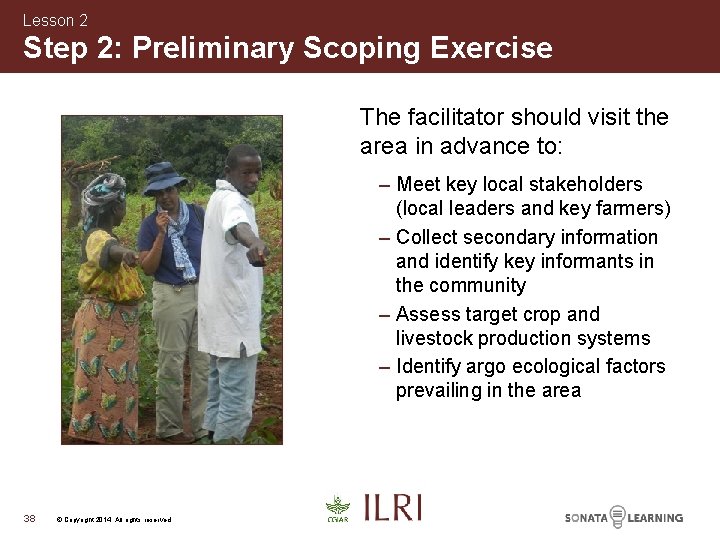
Lesson 2 Step 2: Preliminary Scoping Exercise The facilitator should visit the area in advance to: – Meet key local stakeholders (local leaders and key farmers) – Collect secondary information and identify key informants in the community – Assess target crop and livestock production systems – Identify argo ecological factors prevailing in the area 38 © Copyright 2014. All rights reserved.
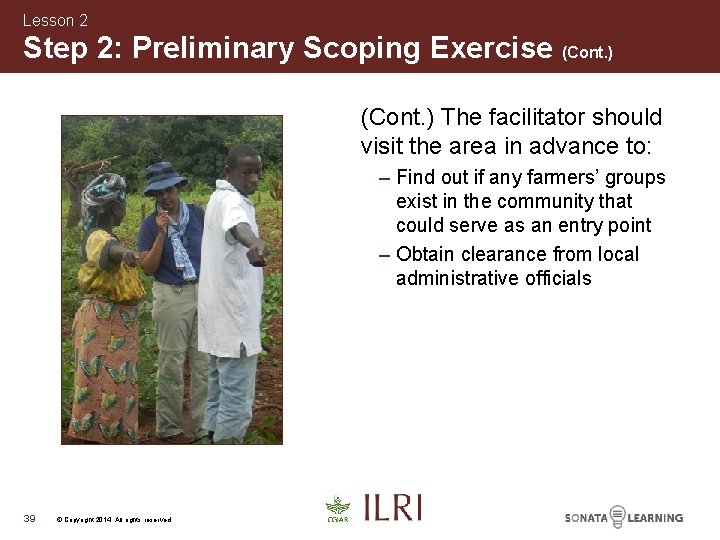
Lesson 2 Step 2: Preliminary Scoping Exercise (Cont. ) The facilitator should visit the area in advance to: – Find out if any farmers’ groups exist in the community that could serve as an entry point – Obtain clearance from local administrative officials 39 © Copyright 2014. All rights reserved.
Lesson 2 Step 3: Forming PRA Teams & Farmer Groups While visiting the area in advance, the facilitator should: • Identify community members capable of helping the facilitator manage the PRA process (PRA Technical Teams) • Recruit farmers to participate in the PRA process (Farmer Groups) 40 © Copyright 2014. All rights reserved.
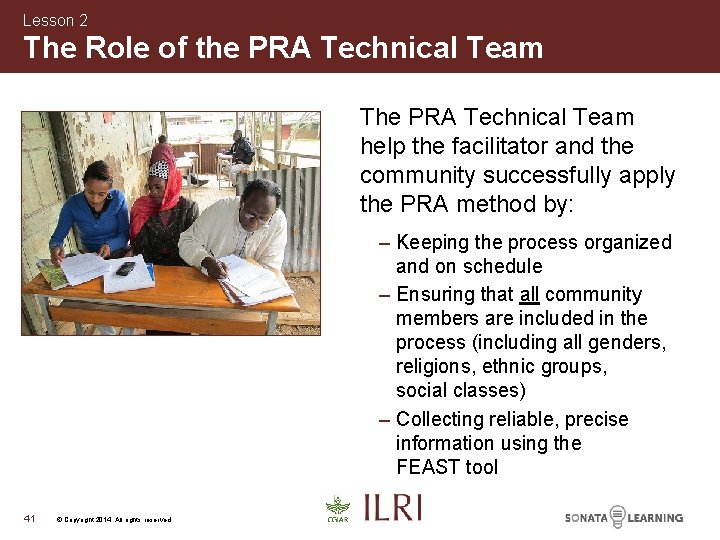
Lesson 2 The Role of the PRA Technical Team The PRA Technical Team help the facilitator and the community successfully apply the PRA method by: – Keeping the process organized and on schedule – Ensuring that all community members are included in the process (including all genders, religions, ethnic groups, social classes) – Collecting reliable, precise information using the FEAST tool 41 © Copyright 2014. All rights reserved.
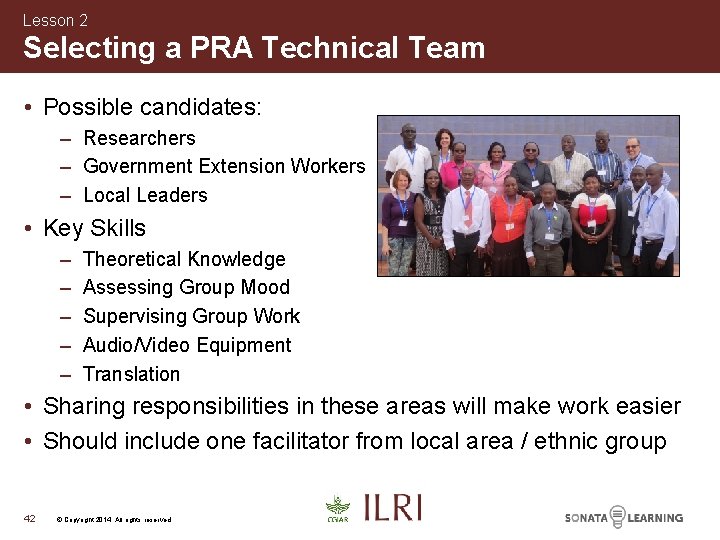
Lesson 2 Selecting a PRA Technical Team • Possible candidates: – Researchers – Government Extension Workers – Local Leaders • Key Skills – – – Theoretical Knowledge Assessing Group Mood Supervising Group Work Audio/Video Equipment Translation • Sharing responsibilities in these areas will make work easier • Should include one facilitator from local area / ethnic group 42 © Copyright 2014. All rights reserved.
Lesson 2 Creating a PRA Technical Team Contract Take into account everyone’s expectations and pledge to: • Communicate with each other • Attend all sessions • Have daily briefings • Etc. 43 © Copyright 2014. All rights reserved.
Lesson 2 Discussion Question #3 • If you have participated in PRA’s before, who was on your team? • Did you create an agreement? • In what ways was working with a team helpful? • Were there any issues / challenges? 44 © Copyright 2014. All rights reserved.
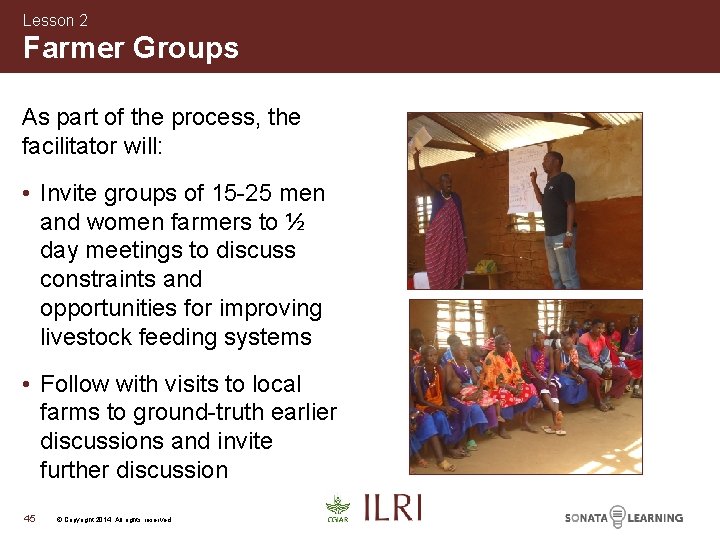
Lesson 2 Farmer Groups As part of the process, the facilitator will: • Invite groups of 15 -25 men and women farmers to ½ day meetings to discuss constraints and opportunities for improving livestock feeding systems • Follow with visits to local farms to ground-truth earlier discussions and invite further discussion 45 © Copyright 2014. All rights reserved.
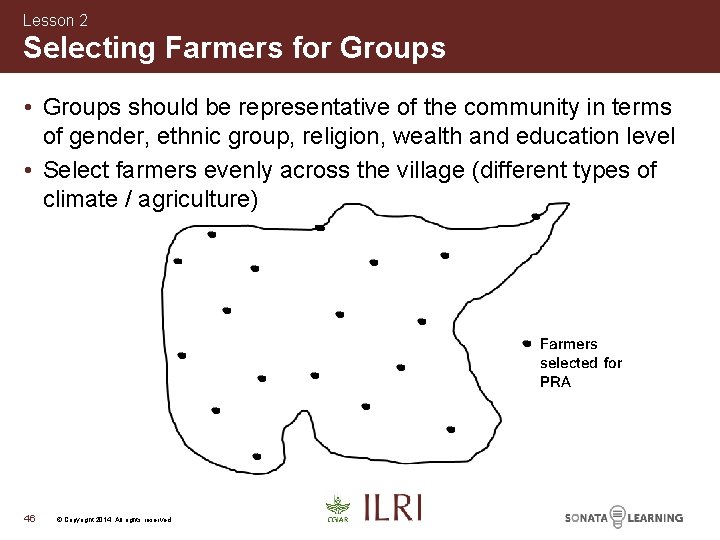
Lesson 2 Selecting Farmers for Groups • Groups should be representative of the community in terms of gender, ethnic group, religion, wealth and education level • Select farmers evenly across the village (different types of climate / agriculture) Farmers selected for PRA 46 © Copyright 2014. All rights reserved.
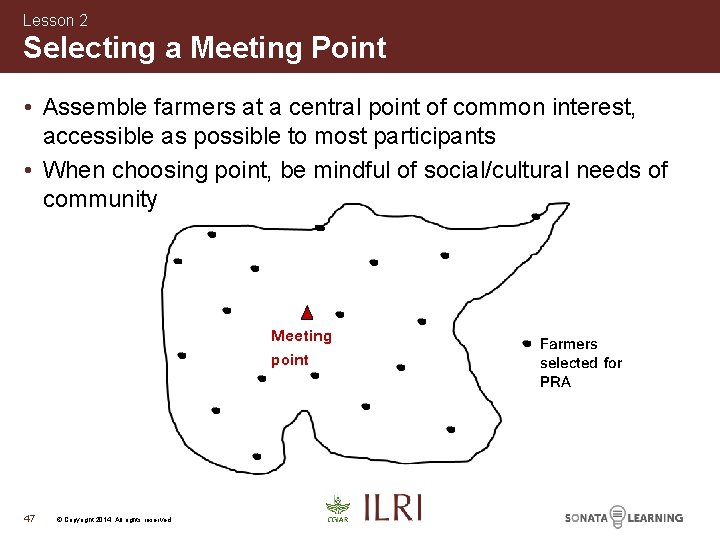
Lesson 2 Selecting a Meeting Point • Assemble farmers at a central point of common interest, accessible as possible to most participants • When choosing point, be mindful of social/cultural needs of community Meeting point 47 © Copyright 2014. All rights reserved. Farmers selected for PRA
Lesson 2 Discussion Question #4 • If you have participated in PRA’s before, what meeting points did you use? • Were the meeting points popular with the farmers? • Why or why not? 48 © Copyright 2014. All rights reserved.
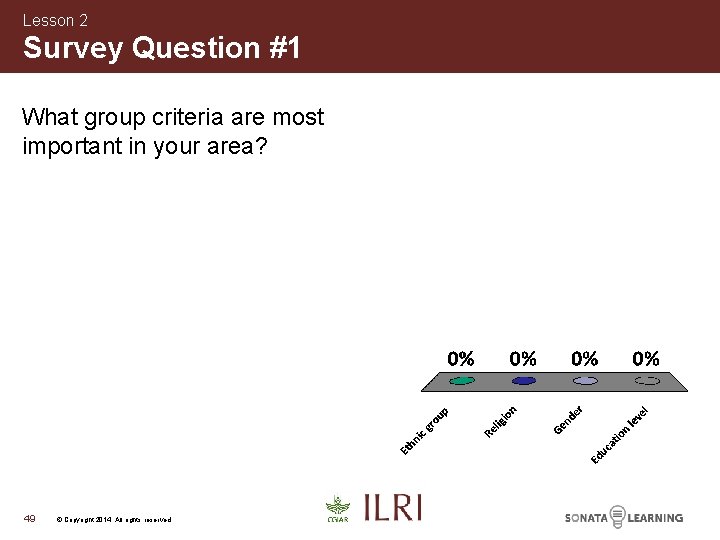
Lesson 2 Survey Question #1 What group criteria are most important in your area? 49 © Copyright 2014. All rights reserved.
Lesson 2 Case Study: The Village of [Anywhere] • Many of the activities in this course involve the fictional village of [Anywhere] • Typical of many communities involved in PRA’s – [Characteristics] 50 © Copyright 2014. All rights reserved.
Lesson 2 Activity #1: Selecting Farmers for Groups [If this is to be a web/computer-based activity, instructions for accessing the activity will go here. Otherwise, continue on to view the slides for a classroom activity. ] 51 © Copyright 2014. All rights reserved.
Lesson 2 Activity #1: Selecting Farmers for Groups • Class will complete this activity together. • Participants will take turns selecting cards representing farmers from the map of [Anywhere] until we have a group of 9 – (For a real PRA, we would select 16 -25 farmers, but we will only select 9 for this activity as an example. ) • Class will evaluate the group of farmers and decide if it is truly representative of the population of [Anywhere], then make adjustments as necessary. • Once a representative group has been selected, class will select a suitable meeting point from the locations marked on the map. 52 © Copyright 2014. All rights reserved.
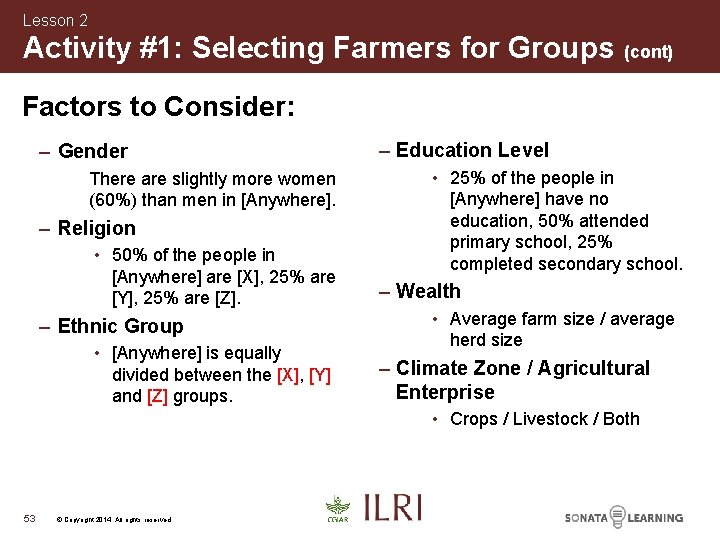
Lesson 2 Activity #1: Selecting Farmers for Groups (cont) Factors to Consider: – Gender There are slightly more women (60%) than men in [Anywhere]. – Religion • 50% of the people in [Anywhere] are [X], 25% are [Y], 25% are [Z]. – Ethnic Group • [Anywhere] is equally divided between the [X], [Y] and [Z] groups. – Education Level • 25% of the people in [Anywhere] have no education, 50% attended primary school, 25% completed secondary school. – Wealth • Average farm size / average herd size – Climate Zone / Agricultural Enterprise • Crops / Livestock / Both 53 © Copyright 2014. All rights reserved.
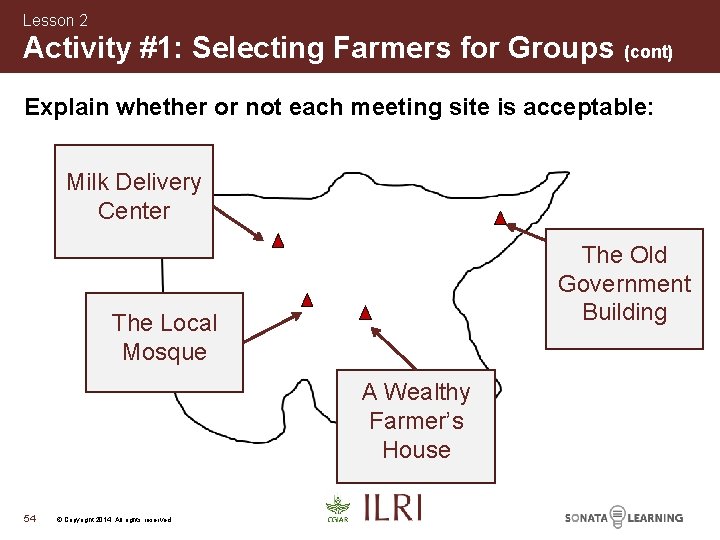
Lesson 2 Activity #1: Selecting Farmers for Groups (cont) Explain whether or not each meeting site is acceptable: Milk Delivery Center The Old Government Building The Local Mosque A Wealthy Farmer’s House 54 © Copyright 2014. All rights reserved.
Lesson 2 Activity #1: Selecting Farmers for Groups (cont) … and what do we need to do before the meeting? Answer: Get clearance from the local officials 55 © Copyright 2014. All rights reserved.
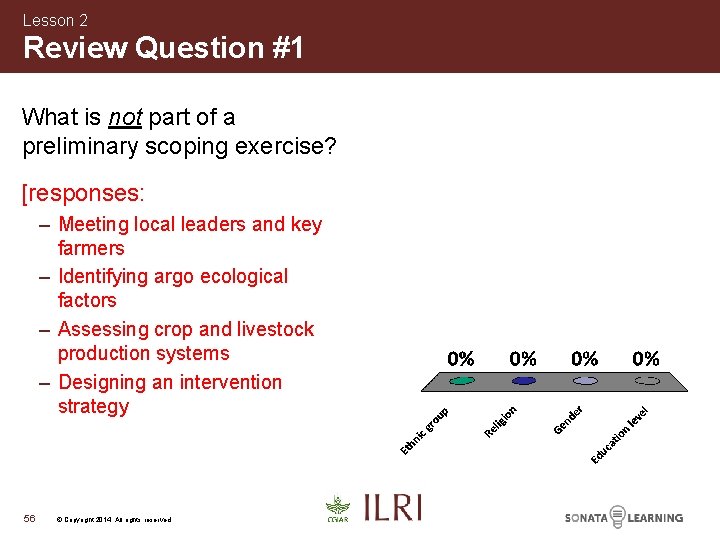
Lesson 2 Review Question #1 What is not part of a preliminary scoping exercise? [responses: – Meeting local leaders and key farmers – Identifying argo ecological factors – Assessing crop and livestock production systems – Designing an intervention strategy 56 © Copyright 2014. All rights reserved.
Lesson 2 Lesson Objectives Review You should now be able to: • List the key steps facilitators take to prepare for a PRA • Explain the benefits of planning • Select groups of farmers to participate in the PRA that are representative of the entire community 57 © Copyright 2014. All rights reserved.
Questions? 58 © Copyright 2014. All rights reserved.
Break 59 © Copyright 2014. All rights reserved.
Lesson X: Introducing the FEAST Tool • Overview of the Feed Assessment Tool • Launching the FEAST Tool © Copyright 2014. All rights reserved.
Lesson X Lesson Objectives By the end of this lesson, you will be able to: • List the components of the FEAST tool and describe their purpose 61 © Copyright 2014. All rights reserved.
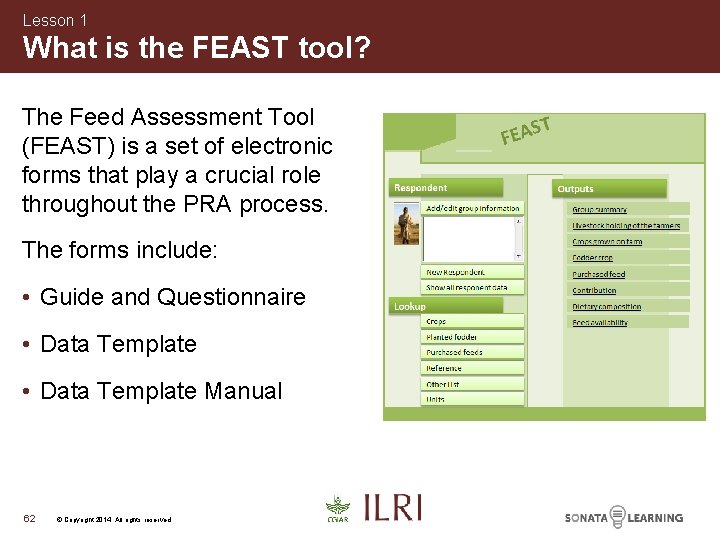
Lesson 1 What is the FEAST tool? The Feed Assessment Tool (FEAST) is a set of electronic forms that play a crucial role throughout the PRA process. The forms include: • Guide and Questionnaire • Data Template Manual 62 © Copyright 2014. All rights reserved.