
Notes Measurement 1 2 1 3 There are
- Slides: 18
Notes: Measurement (1. 2 -1. 3)
There are two systems of measurement that are used today. . . --METRIC/ “Système Internationale” (world-wide) --STANDARD / “Customary” (just USA) King Henry I created the “yard” by the length between fore-finger and nose. Everyone went along with the new, logical idea eventually, except the USA. The French later wanted something easier to work with, and, that everyone could use, based on units of 10. ( What a shocker. )
The METRIC SYSTEM (SI) based on the number “ 10” is the one we will use for scientific measurement. . . (Otherwise, you would have to memorize quantities like carats, stones, hands, furlongs, miles, yards, pints, inches, feet, gallons, quarts, ounces, pounds, tons, cords, and many other units that have no predictable relationship with each other. )
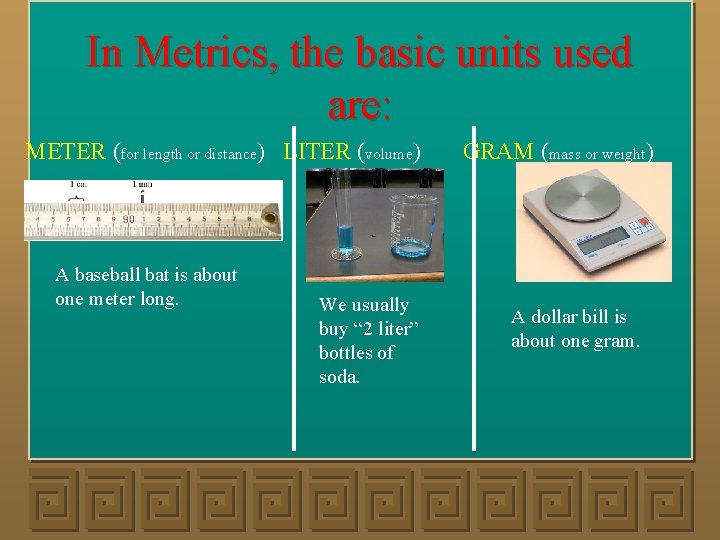
In Metrics, the basic units used are: METER (for length or distance) LITER (volume) A baseball bat is about one meter long. We usually buy “ 2 liter” bottles of soda. GRAM (mass or weight) A dollar bill is about one gram.
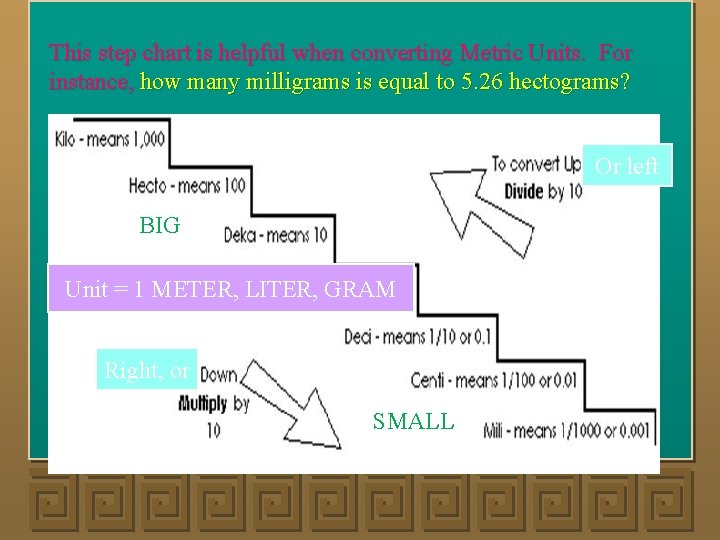
This step chart is helpful when converting Metric Units. For instance, how many milligrams is equal to 5. 26 hectograms? Or left BIG Unit = 1 METER, LITER, GRAM Right, or SMALL
What is appropriate? u When drawing blood, would you rather have. . 4 Liters 4 Deciliters 4 Milliliters drawn? (Think about amounts to compare them to. . . )
What is appropriate? u Would you rather measure your stack of homework in. . . 5 dm 5 mm 5 cm (What does a meter stick look like? )
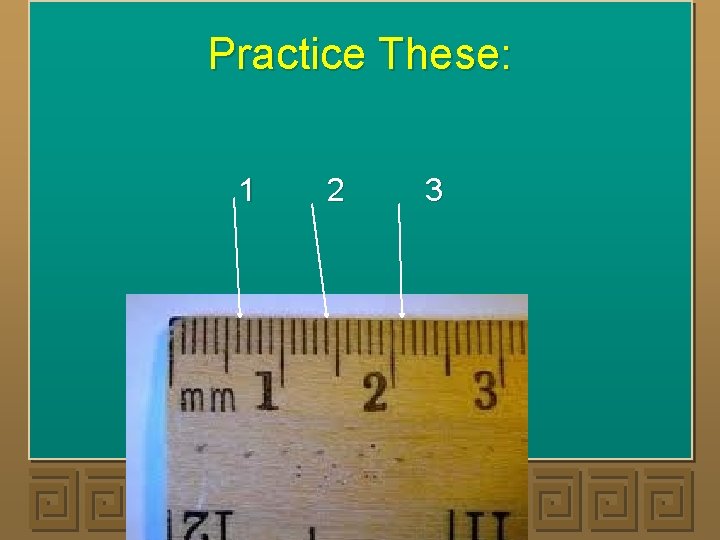
Practice These: 1 2 3
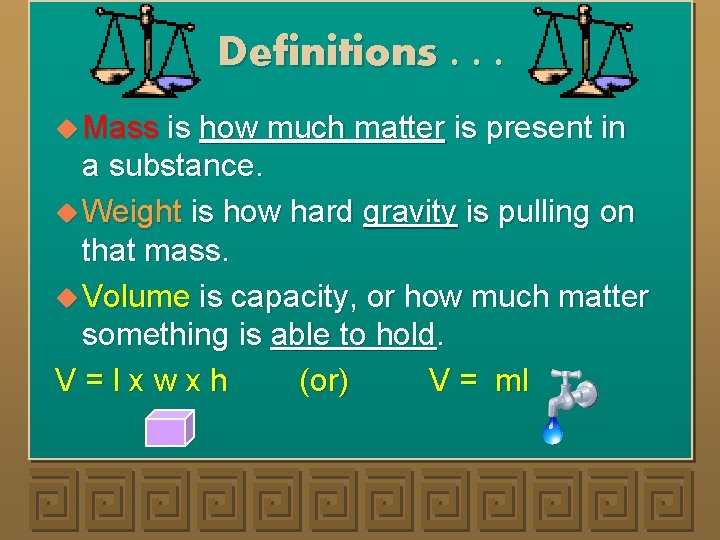
Definitions. . . u Mass is how much matter is present in a substance. u Weight is how hard gravity is pulling on that mass. u Volume is capacity, or how much matter something is able to hold. V=lxwxh (or) V = ml
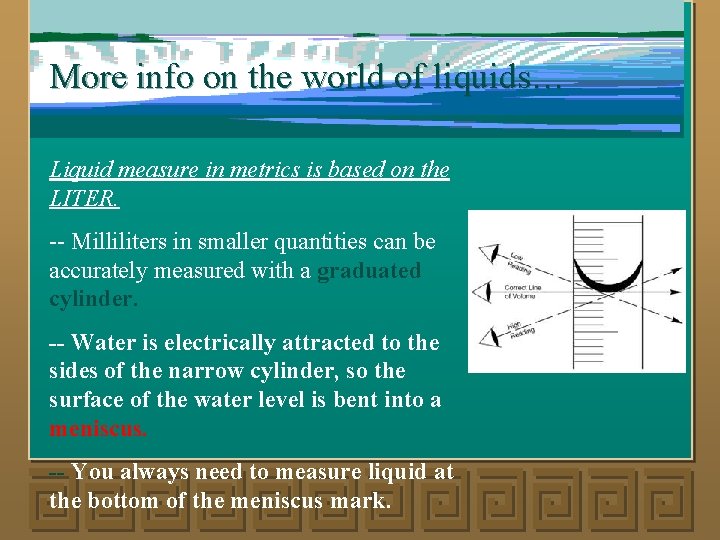
More info on the world of liquids… Liquid measure in metrics is based on the LITER. -- Milliliters in smaller quantities can be accurately measured with a graduated cylinder. -- Water is electrically attracted to the sides of the narrow cylinder, so the surface of the water level is bent into a meniscus. -- You always need to measure liquid at the bottom of the meniscus mark.
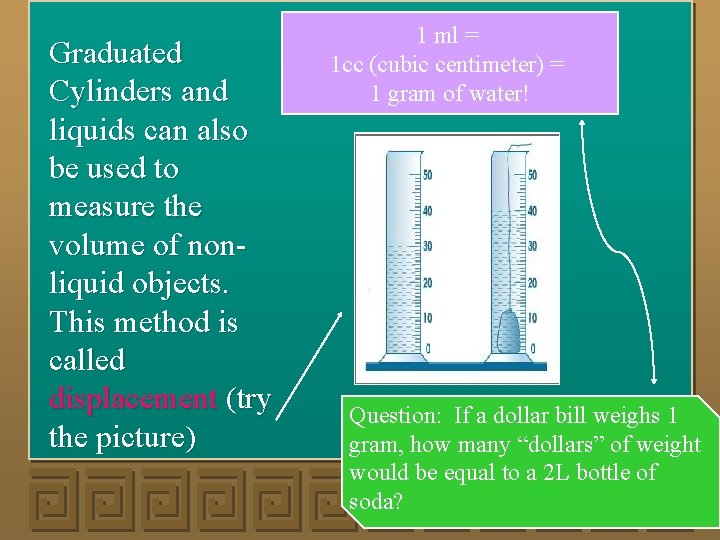
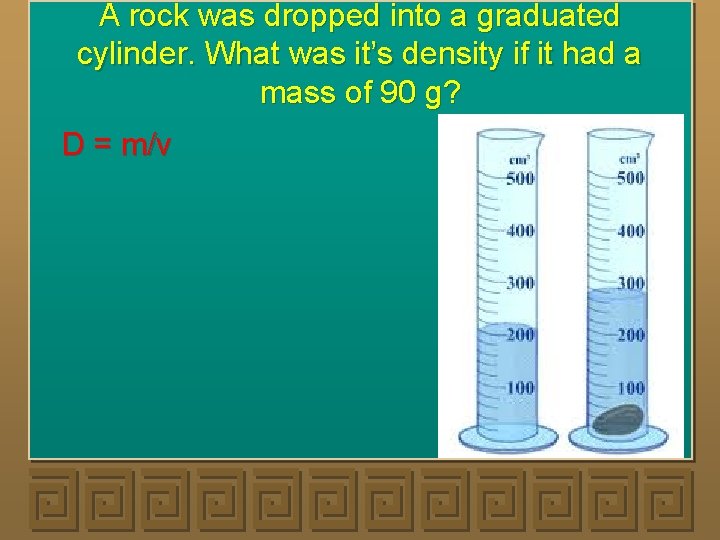
Graduated Cylinders and liquids can also be used to measure the volume of nonliquid objects. This method is called displacement (try the picture) 1 ml = 1 cc (cubic centimeter) = 1 gram of water! Question: If a dollar bill weighs 1 gram, how many “dollars” of weight would be equal to a 2 L bottle of soda?
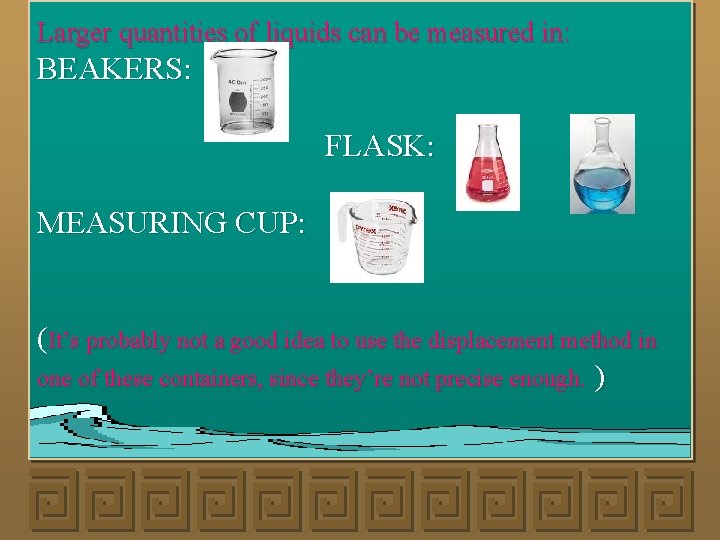
Larger quantities of liquids can be measured in: BEAKERS: FLASK: MEASURING CUP: (It’s probably not a good idea to use the displacement method in one of these containers, since they’re not precise enough. )
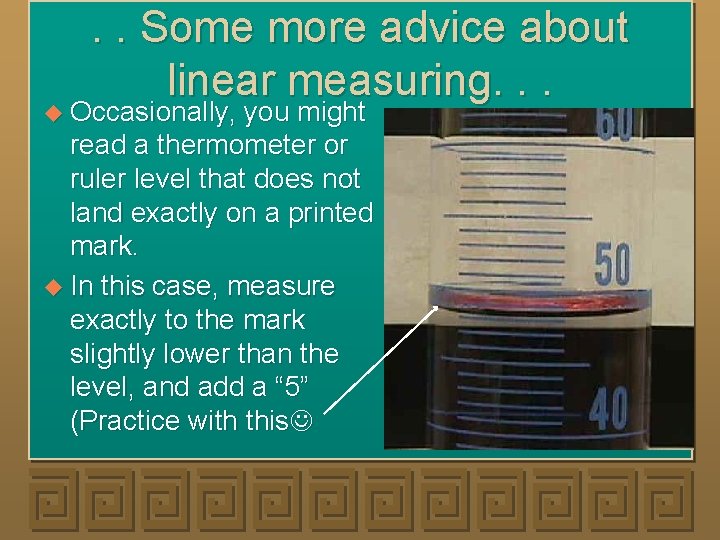
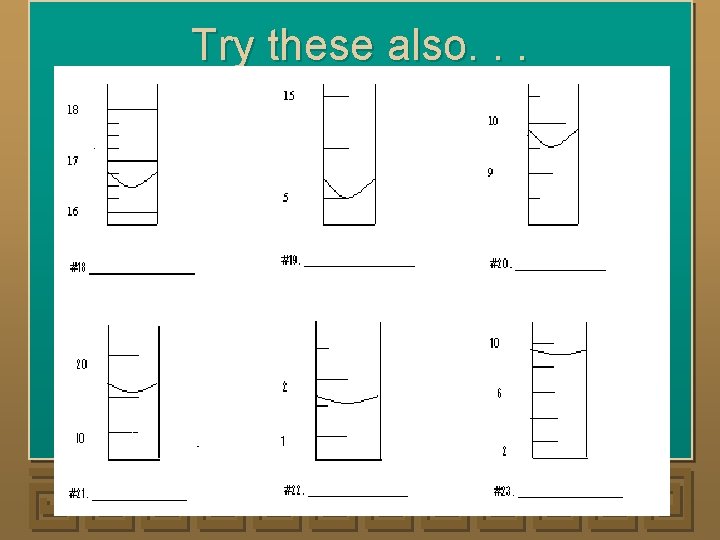
. . Some more advice about linear measuring. . . u Occasionally, you might read a thermometer or ruler level that does not land exactly on a printed mark. u In this case, measure exactly to the mark slightly lower than the level, and add a “ 5” (Practice with this
Try these also. . .
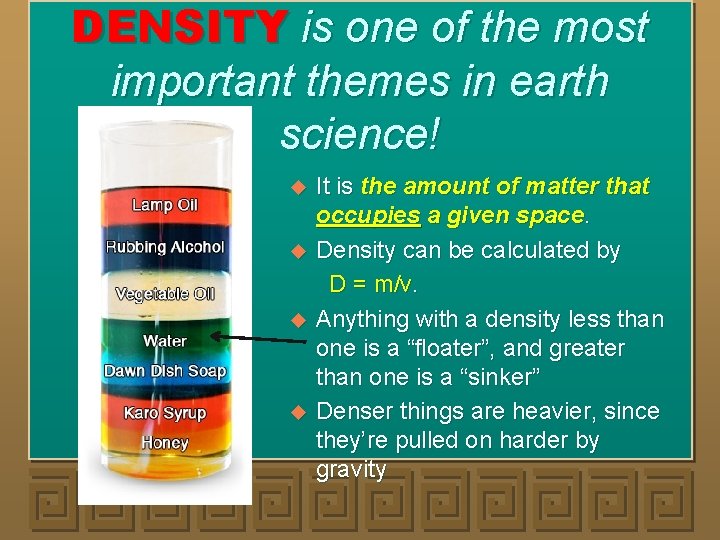
DENSITY is one of the most important themes in earth science! u u It is the amount of matter that occupies a given space. Density can be calculated by D = m/v. Anything with a density less than one is a “floater”, and greater than one is a “sinker” Denser things are heavier, since they’re pulled on harder by gravity
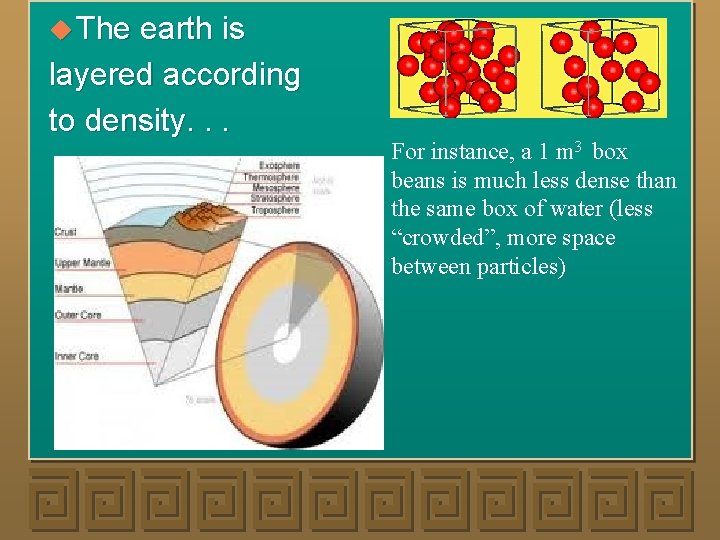
u The earth is layered according to density. . . For instance, a 1 m 3 box beans is much less dense than the same box of water (less “crowded”, more space between particles)
A rock was dropped into a graduated cylinder. What was it’s density if it had a mass of 90 g? D = m/v
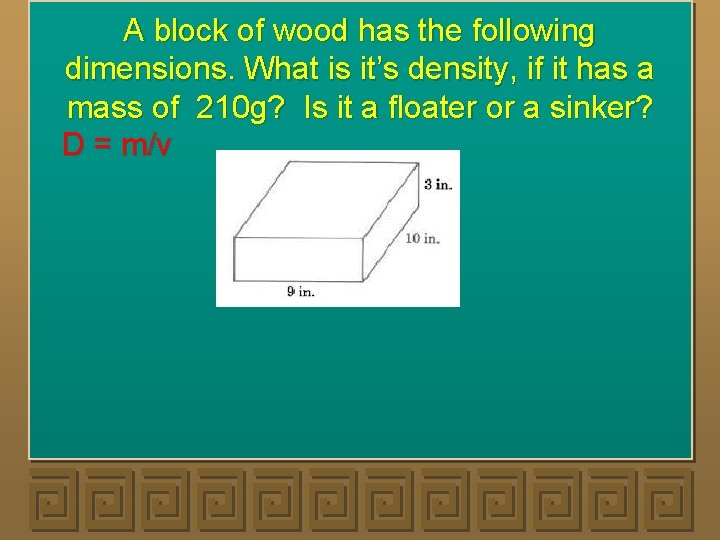
A block of wood has the following dimensions. What is it’s density, if it has a mass of 210 g? Is it a floater or a sinker? D = m/v