
Notes Macromolecule Table Objective Cell biology standard 1
Notes: Macromolecule Table Objective: Cell biology standard 1 h – Students will learn that most macromolecules (carbohydrates, lipids, proteins and nucleic acids) in organisms (and the cells of organisms) are made from building blocks
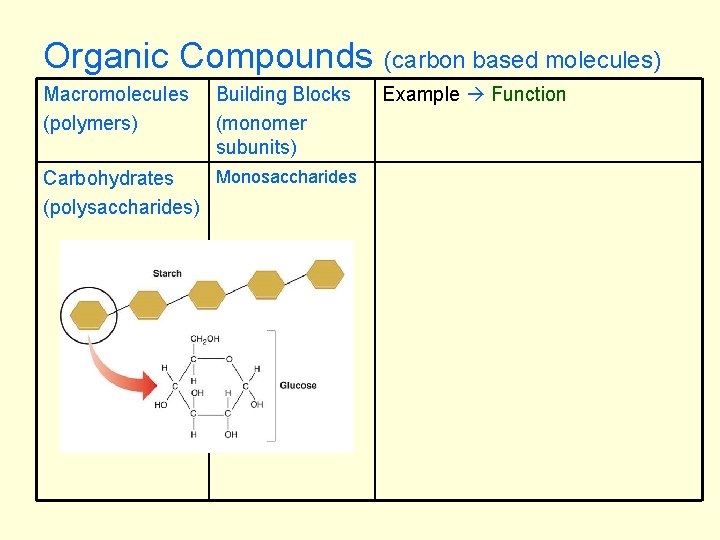
Organic Compounds Macromolecules (polymers) Building Blocks (monomer subunits) Monosaccharides Carbohydrates (polysaccharides) (carbon based molecules) Example Function
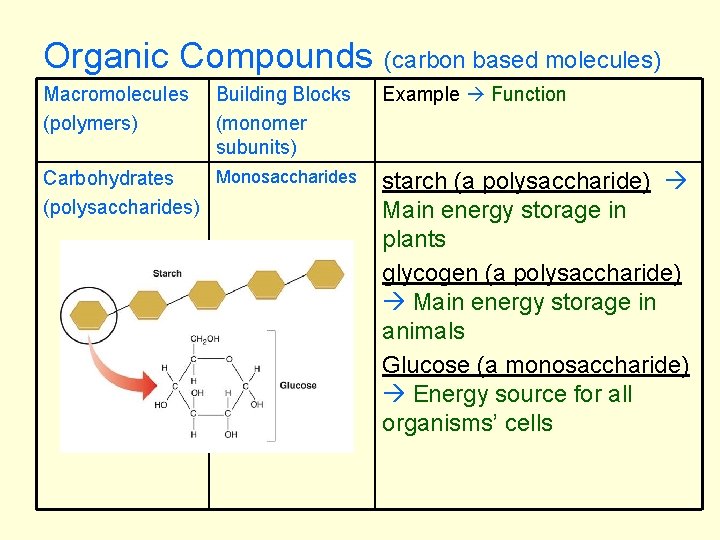
Organic Compounds Macromolecules (polymers) Building Blocks (monomer subunits) Monosaccharides Carbohydrates (polysaccharides) (carbon based molecules) Example Function starch (a polysaccharide) Main energy storage in plants glycogen (a polysaccharide) Main energy storage in animals Glucose (a monosaccharide) Energy source for all organisms’ cells
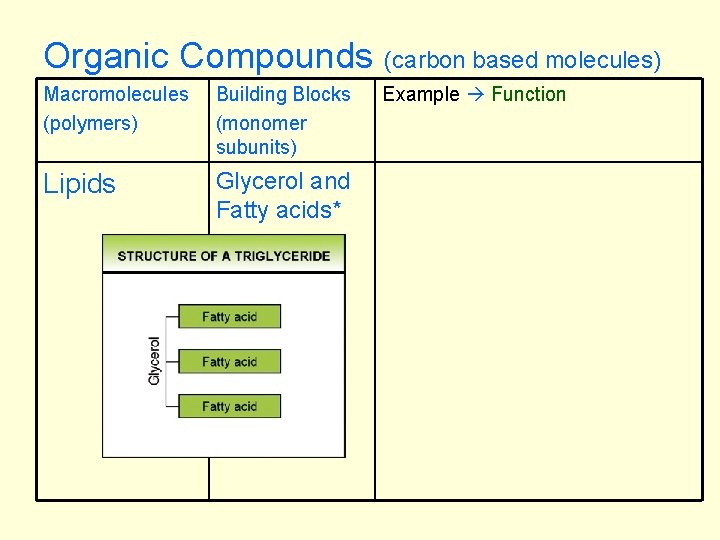
Organic Compounds Macromolecules (polymers) Building Blocks (monomer subunits) Lipids Glycerol and Fatty acids* (carbon based molecules) Example Function
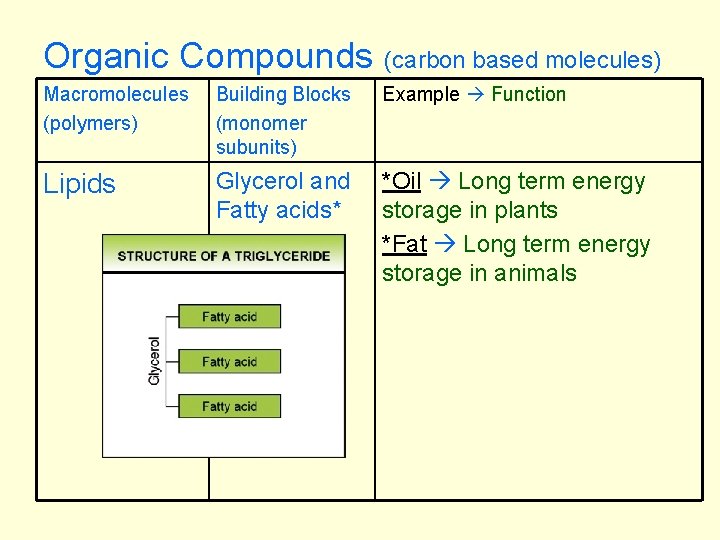
Organic Compounds (carbon based molecules) Macromolecules (polymers) Building Blocks (monomer subunits) Example Function Lipids Glycerol and Fatty acids* *Oil Long term energy storage in plants *Fat Long term energy storage in animals
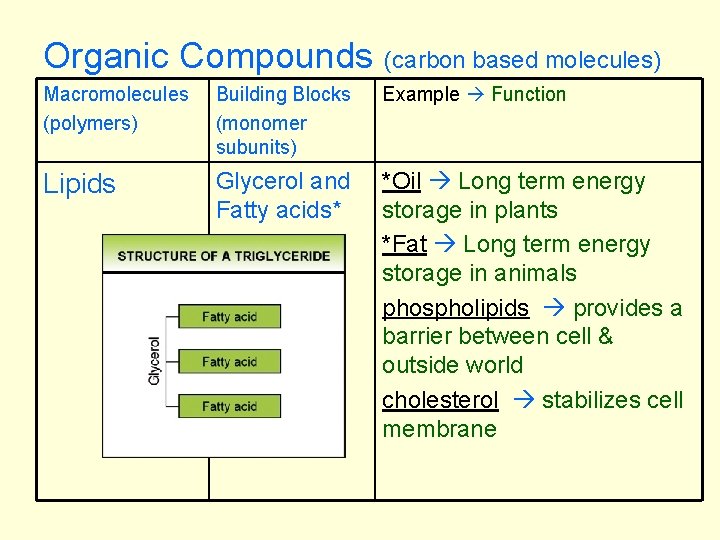
Organic Compounds (carbon based molecules) Macromolecules (polymers) Building Blocks (monomer subunits) Example Function Lipids Glycerol and Fatty acids* *Oil Long term energy storage in plants *Fat Long term energy storage in animals phospholipids provides a barrier between cell & outside world cholesterol stabilizes cell membrane
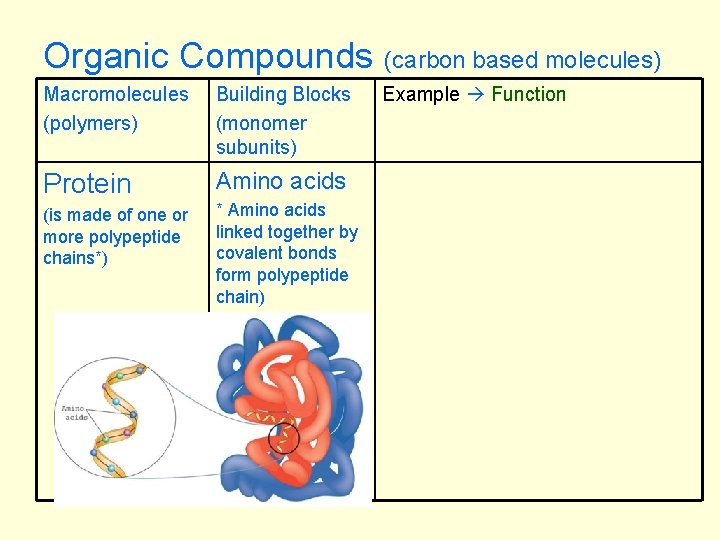
Organic Compounds Macromolecules (polymers) Building Blocks (monomer subunits) Protein Amino acids (is made of one or more polypeptide chains*) * Amino acids linked together by covalent bonds form polypeptide chain) (carbon based molecules) Example Function
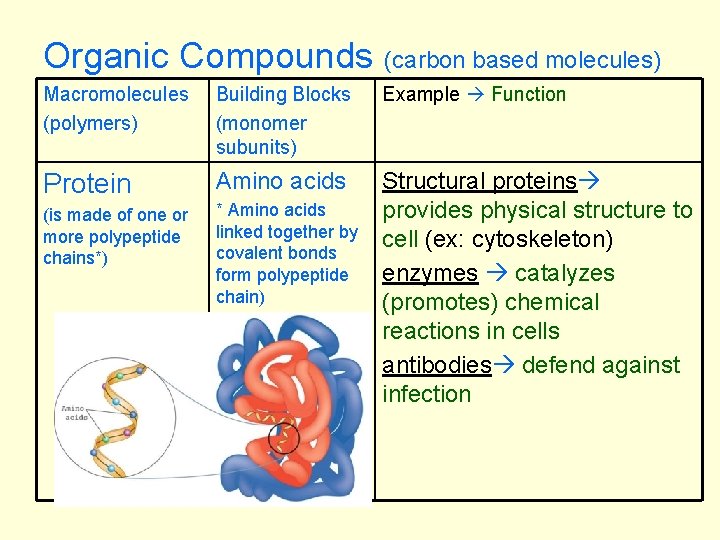
Organic Compounds (carbon based molecules) Macromolecules (polymers) Building Blocks (monomer subunits) Example Function Protein Amino acids (is made of one or more polypeptide chains*) * Amino acids linked together by covalent bonds form polypeptide chain) Structural proteins provides physical structure to cell (ex: cytoskeleton) enzymes catalyzes (promotes) chemical reactions in cells antibodies defend against infection
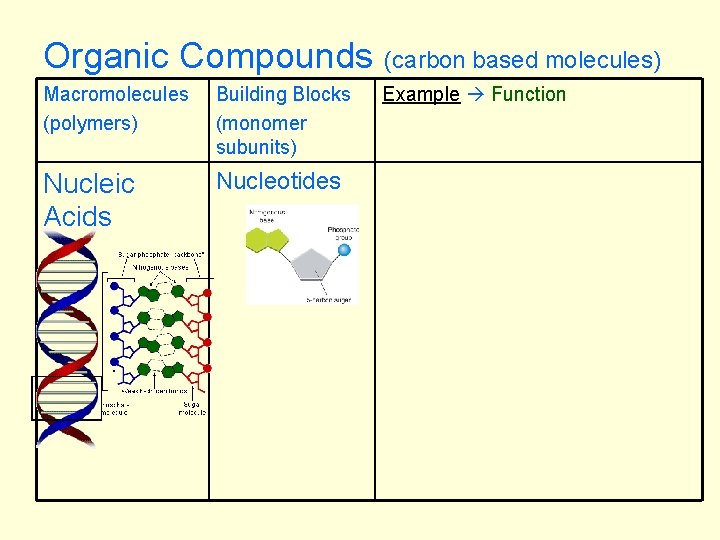
Organic Compounds Macromolecules (polymers) Building Blocks (monomer subunits) Nucleic Acids Nucleotides (carbon based molecules) Example Function
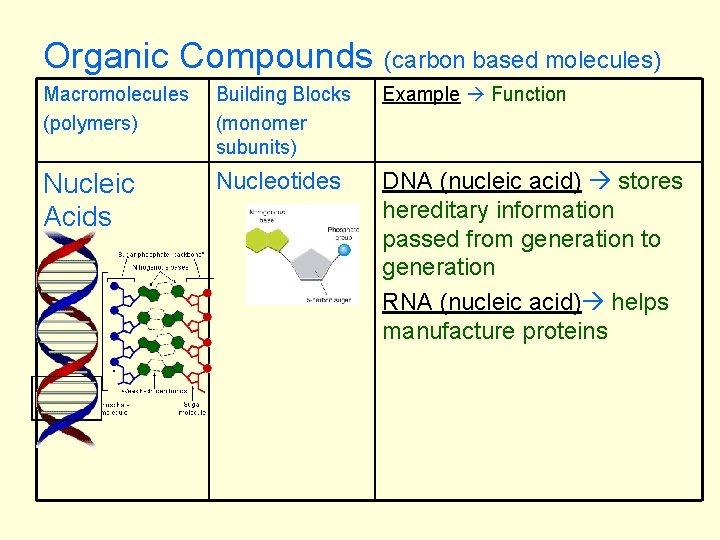
Organic Compounds (carbon based molecules) Macromolecules (polymers) Building Blocks (monomer subunits) Example Function Nucleic Acids Nucleotides DNA (nucleic acid) stores hereditary information passed from generation to generation RNA (nucleic acid) helps manufacture proteins
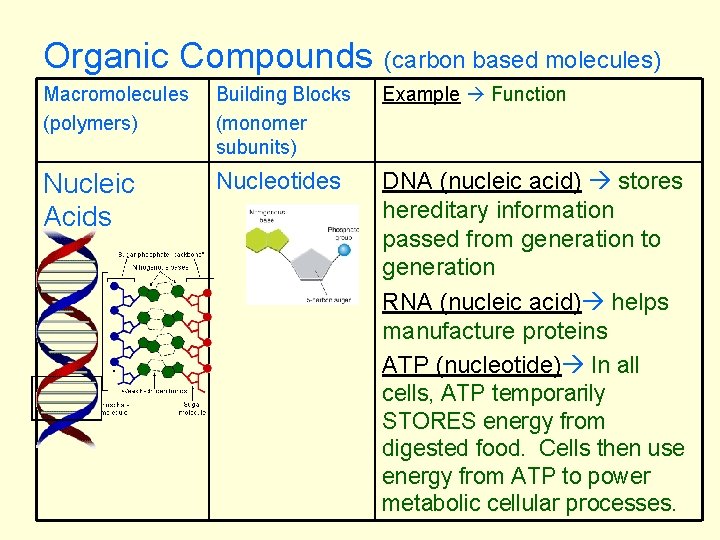
Organic Compounds (carbon based molecules) Macromolecules (polymers) Building Blocks (monomer subunits) Example Function Nucleic Acids Nucleotides DNA (nucleic acid) stores hereditary information passed from generation to generation RNA (nucleic acid) helps manufacture proteins ATP (nucleotide) In all cells, ATP temporarily STORES energy from digested food. Cells then use energy from ATP to power metabolic cellular processes.
- Slides: 11