
NOTES Chapter 1 1 What is Science What

- Slides: 34
NOTES: Chapter 1. 1 What is Science?
What is a “FACT? ” • Something that can be proved or verified by observation or measurement
What are some other types of facts besides the kind you just listed? Examples: historical facts, scientific facts, facts read in the newspaper
Is it possible for a fact to change? • It depends on the type of fact. • Historical facts: No. They already happened.
• Scientific facts: Yes. These facts are based on current knowledge & since we will never know everything, scientific facts can change when new data is discovered. Science is flexible!
● It is a process and a way of looking at the world around us. Science explains the world today, based on research and evidence we have collected so far.
1. 1: What Methods are Used in Science? What is the Nature of Science / Biology? Vocabulary: ~Science ~Observation ~Data ~Inference ~Hypothesis
The Goal of Science… • To investigate and understand nature • To explain events in nature • To use those explanations to make useful predictions The scientific method makes science different from nonscience.
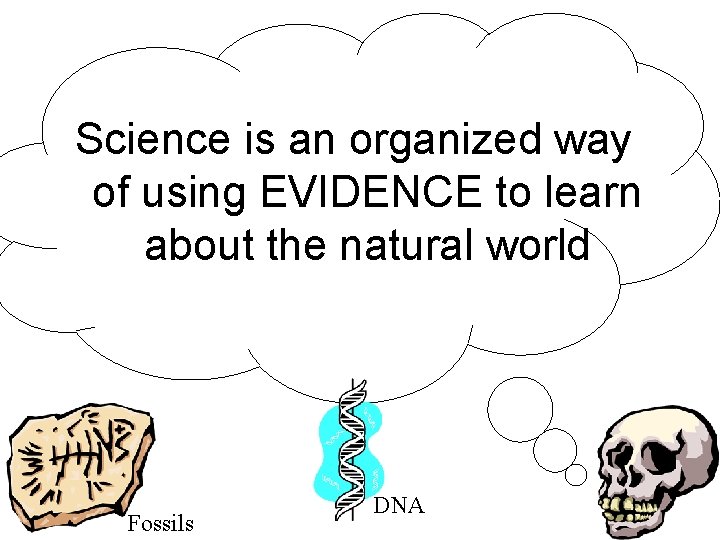
Science is an organized way of using EVIDENCE to learn about the natural world Fossils DNA
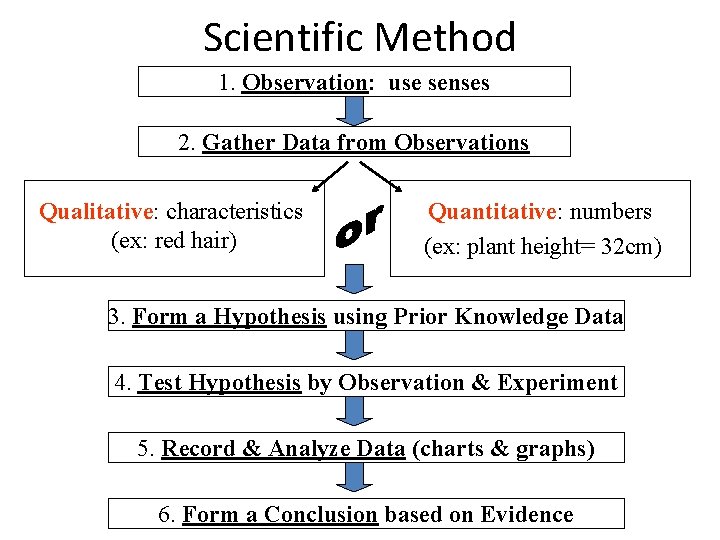
Scientific Method 1. Observation: use senses 2. Gather Data from Observations Qualitative: characteristics (ex: red hair) Quantitative: numbers (ex: plant height= 32 cm) 3. Form a Hypothesis using Prior Knowledge Data 4. Test Hypothesis by Observation & Experiment 5. Record & Analyze Data (charts & graphs) 6. Form a Conclusion based on Evidence
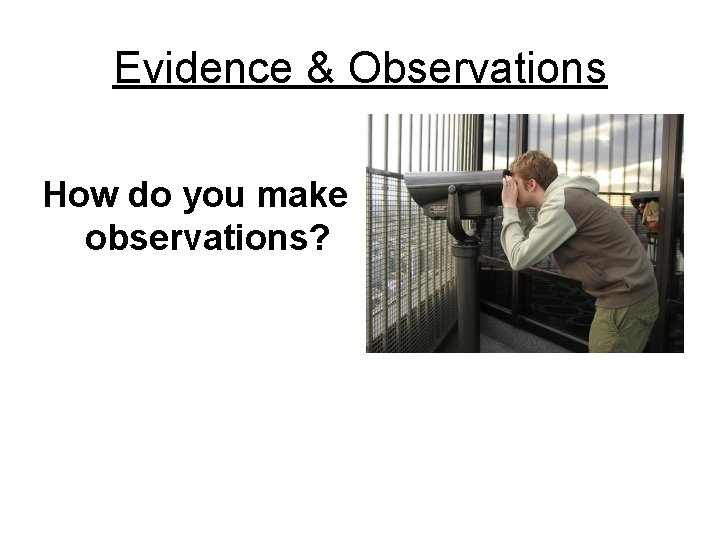
Evidence & Observations How do you make observations?
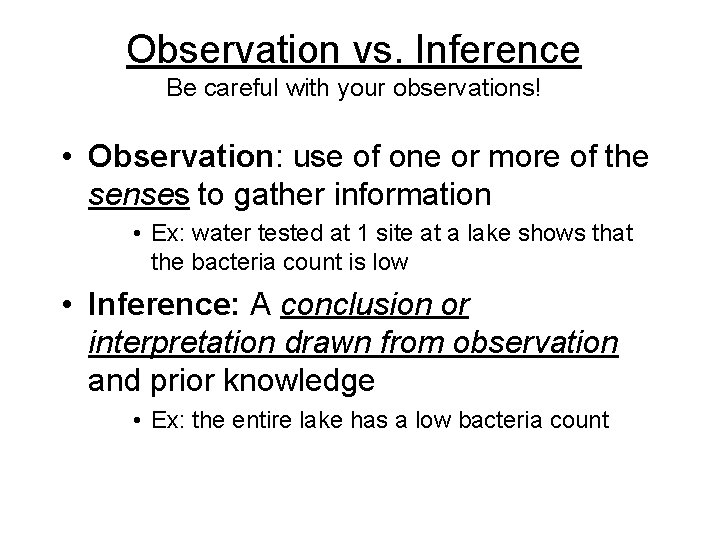
Observation vs. Inference Be careful with your observations! • Observation: use of one or more of the senses to gather information • Ex: water tested at 1 site at a lake shows that the bacteria count is low • Inference: A conclusion or interpretation drawn from observation and prior knowledge • Ex: the entire lake has a low bacteria count
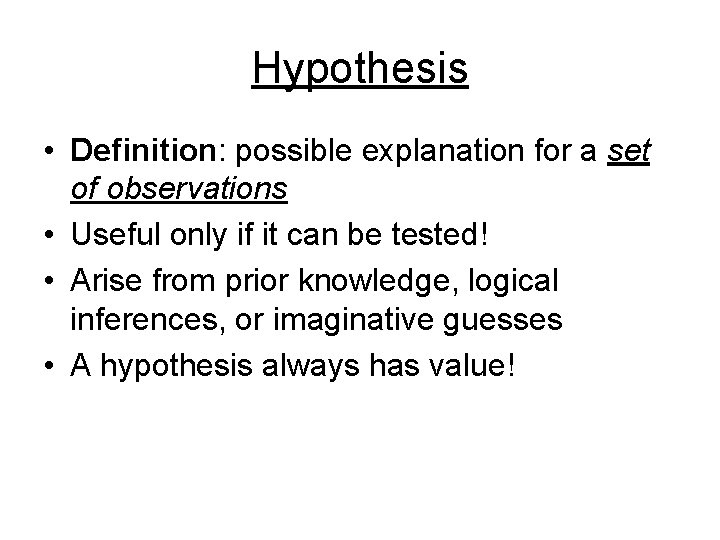
Hypothesis • Definition: possible explanation for a set of observations • Useful only if it can be tested! • Arise from prior knowledge, logical inferences, or imaginative guesses • A hypothesis always has value!
So you’ve made an observation… • The information gathered from observations is called…? • Data can be divided into two types • Qualitative: descriptions (things NOT counted/measured) • Quantitative: using numbers
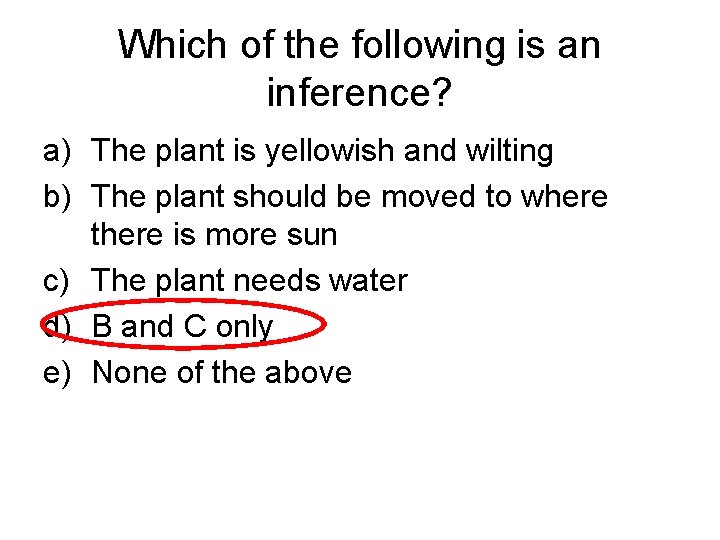
Which of the following is an inference? a) The plant is yellowish and wilting b) The plant should be moved to where there is more sun c) The plant needs water d) B and C only e) None of the above
Why Do Scientists Write Lab Reports? • So their work can be replicated by either themselves or other researchers – WHY? to assure us that the results aren’t due to chance & that they are accurate
1. 2: Science in Context Vocabulary: a. Controlled experiment a. Independent variable a. Dependent variable a. Theory
Remember, the Scientific Method is… an organized way of using evidence to learn about the natural world
Steps of the Scientific Method • observations which lead to a problem • form a hypothesis (possible explanation for observations) • test hypothesis by setting up a CONTROLLED EXPERIMENT
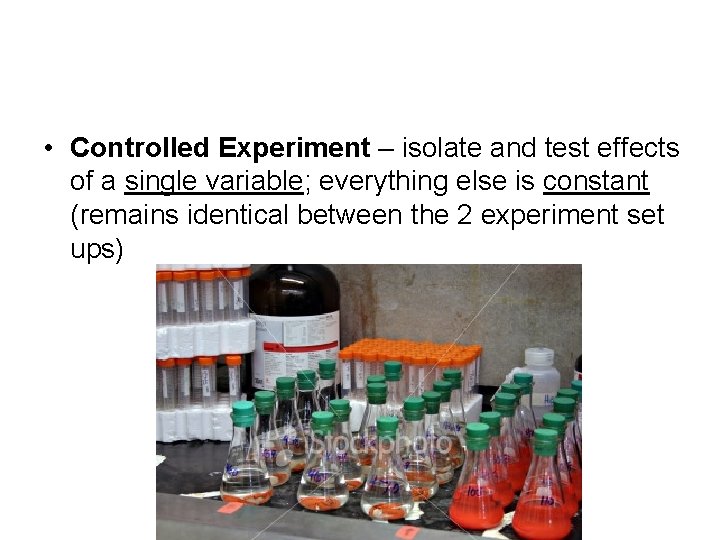
• Controlled Experiment – isolate and test effects of a single variable; everything else is constant (remains identical between the 2 experiment set ups)
• Control: the standard in which all the conditions are kept the same • Independent Variable: the condition that is changed because it affects the outcome of the experiment • Dependent Variable: the condition that results from changes in the independent variable
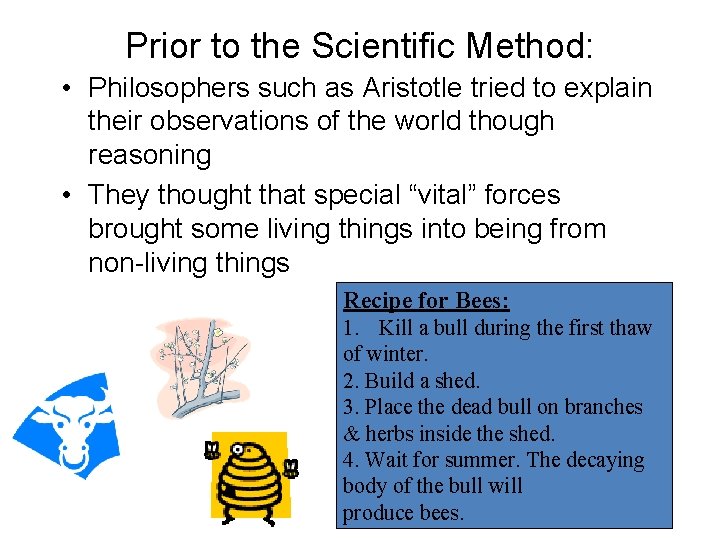
Prior to the Scientific Method: • Philosophers such as Aristotle tried to explain their observations of the world though reasoning • They thought that special “vital” forces brought some living things into being from non-living things Recipe for Bees: 1. Kill a bull during the first thaw of winter. 2. Build a shed. 3. Place the dead bull on branches & herbs inside the shed. 4. Wait for summer. The decaying body of the bull will produce bees.
• This idea is called… SPONTANEOUS GENERATION – Life from non-life • It was accepted for centuries – Ex: Maggots are formed from meat; mice from grain; beetles from cow dung
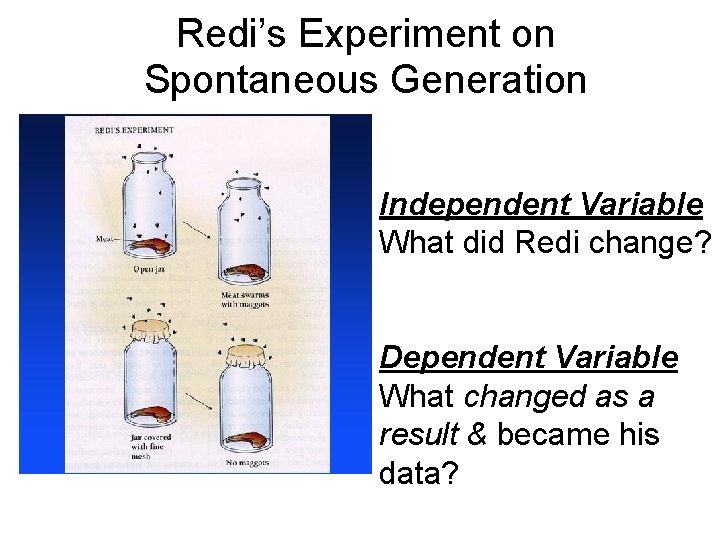
Redi’s Experiment on Spontaneous Generation Independent Variable What did Redi change? Dependent Variable What changed as a result & became his data?
What were the variables? Controlled variables • jars, types of meat, location, temperature Independent variable • gauze coverings Dependent variable: • if maggots appeared or not
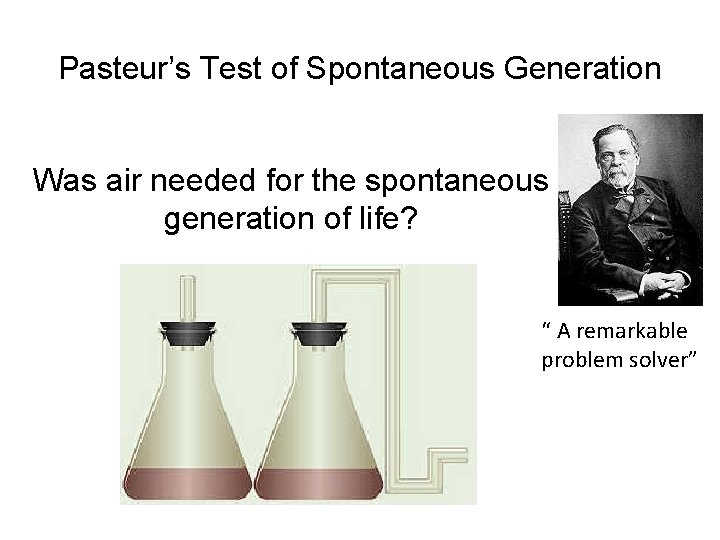
Pasteur’s Test of Spontaneous Generation Was air needed for the spontaneous generation of life? “ A remarkable problem solver”
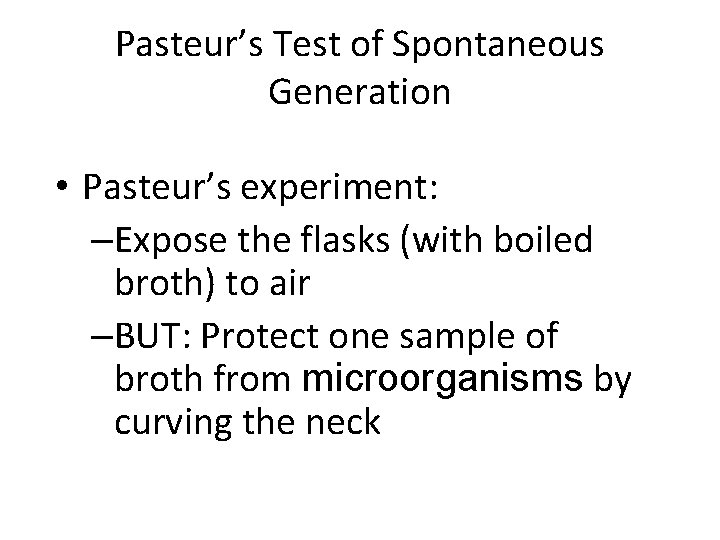
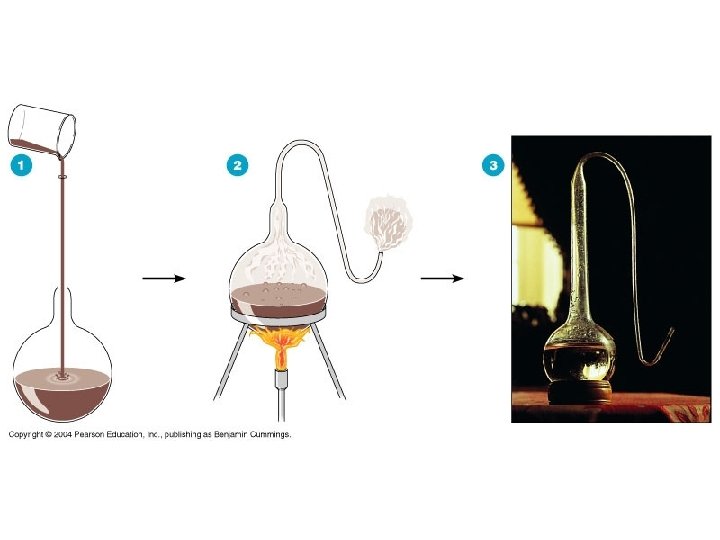
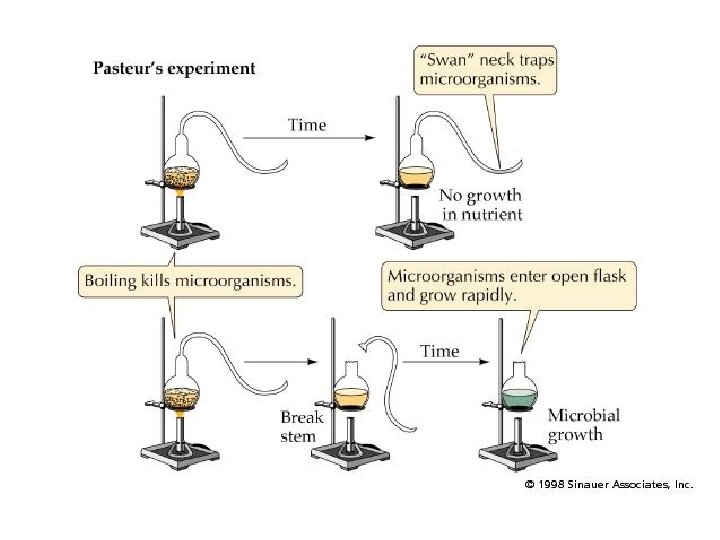
Pasteur’s Test of Spontaneous Generation • Pasteur’s experiment: –Expose the flasks (with boiled broth) to air –BUT: Protect one sample of broth from microorganisms by curving the neck
Pasteur’s Test of Spontaneous Generation • When Pasteur broke the neck of the flask, broth quickly was filled with microorganisms • His work convinced everyone: ALL living things come from other living things!!
When does a hypothesis become a theory? ● when a hypothesis is tested and confirmed often enough that it is unlikely to be disproved by future tests ● In science, the word theory applies to a well -tested explanation that unifies a broad range of observations ● a theory may be revised or replaced as new evidence is uncovered… SCIENCE IS A PROCESS
For your information… • Theories and laws are DIFFERENT kinds of knowledge • LAW = generalizations/description of a pattern in nature • THEORY= explanation of those generalizations Theories do NOT become laws (or vice versa)
What is a controlled experiment? a) An experiment in which the scientist controls every aspect and records all data accurately b) An experiment in which there is an experimental group and a controlled group c) An experiment in which all groups tested have many differences between them (they are all considered experimental groups)