
NOTES 25 2 Nuclear Stability and Radioactive Decay

NOTES: 25. 2 – Nuclear Stability and Radioactive Decay

Why does the nucleus stay together? STRONG NUCLEAR FORCE ● Short range, attractive force that acts among nuclear particles ● Nuclear particles attract one another ● Much stronger than electrical or gravitational force STABLE NUCLEUS ● A nucleus that does NOT spontaneously decay ● MOST ATOMS ARE STABLE!!
Nuclides ● Different atomic forms of all elements ● Most small nuclides have equal # of protons and neutrons ● Some nuclides have “magic #’s” of protons and neutrons and are especially stable
The neutron-to-proton ratio determines the STABILITY of the nucleus ● For low atomic #’s: Equal #’s of protons and neutrons ● Above atomic #20: More neutrons than protons
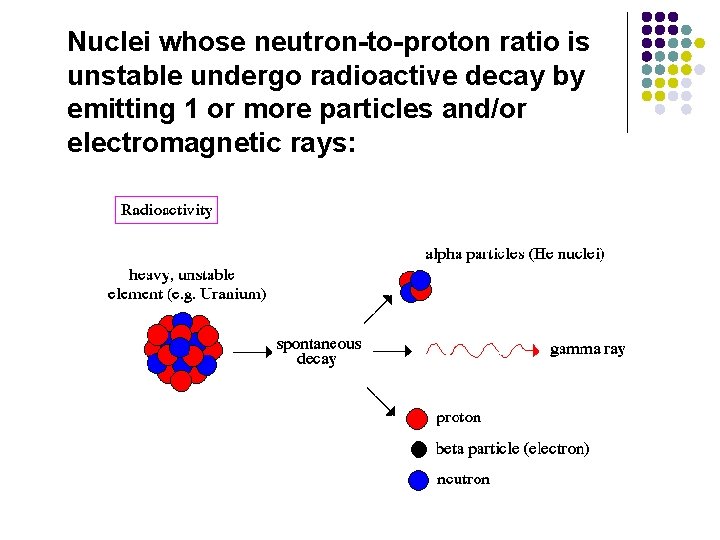
Nuclei whose neutron-to-proton ratio is unstable undergo radioactive decay by emitting 1 or more particles and/or electromagnetic rays:

When is a nucleus STABLE? ● for nuclei below atomic #20, the stable nuclei have roughly equal numbers of protons and neutrons ● EXAMPLES: carbon-12: nitrogen-14: oxygen-16: 6 pro, 6 neu 7 pro, 7 neu 8 pro, 8 neu

When is a nucleus STABLE? ● for nuclei above atomic #20, the stable nuclei have more neutrons than protons; ● the “stable” neutron : proton ratio is 1. 5 ● EXAMPLE: lead-206: 82 protons, 124 neutrons (ratio = 124 / 82 ≈ 1. 5)
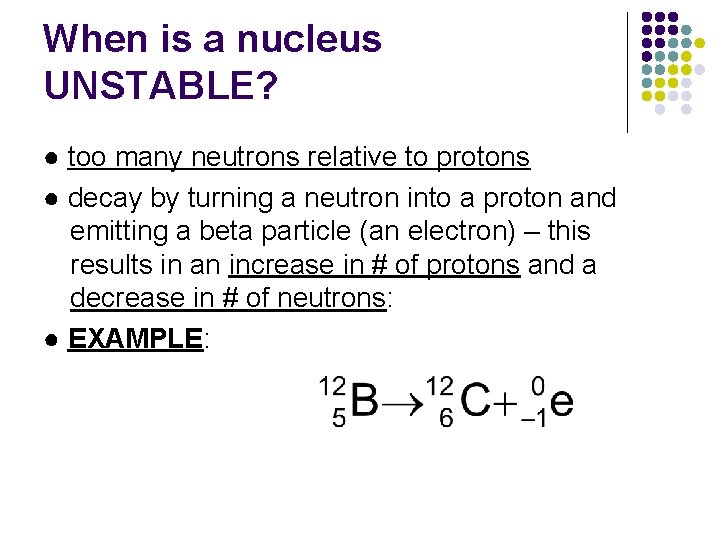
When is a nucleus UNSTABLE? ● too many neutrons relative to protons ● decay by turning a neutron into a proton and emitting a beta particle (an electron) – this results in an increase in # of protons and a decrease in # of neutrons: ● EXAMPLE:

When is a nucleus UNSTABLE? ● too many neutrons AND too many protons to be stable ● all nuclei with atomic # greater than 83 are radioactive and are especially heavy ● most of them emit alpha particles as they decay ● EXAMPLE:

REVIEW: Radioactive Decay ● An unstable nucleus loses energy by emitting radiation ● Radiation = penetrating rays and particles emitted by a radioactive source ● Radioisotopes = unstable isotopes undergo change to become more stable

Nuclei whose neutron-to-proton ratio is unstable undergo radioactive decay by emitting 1 or more particles and/or electromagnetic rays: Type/ symbol Alpha Beta Gamma Proton Neutron Identity Mass (amu) Charge Penetration helium nucleus 4. 0026 2+ low electron 0. 00055 1 - low-med 0 high 1+ low-med 0 very high energy 0 radiation proton, H 1. 0073 nucleus neutron 1. 0087
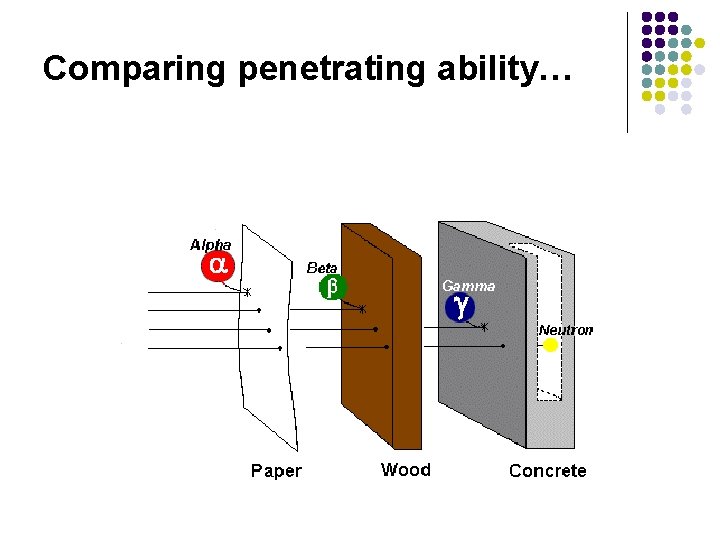
Comparing penetrating ability…

Half-Life: ● every radioactive isotope has a characteristic RATE of decay called the HALF-LIFE. ● HALF-LIFE = the amount of time required for ½ of the nuclei of a radioisotope sample to decay to its products ● Half-lives may be short (fraction of a second) or long (billions of years)

Half-Life

Daughter Parent
Uses of Radioactive Isotopes: ● if there is a long half-life: can be used to determine the age of ancient artifacts; ● if there is a short half-life: can be used in nuclear medicine (rapid decaying isotopes do not pose long-term radiation hazards to patient)
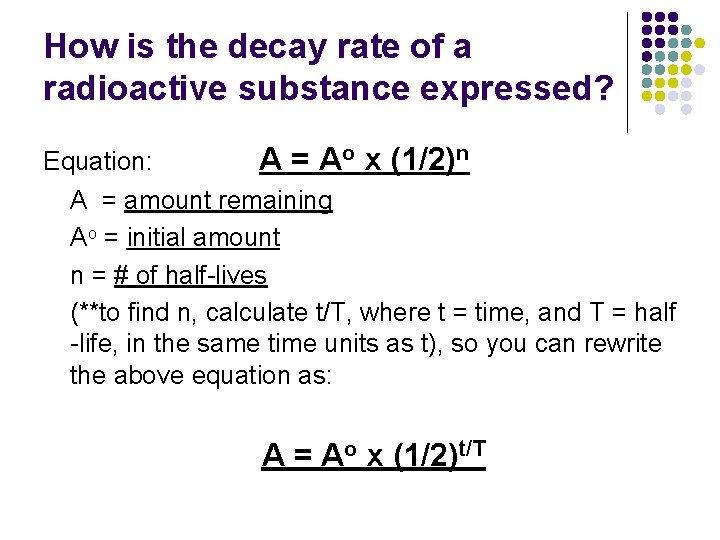
How is the decay rate of a radioactive substance expressed? Equation: A = Ao x (1/2)n A = amount remaining Ao = initial amount n = # of half-lives (**to find n, calculate t/T, where t = time, and T = half -life, in the same time units as t), so you can rewrite the above equation as: A = Ao x (1/2)t/T
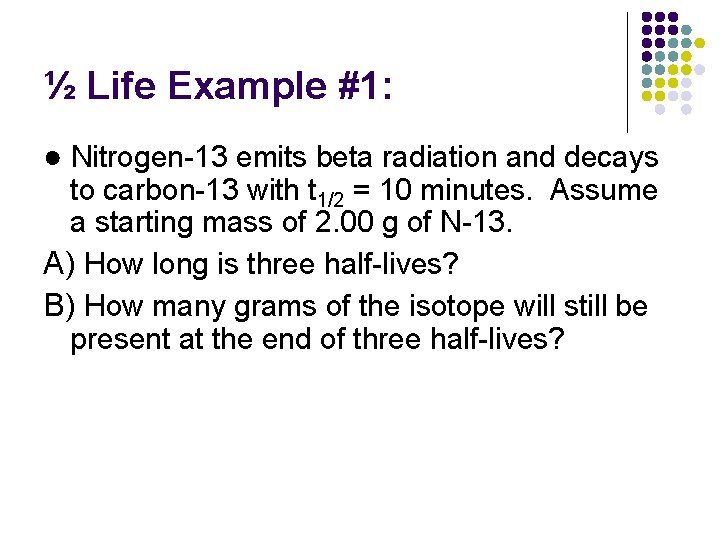
½ Life Example #1: ● Nitrogen-13 emits beta radiation and decays to carbon-13 with t 1/2 = 10 minutes. Assume a starting mass of 2. 00 g of N-13. A) How long is three half-lives? B) How many grams of the isotope will still be present at the end of three half-lives?
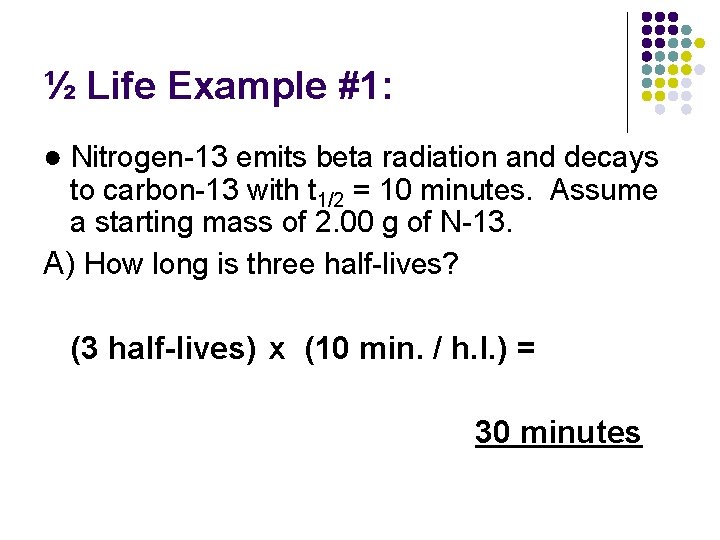
½ Life Example #1: ● Nitrogen-13 emits beta radiation and decays to carbon-13 with t 1/2 = 10 minutes. Assume a starting mass of 2. 00 g of N-13. A) How long is three half-lives? (3 half-lives) x (10 min. / h. l. ) = 30 minutes

½ Life Example #1: ● Nitrogen-13 emits beta radiation and decays to carbon-13 with t 1/2 = 10 minutes. Assume a starting mass of 2. 00 g of N-13. B) How many grams of the isotope will still be present at the end of three half-lives? 2. 00 g x ½ x ½ = 0. 25 g

½ Life Example #1: ● Nitrogen-13 emits beta radiation and decays to carbon-13 with t 1/2 = 10 minutes. Assume a starting mass of 2. 00 g of N-13. B) How many grams of the isotope will still be present at the end of three half-lives? A = Ao x (1/2)n A = (2. 00 g) x (1/2)3 A = 0. 25 g
½ Life Example #2: ● Mn-56 is a beta emitter with a half-life of 2. 6 hr. What is the mass of Mn-56 in a 1. 0 mg sample of the isotope at the end of 10. 4 hr?
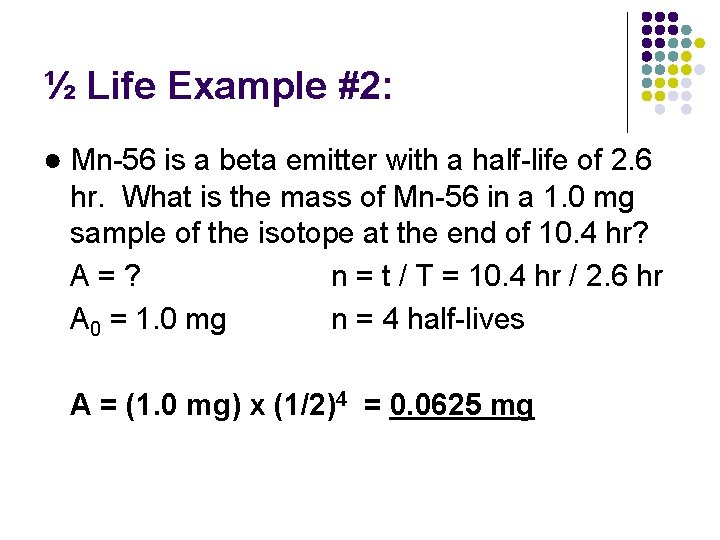
½ Life Example #2: ● Mn-56 is a beta emitter with a half-life of 2. 6 hr. What is the mass of Mn-56 in a 1. 0 mg sample of the isotope at the end of 10. 4 hr? A=? n = t / T = 10. 4 hr / 2. 6 hr A 0 = 1. 0 mg n = 4 half-lives A = (1. 0 mg) x (1/2)4 = 0. 0625 mg
½ Life Example #3: ● Strontium-90 is a beta emitter with a half-life of 29 years. What is the mass of strontium 90 in a 5. 0 g sample of the isotope at the end of 87 years?
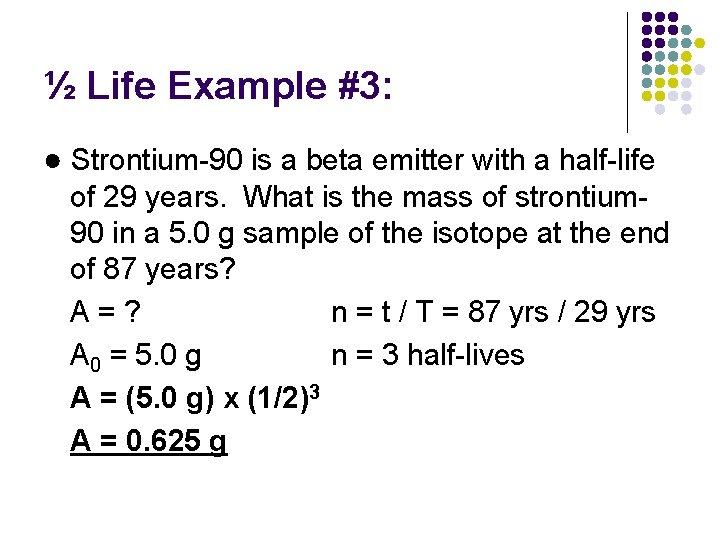
½ Life Example #3: ● Strontium-90 is a beta emitter with a half-life of 29 years. What is the mass of strontium 90 in a 5. 0 g sample of the isotope at the end of 87 years? A=? n = t / T = 87 yrs / 29 yrs A 0 = 5. 0 g n = 3 half-lives A = (5. 0 g) x (1/2)3 A = 0. 625 g
- Slides: 25