
Note to presenter Thank you for participating in
- Slides: 50
Note to presenter • Thank you for participating in the When I’m 65 program and for working to make sure everyone has the information they need to plan for a secure and fulfilling retirement. • This slide set was developed as part of the When I’m 65 program. It is designed to be used with the “Managing Your Money When You’re Starting Out” booklet and the When I’m 65 documentary and complementary video as part of an investor education course or other educational event, curriculum or course of study. • The content is designed to educate teens and young adults who are approaching important financial decisions, such as paying for college, saving to buy a car or starting their first job. The guidance also is designed to help this audience establish good financial habits in order to begin building a solid financial foundation – such as saving wisely, being smart about credit and debt, and learning about investing. • When I’m 65 offers a lot of great video that you can download and include with this presentation including the full documentary. Go to www. wi 65. org/video and click on “Information for Teens and Young Adults. ” • The When I’m 65 materials are all independent, unbiased, noncommercial and for educational use only. Facilitators/presenters are prohibited from selling financial or investing products or services as part of the When I’m 65 program. • Delete this slide before the presentation.
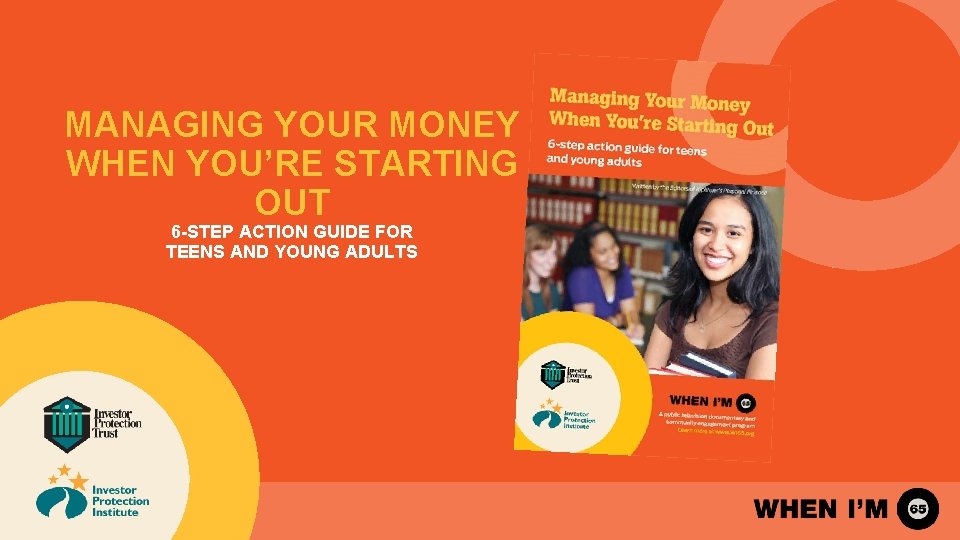
MANAGING YOUR MONEY WHEN YOU’RE STARTING OUT 6 -STEP ACTION GUIDE FOR TEENS AND YOUNG ADULTS
The When I’m 65 program HOW WE LIVE & THRIVE IN RETIREMENT IS CHANGING DRAMATICALLY • The When I’m 65 program is a national public television documentary and a multi-year community engagement program. • The When I’m 65 documentary explores: o Multi-generational approaches to retirement o Changing attitudes toward work, debt, housing, and financial fraud o Financial choices Americans of all ages must make to plan a financially secure future • The When I’m 65 community engagement program uses screenings of the documentary, engagement videos, booklets, in-person training, and other resources to stimulate discussions and online activity to help individuals and families prepare for a financially secure retirement. • www. wi 65. org | facebook. com/WI 65 Project | twitter. com/WI 65 Project
When I’m 65 program partners The When I’m 65 documentary and community engagement program is made possible by: • The Investor Protection Trust (IPT) is a nonprofit organization devoted to investor education. Since 1993, the Investor Protection Trust has worked with the states and at the national level to provide the independent, objective investor education needed by all Americans to make informed investment decisions. www. investorprotection. org | facebook. com/Investor. Protection. Trust | twitter. com/IPT_Info • The Investor Protection Institute (IPI) is an independent nonprofit organization that advances investor protection by conducting and supporting unbiased research and groundbreaking education programs. www. i. Invest. org | facebook. com/Investor. Protection. Institute | twitter. com/IPI-News • Detroit Public Television is a viewer-supported PBS member station located in Wixom, Michigan. Its vision is for a community in which people trust public media to help them discover new ideas, make informed decisions and enjoy enriched lives. The station is notably active in producing programs that showcase arts, culture, news, and analysis. It also creates educational outreach campaigns that use the power of media to provide knowledge and understanding. www. dptv. org | facebook. com/detroitpublictv | twitter. com/detroitpublictv
Introduction • You’re at a time in life when you’ll be asked to make some big financial decisions. • Whether it’s paying for college, earning a salary or figuring out the best ways to save and invest, navigating your finances isn’t as tricky as you may think. • Developing smart money habits now will pay off big later – putting you in a great position to reach the goals that mean the most to you.
6 steps to take today • Start saving and watch your balance grow. • File your first tax return. • Be smart about student loans. • Start off right with credit and debt. • Open a Roth IRA. • Become an investor. Let’s take a closer look at each of the six steps.
Step 1: Start saving and watch your balance grow GROW YOUR SAVINGS • Time’s on your side when it comes to “compound interest. ” • Money in your bank savings account earns interest, which is added to your balance on a daily, monthly, quarterly or yearly basis. • By keeping money in the account, you’ll earn interest on the amounts you deposit plus the interest added to your account each period. • You’re earning interest on your interest! And that’s called compound interest. Time means money • You deposit $100 in a savings account paying 3% annual interest that compounds daily. • If you continue to contribute $100 a month, by the end of 10 years your balance will be $14, 129. • $2, 029 of that is the interest you earned just by keeping your money in the account.
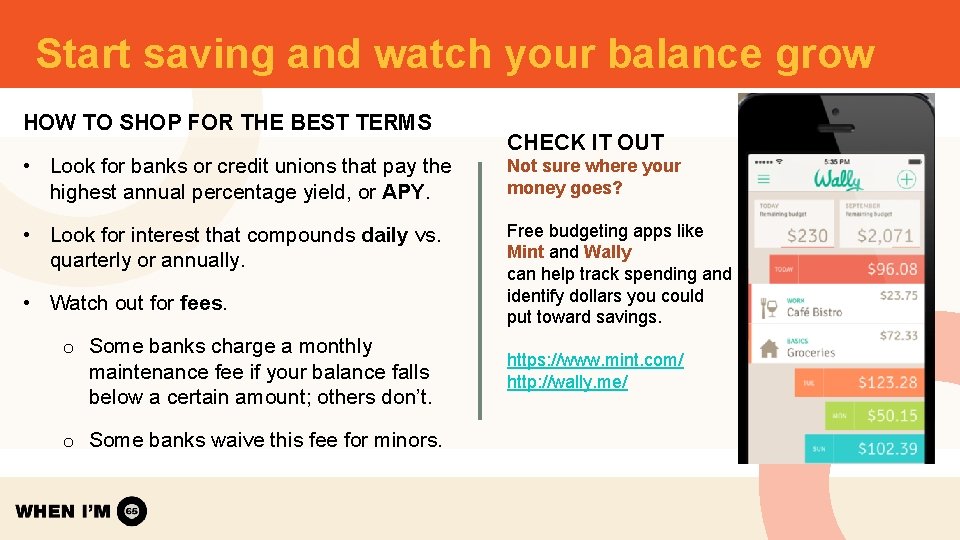
Start saving and watch your balance grow HOW TO SHOP FOR THE BEST TERMS • Look for banks or credit unions that pay the highest annual percentage yield, or APY. • Look for interest that compounds daily vs. quarterly or annually. • Watch out for fees. o Some banks charge a monthly maintenance fee if your balance falls below a certain amount; others don’t. o Some banks waive this fee for minors. CHECK IT OUT Not sure where your money goes? Free budgeting apps like Mint and Wally can help track spending and identify dollars you could put toward savings. https: //www. mint. com/ http: //wally. me/
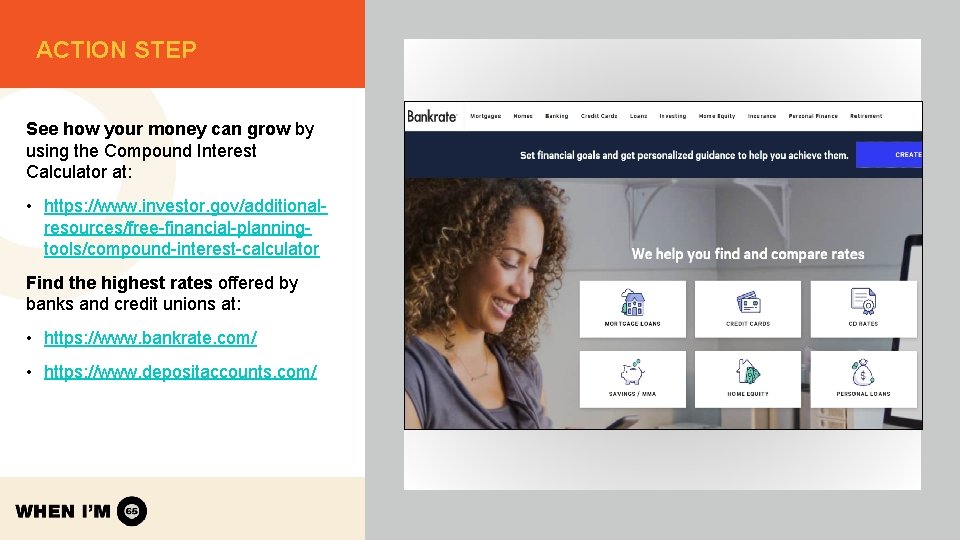
ACTION STEP See how your money can grow by using the Compound Interest Calculator at: • https: //www. investor. gov/additionalresources/free-financial-planningtools/compound-interest-calculator Find the highest rates offered by banks and credit unions at: • https: //www. bankrate. com/ • https: //www. depositaccounts. com/
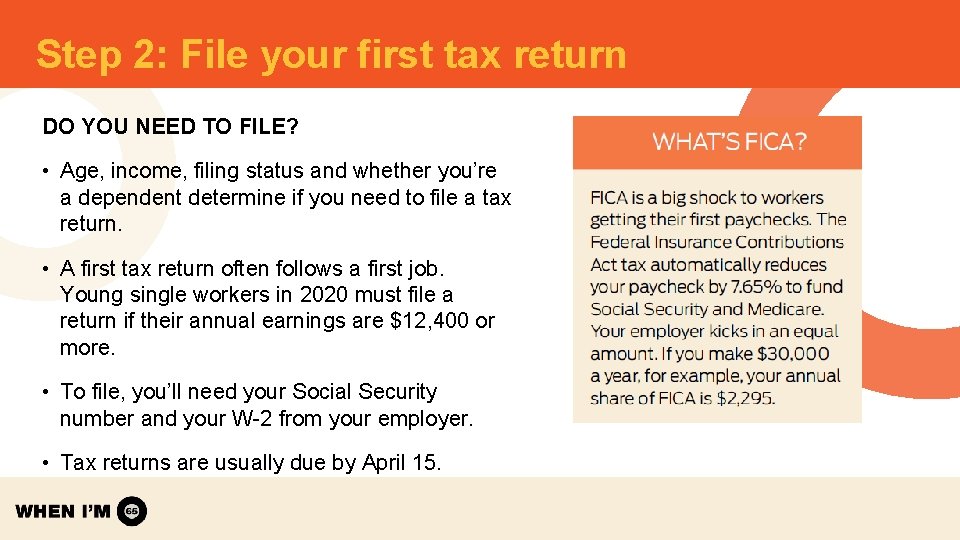
Step 2: File your first tax return DO YOU NEED TO FILE? • Age, income, filing status and whether you’re a dependent determine if you need to file a tax return. • A first tax return often follows a first job. Young single workers in 2020 must file a return if their annual earnings are $12, 400 or more. • To file, you’ll need your Social Security number and your W-2 from your employer. • Tax returns are usually due by April 15.
File your first tax return HOW TO FILE • Tax software can help you fill out the Form 1040 individual tax return – plus fix math errors and suggest tax breaks. Tip: Need help from an expert? • Tax software is available to most taxpayers for free through the IRS Free File program at: https: //www. irs. gov/filing/free-file-do-your-federaltaxes-for-free The IRS’s Volunteer Income Tax Assistance (VITA) provides free tax preparation for taxpayers with low- to moderate incomes. Find the nearest VITA site at: • Tax returns can be electronically filed. • The IRS can directly deposit your refund into your bank account, if you choose. • https: //irs. treasury. gov/fre etaxprep/
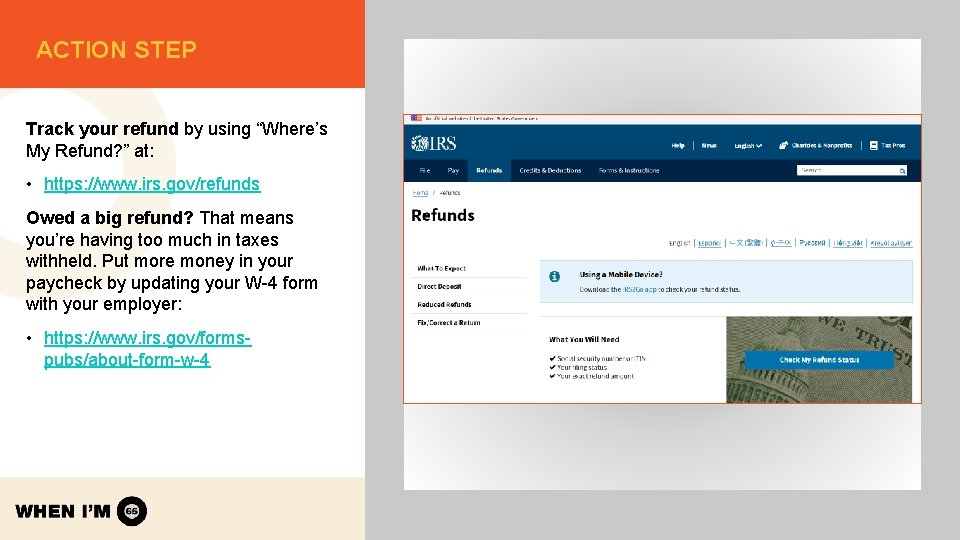
ACTION STEP Track your refund by using “Where’s My Refund? ” at: • https: //www. irs. gov/refunds Owed a big refund? That means you’re having too much in taxes withheld. Put more money in your paycheck by updating your W-4 form with your employer: • https: //www. irs. gov/formspubs/about-form-w-4
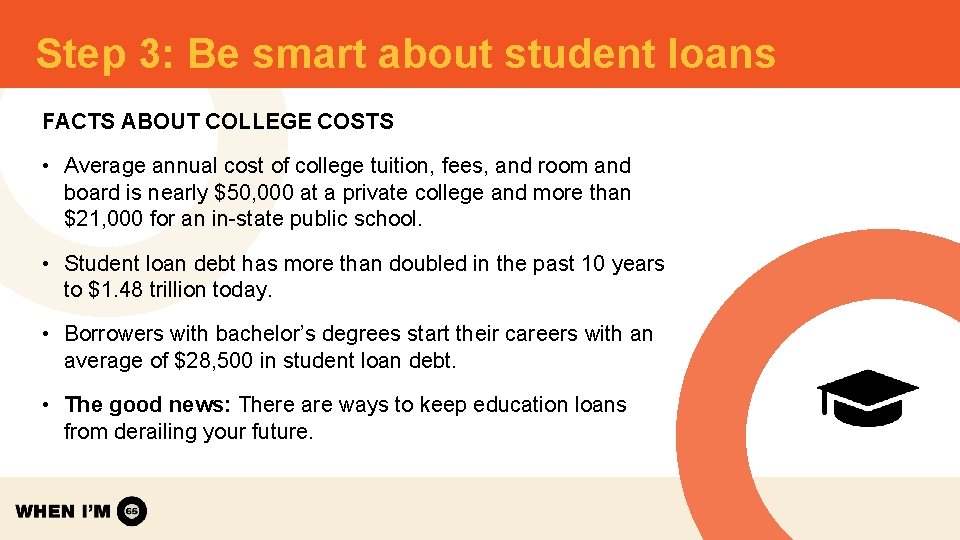
Step 3: Be smart about student loans FACTS ABOUT COLLEGE COSTS • Average annual cost of college tuition, fees, and room and board is nearly $50, 000 at a private college and more than $21, 000 for an in-state public school. • Student loan debt has more than doubled in the past 10 years to $1. 48 trillion today. • Borrowers with bachelor’s degrees start their careers with an average of $28, 500 in student loan debt. • The good news: There are ways to keep education loans from derailing your future.
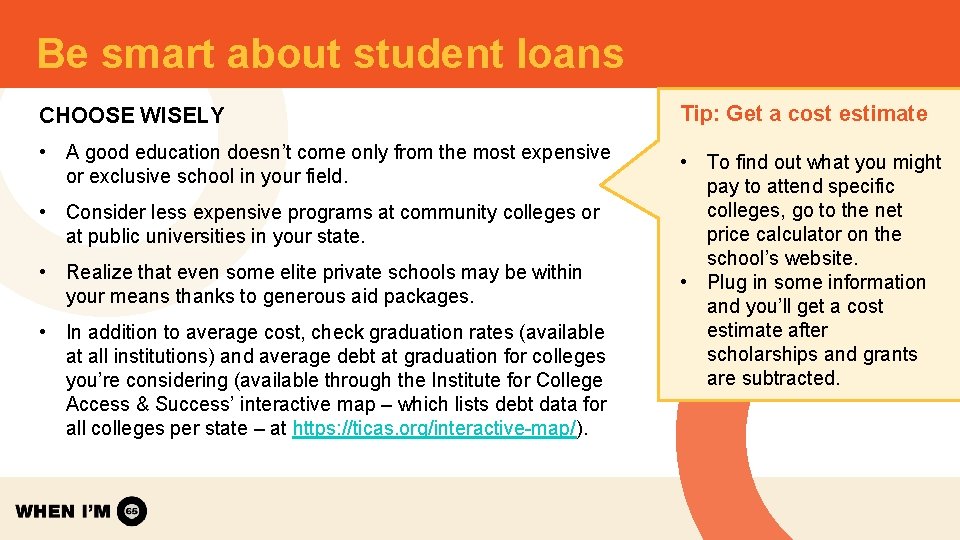
Be smart about student loans CHOOSE WISELY Tip: Get a cost estimate • A good education doesn’t come only from the most expensive or exclusive school in your field. • To find out what you might pay to attend specific colleges, go to the net price calculator on the school’s website. • Plug in some information and you’ll get a cost estimate after scholarships and grants are subtracted. • Consider less expensive programs at community colleges or at public universities in your state. • Realize that even some elite private schools may be within your means thanks to generous aid packages. • In addition to average cost, check graduation rates (available at all institutions) and average debt at graduation for colleges you’re considering (available through the Institute for College Access & Success’ interactive map – which lists debt data for all colleges per state – at https: //ticas. org/interactive-map/).
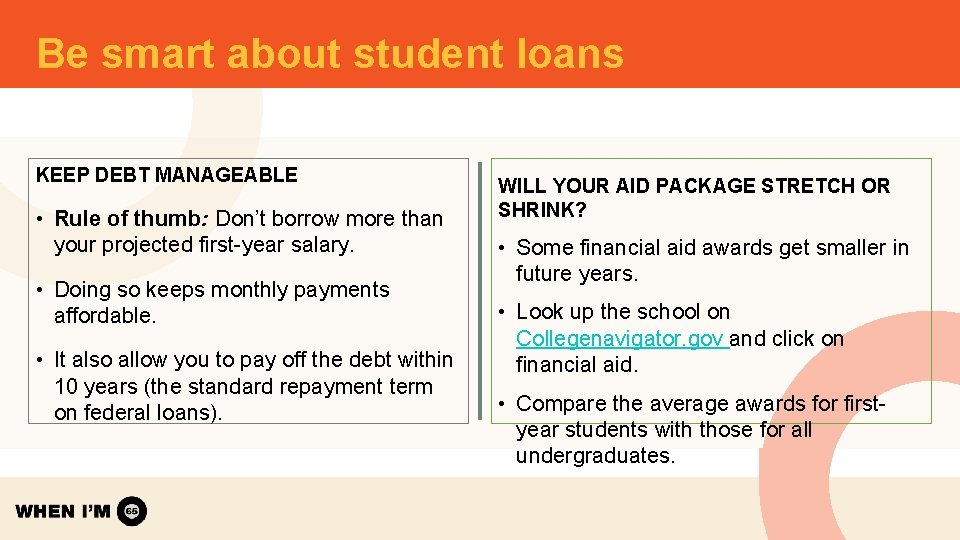
Be smart about student loans KEEP DEBT MANAGEABLE • Rule of thumb: Don’t borrow more than your projected first-year salary. • Doing so keeps monthly payments affordable. • It also allow you to pay off the debt within 10 years (the standard repayment term on federal loans). WILL YOUR AID PACKAGE STRETCH OR SHRINK? • Some financial aid awards get smaller in future years. • Look up the school on Collegenavigator. gov and click on financial aid. • Compare the average awards for firstyear students with those for all undergraduates.
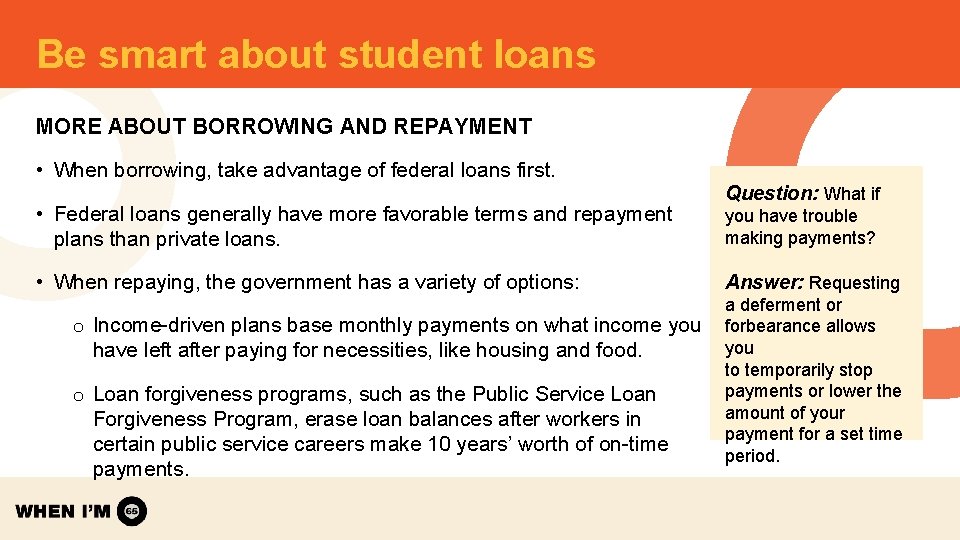
Be smart about student loans MORE ABOUT BORROWING AND REPAYMENT • When borrowing, take advantage of federal loans first. • Federal loans generally have more favorable terms and repayment plans than private loans. • When repaying, the government has a variety of options: o Income-driven plans base monthly payments on what income you have left after paying for necessities, like housing and food. o Loan forgiveness programs, such as the Public Service Loan Forgiveness Program, erase loan balances after workers in certain public service careers make 10 years’ worth of on-time payments. Question: What if you have trouble making payments? Answer: Requesting a deferment or forbearance allows you to temporarily stop payments or lower the amount of your payment for a set time period.
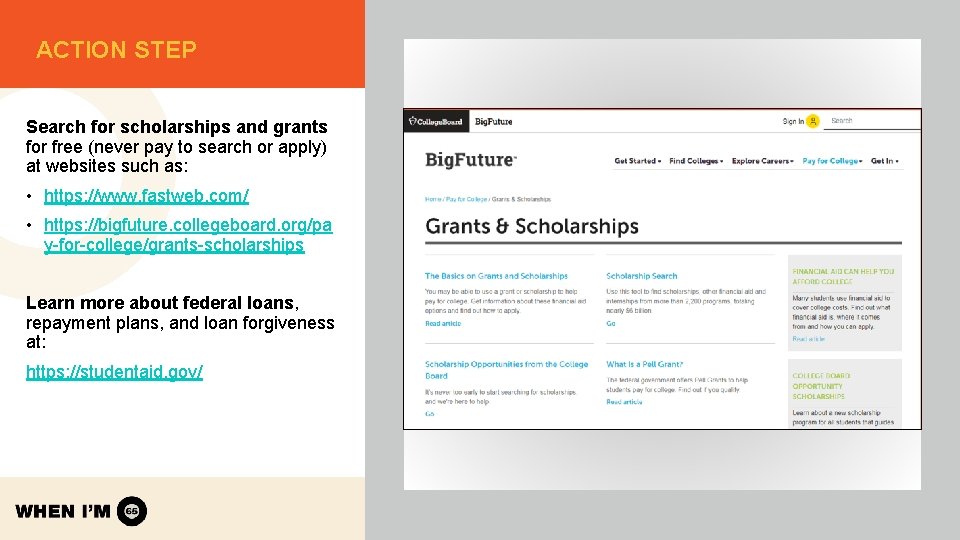
ACTION STEP Search for scholarships and grants for free (never pay to search or apply) at websites such as: • https: //www. fastweb. com/ • https: //bigfuture. collegeboard. org/pa y-for-college/grants-scholarships Learn more about federal loans, repayment plans, and loan forgiveness at: https: //studentaid. gov/
Step 4: Start off right with credit and debt WHAT IS A CREDIT HISTORY? • It’s an ongoing, digital record of the amount of debt you have and whether you pay your bills on time. WHY IS IT IMPORTANT? • Your credit record follows you and your finances for life. o Banks and car dealers will review your credit report before lending to you (and charge higher interest if your history is poor). o Employers may review your report in some cases before offering you a job. o Landlords may want to check your report before renting to you. Let’s look at some ways to build and keep a good credit history.
Start off right with credit and debt WAYS TO ESTABLISH YOUR CREDIT RECORD • Become an authorized user on a parent’s credit card. • Apply for a secured credit card. • Qualify for a traditional credit card. • Consider a credit-builder loan through a community bank or credit union to avoid credit cards. • Repay student loans and auto loans on time to help build a good credit history. Tip: Lower monthly credit card balances are better for your credit score. • Pay bills by the due date and try to keep the balance to less than 20% to 30% of the credit limit.
Start off right with credit and debt LEARN TO MANAGE DEBT Credit cards are a quick way to get into debt trouble if you’re not careful. Strive to follow these do’s and don’ts: • Do consider signing up for email or text alerts from your card issuer on when your payment is due. • Do pay on time to avoid late fees, which can be $28 for the first late payment and up to $39 if you’re late again within six months. • Don’t charge more than you can afford to pay off in full each month. • Don’t just pay the minimum amount due. That allows interest to accrue, causing your balance to swell.
Start off right with credit and debt CHECK IN FREQUENTLY KNOW YOUR NUMBER • Once you establish a credit record, review your credit report for accuracy each year. • A credit score is a three-digit number designed to predict your creditworthiness. • Errors happen and they can damage your credit score. • Get a free copy every 12 months from each of the three major credit reporting companies at: Annual. Credit. Report. com. • Standard credit scores from FICO and Vantage. Score range from 300 to 850. • Your bank or credit card issuer may give your score for free. FICO has a free tool to estimate your score at: MYFICO. com/free-credit-score-rangeestimator.
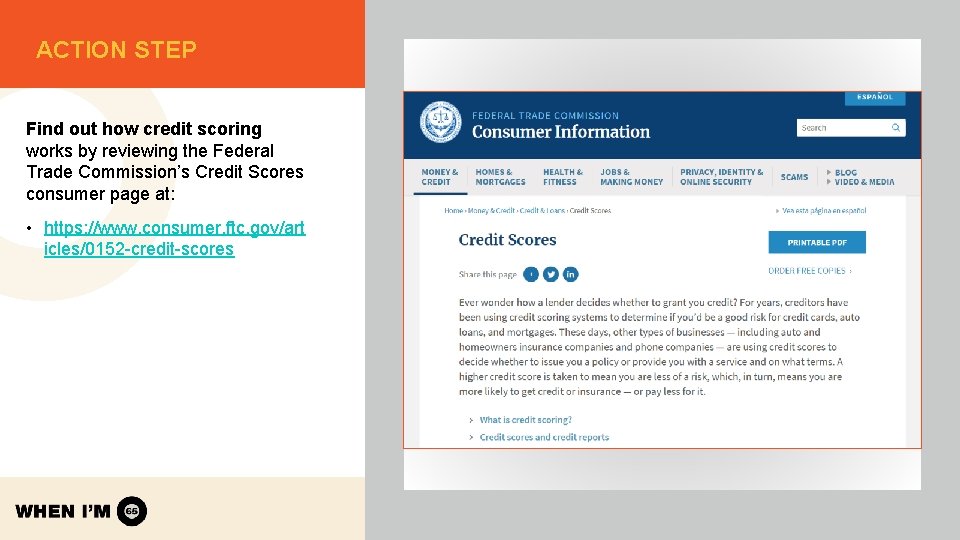
ACTION STEP Find out how credit scoring works by reviewing the Federal Trade Commission’s Credit Scores consumer page at: • https: //www. consumer. ftc. gov/art icles/0152 -credit-scores
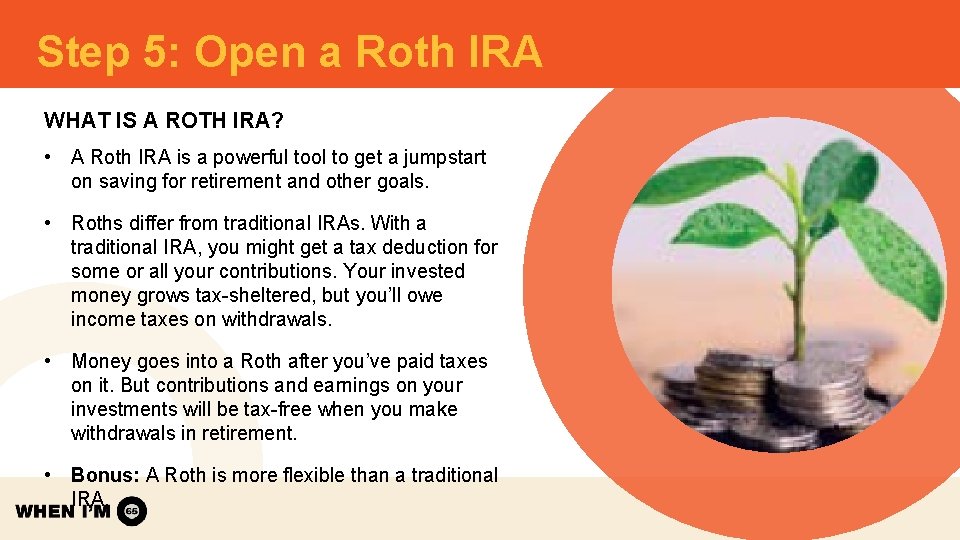
Step 5: Open a Roth IRA WHAT IS A ROTH IRA? • A Roth IRA is a powerful tool to get a jumpstart on saving for retirement and other goals. • Roths differ from traditional IRAs. With a traditional IRA, you might get a tax deduction for some or all your contributions. Your invested money grows tax-sheltered, but you’ll owe income taxes on withdrawals. • Money goes into a Roth after you’ve paid taxes on it. But contributions and earnings on your investments will be tax-free when you make withdrawals in retirement. • Bonus: A Roth is more flexible than a traditional IRA.
Open a Roth IRA FOLLOW THE ROTH RULES • As long as you have earnings from a job, you’re eligible to open a Roth. (If you’re under 18, you’ll likely need to have an adult open a custodial Roth for you). • The most you can contribute is the amount of wages from your job for the year, but no more than $6, 000 in 2020 for those under age 50. • To qualify for tax-free withdrawals, you must own the Roth for five years and be at least 59½. Pull money out earlier, and you will owe income taxes on the earnings and possibly a 10% penalty, too. Here’s an example: • At age 25 you start saving $2, 500 a year in a Roth and you earn 7% annually on your investments. • By age 67, you will have contributed $107, 500, but your account balance will have grown to nearly $662, 802. • And you won’t owe taxes on any of it!
Open a Roth IRA ENJOY THE FLEXIBILITY A Roth has more flexibility than other types of retirement accounts. For example, you can withdraw: • Your contributions (but not your earnings) at any time without taxes or a penalty. • The earnings without penalty to pay for qualified college expenses, although you’ll still owe income taxes on that money. • Up to $10, 000 to buy your first home without owing taxes or penalties on the earnings (once you’ve owned the Roth for five years).
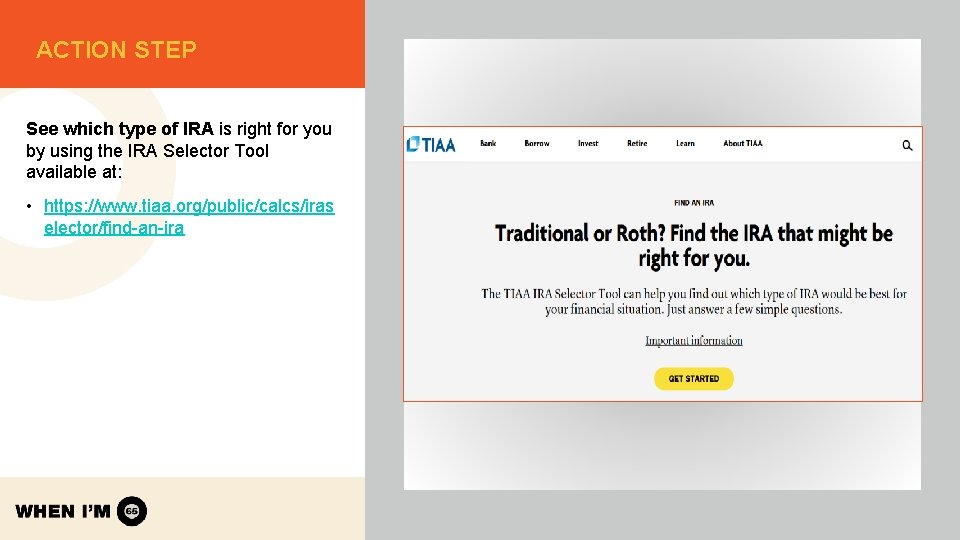
ACTION STEP See which type of IRA is right for you by using the IRA Selector Tool available at: • https: //www. tiaa. org/public/calcs/iras elector/find-an-ira
Step 6: Become an investor REACHING YOUR FINANCIAL GOALS • Stocks – shares of ownership in companies – go up and down, but over time they’re likely to outperform bonds or other investments. • That makes them wise investments for those who are saving for retirement or other long-term goals. • The easiest way to invest in the stock market is through mutual funds and exchange-traded funds that often own hundreds of stocks. • Keep in mind: As with any investments, you can lose money in funds. And mutual funds and ETFs charge fees that can lower your return.
Become an investor UNDERSTAND MUTUAL FUNDS AND ETFs • Mutual funds may own stock in hundreds of companies or bonds issued by the government or corporations. Exchange-traded funds (ETFs) buy stocks, bonds and other securities, usually mimicking holdings of a specific index. • The idea is that if some stocks or bonds fall in value, others in the fund may go up – limiting risk. • You can buy or sell mutual fund shares only once a day. Like stocks, ETFs can be bought and sold throughout the day on a stock exchange. • Some mutual funds have no minimum initial investment; others may require you to invest $250 or $2, 500 or more to get started. The minimum ETF investment is the cost of one share. Question: What’s the difference between “actively managed” and “passively managed” mutual funds? Answer: Actively managed means the fund’s manager decides when to buy or sell securities with the aim of beating the market. Passively managed index funds buy securities similar to those in a benchmark (like the S&P 500 index). Their goal is to match the index’s
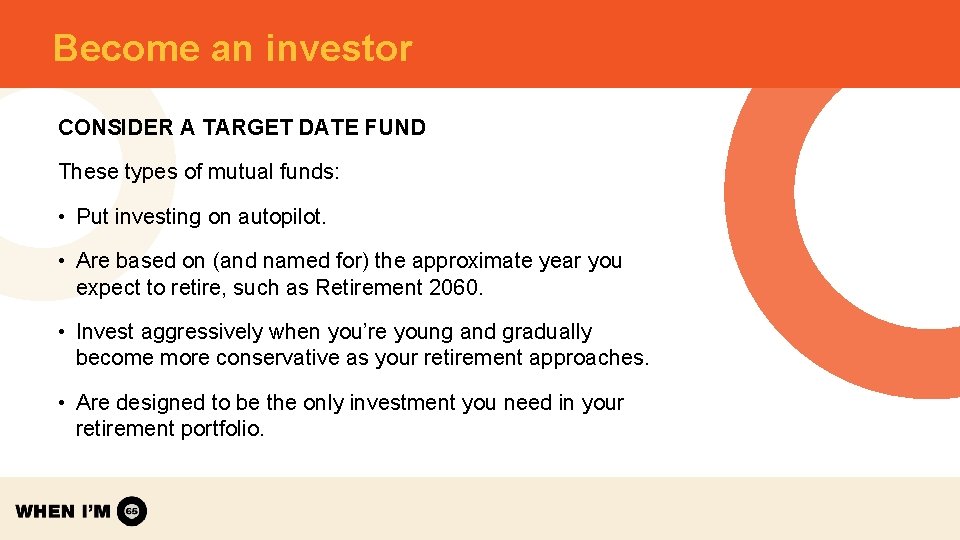
Become an investor CONSIDER A TARGET DATE FUND These types of mutual funds: • Put investing on autopilot. • Are based on (and named for) the approximate year you expect to retire, such as Retirement 2060. • Invest aggressively when you’re young and gradually become more conservative as your retirement approaches. • Are designed to be the only investment you need in your retirement portfolio.
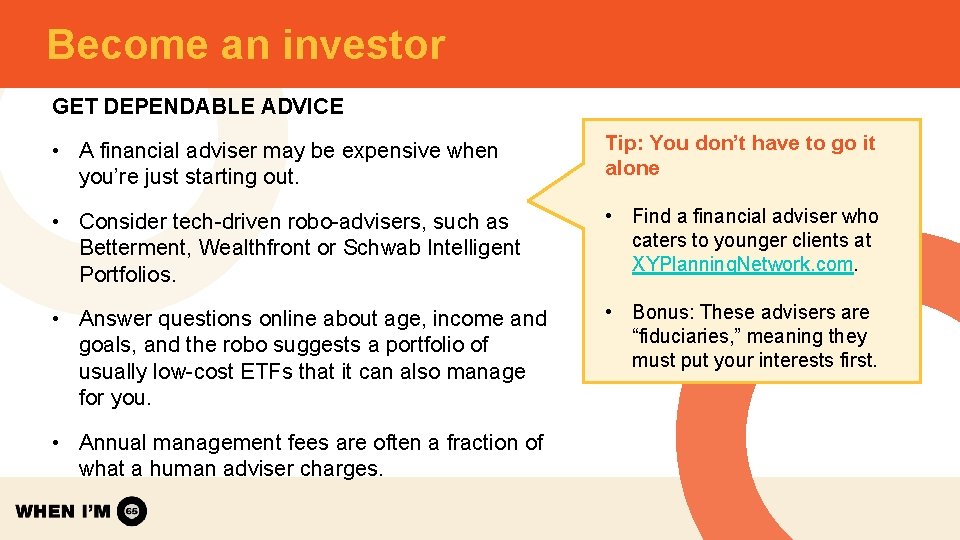
Become an investor GET DEPENDABLE ADVICE • A financial adviser may be expensive when you’re just starting out. Tip: You don’t have to go it alone • Consider tech-driven robo-advisers, such as Betterment, Wealthfront or Schwab Intelligent Portfolios. • Find a financial adviser who caters to younger clients at XYPlanning. Network. com. • Answer questions online about age, income and goals, and the robo suggests a portfolio of usually low-cost ETFs that it can also manage for you. • Bonus: These advisers are “fiduciaries, ” meaning they must put your interests first. • Annual management fees are often a fraction of what a human adviser charges.
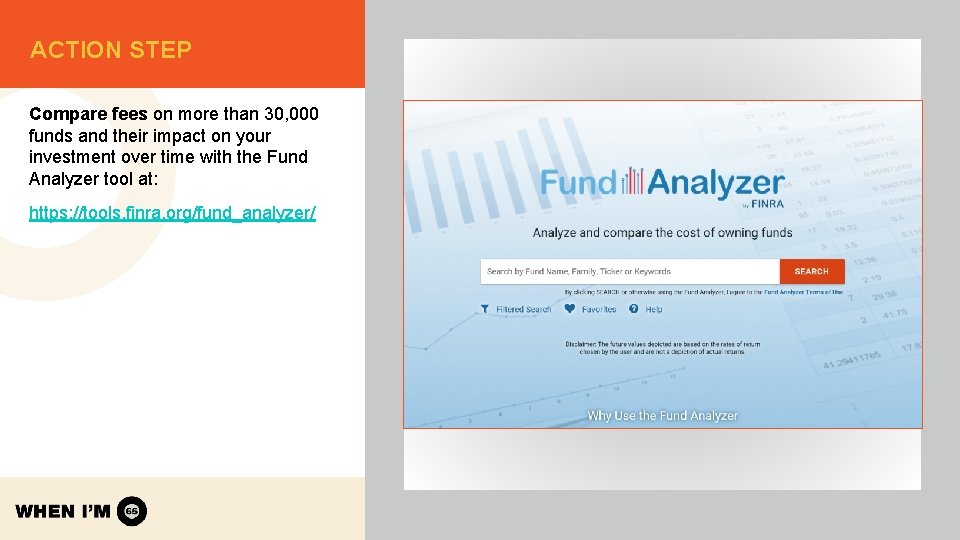
ACTION STEP Compare fees on more than 30, 000 funds and their impact on your investment over time with the Fund Analyzer tool at: https: //tools. finra. org/fund_analyzer/
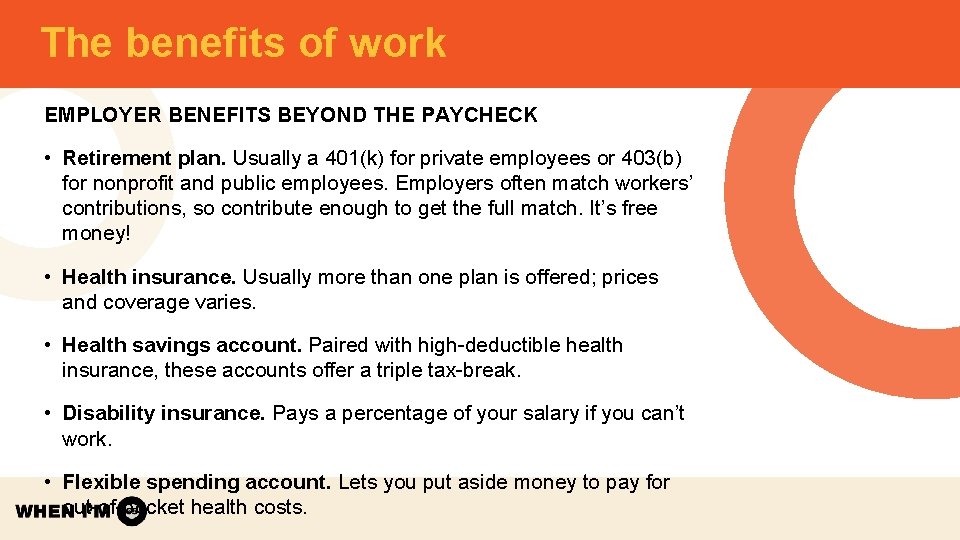
The benefits of work EMPLOYER BENEFITS BEYOND THE PAYCHECK • Retirement plan. Usually a 401(k) for private employees or 403(b) for nonprofit and public employees. Employers often match workers’ contributions, so contribute enough to get the full match. It’s free money! • Health insurance. Usually more than one plan is offered; prices and coverage varies. • Health savings account. Paired with high-deductible health insurance, these accounts offer a triple tax-break. • Disability insurance. Pays a percentage of your salary if you can’t work. • Flexible spending account. Lets you put aside money to pay for out-of-pocket health costs.
Quiz: Test your money know-how Now that you’ve learned more about how to build smart money habits, you’re ready to prepare a personal plan for financial success. Let’s put your knowledge to the test with these eight questions!
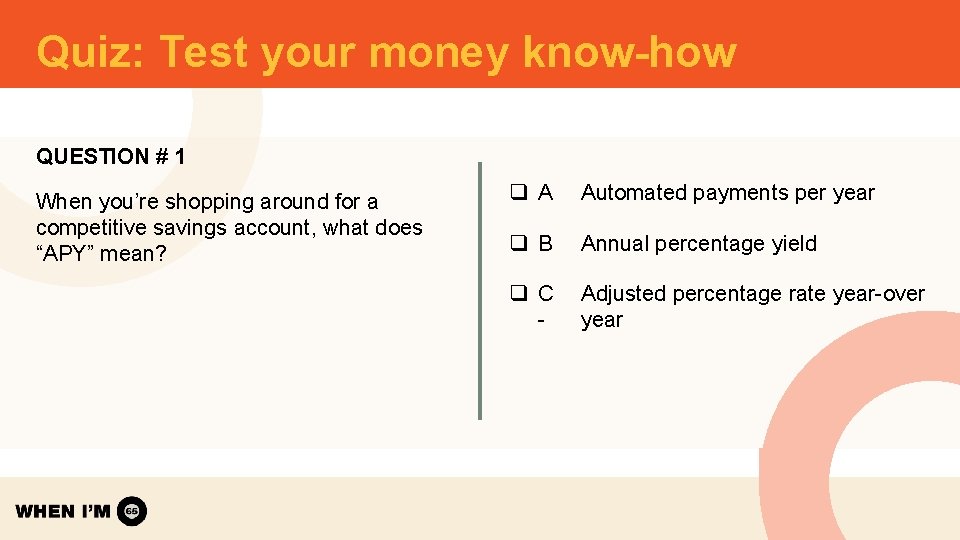
Quiz: Test your money know-how QUESTION # 1 When you’re shopping around for a competitive savings account, what does “APY” mean? q. A Automated payments per year q. B Annual percentage yield q. C - Adjusted percentage rate year-over year
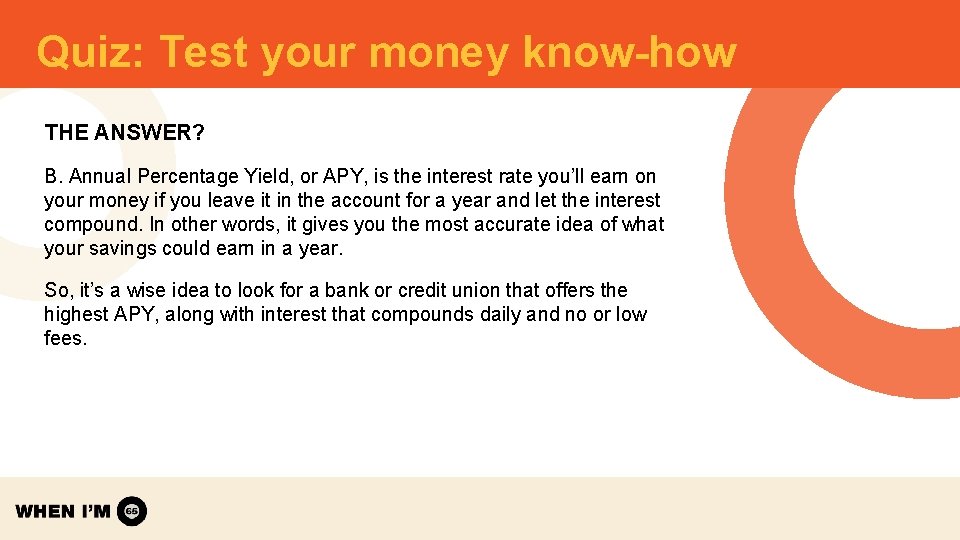
Quiz: Test your money know-how THE ANSWER? B. Annual Percentage Yield, or APY, is the interest rate you’ll earn on your money if you leave it in the account for a year and let the interest compound. In other words, it gives you the most accurate idea of what your savings could earn in a year. So, it’s a wise idea to look for a bank or credit union that offers the highest APY, along with interest that compounds daily and no or low fees.
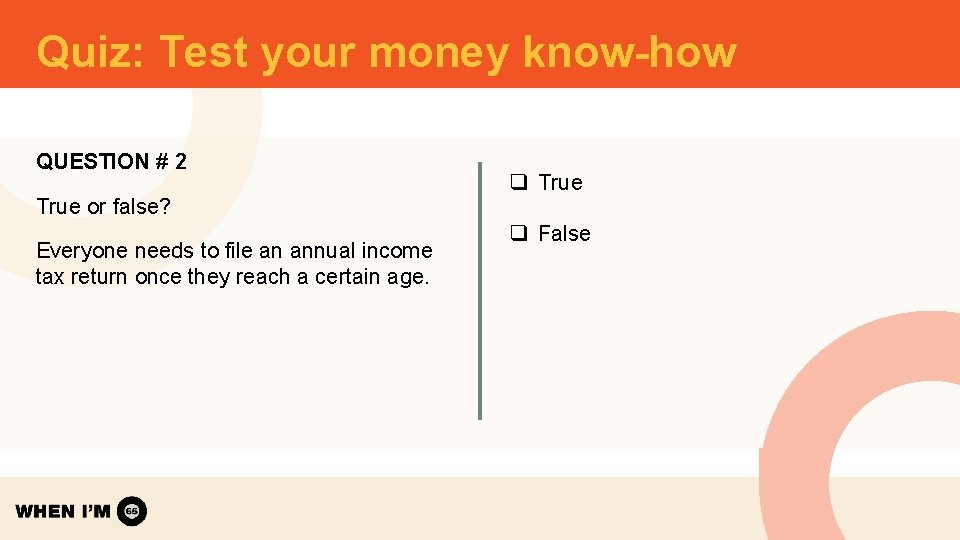
Quiz: Test your money know-how QUESTION # 2 True or false? Everyone needs to file an annual income tax return once they reach a certain age. q True q False
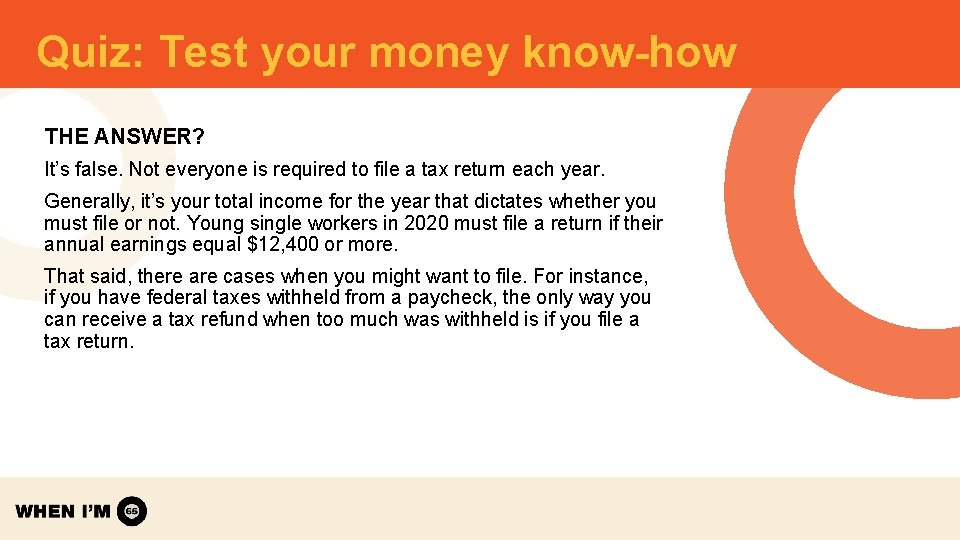
Quiz: Test your money know-how THE ANSWER? It’s false. Not everyone is required to file a tax return each year. Generally, it’s your total income for the year that dictates whether you must file or not. Young single workers in 2020 must file a return if their annual earnings equal $12, 400 or more. That said, there are cases when you might want to file. For instance, if you have federal taxes withheld from a paycheck, the only way you can receive a tax refund when too much was withheld is if you file a tax return.
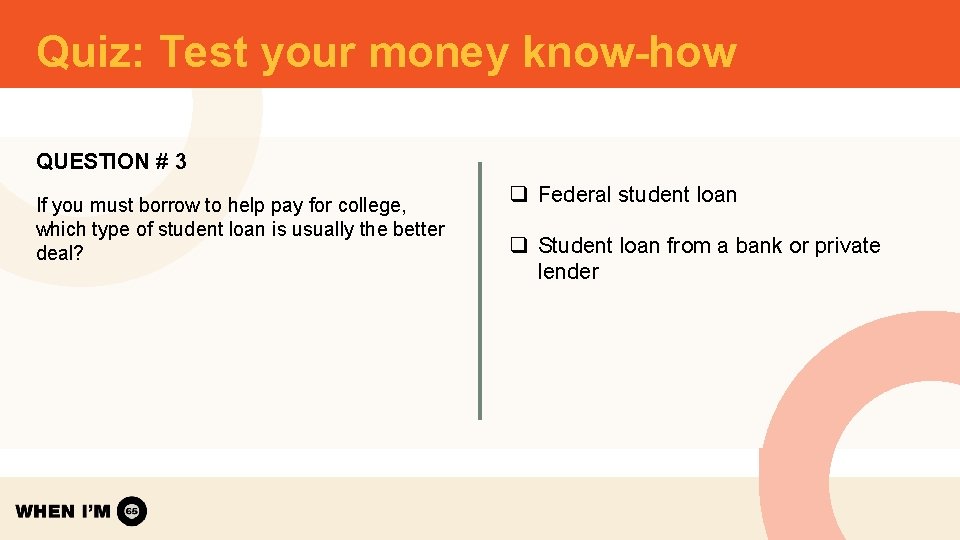
Quiz: Test your money know-how QUESTION # 3 If you must borrow to help pay for college, which type of student loan is usually the better deal? q Federal student loan q Student loan from a bank or private lender
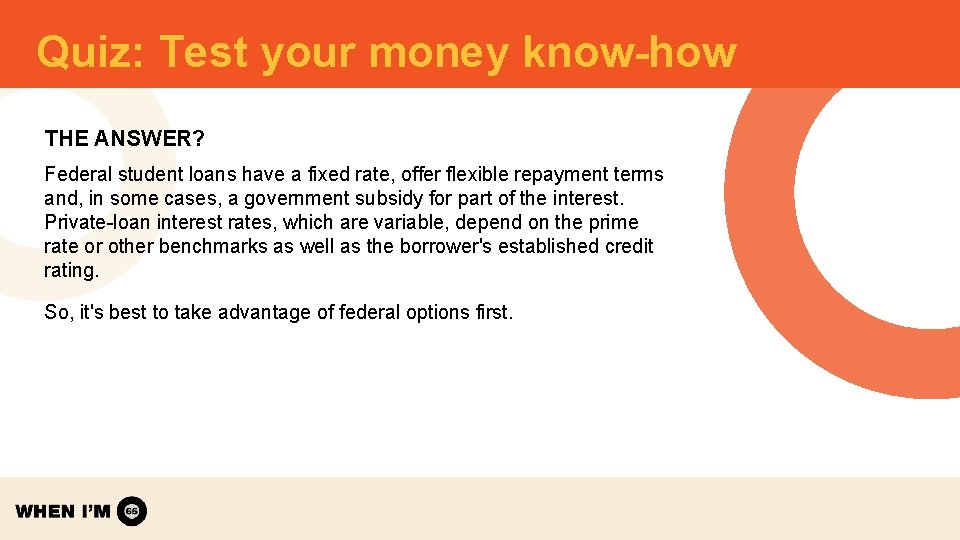
Quiz: Test your money know-how THE ANSWER? Federal student loans have a fixed rate, offer flexible repayment terms and, in some cases, a government subsidy for part of the interest. Private-loan interest rates, which are variable, depend on the prime rate or other benchmarks as well as the borrower's established credit rating. So, it's best to take advantage of federal options first.
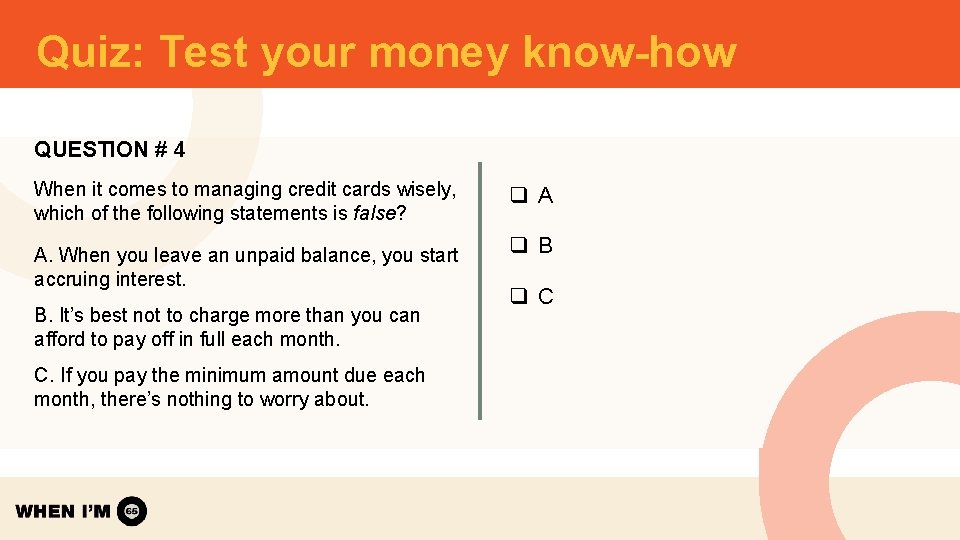
Quiz: Test your money know-how QUESTION # 4 When it comes to managing credit cards wisely, which of the following statements is false? A. When you leave an unpaid balance, you start accruing interest. B. It’s best not to charge more than you can afford to pay off in full each month. C. If you pay the minimum amount due each month, there’s nothing to worry about. q. A q. B q. C
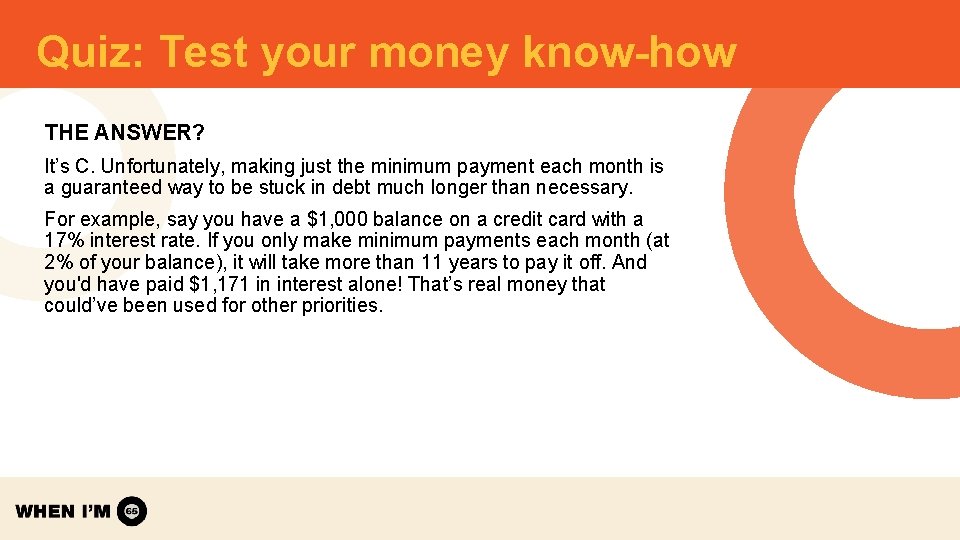
Quiz: Test your money know-how THE ANSWER? It’s C. Unfortunately, making just the minimum payment each month is a guaranteed way to be stuck in debt much longer than necessary. For example, say you have a $1, 000 balance on a credit card with a 17% interest rate. If you only make minimum payments each month (at 2% of your balance), it will take more than 11 years to pay it off. And you'd have paid $1, 171 in interest alone! That’s real money that could’ve been used for other priorities.
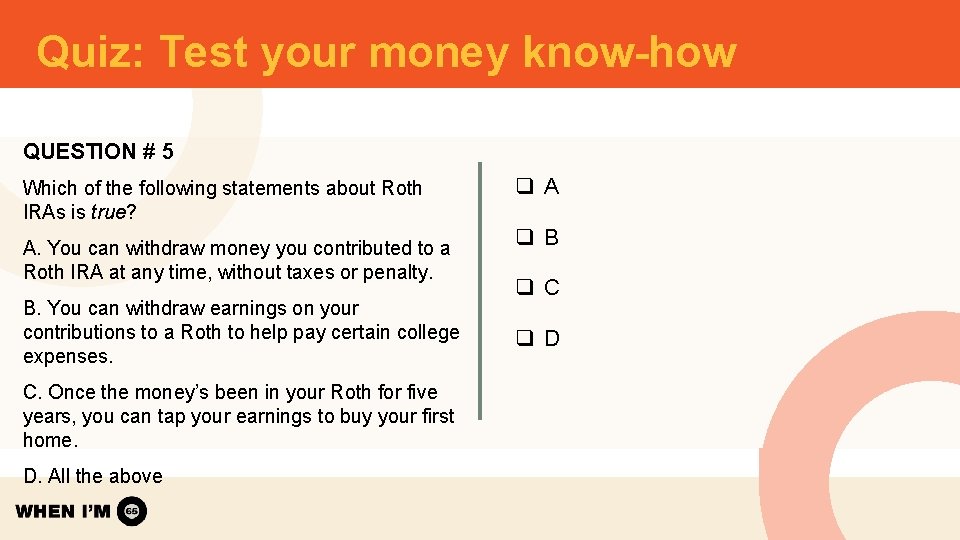
Quiz: Test your money know-how QUESTION # 5 Which of the following statements about Roth IRAs is true? A. You can withdraw money you contributed to a Roth IRA at any time, without taxes or penalty. B. You can withdraw earnings on your contributions to a Roth to help pay certain college expenses. C. Once the money’s been in your Roth for five years, you can tap your earnings to buy your first home. D. All the above q. A q. B q. C q. D
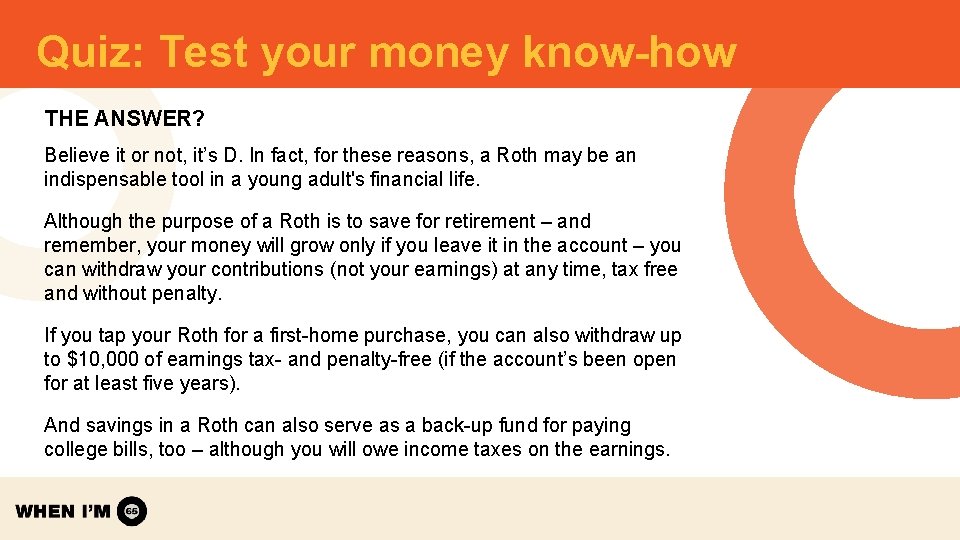
Quiz: Test your money know-how THE ANSWER? Believe it or not, it’s D. In fact, for these reasons, a Roth may be an indispensable tool in a young adult's financial life. Although the purpose of a Roth is to save for retirement – and remember, your money will grow only if you leave it in the account – you can withdraw your contributions (not your earnings) at any time, tax free and without penalty. If you tap your Roth for a first-home purchase, you can also withdraw up to $10, 000 of earnings tax- and penalty-free (if the account’s been open for at least five years). And savings in a Roth can also serve as a back-up fund for paying college bills, too – although you will owe income taxes on the earnings.
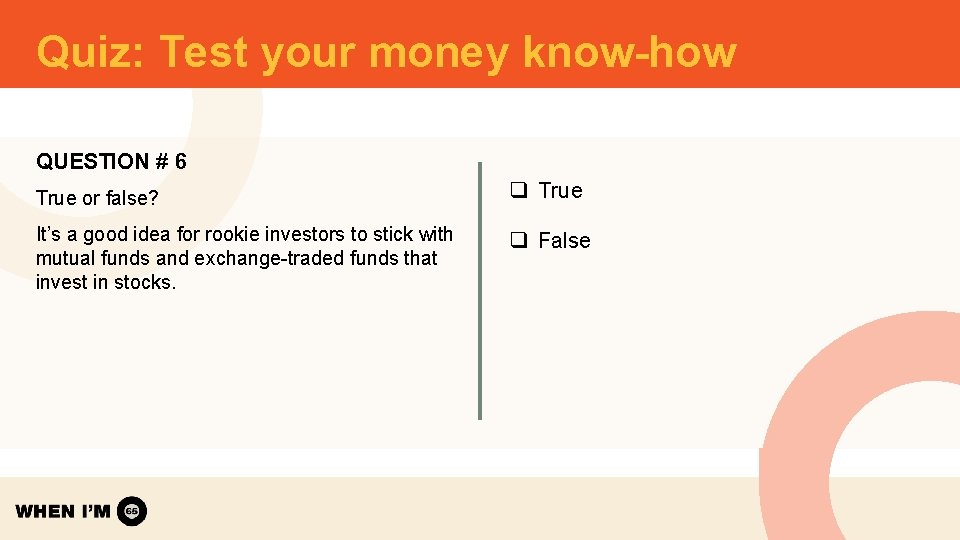
Quiz: Test your money know-how QUESTION # 6 True or false? q True It’s a good idea for rookie investors to stick with mutual funds and exchange-traded funds that invest in stocks. q False
Quiz: Test your money know-how THE ANSWER? It’s true. Because you’re young and have a long way to retirement, you'll want to invest in the stock market to get the highest returns over time. Why should you choose mutual funds or ETFs now? Three reasons: • They’re easy to understand. • You leave the stock-picking to the pros. • They make it easy to spread your risk around multiple stocks or bonds without putting all your eggs in one basket.
Quiz: Test your money know-how QUESTION # 7 Are contributions to a traditional 401(k) plan deducted from your salary before or after taxes? q Before q After
Quiz: Test your money know-how THE ANSWER? Your traditional 401(k) contributions are made before taxes, reducing the amount of your income Uncle Sam can get his hands on. Because 401(k)s are tax-deferred investment plans, your money can grow sheltered from taxes for potentially decades. Once you start withdrawing the money in retirement, though, you will owe income taxes on it. Note: If your employer offers a Roth 401(k) and you contribute, you put in after-tax dollars, but all contributions and their earnings come out tax free in retirement.
Quiz: Test your money know-how QUESTION # 8 A health savings account is. . . A. The same thing as a flexible spending account. B. A kind of insurance plan. C. A way to save for healthcare costs if you have a high-deductible insurance plan. q A q B q C
Quiz: Test your money know-how THE ANSWER? It’s C. Health savings accounts let people ages 18 or older with highdeductible health insurance policies to make tax-deductible contributions to a special account, which they can use tax-free for eligible medical expenses. This money can be used for things like your health insurance deductibles, co-payments, medications and other out-of-pocket health-related costs – even that cool pair of prescription sunglasses.
Contact information • Presenter’s contact information